


Ageing Baby Boomers, the One Mega Trend NO ONE is Talking About
Politics / Social Issues Jul 14, 2009 - 12:17 PM GMTBy: Graham_Summers

 Thus far, analysis the financial collapse has been framed almost entirely in terms of money. All the research I’ve seen has delved into lending standards, securitization, inflation, interest rates, housing and the like.
Yet underneath this veneer lies one larger, mega-trend that has driven all of these themes to a greater or lesser degree. It created one of the largest stock bull markets we’ve ever seen from 1982-2001. It helped drive the Bubbles in Tech stocks AND Housing. And now it will guide the coming collapse in stocks and consumer spending.
That trend is AGE: specifically the Boomer generation and its retirement.
For the sake of simplicity, I will define a “Boomer” as someone born in the post war boom years from 1946-64. Using this data, today’s Boomers are between 45 and 63 years old. All told there are 76 million Americans in this age category. As of late 2008, Boomers:
- Comprised 38% of the US population
- Controlled $13 trillion (50%+) in American Household investable assets
- Controlled 50% of all discretionary income
- Purchased 43% of all new cars
- Accounted for 79% of all leisure travel spending
- Ate out four to five times a week
- Outspent younger generations by 2 to 1
You can see Boomers’ imprints on every major investment trend of the last 30 years whether it’s the rise in consumer spending, the Tech Boom, the Housing Boom, etc. These folks ARE the investing crowd or tide as far as money goes.
Please understand, I am not BLAMING the Boomers for ANY of these developments. I am merely pointing out that these folks were the primary participants who drove ALL of these trends due to their ever-increasing economic clout. Between 1980 and 2007, Boomers were “the money” behind virtually every economic development in the US.
The Boomers first came of age in the ‘80s (they were 16-34 years old at the start of the decade). Boomers were the first generation to fully adopt credit cards: between 1980 and 1990, credit card spending increased more than five-fold while average household credit card balances quadrupled. They were also the first generation to see stocks as THE means of securing ones retirement: stock-based 401(k)s were introduced in 1983.
By the time the ‘90s rolled around, Boomers had completely entered the workforce (ages 26-44). Thanks to easy credit and cheap goods from China (formal trade with the US opened on 1971), the Boomers operated under the illusion they were getting richer almost every year, when in reality they were spending their and their parents’ savings.
Having seen stocks rise almost continuously from 1982-1990, Boomers were only too happy to take over own investment portfolios with the introduction of low cost online brokerage accounts. In 1950, 10% of US adults owned a stock. By the end of the ‘90s more than four in ten American adults were investing in the market. This massive influx of money helped, in part, to create the Tech Bubble.
By the end of the 20th century, Boomers were ages 35-53. They had truly come into their own as THE major wealth demographic, making most of the income and spending most of the money in the US. Having accrued debt for 30+ years without trouble and seen housing prices rise almost continuously during their lifetimes, they began speculating in homes and other higher value assets. This trend was fueled in large by Wall Street’s securitization and the dramatic drop in lending standards in the US.
Which brings us to last year.
In 2008, the Boomer generation was already in the process of or at least beginning to consider retiring. In the decade from 1992-2003, more than 70% of Boomers had seen their wealth increase by more than half. An additional 20% of them saw their wealth increase better than 25%. And they were set to inherit some $7.2 trillion in wealth from their parents over the coming decades.
Then the Financial Crisis hit and the Boomers got crushed.
Last year’s collapse in housing and stocks wiped out $11 trillion in household net worth in the US. That’s roughly 18% of total US household wealth at that time. Put another way, the Boomers just lost nearly 1/5th of their wealth in a single year (the same goes for they money they were set to inherit from their parents which was largely tied up in stocks and real estate).
Boomer wealth continues to plunge: commentators celebrated the fact that home prices ONLY fell another 0.6% in June, but none of them mentioned that this represents another $100 billion in US wealth gone.
Bottomline: the 20+ year expansion in Boomer came to a screeching halt last year. We’ve now entered what may in fact be the greatest period of wealth destruction in American history. The effects this will have on Boomer spending, investing, and the like will completely change the investing and economic landscape for the US REGARDLESS of what the Fed, Obama, or any other economic/ political authority attempts.
In simple terms, Boomers are THE money flow for the US. In light of this, for the US economy to get back on track any time soon (whether it’s through Stimulus, job growth, etc), Boomers need to participate in a big way.
The only problem is that they won’t.
During the recession in the early ‘80s, Boomers were just entering the work force (ages 16-34). The market demographic was technically still in its infancy and growing in economic clout.
In the recession in the early ‘90s, Boomers were ages 26-44. Now controlling most of the wealth in the US they could take a hit and come right back buying more stuff, using their credit cards, and investing in stocks and other investments.
Moreover, in the brief recession in the early ‘00s, Boomers were ages 36-54. The younger Boomers were just coming into their own, looking to buy homes, advance their careers, etc.
Which brings us to today… on the verge of 2010… when Boomers will be ages 46-64 and focusing on one thing: RETIREMENT.
Having just lost 18% of their net worth, potentially lost their jobs, and with record amounts of debt (one in five of Boomers owe more than $50,000 in non-mortgage debt), Boomers are no longer looking for growth or gains, they’re looking for security. Dreams of retirement are no longer soon to be realized (if they will be realized at all). And several key myths have been broken:
Myth #1: You can’t lose money with real estate
Myth #2: Stocks ALWAYS offer the best gains in terms of risk/reward.
Myth #3: Social security and medicare will work
Indeed, if one were to describe the Boomer market demographic in one word, it’d be “disillusioned.” And you can see this disillusionment playing out in the financial markets.
First and foremost, many commentators make a big deal about the S&P 500 clearing 950… well that simply brings stocks back to where they were in July 1997. Boomers (who then were largely in their 40s then) have essentially seen NO GROWTH in their 401(k)s in 12 years. That’s simply astounding when you consider that 1997-2007 saw two of the largest investment bubbles in the history of mankind.
Boomers aren’t too happy about all of this and have begun looking for new sources of investment advice. According to the Financial Times, the number of inquiries on changing asset managers rose 40% during the first five months of 2009. Indeed, Charles Schwab reports 69% of the firm’s new clients said they jumped ship from full-service brokerage firms to independent advisor shops because they had lost trust in their previous firm.
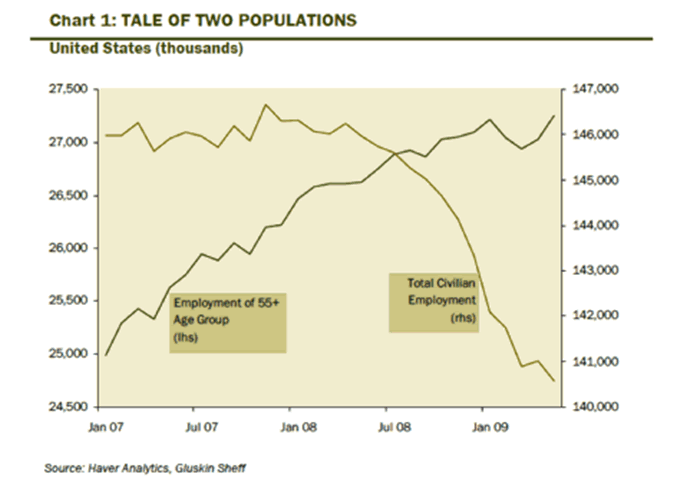
Boomers are also giving up hopes for retirement and instead are taking on more work. The (American Association of Retirement Professionals) reports that 24% of Boomers have postponed retirement. David Rosenberg of Gluskin Sheff adds that the 55+ age demographic is the only segment of the US population that is gaining jobs.
Boomers are also spending a lot less than they used to. The afore-mentioned AARP survey shows that 56% of Boomers are postponing a major purchase. Unit sales of sailboats is down a third in the first five months of 2009. Year over year, auto-sales for May 2009 were down in double digits ranging from 21% (Ford) to 38% (Toyota); remember Boomers accounted for 43% of purchases of new cars in 2007.
This slow down in spending pertains to just about any other high-end part of the retail market. Wine sales for bottles priced above $25 are down 12% year over year. Swiss watches are down 24%, The list goes on and on.
Folks, we are experiencing seismic shifts in consumer spending patterns. The US consumer (the Boomer) is NOT coming back. Boomers are trying to simply get by with less, working longer than they’d hoped, spending less, and saving more. These patterns are here to stay (remember Boomers outspent younger generations by 2-to-1 during the last decade) until someone implements changes that create sustainable job growth (an ultimately wealth) in the US.
Indeed, Boomers, now more than ever, are looking for ways to lock in their retirement. Undoubtedly this will draw them into income plays and gold. The Boomers have caught on that paper money is not going to maintain its value (after all, the dollar has lost 4.4% of its value every year since 1971). So they are going to begin shifting their money into gold and other real assets.
In fact they already are.
According to Capital Gold Group, demand for precious metals in self-directed IRAs has more than doubled since January1, 2009. More and more investors are shifting their retirement into the precious metal.
They know that big trouble is brewing in the market, and they want to protect themselves ahead of time.
I’ve prepared a FREE Special Report detailing three investments that will soar when the Second Round of the Financial Crisis hits. I call it the Financial Crisis Round Two Survival Kit. Swing by www.gainspainscapital.com/roundtwo.html to pick up your free copy today.
Good Investing!
Graham Summers
Graham Summers: Graham is Senior Market Strategist at OmniSans Research. He is co-editor of Gain, Pains, and Capital, OmniSans Research’s FREE daily e-letter covering the equity, commodity, currency, and real estate markets.
Graham also writes Private Wealth Advisory, a monthly investment advisory focusing on the most lucrative investment opportunities the financial markets have to offer. Graham understands the big picture from both a macro-economic and capital in/outflow perspective. He translates his understanding into finding trends and undervalued investment opportunities months before the markets catch on: the Private Wealth Advisory portfolio has outperformed the S&P 500 three of the last five years, including a 7% return in 2008 vs. a 37% loss for the S&P 500.
Previously, Graham worked as a Senior Financial Analyst covering global markets for several investment firms in the Mid-Atlantic region. He’s lived and performed research in Europe, Asia, the Middle East, and the United States.
© 2009 Copyright Graham Summers - All Rights Reserved
Disclaimer: The above is a matter of opinion provided for general information purposes only and is not intended as investment advice. Information and analysis above are derived from sources and utilising methods believed to be reliable, but we cannot accept responsibility for any losses you may incur as a result of this analysis. Individuals should consult with their personal financial advisors.
Graham Summers Archive |
© 2005-2022 http://www.MarketOracle.co.uk - The Market Oracle is a FREE Daily Financial Markets Analysis & Forecasting online publication.
