


Stock Market Perma Bears - Send In The Clowns By All Means!
Stock-Markets / US Stock Markets Jun 02, 2007 - 06:26 PM GMTBy: Clif_Droke
 The bull market in stocks continues, but to hear various exponents of the bearish persuasion talk, you'd think the party was ending right now. At least that's the impression I get reading some of their weekly rants on various Internet sites.
A reader recently directed me to a web site that features the commentary of the distinguished Dr. John Hussman, who runs the Hussman series of mutual funds. Hussman publishes a weekly commentary on various market-related issues on his web site. In a recent commentary published on the Hussman Funds web site ( www.hussmanfunds.com ) he asked the question, “How Much Do Interest Rates Affect the Fair Value of Stocks?” He writes:
“If you watch CNBC for a few minutes, you'll immediately hear some analyst claim that stocks are cheap because the ‘forward earnings yield' on the S&P 500 is higher than the 10-year Treasury yield. The next analyst will just say that “stocks look cheap compared with bonds.” The next will offer some strange convolution of the so-called ‘Fed Model,' like ‘Sure, P/E multiples are above average, but bonds are trading at a P/E of 21.' After a short break from the monotony by some kind of circus clown playing with horns and buzzers, another analyst then comes on saying how the firm's ‘valuation model' (which is driven by forward operating earnings and interest rates) implies that stocks are 20% undervalued.”
After reading the above paragraph, my first impression is that Dr. Hussman is speaking “sour grapes.” Dr. Hussman is an exceptionally brilliant mind and is a former economics professor at the University of Michigan and has been actively in financial markets since 1981 (according to his web site). His experience and credentials cannot be disputed. The performance of his company's Strategic Growth Fund (HSGFX) was strong from its inception in 2001 until the end of 2003. This is quite impressive given the background of the financial markets at that time, viz., a major bear market from 2001-2002. Since peaking in early 2004, however, the HSGFX has underperformed the S&P 500 and has gone mostly sideways for the past 3 ½ years. When one has “missed the party” for so long, it's easy to see how one could develop a negative attitude concerning the bulls who have ridden the market rally since 2004.
Not that Dr. Hussman's attitude is negative concerning the bulls, per se. His gripe seems to be focused on the bulls' reliance of various stock market valuation models that compare the S&P earnings yield with bond yields. Here is where many leading bulls take issue with Dr. Hussman. If Hussman is correct, then one of the central rationales behind this bull market, from a fundamental standpoint, is nothing but hot air and the market is destined to disappoint a lot of bulls. But if the bulls are correct, then it *does* matter that earnings yields are significantly higher than bond yields, both now and in the foreseeable future. Which side is correct?
In his latest piece, Dr. Hussman devotes many paragraphs in defense of his proposition that “There is, in fact, no stable relationship between earnings yields and interest rates.” At one point he even launches into a complex mathematical formula to try and prove that the “true” model of earnings yields “overestimate(s) the importance of interest rates in determining stock yields.” His reliance on numbers to prove his point is evidently aimed at impressing the reader with the vitality of his analysis and correctness of his conclusions. Yet despite all the numbers leaping from the page I still couldn't get out of my head the saying that “a picture is worth a thousand words…and will trump mathematics any day!”
The image I kept seeing was of the IBES Valuation Model and its obvious predictive value since 1979. It predicted the 1980s bull market. It predicted the 1987 stock market crash. It predicted at least one year in advance the bear market of 2000-2002. And it announced an end to that bear market in 2002 and has remained in an exceptionally bullish posture ever since.
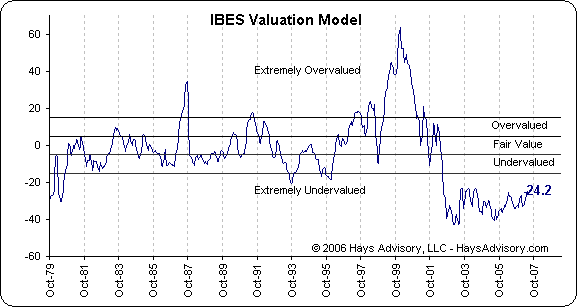
Dr. Hussman, however, doesn't quite see it this way. He writes concerning the relationship between earnings yields and interest rates: “The relationship is actually negative in data since 1929, is marginally positive (but statistically insignificant) in data since 1950, and is only strongly positive in data from 1980 through 2000 as a statistical artifact of the disinflationary period from 1980 to 2000.” He evidently sees the “strongly positive” correlation from 1980 to 2000 as a mere anomaly, a 20-year anomaly at that! I suppose it could be argued that for an investor taking the long-term view, a mere 20 years is a drop in the bucket and could actually be considered a short-term anomaly. But fortunes are made and won in the “short space” of 20 years while a more rational, scientifically-minded investor is sitting idly on the sidelines waiting for those pesky correlations between stock and bond yields to normalize.
Dr. Hussman disparages the use of valuation models that compare stock to bond yields. Yet in a fund prospectus available on his web site we find this statement: “The investment manager believes that the information contained in earnings, balance sheets and annual reports represents only a fraction of what is known about a given stock. The price behavior and trading volume of a stock may reveal additional information about what traders know.”
If Hussman believes that, then why dismiss the strength this market has been showing? The broad market has shown persistent strength since the bottom of last June and since then has shrugged off one negative news item after another. Could it be that the “smart money” knows something about the future of the economic and investment climate that most investors aren't aware of? Could it be that the persistent rally in the major averages since last June is foretelling an even bigger boom ahead? More to the point, could it be that the bull market in stocks is because money always goes where it is treated best (i.e., investors are chasing stocks because the earnings yield is higher than that of bonds)? I wonder…
One of the truisms of financial market analysis, or indeed of any endeavor that involves predicting outcomes, is that a predictive model can and should always be used as long as it shows consistently positive results. Even if the rationale behind the forecasting model is flawed, anything that has consistently predicted outcomes for 20 years or more cannot be easily dismissed as an anomaly or “just a coincidence.” I've heard highly educated individuals argue until they were blue in the face why, for instance, a certain stock market timing model “shouldn't” work based on all sorts of scientific and mathematical data. Yet the models these individuals were railing against were beating the market month after month and year after year. As the old saying goes, “You can't argue with success.” The law of averages and probability statistics is really all you need to know to evaluate the usefulness of a timing model. The IBES Valuation Model passes muster on all counts.
The undisputed fact remains that the IBES Valuation Model has been on target since its first appearance in 1976. It has consistently kept the disciplined investor who followed its signals on the right side of the market over the past 20+ years and no amount of economic dissertation can nullify this fact. As stock market analyst Keith Hays has observed, “This approach to valuation of the market does not take a rocket scientist….You can see just how ridiculously overdone the market got in 2000, and how undervalued it was in early 2003. This gauge has kept us bullish, and rightfully so, for the last 5 years.” Indeed, one can't argue with success, no matter how many mathematical equations one cares to cite.
Dr. Hussman dismisses certain of the bullish camp by dismissing them as “some kind of circus clown.” Yet many of these “clowns” have been having quite a circus party over the last couple of years. The bearish ringleaders, meanwhile, have been trying to lead a bears' parade on Wall Street but haven't been able to muster enough interest to turn things in their favor. The rain is pouring on the bears' parade while the circus party rages on. Given the choice between the bears' vision of the market's future and that of the bulls, I say send in the clowns by all means!
By Clif Droke
www.clifdroke.com
Clif Droke is editor of the daily Durban Deep/XAU Report which covers South African, U.S. and Canadian gold and silver mining equities and forecasts PM trends, short- and intermediate-term, using unique proprietary analytical methods and internal momentum analysis. He is also the author of numerous books, including "Stock Trading with Moving Averages." For more information visit www.clifdroke.com
© 2005-2022 http://www.MarketOracle.co.uk - The Market Oracle is a FREE Daily Financial Markets Analysis & Forecasting online publication.
