
Best of the Week
The Global Financial System is Coming to an End - 21st Nov 08
Gold the Dumb Metal Beats Overqualified Ex-hedge fund Financial Hacks - 21st Nov 08
Silver in Crisis - 21st Nov 08
Why the Stock Market Keeps Falling Despite Value Bargains - 21st Nov 08
Manipulated Inflation Statistics An Undisclosed Act of Treason - 21st Nov 08
Why Gold Price Has Fallen Despite Record Demand - 21st Nov 08
Why China Stocks are a Screaming Buy - 21st Nov 08
How Low will the Dow Jones Stocks Bear Market Go? - 21st Nov 08
World Economic Demand is Collapsing - 21st Nov 08
Economic Consequences of De-leveraging for Investors - 21st Nov 08
Global Economy is Being Sucked into a Black Hole - 21st Nov 08
Worst Stocks Bear Market Since the Great Depression
Credit Collapse, U.S. Treasury Yields Fall to Record Lows
UK Real Retail Sales Deflationary Trend Continues
More on Gold and the Reflation of Assets
Secrets to Stock Market Value Investing Profits - 20th Nov 08
Hyperinflation to Follow Deflationary Debt Unwind - 20th Nov 08
Exploding Global Stock Markets Hit by Economic Torpedo - 20th Nov 08
Stock Markets Look Set to Crash Through 2002 Lows - 20th Nov 08
Global Stock Market Crash Alert- Here We Go Again? - 20th Nov 08
Gold and Silver Obvious Price Maniupulation - 20th Nov 08
Falling Consumer Prices Good or Bad News for Consumers? - 20th Nov 08
U.S. Economy Reflation Challenge and LIBOR Deceptive Manipulation - 19th Nov 08
Economic Forecast, Peering into a Debt Ridden Future - 19th Nov 08
Misguided Bets On The Yield Curve Steepening - 19th Nov 08
What's Frightening Saudis and Iranians into Buying Gold? - 19th Nov 08
Stock Market Apocalyptic Crash Soon? S&P at the Tipping Point - 19th Nov 08
The Road to Financial Ruin: Unrestrained Government Spending - 19th Nov 08
Investing in Stocks During Scary Times - 19th Nov 08
US Capital Markets Portfolio Composition - 19th Nov 08
Spreading Global Recession Signals Caution for Investors - 18th Nov 08
G20 Central Banks Unite to Fight Economic Depression - 18th Nov 08
UK Inflation CPI Falls Sharply as Economy Heads for Deflation - 18th Nov 08
U.S. Treasury the Final Bailout - 18th Nov 08
What's ahead for Apple (AAPL), A Stock Worth Shorting? - 18th Nov 08
Worse than the Great Depression? - 18th Nov 08
Stock Market is Not in Uncharted Territory - 18th Nov 08
G20 Meaningless Statement and the Manageable Recession - 18th Nov 08
FINANCIAL PLANNING: My Guess Or Yours? - 17th Nov 08
Critical Week for Global Stock Markets and Economic Recovery - 17th Nov 08
U.S. Dollar Bullish Worlds Reserve Currency Dynamics - 17th Nov 08
The Ascent of Money and Descent of Niall Ferguson - 17th Nov 08
Citigroups Survival in Doubt as 50,000 Jobs Cut - 17th Nov 08
Flawed Central Banking System and Stocks Bear Market Bounce - 17th Nov 08
Gold Needs to Rise Above $838 to Fullfill Annual Minimum Bull Market Target - 17th Nov 08
Current Commodities Price Deflation to be Followed by Massive Inflation Later - 17th Nov 08
Stock, Commodities and Currency Futures Markets Analysis 17th November - 17th Nov 08
More Bailouts Coming, U.S. Automakers, Freddie Mac and Foreign Exporters - 17th Nov 08
The Brutal Truth About the Credit Crisis - 17th Nov 08
Stock Market Showing Signs of a Tradeable Low - 16th Nov 08
Peak Earnings and the Secular Stocks Bear Market - 16th Nov 08
Gold Long-term Bearish Projection Targets $480 - 16th Nov 08
G20 Economic Summit Changes Nothing - 16th Nov 08
Global Stock Market Crash Extended Leg Lower - 16th Nov 08
Extreme Stock Market Volatility as Corporate America Heads Towards Bankruptcy - 16th Nov 08
Stock Market Bear Still in Control - 16th Nov 08
Why the Dollar is Rising and Potential for Large Stock Market Rally - 16th Nov 08
US Dollar Bull Run, Gold, XOI, HUI, CBOE Put/Call Ratio - 16th Nov 08
G-20 Summit Politicians Blame Investors For Credit Crisis - 16th Nov 08
Bailout for GE But not Yet for GM - 15th Nov 08
End of the Era of Big Consumer Spending - 15th Nov 08
Hydrogen Energy, IEA-2008 World Energy, Climate Change and Fossil Fuel Depletion - 15th Nov 08
Hope for a Dismal Economy & Stock Market? - 15th Nov 08
Paulson's Blunders as Debt Securitization Market Remains Frozen - 15th Nov 08
Economic Forecasts and Analysis For U.S. Financial Markets (Nov 17-21) - 15th Nov 08

Free Instant Analysis

Free Instant Technical Analysis


RSS Feeds

Most Popular 2008
1. The Great Depression 2008 - It can't happen to us....can it?”
2. The Battle for America Has Begun- Strategic Forecasts
3. UK House Prices Plunge Over the Cliff
4. US Banking System Teetering on the Brink of Collapse
5. US Economy Forecast 2008 - First Recession then Recovery
6. How Safe is My FDIC-Insured Bank Account?
7. Rising Risk of a Systemic Financial Meltdown:The 12 Steps to Financial Disaster By Nouriel Roubini
Most Popular 2007
1. US Housing Market Crash to result in the Second Great Depression
2. Operation FALCON - The USA is turning into a Police State
3. US Housing Bubble Meltdown: "Is it too late to get out"?
4. UK Housing Market Crash of 2007 - 2008 and Steps to Protect Your Wealth
5. Global Liquidity Crisis when the Credit Boom comes to an End
Most Popular 2006
1. Last Warning! Three-Pronged Collapse ... Stocks, Bonds and Real Estate
2. UK Interest Rate forecast for 2007 - Bank of England to do battle with inflation
3. UK Interest Rates Forecast to rise much higher due to rising Inflation and high Money Supply Growth
4. Emerging Markets outlook for 2007 - India, China, Russia, Eastern Europe and Brazil

Market Oracle FREE Newsletter

Best of the Month
November 08
Hope for a Dismal Economy & Stock Market?
Where Stock Market Valuations and Technical Support Intersect
Credit Crisis Worse to Come as Bank Credit Contracts
U.S. Economic Pain Precedes Greatest Investment Opportunity of a Generation
Gloom and Doom Folks Will Soon be Proven Wrong
Agri-Foods Long-term Opportunities Amidst Hedge Funds Deleveraging
Will Fortune Favour the Brave in This Crisis Investment Climate?
After Shocks from the October Financial Markets Crash
Transitions From Stocks Bear Markets To Bull Markets
The Great American Housing Market Nightmare Next Phase
Stock Market Investing Dividend Yields Vs Bond Yields Analysis
U.S. Elections and Performance of Stocks, Dollar and Economy
Emerging Markets Turnaround is Getting Closer—Here's Why
Current Economic Crisis Worse than the Great Depression
FTSE 100 Stock Market Index Forecast Year End Rally
Stock Markets Staring into the Abyss
October 08
Stock Market Price Earnings Reversion Towards the Mean
Comex Gold and Silver Markets Hurtling Towards Default
Crooked Central Bank Plumbing the Depths of Depravity
Wild Crude Oil Markets Long-term Trend
Stock Market Crash Investor Overreaction Value Investing
When Will the Stocks Bear Market End?
Bear Market Deleveraging Producing Incredible Value in Agri-Foods
U.S. Dollar Bull Market Update
U.S. Dollar Driven Gold Price Crash
S&P500 Stock Market Crash Compared to Nikkei Index
Investment Opportunities in Municipal Bonds?
Stocks Bear Market Long-term Investing Strategy
Understanding Derivatives to Understand the Credit Crisis
Zinc Two Year Bear Market Coming to an End?
Stock Market Will Bottom Well Before the Economy
The Mechanism Of Capital Destruction
Fed Fighting to Prevent 1930's Style Financial and Economic Deflation
The Financial and Economic Blue Screen of Death
The U.S. Housing Market Economic Double Negative Feedback Loop
Stocks Bear Market Has NOT Hit Bottom!
Financial Markets Crash Greatest Opportunity in History!
Gold Price Manipulation- Bear Stearns Murdered at the Golden Gates
Central Banks Panic as Bailouts Fail to Halt Stock Market Crash
Financial Crisis 2008 Similar to 1987 Stock Market Crash
UK Interest Rate Forecast 2009
U.S. Economy Rapidly Sinking Into Economic Depression
Manipulation of Gold and Commodity Prices to Prevent Inflation and Higher Interest Rates
Bailout Fixes Nothing, Banking System Collapse Approaches Climax
September 08
Financial Tsunami: The End of the World as we Knew it
Financial Catastrophe Entire Global Financial System in Collapse
End of the Financial World- LIBOR TED Spread Flashes Trouble
America's Financial Apocalypse, What Can YOU Do as an Investor?
Bailout Crisis - What Happens Next
Credit Crisis Analysis and Conclusions
Financial Armageddon and the Re-pricing of Collateralized Debt
Systemic Failure of the United States- Game Over
Is the United States In Recession?
BANKRUPT Banks Wiped Out by Tulip Backed Securities

Links
Money Forums
Certz
TradingTheCharts
Housing Market Forecasts

How to Set Stop Losses to Lock in Profits

InvestorEducation / Investing Feb 16, 2007 - 07:17 AM

By: Hans_Wagner

InvestorEducation

I have had several questions regarding how I set stops and why sometimes I use a trailing percent stop and other times I use a specific price. I hope to help clarify my approach with this Point of Interest. The trailing stop is an excellent method to lock in profits or protect from greater losses. By placing a stop order below the current price it limits your loss to a predetermined amount. When the bid price hits the stop price your position is sold and you exit your position. 


The goal of a trailing stop is to let your profits run while protecting most of them in the event of a change in the stock's trend. The trailing stop should be far enough away from the current price level to compensate for normal volatility as price moves in a larger trend. While this article is based on long positions, the same concepts hold for short positions as well.

There are three primary ways to set a trailing stop, two of which reset automatically. The three trailing stop methods are: 

  • A percentage below the current price; 

  • A fixed number of points below the current price and; 

  • A specific stop price based on a technical indicator or support level that you adjust as the price of your stock raises. 

Trailing Percent

The trailing percent stop trails price movements by a set percentage, but only in the direction of the trend. If the price reverses direction, the stop remains at its previous level and will be activated if the price falls below the trailing percentage. The trigger price is readjusted each time a new high is reached. If the stock's price begins to fall and reaches your calculated stop price, your order will be triggered as a market order and your stock will be sold for the best available price.

Setting the percent for the trailing stop depends on your personal risk capacity, the trend in the market and the volatility of the stock. For me I do not wish to take on a lot of risk, which is why I like to buy quality companies at a discounted price. As a result I believe I can have a lower trailing percent than many other people use. When the market is trending strongly up, a trailing percent can be slightly larger than when the market is flat or in a secular bear market. It gives the stock more room to move on its way up. Finally, the volatility of the stock helps to establish the percent. The article Setting Trailing Stops discusses a way to calculate the trailing percent based on the latest month's volatility.

Trailing Points

Another way to set your trailing stop is to use trailing points. This method is very similar to the trailing percent method, only you use a set number of points below the high price, instead of a percentage. If the price reverses direction, the stop remains at its previous level and will be activated if the price falls by more than the trailing points. The trigger price is readjusted each time a new high is reached. If the stock's price begins to fall and reaches your calculated stop price, your order will be triggered as a market order and your stock will be sold for the best available price. 

Specific Price

The third way to set a trailing stop is to use a specific price. This technique takes advantage of the market psychology that is imbedded in the price and volume of a stock. Technicians call these levels support and resistance. Support is the level which a stock seems to find more buyers than sellers and as a result usually has difficulty going lower. Support levels are where buying overcomes the selling that is causing the price to fall. Resistance is the level where a stock seems to find more sellers than buyers and usually has difficulty going higher. Often these areas are where the stock price has stopped going down and started going up again. Unfortunately, setting a price just under a support area does not automatically move up on its own. You must monitor the price movement and adjust the stop price on your own.

My Basic Approach

The ideal stop limits down side risk without executing on a pull back within a rising up trend. When setting the initial and then trailing stop I go through a progression as follows:

1. Look for support levels on the chart that includes key moving averages such as the 50 and 200 day. Note how many times the support level has held and the volume action as the price maneuvers near the support level. If there is stronger volume on the move up away from the support level it is a good sign that this is a strong support level.

2. Calculate the trailing percent stop. This gives me another estimate of where to place a potential stop.

3. Select the best stop method to use given the specific situation of the stock in question. This decision is based on your best judgment and experience. If support levels are very close and the percent stop would give the price more room to move, I will select the percent stop. If there is support just below the percent stop then I might select the specific price just below the support level rather than the percent stop. In each case I decide how much I am willing to lose with each approach. 

4. Monitor the price performance and review which stop method to use as the price move up. There are times when the percent stop is best and there will be times when the specific price just below a support level will be best. As the price approaches your target, you may want to tighten up your stop to be sure you capture the most profits.

Trading for a Living: Psychology, Trading Tactics, Money Management
$41 (45% discount)Trading for a Living: Psychology, Trading Tactics, Money Management


Below is a chart of ALJ. Here is my thinking on setting stops for ALJ. Originally, I used the percentage stop to begin the trade, as I believe it was the best way to begin. It provided sufficient initial room for the price to move, without risking more money. Later as the price rose, I felt the rising trend line and the 200 moving average was a better place to place the stop. I am expecting this trade to last for several months, so I want to leave some room for it to move before getting stopped out. However, if you are a shorter term investor or feel that you would not want to risk the additional downside that a lower stop offers, then I would stick with the 8.7% stop. You might also believe that if the market consolidates and possibly pulls back and take ALJ with it. This would be another reason to stay with the 8.7% stop. You can always buy back in.
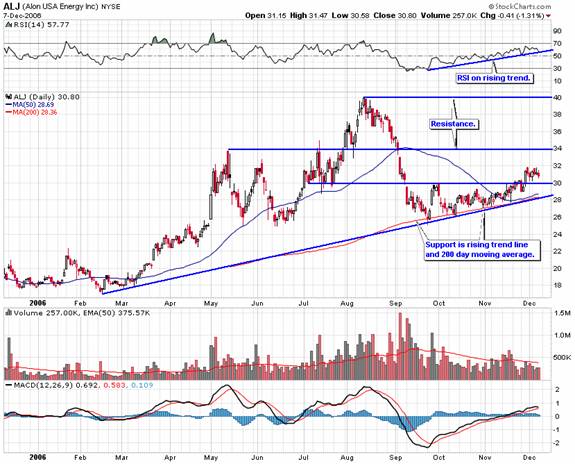
Below is a chart of ALJ. Here is my thinking on setting stops for ALJ. Originally, I used the percentage stop to begin the trade, as I believe it was the best way to begin

Conclusion

So which trailing stop should you use? I am unaware of any study that statistically proves one is better than the other. Successful investors and traders use each method. I like to use both the Percent Volatility and the Specific Price based on support and resistance levels. These two methods have some basis in behavioral psychology of the market. I examine the stop each method identifies and then choose the one that seems to fit the current situation the best. I also use what I know about the overall market trends and cycles, the strength of the trend in place and the general economy to help set my stop.

By Hans Wagner
tradingonlinemarkets.com

My Name is Hans Wagner and as a long time investor, I was fortunate to retire at 55. I believe you can employ simple investment principles to find and evaluate companies before committing one's hard earned money. Recently, after my children and their friends graduated from college, I found my self helping them to learn about the stock market and investing in stocks. As a result I created a website that provides a growing set of information on many investing topics along with sample portfolios that consistently beat the market at http://www.tradingonlinemarkets.com/


Comments


Post Comment (Moderated)


Market Oracle Readership 2008 Awards Ballot
