


US Housing Industry- A Monument to Futility
Housing-Market / US Housing Jun 03, 2008 - 02:23 AM GMTBy: John_Mauldin

 Regular readers of Outside the Box will be familiar with Michael Lewitt's thoughtful commentary. Today, he reminds us that much of the turmoil we are in could have been avoided with proper regulatory structures and then does a very poignant analysis of various sectors of the economy. I agree with him that we have not seen the worst and that we will continue to see this mild recession/slow recovery for longer than we should without true structural reform.
On a side note, I will be on CNBC Tuesday morning at around 10:00 or 10:30 with Mark Haines and Erin Burnett, talking about commodity prices and regulation.
So without further ado, let's jump into today's Outside the Box.
John Mauldin, Editor
Outside the Box
The HCM Market Letter
by Michael E. Lewitt
The Hollow Men
We are the hollow men
We are the stuffed men
Leaning together
Headpiece filled with straw. Alas!
Our dried voices, when
We whisper together
Are quiet and meaningless
As wind in dry grass
Or rats' feet over broken glass
In our dry cellar
Shape without form, shade without colour,
Paralysed force, gesture without motion;
Those who have crossed
With direct eyes, to death's other Kingdom
Remember us - if at all - not as lost
Violent souls, but only
As the hollow men
The stuffed men.
T.S. Eliot (1925)
Introduction - The Mean Season
While many economic pundits are trying to predict the end of the American recession that began last summer, HCM regrets to inform everybody that the United States' economy is entering hurricane season. And we don't call it The Mean Season down here in Florida for nothing. The economic headwinds that have been buffeting the United States for the past several months are only increasing in velocity despite the Herculean efforts of the powers-that-be to bolster the system against collapse. At this point, the domestic economic picture can only be described as ominous. Energy prices have risen from dangerously high to prohibitively high. Housing prices are continuing to drop at alarming rates in many sections of the country. Banks remain reluctant to lend either to individuals or corporations for virtually any type of transaction. And our political and business elites remain a prosper of Hollow Men who continue to whistle past the graveyard as their limousines chauffeur them home each night to their gated mansions.
HCM harps on this leadership void because policy failures led us into our current difficulties. Inadequate financial regulation allowed unfettered securitization and leverage to push the system to the brink of collapse. A complete failure to fashion a responsible energy policy has led to skyrocketing gasoline prices. The damage inflicted on investors, consumers and businesses by these failures were avoidable. Instead, the political and financial elite placed their own short-term interests ahead of the long-term interests of everybody else, and the results are plain to see: burgeoning inflation, choked credit markets, and a deteriorating physical, moral and cultural climate. The only way to improve things is to identify what ails us and then initiate systemic reform. But systems cannot change unless the individuals who manage and participate in them are willing to change. HCM 's past two newsletters ("How to Fix It," April 1, 2008 and "Why We Must Fix It," May 1, 2008) were attempts to engage our readers in the type of debate that must occur as we enter a Presidential election at this crucial and uncertain time in history. In this issue, HCM focuses to a greater extent than in our last two issues on the economic headwinds that are frankly alarming us.
The U.S. Economy
An array of American industries is beginning to experience deep distress. Three in particular are about to experience a wave of restructurings or defaults that will drive a stake through the heart of the American economy: airlines, automobiles and retailers.
The Airline Industry - Unfriendly Skies
Having tried to merge in virtually every permutation available and failed, the airlines are now left with no choice but to cut capacity and pray for oil prices to fall. American Airlines, generally considered the best managed and healthiest U.S. airline, announced on May 21, 2008 that it will cut its capacity by 12 percent and reduce its workforce by a commensurate amount due to high oil prices (which account for 40 percent of its cost structure). 1 Delta and Northwest, which had the dubious distinction of filing for bankruptcy on the same day, have announced that they will merge (although in the airline industry there is a huge distance between the cup and the lip, so whether this deal is ultimately consummated remains to be seen). United and USAir have been flirting with each other but seem unlikely to mate despite titters that they may try to hook up again. The bottom line is that airlines, which are marginal businesses in the best of times, are unsustainable businesses with oil at current levels. The industry was partially nationalized after 9-11. The current oil spike should finish the job.
The Automobile Industry - One Big Pothole
The automobile industry continues to be weighed down by the albatrosses of outmoded products, unionized workforces, crippling legacy costs, higher raw material costs and the unavoidable conclusion that the world has passed them by. It is both startling and depressing to hear American automakers just now coming to the conclusion that they are still manufacturing too many gas-guzzling trucks and SUVs and too few hybrid and diesel passenger vehicles. Few industries have seen such profound failures of vision and leadership. Ford announced in late May that it no longer expects to be profitable in 2009 and expects to produce 120,000 to 150,000 fewer trucks and SUVs in the third quarter of 2008 than a year earlier, and 60,000 to 100,000 fewer in the fourth quarter of this year than last year. Job losses and plant closings are sure to follow unless current facilities can be converted to manufacture more fuel efficient vehicles. Ford is generally considered the healthiest of the Big Three.
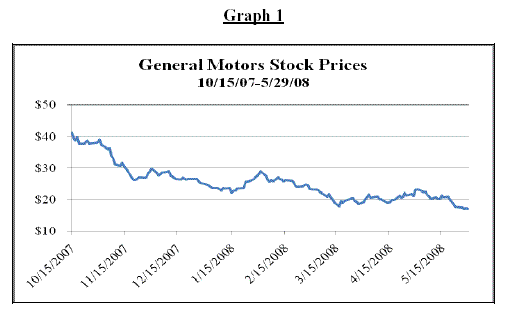
Now General Motors, whose stock (see Graph 1 below) has hit a multi-decade low, is preparing a new restructuring plan in order to reduce costs and preserve cash. The reference to "preserving cash" should raise alarm-bells in the minds of investors in General Motor's debt and equity securities. HCM has long maintained in this publication and elsewhere that General Motors will ultimately have to restructure its balance sheet (probably through a bankruptcy filing). We take no pleasure in noting that the evidence is mounting that General Motor's woes appear to be accelerating. The ongoing soap opera at General Motor's largest parts supplier, Delphi Corp., 2 is also placing additional financial stress on the company since General Motors has continuing financial obligations to the parts maker, which it spun off several years ago. Investors should not for one minute try to convince themselves that General Motors is too big to fail. It is not a financial institution like Bear Stearns whose bankruptcy would call into doubt the viability of the financial system. General Motors is just a stumbling industrial giant that has outlived its usefulness and failed to adapt to the times. Investors should avoid General Motors' securities even if it means taking losses at current prices .
Some private equity players thought they could outsmart the trends that were pushing America's auto industry onto the junk heap. In what is turning out to be the irony of ironies, General Motors was thought by some (including HCM ) to be selling its crown jewel when it parted with a majority stake in its finance arm, GMAC, to private equity Cerberus Capital Management, L.P. ("Cerberus") in a 2007 transaction. Instead, Cerberus is scrambling to keep GMAC afloat under the weight of its mortgage business, Residential Capital, LLC ("ResCap"), which has suffered enormously from the collapse of the housing market. Not sufficiently sated with swallowing half of GMAC, Cerberus went on to gobble up Chrysler Corp. and Chrysler Finance. Now Cerberus is desperately trying to figure out how to keep that failed automobile company and its finance arm from going under. Chrysler is a disaster unto itself, which is why Daimler AG was so eager to dump it. Chrysler has three North American plants producing full- size pickup trucks but last year sold only 358,000, or less than two plants' worth. In the dictionary of private equity terms, the automobile industry may soon come to be defined as "Waterloo."
The Retail Industry - Dropping Before They Shop
When you're about to lose your home and you can't afford to fill your car with gas at $4.00/gallon, you're probably not thinking about driving to the mall to spend more of the money you don't have. The U.S. consumer - the one-time engine of global economic growth - is struggling mightily, and retailers are feeling the pain. The year began with a string of smaller retailers throwing in the towel and filing Chapter 11, including several furniture retailers (Bombay, Levitz, Domain and Wickes), Sharper Image, Fortunoff, Harvey Electronics and the catalogue retailer Lillian Vernon. Linen 'N Things became the largest casualty in the sector in May after struggling from virtually the day that private equity giant Apollo Management L.P. took it private to sell more of what nobody wanted. Many other retailers that are still solvent are feeling the pain and making anticipatory cutbacks, including Foot Locker, which has announced that it will close 140 stores, Ann Taylor, which is shuttering 117 locations, and Zales which will eliminate 100. Another Apollo-owned retailer, Claire's Stores, has seen its bonds trade down to distressed levels (although HCM is less convinced that this is a bankruptcy candidate, probably based on the many torturous hours I spent with my daughter Alessia at the Claire's store in the Boca Raton mall).
Sears - Sad and Sadder
Sears Holdings Corp., the largest U.S. department store chain, surprised the market on May 29, 2008 with an unexpected first-quarter loss of $56 million, or $0.43/share, compared with year earlier net income of $223 million, or $1.45/share. Analysts were projecting a small profit, which is why they are analysts. Revenues for the quarter declined by 5.7 percent, or roughly $680 million, to about $11.1 billion from just under $11.75 billion a year earlier. Most of the sales decline came in the high margin appliance area as well as in the lawn and garden and clothing categories. Consumers are definitely cutting back. Same-store-sales for stores open at least a year plunged 8.6 percent, with Sears's stores seeing a 9.8 percent drop and Kmart locations showing a smaller but still severe 7.1 percent fall. Poor results did not dissuade Sears' management from purchasing an additional $40 million of stock during the quarter (admittedly a mere bagatelle in the scheme of things) or its board of directors from adding an additional $500 million to the $143 million the company is already authorized to buy back.
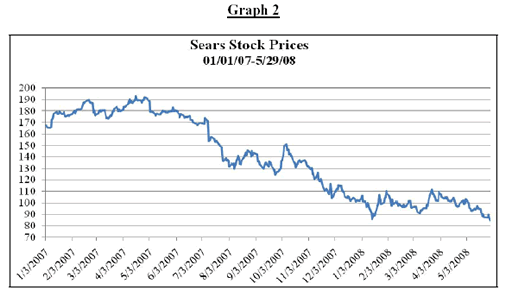
HCM continues to question the wisdom of these stock repurchases while the company's business continues to deteriorate. Sears' cash balance declined to $1.4 billion from $3.5 billion in the year-earlier quarter, and was $200 million lower than the $1.6 million it held at the end of its fiscal year on February 2, 2008. During the quarter, the Company spent $70 million more on marketing and $10 million more on its on-line unit, lifting selling, general and administrative expenses to 25.4 percent of sales from 22.5 percent of sales a year ago (with little to show for it, apparently). Sears is what we at HCM call a melting ice cube. It continues to consume itself through share buybacks and misbegotten marketing ploys. The unhappy truth is that Sears and Kmart are yesterday's retailers. Graph 2 shows the inexorable decline in Sears' stock since it hit a high of $193/share in April 2007. Investors are clinging to the hope that the Company's real estate will bail them out. In HCM 's view, such are not the dreams of which fortunes will be made.
It boggles HCM 's mind that so many financial institutions have been willing lenders to the retail industry over the years in view of the high rate of defaults that this industry has seen. Retailers are generally loathe to amortize debt - they would rather open additional locations. Actually, they are genetically compelled to do so. Accordingly, they make the worst of borrowers because they always need more money and never repay the money they borrowed in the first place. There are few barriers to entry since new malls are being built on every street corner in America (or at least were being built before the recent credit crunch). Retail ideas are easily copied (for example, Linens 'N Things is just another version of Bed Bath & Beyond, which is competing with Wal-Mart, Kmart, Target and many catalogue retailers. Even more disturbing are the high prices at which recent retail LBOs were done in an era of low cost capital. These transactions were almost assured of running into trouble, as they are now beginning to do. There will be more bankruptcies to come.
The Housing Industry - A Monument to Futility
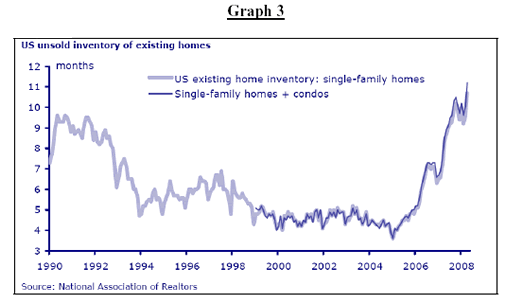
Then there is the housing industry, where the news just keeps getting worse and worse. The Office of Federal Housing Oversight reported that U.S. house prices dropped by 3.1 percent in the first quarter of 2008 compared with the first quarter of 2007. Prices for previously-owned single-family homes fell in 43 states, with California and Nevada seeing 8 percent drops. The inventory of unsold homes also continues to rise to unprecedented levels. Graph 3 shows how this inventory has actually been spiking higher this year.
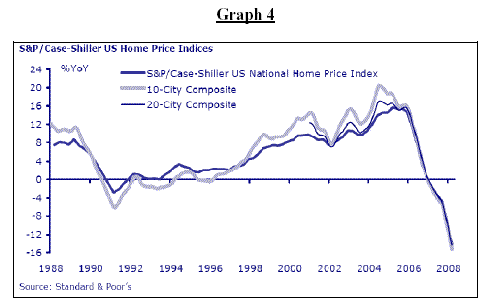
One of the reasons for this is that mortgages are extremely hard to come by in today's market. HCM has heard anecdotal evidence of fully qualified potential buyers of high-end homes in California being unable to obtain mortgages, and we imagine this is illustrative of conditions throughout the country. Foreclosure data is almost mind-numbing. In April, foreclosure filings were up 65 percent year-over-year to a record 243,343 according to RealtyTrac . Not all of these houses will actually enter foreclosure, but many of them will. Finally, the S&P/Case-Shiller National Home Price Index shown in Graph 4 declined by 14.1 percent year-over-year in the first quarter of 2008, compared with a 8.9 percent year-over-year decline in the first quarter of 2007. Consecutive declines of this magnitude reverse increases of similar magnitude earlier in this decade, showing the dark side of the real estate bubble that loose monetary policies engendered.
While the Federal Reserve has lowered interest rates and taken other steps to place a safety net under the housing market, there are scant signs of success thus far. In fact, mortgage rates have not dropped nearly as much as hoped due to deeper problems in the credit markets. The mortgage market has not responded in the traditional manner to the Federal Reserve's sharp interest rate reductions because of structural problems arising from the collapse of securitization markets and the vaporization of liquidity from the mortgage market. As a result, lenders (with a push from the government) have been working with borrowers to keep them in their houses. But the government has yet to come up with comprehensive legislation to address this problem, and the American landscape is increasingly littered with empty houses that are expensive for lenders to maintain and whose physical condition is deteriorating. It is going to take years for the housing economy to recover from its downturn, and it is clear that the sector has not hit bottom yet.
Energy - Sapping the Energy Out of Everything Else
In 2007, it did not require a hurricane in the Gulf of Mexico to push oil to $100/barrel. As the United States approaches another storm season, the picture is far grimmer. Oil now exceeds $130/barrel and the best last hope for a meaningful drop in price appears to be the sharp economic slowdown that high oil prices pretty much guarantee at this point. The International Energy Agency is expected to sharply reduce its forecast for future oil supplies when it completes work on a study it is doing on the industry. For several years, the IEA has predicted that supply would keep up with demand that was expected to reach 116 million barrels a day by 2030, up from around $87 million barrels today. The agency is reportedly now coming to the conclusion, which will warm the hearts of believers of the Peak Oil thesis (like HCM ), that it will be difficult to squeeze more than 100 million barrels per day out of the ground over the next two decades. It appears that higher oil prices are here to stay.
What To Do?
What is an investor to do in such an environment? Bridgewater Associates' Ray Dalio, widely regarded as one of the savviest guys around, writes the following: "From an investment perspective... portfolios should be structured with the assumptions of sustained slow growth and/or a very weak dollar (especially relative to emerging market currencies.)" 3 HCM would fine-tune this suggestion by pointing out that the industries discussed above - airlines, autos and retailers - and those closely related to them are likely to experience not slow but negative growth in the months ahead. HCM also concurs with the weak U.S. dollar thesis, and believes that the best U.S. dollar play remains against the South Asian currencies, the Chinese remnimbi and the Indian rupee (even though the rupee does poorly with high oil prices, it remains a good long-term play).
These currencies have now appreciated more than 40 percent against the U.S. dollar since 2002, compared with 100 percent appreciation of the Euro, which represents an economic bloc that suffers from even worse structural flaws than the U.S. Over time, holding currencies such as the Singapore dollar, Taiwanese dollar, Hong Kong dollar, as well as those of growing giants India and China, will handsomely reward investors. HCM would also recommend that investors invest in gold, which will remain a store of value as long as U.S. economic policies continue to debauch the dollar. The U.S. dollar represents political stability, but as Fareed Zakaria points out in his newly published book, The Post-American World , political stability is no longer is short supply in today's world:
"It seems that we are living in crazily violent times. But don't believe everything you see on television. Our anecdotal impression turns out to be wrong. War and organized violence have declined dramatically over the last two decades. Ted Robert Gurr and a team of scholars at the University of Maryland's Center for International Development and Conflict Management tracked the data carefully and came to the following conclusion: 'the general magnitude of global warfare has decreased by over sixty percent [since the mid-1980s], falling by the end of 2004 to its lowest level since the 1950s. 4 ' Violence increased steadily throughout the Cold War - increasing sixfold between the 1950s and early 1990s - but the trend peaked just before the collapse of the Soviet Union in 1991 and 'the extent of warfare among and within states lessened by nearly half in the first decade after the Cold War.' Harvard's polymath professor Steven Pinker argues that 'today we are probably living in the most peaceful time in our species' existence.'" 5
Whatever one thinks about the Iraq War, it has coincided with two broad economic trends that are indisputably negative for the so-called victor, the United States: higher oil prices and a lower dollar. The world is undoubtedly a better place without Saddam Hussein running around starting or threatening wars, but the ironic byproduct of his elimination (and long-overdue appointment with the gibbet) could be considered an improvement in global stability and a coincident lowering of the need for the U.S. dollar as a haven of political safety. The result has been a move among many sovereign investment funds - not least of all those in the Middle East - to diversify their holdings into the Euro and other currencies. The world has not yet crossed the Rubicon whereby oil will no longer be priced in dollars, but that is no longer an inconceivable concept, although its consequences for the U.S. currency are well nigh inconceivable.
Moreover, it would be difficult to argue with the proposition that dollar confidence has been damaged because the current credit crisis emanated from the heart of American finance. The fact that American investment banks spawned the financial technology of securitization, CDOs, CDS and other structured products that pushed the system to the brink earlier this year raises profound questions about the philosophical, intellectual and moral foundations underlying Western free market capitalism and its base currency, the U.S. dollar. The growing distrust of this capitalist model is further enhanced by the very legitimate questions raised by the asymmetric compensation schemes that rewarded many of the promulgators of these financial disasters while leaving institutions representing retirees and municipalities and other "mom and pop" investors nursing enormous losses. This loss of confidence in what remains the best system of economic organization known to man, flawed as it may be, is the type of long-term systemic damage that HCM has in mind when it speaks of the failure of business and political leaders to think in terms beyond themselves about the consequences of their actions and the policies they promote.
Opportunities Out of the Muck
Years ago, a friend of ours used to ask for a hemlock martini upon returning to the clubhouse after a particularly bad round of golf. Some of our readers might feel like such a cocktail after imbibing the unremittingly negative tone of this report. But investors should remember that opportunities are created during the periods of deepest dislocation. And while things could certainly be worse - and HCM strongly believes will get worse before they get better over the course of the second half of 2008 - this is certainly one of those periods in which great investment opportunities are being created. Before suggesting a couple of areas that might be ripe for exploration today, HCM needs to emphasize that investors seeking opportunities out of the current muck must have long-term time horizons .
In the near-term, market volatility will remain elevated by a number of factors. Not least among these factors is the dominant presence in the markets of the quantitative investors. HCM finds these strategies flawed for several reasons. First, they generally tend to use high levels of leverage, which tells us that the underlying investments are not very attractive without leverage. Second, quantitative investing strikes us as the epitome of speculation; it adds nothing to the productive capacity or capital account of this nation or any nation. Quants build nothing. Third, quantitative strategies contribute disproportionately to the volatility of the markets, which in turn damages confidence in markets. Markets cannot prosper if investors are not willing to trust them and risk their capital in them. When investors see the prices of stocks or bonds or bank loans blow around like palm trees in a hurricane, and then look outside and see that the sun is shining and the air is calm, it makes them question the very foundations of the market. This leads to the withdrawal of capital from the market for the risk-taking purposes that it is needed. Fourth, it is nothing less than a national tragedy that so many bright and talented minds are being swept into the arms of Wall Street to build quantitative investment models rather than devoting themselves to the sciences and medicine and other life-affirming activities. The latter complaint is one that all of our readers can and should address through their philanthropic and community work.
So where are the opportunities? In the credit markets, the best long-term opportunity is to take advantage of the dislocation in the market for leveraged bank loans. Despite some recovery in this market, loans of many attractive credits continue to trade at healthy discounts. The enormous disparity between technical conditions in this market and credit fundamentals that opened up last summer with the demise of the Structured Investment Vehicles (SIVs) remains extant and offers an opportunity to earn attractive risk-adjusted returns in the hands of a seasoned manager. In the equity markets, HCM would advise being more cautious due to the outsized presence of quant funds and other short-term oriented investors who have raised volatility to unhealthy levels. The energy sector remains attractive for those who believe, like HCM , that we are seeing the early stages of the Peak Oil thesis come to life. Companies contributing to the enormous buildup of infrastructure in the Middle East and Asia are also attractive. Financials should be avoided at all costs. Asian and other emerging markets are more attractive than the U.S., though in all cases we would consider stocks on a case-by-case basis.
Footnotes:
1 Of course, the media paid most attention to American's decision to charge $15 for checking bags, a move that will not raise any meaningful revenue for the airline, aggravate the flying public, and may be best understood as a cry for help aimed at politicians in Washington.
2 Delphi Corp. is suing an Appaloosa Management-led group for backing out of a financing pact that would enable the parts maker to emerge from bankruptcy. The problem, as Appaloosa and its partners have figured out, is that industry conditions are likely to land Delphi Corp. right back in bankruptcy before long.
3 Bridgewater Daily Observations , May 21, 2008.
4 See Ted Robert Gurr and Monty G. Marshall, Peace and Conflcit 2005: A Global Survey of Armed Conflicts, Self-Determination Movements and Democracy , Center for International Development and Conflict Management, University of Maryland, College Park (June 2005).
5 Fareed Zakaria, The Post-American World (W.W. Norton & Company: New York, 2008), pp. 8-9.
Your concerned about the regulatory response analyst,
John F. Mauldin
johnmauldin@investorsinsight
John Mauldin, Best-Selling author and recognized financial expert, is also editor of the free Thoughts From the Frontline that goes to over 1 million readers each week. For more information on John or his FREE weekly economic letter go to: http://www.frontlinethoughts.com/learnmore
To subscribe to John Mauldin's E-Letter please click here:http://www.frontlinethoughts.com/subscribe.asp
John Mauldin is the President of Millennium Wave Advisors, LLC (MWA) which is an investment advisory firm registered with multiple states. John Mauldin is a registered representative of Millennium Wave Securities, LLC, (MWS) an FINRA registered broker-dealer. MWS is also a Commodity Pool Operator (CPO) and a Commodity Trading Advisor (CTA) registered with the CFTC, as well as an Introducing Broker (IB). Millennium Wave Investments is a dba of MWA LLC and MWS LLC. Millennium Wave Investments cooperates in the consulting on and marketing of private investment offerings with other independent firms such as Altegris Investments; Absolute Return Partners, LLP; Pro-Hedge Funds; and Plexus Asset Management. All material presented herein is believed to be reliable but we cannot attest to its accuracy. Investment recommendations may change and readers are urged to check with their investment counselors before making any investment decisions.
Opinions expressed in these reports may change without prior notice. John Mauldin and/or the staffs at Millennium Wave Advisors, LLC and InvestorsInsight Publishing, Inc. ("InvestorsInsight") may or may not have investments in any funds cited above. Disclaimer PAST RESULTS ARE NOT INDICATIVE OF FUTURE RESULTS. THERE IS RISK OF LOSS AS WELL AS THE OPPORTUNITY FOR GAIN WHEN INVESTING IN MANAGED FUNDS. WHEN CONSIDERING ALTERNATIVE INVESTMENTS, INCLUDING HEDGE FUNDS, YOU SHOULD CONSIDER VARIOUS RISKS INCLUDING THE FACT THAT SOME PRODUCTS: OFTEN ENGAGE IN LEVERAGING AND OTHER SPECULATIVE INVESTMENT PRACTICES THAT MAY INCREASE THE RISK OF INVESTMENT LOSS, CAN BE ILLIQUID, ARE NOT REQUIRED TO PROVIDE PERIODIC PRICING OR VALUATION INFORMATION TO INVESTORS, MAY INVOLVE COMPLEX TAX STRUCTURES AND DELAYS IN DISTRIBUTING IMPORTANT TAX INFORMATION, ARE NOT SUBJECT TO THE SAME REGULATORY REQUIREMENTS AS MUTUAL FUNDS, OFTEN CHARGE HIGH FEES, AND IN MANY CASES THE UNDERLYING INVESTMENTS ARE NOT TRANSPARENT AND ARE KNOWN ONLY TO THE INVESTMENT MANAGER.
© InvestorsInsight Publishing, Inc. 2008 ALL RIGHTS RESERVED
John Mauldin Archive |
© 2005-2022 http://www.MarketOracle.co.uk - The Market Oracle is a FREE Daily Financial Markets Analysis & Forecasting online publication.
