


People's Bank of China Takes With One Hand, Gives With The Other?
Interest-Rates / China Economy May 19, 2007 - 09:30 AM GMTBy: Paul_L_Kasriel
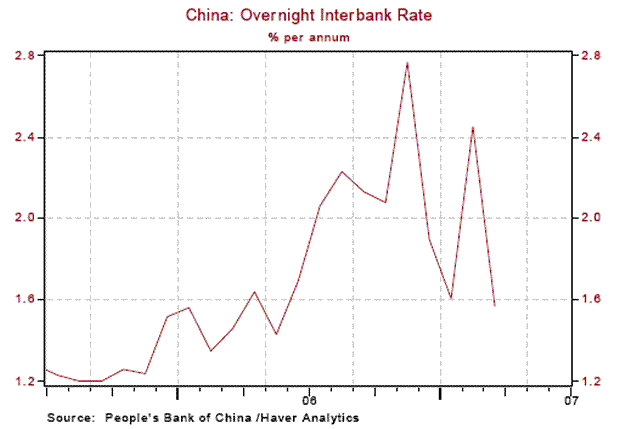
 The People's Bank of China (PBOC) announced today that it was raising the required reserve ratio on its constituent banks by 0.5 percentage points to 11.5%. This would be the eighth increase in the required reserve ratio since June 2006 when the ratio was 7.5%. You would think that with the PBOC mandating that banks now hold more reserves, the cost of reserve credit would be moving up. Think again. Chart 1 shows that the Chinese overnight interbank interest rate, the equivalent of the U.S. fed funds rate, stood at 1.57% in March (latest data that I have available) - 12 basis points lower than where it was in June 2006, before the required reserve ratio started its ascent.
Chart 1
If the demand for something has gone up, in this case, the dictated demand for bank reserves, how can the price of that something, the overnight interest rate on bank reserves, stay almost the same? The supply of that something, bank reserves, must have gone up commensurately. Chart 2 shows that the year-over-year growth in reserves created by the PBOC jumped from 10.0% in June 2006 to 23.1% in March 2007. In effect, it looks as though the PBOC has been "sterilizing" its reserve-requirement increases.
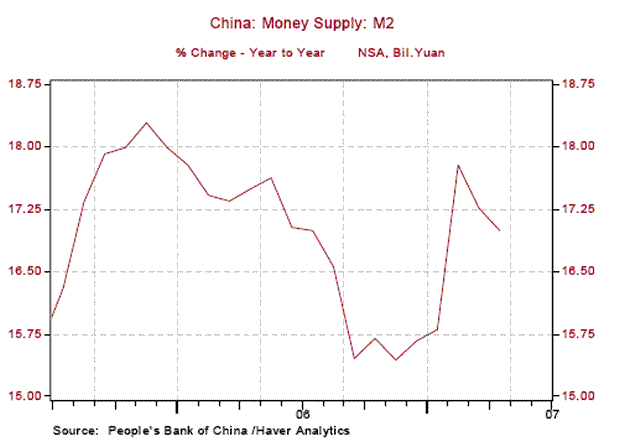
That is, the PBOC is accommodating its imposed increased demand for reserves by "printing" more reserves, effectively keeping the interest rate on reserve credit essentially unchanged. This might explain why the year-over-year growth in the Chinese M2 money supply in April 2007 was 16.99% -- not much different from the 17.03% in June 2006, just before the required reserve ratio began being raised (See Chart 3).
Chart 2
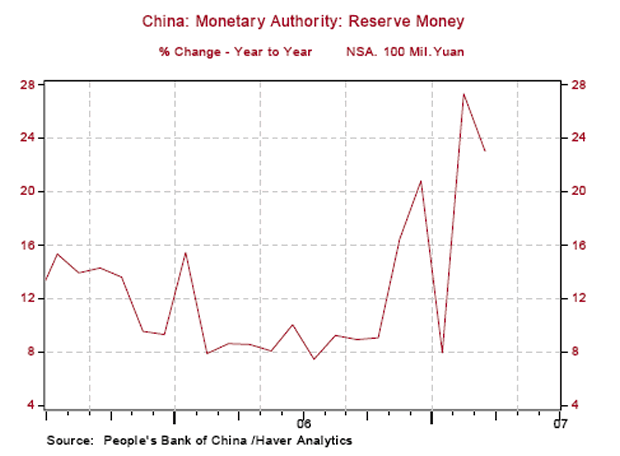
Chart 3
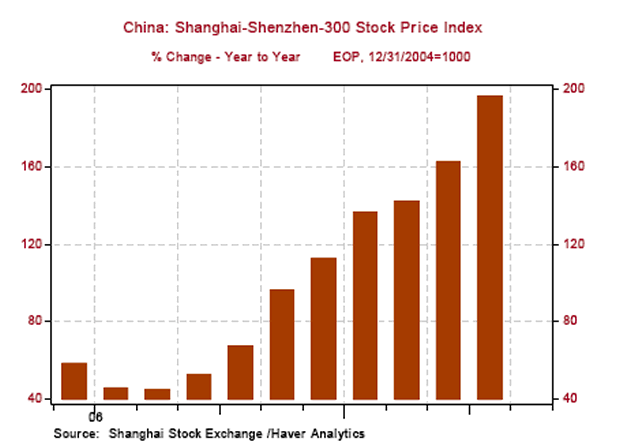
Why is the PBOC cosmetically tightening its monetary policy? It might have something to do with the more rapid increases in the prices of consumer goods and services of late (see Chart 4) and the more rapid increases in the prices of Chinese corporate equities of late (see Chart 5).
Chart 4
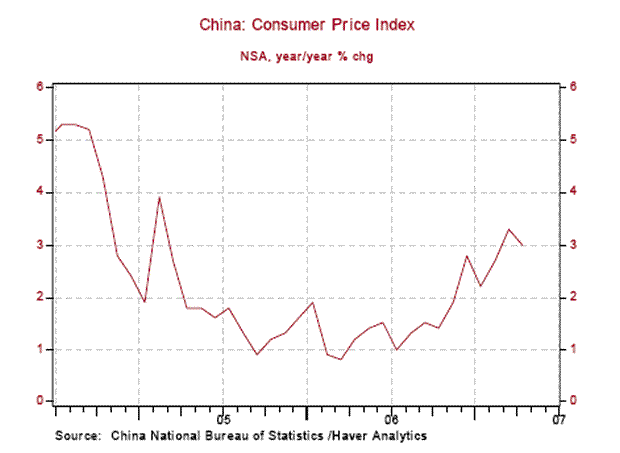
Chart 5
Now, with today's announcement of an increase in the required-reserve ratio, the PBOC also announced some increases in interest rates - just not increases in the interest rate on reserve credit. The PBOC increased the interest rate on one-year bank loans by 18 basis points to 6.57% and the interest rate on one-year bank deposits by 27 basis points to 3.06%.
With consumer price inflation running "officially" at 3.0% and with stock prices growing at an annual rate of almost 200%, why would many Chinese find a 3.06% nominal return on their savings very attractive? In other words, it is doubtful that the PBOC's deposit interest rate increase is going to do much to slow down the velocity of M2. Likewise, a 6.57% borrowing interest rate in the face of an almost 200% annual increase in stock prices is unlikely to slow significantly the demand for bank credit. And U.S. banks can only look on in envy at Chinese banks that can fund themselves overnight at 1.6% and lend for one-year at 6.57%. In sum, it does not look as though the steps taken today by the PBOC on reserve requirements and interest rates will do much to slow down bank credit / money supply growth and, thus, consumer price and asset price inflation unless these steps are taken in conjunction with a sharp slowdown in the PBOC's provision of bank reserves.
A slowdown in bank reserve provision would lead to a rise in the overnight interbank interest rate. The rise in this rate also would put upward pressure on the yuan/dollar exchange rate. And the PBOC also announced that it would allow the yuan/dollar relationship to vary more on a daily basis - from 0.3% to 0.5%. Under current conditions, the only way the PBOC can rein in consumer and asset price inflation is to slow down the provision of bank reserves and that will entail a rise in the yuan relative to the dollar. The PBOC has to make a decision - does it want to maintain a relatively steady yuan/dollar relationship or does it want to prevent Chinese inflation? It can't have both. As the Chinese say, "May we live in interesting times."
By Paul L. Kasriel
The Northern Trust Company
Economic Research Department - Daily Global Commentary
Copyright © 2007 Paul Kasriel
Paul joined the economic research unit of The Northern Trust Company in 1986 as Vice President and Economist, being named Senior Vice President and Director of Economic Research in 2000. His economic and interest rate forecasts are used both internally and by clients. The accuracy of the Economic Research Department's forecasts has consistently been highly-ranked in the Blue Chip survey of about 50 forecasters over the years. To that point, Paul received the prestigious 2006 Lawrence R. Klein Award for having the most accurate economic forecast among the Blue Chip survey participants for the years 2002 through 2005.
The opinions expressed herein are those of the author and do not necessarily represent the views of The Northern Trust Company. The Northern Trust Company does not warrant the accuracy or completeness of information contained herein, such information is subject to change and is not intended to influence your investment decisions.
© 2005-2022 http://www.MarketOracle.co.uk - The Market Oracle is a FREE Daily Financial Markets Analysis & Forecasting online publication.
