
Best of the Week
Most Popular of the Week
1.Election Risks, Debt and Inflation Push British Pound Below £/$1.50 Towards £/$1.40 Target- Nadeem_Walayat
2.British Pound GBP Australian Dollar AUD Currency Analysis and Forecast 2010- Nadeem_Walayat
3.U.S. Credit Turns to Debt, Will The U.S. Devalue The Dollar?- Darryl_R_Schoon
4.Economic Recession, Depression, or Systematic Breakdown- James_Quinn
5.Bill Gates Talks About Vaccines to Reduce World Population- F_William_Engdahl
6.Gold Going Higher, Even George Soros Agrees With Marc Faber- LewRockwell
7.An Attempt to Think Through the Greek Debt Crisis- 2nd Mar 10 - John_Mauldin
8.Bernanke on a Bailout of the U.S. Treasury- 3rd Mar 10 -Gary_North
Weeks Analysis
Bifurcation of American Society Continues at Pace; Nearly Half Have Less than $10K for Retirement,- 9th Mar 10
Gold Safe-haven Status is Based on Hype Not History - 9th Mar 10
Iceland Votes No to Repaying Icesave Debt to Britain and Netherlands- 9th Mar 10
The European Union Debt Deflation Trap - 9th Mar 10
Entropy, Why the World as We Know It Is Dying- 9th Mar 10
U.S. Real Estate Confusion or Lies?- 9th Mar 10
The Scandinavian Socialist Welfare Myth Revisited- 9th Mar 10
Stocks Unhappy Anniversary- 9th Mar 10
Fraud, Mastered by the Criminal Banking Industry- 9th Mar 10
China's Economic Challenge- 9th Mar 10
UK Savings Interest Rates Tumble to Fund Mortgage Cuts- 9th Mar 10
Four Dividend Stock Hotspots for Investors to Investigate- 9th Mar 10
Gold Catches Traders by Surprise- 9th Mar 10
How to Profit From Investing in the “Fertilizer Wars”- 9th Mar 10
S&P VIX Ratio Signals Looming Decline for the Stock Market- 9th Mar 10
Tax Free Cash ISA Deadline, Best Savings Account Pays 3.5% Interest Rate- 9th Mar 10
John Embry Says Gold Will Rise As Confidence Returns- 8th Mar 10
Trade Deficits and Fiat Currencies- 8th Mar 10
The Global Debt Crisis- 8th Mar 10
Greeks Paying the Price for Worshiping the Keynesian False God- 8th Mar 10
An Energy Comeback Story No One is Watching- 8th Mar 10
Papandreou, Sarkozy, Merkel Blame Speculators, Sarkozy Says E.U. Must Support Greece or Risk Destroying Euro- 8th Mar 10
Stock Commodity and Financial Markets Chart Analysis - 8th Mar 10
Battle of the Titans, Stocks Bulls vs Bears, Inflation vs Deflation - 8th Mar 10
A Cyclical Peak into the Future for Stocks, Dollar and Gold- 8th Mar 10
From the Greenspan Put to the Kohn Put: Our Brilliant Central Bankers - 8th Mar 10
Washington Must Ban U.S. Credit Derivatives as Traders Demand Gold- 8th Mar 10
Gravest Financial Dangers and Greatest Investor Profits- 8th Mar 10
Stocks Look To Consolidate Gains From Friday - 8th Mar 10
XGD Confirms New Gold Rally- 8th Mar 10
The Dividend Stock Recovery: Investors Get Ready for a High-Yield Bonanza- 8th Mar 10
Which Stocks and Sectors Will Lead the Economic Recovery?- 8th Mar 10
Sensible People See Through Keynesian Economics, But Not Economists- 8th Mar 10
Unemployment- 8th Mar 10
Crude Oil Breaks The Dollar Rule For The Summer High Noon- 8th Mar 10
Riding the Stocks Stealth Bull Market Without Falling Off- 7th Mar 10
If You Can't Beat 'Em, Join 'Em, Right?- 7th Mar 10
On the Brink of an Asset Explosion- 7th Mar 10
The FED Won't Deflate or Even Seriously Disinflate- 7th Mar 10
Gold Price Stealthly Creeping Higher Towards New Highs- 7th Mar 10
The Stock Market Energizer Bunny Rally, Bearish Head and Shoulders Pattern?- 7th Mar 10
U.S. Treasury Scrambling to Offload Junk Bought During 2009 Bailout Frenzy- 7th Mar 10
Strong Unemployment Report Sends Oil Prices to Two Month High- 7th Mar 10
Stock Market Investor Sentiment, Don't Stray Too Far From The Data- 7th Mar 10
Stock Market S&P 500 Trend, What a Pump!- 6th Mar 10
The Bio and Nano Tech Revolution to Rival Computer Revolution- 6th Mar 10
Too Much Hope and Audacity, Obama’s Budget is Worse than You Thought- 6th Mar 10
Sovereign Debt and the Economic Crisis, When Countries are Bankrupt...- 6th Mar 10
British Pound in for a Sharp Fall?- 6th Mar 10
The Bubble That Broke the World- 6th Mar 10
Krugman Fails to "Get It" on Japan- 6th Mar 10
The Inflationist View of History- 6th Mar 10
Gold as Money is Power to the People- 6th Mar 10
Financial Speculation, The Global Casino- 6th Mar 10
Gold's Value Stands the Test of Time- 5th Mar 10
Learn Elliott Wave Theory Analysis - FREE- 5th Mar 10
Gold Stocks Analysis and its Usefulness For Precious Metals Investors - 5th Mar 10
Why Gold Bulls Should be Excited- 5th Mar 10
Protecting Profits from The Apparent Economic Recovery- 5th Mar 10
U.S. Jobs Contract by 36,000; Unemployment Rate Steady at 9.7%- 5th Mar 10
Financial Markets Weathering U.S. Payrolls Report- 5th Mar 10
Gold, What’s More Important, Price Per Ounce or Ounces Owned?- 5th Mar 10
Whither Financial Reforms on Fear of a Second Crash?- 5th Mar 10 -
Gold Euro Record Highs- 5th Mar 10
Why is the Gold Price Rising Now?- 5th Mar 10
We Need Bigger Budget Deficits Or We're Toast - 5th Mar 10
Brits Pounded As Debts and Deficits Hit Home. Next the U.S.- 5th Mar 10
U.S. Treasury Bonds, Till Debt Do Us Part- 5th Mar 10
Penny Mining Shares, U.S. Dollar and Gold - 5th Mar 10
Prospects for U.S. Dollar Treasury Debt Exports- 5th Mar 10
International Monetary Policy Favors Gold as Interest Rates Remain Near Zero- 5th Mar 10
Brazil, The Market Investors Cannot Afford to Miss- 5th Mar 10
Financial Markets are Driven by Two Powerful Emotions, Greed and Fear- 5th Mar 10
Stock Market Poised for Jobs Report - 5th Mar 10
Brazil, Iran: A Troublesome Relationship for the U.S.- 5th Mar 10
Winning the Energy Investing Game with Zero-Risk Capital- 5th Mar 10
The Fall of Greece, Is it a Capitalist Plot?- 4th Mar 10
Three ETFS to Protect From Rising Interest Rates- 4th Mar 10
Economic Recession, Depression, or Systematic Breakdown- 4th Mar 10
How to be a Contrarian Stock Market Investor- 4th Mar 10
Precious Metals and the U.S. Dollar- 4th Mar 10
The Debt Default Dominos - 4th Mar 10
Elliott Wave Principle Crash Course: There's No Going Back- 4th Mar 10
Stock Markets Testing the 78.6 Fibonacci Level- 4th Mar 10
Sultans Of Swap: Fearing the Gearing! - 4th Mar 10
CNBC Protects Bad Guys Who Took Huge Bailouts from Taxpayers- 4th Mar 10
Natural Gas Trumps Gold's Comeback...- 4th Mar 10
“WALL STREET” the Movie, And What It Means For the Stock Market- 4th Mar 10
Vulture Funds Preying on African Debt Video- 4th Mar 10
Stock Market Battle Lines Drawn Between Bulls and Bears- 4th Mar 10
Bill Gates Talks About Vaccines to Reduce World Population- 4th Mar 10
Real Financial Reform... or Political Gridlock?- 4th Mar 10
Consquences of Storing Wealth in Cash Paying Negative Real Returns- 4th Mar 10
Sovereign Debt Crisis, Transferring Risk From Private Banks to Governments- 4th Mar 10
Marc Faber Discusses U.S. Debt Default and Hyper Inflation- 4th Mar 10
Investors Beware of Government Bonds- 4th Mar 10
Is Anyone Else Sick of this Nascent Economic Recovery Talk?- 4th Mar 10
Cyclical Stocks Bull Market vs. Secular Gold Bull- 4th Mar 10
Gold Price Trend in U.S. Dollars and Other Currencies- 4th Mar 10
Gold Looking Good, Silver Even Better- 4th Mar 10
Colombia, A New Gold Rush?- 3rd Mar 10
Chinese Yuan v The U.S. Dollar: In The Case of Global Reserve Currency- 3rd Mar 10
Long-end Treasuries Drives Valuation Of Stocks And Real Estate: Where Are They Going?- 3rd Mar 10
Buying the World's Cheapest Stock Market- 3rd Mar 10
Stock Market Improving Risk Sentiment Despite Continuing Greek Debt Crisis- 3rd Mar 10
IMF Recommends Doubling Inflation Targets!- 3rd Mar 10
Evolving Economic Catastrophe, Greek Debt Tragedy Comes to America- 3rd Mar 10
Gold Going Higher, Even George Soros Agrees With Marc Faber- 3rd Mar 10
Politicians Hopelessly Bad at Economics- 3rd Mar 10
Bernanke on a Bailout of the U.S. Treasury- 3rd Mar 10
The Four Keys to Gold Price Trend 2010- 3rd Mar 10
U.S. Credit Turns to Debt, Will The U.S. Devalue The Dollar?- 3rd Mar 10
Stock Market Trend Reversal Doji Pattern?- 3rd Mar 10
British Pound GBP Australian Dollar AUD Currency Analysis and Forecast 2010- 2nd Mar 10
What Does NOT Move Markets? Examining 8 Claims of Market Efficiency- 2nd Mar 10
The Case Against Greenspan and Bernanke- 2nd Mar 10
Buffets Berkshire Hathaway New Investing Lessons for 2010- 2nd Mar 10
Greece Debt Crisis, From Hard Money to Fool's Gold- 2nd Mar 10
Euro Dollar Cross Currency Analysis- 2nd Mar 10
IMF Economic Fear Mongering Comes to America- 2nd Mar 10
Financial Insanity or Loathsome Fraud, Creating Money to Buy Government Debt- 2nd Mar 10
Stock Market Bulls Vs. Bears, Who’s Winning Wall Street’s Biggest Battle?- 2nd Mar 10
The Dollar Nears it's Cyclical Ides of March- 2nd Mar 10 -
Benefit of the Doubt Must Go to the Stock Market Bulls- 2nd Mar 10t
Election Risks, Debt and Inflation Push British Pound Below £/$1.50 Towards £/$1.40 Target- 2nd Mar 10
An Attempt to Think Through the Greek Debt Crisis- 2nd Mar 10

News Feeds
RSS Feeds

Free Instant Analysis

Free Instant Technical Analysis


Market Oracle FREE Newsletter

Most Popular 2009
1.Gld ETF Warning, Tungsten Filled Fake Gold Bars - Rob_Kirby ()
2.Depression 2009 The Largest Train Wreck in Economic History - Darryl_R_Schoon ()
3.Gold Price Forecast 2009 - Nadeem_Walayat ()
4.UK Housing Market Crash and Depression Forecast 2007 to 2012 - Nadeem_Walayat ()
5.UK CPI Inflation, RPI Deflation Forecast 2009 - Nadeem_Walayat ()
6.CAUTION: Stock Market Crash /Collapse Dead Ahead Say Faber, Rogers, Dent and Celente - Mac_Slavo ()
7.Emerging Giants Russia, China, Brazil and India Looming Collapse 2009 - Martin Weiss ()
8.Ten Major Threats Facing the U.S. Dollar in 2009 - Eric_deCarbonnel ()
9. Nouriel Roubini 2009 U.S. GDP Forecasting 40% Home Mortgage Failures? - Andrew_Butter ()
10.Baby Boomers- Your Generation's Crisis Has Arrived - James Quinn ()
11.Stock Market Crash 2009: Fine Tuning DJIA Target To 5,800 - Eric_Chevrette ()
12.US, UK, Eurozone Banks Face Collapse: Global Banking System Insolvent - Mike_Shedlock ()
13.Stealth Bull Market Follows Stocks Bear Market Bottom at Dow 6,470 - Nadeem_Walayat ()
14. .Hyperinflation Begining in China and Will Destroy the U.S. Dollar - Eric_deCarbonnel ()
15. Stock Market to Fall AT LEAST Another 40%! - Martin Weiss ()
16.Financial Crisis Worst is Yet to Come, Market Forecasts Into 2015 -Lorimer_Wilson ()
17. Fed Manipulating Market Prices, Gold, Oil and Bonds - Rob_Kirby ()
Most Popular 2008
1. The Great Depression 2008 - It can't happen to us....can it?”
2. The Battle for America Has Begun- Strategic Forecasts
3. UK House Prices Plunge Over the Cliff
4. US Banking System Teetering on the Brink of Collapse
5. US Economy Forecast 2008 - First Recession then Recovery
6. How Safe is My FDIC-Insured Bank Account?
7. Rising Risk of a Systemic Financial Meltdown:The 12 Steps to Financial Disaster By Nouriel Roubini
Most Popular 2007
1. US Housing Market Crash to result in the Second Great Depression
2. Operation FALCON - The USA is turning into a Police State
3. UK Housing Market Crash of 2007 - 2008 and Steps to Protect Your Wealth
4. US Housing Bubble Meltdown: "Is it too late to get out"?
5. Global Liquidity Crisis when the Credit Boom comes to an End
Most Popular 2006
1. Last Warning! Three-Pronged Collapse ... Stocks, Bonds and Real Estate
2. UK Interest Rate forecast for 2007 - Bank of England to do battle with inflation
3. UK Interest Rates Forecast to rise much higher due to rising Inflation and high Money Supply Growth
4. Emerging Markets outlook for 2007 - India, China, Russia, Eastern Europe and Brazil

Links

Money Forums
Certz
TradingTheCharts
Housing Market Forecasts
Local Issues


FREE Inflation Mega-Trend EbookThe Most Important Investment Report of 2010

U.S. Housing Market Deteriorates as Foreclosures Soar

Housing-Market / US Housing Jul 01, 2009 - 12:45 AM

By: Mike_Shedlock

Housing-Market

Best Financial Markets Analysis ArticleThe Office of the Comptroller of the Currency says Delinquencies Double on Least-Risky Loans.

Delinquency rates on the least-risky mortgages more than doubled in the first quarter from a year earlier as U.S. efforts to help homeowners failed to keep pace with job losses that pushed more borrowers toward foreclosure.


Prime mortgages 60 days or more past due climbed to 2.9 percent of such loans through March 31 from 1.1 percent at the same point in 2008, the Office of the Comptroller of the Currency and the Office of Thrift Supervision said today in a report. First-time foreclosure filings on the loans rose 22 percent from the fourth quarter, the report said.

“I’m very concerned about the rise in delinquent mortgages and foreclosure actions,” Comptroller of the Currency John Dugan said in a statement with the report. President Barack Obama’s plan to create “sustainable, payment-reducing modifications is a positive step that should show significant benefits in the coming months,” Dugan said.

Obama’s program, unveiled Feb. 18, aims to help as many as 4 million homeowners by modifying loans and calls for Fannie Mae and Freddie Mac to refinance mortgages for as many as 5 million borrowers who owe more than their houses are worth. Foreclosure filings surpassed 300,000 for a third straight month in May, according to RealtyTrac Inc., and the U.S. economy has shed about 6 million jobs since the recession began in 2007.

Serious delinquencies on prime loans, which account for two-thirds of all U.S. mortgages, rose to 661,914 in the first quarter from 250,986 a year earlier, according to the report. Overall, mortgages 60 days or more past due rose 88 percent from last year, the report said.

“Serious delinquencies are a leading indicator of increased foreclosure actions in the future,” the report said.

The data shows 5.9 percent of the 21.8 million Fannie Mae and Freddie Mac loans serviced by national banks or thrifts were at least days 30 days late, in foreclosure or subject to bankruptcy, compared with 3.2 percent a year earlier.

The report covers the performance of 34 million loans totaling $6 trillion, the agencies said.

Mortgage Metrics Report for First Quarter 2009

Inquiring minds are digging into the OCC and OTS Release Mortgage Metrics Summary for First Quarter 2009.

The report, based on data from loan servicing companies that manage 64 percent of all first-lien U.S. mortgages, shows:
  • The number of loan modifications significantly increased. During the quarter, servicers implemented 185,156 new loan modifications, up 55 percent from the previous quarter and 172 percent from the first quarter of 2008.
  • The proportion of payment-reducing modifications also increased. More than half of the modifications in the first quarter of 2009 resulted in lower monthly principal and interest payments, as servicers focused on achieving more sustainable mortgage payments. Modifications that reduced monthly payments by 20 percent or more jumped 19 percent from the previous quarter, to 29 percent of all modifications. By contrast, actions that resulted in increased payments constituted only 19 percent of modifications, a drop of 25 percent from the previous quarter.
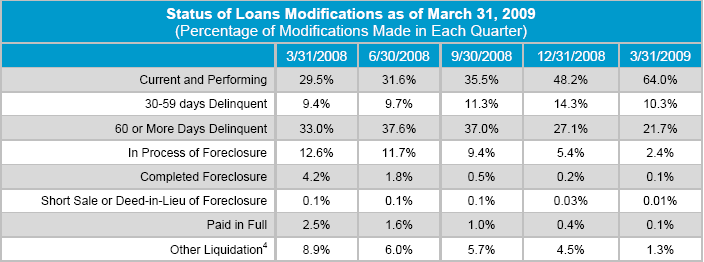
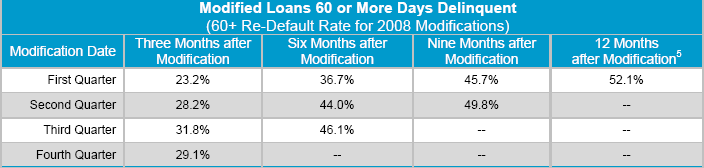
  • Modifications that reduce payments have lower delinquency rates over time. Although delinquencies on modified loans increased each month following modification, delinquency rates were considerably lower for mortgages in which monthly payments were reduced. Six months after modification, only 24 percent of the mortgages that had monthly payments reduced by 20 percent or more were 60 or more days past due, compared with 54 percent of mortgages with monthly payments left unchanged, and 50 percent with higher monthly payments.
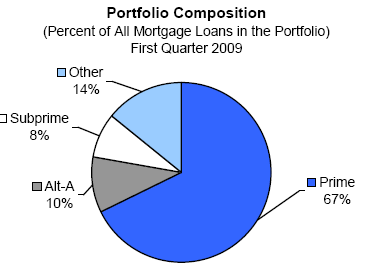
  • Seriously delinquent mortgages increased. Seriously delinquent mortgages (60 or more days past due or involving delinquent bankrupt borrowers) increased as economic pressures continued to weigh on homeowners. Prime mortgages, which represented two-thirds of all mortgages in the portfolio, had the highest percentage increase in serious delinquencies, climbing by more than 20 percent from the prior quarter to 2.9 percent of all prime mortgages.
  • Foreclosures in process increased. Foreclosures in process also increased during the quarter to 844,389, or about 2.5 percent of all serviced loans, as moratoriums on foreclosures expired during the first quarter. This increase represented a 22 percent jump from the previous quarter and a 73 percent rise from the first quarter of 2008.

Data also showed a continuing emphasis on preventing avoidable foreclosures to keep families in homes and mitigate losses, as servicers continued to implement more home retention actions (loan modifications and payment plans) than home forfeiture actions (foreclosures, short sales, and deed-in-lieu-of-foreclosure actions). Prime borrowers received about twice as many home retention actions as home forfeiture actions, while subprime borrowers received more than seven times as many.

The report covers the performance of 34 million loans totaling more than $6 trillion in principal balances from the beginning of 2008 through the end of the first quarter of 2009. The impact of the increase in modifications, particularly those with reduced monthly payments, will be seen only in future data.

OCC and OTS Mortgage Metrics Report

Inquiring minds are also digging into the 42 page OCC and OTS Mortgage Metrics Report

Home Retention Actions: Loan Modifications and Payment Plans

Increased emphasis on loan modifications drove an overall increase in home retention actions, as shown in the table below. Newly initiated loan modifications reached 185,156 during the quarter— rising by 55.3 percent from the previous quarter and 172.3 percent from the first quarter of 2008. The impact of this increase in modifications on reducing foreclosures and enabling borrowers to remain current on their loans will only be seen in future data. Likewise, modification data through the first quarter do not reflect the impact of the Administration’s “Making Home Affordable” program, which was announced in March and began to be implemented after this reporting period.


Modifications during the first quarter of 2009 resulted in lower monthly principal and interest payments on 54.1 percent of all modified loans, as servicers focused on achieving more sustainable mortgage payments. The percentage of modifications that reduced payments by 20 percent or more increased to 29.3 percent of all modifications made in the first quarter of 2009, up 19.2 percent from the previous quarter. Modifications that increased monthly payments declined to 18.5 percent of all modifications during the quarter, down from 25 percent in the fourth quarter and 33.5 percent in the third quarter. Actions that left payments unchanged increased slightly to 27.3 percent.

New to this report are data on the types of actions taken to modify loans. Nearly two-thirds of modifications were “combination modifications” that involved two or more changes to the terms of the loan. Capitalization of delinquent interest, fees, and advances, combined with interest rate reductions and extended maturities were the predominant combination of modifications made during the first quarter. Interest rate and payment freezes, principal reductions, and principal deferrals were less prevalent. Of the 185,156 mortgages that were modified in the first quarter of 2009, 70.2 percent included a capitalization of missed payments and fees, 63.2 percent reduced the interest rate, and 25.1 included an extended term. By comparison, 12.6 percent of the mortgages received modifications that froze the interest rate, 1.8 percent included a reduction of principal, and 1.1 percent included a deferral of principal.

Status of Loans Modifications as of March 31, 2009
Re-Default Rate for 2008 Modifications
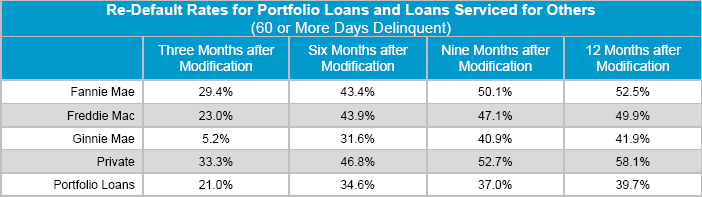
Re-Default Rates for Portfolio Loans and Loans Serviced for Others
Overall Mortgage Portfolio
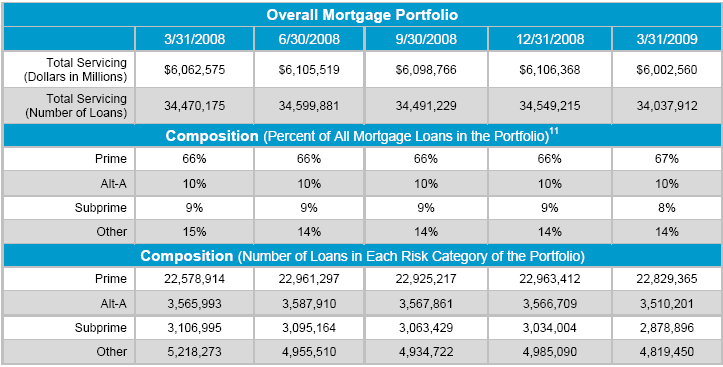

Portfolio Composition
(Percent of All Mortgage Loans in the Portfolio) First Quarter 2009
Damning Report

This is a damning report on the success (or lack thereof) of the mortgage foreclosure workout programs to date. Redefault rates are near 50% after Fannie/Freddie loan modifications. Of course Fannie and Freddie can grant bigger loan mods (and probably will), but taxpayers will have to eat the cost.

Private loan mods are redefaulting at a stunning 58.1% rate 12 months after modification. Can those people redeafulting can afford ANY payment? Even if they can, the incentives to walk away are enormous.

Certainly those out of a job are unlikely to be able to afford any payment, and the unemployment rate is soaring.

Prime Loan Math in Dollars


Moreover note that 67% of loans are "Prime Loans". Prime mortgages 60 days or more past due climbed to 2.9 percent of such loans through March 31 from 1.1 percent at the same point in 2008 according to the report.

Total Servicing is $6 Trillion. $4 Trillion of that is "prime". 2.9% of that is 60 days late or worse. 2.9% of $4 Trillion is $116 billion. And that ignores the problem in Alt-A and Pay Option ARMs.

Prime Loan Math in Units

There are 22.8 million prime loans. 2.9% of that is 661,200. That's a lot of potential housing supply.

Jobs Are The Key

Unless the job market quickly improves, expect those numbers to soar. Here's a hint: the job market is unlikely to significantly recover for years.

This was a very damning report on the state of housing.

By Mike "Mish" Shedlock
http://globaleconomicanalysis.blogspot.com

Click Here To Scroll Thru My Recent Post List

Mike Shedlock / Mish is a registered investment advisor representative for SitkaPacific Capital Management . Sitka Pacific is an asset management firm whose goal is strong performance and low volatility, regardless of market direction.

Visit Sitka Pacific's Account Management Page to learn more about wealth management and capital preservation strategies of Sitka Pacific.

I do weekly podcasts every Thursday on HoweStreet and a brief 7 minute segment on Saturday on CKNW AM 980 in Vancouver.

When not writing about stocks or the economy I spends a great deal of time on photography and in the garden. I have over 80 magazine and book cover credits. Some of my Wisconsin and gardening images can be seen at MichaelShedlock.com .

© 2009 Mike Shedlock, All Rights Reserved

Mike Shedlock Archive

© 2005-2010 http://www.MarketOracle.co.uk - The Market Oracle is a FREE Daily Financial Markets Analysis & Forecasting online publication.


Comments


Post Comment (Moderated)


(Note Commenting Issue: If after Submitting you are returned to the Main Index Page then due to site caching your comment has not been accepted. Solution - Click the Browser Back Button to the article page and Press PAGE REFRESH (you should see the message "You are not authorized to carry out this operation") Now re-enter your comment (ignoring the notice) - If all's well then you will remain on the article page after submitting, a moderator will check and authorise the comment. Alternatively EMAIL to comments @ marketoracle.co.uk , quoting the article number.

FREE Deflation Survival GuideFREE Updated 118 Page Independant Investor E-book