


Global Credit Cycle Crunch
Stock-Markets / Credit Crunch Jun 18, 2007 - 12:19 PM GMTBy: Captain_Hook
 Is a credit cycle crunch about to befall global finance? There are those who would argue that although mature Western economies could certainly feel the pinch if credit trends begin to reverse, Eastern economies are immune from such considerations with growth prospects for the area still so robust. And you need to realize a great many investors have their portfolios aggressively positioned with this belief in mind, having thrown all sense of caution to the wind. What's more, it should be realized what we will call ‘complacency' has now gripped the investing public and their professional money managers like never before, primarily predicated on the belief portfolio insurance schemes disingenuous bankers sell them will actually protect assets in the end.
Worried about counter-party or market risk? Well, wouldn't you know it, so is your friendly banker who would be more than happy to sell you ever-increasing varieties of insurance in this regard. And man are they selling a pile of this brand of insurance these days, where for the banker, he doesn't worry about paying out on claims because he knows the Fed is keeping the system well liquefied , and is assuming premiums are as good as money in the bank.
Not surprisingly then, bankers are also not worried about all the derivatives they sell against potential stock market weakness either, where again, history has taught them to expect persistently buoyant prices as long as the Fed is doing it's job. And according to the Fed, this job is to provide ‘price stability', and in this regard it appears they are doing a stellar job to surface dwellers. Here, hedge fund managers don't mind paying for this insurance because they know the gains from leveraged portfolios will dwarf such costs of doing business. So you see these are the guys buying most of the puts on the S&P 500 , not bearish speculators and / or small investors. Most of these guys were all handed their heads long ago, which is why you don't hear many market pundits talking in such a fashion anymore. In fact, it's just the opposite, where even venerable market mavens the likes of Richard Russell have finally been swayed over into what we will dub the complacent camp. Here, the assumption is a rising tide of liquidity is all that matters, and that it will keep rising to infinity.
So to me, this signals we are very close to an end of the madness, if not right on fate's doorstep in a relative sense. That is to say, it's my opinion we are very close to a popping of the larger credit bubble, as it were. Does this mean prices will collapse tomorrow, given growth of the global monetary system depends on a continually rising tide of credit? No, such a development would not mean prices would necessarily collapse right away. Why is this? In breaking things down into component parts, because in theory monetary authorities still have a more aggressive brand of hyperinflation to let loose on us within the larger ‘liquidity cycle', which must be differentiated from the credit cycle. In terms of focusing on what still appears to be a functioning credit cycle for now however, we would like to borrow from Kevin Duffy in his latest excellent must read on the condition our condition is in, where he in turn borrows from famed Austrian School economist Ludwig von Mises , warning, “There is no means of avoiding the final collapse of a boom brought about by credit expansion.” And in furthering this understanding in terms of the hypothesis we are in fact very close to such an occurrence on a global scale, we also offer the following in quoting Von Mises further, which we present in graphic form due to it's importance in arriving at a larger understanding of why days are number for the current global credit cycle.
"The dearth of credit which marks the crisis is caused not by contraction but by the abstention from further credit expansion. It hurts all enterprises - not only those which are doomed at any rate, but no less those whose business is sound and could flourish if appropriate credit were available. As the outstanding debts are not paid back, the banks lack the means to grant credits even to the most solid firms. The crisis becomes general and forces all branches of business and all firms to restrict their activities. But there is no means of avoiding these consequences of the preceding boom.
"Prices of the factors of production - both material and human - have reached an excessive height in the boom period. They must come down before business can become profitable again. The recovery and return to "normalcy" can only begin when prices and wage rates are so low that a sufficient number of people assume that they will no drop still more."
And while the above understanding may mean little to those who believe the credit cycle in the East still has miles to go , and that nothing else matters despite the fact even ‘high flyers' within the current establishment view our condition as being in a state of ‘stable disequalibrium' (quoted from Bill Gross of Pimco) at best; perhaps a better view of global finance today is Asia's growth should not be viewed in isolation, as Doug Noland points out in his latest edition of the Credit Bubble Bulletin . What's more, and again, borrowed from the attached, if the future is so bright we should all be wearing shades, then why does agency debt in the US need to be expanded at a mind-boggling rate just shy of 40-percent, which is hyperinflationary rate? And why all the increasingly large private equity deals, which is in fact de facto money creation not properly accounted for within monetary aggregate measures? At what rate is the money supply really growing with all this unaccounted for stimulus factored into the equation? And what's going to happen when the urge to merge and all these private equity deals begins to slow, which is likely not too far off considering the largest companies in the world are already in play?
All good questions, which we will attempt to deal with in further detail below this week if time allows. In general terms however, the abundance of private equity deals is in essence an indication US securities markets are already being heavily monetized. Naturally then, the next question logic prompts is if things are so damn good in the economy these days, which is the general consensus amongst politicians and business leaders, why does the stock market need to be monetized at an increasingly aggressive rate, with private equity deals for 2007 already 60-percent above last year's totals? And then of course we could move over to the other side of the ledger along this line pf questioning, where again, if things are so good, then why must governments all over the world keep monetizing US debt requirements at an ever-increasing pace? And then, what is undoubtedly the most important question along these lines, what would happen if foreign support of US debt markets were to fade dramatically, where as pointed out last week , the biggest risk to US stocks is not from within directly, but from its trading partners, the central quote attached for your convenience, as follows:
“What could pop the bubble in stocks now? How about the very real threat of protectionist tones developing between China and the States – that's as good an excuse I can think of to start selling stocks before heading to the Hamptons this summer. Is the smart money getting short right now just prior to this story breaking, providing ‘good reason' to sell both US and Chinese stocks? One thing is for sure; it wouldn't be surprising knowing the players involved. Be that as it may however, and on a higher level, one should realize it does not matter what event(s) are credited with popping stock market bubbles in the end, as technical / market internal conditions are finally coming in line with fundamentals, which should catch the majority of trend followers ‘flat footed'.”
As you can see in the above quote then, not only is it important to understand there is a risk of foreign US debt purchases slowing further due to the Chinese becoming increasingly annoyed with American politics, which perhaps accounts for skittishness already showing up in the debt market , we also have the risk Chinese authorities pop their own equity bubble , which would of course send ripples around the world in foreign stock markets, commodities, derivatives, and potentially in the ability to issue credit on a sweeping scale as economic activity slows. In this respect you may remember our comments last week, where it was pointed out that like US authorities at earlier junctures in their coming out party embracing an unbridled non-gold monetary world, it was the official tinkering of inexperienced officials that ultimately popped the global bubble de jour in 1929, and that we would not be a bit surprised at a repeat this time around on the part of Chinese authorities. Sure enough, after the close of business overseas for the week, Chinese officials announce yet another set of official actions, where they are both tightening the screws (interest rates) at home, and loosening the goose (currency trading bands) abroad, in an effort to slow down the speculation in stocks and lending practices.
And although this announcement has so far received a big yawn from Western stock markets as they appear able to shake off any bad news these days with all the loose credit available, let me assure you that one of these days such measures will work, and just when one would not expect it to boot, like in the third year of a Presidential Election cycle, with stock markets still cheap to some who consider current earnings as being sustainable even though it now takes a full four dollars of debt to generate one dollar of GDP growth in the States. Here then, the important thing to realize is if not now, but for the reasons cited above, not long from now, the growth of unsustainable imbalances is halted, along with the resultant creation of ever-increasing bubble economies, when something pops in China, no matter how much insurance investors have on their portfolios, it won't be enough. In this respect, the one ‘key' variable you want to keep your eye on for the signal an unwinding is in progress is the Japanese Yen, because once it starts to rise in earnest, indicating the cheap leverage is being collapsed, things could spiral out of control very quickly. In this regard, below is a ‘big picture' view of the Euro against the Yen (meaning a rising ratio indicates a falling Yen), where up until recently European stocks were the preferred bubble market destination of the developed (Western) world. As you can see, this chart shows more upside is still in the cards based on the observation the dominant Fibonacci resonance signature still has another 10-points to rise before the measure is fully traced out. (See Figure 1)
Figure 1
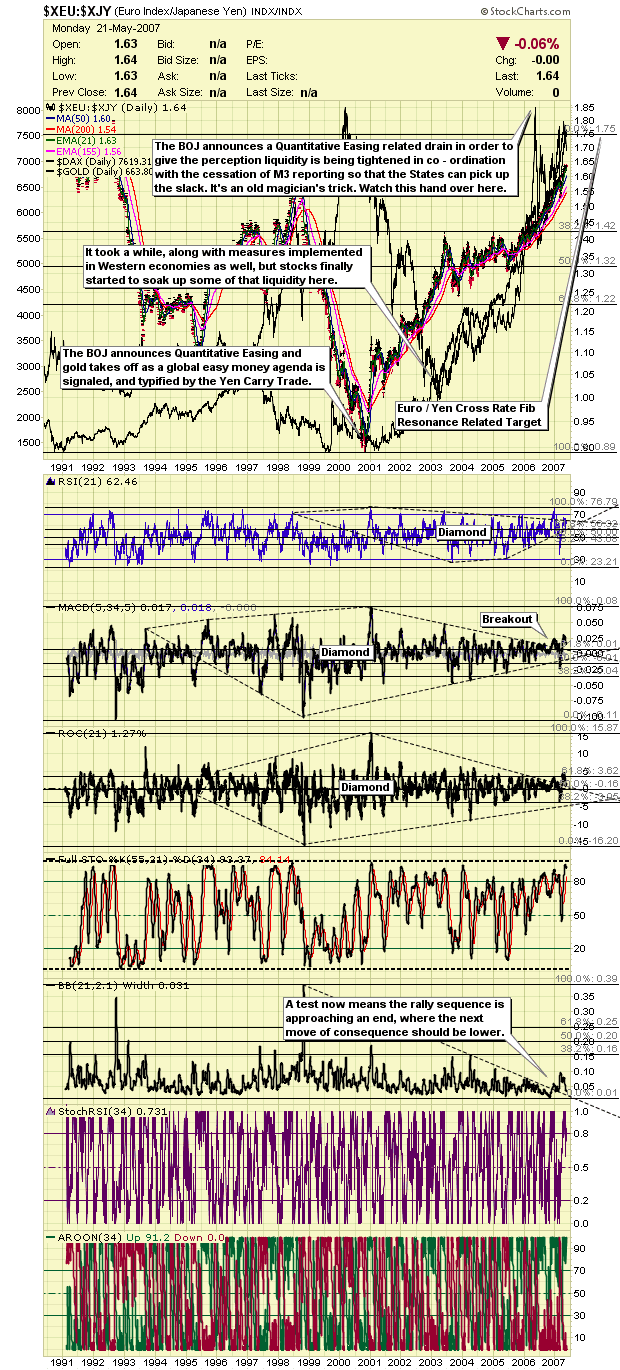
Does the Fibonacci resonance related signature shown above necessarily need to be fully traced out? Answer, definitely not, which is why plots of both gold and the DAX are superimposed in providing an appropriate ‘big picture' view. Here, not only can you see how closely all three are correlated, each essentially in lockstep with the other in a manic ascent, but in knowing this then, one should also realize that if one falters, like gold is threatening to do now, that all three are in jeopardy of making meaningful reversals in coming days, weeks, or months. Moreover in this regard, it's important to understand such reversals will occur at some point no matter how high prices go in the interim, and that the entire ‘bubble episode' will be retraced. Thus, from this perspective the sooner this occurs the better. But of course one should never underestimate another man's greed, or stupidity, meaning manic moves are best respected; where again, based on the Fibonacci signature present in the trade shown above, we suggest that if you are in the process of buying some insurance for your portfolio based on last week's discussion, you take your time about it, if not abstain from such activities all together until market internals are more supportive of such activities. This is why we have pulled the link to the Short Portfolio that was put up last week, as it now appears stocks could get squeezed substantially higher from here.
If this is the kind of analysis you are looking for, we invite you to visit our new and improved web site and discover more about how our service can further aid you in achieving your financial goals. For your information, our new site includes such improvements as automated subscriptions, improvements to trend identifying / professionally annotated charts , to the more detailed quote pages exclusively designed for independent investors who like to stay on top of things. Here, in addition to improving our advisory service, our aim is to also provide a resource center, one where you have access to well presented ‘key' information concerning the markets we cover.
On top of this, and in relation to identifying value based opportunities in the energy, base metals, and precious metals sectors, all of which should benefit handsomely as increasing numbers of investors recognize their present investments are not keeping pace with actual inflation, we are currently covering 61 stocks within our portfolios . Again, this is another good reason to drop by and check us out.
And if you have any questions, comments, or criticisms regarding the above, please feel free to drop us a line . We very much enjoy hearing from you on these matters.
Good investing all.
By Captain Hook
http://www.treasurechestsinfo.com/
Special Note: Apologies for the restricted links but there is no way we can open them up just for this article.
Treasure Chests is a market timing service specializing in value-based position trading in the precious metals and equity markets with an orientation geared to identifying intermediate-term swing trading opportunities. Specific opportunities are identified utilizing a combination of fundamental, technical, and inter-market analysis. This style of investing has proven very successful for wealthy and sophisticated investors, as it reduces risk and enhances returns when the methodology is applied effectively. Those interested in discovering more about how the strategies described above can enhance your wealth should visit our web site at Treasure Chests
Disclaimer: The above is a matter of opinion and is not intended as investment advice. Information and analysis above are derived from sources and utilizing methods believed reliable, but we cannot accept responsibility for any trading losses you may incur as a result of this analysis. Comments within the text should not be construed as specific recommendations to buy or sell securities. Individuals should consult with their broker and personal financial advisors before engaging in any trading activities, as we are not registered brokers or advisors. Certain statements included herein may constitute "forward-looking statements" with the meaning of certain securities legislative measures. Such forward-looking statements involve known and unknown risks, uncertainties and other factors that may cause the actual results, performance or achievements of the above mentioned companies, and / or industry results, to be materially different from any future results, performance or achievements expressed or implied by such forward-looking statements. Do your own due diligence.
Copyright © 2007 treasurechests.info Inc. All rights reserved.
Unless otherwise indicated, all materials on these pages are copyrighted by treasurechests.info Inc. No part of these pages, either text or image may be used for any purpose other than personal use. Therefore, reproduction, modification, storage in a retrieval system or retransmission, in any form or by any means, electronic, mechanical or otherwise, for reasons other than personal use, is strictly prohibited without prior written permission.
Captain Hook Archive |
© 2005-2022 http://www.MarketOracle.co.uk - The Market Oracle is a FREE Daily Financial Markets Analysis & Forecasting online publication.
