


Bond Convexity From Mortgages Means Higher Interest Rates
Interest-Rates / US Interest Rates Jun 21, 2007 - 08:04 PM GMTBy: Jim_Willie_CB
 The cancer that is mortgage bonds does not linger in isolation. Everything in the bond world is connected to almost everything in the bond world, at least within the US sphere of speculative madness. The financial credit market is a confusing jumble of speculation, risk reducing hedges, and leveraged insanity found mainly in the hedge fund arena. Mortgages are causing problems from their bond hedge schemes, both on the loan portfolio side and the bond security side. Always one should consider both, and never are they inseparable. The only separable aspect is who the loser is nowadays.
Negative convexity dictates the sale of bond futures in the absent midst of cash flow on the portfolio side, and in hedge book management of losses in the securities (bond) side. The mortgage debacle might be finally hitting the US credit market on a wider scale, despite the claims of no contagion made by corners bereft with common prostitution. Heck, abject liars, carnival barkers, shell game artists, and self-interested promoters might be a better description, so as not to insult prostitutes who offer a worthwhile honest service in the oldest but illegal profession in most societies. A hidden force is this convexity, alluded to by astute bond market students and observers with eyes trained on the Chicago pits.
The deception offered is that the US Treasury Bonds are rising in long-term interest rates because of stronger imminent economic growth. The opposite is true, the reality, the harsh foul breeze founded in unwanted facts. Why the shallow reporting? Because to identify the bond convexity would reveal how it is lined up to deliver a lusty vicious circle of blows likely to inflict round after round of nasty blows to the bond market. The story of stronger growth implies good continuity of corporate earnings, what Wall Street wants you to incorrectly believe. The reality is especially ugly when one notes that borrowing costs are every bit as important as commodity and energy costs for corporations. Falling borrowing costs were the primary driver of the 1990 decade-long stock bull market. Rising borrowing costs might be the main story for the next two years, during the Great Unwind of the Bond Bubble. The other big story is the global revolt against the USDollar and USTBond vehicles which carry the US $ license plates, halted at border crossings. That is not the focus here with this article
THE PURPOSE OF BOND HEDGES
If a mortgage lender has a mountain of mortgage loans in portfolios, the firm will want to hedge against the FALLING interest rate. Believe it or not, a lending institution is harmed by falling rates, since their interest yield income is reduced by bond held, and since lower interest income is integrated within the newer contracted mortgages. A refinance is actually a major headache for lenders, closing out a contract and replacing it with one promising the lender a lower return on the loan. The smiles at the loan originator office are connected to the origination fee earned, NOT the lender dealing with turnover.
So the lender will match the loan portfolio, dollar for dollar, with a similar volume of US TBonds. A falling bond yield scenario will hurt the lending business side from business losses, but benefit the hedge in the form of long USTBond futures from contract gains. Some firms less prone to the wild side will work with actual USTBonds on the cash market. However, since much less money is required on the futures contract side, most tend to deploy leveraged futures contracts, figuring they are smart and nimble enough to walk through raindrops. They also impress management by diverting a smaller amount of valuable corporate funds in the hedge, deemed efficient.
The hedge is rate neutral, thus the name of ‘hedge' associated. Hedge funds long ago were hired to eliminate risk. Over time, typical of US insanity, hedge funds decided to sell accounts in the management of gigantic leveraged risk games which dwarf casinos. The world's largest casinos are located in New York City (Wall Street, NYMEX) and Chicago (COMEX). The entire USEconomic financial system can at times be depicted as a hedge fund, rising the fortunes with high leveraged contraptions. The victims are little things like your pension fund or life savings or sale of an asset held for most of a lifetime.
Things go wrong when interest rates rise. The lending institution sees the worst of both worlds, instead of a neutralized state of affairs. Their loan portfolios suffer delinquencies (reduced immediate income), defaults (assured reduced future income), and foreclosures ($80k loss per property, no more income forever). Their bond hedges go into leveraged losses. A typical USTB contract involves 30-to-1 leverage. So a 5% loss on the bond principal (in held asset or underlying derived asset) can wipe out the entire initial quantity devoted to the hedge. The loss from the 108 level to the 105 level constitutes almost a 3% loss suddenly. Given the leverage (remember the EFFICIENT hedge), the hedge has been just about wiped out!
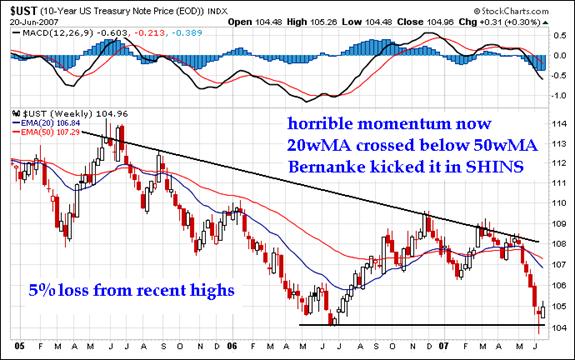
To compound the problem, the lack of new loans hurts the cash flow. The thin volume of refinances also hinders the cash flow. The lending firm needs cash to fund its operations. The salvage process of hedge sales can help to raise valuable cash. That is the source of the VICIOUS CIRCLE though. The unwinding process aggravates the situation tremendously. Everybody loves the leverage when it pushes rates down, like it did in 2003, 2004, 2005. Those days are over. Next comes the hangover from the Greenspan Animal House drunken bacchanalia celebrated as banking policy management. His only brilliance was leaving Dodge City and handing Sheriff Ben the bag. The effect of this latest round will be further bond hedge sales soon, which take long-term rates toward 5.5%, then toward 6.0%, perhaps higher. Should rates meander up to the actual consumer price inflation 10% rate?
The next few months will see continued horrendous stories about panicky collateralized bond sales. Reports emanating from Bear Stearns dominate so far. They are called isolated, until they become undeniable in their systemic nature. Look to hedge fund blowups also. They are the primary knuckleheads in the bond speculation game gone bad. They really should be required to don propeller hats when showing up at the office, especially when meeting with clients.
THE VICIOUS CIRCLE
As bond hedges are sold, leverage applies to lift long-term interest rates. In the single week of June 15th, the 30-year fixed mortgage rate rose 20 basis points to hit 6.74% in a punishing blow. The 10-year USTNote bond yield rushed toward 5.25% and 5.30%, urged higher by European markets, dampened lower by US markets the next morning, day after day. The microcosm is the bond market. Its extension is the stock market, greatly dependent upon the low bond yield to encourage investment in stocks which promise higher earning yields of return than bonds. The macrocosm is the USEconomy, where consumers retrench, where corporations rein in capital expenditures, and not incidentally, where lending institutions go bust and shutter operations. Get back to me when the only bankrupted such firms are the subprimes. What a lie, one in a long list of lies, and if not pure deception, then shallow analysis. The participants in hedge schemes are all across the entire financial sector, from small and medium and large banks and mortgage firms, to small and medium and large banks and capital management firms.
Each quantum step up in long-term interest rates generates a new round of business decisions, to assess the effectiveness of the bond hedges, to rejigger the actual hedges still on the books, to judge the needed cash flow, to make urgent decisions for survival of businesses, and to plan for lawsuits against broker dealers on Wall Street. The VIRTUOUS CIRCLE a few years ago saw steps in what were called ‘new rounds of refinancing' by Secy of Inflation Sir Alan (Magoo) Greenspan, chief alchemist and designated charlatan, protector of bankers and scheister to households, mythology spokesman of politicians and shylock to homeowners. NEXT COMES THE VICIOUS CIRCLE, whose end is not determined. In the first couple weeks of June, we finally saw the TNX move above the 5.0% mark, which will surely serve as the new support level for long-term bond yields. The TNX resistance is at 5.25%, which when exceeded, will lead to a surprising and gut-wrenching move to 5.5% or higher in the long-term bond yields.
Remember, economists and financial firm analysts do not care about correct forecasts. They strive to produce credible forecasts, the basis for promotional programs, glossy leaflets, and advertisements stated during media interviews. They do have nice dresses and suits. That is why they continually shift their story to focus on the next half of the year. They perpetuate their errors, managing credibility, doling out the lies.
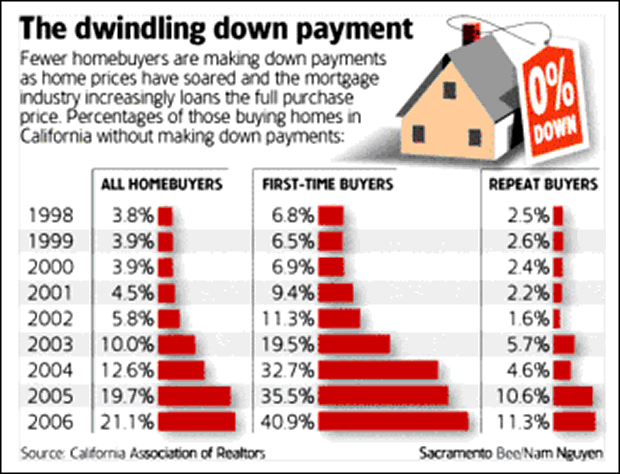
The degree of risk to lenders, both in portfolios and collateralized bonds, is enormous. Risk has never been so great in bonds since 1973, 1974, 1975. That is the onliest similarity to that 1970 decade in my book, as the commodity story is the exact opposite. Demand drives higher prices in this decade, whereas OPEC demanded higher prices back in the 1970 decade. The common thread to the contagion spreading across bonds is the lax lending across numerous classes of loans to numerous types of borrowers. Here is an example of the depth of insanity, which continued into 2006. In the last calendar year, over 40% of California first-time buyers used no down payment in the purchase of their new nestegg homesteads, as in 0% equity out of the gate. Across the state, among all home buyers, over 21% used 0% down payment loans. The lenders associated, and the bond holders who were suckered into investing in related tranches, they will be even more pressed to hedge their acidic investments. Let's not even touch upon the mortgage resets. Is it painfully clear that the bond bubble spawning the housing crisis and mortgage debacle has numerous facets???
THE BANKERS STOCK INDEX
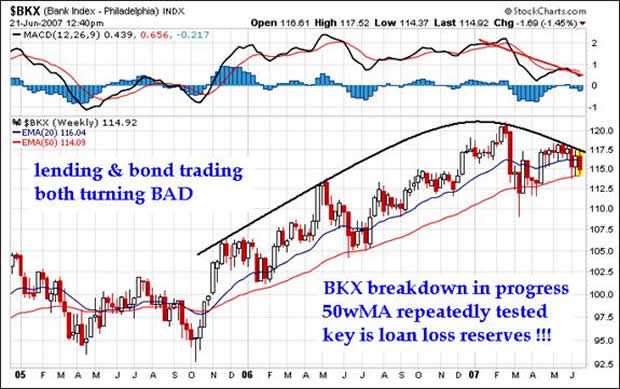
Convexity in hedged risk management produces leveraged bond futures sales, doing great harm to bankers. Their chief operation is not lending, but gambling, errr speculating at trading desks, managing the arbitrage game in the Wall Street and Chicago casinos. The distress in the BKX banking stock index only begins to tell this story. This will continue. They finally will have a chance to lend at long rates and borrow themselves at short rates, enough to provide an actual profit margin. For two years, this group has reported heavy lending losses, huge trading gains, and solid net profits. Their story is in the process of profound change. The BKX index is struggling mightily to stay above the 50-week moving average. So far it is faring relatively worse than the overall S&P stock index, as shown in the June report posted for the Hat Trick Letter. Note the rounded top and breakdown in progress.
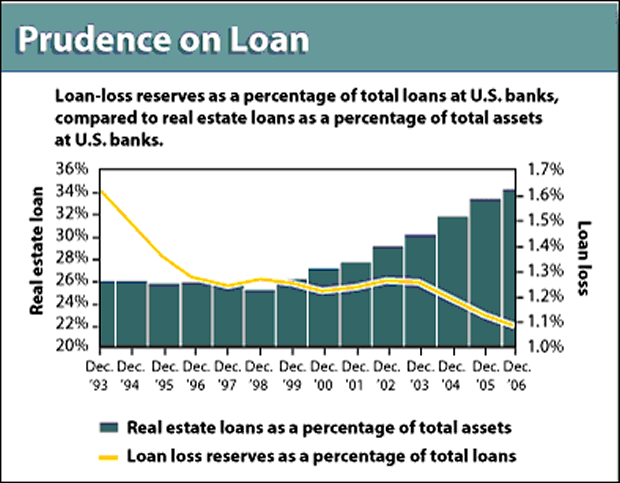
Bankers will be forced to report losses from lending operations, since their loan loss reserves are woefully inadequate. As the proportion of loans tied to real estate grew versus overall loans, they decided to devote a piddling amount, less each year in fact, to loan loss reserves. As realized losses come to a boil (imagine a kettle with water or a blemish filled with puss), look for more loan loss reserves from funds set aside, doing great harm to corporate profits. Bankers have taken hefty stock options, just like the rest of the white collar bandidos, reluctant to set aside much lately. To do so would have reduced stated earnings!
USFed Chairman Bernanke threw a wrench in the entire bond engine works. His message in early June was quite clear. No official interest rate cut is likely in the foreseeable future. One can quickly infer that the USFed will defend the USDollar, not housing. The problem for the USFed is that housing will enter the next phase of decline, and take the USEconomy into an undeniable recession. The immediate problem is the bond market modification. With no rate cuts coming, the bond market has been forced to adjust on the low-end maturities in direct response to a slower economy. Forecasts probably changed overnight to anticipate some continued USEconomic slowdown without the needed stimulation. Rising long-term rates were addressed, at least the confusing elements identified, in last week's article. Bonds throughout the entire USTreasury spectrum must adjust to a more salty reality. The story not properly reported is how short-term interest rates are actually coming down, ADDING to pressure on the US Federal Reserve to cut official interest rates.
HEAVY COLLUSION FROM RATING AGENCIES
The mortgage bond world might not be so easily contained through vested interest collusion. The ratings agencies (Moodys, Fitch, Standard & Poor) and broker dealers have a wink system to prevent debt downgrades, with tremendous conflict of interest at work. These three firms are sitting on their hands or asleep on the job, in a vise of their own relationships. They have failed to respond to delinquencies and foreclosures which have a direct bearing on collateralized bond performance. Big downgrades might be imminent, just around the corner. Delinquencies, defaults, and foreclosures in recent months have seemed not to matter to the price structure of asset-backed bonds such as mortgage bonds, to the mystery of many experts. Income from loan performance is vividly clear. The collusion is ugly. The vested interest of ratings agencies is obvious. They do not receive full payment for services if their customers deem the ratings to be unfair. Or is it they don't pay out if the agencies do harm to their clients or their issuance process? Even the rating agency heads are making disclaimers, as they deny their impartiality and any charter for disclosure.
The big banks are unloading damaged mortgage bonds to their hedge fund clients. They are doing so quietly, probably at heavy discount, with the assured purpose of preventing big declines in the bond principal value. Such cuts in price do not see the light of day, observed by the public or most investment circles. These acidic mortgage bonds are being levitated in value, as their owners seek suckers to buy them before the rating agencies lower the boom. My guess is the agencies will be told when to issue the cascade of debt downgrades, only when the banker customers give the green light on finding hapless pension funds and mutual funds to buy the garbage. Bear Stearns is on the campaign trail trying to pitch their acidic assets to the institutions. They are junk bonds masquerading as high grade investment grade bonds. The key here is maintain investment grade, so that large institutions are kept from selling en masse. That event is certain.
SYSTEMIC RISK & US DOLLAR & GOLD
The risk so deeply engrained within mortgages seems finally to have crept into USTreasury Bonds. Since USTBonds are no longer acting in a contained fashion, the vulnerable mortgage bond holders are reacting. All the above problems have an additional dynamic to deal with, that being mortgage bond holders react to their own situations. The claim of no ‘CONTAGION' from the mortgage debacle is pure poppycock propaganda drivel denial nonsense. The avenues of contagion are too numerous to cite. The effect of higher long-term rates has created a vicious circle, whereby mortgagors and owners of mortgage backed securities react again and again to higher further rising long-term rates, selling more USTBonds and their derivatives.
There is the key word, credit derivatives. These heavily leveraged instruments are connected to everything, as described in the May Special Report for HTL readers. There is no need for a 50% annual rise in credit derivatives if all things are placid, within normal bounds, all well on the bond front. Things have already begun to unravel, and soon things will noticeably appear to unravel above the surface. THIS CREDIT DERIVATIVE RISK SEEMS BADLY MISJUDGED BY BERNANKE AND THE ELVES AT THE USFED. They have been minimizing the threat for over a year like either idiots or amateurs. JPMorgan and Goldman Sachs are keenly aware of the threat, since they manage the upside down pyramid of derivatives.
My conjecture is that JPM and GSax are active agents in the convexity trades to sell their mortgage hedges placed in USTBonds, along with Fannie Mae & Freddie Mac. The Wall Street firms are on the job selling bonds and related futures contracts. Morgan Stanley has already warned its clients. They assess that the US housing slump is far more serious than widely believed. They expect a potential full-scale global crisis, since US mortgage bonds and Fannie Mae bonds are so widely held among foreign banks. The US might not export much, but inflation and acidic bonds surely are exported in droves.
Higher interest rates do attract more investments. That is the USGovt story on stability claims for the USDollar. Corporate earnings are slowing down, the exact opposite of the Wall Street story. They promote the story to claim that rising earnings will offset rising bond yields which affect stock valuations. They overlook that borrowing costs are an integral portion of the corporate cost structure. Rising interest rates are the important phenomenon, rendering stocks overvalued, delivering shock waves.
As interest rates rise, investments find gold, lifting gold demand. The reality of 10% consumer price inflation is not properly told. That is the reality, as explained by the Shadow Govt Statistics folks, who eliminate gimmicks and chicanery from statistical calculations, whose motive is truth and not painting a deceptive rosy picture. The conflict of interest in almost every conceivable USGovt agency is staggering, obvious, and a grand undermine.
GOLD HAS THRIVED IN ALMOST EVERY PERIOD WHERE LONG-TERM INTEREST RATES RISE. This time is not much different. The primary risk pertains to liquidity drains, the sea pulling water away from shores, and accidents sure to demand asset sales in times of emergency to desperate funds, both hedge fund and institutional players. As the banking crisis continues, gold will thrive. Recall that 40% of all US bank assets are related to mortgages. The USDollar will be repeatedly tarnished with a brush, enough to make it fade below the critical DX=80 support. As the credit derivative crisis continues, gold will thrive. A systemic problem is gradually becoming obvious. As price inflation and general systemic risk become more clear, gold will thrive.
Foreign USTreasury Bond holders have two risks. Their bond principal is falling, tied to rising bond yields. The USDollar translation has been damaging in recent years, and in recent months. The claim of higher long-term yields attracting foreign investments is true ONLY for new bond issuance. Given that current foreign ownership is a million times larger , this is an empty truism. Gold is prepared to rise in the second half of this year, during its favorable season. The main storm cloud on the golden horizon is the planned sale of 250 tonnes of gold bullion by the corrupted Swiss National Bank, once a paragon of discipline, wisdom, and leadership. They plan to dump this gold in the many months up to 2009 in what they describe to be a currency reserves adjustment. One can only wonder what the powers that be, or the Euro Central Bank, offered them in return. Perhaps a bigger seat at the table.
Thanks to Joe Martin and the Cambridge House staff for another fine gold & metals conference in Vancouver (HongKouver). What a pleasure! What a great gang of people! What excellent speeches, the most memorable to me being by Frank Holmes and Rick Rule. Good chocolates too, but not enough eye candy!
THE HAT TRICK LETTER PROFITS IN THE CURRENT CRISIS.
From subscribers and readers:
“I want to congratulate you and thank you for your quick and frankly stated revision on bonds [the 4.0% forecast]. That was my thinking all along, but I must say that your writing was and continues to be a most valuable input to my thinking in the first place. That type of integrity makes me value your opinion all the more and is likely to keep me as a loyal subscriber for years to come.” (ScottD in Pennsylvania )
“I am staggered by the depth and breadth of the information I now have access to in your newsletter. Just one problem, I cannot put my computer down. Reading your current reports and catching up on earlier editions you make available in your ‘library' is dominating my mornings, afternoons and evenings!” (DavidR in England )
“I believe your wit and disgust at the state of affairs stand untouched.” (Charlie P in Virginia )
“I am currently subscribed to over 60 paid newsletters. Your analysis is by far the most accurate every time. The most impressive characteristic of your thought processes is your ability to think in multi-factorial terms. You are one of the few remaining intellectuals with such capacity intact.” (Gabriel R in Mexico )
By Jim Willie CB
Editor of the “HAT TRICK LETTER”
www.GoldenJackass.com
www.GoldenJackass.com/subscribe.html
Use the above link to subscribe to the paid research reports, which include coverage of several smallcap companies positioned to rise like a cantilever during the ongoing panicky attempt to sustain an unsustainable system burdened by numerous imbalances aggravated by global village forces. An historically unprecedented mess has been created by heretical central bankers and charlatan economic advisors, whose interference has irreversibly altered and damaged the world financial system. Analysis features Gold, Crude Oil, USDollar, Treasury bonds, and inter-market dynamics with the US Economy and US Federal Reserve monetary policy. A tad of relevant geopolitics is covered as well. Articles in this series are promotional, an unabashed gesture to induce readers to subscribe.
Jim Willie CB is a statistical analyst in marketing research and retail forecasting. He holds a PhD in Statistics. His career has stretched over 24 years. He aspires to thrive in the financial editor world, unencumbered by the limitations of economic credentials. Visit his free website to find articles from topflight authors at www.GoldenJackass.com . For personal questions about subscriptions, contact him at JimWillieCB@aol.com
Jim Willie CB Archive |
© 2005-2022 http://www.MarketOracle.co.uk - The Market Oracle is a FREE Daily Financial Markets Analysis & Forecasting online publication.
