


Gold GLD ETF Impact
Commodities / Gold & Silver 2009 Nov 20, 2009 - 11:23 AM GMTBy: Zeal_LLC

 Five years ago this week, an obscure little ETF called StreetTracks Gold Shares was born. As the first American ETF enabling stock traders to gain direct price exposure to a physical commodity, GLD was truly revolutionary. Now known as SPDR Gold Shares, this ETF has proven to be a smashing success.
Today GLD is the second largest ETF on the planet, behind only SPY which tracks the flagship S&P 500 stock index. GLD now holds a staggering 1117 metric tons of physical gold bullion in trust for its shareholders, which was worth $41.3b this week! This “people’s central bank” fueled by stock-trader gold demand has amassed so much bullion it now boasts the world’s sixth-largest holdings.
Today GLD holds more gold bullion than the individual central banks of China, Switzerland, Japan, Russia, Europe, and India! Overcoming some controversy after its introduction, GLD has matured into the juggernaut of the gold world. Through their collective buying and selling of GLD shares, stock traders now have far more influence over daily gold price action than the world’s central banks.
With this still-growing ETF already a force to be reckoned with, no investor or speculator in the precious-metals realm can afford to ignore it. GLD’s impact is broad and expanding, and its trading activity alone can drive the global gold price at times. And where gold goes, silver and the PM stocks inevitably follow. Thus PM traders who fail to stay abreast of GLD’s activity will never fully understand PM price trends.
GLD opened up history’s first direct conduit between gold and the vast pools of capital in the stock markets. In all previous gold bulls, there was no quick and easy way for stock traders to gain gold exposure. They had to either expend the considerable time and effort of learning about gold futures (and opening a new futures-trading account) or suffer steep transaction costs to buy physical coins at high premiums.
These barriers to entry for widespread gold ownership were considerable, as the great majority of stock traders weren’t willing to put in the effort in past bulls. But today, thanks to GLD stock traders can instantly gain gold exposure, at a trivial cost, with a click of the mouse. This has led both institutional and individual stock investors and speculators to funnel capital into gold like never before in history.
GLD’s mission is to track the gold price, and there is only one way to accomplish it. This ETF’s custodians must actively shunt excess GLD-share buying and selling pressure directly into physical gold bullion itself. Unlike the futures-based ETFs and ETNs that have so miserably failed to track their underlying assets in this past year’s volatility, GLD has now tracked gold flawlessly for 5 years running.
Life to date, GLD’s correlation r-square with gold has run an absolutely perfect 99.99%! In terms of price exposure in one’s portfolio, GLD effectively is gold. This isn’t an accident, as no other commodities ETF has even come close to achieving GLD’s flawless tracking. Despite endless incoherent ranting by a few wildly-paranoid conspiracy theorists, GLD could not have achieved this without actually buying and selling real physical gold bullion as advertised.
The real-time supply and demand of GLD shares among stock traders is totally independent of that of gold itself. So if stock traders are aggressively buying GLD faster than gold is being bought, this ETF will decouple to the upside and fail its tracking mission. In order to neutralize this excess buying pressure, GLD’s custodians issue new GLD shares and use the resulting cash to buy physical gold bullion. This mechanism directly shunts stock-market capital into physical gold.
On the other side of the coin, sometimes stock traders are selling GLD faster than gold is being sold. If not immediately addressed, GLD’s shares will decouple from gold to the downside. In order to sop up this excess GLD share supply, its custodians buy back shares to reduce this ETF’s total float. Where does this money come from? The custodians actually sell a fraction of GLD’s physical gold to finance these buybacks. Differential GLD buying and selling pressure leads to capital flowing into and out of gold itself.
Keep this in mind as you digest these charts of GLD’s holdings. When GLD’s gold held in trust is growing, it means stock-trader demand for GLD shares is increasing faster than traditional futures and physical demand. When GLD’s gold is falling, stock traders are selling GLD shares at a faster rate than gold itself is being sold. Because GLD is wonderfully transparent and publishes its holdings daily, charting them offers incredibly valuable insights into how gold demand among stock traders is evolving.
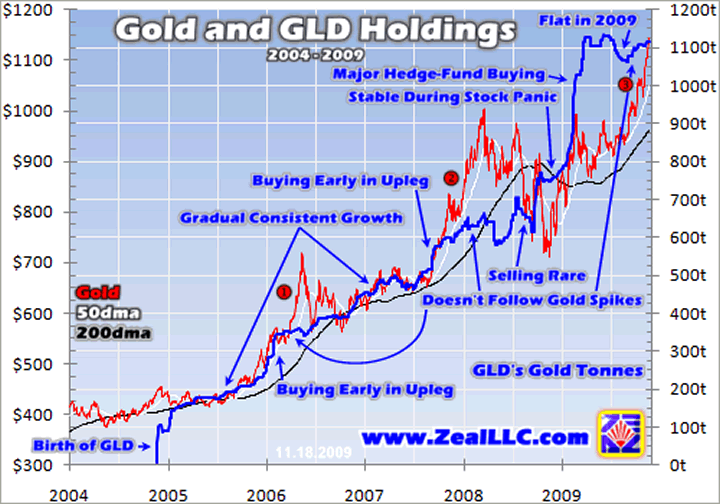
The growth in GLD over its entire lifespan has been impressively gradual and consistent. This ETF has never been a fad. As the powerful secular gold bull continued to unfold, awareness of this metal’s great potential slowly grew among stock traders. And over time more and more discovered GLD as a quick and easy way to gain exposure to the gold price. Thus this ETF’s holdings have gradually grown organically.
While GLD’s holdings have certainly followed gold’s march higher over the years in strategic terms, tactically they have been far less volatile. In early 2006 for example, gold spiked sharply higher yet GLD’s holdings continued to merely gradually grow. There just wasn’t much differential buying pressure on GLD shares because GLD demand expanded at about the same pace as underlying gold demand.
If there is no significant differential buying or selling pressure on GLD’s shares, its holdings remain constant no matter what the gold price happens to be doing. We’ve seen similar behavior in all 3 big gold spikes numbered in this chart, including our latest one in recent months. GLD’s holdings don’t surge rapidly when gold soars to new highs because so far stock-market GLD demand hasn’t rapidly outpaced underlying gold demand during gold’s sharpest moves higher.
Provocatively, the biggest spikes in GLD holdings tend to occur early in major gold uplegs. When gold first starts moving higher again after consolidating sideways, stock traders tend to flood into GLD at a faster rate than gold is being bought which forces its custodians to issue more shares to buy more bullion. But by the time a gold upleg matures to its fast-rallying climax stage, gold demand catches up with GLD demand so this ETF’s holdings remain stable.
It is also fascinating that significant GLD bullion selling is relatively rare. While there often is some differential GLD-share selling pressure when gold is weak, it is fairly moderate as evidenced by the shallow and infrequent dips in GLD’s holdings. This is really impressive to me, as it shows that the stock investors buying GLD are relatively strong hands. Many are in for the long term and don’t get too frightened by periodic gold weakness.
Years before GLD was born, I wrote about how incredibly bullish a gold ETF would be for gold. As history has since proven, it would open up the gold market to vast new pools of capital. And the more money chasing gold, the bigger and longer its bull would be. But opening such a conduit is a double-edged sword, as stock-market capital flowing into and out of gold would lead to a much more volatile gold price.
So one of the main fears before GLD was introduced was that stock-market selling pressure on the ETF would really exacerbate any gold downside. Traditional physical-gold-coin investors like me assumed the stock traders would be capricious and uncommitted, quick to sell. But so far at least, GLD has proven this assumption incorrect. There really hasn’t been much differential GLD selling pressure over its lifespan.
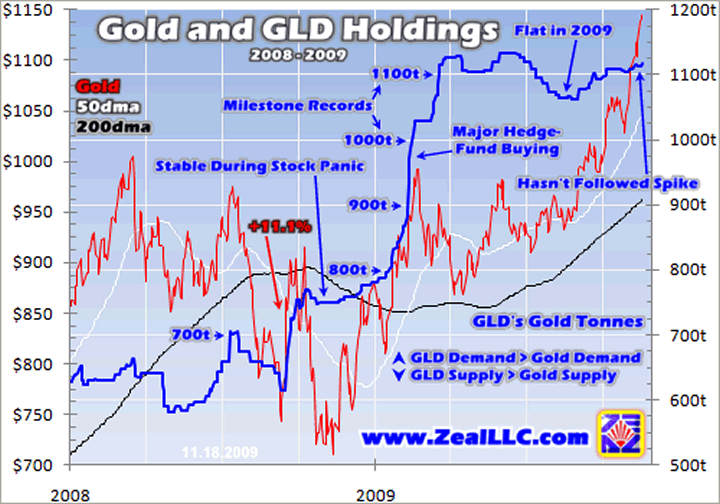
If there was ever a time when all the relatively new stock traders owning GLD ought to have been terrified, 2008 was it. Between the end of that massive early-2008 commodities upleg, the summer bond panic, and the autumn stock panic, the selling pressure in gold was extreme. Heavy differential GLD selling pressure would have wildly increased gold’s downside, but GLD’s holdings remained surprisingly resilient.
In the 6 weeks between mid-March 2008 (a Fed surprise) and early May, gold fell 15.3%. Meanwhile GLD’s holdings fell by 12.6%, which was certainly significant but it didn’t amplify and feed on gold’s weakness anywhere near as much as feared. Between July and September 2008 during the bond panic (which drove major US dollar buying), gold plunged 23.8%. But GLD shareholders weathered this fear pretty well, only driving another 12.5% decline in GLD’s gold-bullion holdings.
And then from early October to mid-November in the heart of the stock panic, gold plummeted 22.4% in under 5 weeks! This was the perfect recipe for massive differential GLD selling pressure, as gold ought to have soared during a global financial panic instead of getting sucked into it. Yet despite the extreme fears bleeding over into gold, GLD’s holdings only shrunk by a trivial 2.2% over this span.
And within this entire troubled period from March 2008 when gold first closed over $1000 to those November panic lows, this metal had fallen 29.3%. This was a serious and very disconcerting selloff, even for the hardest-core gold faithful. But over this undeniably miserable 8-month span for gold, GLD’s holdings actually grew by 12.8%! The stickiness of its holdings, even amidst the most challenging conditions of this entire gold bull, was remarkable.
Either existing GLD owners were not frightened into selling despite gold’s horrendous weakness in 2008, or more stock traders were buying GLD for the first time than existing owners exiting. This is tremendously bullish for gold. At this stage in the gold bull at least, stock-market ownership of GLD is still ramping up. So GLD’s impact on gold prices will likely remain asymmetrically bullish, considerably amplifying gold’s uplegs (differential GLD buying pressure) but not severely exacerbating its corrections.
And I suspect this GLD growth and resulting asymmetric upside impact will continue for years to come yet. Why? America’s stock investors remain woefully underinvested in gold. At the end of October, GLD held $36.9b worth of gold on behalf of US stock investors. This sounds massive, and it is relative to gold. For comparison, the big recent Reserve Bank of India purchase of 200t of IMF gold that laid the psychological foundation for this latest gold surge was just a $6.7b deal.
But compared to the gigantic stock markets, GLD remains trivial. The same day GLD held $36.9b worth of gold, the S&P 500 alone had a collective market capitalization of $9870.4b! Despite GLD’s phenomenal success, it remains tiny in the grand scheme of stock investing. It is only worth 0.4% of the S&P 500’s market cap, and a smaller fraction still of the entire stock markets’. Yet even the most conservative advisors recommend all investors have at least 5% of their portfolios in gold, with some recommending up to 20%.
GLD could still grow by an order of magnitude from today’s levels and still only hit 3.7% of the S&P 500’s market cap! So GLD’s holdings, and thus its upside impact on this gold bull, should continue to grow as long as stock investors remain underinvested in gold. This secular gold bull which started in April 2001 is probably only half over today, and mainstream gold investment should continue to grow throughout its entire second half. So GLD’s holdings ought to grow on balance for many more years yet.
A great illustration of the implications of chronic gold underinvestment occurred earlier this year in February. As you can see, GLD’s total holdings rocketed higher dramatically in their biggest spike of this entire bull. GLD blew through the milestone records of 800t, 900t, 1000t, and 1100t in very short order. This “GLD Rush” was incredibly exciting and important, so I highly encourage our subscribers to download the 3/09 issue of Zeal Intelligence from our website archives to experience it in detail.
But what drove unprecedented 22.0% growth in GLD’s holdings in February alone? Why did it have to buy 185.7 tonnes of bullion that month? A single major hedge fund decided to take a stake in gold. As I explained in depth in the 6/09 ZI after the hedge-fund SEC filings were released, one hedge fund purchased 8.7% of GLD’s shares during the first quarter! Because this fund decided to remedy its state of being underinvested in gold, its GLD buying almost single-handedly drove a 22.5% gold rally in just 5 weeks. And this was despite the US Dollar Index rising 3.4% over this span!
This February GLD rush is important on a couple fronts. First, it illustrates how fast GLD can grow when big players decide it’s time to start investing in gold. We’ll certainly see a lot more of this in the coming years as stock investors’ trivial 0.4% GLD investment continues to rise. Second, this episode utterly shatters the flimsy arguments and outright lies from the conspiracy theorists inexplicably claiming GLD doesn’t actually deal in physical gold.
If GLD didn’t actually shunt excess buying pressure into physical bullion itself, there is no way gold would have rocketed 22.5% higher in just 5 weeks in the face of a rallying US dollar. One hedge fund bought aggressively, GLD was forced to issue shares and buy bullion, the London gold traders where GLD’s gold is stored saw it happen, and this was all reported to the SEC by both the hedge fund and GLD itself. This ETF really is buying and selling physical gold as advertised, and it directly impacts the world gold price.
As GLD becomes more widely-held by stock traders, their collective influence on gold’s day-to-day price action will only grow. This final chart examines GLD’s daily trading volume translated into its tonnes-of-gold equivalent. Back in early 2001, a single 25-tonne gold sale by a central bank was big news that hammered the gold price. But so far in 2009, GLD’s average daily volume has been 47.6t!
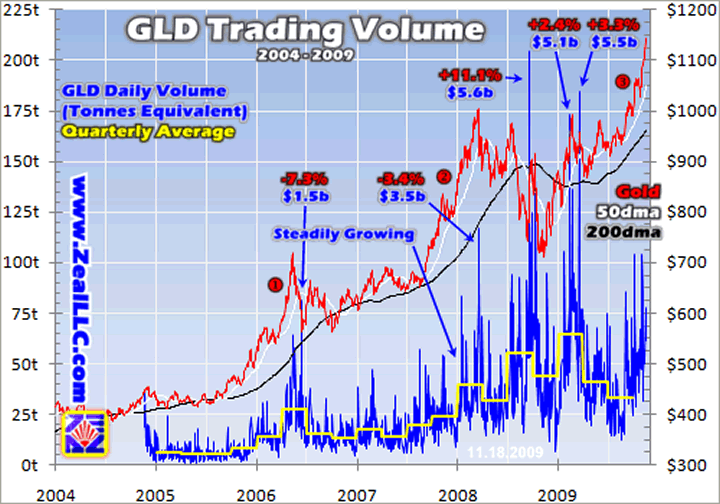
Despite gold rising from $400 to $1100 over GLD’s lifetime, its gold-equivalent volume has still grown massively. In 2005 GLD trading averaged 6.1t per day, about an eighth of 2009’s 47.6t. In capital-volume terms, or the dollar value of the gold traded via GLD shares, the growth in GLD’s influence is far more impressive. Capital volume in 2005 averaged $89m per day compared to $1440m in 2009, incredible growth of 16 times!
With so much stock capital flowing into and out of gold via GLD, it is fascinating to observe how stock traders interact with the gold price. As this chart reveals, the biggest spikes in GLD trading volume tend to occur when gold makes big moves. This implies that most of the time (with the exception of big institutional buying like February 2009) stock traders are still reacting to gold through their GLD trading rather than using GLD to drive gold.
One day in June 2006 following the biggest and sharpest surge of its bull, gold plunged 7.3%. That extreme weakness really scared stock traders driving $1.5b worth of gold to change hands via GLD shares. Interestingly though, GLD’s holdings remained stable through this exceptional selling pressure. So the stock traders weren’t selling GLD any faster than the futures guys were dumping gold itself.
In March 2008 gold fell 3.4% after the Fed showed “restraint” (bullish for gold’s nemesis, the dollar) by only slashing interest rates by 75 basis points instead of the 100 to 125 expected. $3.5b worth of GLD gold changed hands on this development, a record. Provocatively there was outsized GLD selling pressure, as this ETF’s holdings shrunk a major 2.3% that day. It was a stock-trader capitulation signaling that the gold correction was getting overdone.
Between the bond panic and stock panic in mid-September 2008, gold rocketed 11.1% higher leading to huge GLD buying pressure. That day as gold soared, $5.6b worth of gold changed hands in GLD shares! This record stands to today. There was enormous differential buying pressure, as GLD’s custodians had to grow its holdings by an astounding 5.9% on that single day!
In February and March 2009 we saw a couple more giant GLD volume spikes, both on relatively mild gold rallies but still exceeding $5b in each case. The February one was driven by the hedge-fund buying and resulted in GLD growing its holdings by 4.5% in one day. The March one resulted in a far milder but still big 1.4% growth day in GLD’s holdings. The frequency of big GLD interactions with gold is ramping up.
Though beyond the scope of this essay to prove on a day-to-day basis, GLD’s activity in the gold markets is increasingly impacting the gold price. And through GLD, prevailing stock-trader psychology on gold is becoming more important than ever before. Greed and fear among GLD traders is amplifying big gold up days and down days, and the larger GLD grows and the more widely it becomes held the more significant and frequent this influence and interaction will become.
In our acclaimed monthly Zeal Intelligence newsletter, I factor GLD buying and selling into my ongoing detailed gold analysis that we use for actively trading the entire precious-metals sector. If you want to successfully trade PM stocks, GLD’s growing influence on gold’s fortunes simply cannot be ignored. To rapidly grow your knowledge of the financial markets, commodities stocks, and how to thrive in your own trading, subscribe today. Become an informed investor!
The bottom line is GLD’s impact on the entire precious-metals realm is big and growing. By creating the first-ever quick and easy conduit between stock-market capital and gold, GLD is radically expanding participation in this gold bull. While this has certainly increased both upside and downside volatility at times, it is ultimately very bullish for gold given today’s chronic underinvestment in this metal.
The greater the pools of capital chasing any bull, the bigger and longer it will eventually run. The more the merrier! In the meantime, investors and speculators alike can capitalize on GLD’s increasingly frequent big interactions with the gold price. By carefully observing what stock traders’ greed and fear is forcing GLD to do with its holdings, we can increase our odds of finding excellent PM entry and exit points.
By Adam Hamilton, CPA
So how can you profit from this information? We publish an acclaimed monthly newsletter, Zeal Intelligence , that details exactly what we are doing in terms of actual stock and options trading based on all the lessons we have learned in our market research. Please consider joining us each month for tactical trading details and more in our premium Zeal Intelligence service at … www.zealllc.com/subscribe.htm
Questions for Adam? I would be more than happy to address them through my private consulting business. Please visit www.zealllc.com/adam.htm for more information.
Thoughts, comments, or flames? Fire away at zelotes@zealllc.com . Due to my staggering and perpetually increasing e-mail load, I regret that I am not able to respond to comments personally. I will read all messages though and really appreciate your feedback!
Copyright 2000 - 2009 Zeal Research ( www.ZealLLC.com )
Zeal_LLC Archive |
© 2005-2022 http://www.MarketOracle.co.uk - The Market Oracle is a FREE Daily Financial Markets Analysis & Forecasting online publication.
