


Doug Casey Says Bet Against Wall Street, Bonds, and after a few months the U.S. Dollar
Stock-Markets / Financial Markets 2010 Jan 22, 2010 - 05:45 AM GMTBy: Casey_Research

 L: Doug, I saw a Wall Street Journal headline a few days ago that boldly proclaimed, "Car Makers May Hire Soon." Be still, my trembling heart! It’s hard to believe the WSJ would stoop to such a meaningless headline, but I guess they are just trying to give their desperate customers what they want: some hope, whether valid or not. What do you make of the unemployment situation?
 Doug: Well, they say that during the depression of the 1930s, unemployment went as high as 25%. That’s interesting, in that at the time, half the people in the country were still farmers. They knew how to make the things they used in daily life with their own hands, and how to grow their own food. There was less specialization in the economy, and people were more self-sufficient. That made them better able to cope with an economic depression.
So it seems to me that that depression wasn’t anywhere near as bad as this one is going to be. It was caused by the inflation of the currency in the 1920s, by the Federal Reserve, and was prolonged by the actions that Hoover took, which were in exactly the same vein as those Roosevelt took later. Hoover was quite a dirigiste – I mean, Roosevelt applauded all the things Hoover did, but Hoover didn’t have the panache and good PR that Roosevelt did. But everything these two did – and both were disasters, lengthening and deepening the depression – was trivial by comparison to what’s being done today.
The government today is making things far worse than in the 1920s and 1930s. Everything the government is doing is not just the wrong thing; it’s exactly the opposite of the right thing. But more importantly, as far as unemployment is concerned, this inflationary boom has gone on much longer than that of the ’20s. Not only does that call for a bigger correction, but unsustainable patterns of production and consumption have become far more ingrained.
L: Consuming more than you produce is not sustainable, but people can tighten their belts…
Doug: That’s only part of it. If people lose their jobs today… Well, they are pretty far from the land, and I’m not sure people today think about that. Back in the ’20s and ’30s, if your car broke down, it was expected that you would get out and, under a shady tree, fix it yourself. And you could – you could even take the engine apart and fix a bearing. That’s not in the least practical today. You’ve got to have the money to pay a specialist to fix your car today.
Back then lots of people who weren’t even farmers had vegetable gardens and chickens in their yards. Today, people live in suburbs – chickens and goats are out of the question.
L: I get it: what will unemployed golf cart salesmen do when they can’t find jobs – today, they can’t just go back to the farm and help with the chores. But they say unemployment is only around 10% now; even if that’s low, it will need to get more than twice as bad before it compares to the 1930s.
Doug: The government is saying the unemployment is around 10%, but that’s a fraud. They don’t count things the same way as they did then, not even as they did in the recession of 1982. Furthermore, they should count many government employees among the unemployed, since relatively few of them produce anything that anyone would voluntarily pay for. I’m not talking about police, garbage collectors, judges, and the like. The market would employ many of them in their current jobs even if the state were to disappear. But many of the apparatchiks filling offices not only don’t serve any useful purpose, but they actively destroy, and prevent the creation of, wealth. These people are worse than just unemployed.
Something else. Very few of the 1.5 million people in the Armed Forces actually create wealth or would be paid, in a free market, to do what they do. The same goes for the perhaps several million contractors and employees that compose the so-called "defense" industry. Obama is giving veterans preference in hiring for government jobs as well. Which means people who are not only quite jingoistic as a group but most used to taking orders – and giving them – will increasingly dominate the civil service. And, benefits included, government jobs now pay about 50% more than those in the real world. This is not a good trend any way you look at it.
The government’s unemployment figures basically include people who are paid to dig ditches during the day and others who fill them up at night.
L: And they don’t count "discouraged workers" as being part of the workforce, so they’re not unemployed.
Doug: Yes, it’s like that cartoon you ran in this month’s International Speculator, showing all the groups of people who are not working but who are not counted as unemployed. People who’ve given up looking for jobs are not unemployed, Ph.D.s working a few hours a week at Wal-Mart are not unemployed, and there are more stupid evasions like that going on. So fewer and fewer of the numbers they give us are meaningful.
But I always look at the bright side. Many of these people will find their way into the underground economy and provide goods and services to others without government approval. All the taxes they’re saving means they can effectively double their take-home income, or charge half as much, or some combination. And, very important, it denies revenue to the state, even as it puts the thought into people’s heads that they don’t need the state – the state needs them. Many who spend time in the "black economy" might even get the idea that being independent is preferable to being a serf.
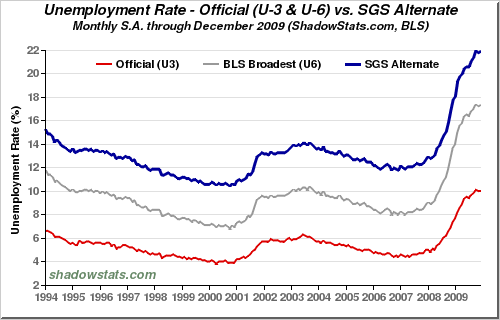 L: I just looked up John Williams’ shadow stats on unemployment, and he’s showing BLS Broadest unemployment, which includes "short-term discouraged workers" at over 17%. His SGS alternate unemployment, which includes "long-term discouraged workers" (who were "defined out of official existence in 1994"), is about 22%.
Doug: So, it’s already much worse than people think. And on top of that, people seem to suffer from a mass delusion that things will get better soon. I don’t think things will get better anytime soon. For one thing, the level of debt in the U.S. is off the charts. Debt means you’re borrowing from the future, saving means putting something aside for the future. The level of debt in all areas – real estate, credit cards, personal loans, and so forth – has brought Americans to negative savings in recent years, a first. That didn’t even happen during the Great Depression.
One of the things that makes this particularly serious now is that rumors are circulating about the government licking its chops over all the money sitting in personal pension funds, Keogh plans, HR-10 plans, etc. The Pension Benefit Guarantee Corporation (PBGC – like the FDIC, but for pension funds) is bankrupt, and it’s going to get much worse. It’s still early days in this grand misadventure. Usually – not always, but usually – when things get really bad, they float some trial balloons to see how people might react to things they are considering. One of the most dangerous proposals floating out there now is that, since people’s pension plans have been hurt so badly, people should be required to buy annuities with their pension funds.
L: Isn’t that what Social Security is supposed to be?
Doug: Well, that’s never been anything but a welfare scheme. Logic does not apply in the government sphere. One way or another, the government will get more involved in pensions, and I suspect they’ll do it like they did down here in Argentina. I doubt most Americans are aware that the Argentine government basically nationalized everyone’s private pension plans last year, including those denominated in dollars, and now they are going to pay people in pesos, fresh off the printing press. I think the same thing is going to happen in the U.S.: they’ll require that a certain percentage of your pension plan be used to buy T-bills, or other government securities, or an approved annuity. This will be for the safety of The People, of course. The end result will be to wipe out an entire form of financial security Americans count on today.
L: What should Americans with pension plans do?
Doug: The smartest thing to do would be to get them offshore. I say this so often in these conversations and other places that I fear sounding like a broken record, but it’s really that important. But it’s absolutely true that for an American, the safest wealth is the wealth that’s outside of the U.S. Your biggest risk is a political risk, from a completely bankrupt U.S. government. Most people are completely unaware of it, but it’s possible to buy productive foreign real estate in your pension plans. It would be difficult for the government to force people to repatriate such assets, and that affords a measure of safety.
People should look at this. The government is desperate for money. They are going to run a trillion-dollar deficit this year, plus, they have to roll over a trillion and a half dollars of short-term paper, so somehow they are going to have to find buyers for $2.5 trillion of debt this year.
L: Somehow, I can’t imagine the Chinese and Japanese lining up to pour that much money into U.S. government promises.
Doug: And absolutely not at the artificially low interest rates the Fed is maintaining. They are going to be in a mad scramble for money; the Federal Reserve will likely wind up buying a lot of it, which could result in up to 2.5 trillion more dollar bills floating around the U.S., in just one year. So, they really are between a rock and a hard place, as we’ve been saying in The Casey Report. There’s just no way out. So I think the pension plans are going to be the next victims of this ongoing crash.
L: So… We have, and will have, much higher unemployment than the government is admitting, and at the same time, the government is going to steal people’s savings?
Doug: That’s precisely what’s going to happen. Unemployment is going to stay high, because the whole of U.S. society is oriented towards patterns of production and consumption that are unsustainable. They were built on a pyramid of debt, and that debt is collapsing. I don’t know what the new patterns are going to be, but there are a lot of people who are going to have to find totally new things to do.
And they’re going to have to find new places to live as well. They just aren’t going to be able to afford their McMansions. Even if the government helps them pay their mortgages, they are not going to be able to pay the soaring real estate taxes, they are not going to be able to maintain them properly, and they are not going to be able to pay the utilities.
L: And again, by "patterns of production and consumption," you don’t just mean spending more than you make. You mean that the U.S. has a surplus of paper pushers and telephone sanitizers, and a deficit of people who actually make things of value, and therefore, as a society, is not productive – or something along these lines?
Doug: Yes. Think about some of these businesses that have grown up during the boom times – like personal trainers. The "service economy" in general. Americans have gotten used to the notion of "We think, they work."
L: Meaning that Americans don’t do physical work?
Doug: Right, so they go down to the gym to exercise. A personal trainer is nice to have but is completely unnecessary. All you really need is a little willpower. Incidentally, I’m not a fan of physical labor; it tends to be of low productivity. Machines should do it and eventually will do most of it. So there should be much more wealth in a free market, with much less work as a result. But you get there by thinking and using engineering and science to give reality to the thoughts.
Unfortunately, few Americans study these things. They go for subjects that range from those that are worth less than nothing – like political science, collectivist economics, and gender studies – to those that are simply worth nothing – like English lit, psychology, and history. As you know (see our conversation on education), I’m not at all opposed to these things. It’s just that you should study them on your own. Meanwhile, kids from the Orient and Eastern Europe are doing math, science, and engineering. I suppose future Americans can do their menial jobs, and a few can become entertainers or athletes.
L: We have a bunch of young Eastern Europeans working for us, and they’re very bright and competent.
Doug: Indeed. Another job that I think caters to the artificially high patterns of consumption we’ve seen over the last 25 to 30 years is being a lawyer. Millions of people have become lawyers over the last couple decades, and 95% of them are unnecessary and a drain on the economy.
L: I read in another WSJ article that crime has actually dropped since the crisis hit, which doesn’t make it sound like boom time for lawyers.
Doug: Well, few lawyers actually defend criminal cases, but that is interesting. Another surplus is MBAs, of which it seems we have millions; if they had any possibility of succeeding in business, that’s what they’d be doing, instead of wasting time and money listening to academics yap about it. And people in the financial business – there’s going to be much less demand for brokers, bankers, advisors, planners, and such in the years to come. They’ve come to expect a lot of money for shuffling paper, based on the financial industry being in a bubble. A huge swath of white-collar workers are going to have to figure out a new and productive way to put bread on the table. Assuming they still have a table after their McMansion gets repo’d.
L: What about Starbucks and all its clones? You think people are going to be willing to pay $5 for a cup of coffee during the Greater Depression?
Doug: It’s interesting… you know, even when I was a kid, one of the catchphrases people used when someone would offer an opinion was: "That and 10 cents will get you a cup of coffee." Since a cup of coffee almost anywhere cost about 10 cents, the implication for the value of the opinion was clear. And a cup of coffee was still 10 cents not so many years ago in most places – your $5 cup of Starbucks coffee is a long way from there.
Given how little a cup of coffee really costs, even with inflation, Starbucks may be a dead man walking; many people are going to be forced to dispense with the extravagance. So there will be a lot of unemployed baristas. However, an argument can be made that in tough times, people do without big luxuries but will still buy little luxuries to make themselves feel better. So I’m not saying Starbucks will disappear; I just don’t think there’s really a market for one on every corner. I expect they’ll wind up closing more than half their stores.
More generally, I’d say there’s just too much retail out there.
L: Particularly high-end retail. I wonder how many $1,000 bikes will be sold when people can go to Wal-Mart and get a decent, light-weight aluminum bike for $100 or less.
Doug: And how many closets full of suits and shirts and pants and shoes are out there that people don’t even use? Who’s going to buy clothes when they have more than they can wear and don’t have a job? A lot of that stuff is going to last a long time.
L: So, short Calvin Klein and Eddie Bauer?
Doug: Almost no retail business is a good business today. The only exception I can think of is a grocery store.
L: People are going to need to eat, no matter what.
Doug: That’s really about it.
One business that’s been pretty good over the last decades is the public storage unit business. People have so much stuff, they can’t even fit it all in their garages – which they need for their boats and ATVs – and their attics are overflowing. People simply have too much stuff, and they are going to stop buying it as their wages go down. Maybe eBay is the way to go, as people try to unload some of the stuff they’ve accumulated to raise cash.
Here’s the thing about unemployment: you can’t just think in terms of the U.S. Americans have insanely high wages, relative to people in other countries of equal intelligence, maybe a better education, and definitely a better work attitude.
L: That’s for sure. I had three guests, former students of mine from the Republic of Belarus, who stayed with my family this summer – at the height of the post-crash scare. Everyone was moaning about there being no jobs, but these kids got on the bikes I lent them and rode for many miles every day until they found jobs – at least two each. And these are students who’d never worked a day in their lives, had no experience whatsoever, no training, nothing to put on a résumé. But they wanted to work and were eager to exchange labor for dollars.
Doug: What kind of jobs?
L: Kitchen help in a pizza restaurant, stocking shelves in supermarkets, stuff like that.
Doug: In other words, the kind of labor self-respecting Americans don’t want.
L: Yes. You know, leftists complain that globalization is unfair to poor countries – but in fact, modern production is becoming increasingly independent of geography, so pay rates worldwide are trending towards more equality than the world has ever seen. Wages are rising in the third world and dropping in the first. Like it or hate it, it’s capitalism that has been helping the poor around the world, with real, productive work – not socialist government handouts.
Doug: Yes, pay scales are being homogenized. Which is why you can expect places like the U.S. to fight the trend with quotas, tariffs, and the like.
You know, properly speaking, the "correct" level of unemployment is zero. Theoretically, the demand for goods and services is infinite. My own desire for goods and services has no limit, and neither does anyone else’s. So even if everyone worked 24/7, they could never satisfy all the potential demand. It’s just a matter of allowing people to work at wages that others are willing and able to pay.
L: So, it’s minimum wage laws and price controls that create unemployment – there’s no natural unemployment rate in the market?
Doug: Yes. Previously, for many years, the government used to say that the normal or correct rate of unemployment was 6%. How they came up with that number, I don’t know.
L: Probably threw darts at a board.
Doug: Yeah, they picked some number out of the air, found a pliable economist to write a paper with a bunch of mathematical symbols, and it became part of the cosmic firmament. It’s ridiculous. In a free-market economy, there would be zero unemployment or even negative unemployment, as particularly ambitious individuals would have two jobs.
L: Okay, but back to these (forcibly) United States…
Doug: I’m sorry to say, it’s going to get much worse. With 15% of the population collecting food stamps, and another 15% eligible but unaware or unwilling to accept the stigma – yet – and more people accepting various other government subsidies, there will be a growing population that doesn’t want to work. In response, there will be higher minimum wages that will keep more of the unskilled out of work, and more regulations and higher taxes will keep businesses from hiring more people. The government is going to enact lots of new laws, supposedly to protect the employees, and that’s going to make it much riskier to hire anyone. It’s a truly vicious cycle that’s going to cause serious structural unemployment for a long time.
L: You think the government will be stupid enough to raise the minimum wage when businesses are failing left and right?
Doug: Yes, of course they are. I’m surprised they haven’t raised it to $20 or $25 per hour.
L: Sure, why not $1,000/hour – we’d all be rich!
Doug: [Laughs.]
L: So, if it’s that bad and getting worse – if the real unemployment rate is just a few percentage points lower than it was during the Great Depression, why don’t we see more lines outside of soup kitchens?
Doug: Well, those people I mentioned getting food stamps – they’re not getting stamps anymore. They get a thing that looks like a credit card. They don’t have to stand in line at any special store or soup kitchen; they can just go down to the nearest Safeway and load up on Twinkies. But I have seen a lot of stuff on YouTube about people living in tent cities. So it’s not as different from last time as you might think – and this time it’s still just getting started. Which reminds me: people in the real estate and construction businesses had better prepare for a long, long drought.
L: I just did a search on YouTube for "tent city" and got 2,660 results. Did you see the one about the uproar over a tent city named Obamaville?
Doug: That’s a good example, and I’m sorry to say that I’m convinced that it’s going to get much worse. There’s no way out for the average person. Except to take stock of his position, hunker down, and figure out what goods and services he can provide others at prices they can afford.
L: Any suggestions for readers?
Doug: Cut down on your standard of living while you can do so in a controlled way – or the market will do it for you. Greatly increase your rate of savings. And be very careful of what you put your savings in.
L: Investment implications? Short retail?
Doug: Yes. Bet against Wall Street, bonds, and after a few months, the U.S. dollar. It’s not a pretty picture.
L: The sort of stuff you cover in The Casey Report.
Doug: Yes, exactly. I wish I could assure everyone that things are going to get better soon. But that’s not the case. This is just the first act. It’s better to be aware of an unpleasant reality than to be blindsided by it.
L: Okay then, another sobering conversation – we’ll have to talk about something more upbeat next week, or we’ll leave our readers too depressed to read us anymore.
Doug: Just remember what Robert Friedland always says: the situation is hopeless, but it’s not serious.
[Doug Casey is one of the few investment visionaries whose forecasts have been spot-on. Don’t miss what Doug predicts for 2010 – to read the rest of this FREE interview, sign up here.]
© 2010 Copyright Casey Research - All Rights Reserved
Disclaimer: The above is a matter of opinion provided for general information purposes only and is not intended as investment advice. Information and analysis above are derived from sources and utilising methods believed to be reliable, but we cannot accept responsibility for any losses you may incur as a result of this analysis. Individuals should consult with their personal financial advisors.
© 2005-2022 http://www.MarketOracle.co.uk - The Market Oracle is a FREE Daily Financial Markets Analysis & Forecasting online publication.
