


Money is too Important to Trust with Central Bankers !
Interest-Rates / Analysis & Strategy Dec 17, 2006 - 11:49 AM GMTBy: Gary_Dorsch
 The late Nobel Economic laureate Milton Friedman once remarked, “Money is too important to be left to central bankers. You essentially have a group of unelected people who have enormous power to affect the economy. I’ve always been in favor of replacing the Fed with a laptop computer, to calculate the monetary base and expand it annually, through war, peace, feast and famine by, perhaps, a predictable 2 percent,” Friedman said.
Financial chiefs from the Group of 20 industrialized and emerging economies could hardly believe their good fortune, as they huddled behind closed doors on Nov 19th. Central bankers from Great Britain, Canada, France, Germany, Italy, Japan and the United States, and 13 emerging economies, including Australia, Brazil, China, India, Russia and South Korea, implemented a joint strategy six months ago to derail the “Commodity Super Cycle”, and they hit pay dirt in the Fall of 2006.
Central banks from a dozen countries worked in close synchronization to either raise their short term lending rates, or lift bank reserve requirements, in a concerted effort to drain the global liquidity swamp that had lifted the “Commodity Super Cycle” to its highest level in 25-years. The strategy worked for awhile, as frightened hedge fund traders unloaded a wide array of commodities, from crude oil, copper, unleaded gasoline, gold, silver, and natural gas over the next few months.
The most ambitious tightening among the G-20 nations, which account for 85% of the world’s economic output, came from the Bank of Japan, which dismantled its 5-year ultra-easy money policy, and drained 26 trillion yen from the banking system. The BoJ capped its historic effort with a rate hike to 0.25% on July 14th, just when crude oil prices were hitting all-time highs of $78.40 per barrel in the spot market.

Whether by sheer luck or apt skill, the BoJ rate hike above zero percent, the first of its kind in six years, triggered an unwinding of the “yen carry” trade, and partially contributed to the 30% plunge in crude oil to as low as $54.86 /barrel on Nov 16th. A $15 per barrel Iranian “war premium” also evaporated from oil prices. In turn, the plunge in crude oil overrode concerns of a slightly tighter G-20 money policy, and ignited a powerful 16% rally in the Morgan Stanley All World Index, which measures blue chips stocks in 43 stock markets.
The plunge in crude oil also suggested that global economic growth would reach 5% in 2006, extending the longest period that growth rates held above 4% since the early 1970’s. But the baby-step rate hikes by members of the G-20 were deceptive, because short term interest rates are still pegged at or below inflation rates, and did not cap the explosive growth of the world’s money supply.
Behind the smiles at the G-20 meeting in Melbourne, Australia on Nov 19th, were underlying worries about a revival of the “Commodity Super Cycle” and a weaker US economy, which accounts for 28% of global GDP. “At a global level, we have a level of real rates that is quite low,” said G-10 spokesman Jean “Tricky’ Trichet. “We have a correct anchoring of inflation expectations. But there’s absolutely no time for complacency. Being credible in price stability is extremely important.”

Undoubtedly, the G-20 noted the strong rebound in global commodity prices in October and November, and OPEC’s moves to put a floor under the crude oil market, with significant production cutbacks. At the same time, global manufacturing growth fell in November to its lowest level in 15 months as US factory activity shrank for the first time in more than 3-1/2 years, resurrecting the ghost of “Stagflation.”
The global manufacturing indicator, produced by JP Morgan fell to 53.3 in November from 53.9, its slowest pace in 1-½ years and new orders growth hit its lowest level since August 2005. The global employment index also slipped to 51.9 from 52.5, largely linked to a decline in US factory activity below the key 50 mark, dividing growth from contraction, to a reading 49.5 from 51.2 in October.
Weak US dollar disturbs the OPEC cartel
The G-20 is also worried about a fall in the value of the US dollar, which can exert upward pressure on global commodity prices, and undermine export oriented economies in Asia and Europe. On Dec 11th, former Fed chief “Easy” Al Greenspan told a Tel-Aviv business conference, “I expect that the US dollar will continue to drift downwards until there will be a change in the US balance of payments."
“There has been some evidence that OPEC nations are beginning to switch their reserves out of dollars and into Euro and yen. It is imprudent to hold everything in one currency,” adding that at some point the US dollar will be moving lower. “That will be the experience of the next few years,” Greenspan predicted. The US dollar Index has declined 5% since Oct 26th, when guru Greenspan made similar remarks.

The weaker US dollar is eroding OPEC’s petro-dollar purchasing power. The dollar hit a 20-month low against the Euro, and a 14-year low against the British pound, punishing OPEC producers who sell their oil for US dollars, but buy most of their goods and services from Europe. As a result, most OPEC ministers are leaning towards cutting oil production beyond the 1.2 million barrels per day they agreed in October, to reduce high world inventories and shore up prices.
“The weak dollar is not helping matters. It affects revenue. If there is a significant drop, it is of concern to us,” said United Arab Emirates’ Oil Minister Mohammed al-Hamli on December 4th. “OPEC is in the process of taking up the challenge of a market that is clearly and steadily getting out of balance, after 3-years of a very strong bull run,” said OPEC’s Secretary-General Mohammed Barkindo on Dec 4th.
The Grand Illusion, the ECB lifts rates to 5-year high
Jean “Tricky” Trichet talks a tough game when it comes to “vigilance in fighting inflation,” but the ECB’s repo rate hike to 3.50% on Dec 7th, is still pegged about a half percent below the Euro Zone’s 4.1% producer price inflation rate. Negative interest rates in Europe are designed to help prevent the Euro from exploding higher against the US dollar and Japanese yen, but are also leading to serious side effects, such as embedding inflation into the Euro zone and global economy.

Adjusted for inflation, the ECB’s cost of money still remains quite low. “By historical standards, monetary policy is still accommodative, which means it still supports growth,” said Finland’s central banker Erkki Liikanen on Nov 8th, pointing to another ECB rate hike next year. “Risks to price stability are there. By all plausible methods there is ample liquidity and interest rates are still accommodative.”
“Oil prices have been low but risks remain to the future. There are also risks when growth is strong such as wage developments,” Liikanen added. Despite the upside inflationary risks however, an economic slowdown in the United States, an impending 3% hike in the German value-added tax to 19%, and a recent surge in the Euro above $1.30 have raised questions about the ECB’s resolve to go beyond jawboning.

The ECB has lifted its repo rate 150 basis points to 3.50% this year, but failed to rein in the explosive 8.5% growth of the Euro M3 money supply. Euro zone bank loans to households are 11.2% higher than a year ago, and loans to corporations outside the financial sector rose at an annual 12.9% in October. Corporate loan growth is linked to $1.3 trillion of mergers and takeovers in Europe so far this year.
But the Euro M3 money supply measure is only one of the pillars of the ECB’s monetary policy. The recent break-out of the Euro above $1.30 could dampen import price inflation, and give the ECB some pause, before contemplating another repo rate hike to 3.75 percent. Asked about the impact of the Euro's 2.7% surge on ECB policy, Trichet merely said that sharp currency moves are undesirable, and also hinted that the next ECB rate move is uncertain or could be delayed to March.
Bank of England allows Explosive money supply growth
Across the English Channel, Britain’s M4 money supply expanded 0.9% in October, compared with a 1.7% rise in September. That took the annual rate down to 14.0% from September’s 14.5%, which was the highest since September 1990. Bank of England policymakers have tolerated long periods of low UK interest rates and an excess supply of cash and rampant borrowing, which is stoking inflation pressures.

The BOE cited M4 growth to justify quarter-point rate hikes in August and November, which took borrowing costs up to 5%. Then, BoE Governor Mervyn King said M4 posed a risk to the bank’s inflation projections. “Broad money is growing rapidly and that does pose an upside risk to the forecast, so money certainly matters,” said BoE chief Mervyn King on Nov 20th. Yet the BoE stood pat on Dec 7th, leaving its base rate unchanged at 5%, taking a breather from the annoying M4 growth rate.
The housing market is showing no signs of slowdown even with the base rate at a 5-year high. UK home prices were 8.6% higher in October than a year earlier, when Britons borrowed an extra 10.9 billion pounds, putting them in hock to the tune of 1.26 trillion pounds, equaling the annual economic output of the country. But the BOE is afraid that further rate hikes above 5% to control M4, could jettison the British pound above the psychological $2.00 level against the US dollar.

With sterling bumping up against a 14-year high near the psychological $2.00 level, BoE chief King was relaxed, noting that against a broader basket of currencies, the pound had been relatively stable. “The stability we’ve had in the economy as a whole has carried over to the stability of the average exchange rate. Our effective exchange rate against an average of all other currencies has not risen in any way near the way we’ve risen against the dollar,” he said.
Interest rate differentials are moving in favor of the pound against the US dollar. In early July, six-month US dollar Libor rates commanded an 85 basis point advantage over the British pound, but the spread has narrowed to just 5 basis points today. Expectations of a BoE rate hike to 5.25% gained momentum on Dec 12th, after the UK retail price index, the basis for UK wage settlements, rose 3.9% in November from a year earlier, the biggest increase since May 1998.
Bank of Korea tightens grip on Explosive Money Supply
South Korean Finance Minister Kwon O-kyu held a meeting with his Japanese counterpart Koji Omi on the sidelines of the G-20 meeting on the recent weakness of the Japanese yen to the Korean won. Kwon called for Bank of Japan actions to control an excessive fall of the yen to the won, which is feared to hurt South Korean exporters. South Korea’s currency, the won, rose to its highest level against the Japanese yen in nine years at 7.92 won per Japanese yen.
Kwon said currency values were up to the market, but modest intervention designed to slow down the speed of the US dollar’s and yen’s decline against the won is probable. “In Korea, the won currency has appreciated more than 40% since 2002 and this year alone it has appreciated almost 8%, which is quite substantial. Some sort of speculative attack could come to the market. In that case, a smoothing-out operation is always possible,” Kwon warned.

The US dollar fell to a 9-year low of 915-won last week, representing a 10% loss this year, following an 18% loss for the previous two years. Yet South Korean exports jumped 15% for the first 11 months of this year over a year earlier, after soaring a combined 47% over the previous two years. Exports jumped to a record $30.94 billion in November or 20% higher from a year ago.
The South Korean economy may face more downside risks next year, but next year’s growth will not deviate much from the finance ministry’s previous forecast of a 4.5% gain. Kwon said exports will increase 15% this year and next year Korea’s growth would be in double digits, but not especially high. “So we need to rebalance between the export sector and domestic demand,” he said.

On Nov 23rd, South Korea’s central bank hiked the reserve ratio on bank deposits by 2% to 7%, the first such move in 16-years, in order to reduce the explosive growth of the M3 money supply which hit a 3-year high of 9.5% in October. M3 includes cash, all types of deposits at financial institutions and all money market instruments issued. South Korea’s household debt expanded at the fastest pace in four years in November, as a 3.7% jump in property prices sparked a surge in mortgage lending.
“The hike will complement the central bank’s call rate decisions by reducing liquidity through curbing lending capability. Banks need to reduce their loan supply,” said Bank of Korea chief Lee Seong-tae. The Bank of Korea has lifted its call rate by 125 basis points from a year ago to 4.50%, but is also widening the won’s interest rate against the Japanese yen, and keeping pace with Fed’s rate hikes earlier this year.

Dealers in Seoul said South Korean authorities purchased about a combined $2 billion in two days of heavy intervention during November, and additional amounts for several other days during the month. Korea’s foreign exchange reserves, the fifth-largest in the world, jumped $4.8 billion to $234.2 billion by the end of November, reflecting the extent of BoK intervention in the market, and an appreciation of its non-US dollar portfolio.
Central banks might hold more of their reserves in non-traditional currencies such as the Russian ruble and South Korean won, said He Fan, a top economist at the Chinese Academy of Social Sciences. Fan expects a further strengthening of the yuan. “For the rest of the year, the yuan’s 3% limit against the US dollar will be breached and the yuan is likely to rise 15% over time to reach an equilibrium level.
Chinese central bank issues second warning over US$
On Dec 7th, the People’s Bank of China (PBoC) issued a second warning about the risks of big slide in the US dollar, seeking to head-off US Congressional protectionist legislation this year. “If external capital stops flowing into the United States, a significant drop in the US dollar may occur with consumption and investment shrinking, interest rates rising and financial markets experiencing turbulence, and endangering global financial and economic stability,” the PBoC said.
The world economy has been enjoying its fourth year of an average 4.7% growth, even as the US current account widened to record deficits and surpluses grew in Asian and oil-producing countries. However, “If the US current account deficit continues to grow faster than GDP, then the investment value of US assets may be subjected to doubts and challenges, and the willingness of investors to continue holding and buying US financial products may weaken,” the PBoC said.
Financial markets are awash with speculation that foreign central banks will spread their portfolio risk by shifting part of their US dollar holdings into other currencies, such as the Euro and British pound. “There could be adjustments in how European private capital, Asian foreign exchange reserves, and oil export proceeds are invested. This could cause changes in capital flows, the exchange rates of major currencies and the value of foreign exchange assets,” the PBoC warned.

Beijing has already suffered a 10% loss on its depreciating US Treasury notes, including the dollar’s devaluation against the yuan since July 2005. Soon, China will face the wrath of a Democratic led Congress that might enact protectionist legislation against Chinese imports. There might be enough nervous Republicans on Capitol Hill worried about defeat in 2008, to cross the isle and override a presidential veto.
Beijing has inflated the supply of its yuan by 16% to 18% for each of the last 3-years, to keep its currency artificially low against the US dollar. The cheap yuan enabled China to rack up a trade surplus with the US of $190 billion in the first ten months of this year, and on track to surpass the $202-billion surplus in 2005. During the Bush presidency, 3.1 million US manufacturing jobs have been lost, and big electoral states like Ohio, Pennsylvania, Michigan, are leaning blue for 2008.
Bush is sending his biggest cabinet delegation to Beijing this week, at a time when the US factory sector is contracting, and Chinese industrial profits are 29% higher than a year ago. US Treasury chief Henry Paulson will be joined by Commerce Secretary Carlos Gutierrez, Energy Secretary Sam Bodman, US Trade Representative Susan Schwab and Federal Reserve chief Ben Bernanke.
China’s central bank governor, Zhou Xiaochuan said he’s “prepared for positive and dialogue,” but PBoC deputy Yi Gang, warned than the yuan exchange rate is “a sovereign issue and this is our principle.” But the hand writing is on the wall. Beijing must accept a sharply higher yuan, crack down on counterfeiting and piracy of US products, and eliminate its barriers to imports of industrial and agricultural goods, or face the risk of Democratic retaliation on its imports next year.
The Bank of India Rattles Bombay stocks
The Reserve Bank of India (RBI) is heeding the call of the G-20, and is asking its banks to set aside the cash equivalent to 5.5% of deposits from 5% previously. The move is aimed at curbing the explosive Indian M3 money supply, which is expanding at an annualized 19.5% rate. India’s $775 billion economy grew at an annualized 9.2% rate in the third quarter, second only to China’s 10.4% growth rate.
Bank of India chief Yaga Venugopal Reddy is faced with pressure from Prime Minister Manmohan Singh to support an annual growth target of 10% next year, while near-record lending by banks and explosive money supply growth exerts upward pressure on inflation. Wholesale price inflation in India accelerated at 5.45% clip in November, just slightly below the central bank’s 6% reverse repo rate.

Still, it will be difficult for the central bank to rein in the M3 money supply growth rate, expanding at an annual 19.5% rate, unless it stops intervening in the currency markets. India’s foreign-currency reserves rose by $8 billion last month to a record $175.5 billion on December 1st, reflecting the central bank’s money printing and intervention operations in the currency markets.
Expectations of a squeeze in liquidity lifted yields on 10-year Indian government bonds to 7.66%, up 27 basis points since the RBI announcement to raise the bank cash reserve ratio, draining 135 billion rupees and leaving less to invest in bonds and stocks. On top of that, corporate tax payments are expected to drain another 300 billion rupees. The Indian overnight call money rate hit a high of 7.75%, above the RBI’s main lending rate of 7.25 percent.

One week ago, the Bombay Sensex index hit a record high of 14,035 on Dec 6th, but has since lost 7% of its value in a broad-based sell-off, triggered by the surprise RBI tightening move. Earlier today, the Sensex index fell as much as 555 points, or 4.1%, to as low as 12,844. The bearish mood in Indian blue chips and banks centered on shocking news that India’s industrial production plunged to an annualized 6.2% growth rate in October, nearly half the 11.4% rate in September.
Bank of Brazil cuts rates to defend the US$
The Bank of Brazil isn’t following the G-20 game plan, and lowered its Selic lending rate 050% to 13.25% on Nov 29th. The BoB has cut interest rates 12 times in a row, the longest period of rate reductions in Brazil’s history. Borrowing costs have fallen by 6.5% points from 19.75% in September 2005. The Selic rate futures contract for January 2008 delivery, traded in Sao Paulo, fell to 12.56% this week, signaling expectations of another BoB rate cut in December.
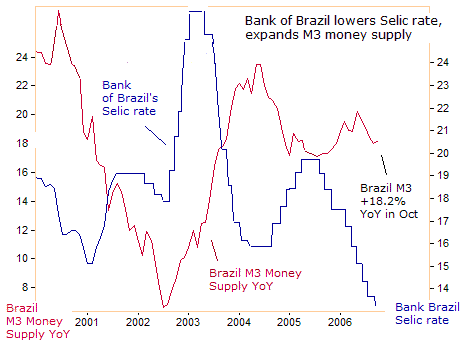
The Bank of Brazil holds a daily auction to buy US dollars on the foreign exchange market, and is putting a floor under the US currency at 2.14 reals. So far, the BoB rate cutting campaign and the 18.2% expansion of the Brazilian M3 money supply, hasn’t been able to give the US dollar a sustained bounce above 2.14 reals. Thus, in a reversal of fortunes, the Brazilian government which was on the brink of defaulting on its debt just 3-years ago, is now working overtime to prevent the US dollar from falling under its own weight, and parking its dollar purchases in US Treasury bonds.
Subscribers will also receive Email Alerts, sent out in-between regular newsletter postings, when important information unfolds in the global markets.
A subscription to Global Money Trends is $125 US dollars per year for 24 issues, including access to all back issues. Click on the following hyperlink, to order now, http://www.sirchartsalot.com/newsletters.php
Disclaimer: SirChartsAlot.com’s analysis and insights are based upon data gathered by it from various sources believed to be reliable, complete and accurate. However, no guarantee is made by SirChartsAlot.com as to the reliability, completeness and accuracy of the data so analyzed. SirChartsAlot.com is in the business of gathering information, analyzing it and disseminating the analysis for informational and educational purposes only. SirChartsAlot.com attempts to analyze trends, not make recommendations. All statements and expressions are the opinion of SirChartsAlot.com and are not meant to be investment advice or solicitation or recommendation to establish market positions. Our opinions are subject to change without notice. SirChartsAlot.com strongly advises readers to conduct thorough research relevant to decisions and verify facts from various independent sources.
© 2005-2022 http://www.MarketOracle.co.uk - The Market Oracle is a FREE Daily Financial Markets Analysis & Forecasting online publication.
