


Stock Market Internals Go Negative
Stock-Markets / Financial Markets Jul 31, 2007 - 09:49 AM GMTBy: John_Mauldin

Will the market rebound this week or continue last week's slide? Will the credit markets stop their turmoil? These are all questions that investors are confronted with by the financial press. In today's "Outside the Box," we will focus our attention on a well-thought out piece by John Hussman, Ph.D. John is the President of Hussman Investment Trust where he manages the Hussman Strategic Total Return Fund - HSTRX and the Hussman Strategic Growth Fund – HSGFX.
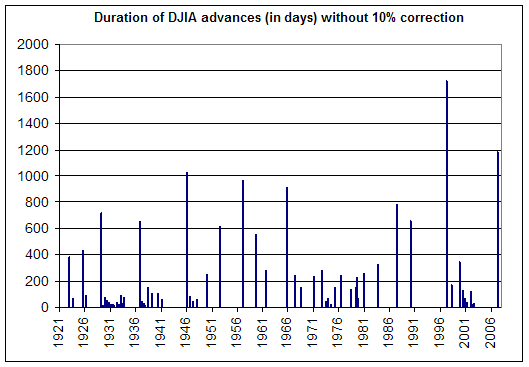
In his Weekly Market Comment , John addresses the recent market volatility and puts it in historical perspective, comparing it in duration to that of previous market cycles. We have currently gone almost 1200 days without a 10% correction, the second longest such period on record.
So, how does a money manager with these views cope in today's market? I keep John's comments about what he is doing in his fund so you can see what this highly regarded professional to hedge his bets. I think you will find what he is doing to be instructive.
While most investors continue to watch their streaming ticker for new record highs, we are patiently waiting for the raw data to form our investment decisions. I believe you find this commentary to be both valuable and "outside the box."
John Mauldin, Editor
Market Internals Go Negative
John P. Hussman, Ph.D.
Well, that was abrupt.
Though the stock market registered fresh highs only a few sessions ago, the total return on the S&P 500 is now about even with Treasury bills for the period from mid-December to the present. Given the steep decline, the market probably deserves a clearing rally by now (which is no assurance we'll observe one). Still, it's important to recognize that the recent pullback has not generated any meaningful improvement in long-term valuations. Indeed, a quick review of periods that had their origins in similarly overvalued, overbought conditions (see A Who's Who of Awful Times to Invest ) indicates that the subsequent losses were invariably deeper than what the market experienced last week.
That's not a forecast. Market conditions may recover in this particular instance. It's just that if investors played a "repeated game" by consistently investing in market conditions similar to the present, they would have experienced significant losses, on average.
Though the S&P 500 is only 6% below its recent highs, it has already provoked a surprising amount of denial and lack of civility, with an irritated financial news anchor suggesting on Friday, for example, that Pimco's Bill Gross should "just shut up." It does no service to investors when the media and the analysts who appear there wholly rule out any possibility of a substantial further market decline, when 10% market losses have typically occurred more than once every 2 years, and bear market losses (generally 25-35%) occur about once every 4-5 years. The point is not that such a decline has to occur just because one hasn't happened in a while. The point is that deeper losses can't be ruled out, and it is irresponsible to pretend that they can, particularly given current conditions.
Abrupt market weakness is generally the result of low risk premiums being pressed higher. There need not be any collapse in earnings for a deep market decline to occur. The stock market dropped by half in 1973-74 even while S&P 500 earnings grew by over 50%. The 1987 crash was associated with no loss in earnings. Fundamentals don't have to change overnight. There is in fact zero correlation between year-over-year changes in earnings and year-over-year changes in the S&P 500. Rather, low and expanding risk premiums are at the root of nearly every abrupt market loss.
Market Internals Go Negative
One of the best indications of the speculative willingness of investors is the "uniformity" of positive market action across a broad range of internals. Probably the most important aspect of last week's decline was the decisive negative shift in these measures. Since early October of last year, I have at least generally been able to say in these weekly comments that "market action is favorable on the basis of price trends and other market internals." Now, it also happens that once the market reaches overvalued, overbought and overbullish conditions, stocks have historically lagged Treasury bills, on average , even when those internals have been positive (a fact which kept us hedged). Still, the favorable market internals did tell us that investors were still willing to speculate, however abruptly that willingness might end.
Evidently, it just ended, and the reversal is broad-based. For example:
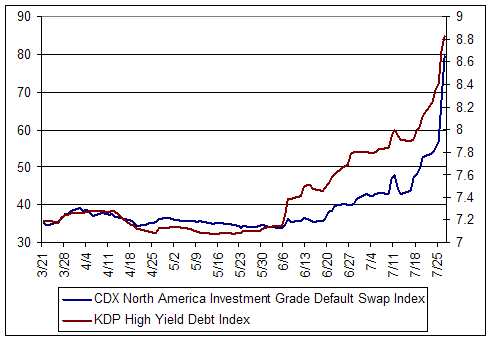
Credit spreads and credit default swap spreads are surging. While we haven't observed the spike in short-term spreads (e.g. 6 month commercial paper versus 6 month Treasury yields) that would indicate near-term recession risks, we are now seeing a "tiered" widening of credit concerns. For example, note that high yield (junk) securities have experienced upward yield pressure since early June (red line). In recent weeks, we've seen a spillover into credit spreads on investment grade securities (blue line). Again, we're not observing this in short-dated spreads, which would be a signal of imminent recession risks, but it's already clear that low risk premiums are being pressed decisively higher.
Market breadth has clearly deteriorated. This was already evident in the failure of most broad-based advance-decline statistics to confirm the recent highs in the major indices. That early weakness has now been followed by a preponderance of declines over advances.
As Jim Stack of Ivestech Research noted near the recent highs, "The DJIA has closed higher in 5 of the past 8 trading days, but declining stocks outnumbered advancing stocks in 7 of 8 of those sessions. That type of negative breadth divergence has occurred only 15 times in 75 years – the majority of which were in bear markets." He also noted "On Monday of last week, the DJIA hit a record high while declining stocks overwhelmed advancing stocks by a 2:1 margin." That divergence has never before occurred in market history, though again, lesser divergences have typically been characteristic of weakening markets.
Leadership has also reversed decisively. I've noted over the years that substantial market declines are often preceded by a combination of internal dispersion , where the market simultaneously registers a relatively large number of new highs and new lows among individual stocks, and a leadership reversal , where the statistics shift from a majority of new highs to a majority of new lows within a small number of trading sessions.
This is much like what happens when a substance goes through a "phase transition," for example, from a gas to a liquid or vice versa. Portions of the material begin to act distinctly, as if the particles are choosing between the two phases, and as the transition approaches its "critical point," you start to observe larger clusters as one phase takes precedence and the particles that have "made a choice" affect their neighbors. You also observe fast oscillations between order and disorder in the remaining particles. So a phase transition features internal dispersion followed by leadership reversal. My impression is that this analogy also extends to the market's tendency to experience increasing volatility at 5-10 minute intervals prior to major declines.
Other interesting measures of "overbought" conditions are also worth noting. Last week, Jim Stack reviewed an observation that a technician named Don Hahn made in the 1960's about the Coppock Guide (a measure of price momentum based on the 10-month smoothing of the averaged 14-month and 11-month rate of change in the S&P 500). He observed that when a double-top or "wave" occurs in this measure, without falling to zero between those peaks, "it identifies a bull market that hasn't experienced any normal, healthy washouts or corrections. That's a runaway market usually headed for disaster.
This double-top has occurred only 6 times in 80 years." Those instances, and the subsequent market losses were: October 1929 (-86.2%), May 1946 (-28.8%), February 1969 (-36.1%), January 1973 (-48.2%), September 1987 (-33.5%), and April 1998 (though followed by an 18% market correction by October 1998, the subsequent recovery produced a third "shelf" in the Coppock Guide by 2000, and the market lost nearly half its value between 2000 and 2002).
While I'm averse to forming expectations about "where the market is headed" or how far a given market movement may carry, these precedents are consistent with the outcomes I noted a few weeks ago in the Who's Who piece [also a thoughtful piece I would comment to you – John Mauldin]. I don't want to create any confidence that the market is headed for steep losses, but I do want to encourage shareholders not to rule out that sort of outcome.
As for us, we'll respond to market conditions as we observe them, focusing on the average return/risk profile associated with each set of conditions, without attempting to forecast specific instances or specific time-frames. The market currently exhibits neither favorable investment merit (based on valuations) nor favorable speculative merit (based on the quality of internal market action). The potential for a snap-back rally aside, we simply have no basis on which to accept an unhedged exposure to market risk.
Prevailing conditions and average outcomes
While last week's decline was typical of the outcome that regularly follows overvalued, overbought, overbullish conditions, I should emphasize that our hedged investment stance was not based on a "forecast" that the market would decline in this instance. Rather, it was based on the average tendency for declines to occur, given prevailing conditions. That may seem like semantics – a distinction without a difference – but it is essential to understanding our strategy.
Our investment approach does not forecast specific, individual outcomes, and we don't attach ourselves to a particular view of the future. We are only concerned with the average return/risk profile associated with the prevailing set of market conditions. Those market conditions could change next week. Meanwhile, the average return we can expect over that short a period is statistically insignificant. It's only over many repetitions that the average outcomes overwhelm the short-term noise and take on significance. Investment discipline doesn't mean investing at all times and at any price. Nor does it mean repeatedly making and revising forecasts about the future. Rather, it means patiently following a reasonably objective strategy in the expectation that short-term noise will average itself away over time, and the underlying long-term edge of that strategy will persist.
[Geek's Note: This is basic statistics – if mu is the mean of X, and sigma is the standard deviation, the expected normalized distance from zero for an individual draw is mu/sigma, which may very well be statistically insignificant. But average the draws over N trials, and the normalized distance of the sample average from zero approaches mu/(sqrt(N)sigma), which may be highly significant despite the low predictability of any individual outcome].
It may improve our confidence that every historical instance of the present set of market conditions has been a disaster. But our aim is always to stay grounded in the present moment; to align ourselves with prevailing conditions and average outcomes, not to make predictions of specific future events in the hope that they will come true.
Again, though, it's only 6% at this point. Our risk management is concerned with far greater challenges than this, and we need to complete a greater portion of this market cycle before we have occasion to revel on the basis of medium-term performance. Assuming our stocks perform no better or worse (after expenses) than the S&P 500, and that the Fund remains hedged, it would still take a further market decline of about 10-12% over a one-year period to put the Strategic Growth Fund ahead of the S&P 500 since the end of 2003. Our actual returns will be higher or lower depending on how our stocks perform relative to the market, and the extent to which we alter our hedges. In any event, it was nice that the Fund registered a fresh all-time high for its 7-year anniversary last Tuesday, having solidly outperformed the market since 2000, with no pullback in excess of 7% since inception.
Market Climate
As of last week, the Market Climate for stocks was characterized by unfavorable valuations and unfavorable market action. I've noted frequently that the S&P 500 has historically lagged Treasury bills, on average, during overvalued, overbought, overbullish conditions, regardless of the status of market action. That has been enough to hold us to a hedged position in recent months. However, the loss of favorable market action is also evidence of a shift in the willingness of investors to speculate.
Very simply, the combination of rich valuations and poor market action has historically been associated with clearly negative stock market returns, on average.
That said, if the market whipsaws higher and recruits sufficient improvement in market internals, I would expect to remove a moderate portion of our hedges, at least until overbought, overbullish conditions are re-established, and particularly if interest rate and credit spread pressures subside. Again, we don't have to forecast whether or not this will occur. We'll respond to the evidence as it emerges. A broad improvement in market internals would suggest that the preference of investors to speculate is durable, despite rich valuations, and that immediate concerns about credit defaults are premature.
In any event, and I cannot emphasize this enough, we will align our position with the prevailing conditions of the market. We don't forecast specific instances. Rather, we are interested in the average return/risk profile associated with the set of market conditions we observe at any point in time. Presently, we're fully hedged.
In bonds, the Market Climate remained characterized by unfavorable valuations and unfavorable market action. Treasury yields have declined notably in recent weeks, but with risk spreads widening sharply, it is clear that most of this is a "flight to quality" response. Unfortunately, it is generally true that prevailing yield levels are a more important determinant of probable bond market returns than prevailing yield trends (which is to say that trend-following approaches do not generally perform well in the bond market once yields decline to relatively low levels). Widening yield spreads do provide some support for the Treasury market here, but again, that condition would be much more helpful if bond yields were starting at a higher level. For now, there is little reason to increase our portfolio duration in the Strategic Total Return Fund.
I've noted before that when interest rates and stock yields are low, "buy signals" from the Fed Model are not particularly useful for stocks, but tend to be very good indications that bond yields are likely to shoot higher. The rising concerns about credit quality may help to suppress this tendency, but again, the low level of yields carries significant weight. Coupled with inflation pressures, dollar risk, and other factors, there is little evidence in favor of increasing our maturities here.
Fed Funds futures rallied on the increase in credit concerns, reflecting hope that the Fed will cut rates in upcoming meetings. My impression is that without a decline in "resource utilization" (i.e. an uptick of a few tenths in the unemployment rate and a downtick in capacity utilization toward about 80% or less), these hopes may be somewhat early. The FOMC is probably not terribly displeased at the tightening of lending standards that is taking place here, provided that it doesn't restrict credit-worthy borrowing too much.
If you look carefully at the CPI figures (and tinker with the monthly numbers), you'll also discover that even if the figures average a 2% annual rate in the months ahead, the year-over-year headline CPI inflation rate will be pushing 4% by November. This is already "baked in the cake." Since Bernanke is clearly concerned with the inflation expectations of the public, as well as the Fed's credibility, that headline CPI figure may create some complications for cutting rates in the months ahead, unless resource utilization falls out of bed.
Finally, the Strategic Total Return Fund continues to hold a portion of assets in precious metals shares, currently approaching 15%, since last week's pullback in these shares (which generally do not have much direct sensitivity to overall stock market trends) provided an opportunity to slightly raise our exposure.
As I write this on Monday morning the markets are jumping all over the place. And while I agree with John and others that this is normal from a historical perspective, it is the credit markets that have me concerned. Stay tuned.
Your ready for the credit markets to find a bottom soon analyst,
By John Mauldin
http://www.investorsinsight.com
To subscribe to John Mauldin's E-Letter please click here: http://www.frontlinethoughts.com/subscribe.asp
Copyright 2007 John Mauldin. All Rights Reserved
John Mauldin is president of Millennium Wave Advisors, LLC, a registered investment advisor. All material presented herein is believed to be reliable but we cannot attest to its accuracy. Investment recommendations may change and readers are urged to check with their investment counselors before making any investment decisions. Opinions expressed in these reports may change without prior notice. John Mauldin and/or the staff at Millennium Wave Advisors, LLC may or may not have investments in any funds cited above. Mauldin can be reached at 800-829-7273.
Disclaimer PAST RESULTS ARE NOT INDICATIVE OF FUTURE RESULTS. THERE IS RISK OF LOSS AS WELL AS THE OPPORTUNITY FOR GAIN WHEN INVESTING IN MANAGED FUNDS. WHEN CONSIDERING ALTERNATIVE INVESTMENTS, INCLUDING HEDGE FUNDS, YOU SHOULD CONSIDER VARIOUS RISKS INCLUDING THE FACT THAT SOME PRODUCTS: OFTEN ENGAGE IN LEVERAGING AND OTHER SPECULATIVE INVESTMENT PRACTICES THAT MAY INCREASE THE RISK OF INVESTMENT LOSS, CAN BE ILLIQUID, ARE NOT REQUIRED TO PROVIDE PERIODIC PRICING OR VALUATION INFORMATION TO INVESTORS, MAY INVOLVE COMPLEX TAX STRUCTURES AND DELAYS IN DISTRIBUTING IMPORTANT TAX INFORMATION, ARE NOT SUBJECT TO THE SAME REGULATORY REQUIREMENTS AS MUTUAL FUNDS, OFTEN CHARGE HIGH FEES, AND IN MANY CASES THE UNDERLYING INVESTMENTS ARE NOT TRANSPARENT AND ARE KNOWN ONLY TO THE INVESTMENT MANAGER.
John Mauldin Archive |
© 2005-2022 http://www.MarketOracle.co.uk - The Market Oracle is a FREE Daily Financial Markets Analysis & Forecasting online publication.
