


The Criminal Economic Stimulus Package
Politics / Economic Stimulus Feb 24, 2010 - 02:21 AM GMTBy: LewRockwell

 Wilt Alston writes: "It [the stimulus package] prevented things from getting much worse than they otherwise would have been. I think everyone would have to acknowledge that’s a good thing." ~ Nariman Behravesh, Global Insight’s Chief Economist
When I previously lamented the appeal of government-funded direct investment – currently known as stimulus – on the LRCBlog, I was purposely dismissive and not very expository. This essay dials that attitude back just a little, because if a recent piece from the NYTimes is any indication, the economic philosophy to which we Austrians ascribe continues to be virtually unknown and/or unimportant to the mainstream media (MSM). Certainly one should not judge success by such a rubric, but at some point the proletariat – who are, in large part, informed by the MSM – must be educated if there is any hope of returning to fiscal responsibility on a national level. (At some point later today, I will likely return to my skeptical stance, but for now, let us be hopeful!)
Why do people like stimulus? In the short run, there can be no debate that projects that would not otherwise be funded are getting funded. That is a fact of government boondoggles. One could further argue that people who otherwise might not be working are employed on those projects. (Using strict utilitarian thinking, if one’s choices are get paid versus not get paid, he will generally opt for the former, all things equal.) One might even convince himself that the negative effects of government spending are far enough into the future that the people being paid – even to accomplish ill-conceived make-work tasks – will be dead before many of the chickens roost. Keynes’s quip that in the long run we're all dead makes sense, albeit regrettably short-sighted, because of this future basis.
The Times piece asserts, among other things, that one can judge the success of the stimulus package by the number of jobs created, saying, "the bill has added 1.6 million to 1.8 million jobs so far and that its ultimate impact will be roughly 2.5 million jobs." Contra the points raised above, one has insufficient information to conclude that without stimulus jobs, no jobs would exist. One must realize that government intervention is to blame for the employment market or lack thereof. That government spending creates a temporary solution is therefore insufficient justification for that spending. Worse, there is no scenario under which government spending results in long-term net positive economics for the citizenry. Why? The government has no money, so spending requires one of two approaches.
Money for Nothing
Approach One, the government can take the money. This is called taxation when completed against rank-and-file civilians. (It is called seizure when completed against someone who has broken a law, typically a law created by the government.) Whether or not one subscribes to the morality of taxation or its necessity or the goodness and practicality of the tasks accomplished with the money, there can be no debate about the source. It is taken from the proletariat at gunpoint and/or under threat of imprisonment. As Hoppe has noted, everyone understands that without enforcement, compliance would fall to nearly zero in no time; ergo, one can deduce that tax money is taken not donated.
Approach Two, the government can print the money. This is called changing the money supply, and is most effectively accomplished via a central bank issuing fiat currency. There is more to it than simply starting a printing press at the U.S. Mint or even hitting the "Enter" key on some keyboard, as it involves commercial banks and loans and other financial legerdemain, but for our purposes, one can simply think of it as starting up a giant printing press and taking the new greenbacks off the end. By the way, this approach does not cause inflation. This approach is inflation – more money chasing the same number of goods.
Some might argue that there are other approaches: borrowing the money; or, selling government land. Borrowing the money would be very roughly equivalent to taking out a loan, just like one might at his local bank, if his local bank was a country like say, China. To use this approach, the State still has to print money or collect taxes to fund the repayment, so this is really just a special case of Approaches One and Two. Selling government land as a separate approach is problematic since the acquisition of the land had to be funded with either Approach One or Two, or simply taken, again at gunpoint.
Others might quibble that the many flavors of taxation – duties, excises, tariffs – should not be lumped together. In every case the State is collecting money to fund services no one wants by adding a fee to transactions in which the State is not a necessary participant. Six of one equals ½ dozen of the other. (To conclude that no one wants the services offered by the State, we return to Hoppe’s logic: compliance would fall to zero without violence and coercion ipso facto no one really wants the services. Further, the implementation of withholding illustrates that the State itself understands that it would receive much less taxation income and/or acquiring that income would be much more difficult without taking their "cut" before you get it.)
No Such Thing as a Free Lunch
Each of the primary approaches has negative consequences. With taxation, the person from whom the money is taken doesn't have it to spend or save as he sees fit. If you've ever had month left at the end of your money, you can readily appreciate why this consequence is negative. With printing, the negative effect is more subtle and future-based, using Keynesian logic. It is worth noting that with borrowing, the negative consequences are even worse than with Approaches One and Two by themselves, but borrowing can only happen because the primary approaches happen so regularly. In other words, the U.S. is a good credit risk because it has a solid stable of taxation livestock, a long-tenured government, and a central bank controlling a very productive printing press.
So, to bring this essay a little closer to a long-awaited climax, what's so bad about stimulus, really? Why do we Austrians lament malinvestment and business cycles? Are we just as worried about an unclear financial future as some environmentalists are about an unclear global warming future? No. The truth about one's financial future, given malinvestment, is pretty clear and requires no complex computer models to decipher.
Firstly, the dot-com bubble and the housing bubble should be clear indications of what happens when government money and policy drives investment into industries that otherwise would not exist in such a state. (We have no correspondingly solid examples from the world of anthropogenic global warming. In fact, we have counter examples aplenty – but maybe that is another debate.) Secondly, and just as important, the negative effects are not that far into the future. Both of the bubbles mentioned above were inflated and popped in portions of my adulthood.
Consider this chart from Wiki:
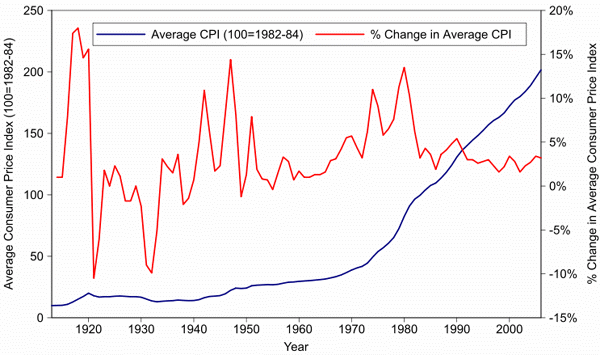
There is no need to be an economist here. Goods and services cost a lot more than they used to, in just a portion of my lifetime. The impact to my personal financial well-being is not found in some Keynesian dead-and-don't-care future. The impact is felt right now, particularly by those in the lower quartiles of the socioeconomic spectrum for reasons noted below. An update to my analysis on the widening gap between the plutocrats and everyone else is on the way, but in the meantime no one should think that profligate government spending, be it on stimulus or other financial boondoggles like wars all over the globe, will only hurt folks who are yet to be a twinkle in their parents’ eyes.
A Structural Transfer of Wealth
Consider a Monopoly game. If a house on Park Place used to cost $1,000 during the previous round, but now costs $1,500 due to an infusion of new money, as long as everyone at the table receives more money, more or less simultaneously, we're good to go. In real life, some people receive their extra money while that house on Park Place still costs $1,000 – allowing them to buy it – while other folks get their money, assuming they actually get more, after the cost has risen to $1,500, placing them further behind in a game they cannot control but must continue to play. When one examines inflation as driven by the Fed, and the resulting economic positioning of the plutocrats vis-à-vis regular folks, he is forced to conclude: this transfer of wealth is structural. Worse yet, since central banking is intended to function in this way, the effect cannot be mitigated by simply "giving the poor people their money first."
Some might suggest that the government could retire the additional money injected into the money supply, using the really smart guys at the Fed to control inflation or some such. To that I would simply say: All measures of the money supply point to it increasing steadily for some time now with no end in sight. Inflation, under the Fed and since the removal of the gold standard, has been positive, substantial, and sustained. Central banks exist to control the money supply, which generally means increasing it. One is hard-pressed to find another reason for their existence.
Once the Cantillon Effect has taken place, that is, after someone has purchased Park Place, or similarly invested the extra money they got ahead of you, it really doesn’t matter if the monetary basis – the money supply – returns to a previous level. (I know quite a few people, and I am one of them, who would vigorously argue that this structural transfer of wealth is exactly the reason the Fed was originally created – but that too is another debate.)
Conclusion
The negative effects of having less money because the State took some of what you had is obvious. The negative effects of inflation need to be just as obvious. If the amount of money held by everyone rose simultaneously with the level of inflation, it would not matter as much, but this is not the case.
The people at the top of the financial food chain are ahead of everyone else on an income and asset basis and will remain so – with a growing lead – for as long as the Fed controls the money. The short-term goodness of a make-work job this year will be mitigated by the increased cost of paying for electricity next year. The guys who own the electric company won't feel it that much. Their banker won’t feel it at all. The working stiff reading the NYTimes and feeling good about stimulus will...every time.
Wilt Alston [send him mail] lives in Rochester, NY, with his wife and three children. When he’s not training for a marathon or furthering his part-time study of libertarian philosophy, he works as a principal research scientist in transportation safety, focusing primarily on the safety of subway and freight train control systems.
© 2010 Copyright Wilt Alston / LewRockwell.com - All Rights Reserved
Disclaimer: The above is a matter of opinion provided for general information purposes only and is not intended as investment advice. Information and analysis above are derived from sources and utilising methods believed to be reliable, but we cannot accept responsibility for any losses you may incur as a result of this analysis. Individuals should consult with their personal financial advisors.
© 2005-2022 http://www.MarketOracle.co.uk - The Market Oracle is a FREE Daily Financial Markets Analysis & Forecasting online publication.
