


New Baghdad and the Collapse of Capitalism
Economics / Global Debt Crisis Mar 16, 2010 - 04:12 PM GMTBy: Casey_Research

 Doug Hornig, Casey Research writes: Forty years ago, it was a small town on the Persian Gulf, merely one of seven sheikdoms joined in federation in 1971 to create the United Arab Emirates. Basically, there was nothing there but sand. Yes, oil had been discovered under that sand, and the city/state was enjoying its first economic boomlet. From about 60,000 in 1968, population tripled by 1975, doubled in the next ten years, and nearly doubled again by 1995.
Problem is, especially compared with many of its Gulf neighbors, it didn’t have all that much oil to begin with, and its reserves were falling fast. What it did have was Sheikh Mohammed bin Rashid Al Maktoum, the most influential member of the family that had ruled for more than a century and a half. And the sheikh had a vision.
Sheikh Mohammed believed that the Muslim world needed a New Baghdad, a center of commerce and learning and culture that would shine like the hub of the old caliphate, which had dominated the civilized world a thousand years earlier. He was determined to erect a dazzling, ultra-modern new metropolis, starting from scratch.
On the sands of Dubai.
The rest of the story is pretty well known. The crown prince, and later ruler, of Dubai had his way. His emirate became one of the richest and gaudiest places on the planet. Population shot to almost 1½ million, about 90% of them immigrants – from unskilled Bangladeshi laborers to software engineers from the U.S. – all lured by the promise of better-paying jobs than they could find at home.
Even more striking was the explosion of construction projects. Up went mansions, office skyscrapers, artificial islands, stadiums, a speedy Metro, a busy international airport, and the world’s only 7-star hotel, among other things. And the capstone was, of course, the Burj Khalifa, formally opened on January 4.
The Burj Khalifa is the tallest manmade structure on earth. Not by a little, mind you; halfway is not a word in Sheikh Mohammed’s vocabulary. Tallest by so much that it boggles the mind. It’s 2,717 feet high. That’s more than half a mile. For comparison purposes, take New York’s late Twin Towers. Stack them one atop the other. Now you’ve got the Burj Khalifa.
Begun in late 2004, the building was originally budgeted at US$869 million. Final tally as we entered 2010 was something north of a billion and a half. That bought the first luxury hotel to bear the Armani name, four swimming pools, a 158th-floor mosque, 57 elevators, and an observation deck at 1,450 feet, along with 52,490 square meters of office space and 288,000 square meters divided among 900 apartments.
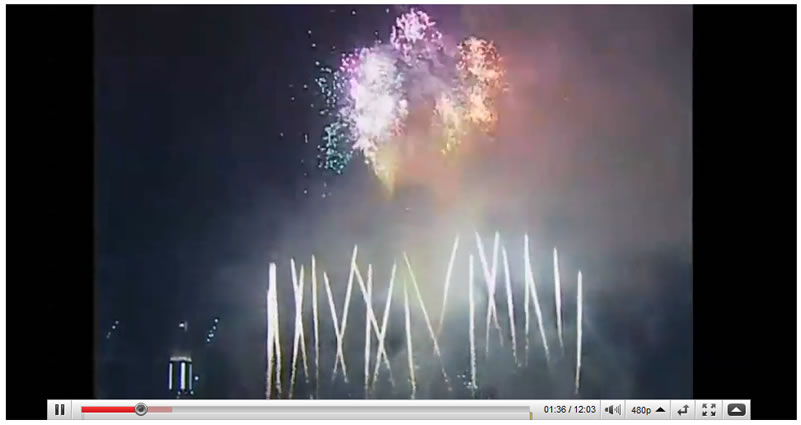
Its coming-out party, with 10,000 fireworks and synchronized fountains shooting jets of water 150 feet into the air, was a spectacular light show, worth watching if you haven’t yet seen it. Hard to believe that you’re looking at a bone-dry desert.
You may also be looking at a gargantuan white elephant. Although every unit in the Burj Khalifa has supposedly been sold, some unknown percentage of buyers (likely very large) was speculators who opted in during the height of the world real estate boom. Properties were flipped like it was Southern California. At the market peak, modest flats were fetching more than $2,700/sq. ft. No wonder Emaar Properties, developer of the project, claims it has already recouped its capital outlay from these suck--, er, investors.
Those prices have now plummeted by up to 50%. Of the folks left holding the bag, how many of the 25,000 slated to live in the building will actually do so? We don’t know, and no one who does will talk vacancy rates. In terms of transparency, Dubai makes the Bush administration look like an ad for Window World.
What we do know is that at the moment the structure is the Big Empty. Western critics have limbered up their keyboard fingers in order to pound out expressions of disdain, everything from “The Final Monument to Excess” to “Bling City Is Dead” to “The End of Capitalism.” The first may be apt, as we’ll probably not see the likes of the Burj Khalifa again, but the last? That’s something we want to look at more closely. There is a lesson to be learned.
The truth of the matter is that there were two key, and contradictory, elements to the Dubai miracle, and when the world recession hit in 2007, one overrode the other and the whole thing came tumbling down.
First: As noted, Sheikh Mohammed didn’t have a river of oil money to rely on. So how did he manage to build his gleaming city by the sea? On the surface, it was simple. Turn Dubai into one of the world’s premier places to do business. Make it essentially tax free. Create investment incentives. Attract entrepreneurs from all over. Enlarge and capitalize on the city’s status as a deep water port. Replace traditional smuggling with legit import/export operations. Become a world financial center.
In short, install the best aspects of free-market capitalism, then send an Open for Business letter to the world.
It worked. Capital, resources, and personnel flooded in. By 2005, oil and gas were responsible for only 6% of the emirate’s GDP. Property and construction was the biggest contributor at 22.6%, followed by trade at 16%, entrepôt (duty-free import/export business) at 15%, and financial services at 11%.
No one, apparently, thought it ominous that nearly a quarter of GDP was generated by the construction and trading of properties, nor paused to consider what would happen when the music stopped and supply exceeded demand. Dubai was riding high, a model for other resource-poor, developing nations, showing them how to get rich.
Today, the hot desert wind blows through half-buildings that will never be finished. Immigrants, their work visas rescinded, are rounded up and sent home. Mercedes Benzes and Jaguars have For Sale signs taped to their windows or are just abandoned at the airport. Real estate prices tanked by 50% in 2009 and are projected to suffer another 30% haircut this year. The stock market has plunged 70%. Unmaintained, the artificial islands designed as millionaires’ playpens have begun to sink beneath the sea.
The glorious ride is over. But just in case there was any doubt, the point was hammered home last November, when Dubai World – one of the country’s leading development conglomerates – told creditors it was declaring a six-month moratorium on repayments it could no longer make.
That sent shock waves through financial markets the world over. Everyone, it seems, had invested in Dubai during the boom times. Now they’re staring at a very unfavorable restructuring at best and flat-out default at worst.
Dubai’s debt, or at least as much of it as its rulers will reveal, is about US$80 billion, or 140% of GDP. Bad enough, but it may well be significantly understated. One local investment banker puts the real number in the $120-150 billion range; with no balance sheets to pore over, we can’t know. Dubai will ask oil-rich fellow emirate Abu Dhabi for help, but there are no guarantees help will be forthcoming. Abu Dhabi has always cast a disapproving eye on Dubai’s helter skelter expansionism, and if it does step in, it will probably demand a whole lot of collateral.
Critics of a certain bent have pounced. History’s grandest experiment in unfettered free-market capitalism ran aground, they cry. Therefore the system doesn’t really work.
Which brings us to the second element in the Dubai miracle. It was built on a mountain of debt that couldn’t survive an economic downturn. And who supported that debt? The government. All of those go-go corporations, like Dubai World, are essentially government owned. Sheikh Mohammed wanted his New Baghdad, no matter the cost.
Granted, private enterprise businesses are imperfect. When in trouble, they will lie and cheat like anyone else. But in the end, they have a bottom line that they have to reveal at some point. Accounting tricks are eventually exposed. Capitalism, like a computer, is strictly binary. A company with sound finances prospers; a company that fails in the marketplace simply disappears.
Government-sponsored entities have no such limitations. They’re actively encouraged to overreach, to take risks that no sane CFO would approve. Because if they bleed red ink, the government is there to step in and prop them up. All of Dubai’s corporations were “too big to fail.” But fail they did, and in the process pushed the government into insolvency as well.
The takeaway from this story is simple. Dubai was no more free-market capitalist than Soviet Russia. Or the U.S., for that matter. If the government is the guarantor of last resort or just perceived as the ultimate reliable source of bailout money, a business has no incentive to be well run. When government (with taxpayer funding) takes a stake in even that most American of corporations, GM, capitalism truly has collapsed. Not, however, because of its shortcomings. Because government has not allowed it to function properly.
Though we lack a symbolic last gasp like the Burj Khalifa, make no mistake about it: we’re all fellow travelers with Dubai now. Washington would do well to study what happened there and hopefully learn a thing or two. Because we’re speeding toward the same crack-up.
The U.S. economy is like an out-of-control sports car in search of a tree, and the government is not “here to help you.” Take matters in your own hands and prepare as best as you can for the crash that will come. To find out what to expect in 2010 and how to bullet-proof your assets, read our FREE special report “The Good, the Bad, and the Ugly.” More here…
© 2010 Copyright Casey Research - All Rights Reserved
Disclaimer: The above is a matter of opinion provided for general information purposes only and is not intended as investment advice. Information and analysis above are derived from sources and utilising methods believed to be reliable, but we cannot accept responsibility for any losses you may incur as a result of this analysis. Individuals should consult with their personal financial advisors.
© 2005-2022 http://www.MarketOracle.co.uk - The Market Oracle is a FREE Daily Financial Markets Analysis & Forecasting online publication.
