


To Beat the Stock Market, Be in the Right Sector - Part 2
InvestorEducation / Learning to Invest Oct 17, 2007 - 12:26 AM GMTBy: Hans_Wagner

 What stock market sector have you been in lately? The sectors that are beating the market or the ones that are trailing behind? Being in the right sectors will make a significant difference in the performance of your portfolio. However, finding the right sector can be a difficult proposition. In part one I introduced the basic theory behind sector rotation as described by Stan Stovell in Standard & Poor's Guide to Sector Investing 1995
  .
.
In this article we will examine a couple of recent studies on sector rotation that help illuminate the opportunities and the problems for investors. In a follow up article we will then provide some guidelines for investors and traders on how to use sector rotation to achieve better investing results.
Sector Rotation and NBER Business Cycles
In a paper published in July 2007 titled "Sector Rotation over Business-Cycles" , Jeffrey Stangl, Ben Jacobson and Nuttawat Visaltanachoti tested the sector rotation theory described by Stan Stovell's book Standard & Poor's Guide to Sector Investing 1995 . The following figure, taken from the paper, is an idealized NBER-style business cycle divided into five stages as done in other studies. Economic expansions span trough to peak in Stages I-III; recessions, peak to trough in Stages IV-V. As indicated, expansions are typically last longer than recessions.
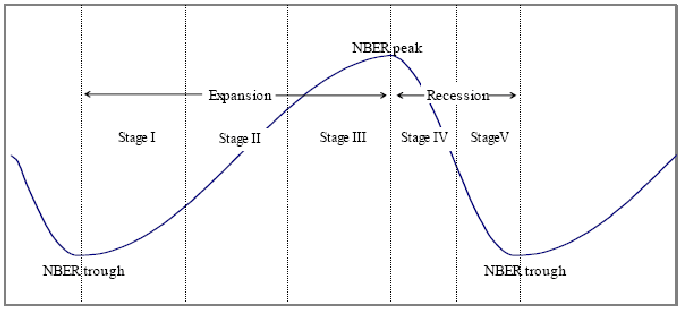
The following table is based on Standard & Poor's Guide to Sector Investing 1995 describes what sectors should perform best in each stage of the business cycle.

The chart below shows cumulative wealth from an initial investment of one dollar over the period 1948-2006 for three different strategies. The Market strategy maintains a portfolio that mirrors the stock market for the entire period. The Sector Rotation strategy uses perfect hindsight to buy and sell stocks in sector portfolios in equal weights during the business cycle stage according to the Sector Rotation model. The Market Timing strategy holds the market portfolio during business cycle Stages I, II, III and V and cash during Stage IV. The results of these three strategies show the simpler Market Timing strategy has greater potential than the Sector Rotation strategy. It also shows that timing strategies would beat buy-and-hold for an investor/trader who can accurately anticipate business cycle phases.
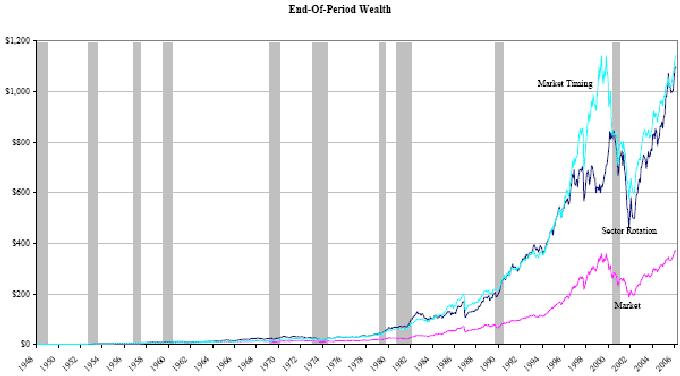
Please note that NBER tracks only business cycle turning points (peaks and troughs), not the five phases defined above, and NBER can take as long as two years after a turning point to designate its date. They also note each business cycle can be very different from another.
Using monthly industry returns, market returns and Treasury bill rates for 1948-2006 (nine complete business cycles), the authors found that:
-
Industry returns exhibit the same general pattern as market averages, lowest during business cycle Stage IV and highest during Stage V. Actual industry performance based on nominal returns across business cycle stages partially confirming conventional wisdom.
-
A sector rotation strategy based on conventional wisdom and perfect hindsight for timing stages of the business cycle produces a 2.1% annual Jensen's alpha .
-
Without perfect hindsight it is unlikely an investor could replicate this performance, especially when transaction costs are included.
-
The performance of sector rotation is inconsistent across the business cycle. During early and middle expansion (Stages I and II) "favored" sectors under perform the market, with negative Jensen's alphas of -5.3% and -1.0%, respectively. This is an area where further study might be able to correct the conventional wisdom resulting in at least market matching returns if not better.
-
During early recession (Stage IV), sector rotation strongly outperforms, with a Jensen's alpha of 10.3%.
-
An alternative, much simpler market timing strategy that is fully invested in the broad market during Stages I, II, III and V and in cash during Stage IV hypothetically beats a sector rotation strategy over the same period in terms of cumulative wealth and Sharpe ratio .
In summary, using a sector rotation strategy as defined by Stovell and the NBER stages it is unlikely that an investor/trader can outperform the broad stock market. The simpler go to cash during the first half of recessions offers greater potential.
This study shows that sector rotation as defined by the Stovell can generate returns that beat the market by investing in the Stovell sectors aligned with the NBER economic cycles. However, perfect hindsight is not the real world and investors are not likely to replicate the returns of the study. It is a matter of timing the entry and exit from the position based on where one is in the economic cycle. Unfortunately, economic cycles do not follow well defined cycles, making the timing strategy a difficult one.
However, further study is called for to improve the results in Stages I and II, where the sector rotation strategy under performed the market.
Many practitioners of sector rotation use it to identify where to focus the search for the right stocks to buy, rather than buying the entire sector. Unfortunately I have been unable to find and definitive studies that prove one way or the other that using sector rotation as a precursor to stock selection works. It is believed to work by many investors and I have found it to be very useful in the stock selection process.
Sector Rotation and Monitory Policy
In another recently completed study titled Sector Rotation and Monetary Conditions ” (PDF) show that U.S. Federal Reserve interest rate policy changes are associated with strong patterns in equity returns. The article, authored by Robert Johnson, C. Mitchell Conover, Gerald R. Jensen, and Jeffrey M. Mercer, to be published in the Journal of Investing indicates that a sector rotation strategy based on the Federal Reserve rate changes could substantially improve a portfolios performance over the past 33 years. According to the study investors do better when they follow a more aggressive strategy when the discount rate is decreasing and a more defensive strategy when the Fed is raising rates.
The key empirical findings reported in the study include the following:
-
Between 1973 and 2005, returns for a market portfolio averaged 12.0 percent. The return was 17.4 percent in periods following discount rate decreases (expansive monetary policy periods) and 5.3% following rate increases (restrictive monetary policy periods). Thus, returns following discount rate decreases were three times the average return earned following rate increases.
-
The average return for cyclical stocks (cyclical consumer goods, cyclical services, general industrials, information technology, financials, and basic industries) was 20.3 percent during expansive periods and 2.3 percent during restrictive periods.
-
The average return for non-cyclical stocks (resources, non-cyclical consumer goods, non-cyclical services and utilities) was 14.7 percent during expansive periods and 10.2 percent during restrictive periods.
-
A sector rotation strategy guided by Fed policy shifts beat the benchmark portfolio by 3.5 percent per year.
-
Federal Reserve policy shifts occur infrequently. In the 33-year study period, the Fed only changed the direction of the discount rate 14 times.
-
In the 33-year study period, the Fed was expansive 57 percent of the time and restrictive the remaining 43 percent.
Consistent with expectations, these authors found that the actual returns varied across sectors. Cyclical stocks exhibit far more sensitivity to changes in monetary conditions. Shifting the make up of the portfolio when a change in the direction of Fed discount rates changes, generates statistically better returns. Specifically, performance is enhanced by shifting into cyclical stocks following rate decreases (a signal of more expansive monetary policy), while the appropriate response to a signal of a more restrictive Fed policy is a shift to defensive stocks. The cyclical sectors include consumer discretionary, energy, financial, healthcare, industrials, materials and technology. The non-cyclical sectors include consumer staples and utilities. Of course cash also works well when the market is heading down.
The Bottom Line
Using sector rotation to time you entry and exit from a sector can work if one is able to accurately identify the transition from one cycle to the other. However, knowing where one is in the economic cycle is a much more difficult problem. This insight can hinder the effective use of sector rotation if one is investing in the entire sector. However, it is believed by many successful investors and traders that sector rotation is a good way to limit the choice of stock selection to those that are entering favorable sectors.
Also following the direction of the U.S Federal Reserve discount rate can also be useful to identify what sectors to invest. When the Fed is lowering the discount rates it is best to be in cyclicals, industrials, technology, financials, and materials. When the Fed is raising the discount rate then investors should focus on non-cyclical stocks such as consumer staples, and utilities.
By Hans Wagner
tradingonlinemarkets.com
My Name is Hans Wagner and as a long time investor, I was fortunate to retire at 55. I believe you can employ simple investment principles to find and evaluate companies before committing one's hard earned money. Recently, after my children and their friends graduated from college, I found my self helping them to learn about the stock market and investing in stocks. As a result I created a website that provides a growing set of information on many investing topics along with sample portfolios that consistently beat the market at http://www.tradingonlinemarkets.com/
Hans Wagner Archive |
© 2005-2022 http://www.MarketOracle.co.uk - The Market Oracle is a FREE Daily Financial Markets Analysis & Forecasting online publication.
