


Japan forced to keep interest rates on hold as Tokyo Warlords Hijack the Bank of Japan
Interest-Rates / Japanese Interest Rates Jan 23, 2007 - 10:46 PM GMTBy: Gary_Dorsch

In an age when ruling parties of every political stripe manipulate data to promote their own self interests, there is also strong universal cynicism towards government statistics on inflation. It is natural for official inflation data to be wildly at odds with the realities of the marketplace, and regarded with utter disbelief. Nowhere on Earth is there more skepticism about inflation data than in Japan, especially after Tokyo's financial warlords rigged the core CPI last August, and shaved 0.4% off the official inflation stats with the stroke of a pen.
That slick maneuver handcuffed the Bank of Japan from raising its overnight loan rate to 0.50% for the past four months. Tokyo was able to buy more time to keep the Nikkei-225 index afloat with a cheap yen policy, but Tokyo gold prices are now bumping against 78,000-yen /oz, just 4% shy of their 18-year highs set in May 2006, reflecting the massive amounts of monetary steroids injected by the BoJ into the Tokyo and global money markets for the past five years.
Now, there is heightened speculation that the regime of PM Shinzo Abe has gone a step further and hijacked the Bank of Japan, robbing the central bank of its independence. “The government and the BOJ should share major policy objectives through mutual understanding, but not numerical targets,” said Japan's top government spokesman, Chief Cabinet Secretary Yasuhisa Shiozaki on January 23rd.
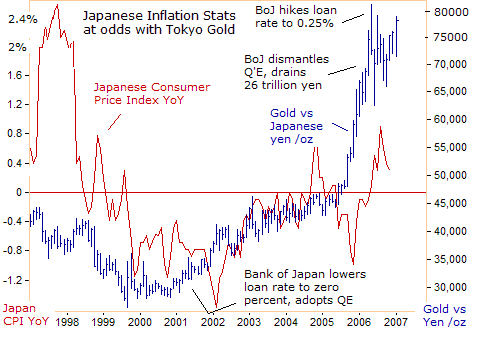
The Bank of Japan was forced to kept its powder dry on January 18th, leaving its overnight loan rate pinned a just 0.25%, and sending the yen to a four-year low against the US dollar, a 9-year low against the Korean won, and a 14-year low against the British pound. Speculation is rife, that the BOJ buckled under heavy pressure from Tokyo's financial warlords, and a global flight from the Japanese yen could be in the cards in the first quarter of 2007.
Bank of Japan Handcuffed by Ruling Politicians
At a time when Iceland's central bank is pegging its overnight loan rate at 14.25% to defend its currency from speculative attack, it's ironic that the world's second largest economy cannot withstand a baby-step rate hike to 0.50 percent. “Speculation is speculation. As always, our decision is based on our careful assessment of the economy and prices. There is no room for factors other than economic and price conditions to wield clout over monetary policy,” BoJ chief Toshiro Fukui explained.
The Bank of Japan faces tough political opposition to a rate hike before an election for parliament's upper house in July. “With the US economy slowing and domestic price growth showing no sign of accelerating, the BoJ's next move should be to lower, not raise, its policy target rate,” said Kozo Yamamoto, a senior vice minister of economy, trade and industry. “Nowhere can we see signs of inflation, and consumer prices could turn negative any time,” he warned.
“There is no reason for there to be talk of a BOJ rate hike unless the core CPI grows consistently above 0.5%,” Yamamoto added. Japan's core CPI was 0.2% higher last month, adjusted for the re-jig of the CPI components last August, which shaved 0.4% off the inflation data. “I believe Japan has yet to come out of deflation,” said Shoichi Nakagawa, the ruling LDP policy chief. “I'm against the BOJ raising rates. Given the state of the Japanese economy, talking of a rate hike is absurd,” he said.
“It's up to the BOJ to decide whether to raise rates,” said Japanese Economics Minister Hiroko Ota on Jan 14th. “We are truly at the crucial moment of finding out whether the Japanese economy could get out of deflation. And consumption has recently been somewhat weak. It is a critical period and the path toward escaping from deflation may reverse. I hope the BOJ will make a decision while taking responsibility for its action,” Ota said.
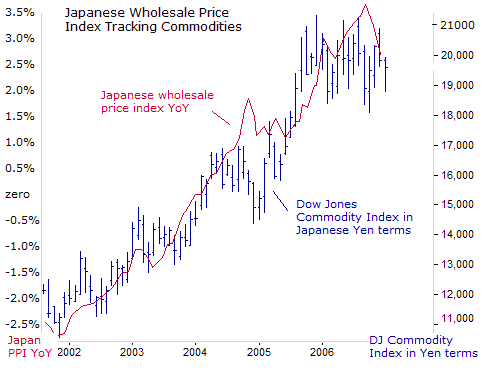
Setting the manipulated CPI data aside, Tokyo said Japanese wholesale prices were 2.5% higher in December from a year earlier. The Japanese corporate goods price index (CGPI), which tracks trends in global commodity markets, slowed for the third straight month after hitting a 25-year high of 3.6% in September, with crude oil and other raw material prices falling sharply, and lowering the costs of key imports.
However, in light of the Japanese yen's devaluation against the US dollar, in which most international commodities are traded, the Dow Jones Commodity Index in yen terms, has stayed elevated in a range within easy striking distance of its 25-year high. A further sharp devaluation of the yen could lift commodities higher in Japan, and lead to higher factory inflation.
The DJ Commodity index is 63% higher in yen terms from five-years ago, or an annualized inflation rate of 12.6%, far above the Tokyo's wholesale price statistics. Where is the deflation that Tokyo's financial warlords fret about? Instead, it's entirely possible, that the BoJ's failure to tighten in monetary policy in a timely manner can revive the “Commodity Super Cycle” and a new wave of global inflation.
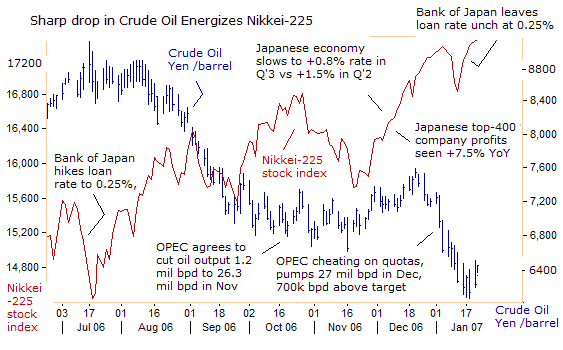
With crude oil falling 10% towards 6,400-yen per barrel in early January, one can might see a down-tick in Japan's official wholesale price stats towards 2.2%, buying more time for the BoJ to keep rates unchanged. Yet the Nikkei-225 has climbed to the 17,500 level, telegraphing a rebound in the Japanese economy from a slack 0.8% growth rate reported in Q'3, with sharply lower oil prices putting more yen in consumer's pockets and boosting company profits.
The US Dollar breaks thru the 120-yen barrier
“I have asked the Bank of Japan that their monetary policy should support economic growth,” said Japanese Finance Minister Koji Omi on January 8th, after meeting US Treasury Secretary Henry Paulson in Washington DC. Omi's comments triggered a US dollar rally above the psychological 120-yen level, to its highest level in four years, perhaps with the consent of the US Treasury.
If the Bush administration has signed on to the yen's devaluation, then it's turning a deaf ear to Detroit's Big Three automakers. The chief executive of hard-pressed automaker General Motors charged on Nov 14th that “the Japanese yen is systematically undervalued, which helps Tokyo to maintain significant trade balance surpluses in our industry. Japan's yen is kept artificially low so that the effect is to provide a subsidy between $3,000 and $9,000 per vehicle for Japanese cars.”
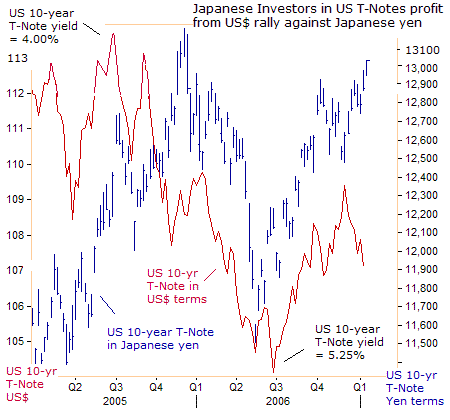
Why would the Bush administration agree to a stronger dollar and a weaker yen, after General Motors slashed 30,000 jobs and closed 12 facilities in North America over the past 12-months? America's dependency on foreign capital to finance its budget and trade deficit puts foreign creditor nations in the driver's seat. The dollar's rally above 120-yen, provides currency profits for Japanese investors in US bonds, and also discourages them from dumping US Treasury debt.
Japan is the largest holder of $637.4 billion of US Treasury securities, but was a seller of $2.2 billion of US bonds in November. Japan has been a gradual seller of US Treasury bonds since August 2004, when its holdings peaked at a record $699.4 billion. Japanese sales of US bonds would probably have accelerated at a much faster clip, if the US dollar was trending lower against the yen.
Since August 2004, China has picked up the slack from Japanese investors, boosting its holdings of US Treasuries from $201.6 billion to a record high of $346.5 billion in November. Beijing was a buyer of US debt, even as it allowed the yuan to appreciate 6.3% against the US dollar since July 2005, sustaining a foreign currency loss in its massive US bond portfolio. Beijing continues to buy US debt to avoid hostile protectionist legislation from the White House.
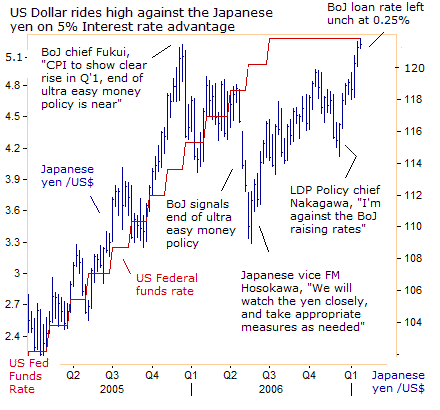
But the BoJ's super easy money policy is only half of the story behind the US dollar's strength against the yen. The dollar enjoys a 5% interest rate advantage over the yen, and “yen carry” traders can borrow in yen and re-lend the funds in higher yielding currencies around the globe, including the Australian dollar, British pound, Korean won, the US dollar, or buy gold and silver. JP Morgan estimates the size of “yen carry” trades world-wide to be about 40 trillion yen, or $331 billion.
The “yen carry” trade has muted concerns about trade imbalances between Japan and the US. Over the past 12-months, Japan racked up a 200 trillion yen ($171 billion) current account surplus, or roughly +3.8% of its GDP, compared to US external deficits of $860 billion, or -6.8% of GDP. Yet the currency with massive external deficits is climbing against the currency with huge surpluses.
Obviously, Tokyo's interest rate policy is far out of alignment with the rest of the world, and is expanding big bubbles in local and foreign markets. But Japan had 765 trillion yen in sovereign marketable securities, or $6.5 trillion, outstanding at the end of June, and its finance ministry will pay 21 trillion yen ($177 billion) in interest expense this year, the equivalent of Hong Kong's gross domestic product. So naturally, the Shinzo Abe regime is opposed to any increase in interest rates.
Europe Expresses Frustration with Tokyo Warlords
Euro zone officials are frustrated by the yen's weakness against the Euro, especially after the BoJ refrained from an expected rate rise, with accusation of dirty politics at play. Jean-Claude Juncker, representing finance ministers from 13 Euro zone countries remarked, “I get the impression that there was something akin to political influence on the Japanese central bank's decision,” he said.
Juncker said the BOJ had been prepared to raise rates. “The Japanese central bank has now voted 6-3 to hold rates steady, so that what was bound to happen has happened, namely the Euro-yen exchange rate has swung so far to our disadvantage that the yen is now enjoying a particular low,” he said. Juncker's comments and French calls for a weaker Euro against both the US dollar and the yen are likely to put exchange rates on the agenda at the next Group of Seven meeting in February.
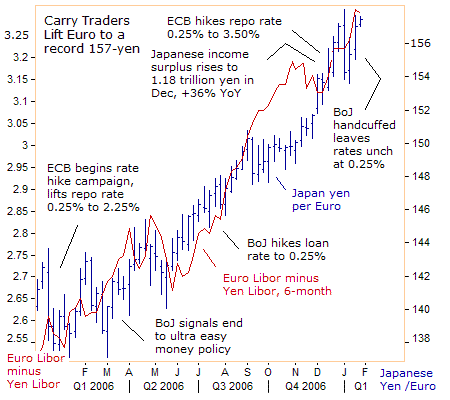
Since the start of the current ECB rate hike campaign, Euro Libor rates have outpaced yen Libor rates by roughly 85 basis points, encouraging carry traders to bid the Euro 14% higher to a record 157.5-yen this week. Until Juncker's outburst, Euro zone officials were silent about the cheap yen policy, allowing currency traders to earn an extra 3.25% interest on the Euro /yen cross rate and a nice profit to boot.
Looking forward, ECB officials are dragging their heels on future rate increases, but are still expected to lift the repo rate to 3.75% in March. Italian central banker Lorenzo Bini Smaghi said on Jan 23rd, “The ECB's repo rate is still accommodating. Growth will remain robust in 2007. If the growth scenario is confirmed, not to adjust interest rates accordingly would mean feeding excessive liquidity growth,” he said.
“I am still of the opinion that there are upward risks to price stability in the Euro zone,” said Bundesbank chief Axel Weber on Jan 22nd, adding that higher-than-expected wage deals were the biggest risk to inflation. “Monetary policy cannot wait until second-round effects materialize. We have to run a forward-looking monetary policy and orient ourselves based on what our expectations are,” he said.
With the ECB's repo rate heading higher and the BoJ handcuffed by Tokyo warlords, there is no end in sight for the Euro's advance against the yen, and the widening of Japan's trade surplus with the European Union, which jumped 51% in November from a year earlier. When asked his views on the Euro /yen and Japan's surging trade surplus with the EU, Japanese Vice finance minister Hideto Fujii sounded annoyed, “As I have said repeatedly, excessive fluctuations and disorderly moves in the currency market are undesirable.”
Who will step up to the plate to buy the low yielding Japanese yen? United Arab Emirates central bank chief Sultan Nasser al-Suweidi dismissed the yen as a possibility for reserve diversification on Nov 19th, “The yen is not a currency. It's very much controlled by the central bank of Japan and I would say it's lost confidence," he said. Arab Monetary Fund director Mannai said the yen lacked appeal for the Arab Gulf states. “I think yen is losing ground in favor of sterling.”
Yen Carry Trade Upsetting Korean Stock Market
Complaints about Tokyo's cheap yen policy may start to grow louder in the months ahead, and leading the pack could be South Korea's finance ministry. The South Korean won rose to 7.75-yen, it's highest in over 9-years, after the Bank of Japan left rates on hold, hobbling the already low-yielding currency. Seoul is coming up with new ways besides market intervention to cap the Korean won's strength.
Seoul plans to exempt Korean investment firms and securities companies from taxes on profits generated from overseas investments, starting from the first quarter of this year for the next three years. Until recently, the government had deducted tax from income at source at the rate of 14 percent. “The following measures are expected to see results of an outflow of around $10 billion-$15 billion, which is an outstanding effect to the market,” said Finance Minister Kwon O-kyu.
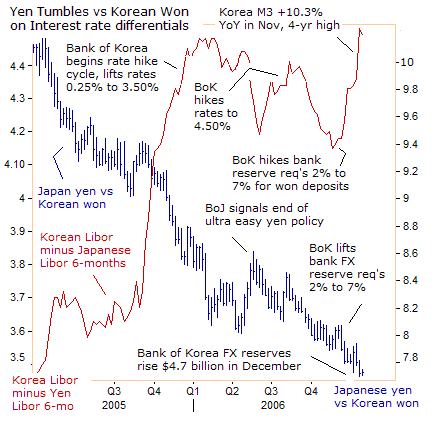
Still, the flow of money from Tokyo into the higher yielding Korean won might mitigate much of the finance ministry's efforts, with Korean won deposits offered 450 basis points above comparable yen Libor rates. Sharply higher yields in Korea have led to a 22% devaluation of the Japanese yen against the Korean won from two-years ago, despite central bank intervention to stem the won's strength. South Korean foreign reserves rose by $27 billion in 2006, mostly due to intervention.
“If the government judges we need to stabilize the won, we can consult with the central bank and we have unlimited resources,” said Deputy Finance Minister Kim Sung Jin on Dec 22nd. “Market participants should clearly recognize that. Basically, the market decides supply and demand, but if the won moves excessively in a short period of time, it can give shocks to the economy. We need a stable currency for the sake of a stable economy and the government will try to maintain that,” he said.
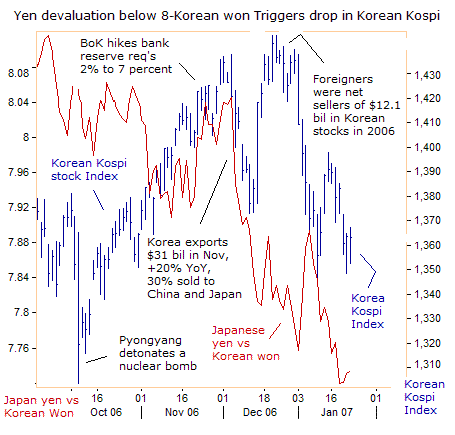
Seoul is worried that a stronger won will make South Korean exporters uncompetitive versus Japanese exporters, especially when a slowdown in the United States is threatening to reduce demand from the world's biggest economy. To maintain competitiveness, Korean exporters must lower their sales prices, thereby squeezing profit margins. Every 1% gain in the won cuts earnings-per-share of Kospi blue-chips Samsung Electronics by 0.8% and Hyundai Motor by 2 percent.
Yet Korean exports jumped by 20% from a year earlier in November to a record $31 billion, even as the won climbed to nine-year highs against the dollar and the yen. China and Japan together account for about 30% of Korean exports. Still, growth in exports, which make up 40% of Korea's $788 billion economy, will slow to 10.4% this year compared with 14.6% in 2006, the Commerce Ministry said on Jan 3rd.
Korean manufacturers are the most pessimistic as the won's surge to the highest since 1997 poses a direct threat to sales and earnings. Shares in Hyundai Motor, which sells three out of four cars it makes overseas, dropped 14% in the second half of last year. The won-yen rate has a significant impact on South Korea's export volume, while the won-dollar rate is related to corporate profitability.
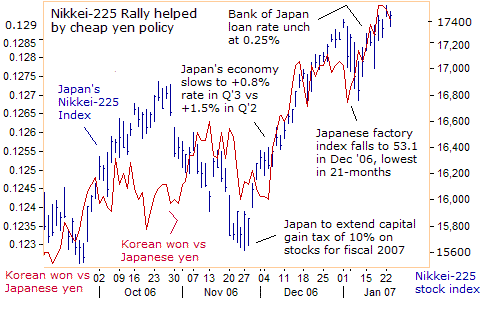
South Korea's benchmark Kospi was Asia's second-worst performing stock index last year. On the flip side to the Kospi's malaise, Japan's Nikkei-225 index sprang to life with a late year-end rally, climbing to 17,500, by tracking the Korean's won's rally against the yen. The Nikkei share average ended with a 6.9% gain last year, marking its fourth straight year of advances and its longest bull run in nearly two decades. The weak yen boosted exporters such as steel and auto makers.
Bank of Japan to fuel Global Inflation
Public support for Japanese PM Shinzo Abe has been gradually declining since he replaced the widely popular Junichiro Koizumi in September, in part due to a perception that he is closely tied to vested interests. The Abe cabinet enjoyed a public support rating as high as 71% when it took office, but a poll for the Sankei Shimbun newspaper found it had fallen to 47.7%, a new low.
 |
With his popularity sinking, Abe might be more determined than ever to tightly control the Bank of Japan and its interest rate policy. However, a chorus of foul-play towards the cheap yen from Japan's major trading partners in Australia, China, the Euro zone, Korea, and elsewhere, might force Abe to relent to a baby step rate hike in the months ahead. |
But a baby step rate hike to 0.50% would still leave Japan's borrowing rates the lowest in the universe, and won't scare off “yen carry” traders. Global imbalances in terms of trade, and bubbles in asset markets could become more pronounced in 2007, due to Abe's reckless policies. Japan's central bankers understand the risks.
In a speech given in March 2006, the BoJ's leading hawk, Atsushi Mizuno said, “The biggest lesson to be learned from the bursting of the bubble in the early 1990's was the importance of forward-looking monetary policy and of monitoring various signals from asset prices. If there are excessive expectations for zero interest rates to continue long-term, then the stimulus on demand will be too strong, and fluctuations in the economy and asset markets could become very big, and that in turn, could make official rate movements that much bigger.”
“Raising rates just to prevent overheating in the economy or excessive gains in asset prices will likely be difficult for the government or market participants to accept, if core consumer prices are rising only moderately year-on-year,” he said. Mizuno's prognostications seem to becoming true, but what he didn't envisioned was a loss of independence for the BoJ to rein in global bubbles before they grow bigger.
By Gary Dorsch, Editor, Global Money Trends newsletter
## “This article is just the Tip of the Iceberg” of what’s available in the Global Money Trends newsletter published around the 1st and 15th of each month in pdf format, and 20-25 pages in length. GMT collects a wide array of news and information from reputable sources, filters out the noise and distractions, and puts all the pieces of the global economic puzzle together into coherent snapshot analyses, with lots of cool charts depicting the inter-relationships of markets and economies from around the world.
Here's what you will receive with a subscription,
Insightful analysis and predictions of, (1) top stock market indexes around the world, and US-listed Exchange Traded Funds (ETF’s) and closed-end country funds. (2) Commodities such as crude oil, copper, gold, silver, the CRB index, and gold mining and oil company indexes. (3) Foreign currencies such as, the Australian dollar, British pound, Euro, Japanese yen, and Canadian dollar. ($) Libor interest rates, global bond markets and their central bank monetary policies.
Subscribers will also receive Email Alerts, sent out in-between regular newsletter postings, when important information unfolds in the global markets. A subscription to Global Money Trends is only $125 US dollars per year for 24 issues, including access to all back issues. Click on the following hyperlink, to order now, http://www.sirchartsalot.com/newsletters.php
Disclaimer: SirChartsAlot.com's analysis and insights are based upon data gathered by it from various sources believed to be reliable, complete and accurate. However, no guarantee is made by SirChartsAlot.com as to the reliability, completeness and accuracy of the data so analyzed. SirChartsAlot.com is in the business of gathering information, analyzing it and disseminating the analysis for informational and educational purposes only. SirChartsAlot.com attempts to analyze trends, not make recommendations. All statements and expressions are the opinion of SirChartsAlot.com and are not meant to be investment advice or solicitation or recommendation to establish market positions. Our opinions are subject to change without notice. SirChartsAlot.com strongly advises readers to conduct thorough research relevant to decisions and verify facts from various independent sources.
© 2005-2022 http://www.MarketOracle.co.uk - The Market Oracle is a FREE Daily Financial Markets Analysis & Forecasting online publication.
