


US Housing Slump Continues - Boom Bust Cycle - Silicon Valley Housing Market Report
Housing-Market / Analysis & Strategy Jan 28, 2007 - 10:42 PM GMTBy: Jas_Jain

In this report you will see facts, based on the available data, that you will not find anywhere else. Vast majority of economists and statisticians who prepare housing reports are "professionals" that get paid to talk up the game. This is a NO BULL! report. The purpose of this report is to not only present the facts but also a commentary on the mindset of people who live there. Just to give you some flavor of the facts, how many people know the following (all home prices are median price)?
Price change, during Apr'00-Dec'06 (80 months), for all homes sold in Santa Clara County = 35%.
Price change, during Apr'00-Dec'06, for all homes sold in Los Angeles County = 165%.
Price change, during Apr'00-Dec'06, of the US Treasury STRIPS in my IRA account = 70%.
Silly.con is a play on words derived from silicon and represent silly little con game that made many in the valley very rich and led to a general climate of prosperity for most of the past dozen years. The con game was a clear case of accounting fraud related to stock options, aka Scam Options. A prosperity like that changes people's perceptions about economics, investments, and even life. Once used to unearned compensation, rooted in fraud, and get-rich-quick schemes, people develop habits and thinking of ignoring material facts and they start to believe their own BS about why the jolly ride will continue. Housing is one area where the jolly ride will crash based on the data available.
Some Important Facts That Should Govern Housing Prices, Long-Term
One must not confuse the speculative demand for a fundamental demand. The most important fundamental facts are supply and demand for house-dwellings, based on population, or households, and the supply of housing units, as well as employment. Table 1 presents changes in these from 2000 to 2005, period for which data, or estimates, are available.
Table 1: Factors Affecting Supply-Demand in Santa Clara County (SCC),
San Francisco Bay Area (SFBA) and CA
| Increasing Supply & Declining Demand Has Led to Explosion In Vacant Units In SCC & SFBA |
|||
| Data Source | http://census.abag.ca.gov | ||
| Table Source: | Jas Jain; 01/25/07 | ||
| Statistic | Change From 2000 to 2005E | ||
 |
|||
| SCC | SFBA | CA | |
| TOTAL POPULATION | -0.8% | -1.0% | +4.2% |
| Employed civilian pop. 16 years and over |
-5.0% | -3.3% | +8.8% |
|
|||
| Total housing units | +4.5% | +4.4% | +6.3% |
|
|||
| Vacant housing units | +85.6% | +88.7% | +25.2% |
When I sent out the above table to my private list one Silly.con Valley bull (SVB), who lives in Los Altos, a featureless neighborhood (as my son described after his recent business trip, his first to the township) with ridiculous home prices (a 3/4BR box home for $1.5M), promptly replied that these were one of my usual "worthless statistics." This SVB then went on to claim that he knows the most important facts about the supply-demand in Silly.con Valley for the period, 2000-05 - the population of Indians, in tech employment, and their living habits, in terms of housing, in Silly.con Valley during late 1990s and 2000 - and he is satisfied that all is well because many of those Indians have gone back during the slowdown of 2001-02. This is how the best and the brightest of Silly.con Valley deal with discomforting fundamental facts - denial and bogus explanations. Had this guy, a white, checked the facts (I gave the link to the source data) he would have discovered the truth about the demographic changes in the area.
Changing Demographic Characteristics
BETWEEN 2000 AND 2005 THE (NON-LATINO) WHITE POPULATION OF SANTA CLARA COUNTY DECLINED BY 11.7%! The white population of the Bay Area during the period declined 8% and that of California declined by 3.4%. I seriously doubt that the white population has begun to increase after 2005. BTW, the population of blacks has also declined in all the areas in the table. Needless to point out that the Asian population in all these areas has exploded and I would not be surprised if the Indian population, a part of the Asian population in the census, has followed the same pattern. I don't think that there has been a single year since 1980, or even earlier, in which the population of Chinese and Indians in Silly.con Valley has declined.
Almost all the decline in the white population of Santa Clara County was replaced by the growth in the Asian population during the period. Could it be that whites unable, or unwilling, to compete are fleeing areas and schools where there is a high concentration of Asians? Evidence on schools seems to suggest that. I know of a well-off white kid (I believe from Los Altos, or nearby) who quit a certain school because he wasn't having fun! And it was okay with the parents. When it comes to sports whites don't easily quit, but when it comes to education it seems that they do. Actually, it says a lot about the general US culture in recent decades. Many blacks and whites are more dedicated to success in sports and entertainment, in terms of sacrifice and effort, than are Asians when it comes to schooling. It wouldn't be much fun for whites when Asians start to eat their lunch. There is a future price for the present fun. Also, there is a future price in terms of lower living standards for the present borrow-and-spend! Is there a free lunch?
The Hispanic population of the areas in the table has also increased but nothing like the Asian explosion, especially in Silly.con Valley. I am quite sure that the average IQ of Silly.con Valley is higher today than in 1995 when the most recent tech boom began. But, when the economy goes into a depression all that brainpower wouldn't save it from economic misery, as was the case with Manhattan during 1930s. The bubble mentality, led by gambling instincts, is much more common among intelligent and "educated" folks, as exemplified by SVB. And the East Asians are notorious gamblers to boot. I think that disproportionate Asian speculation has bid up the prices in many parts of California. My observation is that outside of the Bay Area white men are the least involved, relatively, in speculative buying of homes in the current boom, at least in California. White women have taken some of the slack. Why miss on a sure thing?!
The Latest Trend In Home Prices, Inventory and Sales In Santa Clara County
Santa Clara County (SCC) is a good proxy for Silly.con Valley. I collect data for SCC on a regular basis and therefore I have chosen to focus my data presentation for SCC. Bulls still cling to the insignificant YoY price gains that are reported while ignoring what did happen during the 2006 as shown in Figures 1 and 2 below.
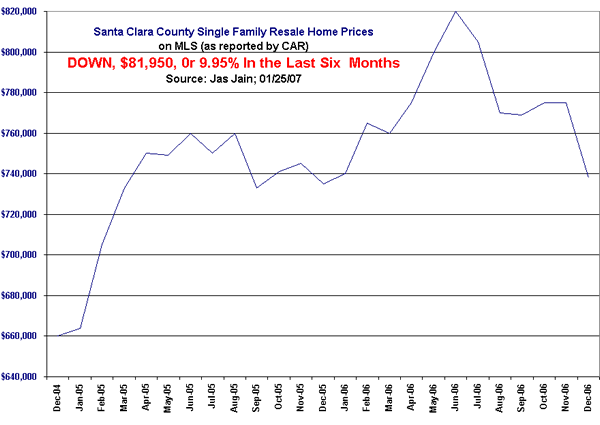

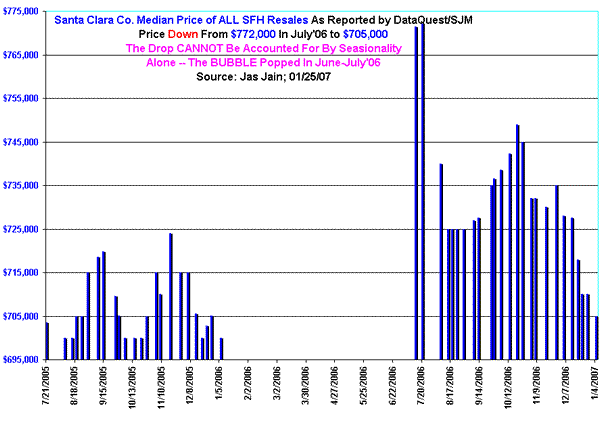
I don't have the data for the missing period in Fig. 2, but Fig.1 should suffice because the two have very high correlation (DataQuest includes SFH resales outside of the MLS listings, including to relatives). In terms of price, seasonality accounts for no more than 3-5% decline from the Spring/Summer peak to Fall/Winter lows. There is no doubt that the price bubble in Silly.con Valley popped during June-August period, which is anything but a slow period, of 2006. Just ponder on the following:
THE MEDIAN RESALE PRICE OF SANTA CLARA COUNTY SFH ON MLS, IN DECEMBER 2006, WAS BELOW THAT OF APRIL 2005 AND ON DATAQUEST REPORTS THE PRICE IN EARLY JANUARY 2007 WAS FIRST REACHED IN AUGUST 2005, OR EARLIER (I AM MISSING THE DATA).
What better proof do you need that the price bubble has popped in 2006?
In order to figure out what lies ahead for the home prices for Silly.con Valley in 2007 let us look at the trend of the median listing price (the best leading indicator of the trend in future sale prices) as well as in supply and demand, or volume of listings and sales.
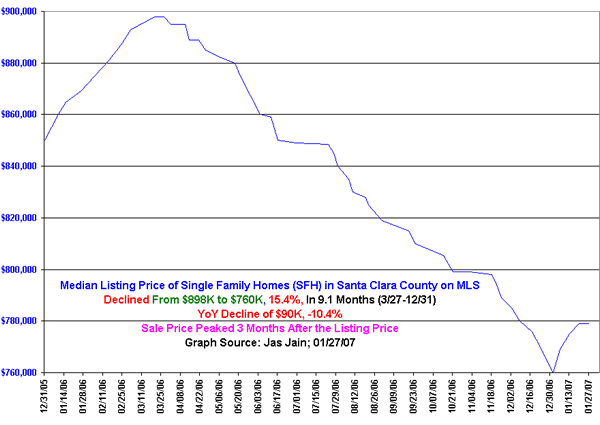
Fig. 3 is the best leading indicator that the prices in 2007 will be lot lower than in 2006 and this is also supported by the supply-demand data in Figures 4 and 5 below.
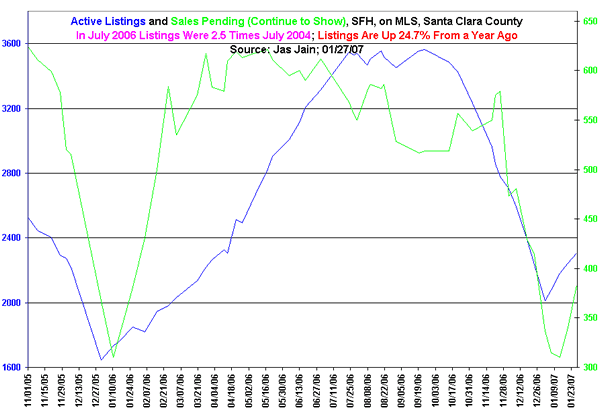
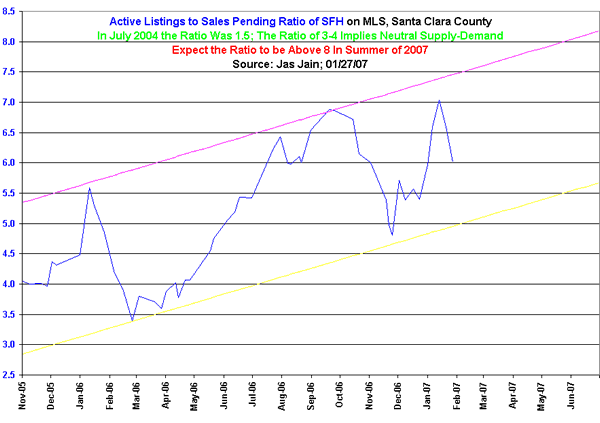
The seasonality of listings and sales is well known and quite obvious in the above figures. SVB made a bogus argument recently that the inventory in the area was down, when in fact the inventory is up close to 25% from a year ago level and the decline during Oct-Dec was strictly seasonal.
The single statistic that is most indicative of the supply-demand mismatch, or balance, is the ratio of Active Listings to Sales Pending. In the summer of 2004 the mismatch was clearly favoring higher future prices, with ratio close to 1.5, but all that changed in the summer of 2006 when the mismatch clearly shifted towards declining future prices. As the 2007 begins the situation is only worse compared to 2006 and the pressure on the prices is to go lower. Some time in 2007 the prices should be down more than 10%, YoY, and down 15-20% from the peak in June-July 2006. Foreclosures and defaults will keep on exploding during 2007.
It will be all over for the bulls when the March and April housing data are released. However, we should know in two months what is in store in those reports based on number of listings and median listing price. Thus far, the listings are up 25% and the listing price is down 10%, YoY, in SCC. Things could get lot worse in another two months when the supply-in-the-waiting comes to the market and all those new homes that got started in the second half of 2006 get completed for the spring selling season. The slowdown in permits and starts wouldn't have any material effect until later in 2007.
A "Historic" Perspective On the Past Dozen Years of the Twin Bubbles
There were two bubbles in the past dozen years, 1995-2006, in the US that would prove to be the worst of their kind in terms of speculative participation and outrageous levels of prices reached at their heights. In Japan, some fifteen years ahead of the US, the two bubbles were closer in time, or more concurrent, than in the US, but the aftermath of the full bursting of the two bubbles would follow a similar pattern. The level of the household debt in the US guarantees a far worse outcome for the American households than was the case for the Japanese households, especially, middle class. The Japanese twin bubbles didn't take as many prisoners! The Japanese prisoners were mostly businesses, including banks, and fat cats. American businesses and fat cats are lot "smarter," i.e., devious; they have transferred the risks and future pain to the middle class. Yes, indeed, there are "cultural differences between Japan and America"! No, you dumbkopffs, the bursting of the twin bubbles wouldn't end better for American middle class than for Japanese middle class. Have you checked the compensation of the CEO of Toyota versus the failed CEOs of the American corporations? Yes, it will end better, financially, for America's CEOs.
Nowhere did these bubbles played more important role in the economy and the lives of people than in Silly.con Valley, though Manhattan should not be far behind. The two bubbles fed each other and Silly.con Valley housing is the best proof of that. With the benefit of hindsight we can understand what did happen. Fig. 6 is a good starting point to show that the dynamics of Silly.con Valley home prices has been very different from that of most of the California as well as the nation.
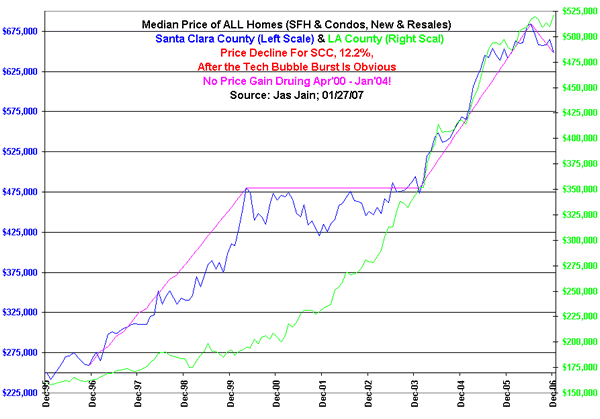
The rapid home price appreciation began in 1996, a year after the tech bubble began, and averaged 16% a year for some five years. This was driven strictly by the demand for housing to house the rapid growth in population, mostly Asian immigrants, driven by the rapid growth in tech employment. As soon as the tech bubble burst the home price appreciation stopped and the prices even began to decline. So far everything was as the fundamental would dictate.
But something dramatically changed soon after the tech bubble burst in 2000 - the Silly.con Valley bubbleheads, who were very heavily speculating in the local tech stocks, because they "knew" the industry and the companies involved!, as well as stocks in general, suddenly learned a lesson in diversification. Diversifying into the US Treasuries, or other high quality bonds, was the last thing that would appeal to a bubblehead. So, quite a few plunged, head first, into residential real estate. Some ventured far but many speculated locally.
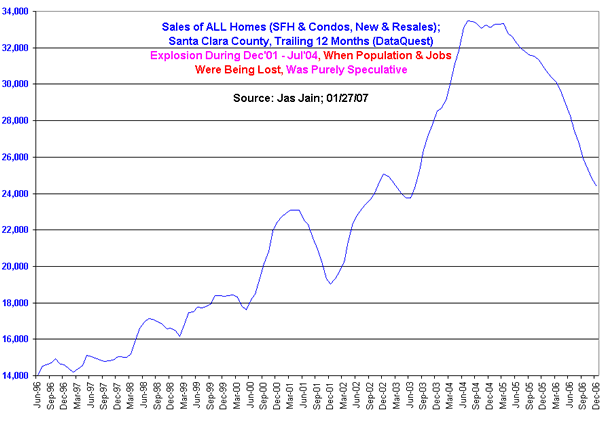
Fig. 7 shows the annual sales volume in SCC. The year after the tech bubble burst the home sales increased some 30% and we can assume that it was people taking money out of stocks and "investing" in residential real estate. Such moves are rarely a sign of an investment but rather speculative buying. Just as the demand for housing began to decline in 2001, concurrent with the nationwide recession, jobs were being lost, and a slow exodus of the population began from SFBA, the real explosion in home sales began in 2002, the worst year for the local economy following the tech bust. This had to be because of the housing bubble that began in Southern California (with San Diego being the leading edge) in 2000 spreading to rest of California. Once again, people diversifying from stocks was probably the most important factor in the beginning of the home price appreciation but later on the bubble took a life of its own. To quite Galbraith: "The rise in prices led to the rise in prices!" That is what the speculative bubbles are all about.
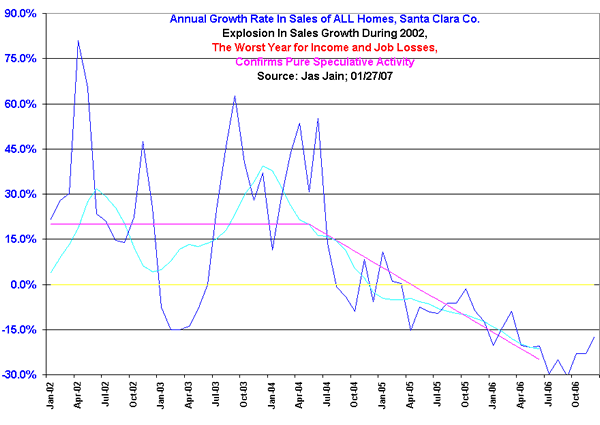
Just look at the explosion in sales volume, as shown in Fig. 8, during the first half of 2002 when the economic conditions were thought to be the worst for the last downturn in Silly.con Valley. Only a fraction of the sales volume can be attributed to people leaving the area due to job losses and selling their homes. The effect of people leaving the area was felt on price, which fell while it was gaining rapidly in Southern California. The speculative demand kept the prices from falling lot more and kept the supply of new homes going despite losses in jobs and population. Builders and developers could hardly believe their good luck. They not only kept on building, they increased the pace because their profits kept on rising despite some slackening in the price.
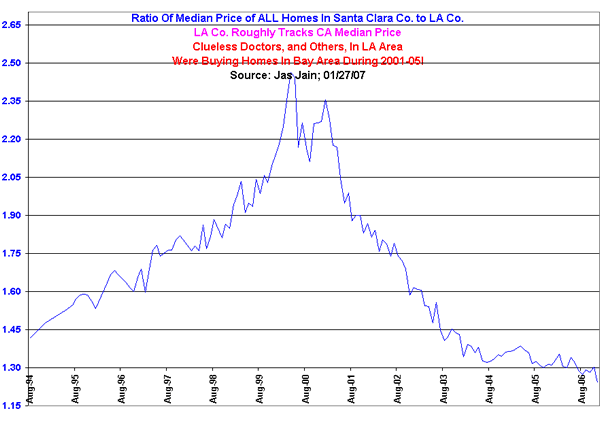
If there is any doubt left that the dynamics of the residential real estate in Silly.con Valley, over the past dozen years, has been very different from the rest of California, outside of the Bay Area, one need only to look at Fig. 9. There are people, in the Bay Area and outside, who think that the Bay Area is special when it comes to housing and bought homes in the Bay Area during the recent bubble for investment purposes. The Bay Area has been by far the worst housing investment over the past seven years compared to the rest of California. Actually, the ridiculously high prices in the Bay Area, relative to rest of California and the nation, driven by the tech bubble, was the single most important factor in people moving out of the Bay Area to the rest of California and to other states.
Smart people are those who sold the Bay Area stocks during 1998-2000 and Bay Area homes during 2004-06. There was a second chance during 2004-06 to sell tech stocks but not many bubbleheads in Silly.con Valley seem to have taken advantage. To quote Jesse Livermore (my emphasis): " The top is never in sight when the vision is vitiated by hope. He continues: "… the average man, who never thinks of values but of prices, and is not governed in his actions by [fundamental economic] conditions but by fears, takes the easiest way he stops thinking that there must be a limit to the advances. That is why those outsiders [general public and not the insiders] who are wise enough not to buy at the top make up for it by not taking profits. The big money in booms is always made first by the public-on-paper. And it remains on paper ." Americans have some $30Tr. of paper wealth that will remain on paper for a while and then disappear entirely. Asset inflation is not wealth; it disappears faster than it had appeared.
The dumbest ones, or the greediest, always are left holding the bags. They keep hoping and wishing and then they wait for the next boom once they miss the boat. Sometimes the next boom could be a decade, or decades, away. Other times, they miss the second boat. And not too many bag-holders have the staying power to wait for decades! Often enough they are forced out at the worst point in time due to changing economic conditions, generally, or their own. Such is the nature of the boom-bust cycles. To quote Jesse Livermore, once again: "In a bull market and particularly in booms the public at first makes money which it later loses simply by overstaying the bull market." Not much has changed in hundred years, or hundreds of years. The bubbles expose the suckers among us! And Silly.con Valley is overflowing with them. It would prove to be a fine example of Easy Come Easy Go.
By Jas Jain , Ph.D.
the Prophet of Doom and Gloom
© 2005-2022 http://www.MarketOracle.co.uk - The Market Oracle is a FREE Daily Financial Markets Analysis & Forecasting online publication.
