


The South Sea Bubble and the Northern Rock Bank Bust
Companies / Financial Crash Nov 22, 2007 - 01:12 AM GMTBy: Adrian_Ash

 "...Out went the silver sixpences, counted slowly as the angry savers queued up...only to come in again through the back door, fooling the crowd and stalling the crisis..."
DEALING WITH A BANKING CRISIS used to be such a simple affair for the Bank of England – not least when the crisis rolled up at its own front door!
Back in Sept. 1720, just as the South Sea Company was hurtling from bubble to bust – and hurtling into the history books as a result – the Bank of England faced a "run" from anxious depositors.
Still a private enterprise, it managed to stem that drain on its assets, calm the panic, and survive to become the monopoly issuer of Pounds Sterling some 120 years later. Now the Bank's charged with ensuring the stability of both consumer prices and the financial system – six decades after it was nationalized – could the same trick used in 1720 prevent a run on its currency today?
Nine years before the South Sea Bubble burst, in 1711, the government in London had hit upon a fantastic wheeze for reducing its huge debt burden, built up during the decade-long War of the Spanish Succession.
This series of pan-Atlantic battles, including Queen Anne's War on the French in Quebec, proved so expensive that by the time the conflict ended with the Treaty of Utrecht, more than one-third of British tax receipts was going to service the debt-interest alone.
How to reduce the national debt and fend off disaster? Step forward the South Sea Company, backed by the infamous Sword Blade Bank and run by that company's secretary, John Blunt.
An historic chancer almost matching the chutzpah of John Law – the brains behind the Mississippi Bubble in Paris – Blunt offered to convert British government bonds into South Sea stock, promising the investors he thus acquired a huge rate of return from the Company's trading monopoly in Spanish South America.
Blunt never actually got round to doing much trade, however – not beyond selling 34,000 West Africans into slavery – and nor did the Sword Blade Company have much to do with making sword-blades after it got into financial engineering, too. Instead, Blunt and his associates became among the wealthiest men in England by giving a profit to existing investors straight out of the funds received from new stock buyers.
This classic "Ponzi Scheme" – a pyramid rip-off requiring ever more new investment to cover the last set of promises – also earned a guaranteed chunk of the nation's tax revenues on top, paid in return for converting the government's debt into South Sea Company stock. The scheme worked beautifully at first, with some £10 million of government debt redeemed for South Sea paper that paid 6% per year in interest and rose nearly 40% in price by the end of 1713 alone.
Come 1719, however, the Company over-reached itself, offering to swap half of the government's outstanding debts for a new issue of stock worth £31.5 million.
"Tiz amazing," said an anonymous broadside hawked around the coffee-houses of Exchange Alley, "that a company at first erected upon pretence of trade should take so little care to begin, fix or improve any Trade, and that when at last they had got into their possession a great deal of ready money, they should employ their genius in stock-jobbing, or so to speak plain, in gaming away their own Treasure, and encouraging others to do the same."
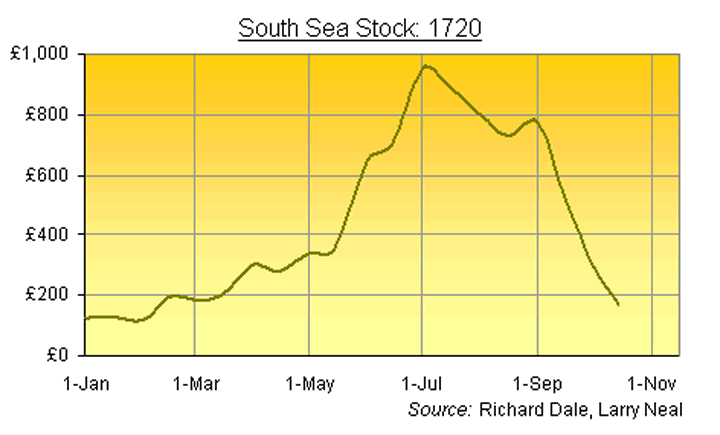
In the summer of 1720, Blunt's pyramid scheme bubbled and burst. The price of South Sea Company shares plunged by 25% during July and August. Panic ripped through London and the rural gentry; some 30,000 creditors had been sucked into the conversion (around 0.5% of the entire population) and there were thousands of stockholders and traders "on risk" as well.
The plunge threatened "Publick Credit" so severely, in fact, that today it "would be called a systemic threat to financial stability" as Richard Dale explains in his history, The First Crash .
"Five well-established banks failed around this time," Professor Dale goes on, "and on 24 September [1720] the South Sea Company's own bank, the Sword Blade Company, stopped payments, leading over the next fortnight to a run on the Bank of England itself."
How come the Bank of England got involved? Still a private company, the Bank of England had also offered to fix up the government's balance sheet in late 1719 – and after losing out to the South Sea Company (its directors had more powerful friends in parliament), the Bank was left holding around 8% of all government debt still outstanding. So when its arch-rival's stock price began to collapse – and a "systemic threat" challenged London 's financial stability – the Bank felt it necessary to help underwrite the South Sea scam.
In mid-Sept. 1720, the Bank of England announced it would exchange South Sea bonds for silver at a price of £400. Anyone wanting to quit their position in the "tricking and shuffling" of that historic scandal could redeem their paper for hard cash, in other words. That would at least put a floor beneath the South Sea Company's stock – down by one-third to £520 in the first two weeks of Sept. alone.
The scheme worked only too well, however, as the market value of South Sea stock traded in Exchange Alley continued to plunge. Once the Sword Blade Company stopped redeeming South Sea stock on Sept. 24th, it seemed that all of London – with his broker in tow! – was queuing up outside its offices in the Grocer's Hall, Princes Street to claim £400 in silver for every bond they held, and the Bank was forced to withdraw its offer.
But alas! The Bank's own customers took this turnaround to mean it didn't hold enough silver to cover its obligations. So a frantic queue of depositors formed outside the Grocer's Hall instead, replacing the South Sea speculators and demanding the return of their savings.
What to do? The method must surely raise a wry smile at the Bank of England today as it finds itself on the hook for underwriting Northern Rock – the over-geared mortgage lender that suffered the first British banking run in more than 130 years this September.
To avert failure in 1720, "the Bank organized its friends in the front of the line and paid them slowly in [silver] sixpences," writes Charles Kindleberger in his Manias, Panics & Crashes , quoting a Victorian history.
"These friends then brought the cash back through another door; it was deposited, again slowly counted, and then made available for paying out once more."
Round and round the silver sixpences went...out over the counter...and in through the back door! Slowly counting out the deposits, only to get them back and then count them out once again, the Bank's diligent tellers helped it survive until the Feast of Michealmas on Sept. 29th. Once the holiday was ended, the panic had passed.
South Sea stock, on the other hand, only continued to plunge, dropping to £290 on Oct. 1st and then sinking to £170 over the following fortnight. The Bank of England, in short, had done well to withdraw its support for the Bubble. Honoring the South Sea Company's false promises had nearly destroyed it.
And today...?
"Taxpayers may be forced to pay for the Northern Rock crisis, the Government has admitted for the first time," reports The Telegraph.
"Alistair Darling, the Chancellor, refused to guarantee in Parliament that the £24 billion of public money [$49.4bn] propping up the bank – the equivalent of £1,000 for every taxpayer [$2,060] – would ever be repaid in full."
What's more, that historic loan to Northern Rock – made by the Bank of England acting in its capacity as "lender of the last resort" – is in fact an adjustable-rate loan, starting with a teaser rate and "adjusting" higher in five years' time.
Hell, that's an even sweeter – and riskier – deal than the two-year ARMs sold by Northern Rock as it grew its mortgage book by 43% in the first half of 2007.
"The Bank of England has repeatedly warned against the 'moral hazard' of public money being made available to a commercial lender," the newspaper goes on, "prompting observers to think a stiff rate was being imposed on Northern Rock of between 6.75% to 7.25%.
"But in fact, it has only been paying the [BoE target] base rate of 5.75%. A further charge of 1.25% is being rolled up to be repaid in five years' time."
Meantime, all that money pouring into Northern Rock through the back-door of unannounced loans from the Bank of England is heading straight out again...out over the counter...as depositors continue to flee the mortgage lender, withdrawing their savings and emptying what little is left in its coffers.
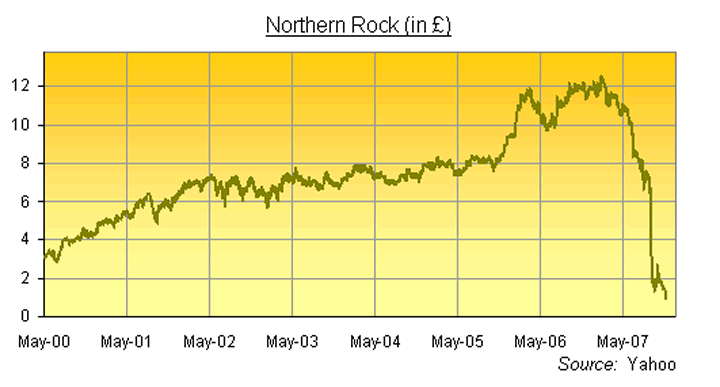
Between the start of the panic in Sept. and the end of the first week in Nov., Northern Rock savers had withdrawn at least £10.5 billion ($21.6bn) of their money. Last month alone, according to the Building Societies Association – of which Northern Rock was a member until it "demutualized" in Oct. 1997, floating on the stock market and embarking on its growth-hungry quest to boost returns to shareholders – private savers moved anything up to £3 billion out of the bank, more than $6bn.
Here at BullionVault, we can only guess what has happened to the other £13.5 billion borrowed on that special teaser-deal from the Bank of England so far. Guesses include:
a) Covering debt interest on commercial loans from the London money market (now charging 6.52% annualized, a near six-year high);
b) Repaying those short-term commercial loans that Northern Rock used to fund the last batch of new mortgage lending before the credit crunch bit and the crisis hit;
c) Covering the wage bill of Northern's 6,000-odd staff in the north-east of England . The region has the second-lowest GDP per capita in the United Kingdom . Chief executive Adam Applegarth, on the other hand, who will stand down at the end of Jan., was paid £1.3 million in cash and shares last year. He sold around £1.62m of stock near Northern's peak price of £11.98 at the start of 2007. It closed today (Weds 21 Nov.) below £0.84 per share.
Wherever the money's gone – and whether it was printed anew by the Treasury or siphoned out of the government's operational budget – it is most certainly NOT being returned to the Bank of England by its friends in the form of silver sixpences.
And as for the shareholders, now bleating about being last-in-line for any refund...way behind taxpayers, depositors and creditors as the government decides whether to nationalize Northern or let it sell for, say, one silver sixpence – loan book and all...little has changed since the South Sea Bubble exploded in Sept. 1720.
Private investors are getting just what they've got coming, as poor Paul of Sunderland is about to find out!
"I recently purchased some shares in the company," he writes on a forum at the Times of London . "A substantial amount...
"What will happen to them if the bank goes bust or they are sold?"
"Shareholders have been blamed in some circles for allowing Northern Rock's directors to get the bank into this mess," says Roger Lawson – another small stockholder who owns "a few thousand shares" according to The Telegraph – "but the vast majority are simply not clued up about the workings of the City and had no idea what was going on behind the scenes."
Having no idea is no defense, however. Shareholders hope to make money in return for taking risks – and with those risks come responsibilities. Not least in the sad case of Northern Rock, shareholders were responsible for holding the board to account for following a high-risk strategy that led to the first genuine banking crisis in Britain since 1876.
Sucker beware.
By Adrian Ash
BullionVault.com
Gold price chart, no delay | Free Report: 5 Myths of the Gold Market
City correspondent for The Daily Reckoning in London and a regular contributor to MoneyWeek magazine, Adrian Ash is the editor of Gold News and head of research at www.BullionVault.com , giving you direct access to investment gold, vaulted in Zurich , on $3 spreads and 0.8% dealing fees.
(c) BullionVault 2007
Please Note: This article is to inform your thinking, not lead it. Only you can decide the best place for your money, and any decision you make will put your money at risk. Information or data included here may have already been overtaken by events – and must be verified elsewhere – should you choose to act on it.
Adrian Ash Archive |
© 2005-2022 http://www.MarketOracle.co.uk - The Market Oracle is a FREE Daily Financial Markets Analysis & Forecasting online publication.
