


Countrywide Financial - The Next Big Bankruptcy To Hit the Financial Markets
Companies / Financial Crash Nov 26, 2007 - 01:42 PM GMT

 Martin Weiss writes: As we warned you here in August ... and as I explained on CNBC a few days later ... America's kingpin of mortgages is on a collision course with bankruptcy.
Its name: Countrywide Financial
If it goes under, the impact on U.S. financial markets will be immediate; the damage to the U.S. economy, long-lasting.
So don't write this off as just another, fleeting chapter in the housing bust story.
Countrywide is the GM and Ford of the mortgage industry, originating $340 billion in loans in the first nine months of the year — more than the mortgage subsidiaries of Bank of America and Citigroup combined.
It's the company that can make or break the entire housing and mortgage industry.
If it goes broke, few stock or real estate investors will be able to escape the consequences. Many could lose everything.
Already, Countrywide has laid off about 12,000 employees, a number that could soon rise to 20,000 as mortgage originations plummet.
Already, Bank of America, which infused $2 billion of bailout funds into the company in late August, has seen nearly half its investment go down the drain. In just 93 days!
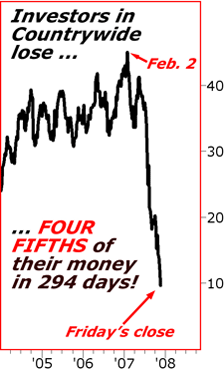
And already, investors who bought Countrywide's shares at its recent peak in February have lost four fifths of their capital. All in just 294 days!
Countrywide CEO Mozilo has apparently been urged by advisers to eliminate the company's dividend, saving about $350 million a year.
But that would hardly be enough.
The company admits it has a whopping $27 billion of delinquent subprime mortgages, more than the total mortgages (delinquent or not) held by some of the nation's largest banks.
At the same time, the company insists that it has enough cash or credit lines to get by.
For now, maybe.
 But if Countrywide is in such dire straits at this stage of the crisis, what will happen as we cross over into 2008, when home foreclosures, already a national epidemic, reach pandemic dimensions?
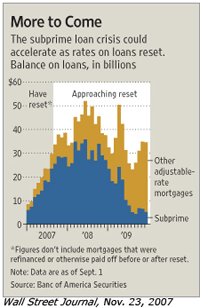
Under the headline "More to Come," even the Wall Street Journal , typically reluctant to make dire forecasts, predicted on Friday that "the subprime loan crisis could accelerate as rates on loans reset."
And based on data from Banc of America Securities, the Journal charted a course for the industry that could be the final nail in the coffin for Countrywide, including the following facts about the nation's adjustable-rate mortgages (ARMs):
- There will be a 6-fold surge in the number of subprime ARMs that are resetting at higher interest rates — from $6 billion per month in January of this year to $36 billion per month in the first quarter of 2008.
- At the same time, we will see a similar surge in other ARMs that reset to higher rates — to over $50 billion per month.
- Although homeowners often default on their mortgages and get forced into foreclosure when their rates go up, many subprime mortgages go bad in their first year or so, well before their interest rates have a chance to go higher.
The Mortgage Bankers Association estimates that 1.35 million homes will enter the foreclosure process this year and another 1.44 million in 2008. But even that dire estimate understates the impact of mortgage-rate resets now on the way.
Three More Urgent Questions for Countrywide CEO Angelo Mozilo
Question #1. What will happen when politicians twist the arms of mortgage companies like Countrywide to temporarily freeze their interest rates at current levels to help subprime borrowers keep their homes?
My answer: To what degree that gesture will help homeowners avoid foreclosures is unclear. But the impact on lenders is obvious: A big hit to their already-sinking cash flow as all subprime borrowers, whether delinquent or not, are allowed to continue making payments at the current rates — rates that were set artificially low to entice them into the loans.
Question #2. What happens when Fannie Mae and Freddie Mac, now cited as agencies that could help ease the pain for many homeonwers, find that they're in the same sinking boat?
My answer: Congress and the Fed will rush to help Fannie Mae and Freddie Mac — not Countrywide.
Question #3, the thorniest of all. What happens when the U.S. economy sinks into a recession?
My answer: The housing bust and mortgage meltdown we've seen so far have been deepening even without higher unemployment and even without falling incomes. In a recession, expect the Fed to pump in a lot more money overall, but to avoid mortgage company bailouts like a plague.
Despite All This, Wall Street's Leading Rating Agencies Have Not Yet Downgraded Countrywide Financial
Wall Street still seems to believe that Countrywide Financial, ground zero of the mortgage meltdown, can survive all this.
Indeed, last week, Moody's confirmed the company's investment grade credit rating. And the company also enjoys investment grade ratings from the two other major credit rating agencies — Standard & Poor's and Fitch.
But as we explained to you two weeks ago, the ratings issued by Moody's, S&P and Fitch are bought and paid for by the very companies that are being rated. (See " Next Phase of the Crisis: The Great Ratings Debacle .")
And as that money flows into the coffers of the rating agencies, it can corrupt the ratings process from start to finish: The rated companies are empowered to shop around for the most liberal ratings. They get sneak previews of the ratings before they're published. They can appeal downgrades and delay their publication. And, ultimately, they can fire the rating agency, taking their business elsewhere.
If disk jockeys accepted just a few bucks from record companies, it would be called payola and they could be carted off to jail. But when the Wall Street rating agencies take tens of thousands of dollars from companies like Countrywide for each rating they issue, that's supposed to be OK.
It's not OK. Even at its best, this is a system that often delays the needed reviews. When the long-overdue downgrades are finally announced, they're typically too late to warn investors with enough lead time to take protective action.
My view: Because of the biases built into the ratings process, the rating agencies often give too much credence to unrealistic promises made by the company's management.
Equally Unrealistic Is the Hope That the Fed Will Bail Out Companies Like Countrywide
Don't expect Ben Bernanke to come to the rescue.
He will have his hands full keeping the nation's thousands of commercial banks — his primary responsibility — out of trouble.
Mike Larson explains why in his article, " The New Savings and Loan Crisis ." (If you missed it, I highly recommend you read it now .)
His main point: Although banks have more capital than they did during the real estate-driven S&L crisis of two decades ago, the real estate mess today is far bigger than it was back then.
"Meanwhile," he writes, "mortgage giants Fannie Mae and Freddie Mac are in freefall. Freddie Mac shares dropped as much as 35% on Tuesday, the biggest drop since it went public in 1988, while shares of Fannie Mae plunged the most since the 1987 stock market crash."
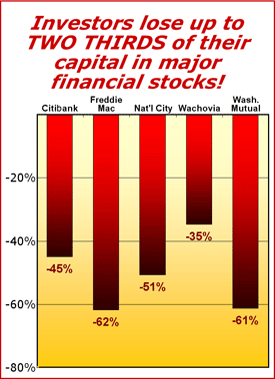
And investor losses are mounting.
On December 7, 2006, if you had invested $10,000 in Freddie Mac shares, all you'd have left from that investment right now (based on Friday's close) would be a meager $3,790. The balance of your money — $6,210 — would be down the tubes.
And this is a government-sponsored enterprise that's supposed to have avoided the subprime mess!
You wouldn't have fared any better with shares in Washington Mutual. A $10,000 investment in its shares made on December 28, 2006 is worth only $3,926, even after a 5% bounce in the company's shares on Friday.
You'd have done a bit better with National City and Citibank shares, losing "only" about half your money. But I don't think that's exactly something you'd thank your broker for.
The moral of the story is three-fold:
First, the Fed is likely to focus its efforts on flooding the banking system with liquid funds to try to tamp down the mortgage mess. It's unlikely to squander precious resources on bailing out individual mortgage lenders like Countrywide, no matter how big they may be.
Second, I fervently hope you've heeded our warnings of many months ago to get the heck out of all financial stocks.
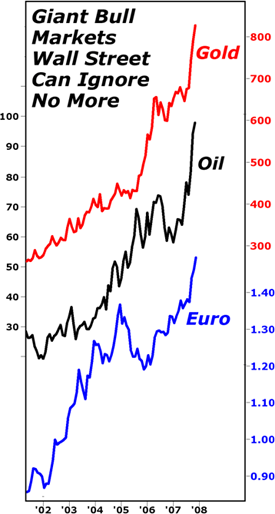
Third, I hope you have acted on our recommendations to move into the big bull markets Wall Street has been mostly ignoring — but can ignore no more.
I'm talking about the bull markets in ...
- Gold, which has surged from under $300 an ounce just six years ago to $831.75 right now, including a $26 surge on Friday and another $8 rise since.
- Crude oil, which has catapulted from under $20 per barrel to a new, all-time closing high of over $98 last week.
- The euro , which will soon be close to double its value of just 6 years ago ... while the dollar continues to fall virtually nonstop, making new all-time lows week after week.
For years, these three markets — gold, oil and foreign currencies — were driven higher by fundamental imbalances in supply and demand.
Now, adding still more fuel to the fire, the Federal Reserve is flooding our economy with cash in a desperate attempt to ease the mortgage mess and credit crunch.
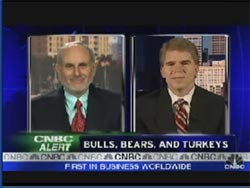
But as I explained to CNBC viewers on Friday, it's too little, too late for the U.S. economy ... and too much, too soon for the falling U.S. dollar. ( Click here to watch it now .)
A U.S. recession is unavoidable. And the only weapon the Fed has left to fight it — lower interest rates and more money pumping — is driving the dollar into a tailspin.
That's why, despite temporary rallies in the one and corrections in the other, financial stocks are likely to continue sinking, while gold, oil and foreign currencies are likely to continue rising.
Just be sure to stay on the right side. And no matter what your favorite investments may be, get out of the way of Countrywide Financial. If it fails, it could take many other real estate and financial investments down with it.
Good luck and God bless!
Martin
This investment news is brought to you by Money and Markets . Money and Markets is a free daily investment newsletter from Martin D. Weiss and Weiss Research analysts offering the latest investing news and financial insights for the stock market, including tips and advice on investing in gold, energy and oil. Dr. Weiss is a leader in the fields of investing, interest rates, financial safety and economic forecasting. To view archives or subscribe, visit http://www.moneyandmarkets.com .
Money and Markets Archive |
© 2005-2022 http://www.MarketOracle.co.uk - The Market Oracle is a FREE Daily Financial Markets Analysis & Forecasting online publication.
