


Can We Profit From Gold Price Seasonality?
Commodities / Gold and Silver 2012 Feb 12, 2012 - 06:15 AM GMTBy: Bob_Kirtley

 Seasonality is observable in a wide variety of variables. In business, sales, production, inventory, man hours and the best time to discount can be at least partially predicted by seasonal effects. Gold is no different. In different months price swings occur somewhat predictably year after year. What causes this, to what magnitude does it occur and most importantly – how can we profit?
As we all know, two things affect the price of all things tangible and intangible – supply and demand.
On the supply side, Gold stays remarkably fixed. It is mined at a very consistent rate year round with factors such as weather and temperature having much less influence than other markets such as soft commodities. In addition to this, supply can only vary rather gradually from a mining standpoint, given that it takes around a decade to bring a new find into production. However, any seasonality in the gold price must be attributed to variations in supply and demand during different times of the year, since supply could also be increased by non-mining entities, such as investors selling their holdings.
Below is the average monthly trend in gold prices since 1969. To find this, we simply add the returns for each month in every year since 1969 and divide them by the number of observed years – 43.
To construct this graph we create an index for gold prices. Day one of each year is set as the base of 1.00. Each successive day is compared to the previous; if day 2 is higher than day 1, the index rises by the percentage increase over the two days, and vice versa.
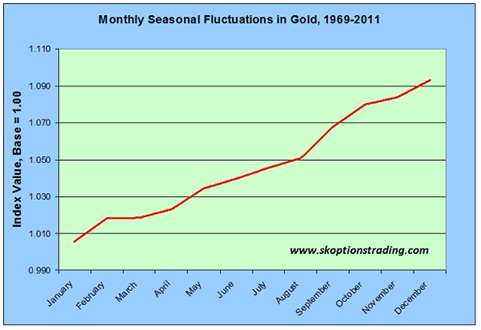
The trend is clear – on average, gold has risen every month over the last 43 years. This conclusion is of no use to us in terms of playing the seasonal shifts. According to the chart there is no “best” time of year to buy or sell, any time is good as the returns are linearly positive. Hence, further analysis is required.
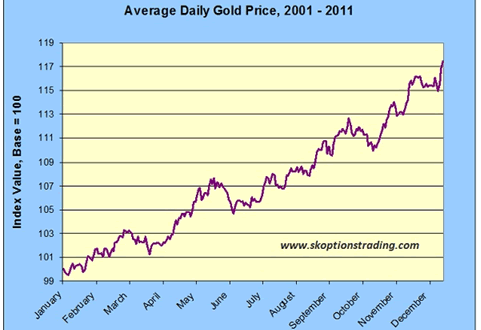
This next chart overcomes the limitations of the original. Firstly, we have increased our observations from 12 (monthly averages) to 250 (number of days gold is traded each year – generally). As the number of data points increases so too does the detail of the line. One can analyse trends not just over months but weeks and even days and a clearer pattern emerges. Secondly, we have narrowed down our data range from 43 years to 11, giving us more timely information. Needless to say, the early post float gold market was quite different than what it has developed into over the last decade or so, hence removing that less relevant data paints a clearer picture.
Between late April and early July, gold has been very flat over the last 11 years, as shown by the graph with an average rise of only 1.4 index points – or just under 1.3% for the period, which corresponds to an annualized return of 6.1%, paling in comparison to the average return annually between 2001 – 2011 of around 19%.
These slow months are known as the summer doldrums. People love to speculate what the reason behind the summer slowdown is. Who knows what the actual reason is, but it could simply correspond with traders/investors taking vacation and demand slowing for that reason. You would imagine that demand for gold will correlate somewhat with global economic activity and with that activity slowing in summer, so too does the demand for gold. A key part may also be simply the perception of the summer doldrums, investors expect things to be quiet around this time of year and therefore refrain from taking large positions, which results in the market being more subdued in a self fulfilling prophecy.
The August/September bull period is a little easier to explain. This time of year coincides with the end of harvest in Asia/India. Agricultural producers and farmers in these relatively poor nations aren’t likely to deposit their profits in the local MegaFinCorp Enhanced Leveraged Credit Opportunities Fund IV. Instead they traditionally store their wealth in gold and with huge numbers of producers doing the same the gold prices rise. India is also the largest importer of newly mined gold in the world. There are various cultural reasons behind this, but suffice to say gold holds an important place in Indian culture, especially in the wedding season which commences in October and gold is often given as a wedding gift. Jewelers in the developed world also contribute to the September rush. In order to have sufficient quantities of jewelery manufactured and ready for delivery in November prior to the Christmas boom, jewelers traditionally acquire the gold they need in August/September.
All of the above are contributing factors to the seasonal variation observed and should be included for consideration when formulating a trading strategy.
As with the 1969-2011 graph but to a lesser extent, the chart above isn’t as timely as we’d like. So once again we reduce the time horizon, this time from 11 to 5 years.
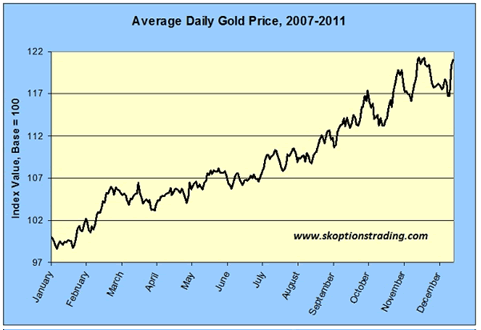
Interpolating the graph above on current gold prices, we can find what seasonality suggests gold prices could be, at any future day in the coming year(s). Here is what our seasonality models predict future prices to be relative to the February 8th price of $1746:
Date |
Model Used |
2001 |
2007 |
2009 |
March 8 2012 |
$1,774 |
$1,814 |
$1,820 |
|
May 8 2012 |
$1,820 |
$1,835 |
$1,881 |
|
July 8 2012 |
$1,820 |
$1,839 |
$1,898 |
|
September 8 2012 |
$1,908 |
$1,941 |
$2,111 |
|
November 8 2012 |
$1,954 |
$2,053 |
$2,217 |
|
Interestingly there are 3 values over the magic $2000/oz mark that some are picking will eventuate in 2012.
Below is the chart that speaks a thousand words. Gold seasonality is compared over four different time frames giving us some very interesting results.
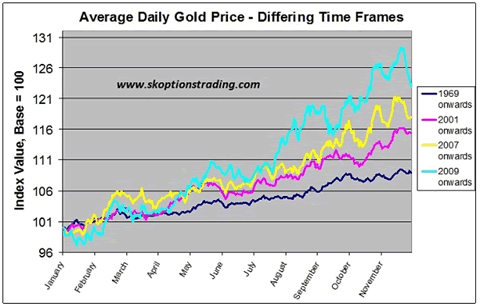
The peaks and troughs closely correspond in each time frame. From this we can deduce, gold definitively follows seasonal patterns and has done for some time, as the curve that plots prices since 1969 closely follows the other more recent trend lines.
The next chart provides a little skepticism to the seasonality debate. Rather than showing the average daily price trend over the last 11 years, we have the daily prices of each of the 11 years separately. A clear pattern is much harder to pick and is a good reminder that anything can and will happen in any given year. With the removal of 2008, the trend looks better. Remember in 2008 during the GFC, investors scrambled for liquidity and cash based assets, even avoiding a renowned safe haven asset that is gold, hence we saw a large drop in the price. One can also note the early start to the end of year rally in 2011 and 2006.
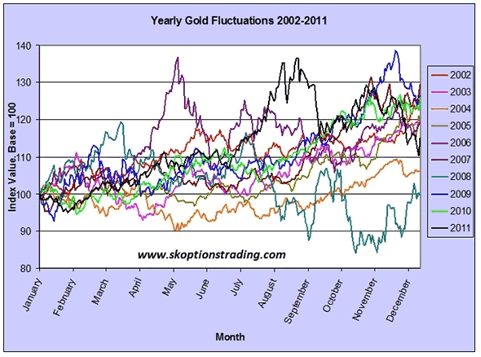
In summary, gold definitely follows seasonal patterns. In the long run, one can likely profit from these patterns, but they are not a hard and fast rule and can be flipped upside down in any given year.
We believe 2012 will be a historic year for the global economy and there is significant upside in gold prices. Investing or trading based on seasonal patterns alone is a little unwise, considering the fragile state of the global economy and the variation that can occur within the model. Seasonality is easily dominated by other events such as the GFC, QE or further developments in the Euro crisis. If QE3 were to transpire early in this year one can almost guarantee seasonal trends will fly out the window.
In conclusion we suggest that seasonality is not a strategy in itself, however, as a responsible trading operation we do factor it into our analysis and make recommendations accordingly, along with the utilization of our other propitiatory models for trading gold and gold options.
Regarding www.skoptionstrading.com. We currently have a number of open trades at the moment however, we do not update the charts until the trade is closed and the cash is back in our account.
Also many thanks to those of you who have already joined us and for the very kind words that you sent us regarding the service so far, we hope that we can continue to put a smile on your faces.
To stay updated on our market commentary, which gold stocks we are buying and why, please subscribe to The Gold Prices Newsletter, completely FREE of charge. Simply click here and enter your email address. Winners of the GoldDrivers Stock Picking Competition 2007
DISCLAIMER : Gold Prices makes no guarantee or warranty on the accuracy or completeness of the data provided on this site. Nothing contained herein is intended or shall be deemed to be investment advice, implied or otherwise. This website represents our views and nothing more than that. Always consult your registered advisor to assist you with your investments. We accept no liability for any loss arising from the use of the data contained on this website. We may or may not hold a position in these securities at any given time and reserve the right to buy and sell as we think fit. Bob Kirtley Archive |
© 2005-2022 http://www.MarketOracle.co.uk - The Market Oracle is a FREE Daily Financial Markets Analysis & Forecasting online publication.
