


The Coming Economic Depression & Christmas On Threadneedle Street
Economics / Global Financial System Jan 10, 2008 - 06:19 AM GMTBy: Darryl_R_Schoon

 The address of the Bank of England is Threadneedle Street , EC2 London. Martha and I could not have been closer. On Christmas day, we were at the Threadneedles Hotel at 5 Threadneedle Street . But proximity to the Bank of England is measured not by distance but by influence. Those closest to the Bank of England are the moneylenders.
England 's reign as a world power actually began on Threadneedle Street . Then, no bank had its own building and bankers were but goldsmiths who lent money and rented space to do business. But after the moneylenders cut their bargain (and it was a bargain) with King William of England , things were never to be the same, either for England or the moneylenders—or the world.
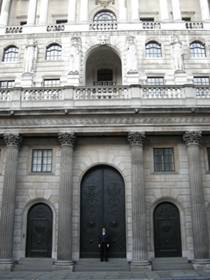 |
| Darryl Robert Schoon at the Cradle of Credit, The Bank of England |
n 1694, by bailing King William out of his debts incurred by England 's war with France , the moneylenders achieved enormous power and a new found respectability. They now called themselves bankers and would profit by the vast sums of credit that were to underwrite the greatest empire since imperial Rome —an era that is now about to end.
In THE GREAT WAVE – Price Revolutions and the Rhythm of History ( Oxford University Press 1996), David Hackett Fisher chronicles the rise and fall of prices and the accompanying rise and fall of epochs. The ending of all such epochs, Fisher notes, are marked by a wave of rising prices lasting from 80 to 120 years. Each wave culminates in economic collapse and the resultant breakdown and transformation of society.
We are now in the final stages of a price wave that began in 1896, a wave that will end the era of England 's influence on our world. A period David Hackett Fisher calls “Victorian England”. But it could well be called “The Era of Credit”; for it was credit that built the era of Victorian England; and, it is the collapse of credit that will bring about its end—for just as day becomes night so too does credit become debt.
WHEN CREDIT WAS KING
THE REIGN OF CREDIT I
England —the cradle of credit
England could not have achieved its immense power nor moneylenders their extraordinary profits had not King William struck his Faustian pact with the moneylenders in 1694, a bargain that was to grant the King unlimited credit to wage war in exchange for the right of moneylenders to issue credit-based money. Both parties were to benefit immensely from the bargain—until now.
England ultimately leveraged its ability to wage war with credit into a world empire; and, the moneylenders, now called bankers, used England 's power to spread their system of credit-based money across the world, multiplying and increasing their profits thereby. And although England 's position as a world power has waned, the power of the moneylenders has grown. Today, bankers are even more powerful than governments.
The king to the banker did say
Tis I who ride you this day
This day it is true the banker did say
But tomorrow tis I who ride you
But the triumph of the bankers will be temporary. It will be short-lived because the United States has now irreparably damaged the credit-based system that England 's bankers so carefully constructed.
The power of the moneylenders originally came from their ownership of gold; and, as goldsmiths, they leveraged their position into a far more profitable enterprise—the charging of interest on the lending of gold and it was to the moneylenders that even the King of England came for money to pay for his wars.
But in their bargain with King William, the moneylenders acquired their most important customer, the public purse; and, granted the power to coin money by the King, the moneychangers instead coined credit, an altogether different beast but one with the government's backing became the accepted coin of the realm.
Paper debt-based money issued by the Bank of England replaced the gold and silver coins pre vio usly circulating as money. The people deposited their savings of gold and silver in government approved banks which were granted the right to make loans in the amount of ten times their actual deposits and profit thereby by charging interest on those loans.
Bankers are and always been moneylenders. Vast sums of credit from the Bank of England, England 's central bank, were thus made available and when the credit inevitably became debt, the interest charged became profits booked on the ledgers of the moneylenders.
To pay the interest due on the increasing amounts of debt created by credit based economies, economies have to continually expand. This was as true in Victorian England as it is today. When credit-based economies contract, the ability to service pre vio usly incurred debt is damaged. If the contraction is severe enough, the economy will collapse. This is what is about to happen to us on a very grand scale.
When the US succeeded England as a world power, the bankers instituted the same system of debt-based money in the US but with very different results. Now in 2008, after three centuries of fueling economic expansion, the magic of the moneychangers has reached its limits. The end of an epoch is at hand.
WHEN CREDIT FAILED
THE REIGN OF CREDIT II
Restraint is a word commonly used to describe the English. It is rarely used when referring to Americans—the cowboys of capitalism.
The effect of credit-driven expansion on the US was not foreseen except perhaps by those who opposed it. In 1913, the Federal Reserve Bank, the US version of the Bank of England, was established thereby replacing savings-based money in the US with credit-based money; and within ten years, this credit-based system was to underwrite the largest stock market bubble in history, a bubble which was to collapse in 1929 and send the US and world economy into its first Great Depression
The significance of the Great Depression cannot be underestimated. A financial breakdown of such magnitude was unprecedented. The constant demand necessary to credit driven economies not only slowed, it contracted; and, as credit collapsed, the lack of demand led first to recession, then deflation, and then to the Great Depression.
HISTORY IS ABOUT TO REPEAT ITSELF
The Great Depression is the great conundrum of economists. No monetary solution has ever been found that could reverse the coriolis-like effect of decreasing demand and increasing deflation that occurred during the Great Depression.
Humpty Dumpty sat on a wall
Humpty Dumpty had a great fall.
All the king's horses and all the king's men
Couldn't put Humpty together again
The response of the US government during this unprecedented monetary crisis bears examination. In 1933, the US government enacted three measures as a result of the crisis: The Emergency Banking Relief Act, and the Glass-Steagall Acts, I and II.
The Emergency Banking Relief Act of 1933 was a measure worthy of any police state. For the first time in history, citizens were prohibited from owning gold by their own government.
WHOSE INTERESTS
WHOSE GOVERNMENT
Such a demand on a citizenry had never before been ordered. When Americans were told to turn over their gold to the US government, it was described as confiscation. It was really an act of tyranny. It was also an indication of who really controls the US government.
Since the beginning of civilization and commerce, gold has represented savings, wealth and money. Prohibiting citizens from lawfully possessing gold is nothing less than tyranny; and that this occurred in a democracy is clear evidence of the limitations of constitutional law and what is believed to be limited government.
WHOSE GOVERNMENT
WHOSE LIMITS
The Glass-Steagall Acts I and II are interesting for different reasons. The first Glass-Steagall Act went right to the heart of fractional reserve banking. This system, concocted by England 's moneylenders, allows banks to issue loans in the amount of ten times the money they have on deposit, sic banks make money by loaning money they don't actually have.
FRAUD ISN'T THE REAL PROBLEM
THE REAL PROBLEM IS GETTING FRAUD LEGALLY CODIFIED
The first Glass-Steagall Act redefined money held on deposit to now include government and commercial obligations, sic debts. These debts were now to be considered, alongside ”real” money, as a demand deposit in the US banking system, a radical departure from the moneylender's system.
The second Glass-Steagall Act was enacted to prevent the occurrence of another speculative bubble such as occurred in 1929. The huge amounts of credit that fueled the 1920s stock market bubble would not have been available had not commercial and investment banking been joined.
The access to commercial bank deposits by investment bankers contributed to the excessive amounts of credit that fueled the 1920s stock market bubble. The primary
purpose of Glass-Steagall Act II was to prevent another bubble by separating investment banks from commercial banks.
All attempts, however, by the US government could not halt the downward spiral of price deflation set in motion during the Great Depression. Indeed, some measures even had the opposite effect, i.e. the Smoot-Hawley Tariff Act of 1930 is widely considered to have been a contributing cause of the ensuing collapse of the world economy.
CONUNDRUM REVISTED
The collapse of the US dot.com bubble in 2000—a speculative bubble even larger than the 1929 bubble and Japan 's 1990 Nikkei—was to give Alan Greenspan and central bankers another chance at solving the economists' great conundrum. This time, Greenspan's solution was to preemptively make so much credit available a contraction of demand and credit might not occur.
But now in 2008, it is evident that Greenspan's gambit did not work. His cheap credit postponed the post-dot.com contraction but in the process created an even larger bubble—the 2002-2006 US property bubble; and, now the inevitable contraction will be magnified by the additional collapse of Greenspan's even larger bubble.
The collapse of such large sequential bubbles will again set in motion the events of the 1930s. As in the 1930s, we will see slowing demand followed by an economic recession leading into a deflationary depression even more severe than that of the 1930s—because this time, money is no longer backed by gold.
The removal of gold from the monetary system by the US in 1971 removed the very foundation stone of the moneylender's system of credit. The basis of the moneylender's credit was gold, albeit highly leveraged but still convertible on demand.
When the US declared the US dollar no longer convertible to gold in 1971, all money, all currencies became fiat currencies, sic government issued coupons. This had never happened before in the history of the world; and we are now about to experience the consequences of that act.
David Hackett Fisher noted in THE GREAT WAVE – Price Revolutions and the Rhythm of History that price waves last from 80 to 120 years; that such waves end in economic collapse and the breakdown and transformation of societies. The current price wave began in 1896. Do the math.
On New Years Eve, Martha and I watched the fireworks over the Thames from our room at the Langham Hotel. It was a spectacular display and the English people appeared to be full of hope as the New Year's festivities began.
But I could not hold back the thought that 2008 will not be as the English want or expect. While many may fear an economic slowdown is in their future, few yet are aware of the severity of the coming contraction and collapse; and fewer still are aware of their government's complicity.
The triumph of the moneylenders over government is almost complete and because of it, in the coming crisis governments will protect the interests of bankers, not the people. The Glass-Steagall Act II, enacted in 1933 to prevent another depression, was repealed in 1999 by President Clinton, a Democrat, at the behest of the investment banks.
The very same year, 1999, Gordon Brown, Chancellor of the Exchequer and a member of the Labour Party, sold 60 % of England 's gold at the bottom of the market allegedly to protect a US investment bank's bet on gold that could destabilize the markets. The moneylenders now own both sides of the aisle on both sides of the Atlantic .
As we watched the New Year's merriment from the Langham, I could not help but be reminded of the play, Cabaret , we had seen earlier that evening. Cabaret , set in 1931 Berlin , begins on New Years Eve and ends with the participants awaiting their respective fates in Hitler's Germany . Most were in denial about what was to occur. The same is true today.
The end of the story has not yet been written. It could end in many different ways. So fragile were the major trends that contingencies of various kinds threatened to disrupt them. A major war in the Middle East or Eastern Europe or some other trouble spot could reignite inflation. A collapse of overvalued security markets could cause panic, depression and deep deflation.
Page 234, THE GREAT WAVE – Price Revolutions and the Rhythm of History , 1996, David Hackett Fisher
We are at the end of a price wave that marks the end of an epoch, the era of Victorian England. As Fisher states, such waves always end in economic collapse. Faith will be needed to get through the difficult times ahead—and gold will come in handy too.
Fiat money, in extremis, is accepted by nobody. Gold is always accepted .
Alan Greenspan in testimony before the US Congress, 1999
Note: I will be speaking at Gold Standard University Live in Dallas , TX , February 11-17 which is presented by Professor Antal Fekete . This is a unique opportunity to hear Professor Fekete who is an expert on gold and its role in monetary matters. Some scholarships are available. Details are available at www.professorfekete.com .
Darryl Robert Schoon
www.survivethecrisis.com
www.drschoon.com
About Darryl Robert Schoon
In college, I majored in political science with a focus on East Asia (B.A. University of California at Davis, 1966). My in-depth study of economics did not occur until much later.
In the 1990s, I became curious about the Great Depression and in the course of my study, I realized that most of my preconceptions about money and the economy were just that - preconceptions. I, like most others, did not really understand the nature of money and the economy. Now, I have some insights and answers about these critical matters.
In October 2005, Marshall Thurber, a close friend from law school convened The Positive Deviant Network (the PDN), a group of individuals whom Marshall believed to be "out-of-the-box" thinkers and I was asked to join. The PDN became a major catalyst in my writings on economic issues.
When I discovered others in the PDN shared my concerns about the US economy, I began writing down my thoughts. In March 2007 I presented my findings to the Positive Deviant Network in the form of an in-depth 148- page analysis, " How to Survive the Crisis and Prosper In The Process. "
The reception to my presentation, though controversial, generated a significant amount of interest; and in May 2007, "How To Survive The Crisis And Prosper In The Process" was made available at www.survivethecrisis.com and I began writing articles on economic issues.
The interest in the book and my writings has been gratifying. During its first two months, www.survivethecrisis.com was accessed by over 10,000 viewers from 93 countries. Clearly, we had struck a chord and www.drschoon.com , has been created to address this interest.
Darryl R Schoon Archive |
© 2005-2022 http://www.MarketOracle.co.uk - The Market Oracle is a FREE Daily Financial Markets Analysis & Forecasting online publication.
