


The Cult of the Bear - Another Missed Bull Market
InvestorEducation / Investing Feb 17, 2007 - 04:33 PM GMTBy: Clif_Droke
 A gradual procession of super bears has been quietly admitting they've been wrong in their bearish assessment of the stock market. As the major stock market indices continue to push to higher highs and as market internals continue to reflect a stellar market condition, even the most stubborn of bearish traders and market commentators have been forced to reconsider their positions. Slowly, and with little fanfare, they've been covering short positions.
Yet these same died-in-the-wool bears refuse to turn bullish and are now standing idly on the sidelines watching stock prices move ever higher. If they can admit they were wrong to sell short, why can't they bring themselves to become buyers in what is obviously a strong bull market? That is the question we'll examine in the commentary that follows.
While discussing the issue recently with friend and colleague Bud Kress, a Wall Street veteran, he offered these comments on the bears: “The perma-bears live in their own little world, wrapped tightly in a cocoon womb.” I couldn't help but laugh when I heard this statement. We then began to openly ponder why certain high-profile “perma-bears” have maintained an unshakeable bearish bias for the past few years even as equity prices and corporate earnings have climbed relentlessly. Our conclusion was that there must be a “cult of the bear.”
I looked up the word “cult” in the Webster's Dictionary and found this definition:
“a great devotion to a person, idea, or thing; esp: such devotion regarded as a literary or intellectual fad.”
This definition, loose though it may be, could easily be applied to the stock market perma-bears. After all, the bears clearly have their leaders to whom they pay unceasing homage and devotion. They have their own unique literature, a body of writing encompassing many books and newsletters written by esteemed members of their own group. They have unwavering devotion to an idea (which we'll discuss a bit later in this commentary). And the whole perma-bear movement could easily be regarded as an “intellectual fad” with its own distinct doctrines and creeds.
In recent years I've found that it has become somewhat fashionable for even university-level academicians to espouse the cult of the bear. Back in the ‘80s and ‘90s you'd have been hard pressed to find any admitted perma-bears among the ranks of college professors. But one can see a growing trend in the cult of the bear among this group ever since the tech market crash and recession of 2000-2002. Some university researchers have even published writings recently on the “inherent instability” of the financial markets and of the possibility (nay, the probability) of another financial super-crash in the very near future.
One ivory tower type sent me an e-mail in response to an article I posted on the market's recent Dow Theory bullish confirmation. It was essentially a dictum as to why the market should stop going up “any time now” and why a bear market should begin. The reasoning behind this argument was a combination of “inflated earnings expectations,” “inflation,” etc. In other words, the same tired arguments the bears have been using since about 1982.
I recall one market sage commenting on the profound psychological impact the “tech wreck” of the early 2000s had -- and will continue to have for many years to come -- on the psyche of the average investor. He pointed out that investors aren't quick to forget severe bear markets and recessions and the negative images tend to remain embedded in investors' collective psyche for at least 6-8 years following the crash. This possibly explains why academicians, who typically specialize in the extrapolation of long-term trends, refuse to let go of the horrible memories of all those years ago.
There is nothing wrong with being bearish when the market situation calls for it. When earnings growth begins to deteriorate, monetary liquidity diminishes, investor enthusiasm peaks and market internals start to erode -- that's the time to turn bearish. The time leading into 1999-2000 was one such instance when it called for a bearish stock market/economic outlook. But now is not the time for being a bear!
It will also do well for investors to remind themselves, in a bull market, of the famous Wall Street saying: “Stocks were created to go up.” How simple, yet how true! Of course stocks can go down and even crash. But even a cursory glance at the long-term charts will show you that the stock market has spent far more time rising than falling; moreover, the average bull market tends to be longer and more dynamic than the average bear market. With this basic fact in mind, how can super bears like Joe Granville (from ca. 1982-1996) or Bob Prechter (ca. 1987-2007) justify their long-term bearish bias? If these were merely two unenlightened, anonymous investors we might just as easily ignore their stubbornness. But by their prominence they have been at least partly to blame for leading untold numbers along the same bearish path during these years, some to their own financial peril. So when the market indicators are decisively bullish (as they now are), how can such perma-bears justify maintaining a bearish stance in perpetuity?
Indeed, many a famous bear lives to regret his own bearishness. Jesse Livermore and Daniel Drew were among the famous bear “plungers” who sometimes fell victim to their ingrained bearish bias. In his autobiography the Wall Street pioneer Drew wrote that if he had it to do all over again he would have spent more of his career “playing the bulls' side of the market instead of the bears'.” In spite of his sometimes spectacular success as a bear raider, he had to admit that his colleagues who preferred the long side of the market during bull campaigns (such as “Commodore Vanderbilt”) came out much better for wear in the long run.
A recent correspondence I received from an Internet friend illustrates the bearishness many seem to be grappling with in spite of the market's sustained uptrend. He writes, “We live the reality. I don't care if the bogus Dow goes to 50,000. No one I know believes in it anymore, nor will they until their own situation improves.…the system is getting fatter and heavier and is skating on thinner and thinner ice. I know they are inflating and lying about it... They make it so you have to buy the “system” to keep up with the inflation that they created, but I'm not buying it. I am buying gold, some gold stocks....even cases of propane and motor oil, but I am not buying Dow/S&P/Nasdaq stocks which are inherently worthless even under the best of circumstances.”
I doubt not the sincerity and frustration over the system this gentleman references in the above. But I fear he may have fallen victim to the seductive mantras of the bear cult. Let's examine first the claim, which is constantly made by many high profile bears, that stocks are “inherently worthless even under the best of circumstances.” For a stock to be “inherently worthless” the company each share of stock represents must also be “worthless.” That would mean the company has net profits of zero on product sales of zero. It would also imply the company isn't engaged in the manufacture or distribution of any desirable commodity or service. I can think of only a tiny handful companies that have actually fit this description in the past 10 years. The most infamous example being an Internet stock which was advertised to prospective investors in the late ‘90s as a company with no formal business objective, but merely an empty shell posting as an “Internet stock” and whose promoters were “searching for a business model” while they collected money from naïve investors. Predictably, the stock's share price collapsed to zero before long and the “company” was soon out of business.
If we assume that most companies issuing shares of stock are engaged in legitimate and profitable enterprise, then how can we in good conscience call such companies “inherently worthless”? Is IBM, which is a Dow 30 component, an inherently worthless company? The company provides innumerable essential produces and services to a broad spectrum and there may be some reading this commentary on an IBM machine. Is its stock price merely an ongoing long-term experiment in artificial share price manipulation and deception? If so, wouldn't the “smart money” professional traders/investors have figured it out by now and dumped the stock down to zero?
Let's take this example one step further. If one had had the foresight (or serendipity) to buy shares of IBM at around $15/share in 1993 and then held those shares through the explosive rise to $135 in 1999 before selling, were his gains mythical or real? Was the extraordinary bull run in IBM “bogus” as the perma-bears might have suggested? When our lucky investor cashed in his winning to the tune of $120-per-share and proceeded to purchase with those earnings a new house or automobile, is his newly acquired wealth any less real than if he had, say, invested that money in gold and cashed in the earnings to buy a new house or car? In either case the investor must first take his profits, presumably in dollars, before spending his fortune. Are shares of IBM somehow less worthy than shares of gold mining concerns? How then can the act of profiting from a stock market transaction in IBM be considered “inherently worthless?”
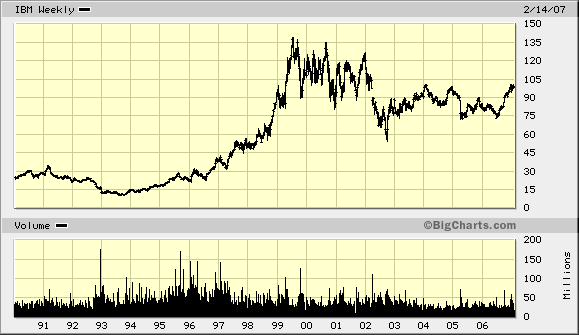
Let's take this exercise a step further. If our proverbial investor had turned bearish in 1999 and sold short IBM at around $135 and held down to the end of the decline at around $60 in 2002 before covering his position, were those gains any more real than the gains made by our investor on the rise from $15 to $135? Does the favored bearish medium of short selling somehow confer a “reality” to stock trading that buying in a bull market doesn't? Are gains made by selling short somehow more “real” than gains made by going long? Or even better: is standing idly on the sidelines parked in cash while the market goes up month after month or year after year somehow more “real” than not taking advantage of the bull market and improving one's financial station?
By now I hope you can see the logic (or lack thereof) used by the bear cultists stretches the imagination and knocks down the walls of sound reason and common sense. Unless one wants to wax philosophical and propose that the world we're living in is merely a holographic projection and that we “don't really exist at all” then I assume you can see the fallacy in the above-mentioned bearish sentiments.
For some, being bearish is an inherent part of their psychological makeup as individuals. To put it bluntly, some people are just plain negative. I'm convinced this must be true for more than one of the high-profile bearish newsletter writers who have retained their bearish posture for more than a decade without wavering. One celebrated bear has been bearish on the U.S. stock market and economic outlook for going on 20 years! Let's face it, if someone has a negative/pessimistic outlook on everyday life it will almost assuredly spill over into his investment outlook. Tragically, such inveterate pessimism, coupled with its refusal to take advantage of positive developments and opportunities, has signaled the financial death knell for many an individual and his family.
The two dominant motives in all financial transactions are: fear and greed. Of these two emotions, fear is by far the stronger one. The bearish investment guru preys on this base human instinct of fear and I believe this is another reason for the popularity the cult of the bear sometimes enjoys. People tend to respond more emphatically to fear (e.g., “protect your hard-earned savings from the coming depression!”) than to an old-fashioned appeal to pie-in-the-sky greed. The bearish cult leader counts on this tendency and personally profits from it.
A case can also be made that the cult of the bear is based on primal emotion more than any other factor. Ask any super bear why he is bearish in the face of a strong bull market, year after year, and after you've stripped away all the intellectual pabulum and excuses it really boils down to this: he is bearish because it “feels right.” Bearishness for most bear cult members is a “feel good” experience. It is stimulating for one to think that he's part of a small cadre of wise observers who “know better than the careless herd” of stock market investors. The perma-bears believe that theirs is a just cause and that their patience will be amply rewarded in due time. They believe they will be the ones to “inherit the earth” when the prophesied stock market apocalypse arrives and share prices come crashing down.
When viewed from this standpoint the cult-like attributes of the bear's religion come clearly into focus. More than once a high profile perma-bear has been overheard exhorting his followers to “keep the faith.” To borrow a term from a famous theologian, bearishness, for many, is a “religious affection.”
**********
The Bears' Lament
“The sky is falling” or so we're told,
but these pronouncements are growing old.
“Sell stocks and bonds and bar the door!”
Haven't we all heard this before?
“The crash will come,” the bears intone.
Too bad for them their shorts are blown.
Perhaps they should give the charts a look,
and see the market they all forsook.
Instead of taking their bad advice,
The investor should ask, “At what price?”
For they've missed more than one bullish run:
no sense in missing another one.
**********
By Clif Droke
www.clifdroke.com
Clif Droke is editor of the 3-times weekly Momentum Strategies Report which covers U.S. equities and forecasts individual stocks, short- and intermediate-term, using unique proprietary analytical methods and securities lending analysis. He is also the author of numerous books, including most recently "Turnaround Trading & Investing." For more information visit www.clifdroke.com
© 2005-2022 http://www.MarketOracle.co.uk - The Market Oracle is a FREE Daily Financial Markets Analysis & Forecasting online publication.
