


Probabilities For The Stock Market Going Forward!
Stock-Markets / Stock Markets 2012 Nov 10, 2012 - 10:37 AM GMTBy: Sy_Harding

 The Dow plunged 433 points, or 3.3%, in the two days after the election. The timing makes it ‘obvious’ to many pundits that it’s due to President Obama being re-elected.
But he was already president prior to the election, and the stock market has been in a strong bull market that started March 10, 2009, less than two months after he was inaugurated. And after a 10% March to June correction this year, the market continued to rally strongly off the June low even as the polls showed him as likely to win re-election.
So it’s doubtful the election is the catalyst for the correction.
Besides which, the correction is not something new this week. It’s been underway since mid-September, almost two months ago. In fact, the correction was already enough to break the trend-line support of the rally off the June low a month ago.
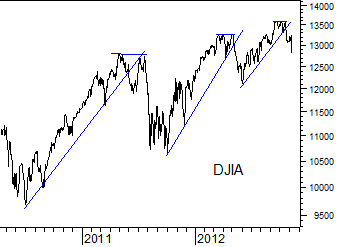
The Dow gained 1,492 points from its June low to its September high, and has now given back 800 points since that September high.
So what is the market’s problem?
If the media’s sudden switch from its obsession with the election to its new fixation on the ‘fiscal cliff’ is any indication, the worries of corporate insiders and hedge funds all summer are finally being recognized as being serious.
Major market participants including corporate insiders and hedge funds did not believe the rally off the June low was justified and were already selling into it at an unusual pace, and increased their selling after the Fed announced in September that it would provide QE3.
From their public pronouncements it was clear that concerns about the dysfunction in Washington, and the resulting ‘fiscal cliff’, were primary factors in the bearishness of corporate insiders, and the high levels of cash raised by hedge funds and other institutional investors. The heads of major corporations, rating agencies like Standard & Poor’s, and even international agencies like the IMF and World Bank, have been warning all summer that the U.S. fiscal cliff must be resolved or the U.S. economy will drop into a recession next year.
Other worries also remain, including plunging U.S. corporate earnings and the euro-zone debt crisis.
Yet some serious concerns are subsiding. Economic reports have been indicating for a couple of months now that the U.S. economic recovery is back on track after its spring and summer slowdown. And recent reports from China indicate similar improvement there, alleviating fears that its economy is slowing into a hard landing.
I’ve been saying for some time, that although my indicators remain on sell signals, conditions seemed to be setting up for a correction but then a typical ‘favorable season’ rally through the winter. And it has been my contention in these articles that regardless of who wins the election, and even though it may be at the last moment, Washington will hammer out a compromise that at least kicks the fiscal cliff down the road into next summer.
Meanwhile, the market’s most consistent pattern, regardless of which party is in office, and regardless of surrounding conditions, is its seasonality.
The basic ‘Sell in May and Go Away” strategy calls for selling May 1, and re-entering on November 1. Academic studies prove that following that simple strategy has out-performed the market by a significant margin over the long-term, while taking only 50% of market risk.
However, my firm’s Seasonal Timing Strategy (STS) improved significantly on the basic Sell in May pattern by incorporating a simple technical indicator, short-term MACD, and a re-entry rule that calls for re-entering the market on October 16 each year unless MACD is on a sell signal at the time. In that event, the re-entry is delayed until MACD triggers its next buy signal.
And that is the case this year. When October 16 arrived, short-term MACD was on a sell signal indicating a correction was underway. And it remains on that sell signal.
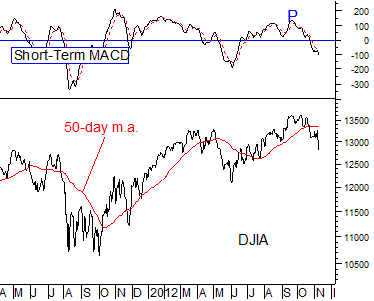
However, at some point in the October/November time-frame the market almost always becomes oversold in a correction and the indicator reverses to the upside to a buy signal that is the re-entry signal for the market’s favorable season.
I expect that to happen again this year, with the catalyst for the upside reversal likely to be a political agreement that resolves the ‘fiscal cliff’, or at least kicks it down the road.
So, for now the risk is for further correction. Not only has my seasonal strategy not yet triggered a re-entry, but my non-seasonal Market-Timing Strategy remains on an intermediate-term sell signal, and some significant support levels like 200-day moving averages, and trendline supports, have been broken.
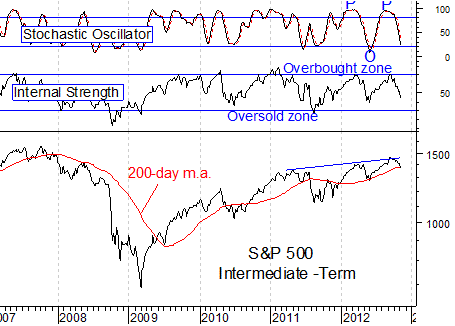
So I advise continuing to hold the downside positioning in ‘inverse’ etf’s that I have been recommending in these articles for several months, as well as high levels of cash.
But it’s not a time to fall asleep at the switch. Given the broken support levels anything can happen. But I still believe conditions are being set up for a typical favorable season rally to next spring once the correction ends.
In the interest of full disclosure, I and my subscribers have 20% positions in each of the inverse etf’s; ProShares Short S&P 500, symbol SH, and ProShares Short Russell 2000, symbol RWM.
Sy Harding is president of Asset Management Research Corp., and editor of the free market blog Street Smart Post.
© 2012 Copyright Sy Harding- All Rights Reserved
Disclaimer: The above is a matter of opinion provided for general information purposes only and is not intended as investment advice. Information and analysis above are derived from sources and utilising methods believed to be reliable, but we cannot accept responsibility for any losses you may incur as a result of this analysis. Individuals should consult with their personal financial advisors.
© 2005-2022 http://www.MarketOracle.co.uk - The Market Oracle is a FREE Daily Financial Markets Analysis & Forecasting online publication.
