


Greenspan Warns Finanical Markets Will Crash if US Can't Solve Fiscal Cliff Problem
Stock-Markets / Financial Crash Nov 16, 2012 - 03:02 PM GMTBy: Bloomberg

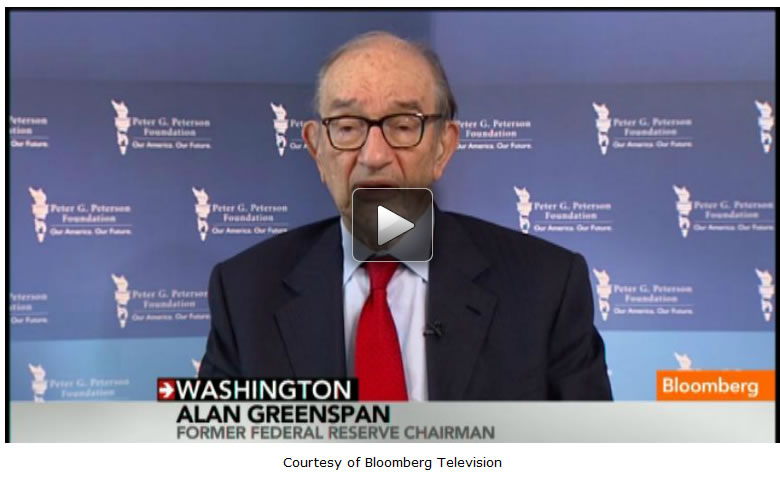
 Former Federal Reserve Chairman Alan Greenspan told Bloomberg Television's Betty Liu on "In the Loop" this morning that "markets will crater if we run into any evidence that we can't solve this [fiscal cliff] problem."
Greenspan said, "If we get out of this with a moderate recession, I would say that the price is very cheap."
Greenspan on the fiscal cliff:
"We have to recognize that this is going to be extraordinarily difficult to solve. All of the simple low hanging fruits have been picked and the presumption that we are going to resolve the big issue on spending by making a few little twitches here and there I think is a little naive. If we get out of this with a moderate recession, I would say that the price is very cheap. The presumption that we will solve this problem without paying I think is grossly inappropriate."
On Simpson and Bowles saying that the markets could crash if a deal isn't made:
"I think it is not only Simpson-Bowles. I think the markets are getting very shaky. And they are getting shaky because I think fiscal policy is out of control. And I think the markets will crater if we run into any evidence that we cannot solve this problem. And I think the notion that the issue of the impact on the economy is strictly the spending tax issue, is also the market. I think we underestimate the extent to which the market value of assets has a very important impact on real GDP."
On whether the U.S. is headed into a recession even if a deal is made:
"Not necessarily. I am just saying that we may get a deal, which will take us for next year or so. But the question isn't that. I think the question is essentially how are we going to stop what is a critical problem here, an extraordinarily rapid rise in what the department of commerce calls government social benefits to persons, which has been rising very rapidly bipartisanly in the sense that it has been rising even faster under Republican administrations than Democratic administrations. And they are all very closely involved in these new benefits, the only problem is that it is eating into the savings of the society and our long-term growth. And yes, we can continue for the next year or so without any really serious problems emerging. But I think it is a highly risky endeavor. The problem is, if we are going to come to grips with this thing, we are going to have to recognize that even if we have got to pay the cost of a significant rise in taxes to get a significant slowing and then decline in social benefits, that is a very cheap price in the sense that a large increase in taxes required to fund what is currently on the books is going to cause a recession. But I think that if we can get away with that is the only cost to this whole problem, I think that is a pretty good deal."
On where Republicans and Democrats will find common ground on cutting entitlement programs:
"It is going to be extraordinarily difficult. The issue is that words matter. If you ask the average person in the street about, for example, their social security benefits, they will say we have paid in, it is our money, we have earned it, I am getting it back. It is not welfare, it is not charity. It is equivalent to a private, fully-funded pension fund. It isn't. It is essentially extremely underfunded. In fact, if we were to go to a fully-funded system, comparable to those fully-funded private systems, we would have to cut benefits by the equivalent of 4% points of payroll taxes or raise payroll taxes by the equivalent amount. Those are very large numbers and would suggest that yes, indeed, people have put money in, but certainly not enough to fund what they are getting back. The notion that we have to confront is that people do not think that this is any different from a private fund. The trouble is that it is."
On tax policy:
"The problem basically is that we have tried for decades to somehow manage our budget in such a way that, yes we can run deficits of this or that size, and we use it sophisticatedly for fiscal policy. It turns out we cannot do that well. It gets out of hand and this is not an accident. There is no question that raising taxes will turn the economy downward. Ideally I would like to just cut spending. I do not think politically that is feasible because the problem, no matter how you look at it, is fundamentally this extraordinary rise in social benefits to persons. That is the core of the problem. But the issue is, if we can solve it the way I would want to solve it, if we go back to where we were earlier at a much lower level of those benefits because I think what is then going on in recent years, we have not been able to afford."
On whether tax rate increases or eliminating deductions and closing loopholes will get the revenue agreement:
"I agree with those who argue that marginal tax rates really do matter. And I thought the genius of the Simpson-Bowles plan to identify a trillion dollar's worth of tax expenditures which Republicans can a look at as subsidies, and the Democrats can look at as increased taxes to upper income groups. The problem is you are looking at the same issue and you can compromise on that. But look, if the issue here is whether you do it tax rates or you do it by taking loopholes out so to speak, obviously the latter is the better choice by far. The issue here is in both cases, you lower the rate of savings in a society and that will curtail capital investment, curtail the rate of growth and productivity, and essentially slow down the rate of real resource creation, which at the end of the day is what funds social benefits."
bloomberg.com
Copyright © 2012 Bloomberg - All Rights Reserved Disclaimer: The above is a matter of opinion provided for general information purposes only and is not intended as investment advice. Information and analysis above are derived from sources and utilising methods believed to be reliable, but we cannot accept responsibility for any losses you may incur as a result of this analysis. Individuals should consult with their personal financial advisors.
© 2005-2022 http://www.MarketOracle.co.uk - The Market Oracle is a FREE Daily Financial Markets Analysis & Forecasting online publication.
