


What Housing Market Recovery? 10.7 Million Homes Still Have Negative Equity
Housing-Market / US Housing Feb 01, 2013 - 06:38 AM GMT

 As I have written in these pages recently, the housing market is still missing the most important part: first-time homebuyers. We have large institutions buying up homes in bulk transactions instead of a good old-fashioned housing recovery where actual home occupants fuel the recovery.
Financial institutions like The Blackstone Group L.P. (NYSE/BX) are eating up the supply of foreclosed and empty homes and driving prices higher in the housing market. Why are they doing it? Because these big funds can’t get better returns elsewhere. Stock market? It’s too high. Bond market? It doesn’t pay enough. “Better buy cheap houses and get tenant money,” seems to be the new thinking.
But is the financial institutional buying of homes going to really change things for the U.S. housing market?
According to CoreLogic, 10.7 million homes or 22% of the entire residential households in the U.S. economy with a mortgage had negative equity in them at the end of the third quarter of 2012. And there are 5.29 million homes in the U.S. housing market that are either delinquent by 30 days or more or in foreclosure. (Source: Lender Processing Services, January 23, 2012.)
As I have been stressing in Profit Confidential, the so-called “recovery” in the housing market is artificial and doesn’t really do any good to the U.S. economy.
Robert J. Shiller, one of the founding fathers of S&P/Case Shiller Home Prices Index, agreed with my notion. At the World Economic Forum in Davos, Switzerland, he said “…it’s going up in the short run, what it will do in the longer run is hard to say. Maybe it will go down.” He also added that the housing market is still a “somewhat risky investment.” (Source: Wall Street Journal, “Shiller Says Housing Still Is ‘Somewhat Risky Investment,’ January 25, 2013.)
The truth of the matter is that it will take years if not decades for the housing market to get back to its peak. Maybe it never will. Back in the good old days, the U.S. government helped drive home prices higher through their lack of mortgage qualification oversight.
Today, we have billion-dollar institutions buying houses, pushing prices up.
I am very skeptical about the small rise in house prices and the increased optimism towards the housing market. Dear reader; let’s think about it this way. Today, the U.S. government announced that the U.S. economy contracted 0.1% in the fourth quarter of 2012—the first decline in gross domestic product (GDP) since the second quarter of 2009.
A surprise? Not for my readers. I’ve been writing for months that the U.S. economy is slowing. As crazy as it sounds, if the economy contracts again in the first quarter of 2013, we’ll officially be in a recession. Good luck to the housing market then.
Michael’s Personal Notes:
Quantitative easing hasn’t done much for the “small guy” in the U.S. economy other than create jobs in low-wage-paying sectors, while the “big guys” have enjoyed the propping up of stock prices. Why aren’t we looking at the Japanese economy as a lesson? After all, what happened there could very well become the fate of the U.S. economy.
Our Federal Reserve unleashed multiple rounds of quantitative easing and so did the Japanese central bank when the country’s crisis hit back in the 1990s. But after eight rounds of money printing, the Japanese economy is back in recession.
What happened in the Japanese economy as it printed money? Its currency, instead of going down in value against other world currencies, went up in value. But all that is changing now. Just look at this chart:
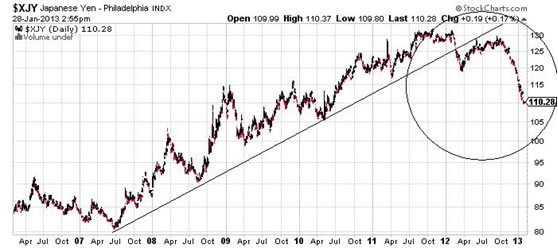
Chart courtesy of www.StockCharts.com
The Japanese yen has been rising in value since July of 2007. But starting in 2012, the yen collapsed as the Japanese decided to go “no holds barred” on quantitative easing. The Japanese yen declined in value significantly compared to other major currencies from a high of in October 2011 of 130 to 110 today.
Since the Federal Reserve announced its first round of quantitative easing, the U.S. dollar has only declined about 11% against a basket of other major world currencies. But, as we see from the chart above (the Japanese “lesson” as I call it), it does not take much for the market to lose faith in a country’s currency. The yen has fallen 15% in just over a year.
My skepticism about what the Federal Reserve is doing grows as I see the Japanese economy continue to suffer even after multiple rounds of quantitative easing and almost two decades of artificially low interest rates. Quantitative easing hasn’t worked for the Japanese economy; the chances of it working for the U.S. economy are bleak in my opinion.
Actually, by increasing its balance to almost $3.0 trillion, the Federal Reserve may have caused a bubble in the stock market.
On the other hand, the Federal Reserve may have no other option but to continue creating money, as the U.S. government needs the money to pay its bills—the government issues bonds, and the Federal Reserve buys the bonds and gives money to the government.
If quantitative easing can bring economic growth to the U.S. economy, then where is it? Why is the jobs market still tormented? Why are businesses stockpiling cash instead of reinvesting it? Why are real incomes declining? Why has the housing market become a playground for big financial institutions instead of homeowners? And why did the U.S. economy unexpectedly contract in the fourth quarter of 2012? Sounds more and more like Japan’s “lost decade” to me.
Where the Market Stands; Where it’s Headed:
Was Tuesday the top for the stock market? We’ll soon find out. On Wednesday, the Dow Jones Industrial Average hit a new post-credit crisis high of 13,969. Since then, the market has come down as companies earnings have disappointed and reality has set in: the U.S. economy contracted in the fourth quarter of 2012.
We’ll see where the market goes from here. But, as I have been writing, we are either at the top or close to it.
What He Said:
The year “2000 was a turning point of consumer confidence in high tech stocks. 2006 will be remembered as the turning point of consumer confidence in the housing market. That means more for-sale signs going up, longer time periods to sell homes, bloated for-sale inventory and eventually lower prices for homes. But this time, the turnaround in consumer confidence will have a bigger impact on the economy. Hold onto your seats, this is going to be a nail biter.” Michael Lombardi in Profit Confidential, August 24, 2006. Michael started talking about and predicting the financial catastrophe we began experiencing in 2008 long before anyone else.
Source
Michael Lombardi, MBA for Profit Confidential
http://www.profitconfidential.com
We publish Profit Confidential daily for our Lombardi Financial customers because we believe many of those reporting today’s financial news simply don’t know what they are telling you! Reporters are trained to tell you the news—not what it can mean for you! What you read in the popular news services, be it the daily newspapers, on the internet or TV, is the news from a “reporter’s opinion.” And there’s the big difference.
With Profit Confidential you are receiving the news with the opinions, commentaries and interpretations of seasoned financial analysts and economists. We analyze the actions of the stock market, precious metals, interest rates, real estate and other investments so we can tell you what we believe today’s financial news will mean for you tomorrow!
© 2013 Copyright Profit Confidential - All Rights Reserved
Disclaimer: The above is a matter of opinion provided for general information purposes only and is not intended as investment advice. Information and analysis above are derived from sources and utilising methods believed to be reliable, but we cannot accept responsibility for any losses you may incur as a result of this analysis. Individuals should consult with their personal financial advisors.
© 2005-2022 http://www.MarketOracle.co.uk - The Market Oracle is a FREE Daily Financial Markets Analysis & Forecasting online publication.
