


What To Do with Your Bank Stocks?
Companies / Banking Stocks Feb 22, 2013 - 03:50 PM GMT

 Sasha Cekerevac writes: One of the strongest market sectors in the stock market over the past year has been the financial market sector. Bank stocks have been on a tear, moving up massively since the lows in June. Looking at the entire market sector through the Financial Select Sector SPDR (NYSEArca/XLF) exchange-traded fund (ETF), the index is now up almost 36% from the lows in June.
Bank stocks have benefited from several factors. Low Treasury yields make the dividend yields from bank stocks highly attractive; the entire market sector has also reduced its risk profile, while eliminating costs. The end result has been a group of companies that offer significant upside.
However, the hunt for safety by average citizens might hurt bank stocks going forward. The latest data by Credit Suisse Group AG shows that for the top-eight banks, the average loan-to-deposit ratio fell in the fourth quarter 2012 to 84%, compared to 87% during the same time period in 2011. In 2007, the loan-to-deposit ratio was 101%. (Source: Dexheimer, E., “JPMorgan Leads U.S. Banks Lending Least of Deposits in 5 Years,” Bloomberg, February 20, 2013.)
The loan-to-deposit ratio shows how much of the deposits bank stocks have lent out. Bank stocks are having trouble lending due to several reasons. These include a lack of demand as well as an increase in regulations to try and reduce risks.
For investors in the financial market sector, this is a double-edged sword. On the one hand, it is positive that bank stocks are being more selective in who they are doing business with. This means that any loans that have been issued over the past few years are much higher in quality.
However, investing in bank stocks means you, as an investor, want these companies to issue loans and make money. This is the point of investing in the financial market sector. If excess cash is sitting idle, making no returns, this is actually a negative for bank stocks.
The total amount of money lent is actually increasing, as the total for loans by the top-eight firms during the fourth quarter was $3.9 trillion. The problem is that deposits are coming in faster than loans can be issued. Total deposits are now at a five-year peak of $5.0 trillion.
Because of this difference between deposits and lending, investors in the financial market sector aren’t making any money. If bank stocks can’t generate profit on this excess cash, it’s simply dead money.
Another worry for bank stocks is that if they lend at current levels and interest rates rise, this will decrease the value of these loans. Clearly, interest rates can’t move much lower; over the next five to 10 years, we will see higher rates, which could mean significant decreases in the value of outstanding loans.
Additional regulation is always a concern for an investor in bank stocks. The benefit of having tighter lending standards for the financial system has to be outweighed with lower overall volume and higher costs of administration. Don’t forget that while some bank stocks were in trouble during the financial crisis, there were many bank stocks that weren’t seriously affected at all because of their conservative nature.
There are also many investors in bank stocks who are sitting on massive profits, and these investors could start reducing their stakes. U.S. Bancorp (NYSE/USB) is one company that hit a low point of $7.61 in 2009 and is currently just below $34.00. The return of 446% is extremely strong for a period of just four years.
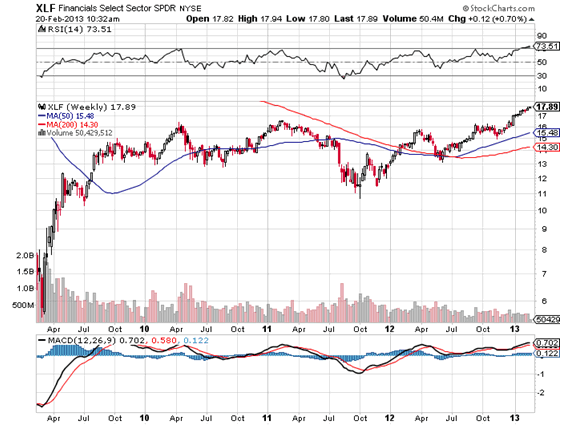
Chart courtesy of www.StockCharts.com
The Financial Select Sector SPDR is an ETF that comprises the financial market sector and, as is quite evident, is up a massive amount over the past few years. While some previous holders from before 2009 might still be waiting to break even, bank stocks might be reaching a level where there is a limited upside, with increasing risks to the downside.
Investing is strictly about risk and reward. At this point, with fewer instances of lending occurring, interest rates potentially moving upward over the next few years, and most of the cost-cutting having been completed alongside a huge amount of price appreciation, we might be looking at a situation where holders of bank stocks might consider taking a significant portion off the table.
Clearly, bank stocks still remain in a strong bull market. However, with the relative strength index (RSI) now showing an overbought condition in the weekly chart above, in addition to some of the concerns already outlined, I would certainly consider taking some profits as a prudent course of action to align my own portfolio.
Source: http://www.investmentcontrarians.com/stock-market/what-can-you-do-with-your-bank-stocks/1473/
By Sasha Cekerevac, BA
www.investmentcontrarians.com
Investment Contrarians is our daily financial e-letter dedicated to helping investors make money by going against the “herd mentality.”
About Author: Sasha Cekerevac, BA Economics with Finance specialization, is a Senior Editor at Lombardi Financial. He worked for CIBC World Markets for several years before moving to a top hedge fund, with assets under management of over $1.0 billion. He has comprehensive knowledge of institutional money flow; how the big funds analyze and execute their trades in the market. With a thorough understanding of both fundamental and technical subjects, Sasha offers a roadmap into how the markets really function and what to look for as an investor. His newsletters provide an experienced perspective on what the big funds are planning and how you can profit from it. He is the editor of several of Lombardi’s popular financial newsletters, including Payload Stocks and Pump & Dump Alert. See Sasha Cekerevac Article Archives
Copyright © 2013 Investment Contrarians - All Rights Reserved Disclaimer: The above is a matter of opinion provided for general information purposes only and is not intended as investment advice. Information and analysis above are derived from sources and utilising methods believed to be reliable, but we cannot accept responsibility for any losses you may incur as a result of this analysis. Individuals should consult with their personal financial advisors.
Investment Contrarians Archive |
© 2005-2022 http://www.MarketOracle.co.uk - The Market Oracle is a FREE Daily Financial Markets Analysis & Forecasting online publication.
