


US Federal Reserve Study points to 51.9% Chance of Recession this year
Economics / Analysis & Strategy Feb 24, 2007 - 02:30 PM GMTBy: John_Mauldin

What are the odds of a recession? According to a recent Fed study, they may be 51.9%. Close enough to 50-50 for government work. We analyze this study, look at a few graphs which show a major disconnect between the housing market and the US manufacturing and services sectors, and then close with some comments on yet another proposed rule change. But let's start with a few housekeeping items.
The latter half of this letter will be written primarily to my colleagues in the financial services area, and to managers, entrepreneurs, and businesses who anticipate the need to raise capital in the future. There are some proposed rule changes at the NASD that will significantly limit the ability of a registered representative to communicate with clients about private offerings, ETFs, venture capital, DPPs, and other offerings. In some cases, it will effectively prohibit communication on the items. This is not just about hedge funds. I think these rule interpretations will have the unintended consequence of the potential to severely impact capital formation in this country. This is under the radar screen of 99% of my colleagues.
Many of my US clients and prospects wonder why I do not write to them about my opinions on the hedge funds and private offerings that are offered to them. The simple fact is that the NASD asserts (if you ask, which I did) that even a simple letter, properly disclosing my income relationship with the offerings, would be considered a research report and therefore fall under the research analyst rules. In fact, any marketing material would is in effect considered research, and thus cannot be sent by a registered representative to clients. The NASD has not publicized this interpretation, but they are getting ready to assert it in proposed rule changes. If you are in the industry, I urge you to read the latter half of this letter and make your feelings known.
Second, I wrote a few weeks ago about the move on the part of the SEC to increase the accredited investor financial requirements from $1 million total net worth to $2.5 million in liquid investments, and provided a link to the SEC comments web site. At the time there were 14 comments. As of today, less than a month later, there are about 376 comments. There have been a lot of articles written about the level of response. Good on my readers! I think it is safe to say the overwhelming number do not want to see the limits raised. If you did not read that letter, or have not yet made your views known, you can go to SEC New Definition of Rich to Restrict Investments into Hedge Funds , read my thoughts on the proposed rule, and find the links further down in the letter to make your comments.
As my Dad would often say, "Speak now, son, or forever hold your peace."
The 51.9% Probability of a Recession
I am often asked how I find so much good research about which to write. Yes, I do get an (sometimes) overwhelming amount of newsletters, articles, and so forth sent to me regularly. But my true secret sauce is that my readers send me a lot of really great material that starts me down a path of inquiry. And that is the case this week. Allan Fisher sent me a note about a study on the yield curve by Jonathon H. Wright, an economist at the Federal Reserve Board.
If you are in the economic forecasting business, you are going to make mistakes. As my good friend Dennis Gartman often says, there is no shame in being wrong. The problem is when you keep getting it wrong and do not change. I have been suggesting we will see a recession this year, based in part upon research about the relationship between the yield curve and recessions.
I have often written about a study by New York Federal Reserve economists Mishkin and Estrella, written in 1996, which discusses the probability of a recession following an inverted yield curve. Wright has updated that study and added some original analysis. It bears looking at in detail. (The graphs and charts below I took from a blog by James Hamilton at Econbrowser.com, as they were better than those in the paper. Thanks, James.)
(You can read the original study at http://www.federalreserve.gov/pubs/feds/2006/200607/200607abs.html )
The 1996 study (and previous research by Dr. Campbell Harvey) showed that there is a strong connection between an inverted yield curve and a recession four quarters later. Wright updates that work, as we will discuss below.
But he also says that we should consider the absolute level of the Fed funds rate as well. So, he does another model which uses the term spread on the yield curve, which his research shows to give a better predictive performance.
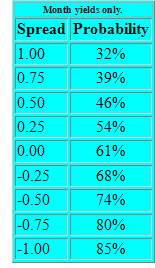
But this is the kicker. It suggests a lower probability of a recession in 2007 than the prior studies. Should I change my forecast? Let's see.
First, let's look at the probabilities of a recession using just the term spread on the yield curve in Wright's study. It shows about a 74% chance of a recession, as the negative spread is about 50 basis points today (on a 90-day average, as he uses).
But what happens to those odds if we also factor in the absolute level of the Fed's funds rate? It drops to about 51.9% (more on how to get that number later).
Let's talk about how to read this chart. The spread is the difference between the 3-month T-bill rate and the 10-year bond. Today that is a around a negative 50 basis points or -0.50. Each column to the left is for a different level of Fed funds rate. Thus FF=4.0 is a Fed funds rate of 4%. There is no column for 5.25%, where we are today, but there are columns for 5% and 5.5%.
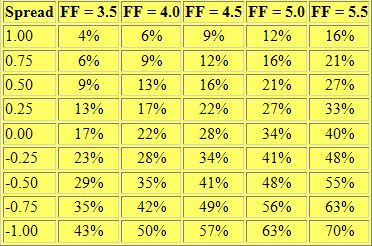
But if you go to a clever web site at www.politicalcalculations.blogspot.com, you can actually calculate the odds of a recession yourself, using current numbers. http://politicalcalculations.blogspot.com/2006/04/reckoning-odds-of-recession.html
Now they don't tell you, but you will need to use the 90-day average for the 3-month, 10-year, and feds fund rates if you are going to duplicate Wright's research. And what you find is that you get a 51.9% chance of a recession (not to put too fine a point on the odds), substantially less than the 74% suggested by using the term spread alone.
In the paper, you can see graphs from last April which show the chances of a recession at that point were considerably less than they are today, around 25%. But Fed funds was at 4.75%, and the term spread was still positive, just slightly less than 25 basis points.
So what does this mean for policy? If you raise the Fed funds rate another 25 basis points to 5.5%, I think it would clearly also increase the negative slope of the yield curve by at least another 25 basis points. That would put the odds of a recession closer to 63%. I would speculate that this research is in the back of Bernanke's mind, as well as the voting members of the FOMC.
 |
$9 (50% discount)    |
The "Surprise" in Inflation
We had an upside "surprise" in the inflation numbers this week. (Didn't I predict that would happen?) Given the rhetoric of the minutes that were also released, it is clear that the Fed governors are still worried about a return of inflation. Just yesterday the Dallas Fed Reserve president reiterated his previous position, stated earlier this month, that "the risk of unacceptably high inflation still outweighs the risk of substandard economic growth." That theme has been repeated by a majority of Fed governors over the past few months.
And it is entirely possible that we will see core inflation rise from here. It is at a very uncomfortable 2.7% over the last 12 months, and rose from the previous month. Unit labor costs are rising at more than 3%. We have a low unemployment rate, which is adding pressure. Note that unemployment is a lagging indicator. It typically does not start rising until a recession is either close or already started.
And even with the high probability of their revising the recent GDP growth downward, much of the US economy is strong. Let's look at two charts sent to me by South African partner Prieur du Plessis. The first is the relationship between manufacturing and the housing market. It suggests that manufacturing still has some downward pressure in the next few quarters.
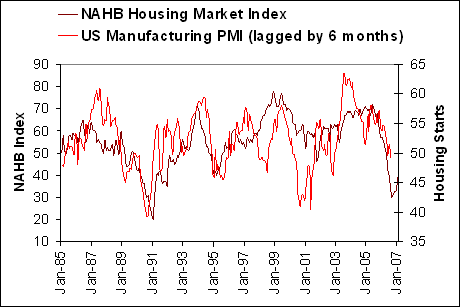
But the relationship between housing and the service sector has completely broken down. Notice that the service sector is even rising somewhat!
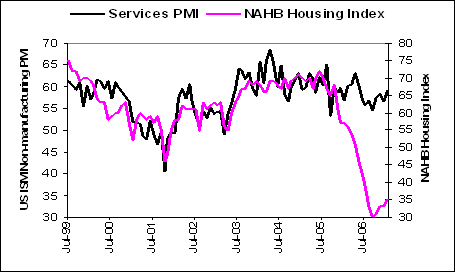
With manufacturing at 23% of the economy and services at 77%, it will take a much bigger drop in manufacturing to bring us into recession.
With the probability of a recession at just 50% or so, and the risk of higher inflation increasing, this is not a Fed that is going to cut rates any time soon. In my opinion, this week's CPI data moved any potential cut out until at least the June meeting, barring some major weakness in the economy which is not evident today.
I still lean toward my view that we will see a recession, as the weakness in the sub-prime mortgage market will impact housing prices more than most observers now think. But the Wright study also reinforces my view that it will be a mild recession, if indeed we do have one.
A Threat to Capital Formation
And now let's turn to a new rule that if enacted would have serious consequences for capital formation in the US. This is really meant primarily for my colleagues in the financial services industry and those who are interested in policies which affect capital formation. The NASD (the self-regulatory body which oversees broker-dealers) has been (on a very limited basis) and intends (in the opinion of my attorneys and other professionals who are paying attention) to apply the research analyst rules to private offerings, ETFs, hedge funds, and other assorted securities. Why am I so alarmed, and why should you care? As we will see, an attempt to apply a rule to hedge funds is going to have major unintended consequences for all private offerings, as well as client communications. We need a little background here.
In the wake of the scandals involving supposedly independent research analysts and the stock offerings made by investment banks, Congress correctly mandated new research analyst rules. Essentially, rules were written to insure that independent research was independent. Research analysts were correctly barred from receiving investment banking fees. The new rules were simple, but as with all rules, the devil was in the details.
A joint NYSE/NASD committee studied the rules and issued, if memory serves me correctly, a one hundred-plus-page opus with suggestions on how to interpret the short congressional mandates in practice. So far, so good.
I am a fairly conservative guy when it comes to the rules. My legal bill is way too high for a firm of my size, because we are always asking for interpretations and clarifications.
About two years ago, we were reviewing the research analyst rules. In the opinion of certain colleagues, there was a small chance the research analyst rules could apply to the written research I did on specific hedge funds and private offerings. Since the research analyst rules did not specifically exempt hedge funds, we wanted to be sure. We felt the conservative approach was to ask. I directed counsel to inquire of the NASD as to whether the rules applied to hedge fund sales literature, which is essentially what the material and any communications I did were considered to be. We were told the rules were clear as written and they declined to answer us.
Since the rules were not clear to us, we submitted what we considered to be sales literature on a hedge fund to the NASD advertising department. We accompanied that submission with a lengthy (and expensive, from my point of view) letter as to why private-placement sales literature should not be subject to the research analyst rules.
The argument was essentially that no matter how many people read a report on a hedge fund and then decide to buy, you cannot affect the price of the fund. It is like a mutual fund in that regard. If I write a report on a mutual fund and 10,000 people buy the next day, they all buy at the same price. If I write about a stock, and 10,000 people buy, I could move the price of the stock. (Which is one of the reasons I do not write about stocks.)
Further, you can't really do fundamental or technical analysis on a fund, in the classic definition of analysis. I can provide information and education, and even recommendations, but that is explicitly covered by the regulations on marketing materials (as it should be).
Nevertheless, the NASD rejected that argument, noting that in their opinion the submitted material was precisely what was meant as a research report and therefore subject to the rules.
As to the nature of the material submitted, it looked and had the feel of normal fund sales literature for a mutual fund. It talked about the nature of the fund, the managers, and compared the historical returns with various indices for comparison. The material was compliant (with minor changes) with sales literature rules, and accompanied by the usual volume of disclosures, including prominently the fact that my firm would be paid a portion of the management fees. This is part of the crux of the practical issue, as through legal alchemy the management fees of a hedge fund technically become investment banking fees when paid to a broker-dealer. It is a rationale only a lawyer can appreciate.
And since research analysts cannot receive a portion of the investment banking fees, if I wrote a "research report" and had to be a licensed research analyst in order to do so, I could not be paid a portion of those fees. I freely admit, with four kids in college, being paid is near and dear to my heart.
But the NASD determined that the report if written personally by me should be considered as subject to the research analyst rules. So, I hired a part-time hedge fund research analyst (an academic of some note) to do independent research reports for my firm on the funds we covered. As a business matter, it was not that much of an issue, as it freed up more of my time, even if it was not cheap. We submitted these reports to the NASD and worked through minor compliance issues, and used them as research analysis.
Now, this is important. The research analyst rules were properly written to address conflicts of interest between investment banking and research analysts. But the intent was on research that could affect the price of the security.
Again, I can write about a hedge fund or private offering and cannot affect the price of the fund if even 200 people buy the fund. You buy a fund at the NAV.
At the same time as we submitted a new research report by my independent analyst, we also submitted a short cover letter that was to accompany the report. In the second paragraph of the letter I clearly stated that I would receive a portion of the fees if they invested in the fund. (It goes without saying that full and explicit disclosure of all fees and costs should be part of any material.) There was no doubt as to my role in this transaction. I was acting as a broker and would participate in the income stream, as I would get a portion of the hedge fund management fees for serving as a broker. I also included three macro reasons why I liked the fund, and suggested they call my associates, or myself, if they were interested in getting more information.
Now here is the critical part. The NASD said this cover letter was in and of itself a research report. On one other occasion we submitted a much briefer cover letter, and it was also deemed a research report.
The NASD said in the Rule Proposal that the definition of "research report" is a "written (including electronic) communication that includes an analysis of equity securities of individual companies or industries, and that provides information reasonably sufficient upon which to base an investment decision."
I was told by NASD staff that a simple (cover) letter from me which recommended a fund would be deemed as a research report, because of the fact that my personal recommendation could be a reasonably sufficient basis upon which a person could invest. This is the broadest possible interpretation of research. When simple opinion and (admittedly fully disclosed and self-interested) recommendation can be elevated to the level of research, we have degraded the concept of research in an effort to regulate a non-problem.
So, I can hire someone to write an independent research report (their opinion, of course, is their own opinion) and send it to clients. I can call the client and talk freely with him. But I cannot have an opinion that is communicated in writing to more than 14 clients. Again, if this was just about my inconvenience and marketing problems, no one should really care. But the implications go way beyond my small concerns.
This is an age of electronic communications. My clients, and I suspect those of the rest of the industry, increasingly want me to write them about my opinions and thoughts, in addition to talking on the phone. If anything we write (PowerPoints, term sheets?) in terms of education or recommendations can be determined to be a research report, then no written communication to more than 14 people can take place from a broker. This places a severe logistical burden on small firms and keeps brokers from giving clients their best and most efficient advice. It forces discrimination among clients (who are you going to call first?) and hampers rational discourse.
In essence, I become a potted plant for all my usefulness to the majority of my clients, as I cannot have an opinion that can be communicated in any useful fashion. Understand, I am not against regulation. Sales literature is already subject to any number of rules and requirements. Anything I write must adhere closely to the rules. There is nothing I could do in sales literature that I could not do in a research report. The extra regulation from the application of the research analyst rule has no benefit to the investor, nor does it provide any more protection. The only additional effect of such an interpretation is to make communication between a broker and his client far more difficult and limited, when clients in fact want more efficient communication.
To my knowledge, I am one of the very few who has been compliant with the rule as the NASD currently interprets it. (Everyone else evidently assumes that the research analyst rule is not applicable.) I have seen a lot of material from my fellow firms which does not meet this standard. In short, this is going to have a major effect on not just the marketing of hedge funds (admittedly a small concern except to those of us who plow in this field) but on all private placements (and ETFs!), which should be of concern not only to the financial services industry but to those who think about America's competitive edge. The compliance officers and legal staff will absolutely shut down communications, to an extent that is far more onerous than today's stiff requirements.
Let me be clear. I do not have a problem with my writing and research being subject to regulations. As a matter of business practice, we submit practically everything we use in connection with my brokerage business to the NASD in advance. Why wouldn't you? They are relatively quite efficient (faster than some attorneys I know), and you make sure that whatever you do is compliant. And if the rules require me to keep doing business as I am now doing, we will still see our business grow. My policy concern is really not about hedge funds, but more about private offerings and venture capital.
Remember the joint NYSE/NASD committee I mentioned earlier , which is composed of both regulators and industry participants who understand the costs and problems of using this rule to apply to private offerings? Their recommendation was to explicitly exempt hedge funds and private offerings. The NASD has rejected that suggestion in recent proposed rule filings. It was not inadvertent. We checked. It was their intention.
As I will note later, this is not a small deal. In a back-door effort to regulate hedge funds with a rule clearly not intended by Congress to do so, the unintended consequences could be to seriously alter how capital is raised for small business.
This is not just about hedge funds. It is about all private placements, including private venture-capital funds. Broadly defining a recommendation or information as a research report (since currently any communication which could help an investor make a decision is considered a research report, even if that is not widely known in the industry) has the potential to seriously impede US investment and capital formation. Such a definition includes any communication that a broker-dealer uses to educate a potential investor about an offering, including but not limited to pitch books, PowerPoints, offering summaries, and term sheets.
It is one thing to require independent research, and I am all for that, as are all right-minded people. Independent research should not be part of the commission stream.
The business giants of tomorrow are often the small businesses capitalized today by small broker-dealers and their clients. This capital formation of small business is the backbone of the American enterprise. It is the foundation of job creation in this country. It is the genius of our market-driven economic system.
The concern expressed by many government and financial industry leaders that America is losing its competitive edge is well known. Expanding the research analyst rule to the extent that rational communication between brokers and their clients is effectively stymied, would only serve to dull that edge even more. Such an interpretation would have a chilling affect on the ability to facilitate capital formation by the small broker-dealer community. Fewer deals will get done. That will be an inescapable result. And while it will not be an issue this year or next year, at some point next decade the cumulative effect will be pronounced. And we will wonder why things seemed to slow down.
Wall Street has lost its place as the leader of the world in IPOs. In a world which is becoming flatter, do we want to see Main Street going to London? I am registered in England, and do work there. I can tell you there is an appetite for American deals there and in the rest of the world.
Where are the regional broker-dealers which used to finance small-cap business? They are gone and their space has been filled by hedge funds. Do we want to see the same thing happen with the small broker-dealer community? If you make it impossible to do business, that is precisely what will happen. Foreign investors and hedge funds will take the lead and the clients of the small broker-dealers will be left out.
The problem is that the entrepreneurial ventures that are funded by the small independent broker-dealer community will lose out. There is a real difference between the deals that private equity hedge funds do and what small broker-dealers do.
Make no mistake, if a broker cannot communicate with clients, cannot create a proposal, term sheet, or PowerPoint that cannot be shown to more than 14 people without subjecting themselves to fines and censure, then we have in effect shut off this vital capital-formation process.
The SEC is proposing to raise the requirements to be considered an accredited investor. But they have wisely decided to exempt private venture funds from this rule, in recognition of the important role they play in capital formation. It would be a shame to have an inadvertent rule interpretation have the same unintended consequence.
In summary, there is no additional benefit to the investor or to the economy as a whole to this rule proposal. There are already legions of rules to cover the communication between a broker and his clients, with a clear path to proposing additional rules that may be necessary without adopting a back-door rule that was not intended to cover private funds. Adding the research analyst rules on top of the sales literature rules defies logic as to what constitutes research, sends the wrong message to the financial services industry, increases costs to the investor (in an effort to keep a long letter short, I did not address this, but it will), seriously limits rational discourse between a broker and his clients, and creates the potentially serious problem of negatively affecting the competitiveness of not only the financial service industry but also the US economy.
What can you do about this? The SEC is taking comments on the proposed rules up until March 5 (I am told). My attorneys at Dechert submitted a comment on my behalf today. It is not yet posted on the SEC website, but I assume it will be on Monday. I have posted it on the internet at http://www.2000wave.com/pdf/Comment_Letter_SEC_Release_No_34-55072.pdf . If you are interested in making a comment and learning in a more legal and technical manner about this issue, you should read it. And definitely copy it and send it to your lawyers and compliance officers and see if they agree with our rationale. If they do, then have them also make a comment, and consider making one yourself as well. If we can create enough interest in this, there is a reasonable chance we can get the relevant people at the SEC to pay some attention.
You can go to the site and make your comments at http://www.sec.gov/rules/sro/nasd.shtml . Scroll down to the notice dated January 9, 2007 (SR-NASD-2006-113). (It is 18 down on the list as of today.) If there are any comments, or ours is posted, there will also be a link to the comments.
A Little Salsa, A Lot of Fun
It is late (already 9!) and time to hit the send button. I do hope that I don't have to write about regulations again for some time. Fed policy is more my cup of tea, but sometimes I just feel compelled to put in my two cents.
I am going to keep my personal comments brief this week, as I promised my twin daughters I would take them salsa dancing, since they came into town from college today. It is hard to believe they will be 22. I think some of the other kids will be joining us as well.
Have yourself a good week. If you get the chance, you should go see The Last King of Scotland. The acting job of Forrest Whitaker playing Idi Amin is one of the best ever. He should be a slam dunk for the Oscar. It is very graphic and one I would not take kids to. But it is a powerful movie.
Your ready for the weekend analyst,
By John Mauldin
Frontlinethoughts.com
John Mauldin is president of Millennium Wave Advisors, LLC, a registered investment advisor. All material presented herein is believed to be reliable but we cannot attest to its accuracy. Investment recommendations may change and readers are urged to check with their investment counselors before making any investment decisions. Opinions expressed in these reports may change without prior notice. John Mauldin and/or the staff at Millennium Wave Advisors, LLC may or may not have investments in any funds cited above. Mauldin can be reached at 800-829-7273.
This information is not to be construed as an offer to sell or the solicitation of an offer to buy any securities and is provided for general information purposes only.
© 2005-2022 http://www.MarketOracle.co.uk - The Market Oracle is a FREE Daily Financial Markets Analysis & Forecasting online publication.
