


What's behind the Global Stock market Shake-out?
Stock-Markets / Analysis & Strategy Feb 28, 2007 - 03:35 PM GMTBy: Gary_Dorsch
 In a keynote speech on February 2nd, in the northern Italian city of Turin, Bank of Italy chief Mario Draghi, warned global stock market operators not to assume that present favorable conditions would last. “It is not realistic to expect that the current orderly market conditions will last forever, we do not know where the next crisis will come from, we must do everything to be prepared,” he said.
“Market pricing does not currently incorporate the full range of potential risks. Financial market participants need to take into account in their risk analyses, the full implications of a possible reversal of the current benign conditions, including the possibility of less liquid markets,” he warned.
But Draghi is the “Boy who Cried Wolf”, and few hedge fund or stock traders heeded his warnings. Central banks, including Draghi’s ECB, are flooding the global money markets with liquidity, encouraging rampant speculation in financial markets. On Jan 29th, the ECB’s Klaus Liebscher admitted, “Liquidity levels continue to be enormously accommodative, driven by high borrowing due to low interest rates,” he said. The Euro M3 money supply is exploding at a 9.8% annual clip, it’s fastest in 17-years!
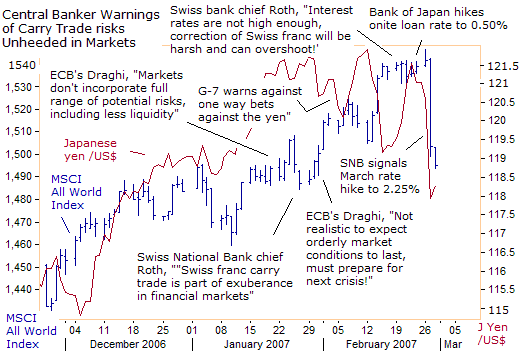
Two of the biggest culprits behind the rampant speculation in global markets are the Bank of Japan (BoJ) and the Swiss National Bank (SNB), whose lending rates are so low, that an estimated $330 billion of “carry trades” in yen and Swiss francs are swirling around the global markets. On Feb 28th, the BoJ’s Atsushi Mizuno, pointed to the side effects of keeping low interest rates near zero percent. “It could cause distortions in global asset prices by speeding up capital outflows from Japan.”
And on January 24th, SNB Chairman Jean-Pierre Roth told the annual meeting of the World Economic Forum. “My current thinking on the Swiss franc, which is going against the fundamental elements in the Swiss economy, is that it’s part of the exuberance in the financial markets,” before vowing to crank up Swiss loan rates. The SNB started cranking up rates from near-zero in mid- 2004 to its current 2%.
Interestingly enough, the latest plunge in global stock markets came on the heels of a hike in the Bank of Japan’s overnight loan rate to 0.50%, its highest in a decade, and renewed warnings by Swiss central bankers of a tighter monetary policy in the weeks ahead, and threats of a short squeeze on speculators betting against the Swiss franc. Earlier, on February 10th, G-7 central bankers warned currency speculators that they could get burned betting in one direction against the yen.
Global Jitters Linked to Downturn in US Housing market
Since former Goldman Sachs CEO Henry Paulson took the helm at the US Treasury last July, the Dow Jones Industrials (DJI) had marched 2,100-points higher, almost without interruption, and without more than a single 2% correction along the way. That was a winning streak unparalleled since 1964. It seemed as if the US Treasury and the Federal Reserve had gained complete mastery over the markets.
“The combination of lower energy prices, job creation and a strong stock market has limited the impact of stagnating house prices on consumer spending,” said Chicago Fed chief Michael Moskow on February 18th, hinting at the Fed’s clandestine strategy. But the higher the DJI flies, the greater the amount of liquidity that is necessary to keep the stock market afloat, and prevent a boom from turning into a bust.
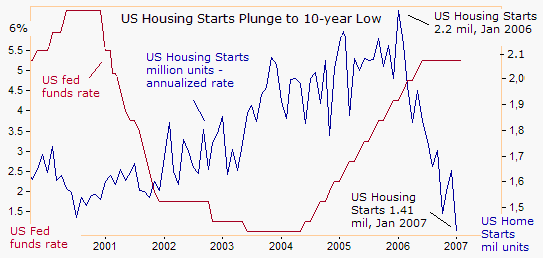
Then on Feb 15th, with the DJI climbing to within a stone’s throw of the 13,000 level, Federal Reserve chief Ben Bernanke identified the depressed US housing market as the biggest risk to the Fed’s goal of a soft landing of 2-½ to 3% growth this year and next. “The ultimate extent of the housing-market correction is difficult to forecast and may prove greater than we anticipate,” he said.
The “soft landing” scenario for the US economy was jolted on February 16th with news that housing starts plunged 14.3% in January to a 1.41 million annual rate, the lowest level since 1997. The Fed’s 2-year rate hike campaign has toppled the US home building industry into a severe recession, and now a meltdown in the sub-prime US home loan market threatens the stock market.
In other signs of severe distress in the all important US housing sector, sales of new US homes plunged 16.6% in January to an annualized rate of 937,000 units, the sharpest monthly decline in 13-years. The Mortgage Bankers Association purchase index fell 4.8% to 381.4 last week, below its year-ago level of 408.7, and is considered a timely gauge of US home sales.
Suddenly, the first major crisis facing the Bernanke Fed arrived without much advance warning – a rash of defaults on sub-prime home loans that if unchecked, can drive the US economy into recession in 2007. Shares of many US sub-prime lenders, such as New Century Financial (NEW.N), and NovaStar Financial (NFI.N), have been brutally hammered in recent weeks, as defaults mount among homeowners with poor credit histories, and where there is smoke, there is fire.
Skyrocketing property values during the US housing boom made it easy for homeowners to borrow heavily against their homes with second mortgages and home-equity loans. But if home prices continue to slide amid a glut of unsold homes and foreclosures, many over-extended homeowners will lose their ATM machines.
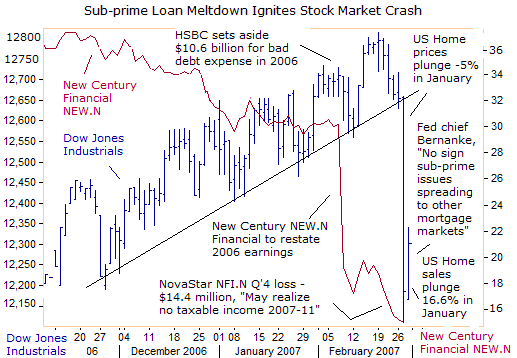
HSBC Holding, HBC.N Europe’s largest bank and a major sub-prime lender in the US, shocked Wall Street by announcing that home-loan delinquencies have gotten so bad that it set aside $10.6 billion to cover potential losses. Delinquencies in the $1.3 trillion impaired-credit mortgage market exceeded 13% among borrowers with sub-prime adjustable-rate loans in the fourth quarter. The top catalyst of delinquencies was second-lien “piggyback” loans taken by borrowers for a down payment.
Defaults could spiral higher as lenders are slated to reset as much as $1.5 trillion in ARM’s this year. A credit squeeze could develop with major players such as HSBC and New Century taking big hits, the entire sub-prime industry is likely to tighten underwriting standards and throttle back on the highest-risk loans.
So with the Dow Jones Industrials badly shaken to as low as 12,086 on Feb 27th, the Plunge Protection Team went into action to rescue the other important ATM machine. “There’s not much indication that sub-prime mortgage issues have spread into other mortgage markets,” Bernanke said on Feb 28th, triggering a 150-point rally in the DJI futures market, and allowing buy-side Wall Street investment bankers to shrug off the bearish news of a 16.6% plunge in existing home sales.
The epicenter of Asian contagion is located in China, and how Beijing decides to deal with the Shanghai bubble, can have a great impact on the outlook for the Chinese economy, global commodity markets, and exporters in the region from Australia, Hong Kong, Japan, and Korea. Will Beijing try to prick the bubble and set-off a steep correction, or carefully calibrate a series of tightening measures to take some steam out of the market and simply flatten it out?
“There is a bubble growing. Investors should be concerned about the risks,” said Cheng Siwei, vice-chairman of China’s National People’s Congress in a January 31st interview with the Financial Times. “But in a bull market, people will invest relatively irrationally. Every investor thinks they can win. But many will end up losing. But that is their risk and their choice,” Cheng warned. Sometimes, markets can boomerang on central banks and torpedo the most carefully designed strategies.
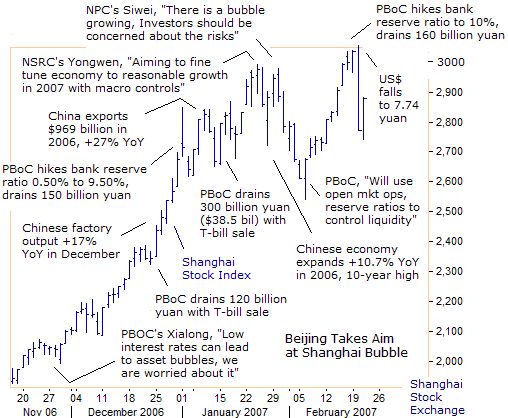
On Feb 9th, the People’s Bank of China (PBoC) tried to keep the market off balance, by warning that it would use a number of tools to keep flush liquidity conditions in check. “The central bank would use a combination of open market operations and higher required reserves for banks in an effort to stave off a credit-fuelled investment boom, and will make the yuan more flexible,” it said.
The PBoC put its verbal threats into action on February 16th, when it lifted bank reserve ratios by half-percent to 10%, coming only six weeks after the last hike, and at faster pace of tightening than expected. The hike in bank reserve ratios should drain about 160 billion yuan ($20.7 billion) from the Chinese money markets. What disturbs Chinese government officials are signs of a speculative bubble in the stock market. Investors opened 50,000 retail brokerage accounts a day in December and mutual funds raised 389 billion yuan last year, quadruple the 2005 amount.
China’s stock markets are dominated by retail investors, who hold 60% of the total trading shares. By comparison, in Hong Kong, which lists a number of mainland Chinese companies, institutional investors account for 70% of daily transactions.
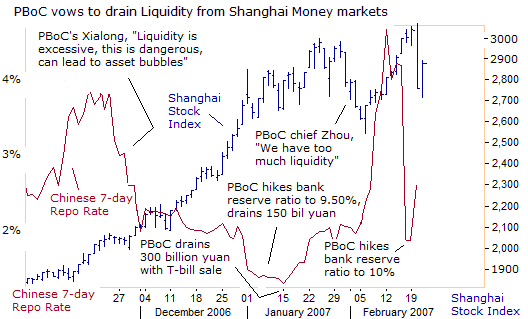
The Chinese stock market has now become the most expensive in Asia, trading at 40 times 2005 earnings, compared to 16 in Hong Kong. The high P/E ratio is supported by expectations of 25% earnings growth for 2006 and 2007, from the possible new tax policy and new accounting standards starting from 2007. However, if 2006 corporate results fail to meet strong expectations, Chinese investors could easily dump inflated stocks, and send the overall market into a tailspin.
Swiss National Bank takes aim at Swiss franc “carry traders” in SMI
Swiss Market Index futures plunged about 175 points from their intra-day high on Feb 21st, following hawkish comments by Swiss National Bank (SNB) chief Jean Pierre Roth. "Inflation will accelerate in 2009. The current interest rate level is not high enough to ensure price stability in the medium term. If the weakness of the franc feeds inflation, an interest rate increase would be necessary” he warned.
Roth also repeated SNB warnings against the risks attached to short-selling the Swiss franc. “The exchange rates on the markets develop out of line with economic fundamentals. Experience shows that such situations are fragile. If the correction comes, it is often harsh and can overshoot,” he said.
Earlier, on Feb 4th, SNB member Thomas Jordan warned investors of the high risks in carry trades, because of a possible sudden and violent appreciation of the Swiss franc. “The weaker the franc gets, the higher the risks investors take when they engage in new carry trades. A sudden appreciation of the franc would lead to heavy losses for those who are short in the franc or sold it in futures,” he said.
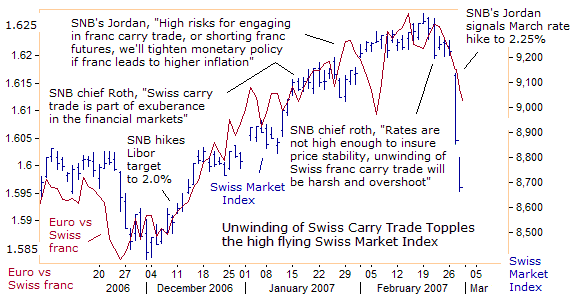
“I am not sure whether all the market participants in this business are always aware of the risk. If import goods got significantly costlier due to the weaker franc and signs of higher inflation existed, we would have to react. We would also move to a tighter monetary policy if the weaker franc led to an overheating in the export industry and a strong wage increase," Jordan warned.
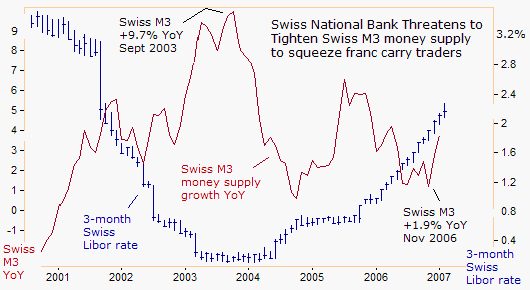
The SNB lifted its target for the three-month Swiss franc Libor rate to 2.00%, on Dec 15th. The next policy meeting is due on March 15th, when the SNB is almost certain to lift its Libor target to 2.25%, to match the ECB’s repo rate hike to 3.75% a week earlier. Two more rate hikes by the SNB to 2.50% might slow M3 to as little as 1-2% growth, which could trigger an unwinding of short positions in the Swiss franc, but put a lid on the high-flying Swiss Market Index.
India Signals Tighter Money Policy to control Inflation
“We will continue to take more steps to dampen inflation,” said Indian Finance Minister Palaniappan Chidambaram on Feb 27th. If true, the Reserve Bank of India still has a long road ahead to contain the M3 money supply, which grew at an annualized 21.3% last month, and bank loans expanded at 30% clip, much higher than the central bank’s target of 20 percent.
India’s central bank has been raising official interest rates gradually for the past 2-½ years, and lifting bank reserve ratios, to curb rapid credit expansion and accelerating inflation, but remains far behind the inflation curve. “It is important to lower inflation perceptions and the Indian central bank will take all measures to rein in price pressures,” said Deputy Governor Rakesh Mohan on Feb 28th.
India’s wholesale inflation rate climbed to 6.73% in January, and prices paid by farmers are at an eight-year high of 8.94 percent. New Delhi expects unprecedented growth of 9.2% in the year to March 31st, the fastest pace after China among the world’s major economies. The economy has averaged 8.6% growth since 2003.
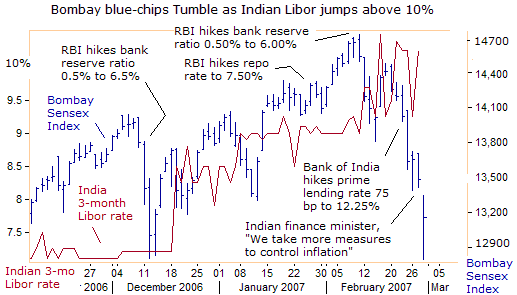
The Bank of India, which owns nearly a quarter of banking sector assets in India,, raised its benchmark prime lending rate by 75 basis points to 12.25% last week, the second time it has raised its benchmark lending rate in two months. It also lifted the rate a half-point to 11.50% in late December. Leading private lender ICICI Bank’s benchmark rate for corporate loans is now 14.75%, and expects Indian loan demand to slow to a 20% annualized rate in the future, and in turn, slowing M3 growth.
The RBI’s tightening campaign, up until now, has failed to slow the M3 money supply or bank lending. But since mid-December, India’s 3-month Libor rate has climbed 300 basis points to 10.25%, the tightest squeeze on Bombay’s money markets in many years. That could take some of the air out of the Bombay Sensex bubble, where 75% of capital inflows are funded with hot money from abroad.
Gold is a Safe Haven from the Global Stock market Storm
So far this year, the Dow Jones Industrials have lost 6.5% to an ounce of gold, much to the chagrin of central bankers. Gold rallied as high as $690 /oz on Feb 26th in Asia, before market contagion knocked it off its upward course. With a background of sub-prime loan debt bombs, explosive global money supply growth, and jitters over Iran’s nuclear weapons program, gold has emerged triumphant over the DJI.
Strategists at 12 of the biggest Wall Street firms predicted in December that S&P 500 stocks would rally an average 7.8% this year. The unanimous bullish outlook on Wall Street last happened for 2001, when the S&P 500 dropped 13 percent. The growing complacency about the stock market is strange with slower earnings and economic growth on the horizon. This quarter may be the first one since 2003 that profits at S&P 500 profits will fall short of a 10% increase.
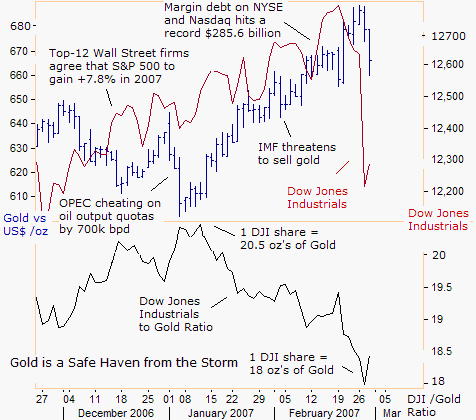
The amount of money borrowed from brokerage firms to buy stock reached a record $285.6 billion last month, topping the prior high set at the peak of the so-called Internet bubble. Changes in the level of margin debt have mirrored those of US stock indexes. After setting an all-time high of $278.5 billion in March 2000, margin debt dropped to less than half that amount by September 2002. For now, gold is seen as a safe haven for the global stock market storm.
The upcoming March 2nd edition of Global Money Trends for paid subscribers will examine whether the latest shake-out in the global stock markets represents a major top with a bear market ahead, or rather a stiff correction in a long-term bull market, along with expanded analysis and forecast of crude oil and gold.
By Gary Dorsch, Editor, Global Money Trends newsletter
http://www.sirchartsalot.com/newsletters.php
## “This article is just the Tip of the Iceberg” of what’s available in the Global Money Trends newsletter published around the 1st and 15th of each month in pdf format, and 30 pages in length. GMT collects a wide array of news and information from reputable sources, filters out the noise and distractions, and puts all the pieces of the global economic puzzle together into coherent snapshot analyses, with lots of cool charts showing the inter-relationships of markets and economic statistics from around the world.
Here's what you will receive with a subscription, Insightful analysis and predictions of, (1) top stock market indexes around the world, and US-listed Exchange Traded Funds (ETF’s) and closed-end country funds. (2) Commodities such as crude oil, copper, gold, silver, the CRB index, and gold mining and oil company indexes. (3) Foreign currencies such as, the Australian dollar, British pound, Euro, Japanese yen, and Canadian dollar. ($) Libor interest rates, global bond markets and their central bank monetary policies.
Subscribers will also receive Email Alerts, sent out in-between regular newsletter postings, when important information unfolds in the global markets.
A subscription to Global Money Trends is only $125 US dollars per year for 24 issues, including access to all back issues. Click on the following hyperlink, to order now, http://www.sirchartsalot.com/newsletters.php
© 2005-2022 http://www.MarketOracle.co.uk - The Market Oracle is a FREE Daily Financial Markets Analysis & Forecasting online publication.
