


Lessons from the Great Depression - Stock Market Crash!
InvestorEducation / Economic Depression May 29, 2008 - 11:50 AM GMT

 Today I think it is appropriate to look at the actual crash of 1929 and how it unfolded. The importance of this post will examine the multiple interventions that entered into the market trying to prop it up while the market steadily unfolded for four years before bottoming out. When we look at a number such as 1929-1933, we seem to compartmentalize that these four years somehow went quicker than our future four years of say 2008-2012.
Try to imagine for a moment, how 2012 will look. Does this seem like tomorrow? Does this seem like a quick turn of a chapter? Of course not. So when we examine the crash of 1929, we realize that the market declined both abruptly and quickly at times but took years. It wasn't for lack of intervention or from motivation. There were those perma-bulls back then that couldn't foresee a world without new credit devices that emerged during the early part of the century.
This is part VI in a series which I think is incredibly important. We have been here and keep in mind Ben Bernanke is a student of the Great Depression and believes that one of the primary causes of the Great Depression was lack of vigorous intervention by the Fed at that time. He will now be able to put his theory into practice.
Lessons from the Great Depression Series:
1. Personal Story by a Lawyer from a Previous Asset Bubble. Can we Learn from the Past and How will the Housing Decline Impact You?
2. Lessons From the Great Depression: A Letter from a former Banking President Discussing the Bubble.
3. Florida Housing 1920s Redux: History repeating in Florida and Lessons from the Roaring 20s.
4. The Menace of Mortgage Debts: Lessons from the Great Depression Series: Part IV: Where do we go After the Housing Crash?
5. Business Devours its Young: Lessons from the Great Depression: Part V: Destroying the Working Class.
With each subsequent rate cut, the market is losing more and more faith with the Federal Reserve. I think the Federal Reserve realizes that there is only so much more room before they hit a zero percent interest bottom. The bullets are running out and soon, a new weapon will be needed.
Crash!
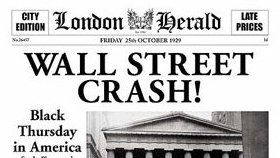 I am a big fan of Frederick Lewis Allen who has written extensively on the historical, social, and economic circumstances of the early half of the century. For those of you who want to see where we are heading we need to have a wider scope than just the last few decades. It doesn't seem that people much care about history yet are willfully accepting to repeat it. This is a chapter titled Crash! that gives an amazing account of the days and time surrounding the crash of 1929:
"Early in September the stock market broke. It quickly recovered however, indeed, on September 19th the averages as compiled by the New York Times reached an even higher level than that of September 3rd. Once more it slipped, farther and faster, until by October 4th the prices of a good many stocks had coasted to what seemed first-class bargain levels. Steel, for example, after having touched 261 3/4 a few weeks earlier, had dropped as low as 204 ; American Can, at the closing on October 4th, was nearly twenty Points below its high for the year; General Electric was over fifty points below -its high; Radio had gone down from 114 3/4 to 82 1/2.
A bad break, to be sure, but there had been other bad breaks, and the speculators who escaped unscathed proceeded to take advantage of the lessons they had learned in June and December of 1928 and March and May of 1929 : when there was a break it was a good time to buy. In the face of all this tremendous liquidation, brokers' loans as compiled by the Federal Reserve Bank of New York mounted to a new high record on October 2nd, reaching $6,804,000,000 -- a sure sign that margin buyers were not deserting the market but coming into it in numbers at least undiminished. (part of the increase in the loan figure was probably due to the piling up of unsold securities in dealers, hands, as the spawning of investment trusts and the issue of new common stock by every manner of business concern continued unabated.) History, it seemed, was about to repeat itself, and those who picked up Anaconda at 109 3/4 or American Telephone at 281 would count themselves wise investors. And sure enough, prices once more began to climb. They had already turned upward before that Sunday in early October when Ramsay MacDonald sat on a log with Herbert Hoover at the Rapidan camp and talked over the prospects for naval limitation and peace.
Something was wrong, however. The decline began once more. The wiseacres of Wall Street, looking about for causes, fixed upon the collapse of the Hatry financial group in England (which had led to much forced telling among foreign investors and speculators) , and upon the bold refusal of the Massachusetts Department of Public Utilities to allow the Edison Company of Boston to split up its stock . They pointed, too, to the fact that the steel industry was undoubtedly slipping, and to the accumulation of "undigested" securities. But there was little real alarm until the week of October 21st. The consensus of opinion, in the meantime, was merely that the equinoctial storm of September had not quite blown over. The market was readjusting itself into a "more secure technical position."
 It is clear from anyone that has studied the Great Depression, that not one event collapsed the market. It was like a tipping point that finally capitulated the market downward. Interestingly enough, a financial group had collapsed in England and also, a public utility company was allowed to split up its stock (doesn't it seem familiar that these two parallel with Bear Stearns being bailed out and also, the proposed splitting up of the monolines who are now failing?). Either way, the market in early 1929 had already had a few incidents where the market declined only to be propped back up by massive speculation. The speculation was so spectacular that even at the last minute, investors were still pushing stocks up. And of course, it almost seemed unfathomable that the market would collapse. Even the prophets of Wall Street couldn't envision such a scenario:
"In view of what was about to happen, it is enlightening to recall how things looked at this juncture to the financial prophets, those gentlemen whose wizardly reputations were based upon their supposed ability to examine a set of graphs brought to them by a statistician and discover, from the relation of curve to curve and index to index, whether things were going to get better or worse. Their opinions differed, of course; there never has been a moment when the best financial opinion was unanimous. In examining these opinions, and the outgivings of eminent bankers, it must furthermore be acknowledged that a bullish statement cannot always be taken at its face value: few men like to assume the responsibility of spreading alarm by making dire predictions, nor is a banker with unsold securities on his hands likely to say anything which will make it more difficult to dispose of them, unquiet as his private mind may be. Finally, one must admit that prophecy is at best the most hazardous of occupations. Nevertheless, the general state of financial opinion in October, 1929, makes an instructive contrast with that in February and March, 1928, when, as we have seen, the skies had not appeared any too bright.
Some forecasters, to be sure, were so unconventional as to counsel caution. Roger W. Babson, an investment adviser who had not always been highly regarded in the inner circles of Wall Street, especially since he had for a long time been warning his clients of future trouble, predicted early in September a decline of sixty or eighty points in the averages. On October 7th the Standard Trade and Securities Service of the Standard Statistics Company advised its clients to pursue an "ultraconservative policy," and ventured this prediction: "We remain of the opinion that, over the next few months, the trend of common-stock prices will be toward lower levels." Poor's Weekly Business and Investment Letter spoke its mind on the "great common-stock delusion" and predicted "further liquidation in stocks." Among the big bankers, Paul M. Warburg had shown months before this that he was alive to the dangers of the situation. These commentators -- along with others such as the editor of the Commercial and Financial Chronicle and the financial editor of the New York Times --would appear to deserve the 1929 gold medals for foresight."
It is often sited that no one really foresaw the crash of 1929 but there were a handful of people that were echoing a warning cry. But how many people listened? Even the predictions were slightly modest from the bears yet they were still not given the time of day. But of course you had your perpetual housing bulls:
"Professor Irving Fisher, however, was more optimistic. In he newspapers of October 17th he was reported as telling the Purchasing Agents Association that stock prices had reached "what looks like a permanently high plateau." He expected to see the stock market, within a few months, "a good deal higher than it is today. " On the very eve of the panic of October 24th he was further quoted as expecting a recovery in prices. Only two days before the panic. the Boston News Bureau quoted R. W. McNeel, director of McNeel's Financial Service, as suspecting "that some pretty intelligent people are now buying stocks . "Unless we are to have a panic-which no one seriously believes-stocks have hit bottom," said Mr. McNeel. As for Charles E. Mitchell, chairman of the great National City Bank of New York, he continuously and enthusiastically, radiated sunshine. Early in October Mr. Mitchell was positive that, despite the stock-market break, "The industrial situation of the United States is absolutely sound and our credit situation is in no way critical . . . .
The interest given by the public to brokers' loans is always exaggerated," he added. "Altogether too much attention is paid to it." A few days later Mr. Mitchell spoke again: "Although in some cases speculation has gone too far in the United States, the markets generally are now in a healthy condition. The last six weeks have one an immense amount of good by shaking down prices. ..... The market values have a sound basis in the general prosperity of our country." Finally, on October 22nd, two days before the panic, he arrived in the United States from a short trip to Europe with these reassuring words: "I know of nothing fundamentally wrong with the stock market or with the underlying business and credit structure. . . . The public is suffering from 'brokers' loanitis."
In these types of situations, be careful who you listen to. The CEO of Bear Stearns as early as 2 days before his company was bailed out by the Federal Reserve had this to say :
"New Chief Executive Alan Schwartz appeared on CNBC Wednesday to allay fears that the firm faces a liquidity crisis, a perception heightened by the Federal Reserve's decision on Tuesday to loan up to $200 billion in Treasury bonds to primary dealers, a move that would allow Bear to swap some of its mortgage-backed securities for more secure debt.
" Our balance sheet has not weakened at all," said Schwartz, noting that Bear's $17 billion cash position was the same as it had been in November. On Monday, the company posted a similar message on its web site: "The company stated that there is absolutely no truth to the rumors of liquidity problems that circulated today in the market."
So much for not having a weak balance sheet. In 2 days Bear Stearns lost 40 percent of its market value. In these times, even those perceived as experts have a motivation to keep the pretense up that all is well. Clearly as CEO, one is to expect that you would have a better sense of your company's situation. I still think we have yet to see the break point where the market trends fully lower. During 1929 the moment came in late October:
"The next day was Thursday, October 24th.
On that momentous day stocks opened moderately steady in price, but in enormous volume. Kennecott appeared on the tape in a block of 20,000 shares,General Motors in another, of the same amount. Almost at once the ticker tape began to lag behind the trading on the floor. The pressure of selling orders was disconcertingly heavy. Prices were going down..... Presently they were going down with some rapidity....Before the first hour of trading was over, it was already apparent that they were going down with an altogether unprecedented and amazing violence. In brokers' offices all over the Country, tape-watchers looked at one another in astonishment and perplexity. Where on earth was this torrent of selling orders coming from?
The exact answer to this question will probably never be known. But it seems probable that the principal cause of the break in prices during that first hour on October 24th was not fear. Nor was it short selling. It was forced selling . it was the dumping on the market of hundreds of thousands of shares of stock held in the name of miserable traders whose margins were exhausted or about to be exhausted. The gigantic edifice of prices was honeycombed with speculative credit and was now breaking under its own weight.
Fear, however, did not long delay its coming. As the price structure crumbled there was a sudden stampede to get out from under. By eleven o'clock traders on the floor of the Stock Exchange were in a wild scramble to "sell at the market." Long before the lagging ticker could tell what was happening, word had gone out by telephone and telegraph that the bottom was dropping out of things, and the selling orders redoubled in volume. The leading, stocks were going down two, three, and even five points between sales. Down, down, down.... Where were the bargain-hunters who were supposed to come to the rescue at times like this? Where were the investment trusts, which were expected to provide a cushion for the market by making new purchases at low prices? Where were the big operators who had declared that they were still bullish? ere were the powerful bankers who were supposed to be able at any moment to support prices? There seemed to be no support whatever. Down, down, down. The roar of voices which rose from the floor of the Exchange had become a roar of panic.
United States Steel had opened at 205 1/2. It crashed through 200 and presently was at 193 1/2. General Electric, which only a few weeks before had been selling above 400, had opened this morning at 315 -- now it had slid to 283. Things were even worse with Radio: opening at 68 3/4, it bad gone dismally down through the sixties and the fifties and forties to the abysmal price of 44 1/2. And as for Montgomery Ward, vehicle of the hopes of thousands who saw the chain store as the harbinger of the new economic era, it had dropped headlong from 83 to 50. In the space of two short hours, dozens of stocks lost ground which it had required many months of the bull market to gain.
Even this sudden decline in values might not have been utterly terrifying if people could have known precisely what was happening at any moment. It is the unknown which causes real panic."
Amazingly, it seems like the fire that lit the fuse was forced selling in October 1929. The current catalyst of this market is the forced liquidation of many companies and margin calls are now starting to creep back into the lexicon of the market. Without credit, the system cannot function just like a Ponzi Scheme cannot go on without new players. Once the buyers (credit) dries up, the gig is up. It wouldn't be a problem if companies were adequately capitalized but they are leveraged to the hilt and really have no viability without access to credit. That is their mistake. Just like many states unable to save during the good times for an inevitable downturn in the future. Those that claim we will not have a recession need their heads examined. Even after the "crash" the market had a few short rallies until it finally capitulated:
"The New York Times averages for fifty leading stocks had been almost cut in half, failing from a high of 311.90 in September to a low of 164.43 on November 13th ; and the Times averages for twenty-five leading industrials had fared still worse, diving from 469.49 to 220.95.
The Big Bull Market was dead. Billions of dollars' worth of profits-and paper profits-had disappeared. The grocer, the window-cleaner, and the seamstress had lost their capital. In every town there were families which had suddenly dropped 'from showy affluence into debt. Investors who had dreamed of retiring to live on their fortunes now found themselves back once more at the very beginning of the long road to riches. Day by day the newspapers printed the grim reports of suicides.
Coolidge-Hoover Prosperity was not yet dead, but it was dying. Under the impact of the shock of panic, a multitude of ills which hitherto had passed unnoticed or had been offset by stock-market optimism began to beset the body economic, as poisons seep through the human system when a vital organ has ceased to function normally. Although the liquidation of nearly three billion dollars of brokers' loans contracted credit, and the Reserve Banks lowered the rediscount rate , and the way in which the larger banks and corporations of the country had survived the emergency without a single failure of large proportions offered real encouragement, nevertheless the poisons were there; overproduction of capital; overambitious (expansion of business concerns; overproduction of commodities under the stimulus of installment buying and buying with stock-market profits; the maintenance of an artificial price level for many commodities, the depressed condition of European trade. No matter how many soothsayers of high finance proclaimed that all was well, no matter how earnestly the President set to work to repair the damage with soft words and White House conferences, a major depression was inevitably under way.
Nor was that all. Prosperity is more than an economic condition; it is a state of mind. The Big Bull Market had been more than the climax of a business cycle; it had been the climax of a cycle in American mass thinking and mass emotion. There was hardly a man or woman in the country whose attitude toward life had not been affected by it in some degree and was not now affected by the sudden and brutal shattering of hope. .With the Big Bull Market zone and prosperity going, Americans were soon to find themselves living in an altered world which called for new adjustments. new ideas, new habits of thought, and a new order of values. The psychological climate was changing; the ever-shifting currents of American life were turning into new channels.
The Post-war Decade had corne to its close. An era had ended."
It is only a matter of time before the current era of easy credit ends. Higher fuel prices are accelerating the decline. Does it happen quick or slowly? The question of when it happens does remain.
 Subscribe to Dr. Housing Bubble's Blog to get more housing content and your full dose of Real Homes of Genius.
By Dr. Housing Bubble
Author of Real Homes of Genius and How I Learned to Love Southern California and Forget the Housing Bubble
www.doctorhousingbubble.com
Dr. Housing Bubble Archive |
© 2005-2022 http://www.MarketOracle.co.uk - The Market Oracle is a FREE Daily Financial Markets Analysis & Forecasting online publication.
