


Oracle of Omaha Bets S&P 500 Stock Market Index Will Outperform Hedge Funds
Stock-Markets / Stock Market Valuations Jun 21, 2008 - 09:18 AM GMTBy: John_Mauldin

-
 Warren Makes a Bet
 - It's All About Values
- Hedging Your Bet
- Mean Reversion of National Wealth
The Sage of Omaha made a bet that was written up in a recent Fortune magazine article. Basically, Warren Buffett bet that the S&P 500 would outperform a group of funds of hedge funds over the next ten years. A million dollars to someone's favorite charity is on the line. This week we will analyze the bet, using it as a springboard to learn about valuation and value investing. As we will see, there are times that making a bet on the S&P 500 to outperform hedge funds (or bonds or real estate or whatever asset class) makes sense and times when it doesn't.
But first, an apology is in order. I get to travel a lot with my daughter and business partner Tiffani (actually, she runs the business) and meet new people. Over the years, she has become as fascinated as I have with their individual stories. Everyone has a story to be told or a lesson to teach. We have decided to write a book about those stories, looking at the differences in perspective between old and young, retired and working, those who are wealthy and those who aspire to wealth. What are the differences in attitudes, in work habits, in how you manage money, in how you look at the future, and a score of other items? How do all of these things correlate?
We sent an email to some of you a few days ago, asking you to fill out a survey to help us gather data, with the intention of sending it to everyone over time. After you complete this survey, I offer an audio stream of a speech I recently made.
The survey software we're using had been stress tested to handle 50,000 surveys in a 24-hour period. For whatever reason, though, the server on which the survey was hosted simply collapsed under the number of people trying to complete the survey and listen to the speech.
I am sorry about the frustration some of you had not being able to get into the survey. We are working on getting the problem fixed and will send an email out sometime next week with a properly working link. I am really quite excited about this project, as we will all learn a lot, Tiffani and I most of all. Thanks for your help, patience, and indulgence.
Warren Makes a Bet
The Motley Fool did a foolish thing and made me one of five nominees for Investor of the Year for 2007. Warren Buffett of course won, but I was surprised (as was The Motley Fool) that I came in second. Buffett is the clear winner in investing, and his wisdom is followed by a large legion of fans, among which I am one. So, let me get myself in trouble and disagree with him on a small matter.
Carol Loomis (one of my favorite financial writers) writes in this week's Fortune about a bet that Warren Buffett made with a hedge fund management company. You can read the fascinating story at http://money.cnn.com/. Quoting:
"And to that there is a certain history, which began at Berkshire's May 2006 annual meeting. Expounding that weekend on the transaction and management costs borne by investors, Buffett offered to bet any taker $1 million that over 10 years and after fees, the performance of an S&P index fund would beat 10 hedge funds that any opponent might choose. Some time later he repeated the offer, adding that since he hadn't been taken up on the bet, he must be right in his thinking."
A New York firm, Protégé Partners, which manages $3.5 billion in a fund of hedge funds, decided to accept that bet. Basically, Buffet and Protégé each put $320,000 into 10-year zero-coupon Treasury bonds that will be worth $1 million in 10 years. The bet is straightforward. Protégé has chosen five funds of hedge funds, and these funds must return more than the S&P 500 over the 10 years beginning January of 2008. (The list of funds is a secret.) The winner gets the $1 million donated to their favorite charity.
Which way would you bet? If the online response at Fortune is any indication, 90% of you would bet with Warren. As one enthusiastic responder wrote, "How can you bet against Buffett? I'd bet my life savings on it ..." Well, Tom, you might want to hedge your bet. Even Warren said he thinks his odds are only 60%.
The basic premise to Buffett's position is that the high fees simply eat up any potential for extra profits, over those of a simple index fund. As Buffett writes:
"A number of smart people are involved in running hedge funds. But to a great extent their efforts are self-neutralizing, and their IQ will not overcome the costs they impose on investors. Investors, on average and over time, will do better with a low-cost index fund than with a group of funds of funds."
And he is right about the fees. Hedge funds, and especially funds of funds, must do much better than average to overcome their high fees. Loomis sums it up as follows:
"As for the fees that investors pay in the hedge fund world - and that, of course, is the crux of Buffett's argument - they are both complicated and costly. A fund of funds nor`mally charges a 1% annual management fee. The hedge funds it puts that money into charge an annual management fee of their own, which for funds of funds is typically 1.5%. (The fees are paid quarterly by an investor and are figured on the value of his account at the time.)
"So that's 2.5% of an investor's capital that continually goes for these fees, regardless of the returns earned during a year. In contrast, Vanguard's S&P 500 index fund had an expense ratio last year of 15 basis points (0.15%) for ordinary shares and only seven basis points for Admiral shares, which are available to large investors. Admiral shares are the ones ‘bought' by Buffett in the bet.
"On top of the management fee, the hedge funds typically collect 20% of any gains they make. That leaves 80% for the investors. The fund of funds takes 5% (or more) of that 80% as its share of the gains. The upshot is that only 76% (at most) of the annual return made on an investor's money accrues to him, with the rest going to the ‘helpers' that Buffett has written about. Meanwhile, the investor is paying his inexorable management fee of 2.5% on capital.
"The summation is pretty obvious. For Protégé to win this bet, the five funds of funds it has picked must do much, much better than the S&P."
True. But the growth of hedge funds and fund of funds suggests that some think there is value there that is worth the fees. But let's set aside that argument for now, and look at the prospects for the bet between Protégé and Buffett.
It's All About Values
As I wrote in Bull's Eye Investing ( Amazon.com ) and occasionally stress in my writing, the long-term returns you get from index fund investing are very highly correlated with the P/E (price to earnings) ratio at the time you make your initial investment. The P/E is price divided by earnings. If the ratio is 10, then earnings are about 10% of the stock price. If the ratio is 20, they are about 5% of the stock price. The higher the price, the less earnings you get for your invested dollar. However, a rising P/E ratio can be a major boost to stock market returns.
If you make your investment when valuations are low, you return is going to be much higher over time than if you make your investment when valuations are high. Look at this graph from South African partner Prieur du Plessis of Plexus:
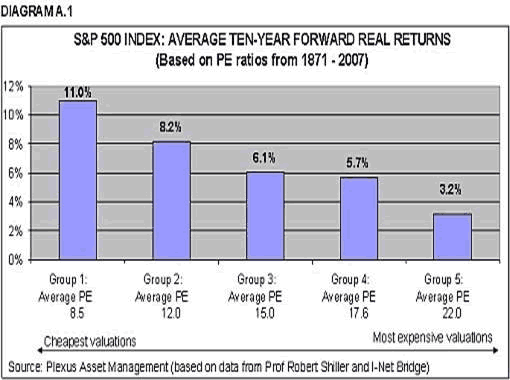
Prieur divided the S&P 500 into five groups based on the initial P/E ratio and then calculated what the returns would be for the next 10 years, after inflation. He also used a 10-year average of the P/E ratio, to take out the fluctuations caused by one-off events, recessions, etc.
As you can see, and long-time readers should expect, if you invest when stocks are at their cheapest, you can make a remarkable 11% on average for the next 10 years after inflation. As stocks get more expensive in terms of their P/E, returns begin to fall. Real returns for the last group are only 3.2% on average.
We are currently in the range of the highest valuations. If you make the generous assumption that inflation will be 3% over the next decade, you are talking about a 6% total return, based on historical averages. Not bad, but not what a lot of investors are hoping for. Remember that 6% number, as we will revisit it in a moment.
One of my basic premises is that we need to look at markets in terms of valuation and not just price. Markets go from high valuations to low valuations and back to high. The round trip can take the better part of 30-40 years. These are long-term secular markets, and they are mean-reverting. By that I mean that markets will go both well above and well below the long-term mean average over time.
To see how well correlated long-term returns and P/E ratios are, you can go to www.frontlinethoughts.com and click on the link where it says "get the stock market graphs here" on the upper right-hand side. You can see what your returns would have been in any period of time since 1900. Then check at the top to see what the P/E ratio was at that time. If the return numbers are white, then P/E ratios were falling and returns were either negative or low. When the numbers are black, that means P/E ratios were rising, and returns are also likely to be good.
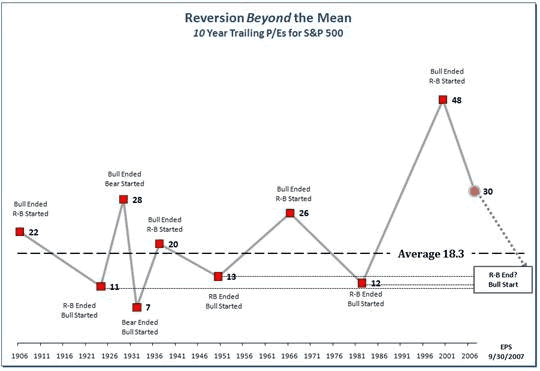
Look at the following charts from Vitaliy Katsenelson (author of the most excellent book Active Value Investing, and one I recommend to anyone interested in value investing. Amazon.com )
Again, these are 10-year trailing P/E ratios. Notice how the P/Es always go back below the average? And we are a long way from the average now. There are two ways that we can get back to low P/Es. Either the stock market can go down or earnings can go up faster than prices (or some combination thereof). The stock market bottomed in 1974 in terms of price, but in terms of valuation the market took another eight years to get to its low. Then in 1982, with valuations below 10, the stock market was a coiled spring ready to explode.
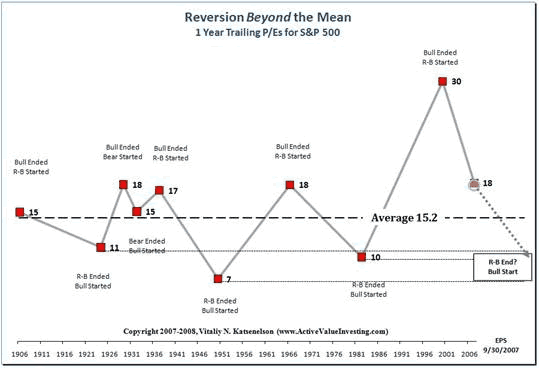
Let's look at one more chart from Vitaliy. This chart shows the one-year trailing P/Es. Today, if you go to the S&P 500 tables at Standard and Poor's, you find the current P/E ratio is a heady 22, with the long-term one-year average being 15.2. There is a long way to go before we get to anything we can call mean reversion.
Hedging Your Bet
Now, let's look at how Warren's bet would have done in the bull market years of 1990-99. We will compare how a fund of hedge funds index from hedgefund.net did between 1990 and 1999, to the S&P 500.
(Note: these hedge fund indexes are representative of funds of funds in general, but you cannot invest in them. They have problems like survivor bias; they don't have all the fund of funds, just the ones that report, etc. Past performance is not indicative of future results. Further, the hedge fund climate is much different today than in 1990. But the indexes are the best proxy we can find if we want to do a comparison.)
The S&P 500 rather handily beat the hedge funds. The S&P 500 went from 353 to 1469 in those 10 years, for an average total return (including dividends) of 433%, or an average 18.2% a year. The hedge fund index returned 14% a year for a total return of 271%, net of fees. The standard deviation for the S&P 500 was 13.38% and for the hedge funds was a lower 7.87%, so the hedge funds were a lot less volatile. Still, buy-and-hold index investors were rewarded for the risk. The chart below shows how $1,000 invested might have grown over the 10 years.
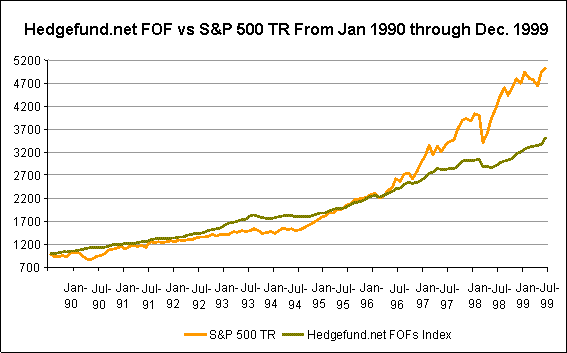
Now, let's look at the last 10 years, from May 1998 to May 2008. Here we use a fund of funds index from Barclayhedge.com. Now, we find a different story. The market returned 4.21% on average, or a total of 51%, with a standard deviation of 14.7%. The hedge fund index returned 7.7%, with a standard deviation of 5.1%. So, you got a lot less return with a lot more volatility, if you stayed with the S&P 500.
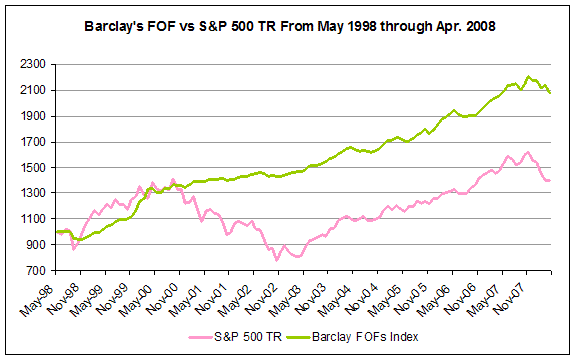
Of course, there was a nasty bear market in 2000-2002, and a roaring bull market in the 1990s. But let me make one observation. In 1990 the P/E ratio was 15 and had been below 12 just a few quarters earlier. In 1998 the P/E ratio was 27.8, almost double what it was eight years earlier. A lot of the difference came from the starting point of stock market valuations.
Where are we today? The P/E ratio is 23.2. Earnings are dropping as we work our way through a very tough economy. As I have written elsewhere, I think the recovery, such as it is, will take at least two years before we can get back to 3% growth, because the twin bubbles of the housing market and the credit crisis will take at least two years to work themselves out. 1-2% growth in GDP for the next two years is not an environment for significant earnings growth. It is also not an environment in which stock markets are likely to thrive.
Roughly 20% of the S&P is financial stocks. Do you think they are likely as a group to start reporting robust earnings growth over the next two years? They are deleveraging, which will not help earnings growth. There are more write-offs to come. A significant portion of the S&P is tied to US consumers, who are pulling back. On the other hand, there are some very large multinational corporations that are benefitting from a weak dollar, as both their exports rise and their foreign subsidiaries profit.
But the climate is not favorable to robust earnings growth for the next few years. That will make it tougher for the stock market to keep up with the funds of hedge funds.
Mean Reversion of National Wealth
One more thought pointed out to me by Woody Brock: National wealth is a mean-reversion machine. That is a fundamental basic truth in economics. Over very long periods of time (multiple decades), growth in national wealth will equal growth in nominal GDP. And by national wealth, I am referring to our homes, stocks, bonds, real estate, etc.
Now, nominal GDP has been running about 5.5% for a long time. But between 1981 and 2006, US national wealth grew at an astounding 7.2%, from $10 trillion to $57 trillion. Mean reversion, or getting back to the average, means that national wealth must dip below 5.5% for an extended period of time. Woody thinks that from 2009 to the end of the next decade, we could see national wealth grow between 2.5-3%, well below our recent experience. National wealth is likely to fall this year and maybe next as housing values drop. This drop in wealth and slower growth means that consumers are not likely to return to their previous "shop till we drop" mode. And that is a serious pressure on earnings.
Graham taught us that in the short run the stock market is a voting machine, but in the long run it is a weighing machine. And what it weighs are earnings.
I have little doubt that earnings will rise at 6-8% on average over the next 10 years. The 1990s saw earnings more than double over 10 years, and the back of my napkin says that is around 8% annualized growth, although earnings dropped by 50% over the next three years. Over the very long run, earnings are going to grow at the level of nominal GDP, or around 5.5-6%.
For the stock market to do more than 6%, P/E levels would have to rise to even loftier levels than at present. Can it happen? Sure, it did in the late '90s; but we saw how that ended.
Let's go back to the graphs from Katsenelson. If P/E ratios continue the process of mean reversion and continue to fall, that will be a serious headwind for stock market growth. And we have no example in history where valuations did not revert to the mean. That doesn't mean that this time it couldn't be different. But that is not usually the way to bet.
If it was 1990 and a lower P/E, or 2002 and low P/Es (on a normalized basis), when the stock market outperformed the hedge funds, then I would not want to bet against Warren. But with today's valuations, a Muddle Through Economy staring us in the face for the next two years, a potential and serious tax increase in 2010 that would prolong any recovery and be even more problematical for earnings and stocks, I think the absolute-return funds will win this time.
In the end, it will depend on how good the funds of funds are that Protégé picked, but these are savvy managers. They want to win, and I bet they picked the best they could find. We will find out each year at the annual Berkshire meeting how the bet is coming along. Right now, the market is down 10% and the hedge funds are down about 2%, but this is a long race. The first five months mean very little.
But the real winners will be the charities they have picked. And that is a good thing, not matter who wins the bet.
Now, if Buffett bet that Berkshire will do better than the funds of funds, I would not take that bet. But that is another story.
New York, Las Vegas, and Sweden
I will go to New York and Philadelphia to meet with managers and partners in a whirlwind two days, and I am scheduled to do Larry Kudlow's show on July 1. Then I will be in Las Vegas July 10-12 for the annual Freedom Fest Conference, where I will speak several times; and the line-up of speakers is as strong as for any conference I have ever been to: Denish D'Souza will debate Christopher Hitchens; and Steve Forbes, Ron Paul, Stephen Moore (Wall Street Journal), Charles Murray, George Gilder, John Goodman, and about 100 other speakers, each impressive in their own right, will be there, as will 1,500 freedom-loving attendees. You can go to http://www.freedomfest.com /promo.htm and click on the list of speakers to see more and to register. Hope to see you there.
Last October I agreed to go to Sweden , so it looks like I will be going to Europe and am going to try and go to the Middle East as well. It looks like I will get to check off a few more countries on my list. I am not certain what I will do in August. I try to leave the heat of Texas for cooler climes, but am not sure the schedule will let me take off all that long.
The wedding shower for Tiffani last Saturday was fun. I got to see a lot of old friends I had not seen for years. Where does the time go? And it was good to have the kids under one roof again, if only for a few days.
This weekend I am going to relax and catch up on some fun reading, and play with my new Apple MacBook Air. It is so light. I think I am really going to enjoy it.
Have a great week.
Your not believing he would bet against Warren analyst,
By John Mauldin
John Mauldin, Best-Selling author and recognized financial expert, is also editor of the free Thoughts From the Frontline that goes to over 1 million readers each week. For more information on John or his FREE weekly economic letter go to: http://www.frontlinethoughts.com/learnmore
To subscribe to John Mauldin's E-Letter please click here:http://www.frontlinethoughts.com/subscribe.asp
Copyright 2008 John Mauldin. All Rights Reserved
John Mauldin is president of Millennium Wave Advisors, LLC, a registered investment advisor. All material presented herein is believed to be reliable but we cannot attest to its accuracy. Investment recommendations may change and readers are urged to check with their investment counselors before making any investment decisions. Opinions expressed in these reports may change without prior notice. John Mauldin and/or the staff at Millennium Wave Advisors, LLC may or may not have investments in any funds cited above. Mauldin can be reached at 800-829-7273.
Disclaimer PAST RESULTS ARE NOT INDICATIVE OF FUTURE RESULTS. THERE IS RISK OF LOSS AS WELL AS THE OPPORTUNITY FOR GAIN WHEN INVESTING IN MANAGED FUNDS. WHEN CONSIDERING ALTERNATIVE INVESTMENTS, INCLUDING HEDGE FUNDS, YOU SHOULD CONSIDER VARIOUS RISKS INCLUDING THE FACT THAT SOME PRODUCTS: OFTEN ENGAGE IN LEVERAGING AND OTHER SPECULATIVE INVESTMENT PRACTICES THAT MAY INCREASE THE RISK OF INVESTMENT LOSS, CAN BE ILLIQUID, ARE NOT REQUIRED TO PROVIDE PERIODIC PRICING OR VALUATION INFORMATION TO INVESTORS, MAY INVOLVE COMPLEX TAX STRUCTURES AND DELAYS IN DISTRIBUTING IMPORTANT TAX INFORMATION, ARE NOT SUBJECT TO THE SAME REGULATORY REQUIREMENTS AS MUTUAL FUNDS, OFTEN CHARGE HIGH FEES, AND IN MANY CASES THE UNDERLYING INVESTMENTS ARE NOT TRANSPARENT AND ARE KNOWN ONLY TO THE INVESTMENT MANAGER.
John Mauldin Archive |
© 2005-2022 http://www.MarketOracle.co.uk - The Market Oracle is a FREE Daily Financial Markets Analysis & Forecasting online publication.
