


Regional Velocity of Inflation a Consequence of US Trade Deficit
Economics / Inflation Jun 30, 2008 - 08:03 PM GMTBy: John_Mauldin

 I mentioned in last Saturday's letter a report by Louis Gave of GaveKal fame on whether inflation may be waning and its importance. Louis gave me permission to use it as this week's Outside the Box. It is typical of the thoughtful analytical work they do.
Louis and his partners and associates at GaveKal write some of the more thought-provoking material I read. They really challenge my position on numerous matters, causing me to look at many items from a different view. That of course, makes this particular piece good for Outside the Box. Whether you agree or disagree, you need to know why you hold a position. If you can't articulate the "against," how can you be sure you truly understand the "for"?
I think given the current debate on inflation, this week's Outside the Box is a must read. While it may look longer, there are a lot of very important graphs here. And thanks to Doug Harrison for helping with the tricky technical aspects of getting this letter out today. It was a lot more than a simple cut and paste, and way beyond my pay grade.
And congratulations to Louis and his wife Kelly who by this time may have a new child. She was due any minute on Friday. I trust you are enjoying your summer. I will be on Larry Kudlow's show tomorrow evening and then having dinner with he and Louis' father Charles (and Tiffani of course). And expect an announcement about a new survey in the next few days.
John Mauldin, Editor
Outside the Box
The End of the Inflation Scare?
by Louis-Vincent Gave
While most economists and strategists spend time worrying about growth, changes in inflation are usually a much greater driver of financial markets than changes in economic activity. This is because:
1- A surge in inflation usually increases volatility of economic growth--which in turn reduces P/Es and the willingness of the private sector to take risks.
2- As highlighted in The Myth of Reverting Margins , inflation typically takes a much meaner bite out of margins than a recession does. As we wrote back then concerning the US growth/margin relationship: "Margins bear little relationship to the level of GDP or consumption growth. In fact, as the economy accelerated from the mid-1960s to the early 1980s, margins plunged. Similarly, as the economy slowed from the early 1980s to the present, margins accelerated... It is inflation, not growth, which wreaks havoc on profit margins (ironically, if everyone has pricing power, no one makes money).
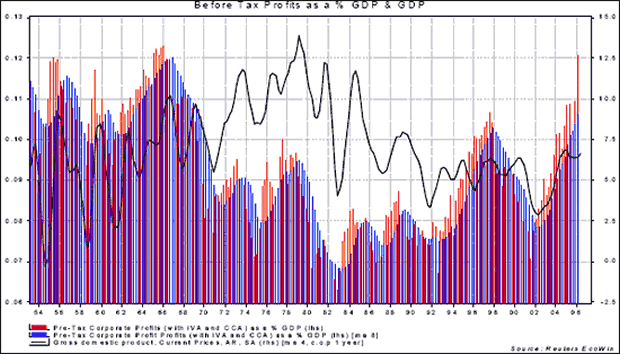
3- Finally, a surge in inflation typically means interest rates will be rising in the near future. Which means that investors get to lose money on both bonds and equities. For example, from 1966 to 1980 (i.e.: the last "inflationary surge" period), US bonds shed -2% per annum and US equities fell -4.9% per year.
Unsurprisingly, given the above, fears are now running high that we may have reentered such an "inflationary bust" period (see The Inflationary Bust Threat ). And to be sure, growth almost everywhere around the world is slowing while inflation in almost every country is still accelerating.
Now everyone knows where the slowdown in growth comes from: de-leveraging in the financial sector, overextended consumers needing to tighten their belts, transfers of wealth from the private sector to the public sector through high oil prices, etc... And there are of course myriad opinions as to how long the slowdown will last. But meanwhile, on inflation, our clients seem to be much longer on questions than answers. Where does the current inflation spike come from? How long is it going to last? And can inflation abate without a "Paul Volcker" like monetary policy from the Fed?
In this ad hoc comment, we aim to review some of these questions and, as we always tend to do--answer these questions with yet more questions of our own!
1- Where Does the Inflation Come From?
Just like George Orwell's farm animals, all currencies are equal... though, of course, one is more equal than others. Indeed, the US$ remains the world's reserve currency and, thanks to this status, foreigners cannot impose a particular kind of monetary policy unto the US. As Treasury Secretary Connolly once said: "the US$ is our currency and your problem". And lately, there is little doubt that the US$ has indeed become the world's problem, with its fall in value associated with the spike in commodity prices, which in turn has triggered a sharp upturn in inflation rates all around the world, but especially in the emerging markets (where food and energy represent a much bigger piece of the average family's spending than in most OECD countries).
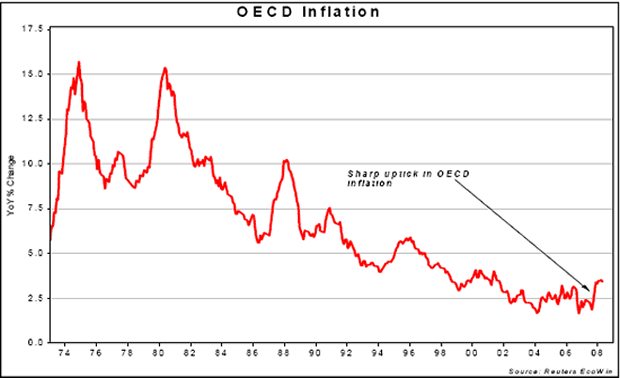
But of course, the surge in commodity prices cannot be the sole explanation for the recent surge in inflation numbers around the world. After all, an event like the spike in oil prices could also prove to be highly deflationary, since it takes money from the private sector and gives it to the public sector which will typically waste it (i.e.: Chavez financing Castro, Ahmadinejad subsidizing Hamas and Hezbollah, etc...). For a commodity price spike to be inflationary, it needs to be accompanied by excess money creation. If it is not, all that we witness is a change in relative prices across the economy (i.e.: oil prices up, auto and house prices down). This is why Milton Friedman once said that "inflation is always and everywhere a monetary phenomenon" while, around the same time, Jacques Rueff made the observation that "inflation is subsidizing expenditures that give no returns with money that does not exist".
So given that we are now living through a surge in inflationary prices, the questions we should ask ourselves is a) where the excess liquidity creation of recent years has come from? and b) whether excess liquidity continues to be pushed into the system, hereby guaranteeing further increases in inflation in the coming quarters and years?
2- What Explains the Surge in the Amount of Money?
As highlighted above, the US$ is "more equal" than other currencies and, consequently, the Fed holds a "special place" in our current financial system. Undeniably, the Fed is the world's most important central bank and it is thus not that surprising that, as inflationary pressures accelerate around the world, most people are quick to blame the Fed for "falling asleep at the wheel" and allowing money supply in the US to grow unchecked. But is this a valid criticism?
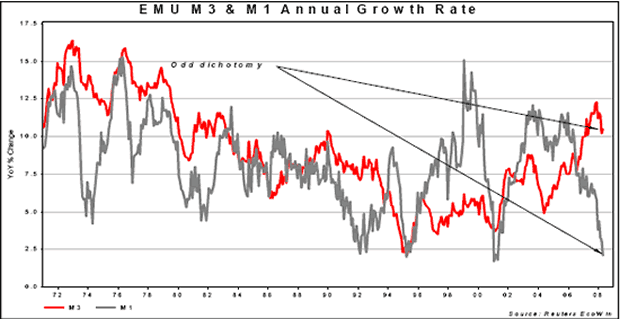
After all, as the charts below highlight, narrow money supply growth in the US (i.e.: the aggregate mostly under the control of the Fed) has not seen much of a rise in recent years (incidentally, the same can be said about Japan and money growth is now decelerating fast in Europe):
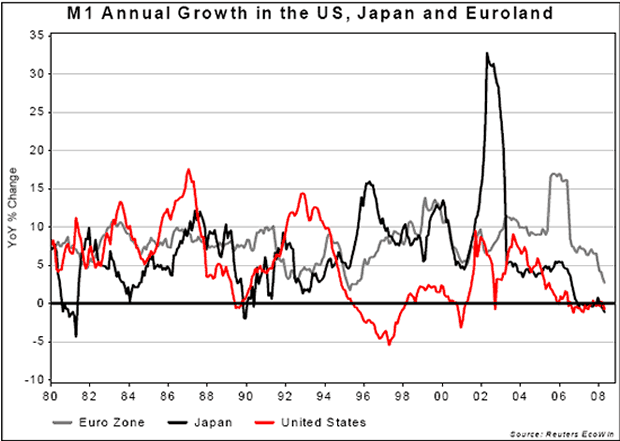
While the Fed did print money aggressively between 2002 and 2005 (M1 annual growth was above +5% and sometimes close to +10%), in recent years, the pace of monetary creation has by and large been tame. So the ‘excess money' had to come from somewhere else.
Now as we never tire of pointing out, two sets of players can create money ex- nihilo in our system: central banks and commercial banks. So if the excess liquidity creation has not been the central banks, then the explanation must lie with the commercial banks.
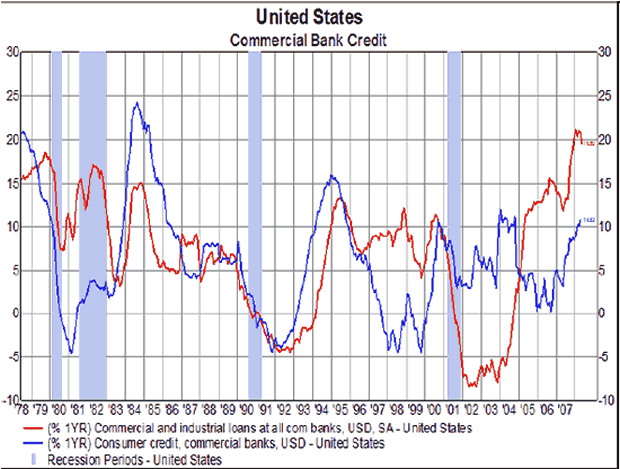
And sure enough, in recent years, banks have ridden the 'financial revolution' as hard as they possibly could and we have witnessed an unprecedented expansion in credit (witness the growth in C&I loans at US banks, red line below):
And, as we now know, money creation off the banks' balance sheets was also, until recently, going strong. Witness, for example, the rapid expansion in corporate paper outstanding in the period between 2003 and 2007 (red line below):
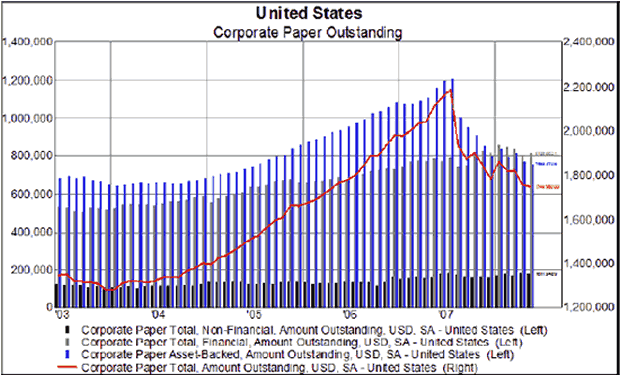
To return to our old favorite, Irving Fisher's equation of MV=PQ, it seems obvious to us that the current increase in P (prices) has more to do with the past few years' extremely buoyant V (velocity) than excessive M (money) growth. A possibility which immediately raises the question of whether velocity will remain as buoyant over the next two years as it did in the 2003-2007 period.
3- Will Velocity Remain As Strong?
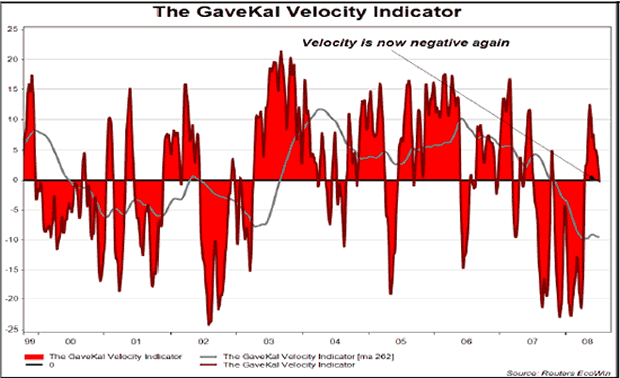
As the chart below suggests, the answer to the above question is a simple "No". With bank balance sheets under severe strain, and with bank shares almost everywhere around the world plumbing new depths, an increase in the willingness to take risk from private lenders would be very surprising. And sure enough, after its longest period ever in negative territory, our velocity indicator is once again negative after a brief respite:
This message of slowing private sector liquidity growth is also confirmed when adding the loans at commercial banks with the issuance of commercial paper (for a total private credit growth aggregate--blue line on following page). We have slumped from an annual growth rate of +13% in private credit one year ago to +2.8% today; a level not seen since 2003 (see chart).
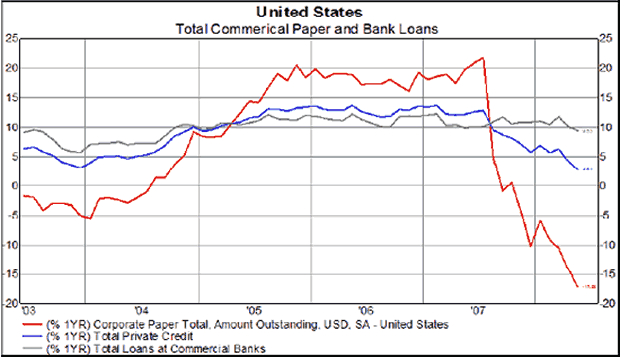
So we are now in a situation where a) The Fed is not printing money and b) US financials are de-leveraging rapidly. Thus, if inflation is "always and everywhere a monetary phenomenon", one may conclude that what we are now seeing in the inflation numbers is the echo of the 2003-2007 credit boom, but that looking ahead, the inflation picture should start improving rather dramatically. But such a conclusion would miss out on the other big contributor to global liquidity growth, namely the US current account deficit.
4- The Importance of the US Current Account Deficit
Because the US$ is "more equal" than other currencies in our global system, the US current account deficit plays a specific, and very important, role in our global monetary systems. In essence, the US current account deficit provides the world with its working capital. After all, at any given point, the world needs US$. For example, Nokia needs US$ to pay for the chips it may buy in Taiwan. China needs US$ to pay for the iron ore it buys from Australia and Sweden needs US$ to pay for the oil it buys from neighboring Norway...
This is why, whenever we see an improvement in the US current account deficit, somebody somewhere goes bust. Indeed, when the US exports a lot of dollars, then the rest of the worlds gets used to a "plentiful" liquidity situation... and when the US exports less money, then somebody gets cut off.
So in essence, the current account deficit has always been the mechanism through which the United States could reflate, or deflate, the global economy. When the US current account deficit improved, the US deflated other countries and vice versa.
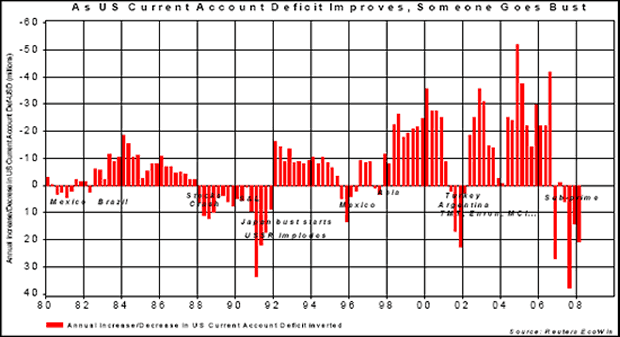
Now today, the US current account deficit still stands at a rather large 6% of GDP. However, the composition of this deficit has changed dramatically: two years ago, around two-thirds of the US deficit went to non-oil producers and one third was for petroleum products. Today, that situation is inversed to the point where one could argue that, while the US is still reflating oil producing countries (which hardly need it), it is now deflating non-oil producing countries by around 2% of GDP. Moreover, should oil prices start pulling back, we would move extremely rapidly into a situation where the US current account deficit was deflating the whole world (below is a chart we borrowed from The Economist )!
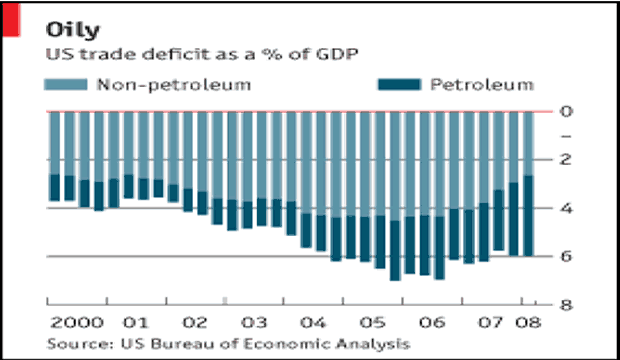
The fact that the US is no longer reflating non-oil producing countries is a very important change in our economies. Indeed, over the past few years, the prevalent belief amongst investors of all stripes has been: a) the US runs a large current account deficit, b) that US interest rates are low, and that, consequently c) the value of the US$ could only fall. And if the value of the US$ could only fall, then borrowing in US$ to finance whatever real estate project, factory, or financial market speculation made perfect sense. This is why, in a number of countries, we started to witness a growth in central bank reserves which far outpaced trade surpluses and foreign direct investment inflows; all of a sudden, a number of large countries started to save more than they earned!
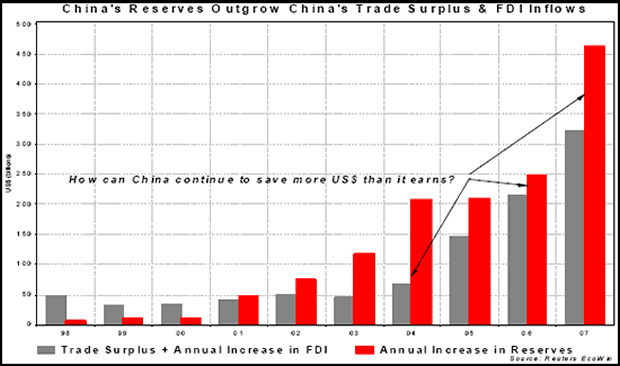
But how can one save more than one earns? The answer, we have argued in the past (see The Surprisingly Strong Growth in Chinese Reserves ) is simple: one borrows the difference. As mentioned above, if the perception is that the US$ can only fall against the RMB, INR, VND, MYR, etc... then why borrow in local currency to finance one's capital expenditures or investments? Much better to finance any spending in the ever falling, and cheap to borrow, US$!
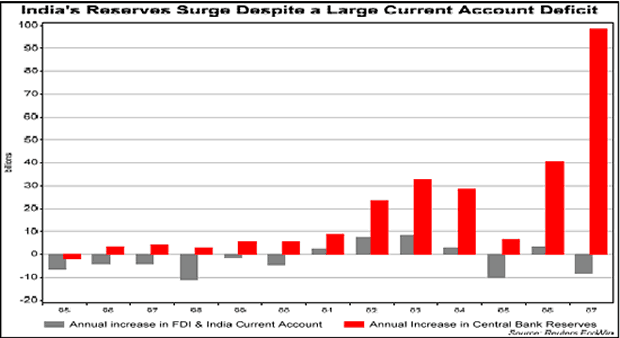
So what happens when a Chinese property developer, or a Vietnamese industrialist, borrows US$ to finance his latest project? The first thing he does is that he changes the dollars he does not need for RMB, Rupee, Dong, etc... And, at this point, the foreign central bank has three choices:
1- It can allow its currency to rise. This is what Brazil, South Korea... have done in recent years.
2- It can print money to prevent its currency from rising and then sterilize its FX intervention.
3- It can print money to prevent its currency from rising and just accept the consequences of fast money supply growth (usually higher inflation and asset prices).
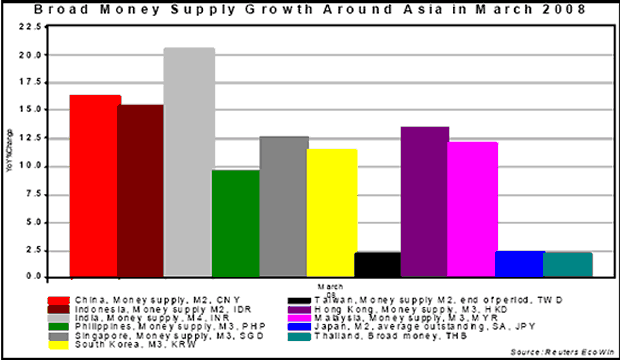
And by and large, this is what most nations on the other side of the US current account deficit (i.e.: Asia and OPEC) have done. And unsurprisingly, these are the countries that are today dealing with the largest inflation threats.
We would thus argue that the US current account deficit has been a double inflationary force for the world at large . First, the US current account deficit has pushed a number of countries towards reflation, and secondly, the large US current account deficit has helped propagate the belief that the US$ could only fall, and thus encouraged large borrowings of US$ outside of the US.
And the US current account deficit, combined with the willingness to borrow US$, has been an inflationary force for more than just Asia and the Middle East. It may also explain the surge in money growth in Europe! Indeed, with central bank reserves growing very rapidly around the world (despite a high oil price which, at the very least, should have drained the reserves of Asian and European countries), central banks such as the PBoC or the RBI have likely spent the past few years diversifying their reserves, which for all intents and purposes means buying the Euro... And, as we argued in our book The End is Not Nigh , this "diversification" of reserves means buying European government bonds or, in other words, subsidizing the expenditures of foreign governments with domestically borrowed money.
Et voila! We are now back to Jacques Rueff's definition of inflation being " a policy which subsidizes expenditures that give no returns (i.e.: government spending in Europe or the US) being financed with money that does not exist (i.e.: central bank reserves that have been borrowed, not earned)! "
5- Will the US Deficit Continue to be an Inflationary Force?
Having established that one of the main factors of excess liquidity growth in the world (the willingness of the financial sector to lend very aggressively) had now disappeared, can we rely on the US current account deficit to continue providing excess liquidity to the world. Will an ever growing US trade deficit continue to force other countries to reflate and lead to an ever lower US$? We tend to believe that the answer to that question is a very firm "no". And, this for several reasons:
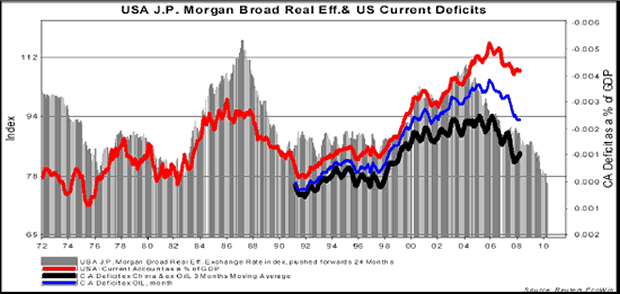
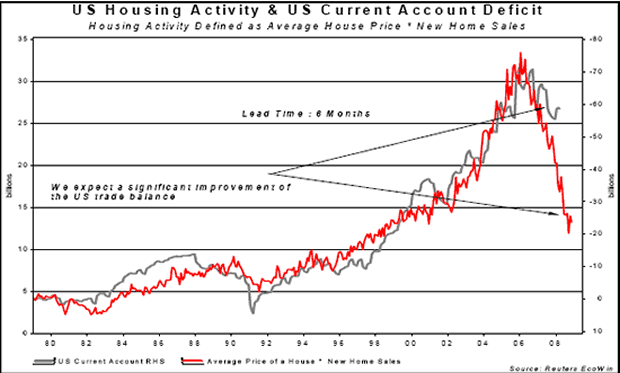
Reason #1: As reviewed on page 6, the US current account deficit is already improving. Moreover, since oil is now a bigger percentage of the US deficit, should oil prices roll over, we could witness the most rapid improvement in the US current account deficit ever seen. But even without oil rolling over, the recent weakness of the US$ argues for a continued improvement in the deficit:
As does the weakness in US housing:
Meanwhile, the prevalent belief of recent years that borrowing US$ to invest in local currencies was a "no-brainer" is now undergoing a significant test. For example, in recent months, the "long dong" strategy has undeniably failed (the black market now expects a devaluation of over 20% in the Vietnamese currency). The strategy is also failing in India where the Rupee, to many investors' surprise, has been amazingly weak in recent months....
In fact, an interesting development is occurring on the US$: fewer and fewer currencies have lately been rising against the US$ and this despite some pretty poor news from the US (MBIA downgrade, fears on Lehman, weak housing, weak growth, high oil, fears of war with Iran...). Now the typical pattern for an equity bull market is that, as it nears its peak, fewer and fewer shares make new highs even as indices keep on powering ahead. Major corrections are typically preceded by a narrowing breadth... And today, we are undeniably witnessing a deteriorating breath in the "anti-US$" bull market:
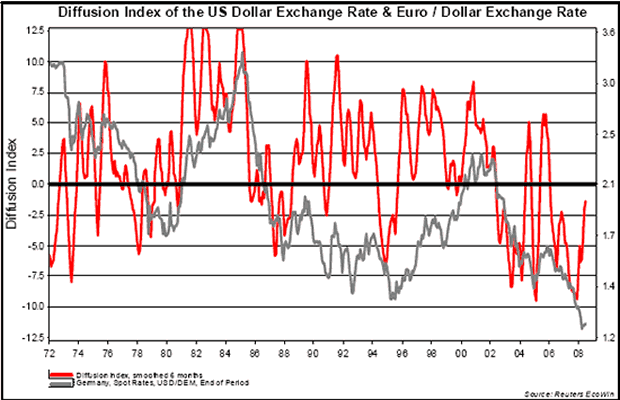
To cut a long story short, and with hindsight, the large US current account deficit and the weak US$ were another very potent inflationary force in our system. But, at least at the margin, these inflationary forces should abate, rather than acceler- ate, over the coming months.
6- Conclusion
There is little doubt that, right now, inflation is proving to be a massive headwind for financial markets. And part of that "inflation headwind" is the fear that the Fed, the ECB and other central banks will have little choice but to tighten monetary policy in the coming months. This is most likely true of some central banks, but maybe not all? After all, looking around the world, the inflationary threat is a sure thing in certain regions, and less of a threat in others:
- In the US: In a recent paper (see The Dollar's Successful Devaluation ), Charles argued that the Fed had just managed to engineer a "good devaluation" for the US$, whereby the currency is brought down without an explosion in monetary aggregates and a rapid acceleration in inflation. This makes the economy competitive and local assets attractive for foreigners. Since then, not much has happened to warrant a change in this view. In fact, since then, the main development has been the roll-over in velocity and renewed fears as to the health of the US financial sector. With velocity plummeting, we think that the bond market is broadly right to not anticipate an acceleration in US inflation.
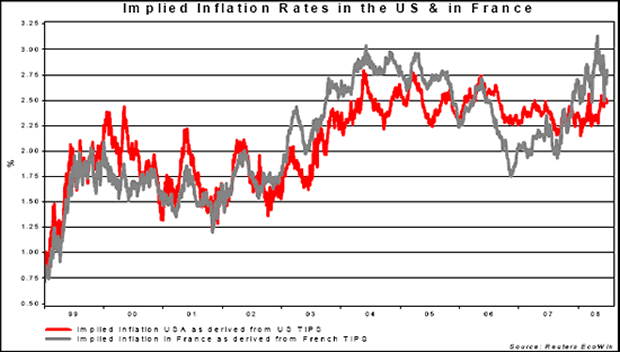
- In Euroland: Just like in the US, the bond market does not seem to really anticipate a massive surge in inflation. And given the very overvalued currency and the inverted yield curve, this makes sense to us.
- In the Middle East: The one region of the world which is still experiencing reflation from the US current account deficit is the Middle-East (and to a lesser extent Russia). The unwillingness of policymakers to revalue their currencies (see The Arab Pegs ) and the inability of local central banks to sterilize their FX intervention means that the local economies are condemned to continue experiencing inflation as long as they refuse to revalue their currency. More worryingly, a pursuit of the current fixed exchange rate, inflationary policies could lead local economies into the same kind of boom-bust cycle that Vietnam (and maybe India?) are now having to endure.
- In India and Southeast Asia: If the US went through a ‘good devaluation' (i.e.: a lower currency without a spike in inflation, triggering an increase in foreign and domestic investments and productivity gains), then it increasingly looks as if India and Southeast Asia have just gone through a ‘bad devaluation' (i.e.: a lower currency which brings about fast money growth, higher inflation, deteriorating trade balances and foreign investor flight). As such, certain countries (India, Vietnam...) are now stuck in the unfortunate position of having to defend their currencies, which is rarely conducive to either economic, or asset price growth.
- In China: Inflation is undeniably a problem but, thus far, it seems to be mostly contained to food and energy prices (see A Dummy's Guide to Chinese Inflation ). Meanwhile, the only pressures on the RMB are still of a positive nature. Thus, if either the US$ rebounds or commodities roll over (two events that are likely to happen simultaneously), China's inflation problem could dissipate relatively quickly. Chinese and HK shares would then soar.
- In Japan, Korea, and Taiwan: Japan, Korea and Taiwan have seen little "hot money" inflows in recent years and have also been better at letting their currencies rise against the US$ (this year, the NT$ is one of the world's best performing currencies with a +6.5% rise while the KRW was one of the best performing Asian currencies between 2004 and 2006). In general rule, these countries today have far less of an inflationary problem than the rest of Asia:
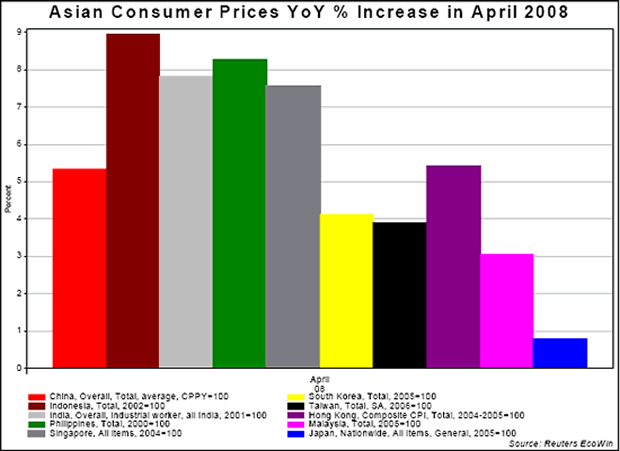
While the markets had started to rally in April and early May, the spike in oil prices fuelled fears of faster inflation and triggered a threat of coming rate hikes from the Fed and the ECB. In turn, all these events weighed down equity markets around the world. However, as we have tried to show in this paper:
- The inflation threat is very different between countries. At most risk today are the Middle East, India and Southeast Asia. Meanwhile, inflation is far less of a threat in the US, Japan and North Asia.
- Given the fact that the forces behind the recent pick-up in inflation are now turning around (strong willingness to take risk amongst financial firms, growing US current account deficits, overall weakness in the US$), inflation could well start abating in the coming quarters. Moreover, with the turnaround in velocity and the implosion in the banking systems, it seems increasingly likely that neither the Fed, nor the ECB will be willing/have to match their recent hawkishness with rate hikes.
- As inflation rolls over in the OECD, the leadership of equity markets should go through a serious adjustment.
Your meditating on inflation analyst,
By John Mauldin
John Mauldin, Best-Selling author and recognized financial expert, is also editor of the free Thoughts From the Frontline that goes to over 1 million readers each week. For more information on John or his FREE weekly economic letter go to: http://www.frontlinethoughts.com/learnmore
To subscribe to John Mauldin's E-Letter please click here:http://www.frontlinethoughts.com/subscribe.asp
Copyright 2008 John Mauldin. All Rights Reserved
John Mauldin is president of Millennium Wave Advisors, LLC, a registered investment advisor. All material presented herein is believed to be reliable but we cannot attest to its accuracy. Investment recommendations may change and readers are urged to check with their investment counselors before making any investment decisions. Opinions expressed in these reports may change without prior notice. John Mauldin and/or the staff at Millennium Wave Advisors, LLC may or may not have investments in any funds cited above. Mauldin can be reached at 800-829-7273.
Disclaimer PAST RESULTS ARE NOT INDICATIVE OF FUTURE RESULTS. THERE IS RISK OF LOSS AS WELL AS THE OPPORTUNITY FOR GAIN WHEN INVESTING IN MANAGED FUNDS. WHEN CONSIDERING ALTERNATIVE INVESTMENTS, INCLUDING HEDGE FUNDS, YOU SHOULD CONSIDER VARIOUS RISKS INCLUDING THE FACT THAT SOME PRODUCTS: OFTEN ENGAGE IN LEVERAGING AND OTHER SPECULATIVE INVESTMENT PRACTICES THAT MAY INCREASE THE RISK OF INVESTMENT LOSS, CAN BE ILLIQUID, ARE NOT REQUIRED TO PROVIDE PERIODIC PRICING OR VALUATION INFORMATION TO INVESTORS, MAY INVOLVE COMPLEX TAX STRUCTURES AND DELAYS IN DISTRIBUTING IMPORTANT TAX INFORMATION, ARE NOT SUBJECT TO THE SAME REGULATORY REQUIREMENTS AS MUTUAL FUNDS, OFTEN CHARGE HIGH FEES, AND IN MANY CASES THE UNDERLYING INVESTMENTS ARE NOT TRANSPARENT AND ARE KNOWN ONLY TO THE INVESTMENT MANAGER.
John Mauldin Archive |
© 2005-2022 http://www.MarketOracle.co.uk - The Market Oracle is a FREE Daily Financial Markets Analysis & Forecasting online publication.
