


How to Survive and Profit From the NEXT Financial Markets Panic
Stock-Markets / Financial Crash Jul 07, 2008 - 12:34 PM GMT

 Martin Weiss writes: Dad was probably the only advisor who helped his clients make a fortune in the great bear market of the 1930s ... and then lived to do it again in the Crash of '87. Before he passed away, he walked me through some of the darkest lessons of America's financial history. And he gave me some valuable advice to share with you when the next financial panic is near.
"When another collapse is about to begin," he warned, "they're not going to ring any bells. Few investors will see it coming, fewer still will take protective action, and almost everyone will get caught in the melee. Don't let that happen to our subscribers!"
Today, the bells are finally ringing and doing so loudly: The Dow has plunged by more than 20%, confirming the bear market we've been warning you about. Unemployment has skyrocketed, signaling the recession we told you was inevitable. America's largest financial companies — Citigroup and Merrill Lynch — have lost over two-thirds of their market cap. Washington Mutual has lost nine-tenths. Detroit's Big Three are on a collision course with bankruptcy.
But still, most investors aren't listening. They're lulled by Wall Street's biased reports, soothed by Washington's rigged releases, and left twisting in the wind when things turn sour.
They don't realize that nearly all of Wall Street's ratings are bought and paid for by the very companies being rated. They don't see how this inflates grades beyond recognition, severely delays downgrades, and inevitably leads millions of investors down the primrose path.
They don't recognize that some of the government's most important economic numbers (GDP, unemployment, inflation, and money supply) suffer from some of the most egregious distortions — the cumulative effect of decades of manipulations, thoroughly documented by Shadow Government Statistics .
Worst of all, they don't realize that each of these distortions contributes to an overvaluation of financial assets. When the truth finally comes out, as it inevitably must, the value of vulnerable stocks and bonds can turn to dust in a flash.
Investors are not ignorant. They know the situation is bad. They also know things are getting worse. What they don't realize, however, is the fact that, behind Wall Street's large façade, lies an equally large house of cards.
Moreover, I think it's safe to say that the house of cards includes a substantial portion of the debts tabulated in the Federal Reserve's latest Flow of Funds (pdf page 68, table L.4) ... plus a big chunk of the derivatives reported in the Office of the Comptroller of the Currency's just-released Quarterly Report on Bank Trading and Derivatives Activities (pdf pages 1 and 13). I'm talking about:
- The $2.7 trillion municipal bond market — now being shaken by the imminent collapse of the nation's largest bond insurers, the plunge of property tax revenues, and the surge in energy costs.
- The $7.6 trillion market for agency and government-sponsored securities — dominated by Freddie Mac and Fannie Mae, both now impacted by the continuing housing collapse.
- The $14 trillion mortgage market that continues to come unglued.
- The $180.3 trillion derivatives market, where major U.S. banks have just experienced a sudden surge in credit exposure to $465 billion — a 50% jump from this past December. And ...
- The massive credit exposure of the biggest derivatives players — 215% of risk-based capital at Bank of America, 279.1% at Citibank, a shocking 411.6% at JPMorgan Chase, and a doubly-shocking 731.3% at HSBC.
The façade also masks an insider's world , where the "experts" speak a dialect of newspeak, but outsiders don't get to see the dictionary. In this language ...
Many A-rated companies are really B companies in disguise. Examples:
- Fitch, Moody's, and Standard & Poor's didn't downgrade Ambac and MBIA this year until long after it was widely known that the two bond insurers were in deep financial trouble.
- In 2001, these same rating agencies didn't downgrade Enron bonds until long after those bonds had been trading at deep, junk-bond prices.
- Standard & Poor's, as well as A.M. Best (the nation's leading insurance rating agency), continued to publish "excellent" grades on the nation's largest life insurers even after they had already gone bankrupt in the 1990s.
For stocks, "buy" really means "hold" ... while a "hold" rating is Wall Street's way of saying "it's time to get the heck out, but don't tell anyone I told you." Examples:
- Just prior to the bear market of 2000-02, which wiped out 75% of the average value of thousands of tech companies, major Wall Street firms continued to issue "buy" and "hold" ratings on 99% of U.S. tech stocks, with "sell" ratings representing less than 1% of the ratings issued.
- By 2002, 94% of the 50 Wall Street firms we reviewed continued to publish "buy" or "hold" ratings on companies that had already filed for bankruptcy.
- Even today, Wall Street analysts rarely issue "sell" ratings, with many still clinging to "hold" ratings on companies known to be on the verge of failure.
More entries from the newspeak lexicon:
"I'm neutral." Wall Street's way of saying "Don't blame me for being wrong and don't fire me for being right."
"Don't panic." Wall Street's way of saying "Don't sell before I do."
"Inflation concerns." Fed-speak for "inflation out of control."
"Slowdown." Washington's code word for recession.
"Recession." Everyone's euphemism for depression.
Investors Are Still Being Duped. But Average Consumers Are Beginning To Suspect Something's Very Wrong.
While most Wall Street pros are still waiting for the next market upturn, most U.S. consumers already see the handwriting on the wall.
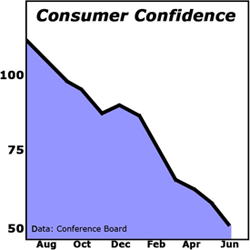
The evidence: Over the last 12 months, the Conference Board's Consumer Confidence Index has plunged all the way from 105.3 to 50.4, its lowest level in 16 years.
Worse, an index that measures future expectations has nosedived to 41, its lowest level in four decades .
The implication: The public feels the credit crisis, sees the gas price surges, and suffers the daily crunch in the household budget. So they're beginning to see the storm on the horizon.
But Wall Street pros can't see the forest for the trees. They're trying so hard to pull the wool over investors' eyes, they've even deluded themselves.
Here's what to do:
Step 1. Start immediately to protect your stock portfolio!
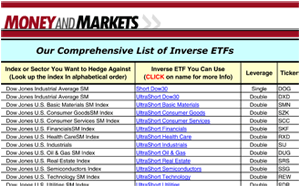
For many weeks, I've been exhorting you to hedge against a U.S. stock market decline by buying inverse ETFs — exchange-traded funds that are designed to rise in value when a market index or sector declines.
 |
| Click on this image for the full report ... |
 |
| Click on this image for the full table ... |
That's why last week I urged you to Sell, Hedge ... or Be Prepared to Lose .
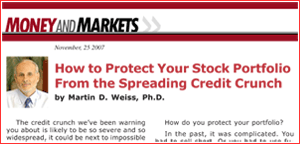
That's why last fall I sent you a free report, How to Protect Your Stock Portfolio From the Spreading Credit Crunch , complete with detailed instructions.
That's why I even included a Comprehensive List of Inverse ETFs .
Now those ETFs are surging in value. But it's not too late to buy them.
For example, consider ProShares' UltraShort Technology (symbol REW on the Amex), the inverse ETF that Mike Larson selected last year to recommend in our Safe Money Report . We think ETFs like this one are made to order for the tech stock bust that's beginning to unfold.
Reason: For every 10% fall in the Dow Jones U.S. Technology Index, REW is designed to rise 20%, giving you double protection against the decline. And sure enough, as tech stocks have fallen, the value of this ETF has shot up 26% since June 4.
My recommendation: If you still have exposure to tech stocks, this kind of protection is an absolute must. And if you have exposure to other vulnerable sectors, be sure to either sell, hedge ... or do both.
Step 2. Start immediately to heed our persistent recession warnings!
Last year, on October 1 , we wrote you that a 2008 recession will be "hard to avoid." But Wall Street and Washington were still unanimously bullish on the U.S. economy. So I could understand your hesitation .
Then, on November 12 , when we wrote that "evidence of an imminent U.S. recession is now piling up high," Fed Chairman Bernanke would admit to no more than "a slowdown." So I could see why you might have waited.
And perhaps you missed our November 19 missive warning that "the housing bust, mortgage meltdown and credit crunch guarantee a U.S. recession" ... our November 20 flash announcing "the beginning of an imminent, unavoidable, potentially deep recession in America" ... or our December 31 email alerting you to "one of the worst recessions since World War II."
That's OK. It's water under the bridge. But no more. Now, prudent investors dare not ignore recession warnings one day longer.
Reasons: May's half-point surge in unemployment, June's 62,000 job loss, and the plunging consumer confidence I just told you about now confirm — and double-confirm — the onset of a potentially rapid and devastating contraction in U.S. construction, retail, autos, and technology.
Plus, it signals the onset of a new vicious cycle — (a) layoffs, (b) more home foreclosures, (c) more home price declines, and (d) still more layoffs.
My recommendation: Move your keep-safe funds to Treasury-only money market funds such as American Century's Capital Preservation Fund , U.S. Global's U.S. Treasury Securities Cash Fund , or our affiliate's Weiss Treasury Only Money Market Fund .
And to offset the risk of a continuing dollar decline, allocate a portion of your money to foreign currencies, using instruments like Everbank's WorldCurrency CDs or Rydex's CurrencyShares ETFs.
Step 3. Start immediately to protect yourself against rising inflation!
People used to say "inflation is never a problem in a recession." We've told you the opposite, and now the evidence of the inflationary recession is everywhere.
It was obvious: When a nation's central bankers try to combat a recession with the greatest outpouring of paper money in modern history ...
When a nation's government lets its currency decline rapidly in value ...
And when other rapidly growing nations around the world are still bidding up the price of world commodities, then ...
You can continue to expect one of the worst recessions AND some of the worst inflation at the same time.
Want hard evidence of inflation? OK. Take a moment to review Sean's latest blockbuster report on the Oil Crisis Worsening and stand by for his blockbuster inflation report the day after tomorrow.
Good luck and God bless!
Martin
This investment news is brought to you by Money and Markets . Money and Markets is a free daily investment newsletter from Martin D. Weiss and Weiss Research analysts offering the latest investing news and financial insights for the stock market, including tips and advice on investing in gold, energy and oil. Dr. Weiss is a leader in the fields of investing, interest rates, financial safety and economic forecasting. To view archives or subscribe, visit http://www.moneyandmarkets.com .
Money and Markets Archive |
© 2005-2022 http://www.MarketOracle.co.uk - The Market Oracle is a FREE Daily Financial Markets Analysis & Forecasting online publication.
