


Washington Manipulation of GDP Data to Hide Recessions
Economics / Market Manipulation Jul 30, 2008 - 03:06 PM GMTBy: Mike_Stathis

 I continue where I left off – discussing just a few of the ways Washington tries to fool us by its misuse and manipulation of data. Washington likes to remind critics that Americans enjoy the highest living standard in the world. As evidence of this, government “experts” discuss statistics such as GDP growth, employment, wealth, income and wage growth, and other economic data without defining exactly what they are referring to or explaining all the assumptions used. In Part 1 of this series, we saw how hedonics can alter GDP and inflation data. Here we look at some additional problems with GDP. After you read this piece, I hope you will agree that the misuse of GDP data as an indicator of economic strength has been one of the biggest errors made in the field of U.S. economics.
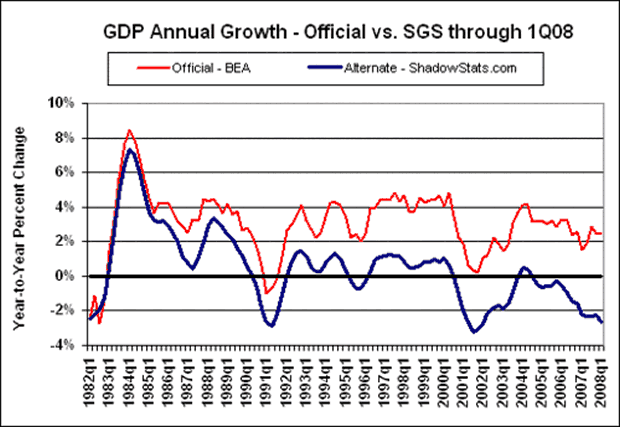
I can make a strong case that over the past three years there has been virtually no GDP growth other than maybe three quarters. After adjusting for hedonics, the use of debt and the other gimmicks, it's clear the U.S. economy has grown little since 2005. Sound crazy? Sure it does – but only if you've accepted the data from Washington at face value, as the media always does. But this grand illusion cannot remain hidden much longer. Already, we are seeing just some of the effects of Washington 's deception – the real estate meltdown and banking crisis. Bernanke is trying to wipe it all under the table by passing out over $1.2 trillion to the banking system, with much more to come. This has caused the further devaluation of the dollar and soaring oil prices. But the real effects still linger in the background, waiting to surface. When, I cannot say for certain, but I will guarantee you they will surface. Soon, the junk bond market will overshadow all other worries. And this could easily lead to a huge problem for the $40 trillion global credit default swaps market.
Since the stock market fallout in early 2000, Washington has been desperate to keep consumers spending at any cost. They like the fact that consumers are spending, even if it has been for imported goods and even though these purchases have been made using credit. As far as they're concerned, strong consumer activity keeps GDP numbers high, pointing to the illusion of economic growth. After the Internet meltdown, Greenspan smashed rates down to 1% because consumers had no real money to spend. But even that wasn't enough, so Bush issued rebate checks hoping consumers would head for the stores to buy more of what they really didn't need – more electronic gadgets and other imports. In 2008, Bush issued an even larger rebate for consumers to inflate GDP. Now there is talk from Congress of another rebate check.
These irresponsible actions by the Fed and Washington are creating more damaging consequences in exchange for superficial, short-term gains. Americans need good jobs and affordable basic necessities – food, energy, and healthcare. A few hundred dollars passed out by Bush isn't going to do much. It won't even pay for the increases in gasoline costs consumers have faced in 2008. What it will do however, is precisely what Bush intended it to do – boost GDP data so economists can claim that there is no recession. Never mind this money has to be borrowed. It's all a game of numbers to Washington .
Many politicians (mostly republicans, including Bush) extinguish any criticisms of large federal and trade deficits, insisting they have no real meaning. Rather than point to deficits as an indicator of economic vulnerability, many of our elected officials highlight GDP as a direct measure of economic growth and thus living standards. These misguided souls believe debt (and therefore deficits) is good for the economy because it helps add to GDP growth. In reality, the massive trade deficits created under the Bush administration have been responsible for the acquisition of critical U.S. assets by China and the Middle East . Meanwhile, the U.S. economy remains highly leveraged and now faces a situation whereby its creditors may soon refuse to hold onto U.S. Treasuries due to their rapidly diminishing value and credit quality.
The gross domestic product is a measure of the value of all goods and services produced in the national economy available for consumption. But GDP numbers say nothing about the source of consumption, whether it's from cash on hand or mounting debt. As well, GDP numbers include government spending, such as that for Katrina and the wars in Iraq and Afghanistan . It doesn't take a genius to realize that these expenditures haven't led to better living standards for most. Just ask victims of Katrina if their living standards have improved. And how can anyone claim that spending up to $2.4 trillion (over the next few years) in Iraq to blow up buildings and rebuild them will improve the living standards of Americans? Even worse, this is money that is added to America 's ballooning record debt.
Meanwhile, America 's own infrastructure continues to be neglected – bridges and highways have collapsed, underground water pipes have broken, drinking water is toxic and contains, among other things, numerous pharmaceutical drugs, from sex hormones to anti-depressants. Even Washington 's U.S. Army Corp of Engineers has estimated it will take at least $2 trillion to restore America 's infrastructure to “good condition.” Other groups have stated these estimates to be much higher. Of course, if America does receive these needed funds, they will count toward the GDP data, although living conditions will only be restored, not improved.
Besides the loose assumptions of GDP, the methods of calculation are also flawed. For instance, the nominal GDP is deflated using a chain-type inflation metric which significantly understates the real inflation rate. This leads to inflated GDP data. And of course Washington fails to adjust GDP growth to the annual population increase, which once again results in a higher GDP. Finally, GDP can be calculated using constant or current dollars; the former doesn't consider the effects of inflation while the later does. When making comparisons of GDP data over time, investors should only use constant dollar GDP data. Unfortunately, when GDP data is plastered throughout the media, rarely is the source of this calculation been mentioned, leaving investors to assume constant dollar GDP data has been reported, adjustments for population growth have been made, and realistic adjustments for inflation are included.
Problems Measuring Living Standards
The importance of GDP as an economic indicator is reflected by its frequent use as a measure of living standards within an economy or nation. However, there are many weaknesses in the use of GDP as a measure of a nation's living standard. In short, GDP only provides an overall measure of economic output of a given nation, but speaks nothing of individual living standards or the overall well-being of a population. As an example, consider that a nation which exports 100 percent of its production ( Iraq for instance, due to oil exports) might have a high GDP but not necessarily a high standard of living. As it turns out, many other factors are involved in determination of living standards, such as employment and wage data, inflation, interest rates, currency exchange rates, debt levels, fiscal and monetary policy, and government benefits. Finally, quality of life (which is a significant component of living standards) is determined by other factors unrelated to finances such as life span, work week, minimum required vacation days, social factors, and many other variables.
The counterargument is that while GDP may not provide an accurate measure of living standards, trends in living conditions tend to move in the direction of changing GDP data. While that may be true over a long time frame, in my opinion that cannot be said necessarily for less than a five-year period. Yet, when GDP figures are released each quarter, the stock and bond markets react as if this number has provided an accurate picture of the economy. In reality, this is rarely the case. And when Washington wants to assure consumers that the economy is strong, officials remind us that the U.S. has the world's largest GDP, and thus highest living standards. What they fail to mention however, is that the methods used to calculate GDP are flawed. As well, the productivity gains have not been equally distributed to all Americans. If in fact GDP data serves as an accurate measure of improvement in living standards, it only applies to the top 10% of wage earners.
Failure to Account for Deficits
Because consumer spending accounts for about 66 percent of the GDP, and since the majority of goods purchased in the U.S. are produced overseas in full or in part, GDP growth indicates the extent of exportation of America 's asset base when it's running large annual deficits. In order to better understand this rationale, recall that each federal budget deficit is added to the national debt, which is financed by selling U.S. Treasury securities. Foreign nations have financed 50 percent of this debt, so America has been trading ownership rights for imported goods. Thus, even if GDP data indicates net productivity, this data does not factor in the deficit incurred as a result of government spending or the trade imbalance—all of which adds to the national debt and decreases America 's net worth or wealth.
As well, consider that the annual deficits have been financed by foreign nations to the tune of 99 percent in 2004, and by 81 percent between 2003 and 2005. If you were selling your goods and services to a customer who couldn't afford to pay using cash, wouldn't you extend them credit? Sure you would; you'd benefit two-fold in receiving profits from sales and financing charges. But there's credit risk involved based upon the debtor's ability to repay the principal with interest. Along with the weak dollar, the increased credit risk of U.S. Treasuries threatens to increase the global push for dethroning the dollar as the universal currency.
For many years, America has maintained the highest credit status in the world. Its high standing as a debtor is directly tied to its perceived ability to repay debt obligations. But if the dollar loses its position as the universal currency, this perceived repayment ability would falter, causing foreign holders to dump dollar-denominated assets. And U.S. Treasury securities would be the first to go. This would easily trigger a global catastrophe. Understand that most nations already want out of the weak dollar. If one or more large holders of U.S. Treasury securities begin to sell, such as China , this could cause other nations to do the same in anticipation of a price drop. Thus, what might have been intended as a benign and gradual liquidation of U.S. debt by one nation could snowball into a collapse quickly.
Many point to America 's annual 5.0 percent GDP growth rate over the past decade as a sign of its continued stability and economic dominance. During that same time period, America 's trade deficit has grown by over 25 percent per year, household debt as a percentage of disposable income has doubled, and household savings has declined by 75 percent. What does that tell you? To me it says America 's “growth” has been fueled by credit spending that's been grossly disproportionate to this “growth.” Credit spending is certainly no indicator of wealth, but lack thereof.
America has been consuming much more than it produces for three decades. Early on, this excess consumption was buffered by the enormous wealth surplus generated after WWII. But now America 's dangerous consumption trends from the past 15 years have surfaced due to the depletion of its post-war wealth. As a result, it faces a huge debt burden financed largely by foreign central banks and financial institutions. In fact, America 's global competitors have been transformed into its bankers and suppliers, providing financing for its undisciplined government and consumer spending practices.
This chronic behavior has allowed foreign nations to gain more influence over America , both economically and politically. And when they decide to no longer lend the U.S. government money, interest rates will skyrocket to double digits and the dollar will nose dive. That's right. The real dollar crisis is ahead of us. You might have noticed as of late, several nations are telling Washington how they should be running things - nations with a huge financial stake in the U.S. economy. The U.S. is now dependent on these nations for economic sustenance. Therefore, America can no longer push other nations around.
Failure to Account for Savings and Debt
Calculation of GDP also neglects to factor in the external effects of saving versus spending. Japan 's case is particularly illustrative of this point. The savings rate in Japan has been high ever since the NIKKEI collapsed nearly twenty years ago. As a result, while the GDP is not as high if Japanese had spent more of what they earned, they are not slaves to debt. As well, Japanese companies have been investing large amounts of capital overseas (e.g. auto facilities, insurance and media in the U.S. ) resulting in a much lower GDP than one might expect.
In the case of America , decades of declining savings and increased debt burdens are not factored into GDP data. But borrowed money falsely inflates this data. Likewise, economies experiencing asset bubbles (eg. real estate, credit, and the stock market) tend to show higher GDP figures than in reality since consumption is higher than can be maintained over an extended period. And during these asset bubbles the total credit bubble grows along with the GDP. This is the current state of America . In fact, it appears as if the Federal Reserve will continue creating bubbles as its only way to prop up GDP data. But we all know what happens to bubbles. They eventually burst. A few years ago, we experienced unthinkable devastation as a result of Greenspan's Internet bubble. Today, we are seeing the early stages of the implosion of Greenspan's real estate-driven credit bubble. And since Bernanke refuses to let events run their normal course, we will no doubt experience a more catastrophic correction down the road as a result of his misuse of the printing presses.
Failure to Adjust for Net Output
Another shortcoming of GDP is that it measures output that produces no net change or productivity , such as that seen for reconstruction of New Orleans after hurricane Katrina. While capital was pumped into the region to help restore living standards, no net improvement was made relative to before the disaster (unless you count the estimated $1.5 billion stolen from FEMA by some). Yet, GDP data assumes these expenditures resulted in improvements. In fact, one could argue that living conditions are worse now. I'm sure those who have been exposed to the formaldehyde-laden mobile homes would agree.
GDP counts government spending at all levels, from the war in Iraq and hurricane Katrina to homeland security. And despite President Bush's enormous spending spree, tax revenues as a percentage of GDP haven't been this low in many years. What does that tell you? The government has been borrowing money to pump up into the economy without registering commensurate returns. If these investments had been successful, America would have net job and real wage growth, and a strong dollar which would provide affordable energy, utilities, and healthcare. But we see a much different picture despite record federal and trade deficits, as well as record consumer and national debt. The overall impact of these trends can be seen by the weakness of the dollar.
Thus, it's easy to see that a nation that is increasing its debt can show healthy GDP numbers when in fact the picture isn't as rosy as reported. This is especially true when credit spending has accounted for a large amount of the GDP growth, as in America 's case. Therefore, when examining GDP data, one should investigate where and how the productivity occurred, whether there was net improvement to the majority of Americans, and what costs (debt or deficit) were incurred, rather than focusing on the magnitude of the number.
Failure to Account for Resource Depletion
Growth sustainability cannot be predicted by looking at GDP. Upon initial examination it appears that some nations (eg. in the Middle East ) are able to maintain high GDP numbers despite the lack of industrialization. In the Middle East , productivity is almost exclusively dependent upon the amount of fossil fuels remaining as well as the cost and efficiency of crude production. Since oil reserves are limited, some nations disregard environmental protection laws in favor of increasing production ( United States , China , Europe, and Canada ). However, in the long run huge expenses could be incurred for cleaning the environmental mess that was made decades earlier.
Accordingly, short-term gains in GDP are inflated since the economic activities that have led to GDP data have created future liabilities that have not been reflected in a nation's financial statements. In America 's case, the massive liabilities for mandatory expenditures (the $51 to $72 trillion shortfall) are not shown in its financial statements. GDP data should be adjusted for estimates of contingent liabilities that may be incurred as a result of say, a nation's disregard for maintaining a clean environment and government benefits that have been promised or guaranteed - similar to the practice required by all publicly traded corporations.
Failing to Adjust GDP for Real Inflation
How can Washington calculate GDP without proper adjustments for inflation? That is precisely what they do. They select the most modest inflation measures (chain-type inflation) to adjust for the nominal GDP data. Michael Pento lays out a very nice illustration of this in his recent article “Getting Real with GDP.”
Failure to Adjust for Annual Population Growth
Since GDP growth is a measure of productivity, and productivity is influenced by population growth, doesn't it seem reasonable that GDP should be adjusted to the annual population growth rate? From 1990 to 2002, the annual growth in the U.S. population was 1.2%. Since 2002, it has slowed a bit down to around 1.0 to 1.1%. If we subtract this from the GDP data, the “economic growth” over the past few years does not appear to have been so robust. And if more accurate measures of inflation were used to adjust nominal GDP, it paints a very worrisome picture.
Failure to Report Year-over-year Changes
When the Commerce Department reports GDP figures each quarter, the data isn't reported like a U.S. corporation. When a corporation provides an earnings statement, it shows comparisons of revenue, earnings, etc. from the same quarter of the previous year (called year-over-year reporting). In contrast, the U.S. government reports changes in GDP relative to the previous quarter. In addition, each quarterly GDP figure is annualized or multiplied by a factor of four, which implies this quarterly figure will continue over the next three quarters. Why do corporations report year-over-year numbers but the U.S. government reports a rolling, highly inaccurate, annualized number?
According to Washington , GDP can be used to compare living standards with other nations. This would imply that all nations calculate GDP in a similar manner. As far as I am aware, all other developed nations report GDP changes as year-over-year. Why does this matter anyway? Consider that year-over-year numbers minimize the effects of business and economic cycles. The fact is that all businesses (and therefore government operations) experience changes in business health and earnings due to seasonal or business cycle fluctuations inherent to their industry, the dynamics of the company, and the economic cycle. Therefore, in order to minimize the effects of these variables, companies report the year-over-year changes.
For instance, let's take a look at Mattel, a toy manufacturer that's known to generate the majority of its revenues during the month of December. Let's assume the fourth quarter is responsible for 70 percent of the firm's annual earnings (an accurate assumption), while subsequent quarters contribute 10 percent equally to earnings. If Mattel reported fourth quarter earnings like the U.S. government, it would appear as if its growth was exploding during the first quarter of earnings announcements. In conclusion, because each quarterly GDP figure is extrapolated over 12 months, it's virtually impossible to detect GDP trends accurately even if the numbers, when reported were accurate. But as we shall see next, accurate reporting is rare.
GDP is Inaccurate for up to Five Years
If the previous considerations haven't been enough for you to question the accuracy of GDP data, you should keep in mind that Washington provides GDP revisions for up to five years after the data was first reported. That's why you often hear adjustments to GDP numbers long after they were first made public. It's also why the government often changes the dates of recessions several months and sometimes many years later. While these adjustments might be a valuable exercise for historians, they do nothing to alert consumers and investors of the current and future expected economic environment. There's no way to consistently and accurately predict future growth trends using GDP data due to these inaccuracies.
Washington 's official definition of a recession is two consecutive quarters of negative economic growth, as measured by GDP data. As a recent example of the inaccuracy of GDP numbers, on July 30, 2004 , the Bureau of Economic Analysis (BEA) issued its revised GDP data for 2001. According to the definition of a recession, we now know that there was none during 2001 since the latest numbers do not show two consecutive quarters of declining GDP growth.
Looking back at that period, I leave it you to determine if the U.S. was in a recession. So take note all you journalists out there, including the Associated Press - STOP referring to the “recession of 2001” because according to the economic “Gods” you so highly worship, it DID NOT EXIST! The reality is that we did indeed have a recession in 2001; a severe recession in my view. As the National Bureau of Economic Research (NBER) points out, recessions can be defined by data other than looking at GDP. A recession is defined by a decline in economic activity. In many cases GDP says nothing of this, especially when much of the GDP has been due to a war, cash-back financings (home equity loans and cash-back mortgages) during a real estate bubble, and the overall increased economic activity fueled by this bubble. In fact, according to the Federal Reserve, 40% of the GDP growth during the 2005-2006 period came from cash-back financings from homes that were greatly overvalued.
This same “follow the leader” mentality by pundits and journalists has led them to believe that America is not in a recession as of July 2008. Anyone with a brain knows we are in a recession that most likely began in early 2008. But if we adhere to Washington 's very restricted definition of recession, it is possible that these economists missed numerous recessions in the past. Relying solely on GDP data that is subject to revision for up to five years is too inaccurate to provide a reliable measure of economic activity. But when you consider how poorly GDP data reflects real economic activity for consumers, it becomes even more dubious.
In conclusion, the basic rules of reasoning never change. When one tries to paint an accurate picture of a complex variable such as the health of the economy or living standards by looking at one number, they're fooling themselves and those they represent. The best way to measure economic growth and changes in living standards is to examine other macroeconomic indicators in addition to GDP, such as interest rate (yield curve) and inflation trends (the CPI and PPI, core and non-core), trade imbalances, currency exchange rate trends, job loss and recovery, underemployment, real wage and benefit growth, debt and money flow trends. And if you do elect to use GDP as a measure of economic activity, at least measure it accurately and make the appropriate adjustments.
With thousands of economists working for the government or in academia serving on government committees or as consultants for government agencies, it seems strange they're unwilling or unable to provide a comprehensive analysis of the economy based on other data. Then again, the current system of illusion and confusion serves Washington just fine. Most serve as parrots, mimicking the same lines they hear from myopic economists in their ivory towers. Consumers don't need economists to tell them what the data of the day means based upon flawed calculations. They need economists to report realistic data. Only then will they stand a chance to come up with accurate forecasts. If they cannot achieve this then they are only serving as record-keepers at best and partners in deception at worst. With all the forecasts economists make, I know of not a single one who has made a fortune in the stock market as a result of these “timely and valuable” forecasts.
By Mike Stathis
http://www.apexvc.com
Copyright © 2008. All Rights Reserved. Mike Stathis.
Mike Stathis is the Managing Principal of Apex Venture Advisors , a business and investment intelligence firm serving the needs of venture firms, corporations and hedge funds on a variety of projects. Mike's work in the private markets includes valuation analysis, deal structuring, and business strategy. In the public markets he has assisted hedge funds with investment strategy, valuation analysis, market forecasting, risk management, and distressed securities analysis. Prior to Apex Advisors, Mike worked at UBS and Bear Stearns, focusing on asset management and merchant banking.
The accuracy of his predictions and insights detailed in the 2006 release of America's Financial Apocalypse and Cashing in on the Real Estate Bubble have positioned him as one of America's most insightful and creative financial minds. These books serve as proof that he remains well ahead of the curve, as he continues to position his clients with a unique competitive advantage. His first book, The Startup Company Bible for Entrepreneurs has become required reading for high-tech entrepreneurs, and is used in several business schools as a required text for completion of the MBA program.
Restrictions Against Reproduction: No part of this publication may be reproduced, stored in a retrieval system, or transmitted in any form or by any means, electronic, mechanical, photocopying, recording, scanning, or otherwise, except as permitted under Section 107 or 108 of the 1976 United States Copyright Act, without the prior written permission of the copyright owner and the Publisher. These articles and commentaries cannot be reposted or used in any publications for which there is any revenue generated directly or indirectly. These articles cannot be used to enhance the viewer appeal of any website, including any ad revenue on the website, other than those sites for which specific written permission has been granted. Any such violations are unlawful and violators will be prosecuted in accordance with these laws.
Requests to the Publisher for permission or further information should be sent to info@apexva.com
Books Published
America's Financial Apocalypse: How to Profit from the Next Great Depression . Condensed Ed. Copyright © 2007.
Cashing in on the Real Estate Bubble . Copyright © 2006.
America's Financial Apocalypse: How to Profit from the Next Great Depression . Copyright © 2006.
The Startup Company Bible for Entrepreneurs: The Complete Guide to Building Successful Companies and Raising Venture Capital . Copyright © 2004 and 2005.
Disclaimer: The above is a matter of opinion provided for general information purposes only and is not intended as investment advice. Information and analysis above are derived from sources and utilising methods believed to be reliable, but we cannot accept responsibility for any trading losses you may incur as a result of this analysis. Individuals should consult with their personal financial advisors before engaging in any trading activities.
Mike Stathis Archive |
© 2005-2022 http://www.MarketOracle.co.uk - The Market Oracle is a FREE Daily Financial Markets Analysis & Forecasting online publication.
