


The Secret to Retirement Investment Planning
Stock-Markets / Pensions & Retirement Aug 21, 2008 - 06:44 AM GMTBy: Doug_Wakefield

 “When it comes to planning for the future, most people think of retirement. Retirement planning is important because it allows you to do the things that you were unable to do while working—travel, start a business, go back to school, be closer to family, or simply relax. Because retirement is such an important phase in your life, careful planning is a must.” – Planning for the Future: Making the Most of Your Retirement
Most people who've been in the financial planning industry over the last three decades have made statements like the one above to their clients. If you have worked with, or are currently working with, an individual who has prepared a financial plan for you or your family, then your expectations are likely closely aligned with such lines of thinking.
By wise planning, your money should be able to produce the lifestyle that you desire – within reason of course. But, somewhere along the way someone forgot to tell planners and investors, “By the way, you're the first generation to try this experiment.” Don't get me wrong; planning for one's future is a prudent course of action. But, perhaps our thoughts surrounding retirement are a bit off.
In the 1980s and ‘90s I thought this was the way to develop a successful advisory business. Learn about your clients' time horizons, goals, and risk tolerances, and then develop an “investment plan,” or, in more sophisticated terms, “an asset allocation model.” Even today, as they seek to advise their clients on where to place investment funds, the vast majority of the more than 58,000 CFP designees follow this mode of operation. But, could there be a problem with this model? You be the judge.
“The Client Comes First”
“Their firms are big and small. They represent clients from millionaires to middle class. And they all have their differences. But when it comes to best practices, these award-winning independent RIA wealth advisers agree on one thing: The client must come first.” Top Advisors Agree: The Client Comes First , July15, ‘08
Now, based on your experience, do you see any problems that could come from placing “the client first” as you build a client's investment plan? If we are willing to admit our own human frailties and tendencies, to me, the answer should be fairly obvious.
As they focus on the investor's idealistic financial world, the process looks so clean and predictable. Though it “could get rough at times along the way,” the models and tools give them the “assurance” that the journey to attain their goals is always predictable in the long run. Thus, investors are led to believe that they are in much more control of their financial futures than they really are. And, if their statements show increasing values, our human tendency is to believe that we have found an investment strategy as scientifically sound as Newton's laws of motion.
The more financial planners meet to share stories of their business successes obtained in such ways, and the more investors – who follow similar advise – see their investment values increase, the less interested the crowd becomes in any evaluation of data. And when success is only measured in this way, risk controls inevitably suffer. When a manager is not “performing,” they are fired, or the investor threatens the advisor, who is expected to suggest a more “worthy” manager or lose the business. If the losses continue, the client's irritation grows and the advisor loses the account, usually without a discussion of why the losses occurred.
In essence, both advisor and investor are in a system that is bound to fail. Though both parties agreed to a course of action, when clients incur losses, at some point, they reach a pain threshold, and the model to achieve the clients' goals is now perceived as broken. While most advisors blame the client for his inability to stay the course, most clients blame the advisor for not monitoring the managers more closely. As we can easily see, the process is flawed.
We must understand that we are not logical beings. We are not apt to ask about our portfolio's standard deviation or the price to earnings ratios of various sectors we are invested in. Money affects us at the deepest roots of our human existence. We relate to this thing called money by what we believe money will provide for us, both now and in the future.
As one of our subscribers, an institutional manager, told me, “To the wealthy, money ultimately means two things: power and sex.” And, anyone who's read a major magazine or watched a movie in the last 20 years must concede that these are often presented among the benefits of attaining wealth. But most of the people I have served on the retail side of the business are not at the upper echelons of the investment world. When they assess the value of money in their lives, security and comfort are the two words I most often hear.
And herein lies the problem. If taking care of the client's monetary needs – a highly subjective term – means the advisor must constantly work to give the client the immediate gratification of opening quarterly statements and seeing the numbers rise, then millions of investors and advisors are beginning to experience some strains in their relationships.
If the Dow and NASDAQ move back to 2002 lows, or lower, questions will begin to surface that traditional models were never set up to address. Newton's third law of motion tells us, “For ever action, there is an equal and opposite reaction.” As advisors' and investors' comfort and security becomes threatened, they often choose to ignore terms like “credit crisis” and “worst since the 1930s.” They dismiss negative real-world events, and the naysayers who bring them to their attention, until the capital destruction becomes too painful to bear.
You see, the truth is that most “retirement planning” has been built on asset models that have never been tested by the real world events we all face today. They are accepted today – not because investors and advisors have asked the hard questions – but because they have yet to fail. Investors and advisors have failed to ask “what science, history, and crowd psychology could show us.” In other words, as many grew older and journeyed toward the world they wanted to live in, they chose not to study whether investing could be much more dangerous than they were led to believe. If it was, they did not want to know.
Money Flows According to Emotions
“Your mind thinks thoughts and the pictures are broadcast back as your life experience. You not only create your life with your thoughts, but your thoughts add powerfully to the creation of the world. If you thought that you were insignificant and had no power in this world, think again. You mind is actually shaping the world around you.” The Secret , Rhonda Byrne, now in its 82 nd week in the top two “Hardcover Advice” of the NY Times Best Sellers.
Over the years we have watched individuals from all walks of life prevail in spite of terrible circumstances and overcome great odds. The stories that inspired me the most, when I had cancer at the age of 24 and when my son beat leukemia ten years ago, were often of individuals living in third world countries, enduring great pain under totalitarian regimes.
But, the courage to overcome requires the courage to face reality. As helpful as it might be, does focusing one's “mind [on] shaping the world around” him or her make unwanted real-world events go away? If people refuse to read emotionally negative articles like, “ Unemployment at 4-year high ” or “ May home prices fell at steepest rate ever ,” will these events affect them any less?
Consider the millions of investors who are currently sticking to their “long term goals” because doing so worked consistently over the last twenty years, with the exception of 2000 to 2002.
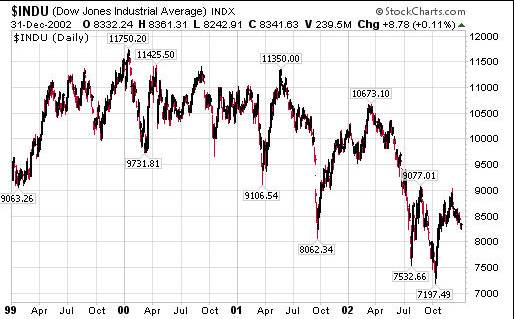
But, how much conviction would American investors and advisors have in their asset allocation models if the U.S. stock market resembled that of Japan?
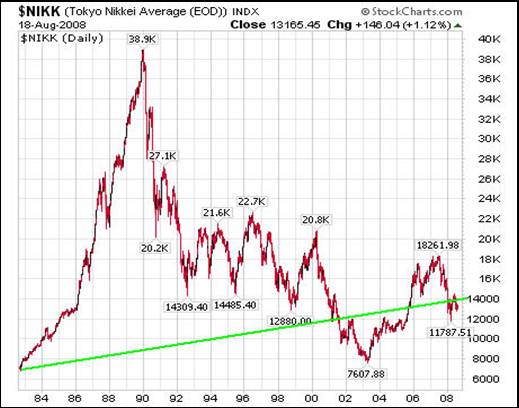
History, Science and Crowd Psychology
How confident should we be that our optimism and tenacity will result in a comfortable and secure retirement? The financial planning profession, as represented by the College for Financial Planning, only came into existence in 1972 , which is to say, the vast majority of investors and advisors have built their investment capital during the largest bull market in US history. So, the majority of today's investors and advisors only experience with a bear market was that which occurred from 2000 to 2002, which was “solved” by the lowest interest rates and the largest amount of credit (debt) ever in U.S. history, which created no incentive to change one's business model from that of the bull market boom.
As we consider how we might grapple with an eighteen year bear market, which has happened twice in the 20 th century in the U.S., recall that investors who've kept their money in S&P 500 index funds since the spring of 2000 has less value now than they did then. In fact, as of Monday, August 18, 2008, the S&P500 is 18 percent lower than it was on March 24, 2000. If these are real losses, then why do so many advisors recommend that their investors “stay the course?”
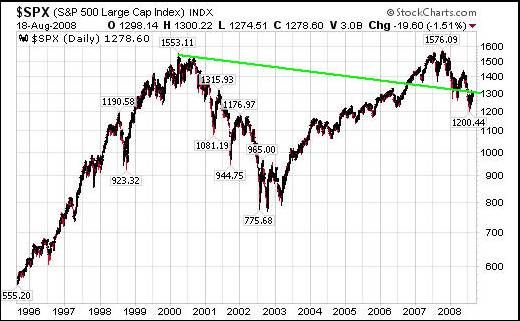
The answer is quite simple. Collectively, the natural tendency of retail investors and advisors and much of the institutional world, is to keep things simple and to avoid change, especially if that change indicates that we may be less in control of our future than we had previously thought.
In our December 2006 newsletter , I interviewed Dr. Janice Dorn , who has coached hundreds of professional traders over the last 15 years. Dr. Dorn has a PhD in brain anatomy and did her postdoctoral work in neurophysiology at the New York Medical College. She reminds us:
“Based on the work of Carl Jung, change is perceived as death. In other words we don't want to imagine that anything is going to be different. Our lives are laid out in a linear fashion. ‘I do this and then I do that.' If a certain amount of change must be dispersed in the daily lives of our society, we will do everything possible to avoid that change, or deny it. This is because it is incredibly difficult to shift paradigms – the way in which we perceive the world.”
As the greatest credit boom in history comes unraveled and begins to tear apart investors' financial capital, and as the plans advisors developed for their investors continue to meet the headwinds of real financial problems, the public will slowly start to realize that investing is much more difficult than simply “remixing your allocation once a year” or following the couch potato theory of holding on until you make money.
For some, the 1930s are nothing more than old black and white movies. Most avoid reading about that period of history because it's “too negative.” But, as we continue to see more comparisons to the 30s as 2008 unfolds, our society's lack of understanding of that period likely means that we have placed ourselves at a disadvantage by vastly underestimating…risk.
Consider H.G. Wells' view of that period from his 1933 work, The Shape of Things to Come . As we consider how the world looked to him, remember these words were written just one year after the world had experienced the most extreme bear market in modern history, in which the Dow, from 1929 to 1932, declined more than 85 percent.
Though the real Secretariat of the League of Nations from 1920 through 1933 was Eric Drummond of the United Kingdom, here Wells recounts a conversation with the fictitious Secretariat for the League of Nations , Dr. Philip Raven – prior to the fall of 1929:
“We fell talking about the speculative boom that was then at its height in America. He said it was essentially an inflation of credit by bulling securities. While it lasted there would be a kind of prosperity, but there was nothing behind it but faith. At any time someone might start a selling that would collapse the whole thing.” [page14]
Here, Wells addresses other driving forces that were unfolding at the top of the boom:
“Currencies rose and towered above others and broke like Atlantic waves, and people found the good money in their banks changed to useless paper in a period of a few months. It became more and more difficult to carry on foreign trade because of the increasing uncertainty of payment. Trade and industry sickened and lost heart more and more in this disastrous uncertainty; it was like being in an earthquake, when it seems equally unsafe to stand still or run away; and the multitudes of unemployed increased continually. The economically combatant nations entrenched themselves behind tariffs, played each other tricks with loans, repudiations, sudden inflations and deflations, and no power in the world seemed able to bring them into any concerted action to arrest and stop their common dégringolade [quick deterioration or breakdown].” [pg 115]
And so, by 1933, for Wells and hundreds of millions around the globe, the world looked very different than 1929, and the things that some foresaw, finally arrived.
“The year 1933 closed in a phase of dismayed apprehension. It was like that chilly stillness, that wordless interval of suspense, that comes at times before the breaking of a storm. The wheels of economic life were turning only reluctantly and uncertainly; the millions of unemployed accumulated and became more and more plainly a challenge and a menace…There had been a considerable if inadequate building boom after the Peace of Versailles, but after 1930 new construction fell off more and more.” [pg 116]
If we were all-powerful, we could throw the history lessons of the 1930s in the trash and use our minds to shape the world we want; but as I read the history of 1914 through 1940, I see parallels to our lives today. And while we'd all agree that our world is far more complex and technologically advanced than theirs, we must ask ourselves, “Have human beings really changed all that much?”
If not, investors would be well advised to ask tough questions of their advisors. If your questions are dismissed without a specific explanation of how your portfolio would be impacted by a several thousand point drop in the Dow over the next several months, you might want to seriously consider moving your funds. If you are an advisor, and you hope to retain your business, since none of us have ever gone through the exact set of circumstances we are facing now, be willing to be blunt with your clients and discuss the challenges we all face today.
Over the last few years, I've had a chance to talk with and work with investors and advisors willing to ask the tough questions. They are seeking managers who know how to trade markets and who have the tools to grow their money in declining markets. Though they vary in a hundred ways, they have one thing in common: they spend countless hours reading, thinking it better to deal with the disease than to allow the fear of facing it to cause us unnecessary pain through ignorance.
They start their due diligence processes by critically examining their businesses and investments, evaluating how they would hold up under the extreme changes of a historic bear market. Though they realize they cannot control the world in which they live, they try to make well-informed, calculated decisions as the world changes. Realizing that we are often our worst enemies, they are always willing to challenge their own thinking. Though they may want to believe that they can get to a point where investing is easy, they realize that, regardless of how it appears in the manic portion of the credit cycle, history shows that investing is never easy.
While Wells advocated the establishment of a socialistic world government as the solution to that period, as real world events continue to unfold, we will likely have to determine whether we think such ideas will prove to be sound monetary and political foundations. Wells notes:
“There is a strong opposition on the part of great interests in America to the President [Franklin D. Roosevelt], who has made himself the spear-head of the collectivising drive; they want to put the brake now on his progressive socialisation of the nation, and quite possibly, at the cost of increasing social friction, they may slow down the drift to socialism very considerably. But it is unbelievable that they dare provoke the social convulsion that would ensue upon a deliberate reversal of the engines or upon any attempt to return to the glorious days of big business, wild speculation and mounting unemployment before 1927. They will merely slow down the drive. For in the world now all roads lead to socialism or social dissolution.” The New World Order, 1940, HS Wells, pg 53
Now, those who've been reading my commentary know that I do not support Wells' proposal. It may be that there is no better way to consider how financial market moves impact crowd psychology, than to consider the ideas espoused at a time of rising uncertainty. HG Wells was a contemporary of Ludwig Von Mises, who points out the dangers of socialistic systems.
“It is customary nowadays to speak of ‘social engineering.' Like planning, this term is a synonym for dictatorship and totalitarian tyranny. The idea is to treat human beings in the same way in which the engineer treats the stuff out of which he builds his bridges, roads, and machines. The social engineer's will is to be substituted for the will of the various people he plans to use for the construction of his utopia. Mankind is to be divided into two classes: the almighty dictator, on the one hand, and the underlings who are to be reduced to the status of mere pawns in his plans and cogs in his machinery, on the other. If this were feasible, then of course the social engineer would not have to bother about understanding other people's actions. He would be free to deal with them as technology deals with lumber and iron.
In the real world acting man is faced with the fact that there are fellow men acting on their own behalf as he himself acts. The necessity to adjust his actions to other people's actions makes hum a speculator for whom success and failure depend on his greater or lesser ability to understand the future. Every investment is a form of speculation. There is in the course of human events no stability and consequently no safety.”[Human Action: The Scholar's Edition (1998), English version, 1948, Ludwig Von Mises, pg 113]
In today's world, it is common to place individuals in one of two camps. On the one hand, we see ourselves as “bottom line thinkers,” who, for various reasons, cannot understand the big picture, while on the other hand, those who delve into philosophical ideas that impact the whole society, are seen as in absent minded professors who can't get his head out of the clouds. But, if we defer our God given ability to use our own minds to the “wisdom of the experts” or “social engineers,” should we expect our personal plans to remain unaltered? In my fifty years of life, I cannot think of a more profound and practical time than today for the average person to engage in such discussions.
Course of Action
• If you still believe your retirement plans will not be impacted by the world in which you live, wake up and smell the gunpowder from the financial explosions going off around you.
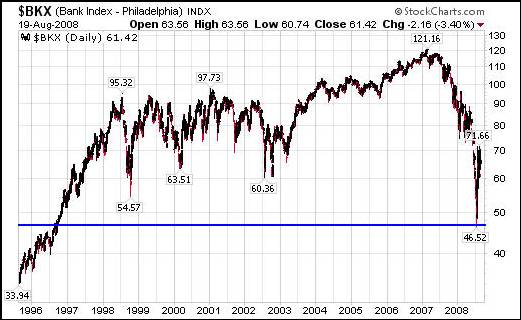
• If you are an advisor who is still using the same tools that built your practice during the roaring credit explosion, you stand a high likelihood of watching your practice evaporate as the credit crisis continues.
• If you think there is no way for the little person to grow their money, read our April article, Staying Alive . There are opportunities to grow your money, but you must be willing to think outside the traditional boxes that have become sacrosanct during the greatest bull market in history.
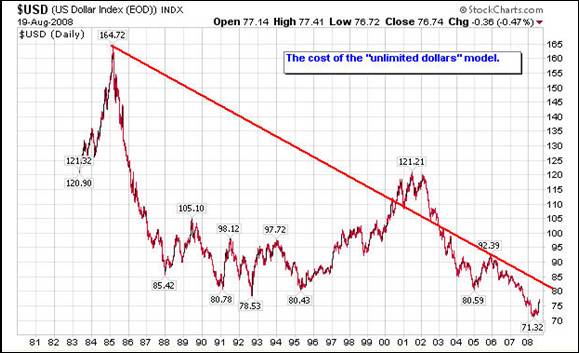
• If you think that big daddy government will always have unlimited amounts of paper dollars to make sure your retirement plans are met, consider the chart below, and ask yourself, “If this goes on for another 20 or 30 years, how much will my standard of living change?”
I also encourage you to view the documentary film, I.O.U.S.A .
• If you are open to asking questions and have come to grips with the fact that the financial markets do not provide equal opportunities for all, you have placed the odds of winning more in your favor – even amidst what will likely be one of the most difficult environments of our day.
If you are interested in learning what you are missing from listening to the daily news without a historical perspective, consider joining our group of worldwide readers. To subscribe to our research, click here . To learn more about our research and advisory services, click here .
A current subscription to our research gives an individual access to all of our educational writings back to January of 2006, as well as our industry research paper on short selling, Riders on the Storm: Short Selling in Contrary Winds.
Doug Wakefield, President
Best Minds Inc. , A Registered Investment Advisor
3010 LBJ Freeway
Suite 950
Dallas , Texas 75234
doug@bestmindsinc.com
phone - (972) 488 -3080
alt - (800) 488 -2084
fax - (972) 488 -3079
Copyright © 2005-2008 Best Minds Inc.
Best Minds, Inc is a registered investment advisor that looks to the best minds in the world of finance and economics to seek a direction for our clients. To be a true advocate to our clients, we have found it necessary to go well beyond the norms in financial planning today. We are avid readers. In our study of the markets, we research general history, financial and economic history, fundamental and technical analysis, and mass and individual psychology.
Disclaimer: Nothing in this communiqué should be construed as advice to buy, sell, hold, or sell short. The safest action is to constantly increase one's knowledge of the money game. To accept the conventional wisdom about the world of money, without a thorough examination of how that "wisdom" has stood over time, is to take unnecessary risk. Best Minds, Inc. seeks advice from a wide variety of individuals, and at any time may or may not agree with those individual's advice. Challenging one's thinking is the only way to come to firm conclusions.
Doug Wakefield Archive |
© 2005-2022 http://www.MarketOracle.co.uk - The Market Oracle is a FREE Daily Financial Markets Analysis & Forecasting online publication.
