


Stock Market Investing Safety Over 5year and 10year Periods?
InvestorEducation / Investing Oct 06, 2008 - 05:14 AM GMTBy: Richard_Shaw

 In a recent post , we studied 82 years of price change for the S&P 500. One of our readers commented, “I read somewhere that over 80% of all five year periods dating back to the Great Depression has seen the market ahead; over 95% for ten year periods.”
That rule of thumb isn't wrong, but it doesn't give a full picture. Let's add some dimension to the statistic.
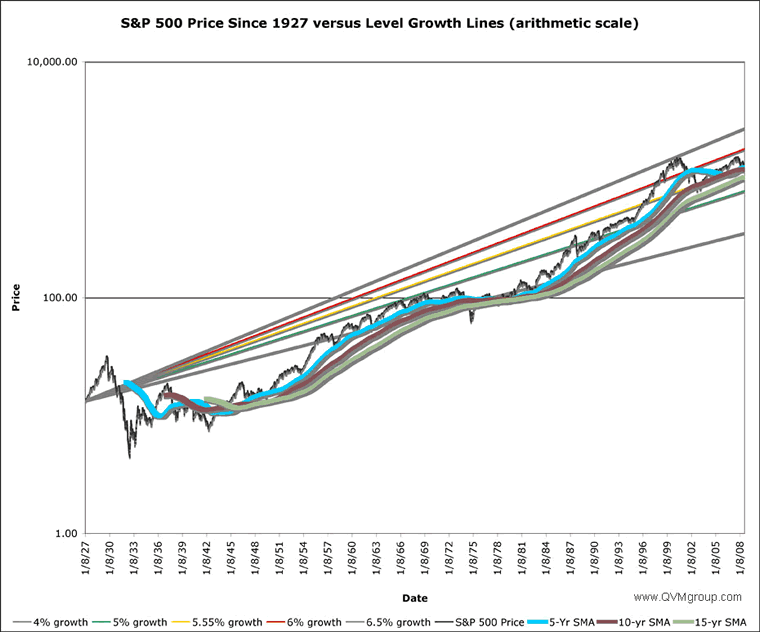
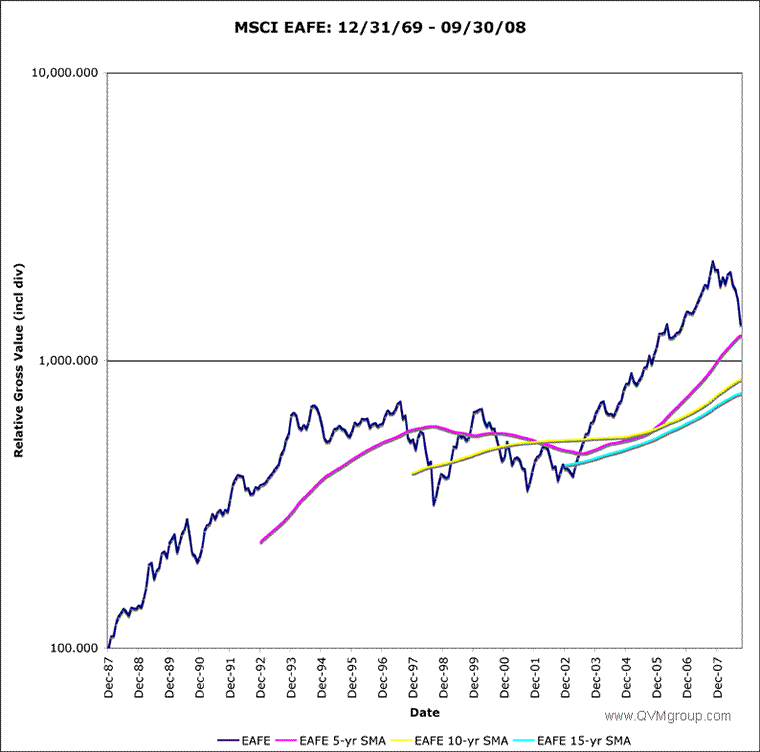
Here are two semi-log price charts showing rolling 5-yr, 10-yr and 15-yr periods for the S&P 500 (proxies SPY and IVV) from 1927, and for the MSCI EAFE (proxies EFA and VEA) from 1987.
S&P 500:
There are periods of price loss with each of the 5-yr, 10-yr and 15-yr rolling averages for the S&P 500.
S&P 500 beginning of 1927
MSCI EAFE:
EAFE is a developed markets index with a shorter history, but it is fairly highly correlated with the US markets and probably will have long-term good and bad periods at frequencies and for durations similar to the US markets.
Only the 5-year rolling average of EAFE shows price losses, but had EAFE been around during the Depression and WWII, we think it would surely have had bad spells like the ones experienced by the S&P 500.
MSCI EAFE from end of 1987
S&P 500 Five-Year Periods:
The thing about statistics is that they can often be sliced and diced to support a position, and then sliced and diced again to support a contrary position.
For example, if you inspect the weekly rolling 5-year average of the S&P 500 from 1927, you can find multiple periods of 1-year or more in length where the rolling 5-year average declined. Some were steep and some were mild. Some were short and some were long.
There are nearly 4,000 weekly rolling 5-year periods and about 800 of them were periods of declining values. That covered about 20% of the time — essentially validating our readers comment.
Looking at it differently, from peak-to-trough-to-recovery, for those unfortunate enough to buy at just the wrong time, more than 20% of the history is a price loss.
Remember, these are price loss periods without dividend considerations.
Price: 1932 - 1952 : For example, the 5-year rolling average on January 9, 1932 was $19.18. The index reached a low of $9.91 during 1943 (a 48% loss), but did not reach $19.18 again until December 26, 1952 (21 years from the peak). That alone is more than 20% of the history, not counting lesser loss periods in the 1970's and early 2000's.
Nine years after the 1943 low, the 1932 investors were whole with their nominal investment.
Dividends: 1932 - 1952 : During the 21 year wait for the price to recover, total dividends were$14.86 (not including reinvestment). That is a total return of about 2.75% as of the recovery date. The sum of risk-free Treasury Bill interest on on the initial investment for the 21 years would have been $7.26 (for a total return of about 1.55%).
If the 1932 investor had held on for 21 years, the return would have exceeded the risk-free return by about 1.2%. Not so great.
Practical Human Considerations : More importantly, it is fairly well documented most people don't/can't hold on during extended losses.
For example, a 65 year old in 1932 would have to stay alive until age 86 to experience price recovery; and previously received dividends would not likely be well enough remembered to be factored into the emotional part of the holding decision.
A 25 years old at 1932, would likely get married, have children, seek to buy to house, somehow not need the investment along the way, and wait until age 46 to see price recovery. We doubt that would have happened in 1 case of a 1,000.
Mostly likely the investment would be sold before the bottom, and if reinvested would have earned less interest than the $7.26 T-Bill interest, because the investment amount would be smaller.
Emotions and behaviours are as important, if not more important, than the statistical analysis.
In real life, the 1932 investors would have been better off in bonds, considering likely behaviors.
As observers of historical results, we have the advantage of knowing the end of the story. You don't know the end of the story when you are in the action. We should not impute the clarity we have looking back, when our need is to look forward.
The 1932 investor probably would have been better off with Treasury Bills or Bonds (today's proxies SHV, BSV, BIV and BND for various maturities) when emotions and behavior are factored into the analysis.
1932 - 1952 Sub-Cycles : Then spinning the stats one more time, there were two minor 5+ year peaks and troughs of the 5-year rolling average within that 21 years from the beginning of 1932 to the end of 1952 in which an investor could have made money.
Active Management/Traders : And, of course, there were nimble folks who did quite well throughout the period of lousy rolling averages.
It's a fact though that on average, over time, active management is a net loss game.
The average manager does not do better than the market and the drag of fees eats away at returns.
It's also a fact that superior active managers have not been able to continue to be superior in the long-term.
Picking the manager who will be superior next year is as difficult as picking the stock that will be superior next year. Persistence of performance is not a proven phenomenon (see Law of Small Numbers below).
Exceptional Conditions 1932 - 1952 : We must point out that the great period from 1932 through 1952 included a Depression, World War II and the Korean War.
We have major economic and military issues facing us today that could have comparable depressive or elevating effects on securities values depending on outcomes, which seem uncertain at this time.
Question : Is the situation today more like 1932 or more like the 1970's or early 2000's? Your answer to that is critical to your investment choices and your future.
S&P Ten Year Periods:
The rolling 10-year average declined 21% from August 28, 1937 to sometime in 1942, but did not recover to the peak price until November 10, 1951 (14 years). That was also a long wait for emotional people who are not detached computing machines, and who do not know the history before it is written.
With dividends received (no reinvestment) the total return during the 14 year holding time would have been 4.1%. The total risk-free return on Treasury Bills on the 1937 amount would have been about 2%.
There were also rolling periods of mild loss in the 1974-1975 period, and the 1977-1979 period.
S&P 500 Fifteen Year Periods:
The rolling 15-year average declined 17% from its peak on January 10, 1942 to a bottom sometime in 1943, but did not recover to the peak price until March 3, 1946 (4 years).
Not such a long wait that time, but do you have the ability to believe in your analysis to wait 15 years for it to prove right or wrong — probably not.
With dividends the total holding time return was 4.4%. The alternative risk-free investment on the 1942 amount would have returned 2.6%.
If you are 65 living on investment income, you'd be a bit daft if you planned that way.
However if you are wealthy and planning to pass major assets across generations, or if you are 25 with decades of earnings and savings ahead of you, a 15-year measurement period might be OK. (see our prior article about suitability and economic age)
Few investors could hold their conviction in the face of assets melting for long periods, which a 15-year perspective would require.
Law of Small Numbers:
One problem with this entire line of research and discussion is the Law of Small Numbers. Yes, we have many data points, but we don't have many market eras.
The Law of Large Numbers leads people to believe that a large sample of data is likely to be good for decision or projection purposes. That is often true — but there are Black Swans, such as we are experiencing now.
The Law of Small Numbers is often overlooked by people who do not realize that a small sample of data is not likely good for decision or projection purposes. The Law seeks to explain the self-defeating reliance of investors (and gamblers) on a short series of data as indicative of the future.
If we begin to break an 80+ year period into eras based on bull and bear markets, or conditions external to the market, we find ourselves with a very small sample. Reliability is probably low.
Black Swans:
A further problem with this kind of analysis is that sometimes “stuff” happens. When conditions fall well outside of the normal probability distributions, such as the way some broad credit default swap measures were out 8 standard deviations last week — all bets are off. “Stuff” seems to be happening now.
Past is Not Prologue:
Then there is the basic disclosure statement that the regulators require — that past performance is no guarantee of future performance. That advice is probably particularly appropriate in our current market conditions.
Implication:
If you are in the market at the end of a long bull, you may need to ride a long bear to become whole again. It is not necessarily true that if you can wait 5 years or 10 years that you will be OK.
Your losses in a negative scenario depend on:
- how overvalued the market is when you enter,
- how undervalued the market becomes after you enter
- how terrible economic conditions become after you enter
- what income stream you receive from your investments
- what time value losses you incur
- what inflation related purchasing power losses you incur.
The market can be a bull or bubble, and it can be a bear or a beast.
We could be receiving a visit from a beast in this now global credit crisis — but maybe not — we don't know.
You need to interpret value, conditions and the future — not rely on comforting statistical sound bites generated by the sell side of Wall Street and mutual fund companies. They need your money.
Organizations that sell products instead of advice are conflicted. Their interests are not fully aligned with yours. Check the source before accepting simple rules of thumb about investing your money.
Closing Note:
Market timing is a not a good idea. Investing with a steady hand and for the long-term is a good idea. However, standing out of the way of a train wreck is not market timing.
In Shakespeare's “King Henry the Fourth”, Falstaff said “ The better part of valor is discretion “. That's a thought worth considering.
Think for yourself. Don't bet your life savings on marketing sound bites from those who want and need to sell you an investment product for their own well being.
We think having substantially more cash than typical is a prudent thing to do if you are in a mature stage of your economic life and cannot replace lost capital with new earnings and savings.
For stock investments, history and prudence would suggest an equity income bias.
Dividends can bridge you over holding periods, even if the returns are not spectacular.
Non-dividend paying “growth” stocks may convert from positive momentum stocks to negative momentum stocks. With no dividend support, opportunity cost due to lack of income and inflationary effects could be quite damaging
Err on the side of safety and risk reduction in these difficult and confounding times, and stay broadly diversified within any stock category. If you need income, make sure your portfolio can generate it without selling positions to obtain the funds.
By Richard Shaw
http://www.qvmgroup.com
Richard Shaw leads the QVM team as President of QVM Group. Richard has extensive investment industry experience including serving on the board of directors of two large investment management companies, including Aberdeen Asset Management (listed London Stock Exchange) and as a charter investor and director of Lending Tree ( download short professional profile ). He provides portfolio design and management services to individual and corporate clients. He also edits the QVM investment blog. His writings are generally republished by SeekingAlpha and Reuters and are linked to sites such as Kiplinger and Yahoo Finance and other sites. He is a 1970 graduate of Dartmouth College.
Copyright 2006-2008 by QVM Group LLC All rights reserved.
Disclaimer: The above is a matter of opinion and is not intended as investment advice. Information and analysis above are derived from sources and utilizing methods believed reliable, but we cannot accept responsibility for any trading losses you may incur as a result of this analysis. Do your own due diligence.
Richard Shaw Archive |
© 2005-2022 http://www.MarketOracle.co.uk - The Market Oracle is a FREE Daily Financial Markets Analysis & Forecasting online publication.
