


When will the U.S. Housing Market Bottom?
Housing-Market / US Housing Oct 09, 2008 - 11:40 AM GMTBy: Hans_Wagner

 Now that the US has signed the rescue bill, investors are analyzing ways they can use the bill to help them beat the market. The collapse of housing prices in the United States led directly to the problems with the mortgage securities that are freezing credit markets. Some investors might think that the bottom in the current recession is near and the markets will recover soon. Others are not so sure. In this case, it pays to look at the past to see if you can learn from prior experiences and the trends in the housing market.
Lessons from Japan
In the early 1990's Japan experienced a real estate bubble fueled by cheap money and liberal financings, similar to what happened in the United States. When the bubble burst, property prices fell, causing defaults on mortgage loans and a drastic cut in bank lending. Sound familiar? What followed was a decade of growth that averaged about 1%.
Most analysts do not believe the United States could experience a similar fate. However, there are significant similarities that should give investors pause.
The chart below is from August 21, 2008, The Economist . As shown between 1985 and 1991, Japanese home prices rose 50%, compared to a 90% rise in the Untied States between 2000 and 2006.
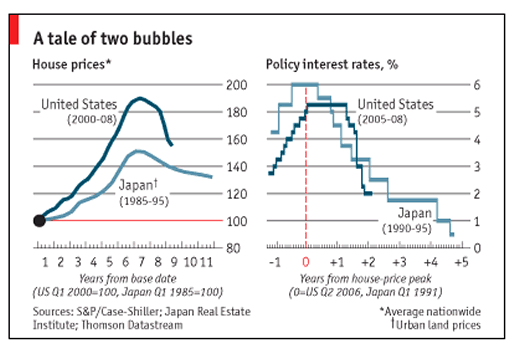
Since their peak the price of Japanese homes have fallen 40%. Depending on whom you quote, prices of homes in the U.S. have fallen about 20%. Some analysts expect a further 10 to 15% decline.
Where is the Bottom in Home Prices?
The decline in the price of houses needs to find a bottom before the economy can begin to recover. Housing in the United States is a major contributor to the overall economy. One in eight people work in housing or housing related industries from the construction worker who builds the homes to the banker who makes the mortgages to the realtor who markets the property.
Two criteria are necessary for the price of housing to stabilize. Home prices need to reach their long-term average price level relative to household income and the excess inventory of homes must fall to normal levels.
According to the National Association of Realtors (NAR) the inventory of unsold homes fell 7 percent to 4.3 million, down from the all-time record of 4.6 million in July. That's a 10.4-month supply at the current sales pace. Around five months of inventory is a more typical level, so there is still an excess supply of 2 million unsold homes.
In August, the seasonally adjusted rate for single-family home sales was 4.35 million. This is down from the 4.81 million level one year ago according to the NAR. It would take six months to sell the excess inventory of homes, let alone account for new construction, additional existing homes for sale and foreclosures. In short, it is gong to take at least a year to see inventories approach their normal level at the earliest.
Again, in August, the median sales price fell 9.5 percent from the same month a year ago, the largest price decline dating back to 1999. The chart below is taken from the US Census Bureau. It shows the ratio of household income to home values for the period 1984 to 2007. A higher ratio indicates that homeowners have more income to cover their house payments including mortgages, taxes, insurance and maintenance. As the ratio falls, homeowners have less income to cover these expenses. The bulk of the decline in the ratio is from homeowners buying homes worth more with less qualifying income to support the payments.
It is clear from the chart that the ratio of household income to home values begins to decline in 1999. This could be caused by an increase in the value of homes due to appreciation and/or people were buying houses that were more expensive than they had earlier.
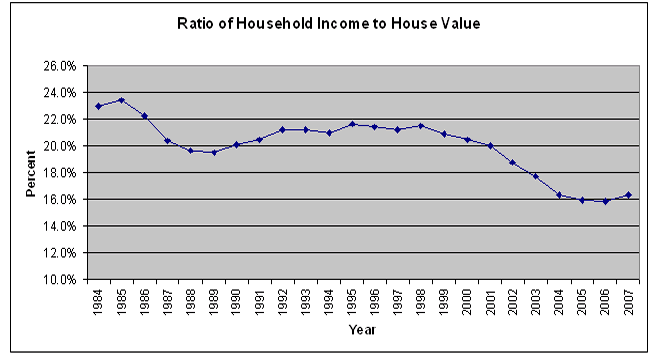
From 1998 to 2006, the ratio fell from 21.5% to 15.9%, caused by the rapid appreciation in the price of houses and the decline of qualifying criteria to obtain a mortgage to buy a house. We all heard the stories about people buying houses for no money down and below market interest rates.
A more normal level of household income to house value is in the 21 to 22% level, the range through most of the 1990's. If we could go back further, it is probably higher as standard mortgage to income rules were closely followed. For the purposes of this discussion, the 21.5% level is a reasonable target.
In order for the ratio to reach the 21.5% level, the price of houses would have to decline by 32% from 2006. If you accept that home values have declined 20% so far, that means we still have 12% to go before we reach a stable level. While no one can predict how long it will take to reach that stable level, I suspect we can assume it will be up to a year.
The Bottom Line
As investors, we can expect the housing sector to continue to experience further difficulties as housing prices find their bottom. Watch the reports from the NAR for signs that the inventory of houses for sale is nearing the sustainable level. Moreover, monitor the price homes to see when they reach an equilibrium level compared to the average household income.
We also need to realize that the market anticipates such an event by up to six months. Often you can observe this bottoming process in a sector by watching the sector ETFs such as the S&P Homebuilders SPDR (XHB) Look for the downtrend to end and the price action to form a flat base. When that takes place, it is a very good indication that a bottom is in place and investors can look to take positions in the sector.
If you want to learn more on analyzing the economic factors that affect investors I suggest reading: Economic Growth by David Weil. An easy to read book that presents the key factors to understand global economies. It is expensive and is used as a textbook for college students, but it is worth the money.
By Hans Wagner
tradingonlinemarkets.com
My Name is Hans Wagner and as a long time investor, I was fortunate to retire at 55. I believe you can employ simple investment principles to find and evaluate companies before committing one's hard earned money. Recently, after my children and their friends graduated from college, I found my self helping them to learn about the stock market and investing in stocks. As a result I created a website that provides a growing set of information on many investing topics along with sample portfolios that consistently beat the market at http://www.tradingonlinemarkets.com/
Copyright © 2008 Hans Wagner
Hans Wagner Archive |
© 2005-2022 http://www.MarketOracle.co.uk - The Market Oracle is a FREE Daily Financial Markets Analysis & Forecasting online publication.
