


IMF Bailout of the United States Coming?
Interest-Rates / Credit Crisis Bailouts Nov 04, 2008 - 06:36 AM GMTBy: Darryl_R_Schoon

 Economics has less to do with money than power. - Modern economics is not rocket science. Modern economics is a fraud. Metrics such as “monetary aggregates” and the “velocity of money” are merely devices meant to divert attention away from the fraud in progress.
Focusing on such metrics has been a critical component in the success of the bankers' extraordinary shell game of modern economics. But the current crisis has not only interrupted the bankers' confidence game, it has shed unexpected light on the precarious positions of those fleeced
The producers, savers, entrepreneurs who had previously accepted the banker's credit based money as legitimate are now discovering they were but suckers in an opaque and cleverly constructed street game, sic Wall Street's, designed to defraud the unsuspecting and vulnerable onlookers and players.
The greatest casualty of today's unfolding crisis is the belief that bankers are performing a needed function in today's world. It is true that in credit driven capital economies founded on debt-based money issued by central banks, bankers are essential. In confidence games, con-men always play a critical role; the banker's shell game of modern economics is no exception.
Modern economics is a system whereby bankers inserted compounding credit with debt-based paper money into every aspect of commerce; and are thus able to live like parasites partying off the productivity of others (gotta love those billion dollar bonuses!). Only now is this becoming obvious; for only when a confidence game breaks down, does the truth become clear.
AAA SUBPRIME COLLATERIZED DEBT OBLIGATIONS
The bankers con game began to disintegrate when US sub prime collaterized debt obligations were given the highest AAA ratings by rating agencies, i.e. Moody's, Standard & Poor, Fitch, etc.; and, when the AAA rated securities began to default, investor confidence in the bankers' global con game began to default as well. The rest is history—or soon will be.
The AAA rating granted to sub prime CDOs is the same rating that is given to AAA US government treasuries. According to the rating agencies, the creditworthiness of US sub prime borrowers is no different than that accorded to the US government—and unfortunately the credit agencies are right.
The major holders of US treasuries—China, Japan, Russia, sovereign wealth funds, pension funds, insurance companies and investors—will soon discover is that the US is no more able to pay its $13 trillion of dollars of debt than sub prime borrowers can pay the $1.3 trillion dollars owed on sub prime mortgages.
DEMOCRATS—THE TAX AND SPEND PARTY
VERSUS
REPUBLICANS—THE TAX LESS AND SPEND MORE PARTY
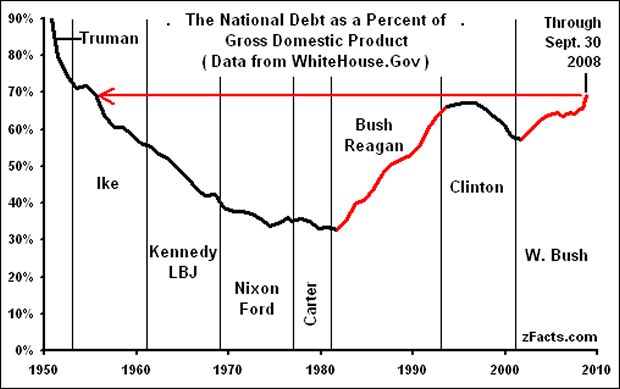
Just as deficit spending stimulates economic activity; so do tax cuts; and when the two are simultaneously applied, the effect is exponentially enhanced. Unfortunately, so, too, are the consequences.
The combination of US deficit spending and tax cuts during the Bush presidency caused an extraordinary expansion of the US economy, an expansion that affected the global economy as well. Unfortunately, the US expansion was based on consumer credit and now that credit has turned into unpayable debt, the US expansion is affecting the world negatively.
The growing US debt is the number one problem facing the world today. The US , the issuer of the world reserve currency, the US dollar, is the world's number one debtor and its borrowing needs have now reached the point of threatening global economic stability.
The growth of US deficit spending combined with tax cuts has transformed the US into a debtor unable to pay down debt without borrowing more. According to Hyman Minsky's Financial Instability Hypothesis, debtors finance debt by either by hedge, speculative, or Ponzi finance. The US is now using Ponzi financing to do so.
Hedge financing units are those which can fulfill all of their contractual payment obligations by their cash flows…Speculative finance units are units that...cannot repay the principle out of income cash flows. Such units need to “roll over” their liabilities: e.g. issue new debt to meet commitments on maturing debt.
For Ponzi units, the cash flows from operations are not sufficient to fulfill either the repayment of principle of the interest due on outstanding debts by their cash flows from operations...A unit that Ponzi finances lowers the margin of safety that it offers the holders of its debts.
The Financial Instability Hypothesis by Hyman Minsky, Working Paper No. 74, May 1992:
Only by rolling its debt forward and borrowing is the US still able to pay its debts—and its ability to do so has now worsened considerably; and the recent growth in US loan guarantees has made US repayment of its debt even more questionable
From the Washington Post, October 18, 2008
…the budget deficit -- the annual difference between government spending and tax collections- ..jumped from $162 billion last year to $455 billion in the fiscal year that ended in September, largely because of the cost of the stimulus package, as well as slowing tax revenues and rising expenses in Iraq and Afghanistan … it's not hard to imagine the deficit rising to $1 trillion .
The inability of the US to pay its debt has grave implications for those who loan the US the trillions of dollars the US borrows. With the US debt levels growing even as the US economy weakens, creditors may choose to not loan the US the vast sums of money the US is now committed to spending, a sum Goldman Sachs estimates to be $2 trillion in 2009 alone.
The marketplace has already taken notice:
LONDON, Sept 24 (Reuters) - The cost of insuring 10-year U.S. government
debt against default rose to a record high on Wednesday as investors fretted
over the feasibility of the government's $700 billion plan to contain the
financial crisis .
Credit default swaps on 10-year Treasury debt expanded to 29.2 basis
points -- its widest ever -- from 26.5 basis points on Tuesday, according to
CMA, a specialized data provider.
CMA said CDS on five-year widened to 22.0 basis points from 20.5 basis
points. (Reporting by Emelia Sithole-Matarise
THE IMF AND THE US
Because the US , the world's lender of last resort, is itself bankrupt, the world economy is in danger of collapse. The IMF has now been asked to bail out Iceland , Pakistan , Hungary and Ukraine . The US may very well be the next IMF client.
What has happened this fall has eclipsed everything that has gone before. What will happen next year will eclipse what is now happening this fall. The crisis is growing as the end-game of capitalism approaches its end irrespective of what central banks try to do.
This time the bankers overstepped themselves in such a way they have brought destruction not only on society but on themselves as well. It is only right that they should suffer too—as, after all, it is they who caused our problems.
It is unfortunate that society is being forced to lessen the burden on bankers even as bankers continue to indebt society. But, then again, that's what government is for—to act as the bankers' agents in the continuing indebting of nations, businesses, producers and savers.
Markets will only be free when the virus of bankers' debt-based paper money is permanently removed from commerce and the present tyranny of banker-controlled government is ended.
By Darryl Robert Schoon
www.survivethecrisis.com
www.drschoon.com
blog www.posdev.net
About Darryl Robert Schoon
In college, I majored in political science with a focus on East Asia (B.A. University of California at Davis, 1966). My in-depth study of economics did not occur until much later.
In the 1990s, I became curious about the Great Depression and in the course of my study, I realized that most of my preconceptions about money and the economy were just that - preconceptions. I, like most others, did not really understand the nature of money and the economy. Now, I have some insights and answers about these critical matters.
In October 2005, Marshall Thurber, a close friend from law school convened The Positive Deviant Network (the PDN), a group of individuals whom Marshall believed to be "out-of-the-box" thinkers and I was asked to join. The PDN became a major catalyst in my writings on economic issues.
When I discovered others in the PDN shared my concerns about the US economy, I began writing down my thoughts. In March 2007 I presented my findings to the Positive Deviant Network in the form of an in-depth 148- page analysis, " How to Survive the Crisis and Prosper In The Process. "
The reception to my presentation, though controversial, generated a significant amount of interest; and in May 2007, "How To Survive The Crisis And Prosper In The Process" was made available at www.survivethecrisis.com and I began writing articles on economic issues.
The interest in the book and my writings has been gratifying. During its first two months, www.survivethecrisis.com was accessed by over 10,000 viewers from 93 countries. Clearly, we had struck a chord and www.drschoon.com , has been created to address this interest.
Darryl R Schoon Archive |
© 2005-2022 http://www.MarketOracle.co.uk - The Market Oracle is a FREE Daily Financial Markets Analysis & Forecasting online publication.
