


The Great American Housing Market Nightmare Next Phase
Housing-Market / US Housing Nov 04, 2008 - 07:07 AM GMT

 Martin Weiss writes: One of the greatest blunders of our time is made by those who blindly assume home prices are so low they couldn't possibly go any lower.
In reality, home prices don't stop going down at some particular level that appears to be “cheap.” Nor do they stop falling because they match some historical price that was previously a low.
The end of the decline in home prices will come only when there are no new economic forces driving them down.
When will that be? I'd love to say it's just around the corner. But everything I see tells me that, despite the sharp declines already recorded, a steeper plunge in home values is dead ahead.
The reason: So far, most of the troubles in the housing market have been caused by bad mortgages going sour. Meanwhile,
- the more common causes of housing slumps — high interest rates, rising unemployment, and recession — are just starting to kick in. And …
- the most powerful causes — depression and deflation — are still on the horizon.
 |
| In the 1920s, my father (left) and uncles never dreamed of borrowing to buy a home. Home mortgages were rare. |
In the boom leading up to the Great Depression of the 1930s, most Americans did not borrow money to buy a home. Variable rate mortgages didn't exist. And Wall Street investors rarely got involved in the business of financing homes. Home prices did fall dramatically. But those price declines came mostly after the stock market crashed, after the economy shrunk and after millions of workers had lost their jobs.
The crux of the problem today: That phase of the housing crisis still lies ahead. Moreover, this time, because of massive debts, the pressure to abandon or sell homes is far greater.
Conclusion: If the U.S. sinks into a depression, home price declines could be as deep as, or deeper than, those of the Great Depression, especially in the hardest hit regions of the country.
It is a frightening thought. Yet, on the positive side, a sharply reduced price for the average home is the only fundamental, enduring mechanism for making homes more affordable and restoring demand — especially if the days of easy credit are gone.
Already, in 2008, one in ten American homeowners has defaulted on their mortgage or lost their home in foreclosure. Nearly four in ten owe more than their home is worth.
And all this is before the recession deepens and before we experience the next phase of the Great American Housing Nightmare.
Why This Was One of the Biggest Speculative Manias of All Time
The Great American Housing Nightmare has no precedent; no historical roadmap to guide you, no proven pathway to follow.
No one can tell you with precision how far U.S. home prices will decline, when they will hit bottom, how many homeowners will lose their homes, or how soon a real recovery will begin. Getting to a recovery could take many years.
In fact, to throw some light on the speculative frenzy and panic that have swept through the U.S. housing market, the most relevant precedents I could find have nothing to do with homes at all. They are the Dutch speculative mania of the 1630s, the South Sea Bubble of the 1700s and the stock market panics of the early 1900s.
In those boom-and-bust episodes, the objects of speculation were tulips, slaves and stocks. This time, it was the American home. But despite that key difference, the critical boom-bust elements that helped create the speculation — and the depth of the losses which ensued — were roughly similar.
Boom-Bust Element #1: Debt
Debt is the fuel of speculation. Without it, speculative bubbles cannot emerge. With it, prices can be inflated beyond the wildest imagination.
In seventeenth century Holland, investors speculated wildly on tulips, putting up as little as 2.5% of their own cash. Similarly, in early 20th century stock market booms, investors put up as little as 10% of their own money, using borrowed funds for up to 90% of their purchases.
But in many respects, the borrowing mania that created the Great American Housing Nightmare makes all previous debt manias pale by comparison.
By mid-year 2008, the Federal Reserve reported a grand total of $14.8 trillion in U.S. mortgages outstanding — 40% more than the entire national debt and triple the total of all the mortgages in America just a dozen years earlier.
Sadly, it was not just the supersized quantity of debt that was so dangerous. Even more dangerous was the substandard quality of the debt. Consider the facts:
 In all prior speculative bubbles in history, investors were required to put up at least some of their own money to buy into the boom. Even in the tech stock mania of the early 2000s, investors had to put up a minimum of 50% cash for their stock purchases.
But in the frenzy that preceded the Great American Housing Nightmare, millions of Americans bought homes with zero money down!
Lenders didn't merely look the other way while home owners borrowed the down payment; they actively encouraged it. Homebuyers without enough cash to buy a $500 TV set were declared the proud new owners of $500,000 luxury homes. Many took it one step further with serial purchases of homes, leapfrogging with glee from one free ride to the next.
 In all prior speculative bubbles, borrowers were invariably required to make payments of interest and principal in full and without fail, with zero tolerance for any other arrangement.
In contrast, during the Great American Housing Nightmare, millions of homeowners were allowed to pay interest only or even less than full interest.
So it should come as no surprise that the majority opted to make the smallest payments allowed, while the lender added the unpaid amounts to the loan balance. As with credit cards, the more that time went by, the deeper into debt the borrowers fell.
 In prior historical episodes of rampant speculation, loans were almost invariably held by the lenders, who, in turn, had a vested interest in making sure the borrower's finances were sound and their payments were kept current.
But in the Great American Housing Nightmare, the mortgages were mostly held by non-lenders — institutions and investors that were far removed from the borrowers.
 In earlier manias, investors speculating with borrowed funds were required to document that they were worthy of the loans. They invariably had to present hard evidence of income, proof of assets, or both.
But in the Great American Housing Nightmare, even that was not the case. Millions were allowed to borrow huge sums without a scintilla of proof that they had the wherewithal to make the payments.
 In earlier manias, the bubble was generally confined primarily to one debt sector.
Not this time around! Beyond the $14.8 trillion in residential and commercial mortgages in America, there are another $20.4 trillion in consumer and corporate debts. This meant that mortgages represent only 42% of the private-sector debt problem in the country.
Result: Americans are not only under tremendous pressure to sell their homes due to burdensome mortgages, they are also squeezed by huge credit card balances and by layoffs from employers equally addicted to debt.
By virtually every measure, the debts piled up prior to the Great American Housing Nightmare are far bigger and worse than any debt pile-up ever witnessed in history.
Boom-Bust Element #2: Investor Frenzy
 |
 |
In 1637, at the height of the tulip mania, just one Semper Augustus bulb changed hands for 12 acres of land. Another bulb was sold for a massive collection of goods, including 160 bushels of wheat, 160 bushels of rye, four oxen, twelve swine, two hogsheds of wine, four casks of beer, two tons of butter, 1,000 pounds of cheese and more. But just a few months later, similar bulbs were practically worthless.
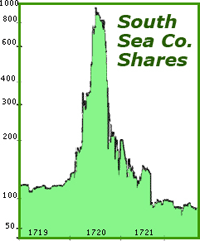
In 1720, investors drove up shares in the South Sea Company from 125 to 960 in six months and back down again to 180 in less than three months.
In 1929, the Dow Jones Industrials surged from 213 in 1928 to 381 in 1929, only fall to 41 in 1932.
In each case, investors and speculators — most with little experience in the market — were caught up in a wild buying frenzy, only to dump nearly everything in an even wilder selling panic.
Unfortunately, we witnessed a similar pattern prior to the Great American Housing Nightmare. As the buying frenzy heated up, homes and condos were flipped faster than hotcakes. Prices were driven through the roof. And even mortgages themselves were transformed into securities that were riskier than some of the riskiest stocks in the world.
At the peak of the housing bubble, the average price of existing home reached nearly five times the total yearly income of its owners, the highest in history. At the same time, the affordability of each home plunged to its lowest level in history.
Once set in motion, the speculative fever spread quickly. From Miami to Phoenix to San Diego to Las Vegas, investors camped outside housing developments to snap up three, four, five, or more units at a time. Condominium developers built gleaming towers in major cities, based almost exclusively on anticipated bids from investors and speculators and with no evidence of real underlying demand. From coast to coast, investors signed on to millions of pre-construction contracts, only to flip them before the first shovels touched the ground.
This kind of speculation was traditionally just a small niche in the giant U.S. housing market. But at the peak of the housing boom, it nearly took over: An astounding 40% of houses and condos were bought as second homes or investments. The yearly rate of appreciation on existing homes catapulted from 3.6% in January 2001 to 16.6% in November 2005. On new homes, meanwhile, it surged from 4.8% in to 18.1%.
Fueling the bubble, government agencies like Ginnie Mae, government-sponsored enterprises like Fannie Mae and Freddie Mac, and private investment banks bundled up mortgages and resold them as securities that could be traded much like stocks and bonds. These securities, in turn, were bought by banks and investors in the U.S., Europe and Asia. The total amount of mortgages transformed into these securities: $4.8 trillion, 60% more than the total value of all the stocks in the Dow Jones Industrial Average.
In just one year — 2006 — $2.4 trillion in new mortgage-backed securities were created, more than triple the amount of just six years prior. Even in past investment manias, there was no such structure. Even the wild and wooly speculators of the 1600s, 1700s and the early 1900s did not take the madness to that extreme.
Boom-Bust Element #3: Government-Created Monopolies, Corruption, Fraud and Cover-Ups
Some of the largest speculative bubbles of all time were born out of government-sponsored monopolies, nurtured by government-bred bureaucrats and kept alive beyond their time by government-inspired corruption, fraud and cover-ups.
In the South Sea Bubble of 1711, the English government needed to find a way to fund the huge debts it had incurred in the War of Spanish Succession. So the Lord Treasurer, Robert Harley, created the South Sea Trading company to help finance the government's debts. The company got exclusive trading rights in the South Atlantic plus a perpetual government annuity of over a half million pounds per year. In exchange, its investors agreed to assume responsibility for about £10 million of the government's debt.
It seemed like a win-win. But the government's sponsorship and the company's monopoly led to big trouble. The company's managers, thinking they had the government's largesse to fall back on, were complacent and ignored signs of economic troubles. They took excessive risk. And ultimately, investigations turned up massive fraud at the company and pervasive corruption in the government.
When the entire structure collapsed, there was nothing the government could do except to pass what later become known as the “Bubble Act” aimed to prevent a future recurrence.
Similarly, in the early 1900s, the Panic of 1901 occurred in the wake of a failed attempt to create a massive railroad monopoly; the Panic of 1907 followed a failed attempt to corner the copper market; and the Crash of 1929 resulted, to a large degree, from collusion among brokers, bankers and tycoons.
In nearly every case, the government gave select companies or individuals special privileges, waived critical regulations and encouraged great concentration of power. And in nearly every case, the government made desperate attempts to salvage the boom long after the bust began. But it was ultimately powerless to avert a collapse in the very structures it had helped to create.
Unfortunately, the same, or worse, could happen in the Great American Housing Bubble: The U.S. government created two monopolies that made England's eighteenth century South Sea Company and America's twentieth century industrial monopolies look small by comparison. Their names: Fannie Mae and Freddie Mac.
The U.S. Government gave these companies monopolistic control over America's largest debt market — mortgages. And then, beginning in the early 2000s, the government spurred these monopolies to compete aggressively with private subprime lenders.
Not surprisingly, the results were similar to those of earlier bubbles: Extreme complacency, excessive risk-taking, and, ultimately, fraud.
In September 2004, the Office of Federal Housing Enterprise (OFHE), Fannie's and Freddie's primary regulator, issued a special report revealing massive accounting irregularities. And four years later, in September 2008, the companies had still not cleaned up their act, prompting the Securities and Exchange Commission to launch new investigations into accounting deceptions.
The biggest deception of all: In their official filings and public pronouncements this year, Fannie and Freddie consistently and wildly overstated their capital, while understating their risk. Supposedly built with mortar and steel, Fannie and Freddie were actually houses of cards in disguise.
Repeatedly, the company executives swore on oath that they had more than enough capital. And even on the eve of their demise, their regulators testified before Congress that the companies were solvent.
Based on their smoke-and-mirrors accounting, perhaps. But based on the basic rules that you and I must abide by, not even close. For longer than anyone cared to admit, Fannie and Freddie had been insolvent. Meanwhile, their chief executives hid behind carefully camouflaged facade, marched into riskier corners of the mortgage market, and trashed the trust of millions of Americans with no sign of restraint and little expression of regret.
Between 2005 and 2008, for example, Fannie Mae purchased or guaranteed at least $270 billion in subprime mortgages — high-fee loans to high-risk borrowers. That was more than three times as much as it had bought in all its earlier years combined.
Yet no one seemed to bat an eyelash.
Quite the contrary, Wall Street and Washington cheered loudly, encouraging them to take on even more risk.
Why such enthusiasm? Because the rapid growth in fees supercharged Fannie's stock price. Because big revenues meant huge bonuses for executives — $90 million for one, $30.8 million for another, and $10 million for a third. And because the easy money flowing to unqualified borrowers indirectly helped politicians buy millions of votes.
Suddenly, however, in September 2008, it was finally recognized that all the financial statements and all the sworn testimony about solvency were unabashed lies. Suddenly, the two largest mortgage lenders on earth, supposedly rich and prosperous, were thoroughly bankrupt. And suddenly, underscoring the depth of their demise, each company needed an unprecedented $100 billion injection of government funds just to keep it alive.
The potential bill to taxpayers: $200 billion. But that figure assumes an end to the credit crunch, no more debt collapses, no recession, and certainly no depression. If any of these assumptions should prove wrong, $200 billion will barely cover what is fast becoming history's largest cesspool of sinking debts and commitments — $5.2 trillion in mortgages guaranteed or owned by the two companies, their $1.5 trillion in debts, and their $2 trillion in derivatives.
Boom-Bust Element #4: Collapse!
How much could home prices ultimately decline in the Great American Housing Nightmare? We have no way of knowing with certainty. But we can draw some lessons from similar bubbles and crashes throughout history:
- In the Dutch Tulip Mania, investors lost nearly all of their money if they bought for cash; more than all of their money if they bought on the slim margin of just 2.5%.
- In the South Sea Bubble, the cost of the shares investors bought fell from a peak of 1,000 to less than 100, a loss of 90% or more.
- In the Crash of 1929 and the ensuing 3-year bear market, investors lost 89% of their money even in America's largest industrial stocks.
- In the tech wreck of 2000-2002, when a myriad of Internet and technology companies collapsed, investors lost 78% of their money invested in the average Nasdaq stock; and 100% in companies that went under.
- In Japan's long bear market, which stretches from 1990 to the present, investors have lost 82% of their money from peak to trough in companies that make up the Nikkei average, and much more in smaller companies.
- And in the financial crisis of 2008, investors lost 99% or more of their money in some of America's most respected financial institutions.
My argument: The speculative bubble in U.S. homes is as extreme as each of these historic examples; and in the most hard-hit regions, the resulting price collapse could be equally extreme. Indeed, the Great American Housing Nightmare is progressing in three phases:
Phase 1. The bust in the subprime mortgage market. This is now history.
Phase 2. A severe U.S. recession. As of this writing, this phase is just beginning.
Phase 3. Depression and deflation. Still ahead.
Therefore, no matter how far home prices in your area have already fallen and no matter how cheap they may appear, they could still fall a lot further.
In the hardest hit regions, an individual home that was once priced for $400,000 at its peak could fall to as low as $200,000 by the end of Phase 1. But don't blindly assume that's the bottom. In Phase 2, it could fall in half again, to $100,000. And in Phase 3, it could fall by at least half for a third time, to as low as $50,000 or $40,000.
Homes with peak prices of $1 million could sell for as little as $100,000; some, originally priced for $10 million may have no buyers at all — even with asking prices as low as $1 million.
Nationwide, the median home price will not fall nearly that far. But that factoid alone will do nothing for homeowners in bubble areas like Florida, Nevada or California. Nor will it help those in blighted regions where factories are closed and unemployment rises far above the national average.
Never before in history have we witnessed home price declines of this magnitude! But that fact alone does not make them implausible, let alone impossible.
Remember: Never before in history has so much debt, speculation, government manipulation, fraud, corruption and consumer abuse been heaped onto any housing market! And if there's one thing that history teaches us, it's that unprecedented causes lead to unprecedented consequences.
Lessons To Learn Now Before It's Too Late
Lesson #1. Don't blame yourself. Virtually every realtor and expert in America told you that investing in homes was a “sure bet”; and any lender in the country that accepted your loan application was, in effect, telling you that you had the means to make the payments.
Lesson #2. Don't look back. Forget what your property was worth at its peak. And try to forget what you paid for it as well. That's water under the bridge. Instead, look at what's happening today — in the headlines, in your neighborhood, at companies in your area.
Lesson #3. Don't count on the government to save the day. There are bound to be a series of public programs to help some people some of the time. But they will be spotty; they won't turn the housing market around; and you may not qualify. For example, the FHASecure program rolled out in late 2007 essentially created three classes of homeowners with mortgages:
- Homeowners current on their mortgages and not at risk of foreclosure were mostly not eligible for federal assistance;
- Those already in foreclosure were also not eligible; and …
- Ironically, only home owners falling behind in their mortgage payments could get government help.
Not only did that make it very difficult for most people to qualify, but it also gave a strong incentive to households to deliberately fall behind on their mortgages. People asked: “ Why should I cut my food budget or give up on my nights out when my neighbor is having all the fun, skipping his mortgage payments and getting rewarded by the government for his imprudent behavior?”
Ultimately, these kinds of government programs are fundamentally flawed and doomed to fail.
The most important lesson of all: Don't underestimate the potential depth, speed and duration of the decline. As the debts are unraveled, the economy comes unglued and the deceptions are uncovered, home prices could continue to plunge much further.
If you are able and willing to sell your properties, do so now. Don't wait.
Good luck and God bless!
Martin
This investment news is brought to you by Money and Markets . Money and Markets is a free daily investment newsletter from Martin D. Weiss and Weiss Research analysts offering the latest investing news and financial insights for the stock market, including tips and advice on investing in gold, energy and oil. Dr. Weiss is a leader in the fields of investing, interest rates, financial safety and economic forecasting. To view archives or subscribe, visit http://www.moneyandmarkets.com .
Money and Markets Archive |
© 2005-2022 http://www.MarketOracle.co.uk - The Market Oracle is a FREE Daily Financial Markets Analysis & Forecasting online publication.
