


Why the Dollar is Rising and Potential for Large Stock Market Rally
Stock-Markets / Emerging Markets Nov 16, 2008 - 12:08 PM GMTBy: John_Mauldin

 The Economy Gets a Margin Call
 - Where Have All the Consumers Gone?
- Why Is the Dollar Rising?
- Can We Actually Muddle Through?
- The Potential for a Large Stock Market Rally
- Is GM too Big to Let Fail?
As long-time readers know, my daughter Tiffani and I are interviewing millionaires for a book we will be writing called Eavesdropping on Millionaires. This has been one of the more personally impacting projects of my life, as the stories we hear are so very provocative. I hope we can transfer to readers of the book at least half of the impact we are personally experiencing. But at the end of each interview, we let the interviewee ask me questions. Often, they are along the line of "Do you really think we will Muddle Through?" Sometimes they ask in need of assurance and sometimes they simply think that my stance is somewhat naïve. It is something of an irony that I am called a perma-bear in some circles and a Pollyanna in others. The Muddle Through middle has been lonely of late.
So, this week I take another look at my Muddle Through stance. We look at some of the recent data on unemployment and retail sales, think about the implications of a falling trade deficit and a rising US government deficit, speculate about the potential for a serious stock market rally, and also comment on the potential for a GM bailout. There is a lot to cover, so let's jump right in.
Where Have All the Consumers Gone?
Retail sales and prices of goods imported to the US dropped by the most on record, signaling the economy may be in its worst slump in decades. Purchases fell 2.8 % in October, the fourth straight decline, the Commerce Department said today in Washington. Labor Department figures showed import prices dropped 4.7%, pointing to a rising danger of deflation, and a private report said consumer confidence this month remained near the lowest level since 1980. (Bloomberg)
Circuit City filed for bankruptcy and Best Buy said sales were down and gave even lower guidance for Christmas. Nordstrom's cut its profit forecast for the third time this year.
It is a perfect storm for retailers. Consumers are having a negative wealth effect as stock and housing prices have plunged, taking almost $20 trillion out of US consumer assets. Unemployment is rising and consumer confidence is at the lowest levels since the last major recession in 1980-82.
The unemployment numbers which came out this week were particularly grim. Jobless claims on a seasonally adjusted basis were 516,000 newly unemployed. But that masked an even deeper actual number of 540,000. The largest previous number for this week was back in 2001 and was 420,000. Actual weekly numbers can be volatile, but such an increase is certainly disconcerting.
I should point out that as of the end of September there were 3.3 million job openings, down slightly from August. It is not as if there are no jobs being created or available. But as pointed out last week, the number of people looking for work for over 8 months is high and rising fast, so there is a serious mismatch of the jobs available and the desire or ability of people to take them.
Continuing claims are now at roughly 3.5 million individuals who are getting unemployment insurance. Let's assume that each week we lose an average of 400,000 jobs. That is 20 million jobs a year. That means the US economy for the last year has created 16.5 million jobs (very roughly). So there is some robustness in the economy even as we slide deeper into recession.
But what happens if we see the number of new unemployment claims start to rise to an average of 500,000 for a period of time? Without more job creation, that would mean an increase in unemployment of 1,000,000 people in just 10 weeks. This week we have seen an increase in continuing claims of 141,000 from just last week. That, gentle reader, is very grim if it were to continue. Unemployment is likely to continue to rise throughout most of 2009, closing in on 8%.
This time of year should see some seasonal rise as retailers begin to hire for Christmas. But with retail sales down and facing the likely prospect of negative growth in Christmas sales for the first time ever, seasonal employment is evidently not responding. More comments on this below as I take up the Muddle Through economy.
Why Is the Dollar Rising?
The trade deficit is dropping slowly, from over $60 billion in July to $56 billion in September. Import prices fell and imports were down by 5.6%. On a less positive note, exports, which had been one of the bright spots in the economy, fell by 6%. The trade deficit would have been another $3 billion less if Boeing had not been on strike.
Oil prices were an average of $104 a barrel in September. For November prices will be closer to $65, down at least one third. That means the possible trade deficit for November could be a lot closer to $40 billion, the lowest since 2003 and well off the highs of almost $68 billion a few years ago.
Why is this important? Two reasons. First, it means that a lot fewer dollars are now going into the world economy. And demand for dollars is rising as the world seeks a safe haven in the current global recession, so it should not be a surprise that the dollar is rising.
The surprise is the violence, the amazing rapidity of the rise. We are seeing movements in currency prices in a week that would normally be a year's worth of volatility. It is a sign of the severity of the crisis, of the wariness of traders, that prices are so volatile.
Second, it also means fewer dollars will be coming back into the US to finance the rising government deficits. As Woody Brock (one of my favorite economists) in a recent essay points out, this is counter-intuitive, but it is nonetheless true. Dollars which go abroad must eventually find a home, and that home is going to be in US assets of some kind, usually government bonds.
Some worry about China or another large country might stop buying US bonds with their dollars. They worry that they might want to increase their holdings of euros, for example. But what that means is they take the dollars and sell them to someone who has euros. Then that country has dollars that they must then do something with. It is not as if the dollars disappear.
The only way for China (and/or the world) to really reduce their dollar balances is to stop selling products to the US consumer or to buy US assets like stocks or real estate or wheat, thus bringing the dollars back to the US.
But what in practice happens is that China and most Mideast countries on a net basis buy US government-backed debt. But if there are fewer dollars going abroad, that means there are fewer dollars to buy newly issued debt. And our government is issuing new debt at a rather startling rate.
The estimates for the deficit next year are close to $1 trillion. But if the trade deficit is "only" $500 billion, that means that the appetite of foreigners for US debt will be less than half what is needed to finance the deficit. Where does the difference come from? US citizens and corporations, primarily banks, are going to have to buy the difference or the Fed will have to monetize a portion. Or rates on longer-term debt could go high enough to entice foreigners to buy US debt.
Higher rates would be a drag on the US economy and especially the housing markets and would also cost the taxpayer a lot in additional interest-rate expenses. Total government debt is now $10.5 trillion, with the public (including non-US holdings) having $6.3 trillion. The average interest rate paid on that debt is 4.009%, and for fiscal year 2008, which ended October 31, the interest expense was $451 billion. Add another trillion and the interest paid would soon rise to $500 billion.
The US will face a serious problem in 2009. Tax revenues are going to take a very serious fall. Remember when capital gains taxes would produce a few hundred billion? Not in 2009. And income taxes will drop as unemployment expenses rise. The perceived need for government stimulus will be offset by the problem of funding the deficit. Resorting to monetizing the debt is a nuclear option. Expect even more volatility in the currency and interest-rate markets next year.
Can We Actually Muddle Through?
In addition to the above, let me list a few problems I have highlighted in the past few months. Roughly 3% of GDP growth for 2002-2007 was from Mortgage Equity Withdrawals and other debt. That stimulus is gone. Consumers are going to start saving once again, taking money from a consumer-spending-driven economy. Taxes are likely to rise, not only at the federal but at the state and local levels, as governments of all sizes are faced with growing deficits and needs. Financial institutions are deleveraging at a very fast pace. It is, as one friend told me, as if the economy at large is facing a massive margin call.
Given all of the above problems, how is it possible that we can Muddle Through?
In January of 2007 I forecast a mild recession beginning in late 2007. I was early. In January of this year, I still thought the recession would be more like that of 1990-91. Clearly, I was an optimist. It is now likely that we will see a recession as deep as 1974. This quarter is likely to see a negative growth number of 4% or more. That is deep by any standard. And I do not think that the economy will begin to actually grow before the third quarter at the earliest. It is quite likely that 2009 will be negative for the entire year, and possibly for all four quarters.
We are, as I have said, hitting the reset button on consumer spending. We are going to some lower level of consumer spending, and corporations and government are going to have to adjust their budgets. Corporate earnings will be under pressure for some time to come.
But, and this is a big but, this too shall pass. At some point we will hit a bottom. Just as irrational exuberance led us into foolish actions, we are now becoming too pessimistic. The pendulum will swing. Minsky taught us that stability breeds instability. The more stable things are, the more comfortable we are with taking risk, which ultimately creates the conditions for a normal business-cycle recession. This time, we took on a whole lot more risk than usual and are facing a deeper recession.
But the opposite is true as well. Instability will breed stability. It is, as Paul McCulley calls it, a reverse Minsky moment. We will adjust to the new environment by becoming more conservative. And that new conservative environment will bring about a new stability, albeit at lower levels. But it will be a level from which we can begin to grow once again. It has been this way since the Medes were trading with the Persians.
And here is where I may not have been clear, as the conversations mentioned at the beginning of the letter have called to my attention. My thought is that Muddle Through is the period after we are finished with the recession. I think that the future recovery when it comes will be a lot slower and longer in getting back to trend growth than normal. It will be a Muddle Through, slow-growth economy. I expect that period to now last through at least 2010. The credit crisis and the housing bubble are not problems that can be quickly or easily fixed. It will take time.
The Potential for a Large Stock Market Rally
Everyone knows that there are large amounts of hedge fund redemptions being processed. Some blame the current vicious sell-off on forced hedge fund sales as they have to meet these redemptions at the end of the quarter.
This brings up an interesting possibility. My guess is that the large bulk of that money is going back to institutions that will need to put the money to work. Where will they deploy it? If they are projecting 7-8% total portfolio returns, they cannot put that money in bonds. My guess is that it will go back to other hedge funds or into long-only managers. This money will start to go to work in mid- to late January. We could see a very large rally the first quarter of next year. For traders, this will be a chance to make some money. I think it will be a bear market rally, as the recession will still be in full swing, and we could see a pullback when that money gets fully deployed. But it will be fun while it lasts.
As traders begin to sense that possibility, we could see a serious year-end rally as well. Would I bet the farm? No, but I offer up the idea as a possibility. And I know a lot of people have large short positions that have made them a lot of money this year. Maybe it is time to think about taking profits.
And now a few thoughts on the possibility of bailing out GM.
Is GM too Big to Let Fail?
(Let me say at the outset I am truly sorry for those who have lost their jobs or are facing the possibility of a job loss, whether at GM or any other firm. I have been there, as have most people at one time or another.)
I wrote in 2004 that GM was essentially bankrupt. They owed more in pension obligations than it seemed likely they would be able to pay, without major restructuring of the union contracts. I was not alone in such an assessment, although there were not many of us. Now that assessment is common wisdom.
Bloomberg today cites sources that claim a collapse of GM would cost taxpayers $200 billion if the company were forced to liquidate. The projections also called for the loss of "millions" of auto-related jobs. GM, Ford, and Chrysler employ 240,000. They provide healthcare to 2 million, pension benefits to 775,000. Another 5 million jobs are directly related to the three auto companies. GM has 6,000 dealerships which employ 344,000 people. According to a recent study by the Center for Automotive Research (CAR), if the domestic automakers cut output and employment by 50 percent, nearly 2.5 million jobs would be lost and governments would lose $108 billion in revenue over three years. (Edd Snyder at Roadtrip blog)
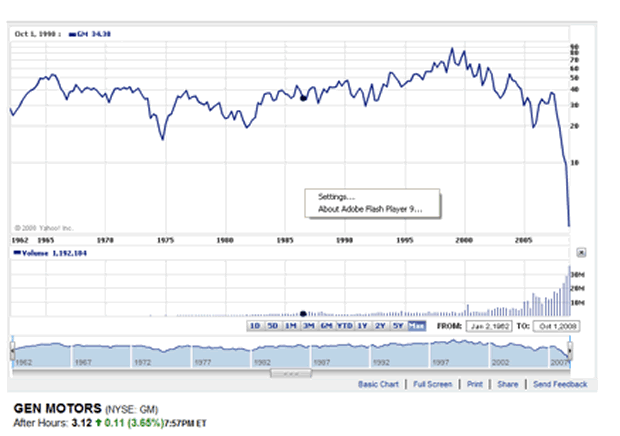
How did we get to a place where the market cap of GM is a mere $1.8 billion and its stock price has dropped from $87 in early 1999 to $3.10 today? (See chart below.) Where Rod Lache of Deutsche Bank has a "price target" of zero for GM? "Even if GM succeeds in averting a bankruptcy, we believe that the company's future path is likely to be bankruptcy-like," Lache wrote.
The litany of reasons is long. At the top of the list are union contracts which mandate high costs and pension plans which cannot be met. Then there is the problem of many years of poorly designed cars, although they are now getting their act together. We can also discuss poor management and bloated costs, like paying multiple thousands of workers who are not actually working. GM is structured for the 50% market share they used to command, whereas now they only have 20%.
Wilbur Ross, a well-known multi-billionaire investor, was on CNBC saying that allowing GM to go bankrupt would throw the country into what sounded like a depression. Of course, he does have an auto parts company which supplies GM; so he, as my Dad would say, does have a dog in that hunt.
Ross said that we as a nation are to blame for GM's problems (I am not making this up) because we do not have a national industrial policy. The US allowed other automotive companies to build plants in states that had lower labor costs, and that is the reason GM is uncompetitive. GM pays an average of $33 an hour, and those selfish other companies pay a mere $19 plus a host of benefits.
Ross evidently believes that because some states have lower taxes and right to work laws, that it is the responsibility of the taxpayer to give GM a certain type of immortality rather than suggest GM deal with its problems directly. I assume that Ross also sides with the French when they suggest that Ireland should raise taxes so they will not have to compete with Ireland for business. Such thinking is nonsense and is also unconstitutional.
Let's all acknowledge that having GM go bankrupt would not be a good thing. But it is not the end of the US automotive industry, nor even of GM. Let's think about what a GM bankruptcy might look like. In a bankruptcy, the debt holders line up to come up with a restructuring plan so that they can maximize the return of their loans or obligations. The shareholders get wiped out, but with GM down over 95%, that has largely been accomplished. That process has happened with airlines, steel companies, and tens of thousand of other companies. It is called creative destruction.
First, let's understand that the real owners of GM are the pension plans, as I wrote in 2004. They are the entities with the largest obligations and the most to lose. They are the biggest stakeholders in a successful GM. Giving them the responsibility for making a new, leaner, meaner GM with realistic union contracts would be rational; otherwise they would lose most of what they have.
Factories need to be closed. Auto sales are down to 11 million cars a year, the lowest since 1982, which was the last major recession. Automotive companies sold cars at such low prices in the last few years that sales went to 16 million a year. But the cars that have been sold will last for a long time. Few people are going to buy a new car when the old one is working fine, especially in a recession and a Muddle Through economy. Further, does GM really need eight automotive lines, some of which have been losing money for years?
A restructured GM with realistic costs could be quite competitive. They have some great cars. I drive one. It is four years old and so good I am likely to drive it for at least another four.
At some point after the restructuring, the pension plans could float the stock on the market and get some real value. If actual pensions need to be adjusted, then so be it. While that is sad for the GM pensioners, is it any sadder than for Delta or United Airlines or steel company pensioners who saw their benefits go down? For the vast majority of Americans, no one guarantees their full retirement. Why should auto trade unions be any different?
Taxpayers in one form or another are going to have to pay something. Unemployment costs, increased contributions to the Pension Benefit Guarantee Corporation, job training, relocation, and other costs will be borne. So, it is in our interest to get involved so as to minimize our costs, as well as help preserve as many jobs as possible.
Sadly, I think it is likely that a Democratic majority next year will quickly pass a bailout that will not solve any of the longer-term problems. Obama evidently wants to appoint an "automotive czar;" and the name being floated is the very liberal Michigan former Representative David Bonior, whose anti-trade and pro-union positions are well known. This is appointing the fox to guard the hen house. It is not a recipe for the restructuring that is needed.
The bailout for GM is a bailout for the trade unions and management (who not coincidentally both made large contributions to the Democratic Party and candidates). US consumers are simply going to buy fewer cars in the future. That is a fact. Spending $50 billion does not address that reality. That $50 billion can be better spent by helping workers who lose their jobs. Without serious reforms a bailout will simply postpone the problem, and there will be a need for more money in a few years. And do we think that the management which got GM into the current mess is the group to bring them out?
And as to the argument that "We bailed out Wall Street, so why not GM?" it doesn't hold water. What we did and are doing is to try and keep the financial system functioning, so we don't see the world economy simply shut down. But don't tell the 125,000 people who have lost jobs on Wall Street that it was a bailout. That number is likely to go to 200,000. No one thinks that a restructured GM would see anywhere close to half that number of job losses.
Do we protect Circuit City? Sun just announced plans to lay off 6,000 workers. Where is their bailout? Citibank announced 10,000 further job cuts today. This is a recession. And sadly that means a lot of jobs are going to be lost. GM workers should have no more right to their jobs than a Sun or Citibank or Circuit City worker.
Now, would I be opposed to a bridge loan to help in the transition? No, because a viable Detroit is good for the country and will cost the taxpayer less in the long run than if we have to pick up their pension benefits. But any money must come with realistic reforms that put in charge new management and a realistic cost structure so GM can compete.
New York, Moving, and Another One Leaves the Nest
Today, while I am writing this letter, my #2 son Chad is moving out, to an apartment not far from me, but still no longer in the house. He is 20 and eager to be on his own. He has recently taken a job at Best Buy, while trying to decide what to do next. I am happy for him, as you can clearly see the anticipation on his face. Six down and one left. Trey, the youngest, is 14, and I suppose the day will come when he too decides it is time to be on his own. That is what we as parents hope for. But there is a part of me that will miss Chad being under my roof.
Thanksgiving is coming up and I am making plans, not just for the usual big dinner but also for moving that weekend to another home not too far away. I will move my office into the same house in mid-December. The savings will be substantial, but the savings in commute time will be even more valuable. I will miss this Ballpark office, though.
I will be in New York next month (December 4) for Festivus, a holiday fundraiser sponsored by my friends at Minyanville.com. If you are there, be sure and look me up. It will be a fun weekend, as there will be dinners with friends, and Barry Habib (of the Mortgage Market Guide and one of the show's producers) has arranged for tickets to the musical Rock of Ages.
It is quite late. For some reason, this letter was harder to write than usual, but even letter writing comes to an eventual end. Have a great week.
Your ready already for recovery analyst,
By John Mauldin
John Mauldin, Best-Selling author and recognized financial expert, is also editor of the free Thoughts From the Frontline that goes to over 1 million readers each week. For more information on John or his FREE weekly economic letter go to: http://www.frontlinethoughts.com/learnmore
To subscribe to John Mauldin's E-Letter please click here:http://www.frontlinethoughts.com/subscribe.asp
Copyright 2008 John Mauldin. All Rights Reserved
John Mauldin is president of Millennium Wave Advisors, LLC, a registered investment advisor. All material presented herein is believed to be reliable but we cannot attest to its accuracy. Investment recommendations may change and readers are urged to check with their investment counselors before making any investment decisions. Opinions expressed in these reports may change without prior notice. John Mauldin and/or the staff at Millennium Wave Advisors, LLC may or may not have investments in any funds cited above. Mauldin can be reached at 800-829-7273.
Disclaimer PAST RESULTS ARE NOT INDICATIVE OF FUTURE RESULTS. THERE IS RISK OF LOSS AS WELL AS THE OPPORTUNITY FOR GAIN WHEN INVESTING IN MANAGED FUNDS. WHEN CONSIDERING ALTERNATIVE INVESTMENTS, INCLUDING HEDGE FUNDS, YOU SHOULD CONSIDER VARIOUS RISKS INCLUDING THE FACT THAT SOME PRODUCTS: OFTEN ENGAGE IN LEVERAGING AND OTHER SPECULATIVE INVESTMENT PRACTICES THAT MAY INCREASE THE RISK OF INVESTMENT LOSS, CAN BE ILLIQUID, ARE NOT REQUIRED TO PROVIDE PERIODIC PRICING OR VALUATION INFORMATION TO INVESTORS, MAY INVOLVE COMPLEX TAX STRUCTURES AND DELAYS IN DISTRIBUTING IMPORTANT TAX INFORMATION, ARE NOT SUBJECT TO THE SAME REGULATORY REQUIREMENTS AS MUTUAL FUNDS, OFTEN CHARGE HIGH FEES, AND IN MANY CASES THE UNDERLYING INVESTMENTS ARE NOT TRANSPARENT AND ARE KNOWN ONLY TO THE INVESTMENT MANAGER.
John Mauldin Archive |
© 2005-2022 http://www.MarketOracle.co.uk - The Market Oracle is a FREE Daily Financial Markets Analysis & Forecasting online publication.
