


U.S. Fed Monetizing Debt by Printing Money
Interest-Rates / Central Banks Dec 02, 2008 - 09:15 AM GMTBy: Axel_Merk

 Deflation won't happen here; at least not if Federal Reserve (Fed) Chairman's Ben Bernanke's plan pans out. Deflation is considered a persistent decline in prices of goods and services; in a speech in 2002 , Bernanke outlined the steps he would take if the U.S. ever faced the threat of deflation. Deflation is suffocating anyone holding debt as the debt burden becomes more difficult to finance with shrinking income; in contrast, inflation bails out those who have a lot of debt. In our assessment, fighting deflation is the Fed's top priority now; the latest minutes from the Fed's Open Market Committee (FOMC) meeting state:
Indeed, some [FOMC members] saw a risk that over time inflation could fall below levels consistent with the Federal Reserve's dual objectives of price stability and maximum employment. [..] the limited scope for reducing the [Federal Funds] target further were reasons for a more aggressive policy adjustment; [..] more aggressive easing should reduce the odds of a deflationary outcome.
To understand how “more aggressive” easing is possible when interest rates are close to zero, a little background is required on how the Fed is “printing” money. Until a few weeks ago, the Fed's main tool to control interest rates was to manage the Federal Funds target rate by engaging in “open market operations” to buy or sell short-term government securities, mostly Treasury Bills. These operations are based on the principle that banks have cash deposits as reserves to lend money; for any dollar on deposit, a multiple may be provided as loans; the basic principal of modern banking assumes that not all depositors will want their money back simultaneously; a ‘run on the bank' would occur in such a situation that would either result in the Fed coming to the rescue or the bank's failure.
The Fed can now “tighten” monetary policy by selling, say, Treasury Bills, to the bank; in return, the Fed will receive the cash; and the bank will have less cash available to lend – because of the multiplier effect, small actions by the Fed tend to have – albeit with a delay of a couple of months - significant impact on lending and thus economic activity. There are no coins exchanging hands; these are entries into the balance sheets at the bank and the Fed. By making cash less available in the banking system, the cost of borrowing, i.e. interest rates, goes up.
Conversely, the Fed can buy Treasury Bills from banks and supply them with cash (providing liquidity) in return. This unleashes lending power at the banks and lowering the cost of borrowing.
This world was shaken when Congress, as part of passing the TARP bank bailout program, authorized the Fed to pay interest on deposits at the Federal Reserve. Theoretically, even if the Fed provides massive amounts of liquidity, interest rates should not go to zero as banks should always be able to go to the Fed and receive interest on deposits there. The idea is that the banking system could be flooded with liquidity while ensuring that interest rates don't go down to zero. Fed officials are fairly miffed that the market hasn't quite worked that way as short term Treasury bills have hovered close to zero with the official target Federal Funds rate at 1% and the interest paid on deposits at the Fed at or near 1%. Note that many of the new programs the Fed has introduced have little or no historic precedent; as a result, the programs may not be as effective or may have unintended consequences.
Aside from paying interest on deposits, the Fed, using the above model, can do a lot more to provide “liquidity”. Namely, the Fed is not limited to buying and selling T-Bills; as recent announcements have shown, the Fed is free to buy just about anything: mortgage backed securities (MBS), car loans, commercial paper, to name a few; the Fed could also buy typewriters, cars, domestic or international stocks, anything. In an announcement on November 25, 2008, the Fed said it would buy up to $600 billion of mortgage-backed securities issued by the government-sponsored entities (GSEs) Fannie and Freddie.
For example, a bank would like some cash, but cannot find a buyer for mortgage-backed securities it holds. The Fed may step in, buy the securities and provide the bank with cash. The bank in turn is now free to lend money – a multiple of the cash received.
How does the Fed get its money? It doesn't need to borrow it; it merely creates an entry into its balance sheet. All the Fed requires to “print” money is a keyboard connected to a computer. The difference between the Fed and the Treasury issuing money is that the Treasury needs to get permission from Congress before selling bonds. In this context, it shall be mentioned that physical cash (coins, bank notes) are entered as liabilities on the Fed's balance sheets; they are rather unique liabilities, however, as you can never redeem your cash: if you went to a bank, the best you can hope for in return for your dollar bill is a piece of paper that states that the bank owes you one dollar. While it is possible for central banks to remove cash in circulation, they are not obliged to do so.
Until recently, the Fed would only temporarily park non-government securities on its balance sheet: a bank would typically receive a temporary, often overnight, loan for depositing top rated securities with the Fed; these “swap agreements” were traditionally intended for very short-term loans, but the crisis has led the Fed and other central banks around the world to engage in 60, 90 day or even longer agreements. Since late September, the idea of swap agreements has been supplemented by outright purchases.
When the Fed issues cash for debt securities it acquires, we talk about “monetizing the debt”.
This can be taken a step further, although this last phase has not yet been implemented: when the government needs to raise money, the Treasury issues debt in form of Treasury bills and Treasury bonds. To keep the cost of borrowing for the government low, the Fed may step in and buy Treasury bonds. Whereas traditionally, the Fed is actively managing short-term interest rates by buying and selling short-term Treasury bills, the Fed may also buy, say, 10 or 30-year bonds. It's a wonderful funding mechanism: if the Treasury needs to raise cash, the Fed could come and provide it.
Isn't this extremely inflationary? Quite possibly, quite likely, but not necessarily is the short answer. First of all, the Fed has the ability to “sterilize” its debt monetization program. Take the situation where the Federal Reserve buys “highly rated”, toxic assets from the bank, but doesn't want the bank to go out and lend a multiple of the cash it receives. What the Fed can do is to sell the same bank, for example, some Treasury bills to “mop up” the extra liquidity. This would have the impact of improving the bank's balance sheet without supercharging the economy. Indeed, in late September the Treasury instructed the Fed to do just that; they even invented “Supplementary Financing Program” (SFP) bills for this purpose. On the chart below, the dark blue line indicates the cumulative growth in the Fed's balance sheet, i.e. the Fed's “printing of money”; the light blue line shows the cumulative activity to mop up the added liquidity by selling SFP bills to banks. The Fed's balance sheet has grown by about $1.2 trillion to currently over $2 trillion; Dallas Fed President Richard W. Fisher said the Fed's balance sheet may reach $3 trillion by January.
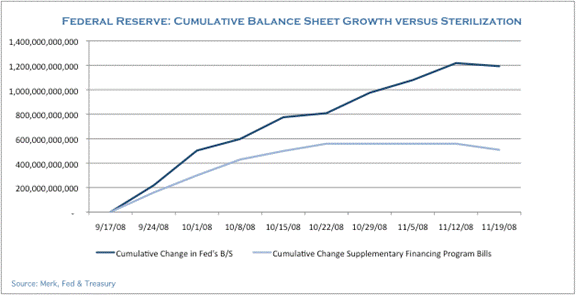
As even the untrained eye can see, the Fed has not mopped up all of its liquidity injections; indeed, as of October 22, 2008, the Fed seems to have all but abandoned the program. In our assessment, at least for the time being, the Fed is not interested in mopping up, but to add massive amounts of liquidity.
Well, isn't that extremely inflationary? It depends on your definition of inflation; if it's a growth in money supply, then, yes, this is already extremely inflationary. But so far, this hasn't translated into higher price levels or even higher long-term inflation expectations as measured by the spread of 10 year TIPS versus 10 year Treasury bonds; TIPS are inflation protected Treasuries that provide compensation for increases in the consumer price index (CPI); it is this spread that the Fed is most concerned about when gauging the market's inflation expectations.
Why has it not (yet) been inflationary? Well, the Fed can provide all the money it wants, but it cannot force institutions to lend. Below is a chart of the “excess reserves” in the banking system; these are the reserves banks hold in excess of what they are required to maintain.( Fed statistical release H3, table 1 column 4 ):
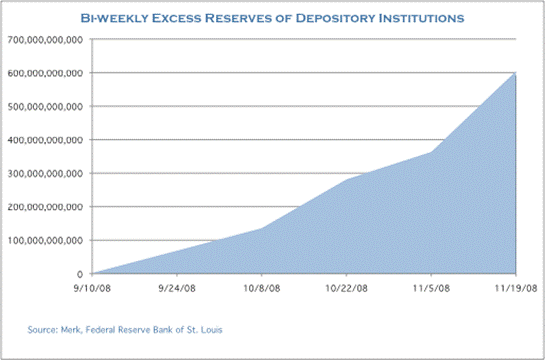
Until September, excess reserves hovered at or below about US $2 billion, but have ballooned to over $600 billion as of November 19, 2008. Read in conjunction with our discussion above on the Fed “printing money”, the Fed has thrown money at the banking system, but the banks are hoarding the cash , they do not lend. For banks to lend money, two basic conditions must be bet: they must feel strong enough to provide credit; and they must feel their customers – be they consumers or businesses – are creditworthy enough.
Before we discuss the next step the Fed has taken in its undeterred will to unlock credit in the economy, let's pause for a second to look at a potential unintended consequence. If you are a bank and don't like to lend to the private sector, but are awash in cash, what do you do? You can deposit the cash at the Fed and earn 1% interest; you can buy Treasury bills and earn approximately zero; or you can lend money to --- the government. In our view, it seems a logical conclusion for banks to buy longer dated Treasury bonds. Banks are in the business of borrowing short and lending long: typically, banks would have deposits (short-term loans from depositors, callable at any time) and lend to finance long-term projects. This may well be the greatest carry trade of all times, except that it has neither credit, nor currency risk; it does have interest risk, i.e. if long-term interest rates go up because the market prices in the risk of inflation, then banks could lose money.
While Congress may be furious that banks are not lending, the Fed has an interest in keeping the long-term cost of borrowing low. Under normal circumstances, the cost of borrowing should group as unprecedented amounts need to be raised to finance the various programs in the pipeline and additional spending programs expected by Congress; the cost of borrowing has the potential of going dramatically higher if Asian buyers don't increase their appetite for U.S. debt; Asian buyers have, in recent years, purchased the majority of debt issued by the U.S. government. Now, however, there's less trade with the U.S., and Asian governments need to stimulate their domestic economies; while some may try to keep their exports cheap, the Chinese approach of investing about US$ 600 billion into their domestic economy is more efficient. And unlike the U.S. government, China is sitting on over $2 trillion in foreign currency reserves and can afford to have a massive domestic stimulus package. In our view, foreign governments are unlikely to be able to step in and keep U.S. borrowing costs low.
Never underestimate the Fed. If the money thrown at the banking system doesn't stick, i.e. doesn't result in easier credit for the rest of the economy, they can also be more targeted. As of November 25, 2008, the Fed has announced it will buy mortgage-backed securities in the open market to get the cost of borrowing down. Specifically, debt securities issued by Fannie and Freddie, the government sponsored entities, will be purchased. Almost immediately after the announcement, the prices of these securities rose, causing the yields to go down. The goal of the Fed in this program is to keep the cost of borrowing for homebuyers low. While this will keep the cost of borrowing low for those who qualify for a loan, this program may do little to provide access to the mortgage market for those that have been shunned from it. This includes the difficulty for many to refinance their homes when the value of their house is less than the value of the mortgage.
In our assessment, the Fed will do anything to keep the cost of borrowing low. This has included targeted purchases of mortgage-backed securities to help homeowners; this has included purchases of commercial paper to help corporate America; it has included providing banks with massive liquidity; and it may include the outright purchase of government debt to help finance the spending programs in the pipeline.
What happens if the Fed keeps the cost of borrowing artificially low, either directly or indirectly? Traditionally, the Fed only controls the cost of short-term borrowing, but recent Fed actions set the stage for more active involvement throughout the yield curve, i.e. also for longer dated government bonds. Think about it from the vantage point of the potential buyer of Treasury bonds or Fannie and Freddie paper. If the yield offered is artificially low, then potential buyers are likely to abstain; after all, there may be other investments whose price are less, or not at all, manipulated. Investors don't require a high, but a fair return on their money; they want to be compensated for the risk they are taking. This includes those who lend to governments. In a world where the cost of borrowing is artificially lowered, it may be up to the Fed to be the backstop of all economic activity as other buyers may be more reluctant to step in. Paradoxically, it's precisely government debt that investors are looking for because of all the uncertainty in the private sector. However, as the U.S. does not live in a vacuum, international flows of funds do need to be considered. A foreign investor may think twice before buying U.S. government bonds or agency papers if they are not fairly compensated for the risk they are taking. Aside from our argument above that Asian buyers may not be able to finance U.S. spending, they may be put off by unattractive yields.
After all, the massive stimuli under way should be highly inflationary; but if the Fed helps to engineer that markets cannot price inflation into bond prices, there has to be a valve. This valve, in our view, will be the U.S. dollar; we cannot see the dollar hold up in face of the types of intervention that are under way and that we see play out. Incidentally, a substantially weaker dollar may be exactly what Fed Chairman Bernanke wants. He has repeatedly praised Roosevelt for going off the gold standard during the Great Depression to allow the price level to adjust to the pre-1929 level; this is Fed talk for praising the pursuit of inflationary policies. His only criticism has been that he didn't act fast enough. Similarly, his criticism of the Japanese encounter with deflation has been that the Japanese have not acted forceful and fast enough to fight it; what he may underestimate is that the Japanese have traditionally financed their deficits domestically. In the U.S., these days, most of the deficit is financed abroad; the U.S. is lucky that at least the debt is U.S. dollar denominated so that it can, at any time, repay its debt by simply printing more money. However, the value that foreigners may place on the U.S. dollar may be substantially less the more inflationary the policies are the U.S. is pursuing.
Many still believe in the infallibility of the Fed. Foremost, many support the massive liquidity push because they are firmly convinced that the Fed will mop up the excess liquidity when markets normalize. Indeed, without this confidence, the markets might overwhelm the Fed and cause a disorderly outcome for inflation or the dollar. Even we don't doubt that the Fed has the best of intentions. The Fed believes that the end justifies the means; however, we doubt the end will be as intended, thus questioning whether the means are justified. But just as the past 22 months have shown that the markets do not act exactly as Fed official have anticipated, we cannot see that the Fed, Treasury and other government programs will work as designed. While we don't rule out that an inflationary boom is possible, once the liquidity is starting to be mopped up, we are afraid, economic growth is likely to collapse once again. Unless real wages can be improved, consumers must de-leverage. Propping up a broken system will simply make the later crash even more severe.
Similarly, if Asian governments continue to support the dollar, they will seriously weaken their own position; in a best-case scenario, we will then face the same challenges again in 10 to 15 years, but then a country like China won't have $2 trillion in reserves, but have great difficulty to stabilize its economy. The U.S. has taken the attitude that other countries must support the dollar because it is in their interest. But there's a limit to what other countries can do; there's also a limit when it seizes to be in their interest. In particular, it is irresponsible for the U.S. to pursue a policy that is destructive to the dollar while counting on Asian governments to prop it up. In the meantime, responsible savers in the U.S. have their savings put at risk due to all the bailouts.
A substantially weaker dollar may cause price levels to rise; as a result, the dollar may be a better indicator of inflationary pressures to come than the yield curve that is distorted because of the various Fed programs. Fed Chairman Bernanke may want to have a weak dollar and inflation, but may ultimately be getting more than he is bargaining for.
We manage the Merk Hard and Asian Currency Funds, no-load mutual funds seeking to protect against a decline in the dollar by investing in baskets of hard and Asian currencies, respectively. To learn more about the Funds, or to subscribe to our free newsletter, please visit www.merkfund.com .
By Axel Merk
Chief Investment Officer and Manager of the Merk Hard and Asian Currency Funds, www.merkfund.com
Mr. Merk predicted the credit crisis early. As early as 2003 , he outlined the looming battle of inflationary and deflationary forces. In 2005 , Mr. Merk predicted Ben Bernanke would succeed Greenspan as Federal Reserve Chairman months before his nomination. In early 2007 , Mr. Merk warned volatility would surge and cause a painful global credit contraction affecting all asset classes. In the fall of 2007 , he was an early critic of inefficient government reaction to the credit crisis. In 2008 , Mr. Merk was one of the first to urge the recapitalization of financial institutions. Mr. Merk typically puts his money where his mouth is. He became a global investor in the 1990s when diversification within the U.S. became less effective; as of 2000, he has shifted towards a more macro-oriented investment approach with substantial cash and precious metals holdings.
© 2008 Merk Investments® LLC
The Merk Asian Currency Fund invests in a basket of Asian currencies. Asian currencies the Fund may invest in include, but are not limited to, the currencies of China, Hong Kong, Japan, India, Indonesia, Malaysia, the Philippines, Singapore, South Korea, Taiwan and Thailand.
The Merk Hard Currency Fund invests in a basket of hard currencies. Hard currencies are currencies backed by sound monetary policy; sound monetary policy focuses on price stability.
The Funds may be appropriate for you if you are pursuing a long-term goal with a hard or Asian currency component to your portfolio; are willing to tolerate the risks associated with investments in foreign currencies; or are looking for a way to potentially mitigate downside risk in or profit from a secular bear market. For more information on the Funds and to download a prospectus, please visit www.merkfund.com.
Investors should consider the investment objectives, risks and charges and expenses of the Merk Funds carefully before investing. This and other information is in the prospectus, a copy of which may be obtained by visiting the Funds' website at www.merkfund.com or calling 866-MERK FUND. Please read the prospectus carefully before you invest.
The Funds primarily invests in foreign currencies and as such, changes in currency exchange rates will affect the value of what the Funds owns and the price of the Funds' shares. Investing in foreign instruments bears a greater risk than investing in domestic instruments for reasons such as volatility of currency exchange rates and, in some cases, limited geographic focus, political and economic instability, and relatively illiquid markets. The Funds are subject to interest rate risk which is the risk that debt securities in the Funds' portfolio will decline in value because of increases in market interest rates. The Funds may also invest in derivative securities which can be volatile and involve various types and degrees of risk. As a non-diversified fund, the Merk Hard Currency Fund will be subject to more investment risk and potential for volatility than a diversified fund because its portfolio may, at times, focus on a limited number of issuers. For a more complete discussion of these and other Fund risks please refer to the Funds' prospectuses.
The views in this article were those of Axel Merk as of the newsletter's publication date and may not reflect his views at any time thereafter. These views and opinions should not be construed as investment advice nor considered as an offer to sell or a solicitation of an offer to buy shares of any securities mentioned herein. Mr. Merk is the founder and president of Merk Investments LLC and is the portfolio manager for the Merk Hard and Asian Currency Funds. Foreside Fund Services, LLC, distributor.
Axel Merk Archive |
© 2005-2022 http://www.MarketOracle.co.uk - The Market Oracle is a FREE Daily Financial Markets Analysis & Forecasting online publication.
