


Why Bailouts Will Lead to Inflation Not Deflation
Economics / Money Supply Dec 07, 2008 - 10:40 AM GMTBy: Money_Morning

 Martin Hutchinson writes: The U.S. Producer Price Index (PPI) and Consumer Price Index (CPI) both fell in October. Those declines – combined with sharp downward spirals in worldwide stock and commodity prices – have caused many analysts, and even central bankers, to worry that we are on the brink of deflation.
Such concerns may be warranted in the short-term. But in the long run, deflation won't be the challenge we face.
Thanks to an overly aggressive central bank, and more than $1.5 trillion in U.S. Treasury Department bailout programs – as well as other factors related to the ongoing global financial crisis – inflation will be the problem that ultimately bedevils us.
As long as oil and commodity prices drop, the PPI and CPI indices, which include oil and commodity prices, also will fall. Such a decline, however, does not constitute deflation; it is simply a one-time price adjustment. This is particularly true if most of the commodity-price declines are simply a reversal of excessive increases that had occurred over the previous year. That's essentially what we've been seeing here.
However, the deflation believers currently have an additional argument: With output in the United States plunging, and the stock market down around 50% from its October 2007 peak, there are very few pressures pushing prices upward. For instance:
- Manufacturers, facing sudden sales declines, cut prices in an attempt to clear inventories or engage in foreign sales drives, intensifying price competition in all markets.
- Nobody is pushing for wage increases – folks are all too pleased to keep their jobs, and their employers know this.
- So while the U.S. economy is declining sharply, prices will not increase significantly and may even decline.
But even this will not turn into deflation, unless the recession is exceptionally prolonged. Currently, output and employment are dropping very sharply, as is the stock market . This cannot continue for more than a few months – the latest being perhaps late spring of the New Year. As output declines, forces pushing it towards recovery will become stronger and equilibrium will appear.
Provided world trade remains open healthy – and doesn't plunge by 60%, as it did during the horrid stretch from 1929 to 1932 – we will avoid a second Great Depression , so the bottom in output cannot be all that far down, and will be reached relatively quickly.
Since inflation was running at more than 5.0% when output began its steep descent, it is unlikely to have turned significantly negative by the time the economy reaches bottom. After all, the so-called “core” PPI rose at a rapid clip of 0.4% (equivalent to 5.0% per annum) even in October, while the Cleveland Fed's “median” CPI, which smoothes out fluctuations, rose by 0.1% in October and 3.2% over the past year.
Once the bottom has been reached, the excess liquidity that has been created over the last few months through the various bailouts – such the Treasury Department's $700 billion Troubled Assets Relief Program (TARP), which is fueling bank takeovers, and not expansionary lending, and the follow-on $800 billion credit-market stimulus unveiled late last month – will combine with the huge federal budget deficit to spur inflation. By that time, discounting will have become much less prevalent, as the most aggressive discounters will have gone out of business and inventory excesses will have been worked off. Costs will have increased, since many producers will be operating well below capacity. And the excess money supply will push up inflation.
This time, there will be no surges of foreign competition restraining price increases – Chinese producers are currently suffering high inflation in both wages and prices, so their sales prices are increasing fast.
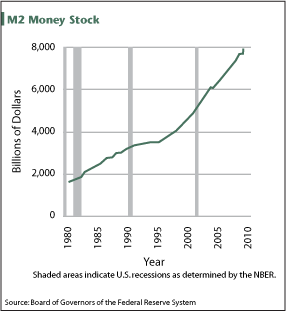 To estimate the inflation rate we might see, you can look at money supply growth over the past year. The St. Louis Fed's M2 money stock , the broadest money supply growth now reported by the U.S. Federal Reserve, has increased by 10% over the past year, while the St. Louis Fed's Money of Zero Maturity (MZM), the nearest we can get to the old M3, has increased by 7.4%.
Both those rates are far higher than the increase in nominal Gross Domestic Product (GDP). In fact, money supply has been increasing about 65% faster than GDP since 1995, which is when former U.S. Federal Reserve Chairman Alan Greenspan began to overly relax monetary policy. In the most recent two months, MZM has risen only modestly, at a 3.1% annual rate, but M2 has risen much more rapidly, at a 20.6% annual rate. (The difference between the two figures reflects quirks produced by the various bankruptcies and bailouts – for example Washington Mutual Inc. (OTC: WAMUQ ), nominally a “thrift,” has been taken over by Bank of America Corp, ( BAC ), a bank).
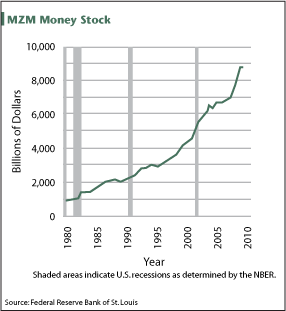 In any case, it seems likely that inflation in the 7%-10% range lies in our future once output stabilizes. The deflationists here have a huge problem: Their view of falling prices is in incompatible with swiftly rising money supply, so only a sharp fallback in money supply, which we are not seeing, would make deflation plausible. The Fed has been blamed so widely for not expanding money supply fast enough during the Great Depression, that it is showing every sign of making the opposite error now.
If inflation does return with renewed force, we need to invest accordingly. One way of doing so would to use Treasury Inflation Protected Securities (TIPS). TIPS yields have recently risen, as investors have focused on deflation. Indeed the 10-year TIPS currently yields 3.11%, only 0.08% lower than the 10-year conventional Treasury, so the market is saying inflation will average 0.08% over the next 10 years. That's nonsense, and such a mis-pricing makes TIPS an attractive investment, even though conventional Treasuries are vulnerable.
Another investment that benefits from inflation is gold, which has declined in price, albeit less than oil, and is currently selling around $770 per ounce. If inflation is expected to take off, gold prices will rise sharply, and a gold price of $1,500 per ounce is by no means out of the question. The most efficient way to buy gold is through the SPDR Gold Shares ETF ( GLD ).
By Martin Hutchinson
Contributing Editor
Money Morning/The Money Map Report
©2008 Monument Street Publishing. All Rights Reserved. Protected by copyright laws of the United States and international treaties. Any reproduction, copying, or redistribution (electronic or otherwise, including on the world wide web), of content from this website, in whole or in part, is strictly prohibited without the express written permission of Monument Street Publishing. 105 West Monument Street, Baltimore MD 21201, Email: customerservice@moneymorning.com
Disclaimer: Nothing published by Money Morning should be considered personalized investment advice. Although our employees may answer your general customer service questions, they are not licensed under securities laws to address your particular investment situation. No communication by our employees to you should be deemed as personalized investment advice. We expressly forbid our writers from having a financial interest in any security recommended to our readers. All of our employees and agents must wait 24 hours after on-line publication, or 72 hours after the mailing of printed-only publication prior to following an initial recommendation. Any investments recommended by Money Morning should be made only after consulting with your investment advisor and only after reviewing the prospectus or financial statements of the company.
Money Morning Archive |
© 2005-2022 http://www.MarketOracle.co.uk - The Market Oracle is a FREE Daily Financial Markets Analysis & Forecasting online publication.
