


Deflation Depression II as $10 Trillion Wealth Destroyed
Economics / Deflation Dec 23, 2008 - 09:21 AM GMTBy: John_Mauldin

 Have you done your Christmas shopping yet? Research shows that more of us are putting it off in expectations of better prices. In other words deflationary expectations! The prices I have seen while out shopping the past few weeks are simply amazing. I have to admit to have made a few purchases for some items that I was not planning to buy just yet because prices were off by 60% or more. A few days ago a friend came in sporting a new black cashmere sweater top with jeweled embroidery and quite fancy. She said she got it at Saks. But the real story is that when she walked into Saks looking for a present for her kids they handed her a coupon with a 30% off any one item from whatever price it was already marked down. That top? At one point it was almost $500. She bought it for $75.
I have to confess that made me worry about retail sales and future unemployment. I like low prices, but I like profitable companies and employment. I went and talked to a Saks salesperson a few weeks ago who had been there 25 years and asked if they had ever discounted like that before Christmas and he said never. It was Saturday in New York and the place looked busy. I asked why? And he said, "The store is empty during the week." And I bought a few sweaters at 60% off. Tiffani just got some presents from J Crew at over 60% off. Before Christmas! How many readers have seen the same sales? And yet shopping is down?
As a side note, this year most of the kids and in-laws are all going to get a Visa gift cards so they can take advantage of what I think are going to be even better sales after Christmas. It is not that Dad put off his shopping to the last minute (which I did) but the kids are really looking forward to finding their special items on sale. I wonder how many more are doing that?
This week we look at David Rosenberg's latest missive. While listing a number of negative data points, the thing to watch for is all the deflationary news. I have been pounding the table for YEARS that deflation is going to be the problem, and there would be massive stimulus from the Fed to fight it. We are now coming to that inflection point. Rosenberg is one of my favorite main stream economists and the North American Economist for Merrill Lynch. I would say enjoy this week's Outside the Box, but it is not enjoyable reading, but you should read it anyway.
Have a Merry Christmas. And enjoy the after Christmas sales! All the best,
John Mauldin, Editor
Outside the Box
A Daily Snapshot Of Market Moving Developments
by David A. Rosenberg
Overseas Overnight Market action Outside of Japan, which rallied 1.6% on speculation that the BoJ would buy corporate debt to ease credit risk, equity markets across Asia were weaker across the board. The Hang Seng sank 3.3%, or -505 points, to 14,622. India's Sensex was off 1.7% while China's Shanghai Composite dropped 1.5%. The Korean Kospi, however, fell just 0.1%. In Europe, equity markets are trading lower and off about 0.8% in the aggregate. US equity futures, however, are pointing to a higher open across the major indices. Bonds are trading mixed across the globe, with yields down 2-4 bps in Europe but up a bp in the US. JGBs were down a bp to 1.2%. On the commodity front, we see that gold is rallying, up $6.50 an ounce to $844.75.
On the data front
This is a truly global recession. We learned overnight that Japanese exports collapsed 26.7% year-over-year in November; that's the biggest drop on record. Shipments to the US plunged at an unprecedented 34% year-over-year rate. Meanwhile, imports into Japan sank 14.4% year-over-year in a sign of weakening domestic demand. A similar story out of Thailand, where exports dropped 18.6% in what was the biggest drop in at least 16 years. In China, interest rates were cut for the fifth time in three months. The key one-year lending rate was cut 27 bps to 5.31%. The reserve requirement was cut 50 bps to 15.5% for big banks and 13.5% for smaller ones. Chinese policymakers are trying to head off social unrest. Take a look at page A8 of today's WSJ, "China Faces Unrest as Economy Falters." For a read of how another BRIC nation has hit a wall in the face of a deepening global recession, turn to page A10 of today's WSJ, "India's Textile Industry Unravels."
Across the pond, signs of deflation abound. Germany's import price index dropped 3.4% MoM in November on top of a 3.6% drop in October. This was well below the consensus estimate, which was looking for a 2.5% decline. In France, producer prices plunged 1.9% in November on top of a 0.9% decline in October, well below the consensus, which was looking for a 0.9% drop for the month. Meanwhile, European industrial orders dropped 4.7% MoM in October on top of a downwardly revised 5.4% decline in September. This took the year-over-year rate to -15.1%, which is the the worst on record. We also see that German consumer confidence remained essentially unchanged at 2.1 in January from 2.2 in December.
The next bailout: commercial real estate
Now that the auto-makers have secured a $17 billion bailout, the next group heading to Washington for government assistance is property developers. Take a look at the front page of today's Wall Street Journal, "Developers Ask US For Bailout as Massive Debt Looms." Developers are warning policymakers that office complexes, malls, hotels and other commercial real estate are headed into default and bankruptcy. According to Foresight Analytics, some $350 billion of commercial mortgages will be due for refinancing over the next three years. And, with credit virtually unavailable, borrowers will have give up the property to lenders.
Whiffs of deflation in pharmacies
Take a look at page B3 of today's WSJ, "Pharmacies Fight Tough Battle on Generic Prices." In response to a discount prescription drug program from Wal-Mart, retail pharmacies like CVS, Caremark, Walgreen's and Rite Aid have started to aggressively promote their discount drug programs.
Breaking News Today's events
It is quiet today with no economic data released. Tomorrow, we'll get the final take on third quarter GDP, which is expected to remain at -0.5% QoQ annualized. The U of M index of consumer sentiment is due as well and expected to drop to 58.7 in December from 59.1 in November. New home sales are expected to drop again to 415,000 units annualized in November from 433,000 in October. Existing home sales are up too and expected to drop to 4.93 million units annualized in November from 4.98 million units in October. On Wednesday, we'll get the personal income and outlays report. Personal income expected to come in flat in November while spending is expected to drop 0.7% MoM in November on top of a 1% decline in October. The core PCE price index is expected to drop to 2% YoY in November from 2.1%. Durable goods round out the week and are expected to drop 3% MoM in November after a 6.9% collapse in October. Ex-transportation orders look to drop 2% too after a 5.4% plunge in October.
Making it up as he goes along
The latest news out of the Obama economics camp is that the upcoming fiscal plan will create 3 million jobs instead of the 2.5 million pledged just a few weeks ago. It begs the questions: How does the government "create" jobs anyway? What jobs? Where will they come from? Doesn't the government really help create and nurture the backdrop for the private sector to generate employment and economic growth? See "Obama Expands Recovery Plans As Outlook Dims" on the front page of the Sunday NYT. Indeed, 3 million jobs sounds good and makes for front page headlines, but it would be useful to see a line-item list of where these bodies are going to come from and whether they have the skills to build new ports, medical infrastructure, mass public transit infrastructure and expanded electricity grid and "green" technologies.
Let's do the math
We have 1.2 million unemployed construction workers. We have 123,000 unemployed architects and engineers. We have 83,000 unemployed machinery workers. We have 145,000 unemployed transportation-related workers. So that brings us to barely more than 1.5 million of a labor pool the government can tap into for all the new building activity. But the bulk of the joblessness is in financials (up to half a million), retail/wholesale (1.2 million), leisure/hospitality (1.3 million) and health/education (1.2 million). And if investment bankers, shopkeepers, bell captains and medical chart technicians have anything in common it is that they don't have much experience in shovel-ready activities.
Urban renewal in Obama's fiscal package
As an aside, we published a report two weeks ago highlighting the need for urban renewal as part of Obama's fiscal package - and it looks like somebody in Washington shares our view. See "Top Democrat Seeks to Boost Mass Transit's Share of Funding" on page A4 of the weekend WSJ. This is a secular theme. Another place we can see Obama's infrastructure program touch is the nation's levees, where repairs have lagged. See the front page of today's USA Today for more, "Most Levee Repairs Lagging."
Deflation risks are intact
Households have lost over $7 trillion in terms of net worth in the year ending 3Q, and it looks like this wealth destruction will top $10 trillion when the 4Q Fed flowof-funds data come out (that already exceeds the entire $4 trillion loss during the tech wreck). For a great synopsis, see "A Deflation Maelstrom In the Making" on page 11 of BusinessWeek. Friday's WSJ (page B1 - "Retailers Drop Prices to Avert a Flop") was filled with stories of how merchants are discounting more now than they were on Black Friday. Macy's has cut the prices of its diamond earrings from $800 a pair to $249 and the GAP just sliced another 60% off its already discounted clothing prices (as Bloomberg News reported over the weekend) and we are supposed to be consumed about deflation fear. Really? As a sign of how consumers are delaying their purchases in anticipation of even lower prices, only 47% of shoppers have completed their holiday activity versus 53% a year ago. We regard this as evidence that deflation expectations are creeping in.
And one of the conditions for deflation is, of course, wage flexibility, and everywhere we look, we see an increasing number of companies cutting back on their wage bills. FedEx is just one example - slashing wages for 35,000 employees by 5% (that is 16% of the company's workforce), including a 20% base pay cut for its Chairman and CEO (plus no company contributions to 401k plans in 2009). We also see that Nortel, Eastman Chemical, Newell Rubbermaid, Agilent Technologies, Atlas World Group, and AK Steel Holding have all cut wages and salaries in the past few weeks. According to Watson Wyatt Worldwide, another 6% of companies also plan to cut wages and benefits and 23% intend to reduce the size of their staff in 2009. Also have a look at the front page of "In Need of Cash, More Companies Cut 401(k) Match" - again, the labor market is definitely deflating. Not only that, but these cuts to 401(k) contributions are going to accelerate the process towards rising personal savings rates in coming quarters and years - again, a highly deflationary development and we are not sure that there is an appropriate response to this given that the savings rate is already at rock bottom levels of around 2%.
Moreover, the national labor market has frozen to such an extent that labor mobility has contracted significantly - see "Data Show Drop in Americans On the Move" on page 27 of the FT. Also have a look at front page of today's New York Times, "More Companies Cut Labor Costs, Without Layoffs." Companies are implementing four-day workweeks, unpaid vacations, wage freezes and pension cuts but keeping their headcount. Finally, take a look at page 13 of today's Financial Times, "Christmas Shutdown in Silicon Valley." What is usually limited to traditional manufacturing industries like auto has now hit tech. Companies across Silicon Valley are shutting down until after the holidays to cut back on spending. In spite of the forced time-off, some workers will be required to use up part of their holiday entitlement or if they don't have vacation days, take unpaid leave.
Historians may title this era GDII
As we said, historians may look back on this era and title it GDII: After all, look at how people are behaving - one of the newest fashions is renting movies about the Great Depression, or that have a similar theme like the "Grapes of Wrath" and "It's a Wonderful Life". See "Reality Can be Escaping, Too" on the front page of the Sunday NYT's Week in Review section.
Consensus still loves equities and despises bonds
See Barron's for more on the 'groupthink' theme - every single strategist surveyed (outside of us) sees the 10-year note yield backing up next year from current levels (page M12). The consensus is 3% for the end of 2009. As for equities, the Roundtable (see page 23) is at 1,045 for the S&P 500 (which would be +15 from here). Nobody is lower than 975 (Rich B's prediction) so +10% is at the low end of the entire spectrum. Health care was cited as a 'favorite sector' by 10 of the 12 pundits, and at least one of utilities/staples/telecom showed up on the top list of two-thirds of the respondents. So the view seems to be that we are going to have a bounce next year, led by ... the defensives. Interesting.
We don't understand why so many are bearish on rates
What we truly don't understand is why it is that so many folks are bearish on interest rates when in fact we need a sustained period of very low yields to help blaze the trail for the next sustainable economic expansion: After all, isn't it good news that, because of Mr. Bond's strength and resolve, we now have the benchmark 30-year fixed-rate mortgage at the lowest level in at least 37 years (5.27%)? Mortgage rates are now down 7 weeks in a row (it does the beg the question, however, as to why it is that mortgage applications for new purchases slid at a 20% annual rate in November and are off in 9 of the past 10 months). And despite the best affordability ratios in 35 years, what did we hear from Lennar last week - that its order book collapsed 46% in the past year and backlogs are down 67%. Maybe the classic affordability ratios that use conventional mortgages don't tell the complete story - because nonconventional mortgage rates have lagged with jumbo loans still costing 6.9%.
Homebuilders pressuring Washington for a bailout
As the bailouts pile up, we thought that the best read of the weekend was from the Weekend WSJ - see page W1 ("Is the Medicine Worse than the Illness?"). And now we see that the homebuilders are pressuring Washington to provide first-time homebuyers with a $22,000 tax credit. It's as if there is now a pervasive belief that there is a bottomless pit of cash ready to be put to use to correct all the excesses of the past decade from financials, to autos to builders. It's amazing that we could have let so many tech companies go belly up in the last cycle but have gone this route of accelerating rescue packages this time around. At least in the last cycle, we were running balanced budgets as opposed to trillion-dollar deficits. What does concern us is the risk to civil liberties when bankruptcy judges can alter contracts, the government can force banks to accept public capital injections (Jamie Dimon said on CNBC he didn't want or need Paulson's help), the government by fiat can bring mortgage rates down as opposed to market forces, the government tells lenders how to price their credit card business (since when did a piece of plastic become a right instead of a luxury?).
The major risks for 2009
We continue to believe that trade protectionism, competitive devaluations and military conflicts are the major risks for investors for 2009 - this is, after all, the most broadly based global recession (according to the IMF, not just us) in the post-WWII era: Ecuador defaulted on its foreign debt. Since the G20 meeting in Washington in October, five of those countries - Russia, India, Indonesia, Brazil and Argentina - have announced their intentions to raise import tariffs or otherwise restrict trade. Russia has announced plans to raise tariffs on autos; India has already lifted duties on iron, steel and soy; Brazil and Argentina are putting together a case within Mercosur for boosting external tariffs. Vietnam just raised taxes on steel imports to 12% from 8%. The EU said it may reimpose duties of 79% on a paper-binder component in retaliation against China. French President Sarkozy has established a $7.5 bln fund to invest in domestic companies so as to avoid foreign takeovers. China has reinstated export rebates and now we see that US steel, textile and paper markets intend to file complaints against Chinese imports, and did anyone notice that this auto-bailout excludes foreign companies?
It's all about self-preservation. We think that for anyone who missed it, the article on the front page of Friday's NYT is a worthwhile read ("After 30 Years, Economic Perils on China's Path"). Russia also cannot be regarded as a stable data point either as it just posted its first monthly budget deficit in November and the sovereign debt was just downgraded by S&P for the first time in a decade (Friday's WSJ reports says "public panic is one of the Kremlin's greatest fears"; the NYT reports that "as Beijing worries about strikes and mass layoffs even in some of the its most prosperous areas, official tolerance of political dissent has seemingly narrowed".) Gold will be an important hedge against policy missteps
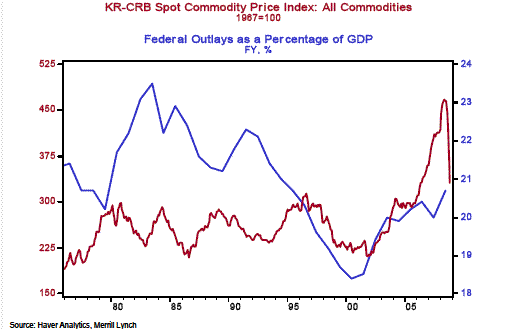
Gold, in our opinion, is going to be important hedge against such policy missteps in 2009; and not only gold, but security of supply and government procurement policies may end up putting a floor under the beleaguered commodity complex earlier than a lot of folks think. As the chart below attests, there is a pretty good link between government spending as a share of GDP and the CRB index, because governments don't buy clothing or jewelry but they do buy "material".
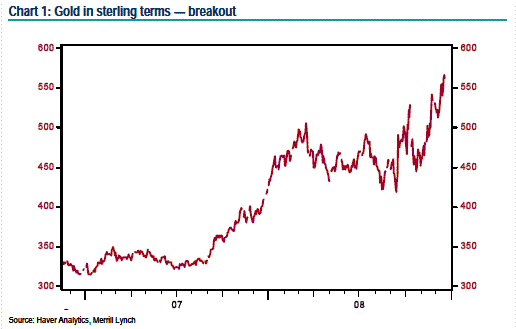
And as for gold, the chart looks good against a vast majority of currencies and has broken out against Sterling. See chart below.
As we said before, the new growth engine for the economy is government spending, which is already on the rise and set to take out the prior high of over 23%. After all, when you are in trouble, you go to family members for help first. Uncle Sam.....?
By John Mauldin
John Mauldin, Best-Selling author and recognized financial expert, is also editor of the free Thoughts From the Frontline that goes to over 1 million readers each week. For more information on John or his FREE weekly economic letter go to: http://www.frontlinethoughts.com/learnmore
To subscribe to John Mauldin's E-Letter please click here:http://www.frontlinethoughts.com/subscribe.asp
Copyright 2008 John Mauldin. All Rights Reserved
John Mauldin is president of Millennium Wave Advisors, LLC, a registered investment advisor. All material presented herein is believed to be reliable but we cannot attest to its accuracy. Investment recommendations may change and readers are urged to check with their investment counselors before making any investment decisions. Opinions expressed in these reports may change without prior notice. John Mauldin and/or the staff at Millennium Wave Advisors, LLC may or may not have investments in any funds cited above. Mauldin can be reached at 800-829-7273.
Disclaimer PAST RESULTS ARE NOT INDICATIVE OF FUTURE RESULTS. THERE IS RISK OF LOSS AS WELL AS THE OPPORTUNITY FOR GAIN WHEN INVESTING IN MANAGED FUNDS. WHEN CONSIDERING ALTERNATIVE INVESTMENTS, INCLUDING HEDGE FUNDS, YOU SHOULD CONSIDER VARIOUS RISKS INCLUDING THE FACT THAT SOME PRODUCTS: OFTEN ENGAGE IN LEVERAGING AND OTHER SPECULATIVE INVESTMENT PRACTICES THAT MAY INCREASE THE RISK OF INVESTMENT LOSS, CAN BE ILLIQUID, ARE NOT REQUIRED TO PROVIDE PERIODIC PRICING OR VALUATION INFORMATION TO INVESTORS, MAY INVOLVE COMPLEX TAX STRUCTURES AND DELAYS IN DISTRIBUTING IMPORTANT TAX INFORMATION, ARE NOT SUBJECT TO THE SAME REGULATORY REQUIREMENTS AS MUTUAL FUNDS, OFTEN CHARGE HIGH FEES, AND IN MANY CASES THE UNDERLYING INVESTMENTS ARE NOT TRANSPARENT AND ARE KNOWN ONLY TO THE INVESTMENT MANAGER.
John Mauldin Archive |
© 2005-2022 http://www.MarketOracle.co.uk - The Market Oracle is a FREE Daily Financial Markets Analysis & Forecasting online publication.
