


Stock Market Crash Red Alert: Meltdown Imminent!
Stock-Markets / Financial Crash Feb 23, 2009 - 06:58 AM GMT

 Martin Weiss writes: The nation's largest banks are so close to collapse and the world economy is coming unglued so rapidly, a major Wall Street meltdown is now imminent.
Specifically, it's now increasingly likely that virtually all of our forecasts of recent months could come to pass in a very short period of time, including …
- Stock market crash: A swift plunge in stocks to about 5000 on the Dow, 500 on the S&P 500 and 900 on the Nasdaq … or lower. (For our reasons, see “ Stocks to fall AT LEAST another 40%! “)
- Corporate bankruptcies: A chain reaction of Chapter 11 filings or federal takeovers, including not only General Motors and Chrysler, but also Ann Taylor, Best Buy, Jet Blue, Macy's, Saks Fifth Avenue, Sears, Toys “R” Us, U.S. Airways and even giants like Ford or General Electric.
- Megabank failures: Bankruptcies or nationalization not only of Citigroup and Bank of America, but also JPMorgan Chase and HSBC. (See my January issue, “ Megabanks Could Fail Despite Federal Aid .”)
- Nationwide epidemic of small and medium-sized bank failures: Outright FDIC takeovers, with little prospect of nationalization. (I'll give you a link to our free guide with a more extensive list in a moment.)
- Insurance failures: State takeovers of companies like Ambac Assurance, Bankers Life and Casualty, Conseco, FGIC, Medical Liability Mutual, Mortgage Guaranty Insurance, Nuclear Electric Insurance, PMI Mortgage, Standard Life of Indiana and many others. (Our free guide also contains a more extensive list of insurers.)
- Cities and states: An epidemic of defaults by thousands of cities, states and other issuers of tax-exempt municipal bonds.
- Stock market shutdowns: Trading halts on major, big-cap stocks … plus on-again, off-again exchange shutdowns, making it increasingly difficult for investors to liquidate their holdings at any price.
- Credit market deep freeze: A virtual shutdown in all debt markets except U.S. Treasuries. An avalanche of selling — and virtually no buyers — for corporate bonds, commercial paper, asset-backed securities, municipal bonds and all forms of bank loans.
- Government bond collapse: A steep decline in the price of medium-and long-term government securities, as the U.S. Treasury bids aggressively for scarce funds to finance a ballooning budget deficit.
Shocking? Perhaps. Avoidable? No.
Nor am I alone in anticipating this rapid unraveling of the economy and financial markets. This past Friday, at a Columbia University dinner reported by Reuters …
- George Soros said the financial system has effectively disintegrated, with the turbulence more severe than during the Great Depression and with the decline comparable to the fall of the Soviet Union, while …
- Paul Volcker said he could not remember any time, even in the Great Depression, when things went down so fast and quite so uniformly around the world.
Both recognize that we're in a new era of chaos. What's the landmark event that separates us from the past era of relative stability?
According to Soros, it's precisely the same event we forecast in 2007 and the same event we have repeatedly highlighted here in Money and Markets : The bankruptcy of Lehman Brothers. (See “ Dangerously Close to a Money Panic,” December 3, 2007 and “ Closer to a Financial Meltdown,” March 17, 2008 .)
That was the final straw that punctured the already imploding bubble. And it was the first major domino that set off the chain reaction of events now careening out of control: The collapse of consumer credit markets … surging unemployment … and now, a new set of even larger financial failures looming.
The Raging Debate Right Now Is How To Prevent A Banking Collapse: To Nationalize Or Not To Nationalize. But It's A Moot Point.
Based on the analysis we presented here in August 2008 (” The Next Big Failures “) …
Based on the frank recognition of the catastrophe by Soros and Volcker on Friday …
And based on the trillions in government bailout funds already spent, lent or guaranteed (” The Obama Stimulus: Truth and Consequences “) …
The fact is that the banking collapse has already occurred!
So the relevant question is not “How can we prevent it?” Instead, it's “How can you protect yourself from the inevitable fallout?”
Washington and Wall Street, however, are either too cowered or too confused to give you the answers you need.
They won't tell you which banks are the most likely to fail or which ones are the most likely to survive.
They won't offer you alternative safe havens for your money.
They won't even guide you to publicly available information provided by the U.S. Treasury Department itself.
 |
In August of last year, Mike Larson and I took steps to fill that gap. As a public service, we invited readers to attend our 1-hour video, the “X List,” later making the recording widely available on the Web and attracting over 100,000 viewers.
In the video, we shocked the financial community by forecasting the failure of Citrigroup, Wachovia, Washington Mutual and others; and unfortunately, today, less than seven months later, most of those forecasts have come true.
More importantly, we gave you specific instructions in the video on exactly where to find true financial safety, how and why. If you didn't attend, or you didn't act on our recommendations, you're fortunate in that you still have the opportunity to do so now.
But With The Latest Dramatic Events, You're Clearly Running Out Of Time!
So Here's What I Suggest You Do Immediately …
First, whether you've seen it before or not, invest a short hour of your time to watch our “X List” video . Given the urgency of this crisis, we have put it back online; and despite the dramatic changes that have taken place since, the advice remains 100% valid today.
Second, refer to the edited transcript of the first half of the program, which I'm providing below with my latest comments.
Third, download our free survival booklet , which we've just updated — my gift to you, conveying both my gratitude for your sincere interest and my concern for your financial safety.
In it, you'll find step-by-step instructions on how to buy Treasury bills, what to do with your 401k, how to get rid of risky stocks, how to find a strong bank, how risky is your insurance company, plus more.
Fourth, in the guide, be sure to check our handy lists covering the weakest and strongest banks and thrifts, the weakest and strongest insurers, plus select U.S. brokers.
Fifth, join us online THIS WEEK for our next landmark video event. Here are the facts:
Time: Thursday, February 26, 12 noon Eastern Time
Subject: 11 Laws for Bear Market Success
For more information: Click here
For free registration : Click here (Unless you sign up ahead of time, it will be impossible to attend.)
Now, here's the annotated transcript of the first half of the “X List” …
The “X List”: The Next Big Failures
Original Edited Transcript of
First Half of August 2008 Program
[ With My Current Comments in Red Type ]
Martin Weiss: Big banks and brokers have announced massive losses, with much more to come.
But government regulators generally make it difficult for average citizens to figure out which banks or brokers are the weakest and which are the strongest …
- The FDIC maintains a watch list of troubled banks that are likely to be among the next to fail, but it's strictly confidential.
- The SEC keeps tabs on the nation's privately held brokerage firms, but makes it difficult for you to get the critical data you need to evaluate their finances.
Today, we're going to tell you what Washington won't, unveil our own “X List” of institutions and name the banks we feel are the most or least vulnerable to financial difficulties. Then, we're going to answer your questions, live.
It's the first time these lists are being released. And it's the first time we are taking live questions from viewers online. But the seriousness of the situation warrants these special steps. Every dollar you earn, save or invest could now be at stake.
Just look at what's happening all around you. The recession is still in its early phase. But already, we have one of largest bank failures in history, IndyMac Bank, and the largest brokerage firm failure in history, Bear Stearns. What will happen as the recession deepens? What will happen now that the mortgage crisis is spreading beyond subprime mortgages to the far larger market for prime mortgages?
My friends, this crisis is not over, not by a long shot .
All this raises urgent questions for you — as a saver, as an investor, and if you run a business: How safe is your bank? How safe is your broker? What would happen to your money and your investments if your bank or broker failed?
No one has all the answers, but we do have the data to provide most of the important answers.
And joining me today is Mike Larson, one of the few analysts who warned us ahead of time about the disaster that was — and still is — at the heart of this crisis: The real estate and mortgage crisis. It was thanks to Mike's research that our Safe Money Report laid out, many months ahead of time, the precise events that are unfolding today, step by step, play by play.
Mike, let's get straight to the heart of the matter. You, me and the Weiss Research team have been hard at work assembling our “X List,” starting with the U.S. banks that, based on our research, are the most likely to run into financial difficulties.
Mike Larson: Correct. Here it is …
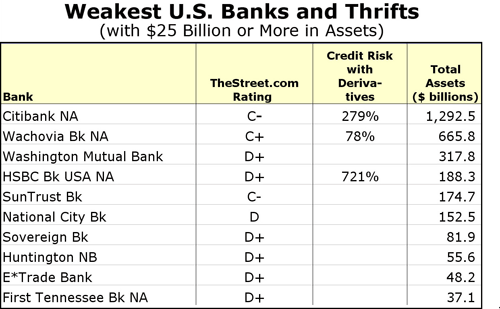
[My current comment: Citibank has been downgraded to D+ by TheStreet.com. Plus, I have added Bank of America and JPMorgan Chase to the list. Meanwhile, most of the above institutions have now failed, been bought out or bailed out. All have suffered massive declines in their share price or the shares of their parent companies. And all should be avoided by both investors and savers. ]
These banks are listed with the largest at the top.
Column B is TheStreet.com's Financial Strength Rating, which covers capital, asset quality, liquidity, earnings and more. This is a key input in helping us form our opinion, but not the only input.
Beyond their rating, we are also looking at the credit risk the largest banks are taking with their derivatives, according to the Office of the Comptroller of the Currency — big bets on top of big bets. That's in Column C . Plus, I've drilled down into their mortgage exposure (not shown in the table).
But before we jump into this, I have two important caveats:
First , don't assume that everything you hear or read is true — whether good or bad. Specifically, do not lower your guard just because officials tell you “everything's fine and dandy.” And, by the same token, do not rush to act based on rumor.
[ This is especially true today in early 2009. The U.S. Treasury Secretary would have you believe that the government can prevent a collapse with the newest, still-to-be-revealed bank bailout plan. Others say that the crisis will be resolved by nationalizing the largest banks. But at best, all that Washington can do is postpone the inevitable, which, in the final analysis, will deliver massive losses to millions of citizens who take no protective action. ]
Second , no one can predict with certainty the failure or survival of a particular company. Everything we say here today is about the relative probability of a failure or survival, based on diligent research.
Martin: Most people think that “big” means “safe.” So the first shock to most people reviewing this list is going to be the simple fact that some of the nation's very largest banks and thrifts could be vulnerable to financial difficulties: Citibank, Wachovia, Washington Mutual, HSBC.
Mike: Citigroup is on the list because of three factors: Its main banking unit has a C- financial strength rating. It has large exposure to the credit risk of derivatives. Plus, it has a big exposure to mortgages — $198 billion.
Wachovia is in a similar situation: It made the fatal mistake of buying the nation's largest and most aggressive mortgage lender — Great Western Financial — at the worst possible time. And it's also got some serious exposure to derivatives.
Washington Mutual, the nation's largest thrift, has a D+ rating and is loaded with mortgage exposure.
HSBC has a D+ rating. Plus, it has an exceptionally large 721% of its capital exposed to the credit risk of derivatives. In other words, for every single dollar in capital, HSBC is taking a credit risk of $7.21 with trading partners in derivatives, according to the U.S. Comptroller of the Currency.
This bank also made a big blunder, similar to Wachovia's, with its purchase of Household Finance, which is loaded with household and consumer loans that are going bad.
Martin: Mike, we're getting questions pouring in from all sides — via instant messenger on my computer and from our Customer Care representatives who are feeding us live questions from customers. Here's a question which summarizes what many readers think about the idea of big banks failing:
Q. Everyone I speak to says that big banks like a Citigroup could never fail. The government would never, NEVER let it happen. What is your response to that?
Martin: Our mission here is not to speculate about what the government may or may not do. Our mission is to present the facts and evaluate each bank on its own merits.
Mike: We had a similar question that came in earlier from a Safe Money subscriber who has money in Wachovia. He asks:
Q. As long as the government is going to keep my bank alive, why should I care? What difference is it going to make to me?
Martin: When a bank goes under, the government steps in, finds a merger partner or takes it over. This can be a quick process. But sometimes it may not be. We see three possible situations:
Situation #1. You're an insured depositor. You've got savings or checking accounts with the bank and they are under the FDIC insurance limit. Run through that situation first.
Mike: You will get your money back. If the FDIC runs out of money, it has the authority to borrow up to $30 billion more from the U.S. Treasury, plus another $40 billion beyond that from the Federal Financing Bank. And even if it maxes out that credit line, Congress would probably approve more.
Martin: But before things get that far, we would have to revisit this question and make a rational decision at that time, whether or not you should rely on FDIC insurance.
Mike: Right. For now, suffice it to say that at this time , the reliability of FDIC insurance is not an issue.
[ Today, less than seven months later, FDIC insurance is still functional. However, as the federal deficit balloons toward $2 trillion, as larger financial institutions collapse, and as government resources are stretched beyond any reasonable limit, the viability of depositor insurance is bound to come into serious question. ]
Martin: Situation #2. You're a shareholder. You own stock in a failing bank. In this case, it doesn't matter much what the government does. If the FDIC takes over the bank, like it did with IndyMac Bank recently, shareholders are wiped out. If the Federal Reserve steps in to keep the bank open, shareholders are probably still wiped out.
Mike: Either way, if you own shares in a weak bank, our recommendation is to get the heck out. One word of caution: When a bank's stock is falling, it's not a good sign. But remember — just because a bank is losing money and its stock is going down doesn't mean the bank is failing and your deposits are in jeopardy. What you do with your stocks and what you do with your deposits are two separate decisions.
[ This is still true. But crashing share prices have emerged as an important factor in a financial institution's demise. Last week's plunge in the shares of Citigroup, Bank of America and General Electric, for example, are telltale warning signs that must not be ignored. ]
Situation #3. You're an uninsured depositor. You have deposits with a bank that are over and beyond the FDIC insurance limits, or you've bought bank bonds or bank debentures. In most bank failures, you will suffer losses. And even with the so-called “too big to fail” banks, you could suffer losses as well.
Martin: Correct. We don't really know how government rescues will pan out. They may decide to cover certain groups of creditors but not others.
Mike: Exactly. So our recommendation is very simple: Do not count on the government to cover uninsured deposits or bonds.
Martin: Let me sum up, then: Avoid bank stocks. Keep your deposits under the FDIC insurance limit. And beyond the FDIC insurance, don't count on the government to protect you no matter how big the bank may be .
We'll take more questions in a moment. Let's move on now to the other banks on this list.
Mike: SunTrust Bank — a super-regional, concentrated in the Southeast, also with a marginal rating. It has large exposure to construction loans and commercial mortgages in a region that's likely to get hit very hard by the real estate crisis.
Plus, here are two Ohio banks that we feel are also in danger: National City Bank and Huntington Bank. Weak ratings. Large mortgage exposure.
And here are three more: First Tennessee Bank, Sovereign Bank in Pennsylvania, and E*Trade Bank in Virginia. All bad ratings. All with huge mortgage exposure.
Martin: Once we get down into this middle tier — large regional banks that are not necessarily critical for the national financial system — then the question arises: Would the Fed also try to keep these banks afloat? We don't have a firm answer to that question, do we?
Mike: No, we don't. The fact is, no one knows. But it seems less likely that the government would pull out all the stops to save these middle-tier banks.
Martin: Here's another question we got earlier via email. Leon asks:
Q. I have two 6-month CDs with Horizon Bank in Austin, Texas, rated B-, with five months to go, and I'm over the FDIC limit. Should I withdraw early and pay the penalties? Or should I stick it out?
Martin: Leon, before I answer your question, for everyone's benefit, let me review for you the ratings scale:
A = Excellent
B = Good
C = Fair
D = Weak
E = Very weak
+ = the upper third of each grade range
- = the lower third of each grade range
And based on these ratings, here are the guidelines we think you should follow. If your bank is rated …
- B- or higher , you should be OK where you are, in most circumstances.
- D+ or lower , that's a red flag. Seriously consider moving your money elsewhere.
- C+, C or C- , consider it a yellow flag. When we have the data, especially with large banks, we check for other dangers as we did with Citigroup, Wachovia and HSBC. If you can't do that, monitor the rating periodically to make sure it has not been downgraded to the D range.
And if you're shopping for a new bank or thrift, favor those with a rating of B+ or better .
Now, let me answer your question more directly: Your bank was a B-, right? OK. So that means there should be no rush to abandon your bank. But you're over the FDIC limit. So to be on the safe side, I'd reduce your bank balance to below the FDIC limit. That gives you the double protection I think you need.
Mike: We've had a lot of questions that go like this:
Q. I have a CD for only $50,000, which is fully insured by the FDIC. So why should I care about the bank's safety rating? As long as my money is insured, what difference does it make? Even if the bank has a lousy rating, so what?
 |
Martin: Let me describe a real situation and then you can form your own opinion …
Several months ago, a bank in California submitted its financial report to the banking regulators. Based on that report, it merited a safety rating of E- — the lowest possible rating and a clear warning of failure. So customers of that bank could have also asked the same question you have: “Why should I care?”
I'll tell why: Because the name of that bank was IndyMac, and it failed. You should care because you don't want the inconvenience of waiting on line for your money, even for a single day. You should care because, no matter how orderly the process may be, you don't want to have to hassle with bank officials telling you to “please be patient.”
Plus, here's another important reason you should care: The FDIC's responsibility is strictly to get you your money back. The FDIC has no obligation to honor the special deals or the special features on your checking account. It has no obligation to honor credit lines or anything else you may have liked about your bank.
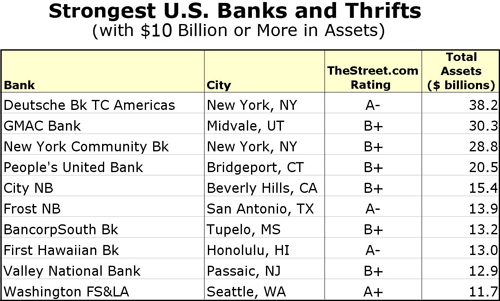
Mike: These pictures are depressing. Can we talk about the positive side now? The fact is that there are still many strong banks all over the country, and they're not hard to find. Consider this list, for example …
Martin: Actually, the fact that they're not so big may be helping them stay out of trouble — away from derivatives, away from the “too big to fail” syndrome that might make them complacent about risk.
Mike: They have solid capital. They take fewer risks. And they're better positioned to ride out this crisis. These are all the large banks and thrifts in the country (with $10 billion or more in assets) that have a rating of B+ or better.
Plus, there are a lot of smaller ones that are not on this particular list. The list we're sending out right after this event has many more.
Martin: What about Dime Savings in Brooklyn, New York? Back in the 1970s and 1980s, when hundreds of banks and S&Ls were failing everywhere, I remember Dime Savings stood out as one of the safest. Is that still true today?
Mike: Yes, it is. It has an A- rating, which is excellent. But it has about $4 billion in assets, and the cut-off for this list was $10 billion.
The strongest among these top 10 is the smallest: Washington Federal Savings & Loan in Seattle, Washington. Since they're listed from largest to smallest, it's at the bottom of the list. But it's got the highest rating — an A+. Like in school grades, there is no higher rating than that.
Martin: So even if it gets stuck with some bad mortgages, even if it loses money, it has the capital — its own deep pockets — to cover those losses.
Mike: Correct. Here's a larger bank with an excellent rating: Deutsch Bank Trust Company Americas, based in New York City. Strong capital. Low risk profile. And here's another one in San Antonio, Texas (Frost National Bank). Also an A-, with $13 billion in assets. Or if you live in Hawaii, you're in luck because you have First Hawaiian — also a strong bank with an A- rating, also $13 billion in assets.
Martin: Plus, I notice there are quite a few B+ banks. Like I said earlier, if you're starting a new banking relationship or you're thinking of moving from an unsafe situation, seek to do business with banks that have a rating of B+ or better. And as you can see just from this list of banks with $10 billion or more in assets, there are quite a few to choose from.
Mike: Martin, there's an instant message on your computer that we have a question coming from the Weiss Research Customer Care Department.
Eva Kaplan: Hi, my name is Eva and I work for Weiss Research in the Customer Care Department. We have a lot of questions coming in about banks and about brokers. Here's one which is generic:
Q. What's the best place to put $10 million and keep it safe?
Martin: With that amount of money, we recommend mostly short-term U.S. Treasury securities. You can open an account online with the Treasury using your Social Security number — no bank or broker between you and your money. Another approach is to have your bank or broker buy them for you at the regular Treasury auction. They'll charge you a fixed fee. But if you're investing $10 million, it shouldn't make much of a difference.
Plus, for maximum convenience and liquidity, you can invest in a money market mutual fund that buys exclusively Treasuries or equivalents with your money. Here's the key: No matter where or how you buy them, the U.S. Treasury securities themselves are guaranteed by the U.S. government with no limit. It doesn't matter if you invest $10,000 or $10 million, you enjoy the same unlimited guarantee from the U.S. Treasury Department.
The downside risk we see is the decline in the U.S. dollar. But to offset that downside risk, taking all your money out of the dollar and abandoning the safety of U.S. Treasury securities is not the solution. Instead, we feel the solution to the dollar weakness is to allocate some of your money to investments that go up when the dollar goes down.
Eva: Martin, can I follow up on that question? Some of our customers are saying:
Q. In your writings, you and your team talk a lot about “the collapse of the dollar.” If the dollar is truly collapsing and Treasury securities are denominated in dollars, aren't you, in effect, recommending an investment that's collapsing?
Martin: I think we sometimes overuse the word “collapse,” and I'm guilty of that as well. For example, if the dollar is falling sharply in the foreign exchange market, we say “the U.S. dollar is collapsing,” just like we'd say “the Dow Jones Industrials is collapsing.”
But that doesn't mean the dollar or the Dow are going to vanish and suddenly be worthless. The U.S. dollar will continue to be a viable currency for many years to come. Besides, we're not asking you to trust the U.S. government for the next 30 years with a Treasury bond — only for the next three months or less, with Treasury bills and other short-term Treasuries.
For the balance of the transcript, click here .
Good luck and God bless!
Martin
This investment news is brought to you by Money and Markets . Money and Markets is a free daily investment newsletter from Martin D. Weiss and Weiss Research analysts offering the latest investing news and financial insights for the stock market, including tips and advice on investing in gold, energy and oil. Dr. Weiss is a leader in the fields of investing, interest rates, financial safety and economic forecasting. To view archives or subscribe, visit http://www.moneyandmarkets.com .
Money and Markets Archive |
© 2005-2022 http://www.MarketOracle.co.uk - The Market Oracle is a FREE Daily Financial Markets Analysis & Forecasting online publication.
