
Best of the Week
Robert Prechter's - The DEFLATION Survival Guide - FREE 60 page Ebook
Most Popular of the Week
1.United States Economy At Zero Hour To Service Debt Mountain- John_Mauldin
2.Stock Market Rally is Worth Shorting Here - Alistair_Gilbert
3.Deflationists Are WRONG, Prepare for the INFLATION Mega-Trend - Nadeem_Walayat
4.Stocks Bull Market Swing Juncture?- Nadeem_Walayat
5.Zinc Dimes, Counterfeit Tungsten Gold and Lost Interest- Jim_Willie_CB
6.If This is Economic Recovery, Where Are the Increased Tax Revenues?- John_Mauldin
7.Global Warfare, U.S. Military Operations in All Major Regions of the World-Rick_Rozoff
8.The New Command Economy Impact on Stocks and Crude Oil- Christopher_Wood
Weeks Analysis
Year-End Investment Profit Parachute Strategy - 21st Nov 09
Financial and Economic Situation Could Get Ugly Fast - 21st Nov 09
The Pending Financial, Economic, Political and Social Collapse Of The United States - 21st Nov 09
The Great Economic Stimulus Debate of 2009- 21st Nov 09
Gold Trend Channel Break OutOut What Does This Mean For You?- 20th Nov 09
A Wiser Use of Borrowed Money- 20th Nov 09
Gold GLD ETF Impact- 20th Nov 09
Gold Investing Expert: Bob Moriarty Goes on Record- 20th Nov 09
Gold Contrarians Will Get Killed- 20th Nov 09
How to Profit from the Falling U.S. Dollar With ETFs- 20th Nov 09
The Pro-Free-Market Program for Economic Recovery- 20th Nov 09
Gold’s Evolving Supply and Demand - 20th Nov 09
Good Inflation- 20th Nov 09
Is the U.S. Dollar Euro On the Turn?- 20th Nov 09
Obama in China Opening the Doors for Wall Street, Nothing More- 20th Nov 09
Keynes the Man as Rotten as His Economic Theory- 20th Nov 09
The U.S. Recession Jobless Interest Rate Conundrum- 20th Nov 09
U.S. Economy is a Geriatric on Viagra- 20th Nov 09
The Great U.S. China Romance- 20th Nov 09
Gold Steam Roller Running Towards $1300- 20th Nov 09
Betting on Beryllium for the New Nuclear Fuel Technology- 20th Nov 09
Dow and NASDAQ Stock Indices Ready for Major Reversal?- 20th Nov 09
Is the S&P Stock Market Index About to Plunge or Headed Higher? - 20th Nov 09
Central Bankers Blowing Bubbles in Global Stock Markets- 19th Nov 09
What If the Foreigners Stop Buying Our Debt?- 19th Nov 09
New Technology Turns Coal Into Clean, High-Powered Gas- 19th Nov 09
Cap-And-Trade "Three-Card Monte" Dead For 2009- 19th Nov 09
UK Budget Deficit Could Hit £200 Billion, 18% of GDP- 19th Nov 09
Energy and Precious Metals ETF Trading Report- 19th Nov 09
The New World Of Investing SPDR KBW Regional Banking KRE ETF- 19th Nov 09
U.S. Debt, Where’s the Money Going to Come From?- 19th Nov 09
Show Me the Money - 19th Nov 09
The Great Geopolitical Battle Over Energy Transit Routes- 19th Nov 09
Why Exaggerate Global Warming? Cop15 Failure And Peak Oil Success - 19th Nov 09
BubbleOmics: Dubai Property Market Down And Out…Or Bounce? - 19th Nov 09
What Has Government Done to the U.S. Dollar?- 18th Nov 09
Will Consumer Spending Really be Different This Time?- 18th Nov 09
More than 130 banks will have failed by the end of 2009. Is Your Bank Safe?- 18th Nov 09
Zinc Dimes, Counterfeit Tungsten Gold and Lost Interest- 18th Nov 09
Roubini Says Gold $2,000 is Utter Nonsense- 18th Nov 09
Central Banks Increasing Gold Reserves- 18th Nov 09
Fiat Money and Debt Monetization Pushing Gold Higher- 18th Nov 09
U.S. Real Estate Market Getting Worse- 18th Nov 09
Our Steroidally Challenged Economy- 18th Nov 09
Deflationists Are WRONG, Prepare for the INFLATION Mega-Trend - 18th Nov 09
U.S. Dollar on Death Row Means Boom Time for Gold Stocks- 17th Nov 09
USA Today, China Pushes Solar, Wind Development- 17th Nov 09
Revisiting Three Stages of Stocks Bear Market Rally, Right on Schedule- 17th Nov 09
Silver Cycles, Silver-to-Gold Ratio, and the USD Index Analysis- 17th Nov 09
Global Warfare, U.S. Military Operations in All Major Regions of the World- 17th Nov 09
What Strong U.S. Dollar Policy? - 17th Nov 09
Just Sell Something, Please!- 17th Nov 09
Gold Hard Money Wins Out!- 17th Nov 09
Gold On the Fast Track Toward $1,200?- 17th Nov 09
Gold $5000 By End 2010 on Monetary Debauchment - 17th Nov 09
U.S. Economy Will Dodge Double Dip Recession- 17th Nov 09
Beware of Credit and Debit Card Foreign Usage Charges this Winter- 17th Nov 09
Silver About to Explode Higher?- 17th Nov 09
Bernanke and Pinball Could Learn A Lot From Hong Kong’s Property Bubble - 17th Nov 09
U.S. Dollar Trend to Determine Next Trend for Gold, Stocks and Other Markets - 17th Nov 09
Goldman Sachs Betting on Derivatives Collapse Sparked Financial Crash?- 17th Nov 09
United States Economy At Zero Hour To Service Debt Mountain- 17th Nov 09
Extremely Low Global Food Storage Balances to Drive Agri-Food's Bull Market- 16th Nov 09
What Bernanke's Economic Recovery Means for U.S. Jobs- 16th Nov 09
GDP Forecasts Revised Higher and Gold Boosted by Negative Returns in All Currencies- 16th Nov 09
Second U.S. Economic Stimulus Package Headed Our Way?- 16th Nov 09
The Fed's Policy of Near Zero Interest Rates- 16th Nov 09
Market Trends for Gold, Crude Oil, and the U.S. Dollar- 16th Nov 09
Five Reasons China Is Not a Bubble- 16th Nov 09
Would the U.S. Start a War to Stimulate the Economy? - 16th Nov 09
Exciting Gold Stocks Performance Down Under in Australia- 16th Nov 09
U.S. Unemployment Projected Scenarios For the Next 10 Years- 16th Nov 09
Gold Is Busting Out All Over- 16th Nov 09
ETF Commodities Trading Analysis and Forecasts for GLD, SLV and UNG- 16th Nov 09
Deficit Doubles for Government's Pension Benefit Guaranty Corp- 15th Nov 09
Stock Market Failed Bearish Technical Setups May Be Bullish- 15th Nov 09
Gold Long Run on Route to $2,050 via $1,575- 15th Nov 09
Silvers Paradoxical Performance Relative to Gold, Strength With Weakness- 15th Nov 09
Barack Hoover Obama, The Audacity of Failure- 15th Nov 09
How the Financial Sector Servant Became a Predator - 15th Nov 09
Gold Short-term Overbought, Longterm Parabolic Bullish- 15th Nov 09
Stock Market Trend Too Uncertain to Call- 15th Nov 09
Stock Market Smart Money Turning Bearish- 15th Nov 09
What Is At Stake With Free Trade- 15th Nov 09
The New Command Economy Impact on Stocks and Crude Oil- 15th Nov 09
China Currency Manipulation About to Trigger Protectionism Crisis- 15th Nov 09
Stocks Bull Market Swing Juncture?- 15th Nov 09
China's Phony GDP Growth Data, Evidence Ordos the Empty City- 14th Nov 09
Financial System Designed Almost Exclusively to Benefit the Rich- 14th Nov 09
If This is Economic Recovery, Where Are the Increased Tax Revenues?- 14th Nov 09
Stock Market S&P500 Knocking at the 1100-1007 Door - 14th Nov 09
Stock Market Rally is Worth Shorting Here - 14th Nov 09
Manic-depressive Stock Market Inviting a Black Swan Event?- 14th Nov 09
Origins of the Federal Reserve Banking System- 14th Nov 09

News Feeds
RSS Feeds

Free Instant Analysis

Free Instant Technical Analysis


Market Oracle FREE Newsletter

Most Popular 2009
1.UK Housing Market Crash and Depression Forecast 2007 to 2012 - Nadeem_Walayat (67,933)
2.Gold Price Forecast 2009 - Nadeem_Walayat (60,634)
3.Depression 2009 The Largest Train Wreck in Economic History - Darryl_R_Schoon (56,968)
4.Nouriel Roubini 2009 U.S. GDP Forecasting 40% Home Mortgage Failures? - Andrew_Butter (47,613)
5.Baby Boomers- Your Generation's Crisis Has Arrived - James Quinn (36.400)
6.The Financial War Against Iceland, Being Defeated by Debt is as Deadly as Outright Military Warfare - Prof Michael Hudson (35,542)
7.Ten Major Threats Facing the U.S. Dollar in 2009 - Eric_deCarbonnel (35,401)
8.Emerging Giants Russia, China, Brazil and India Looming Collapse 2009 - Martin Weiss (34,247)
9.Dow Jones Stock Market Forecast 2009 - Nadeem_Walayat (33678 )
10.Stealth Bull Market Follows Stocks Bear Market Bottom at Dow 6,470 - Nadeem_Walayat (33,082)
11. Economic & Financial Markets Forecast 2009: Collapsing Global Financial System Ponzi Scheme -Ty_Andros (32,413)
12.Hyperinflation Begining in China and Will Destroy the U.S. Dollar - Eric_deCarbonnel (31,215)
13. Stock Market Crash 2009: Fine Tuning DJIA Target To 5,800 - Eric_Chevrette (30,784)
14. .Stock Market to Fall AT LEAST Another 40%! - Martin Weiss (30,336)
15. Economic Forecast 2009: Deflation, Deleveraging, and Recession - John_Mauldin (28,922)
16.How Hedge Funds, Pyromaniacs and Gangsters Caused the Global Financial Crisis - Martin Hutchinson (28,636)
Most Popular 2008
1. The Great Depression 2008 - It can't happen to us....can it?”
2. The Battle for America Has Begun- Strategic Forecasts
3. UK House Prices Plunge Over the Cliff
4. US Banking System Teetering on the Brink of Collapse
5. US Economy Forecast 2008 - First Recession then Recovery
6. How Safe is My FDIC-Insured Bank Account?
7. Rising Risk of a Systemic Financial Meltdown:The 12 Steps to Financial Disaster By Nouriel Roubini
Most Popular 2007
1. US Housing Market Crash to result in the Second Great Depression
2. Operation FALCON - The USA is turning into a Police State
3. UK Housing Market Crash of 2007 - 2008 and Steps to Protect Your Wealth
4. US Housing Bubble Meltdown: "Is it too late to get out"?
5. Global Liquidity Crisis when the Credit Boom comes to an End
Most Popular 2006
1. Last Warning! Three-Pronged Collapse ... Stocks, Bonds and Real Estate
2. UK Interest Rate forecast for 2007 - Bank of England to do battle with inflation
3. UK Interest Rates Forecast to rise much higher due to rising Inflation and high Money Supply Growth
4. Emerging Markets outlook for 2007 - India, China, Russia, Eastern Europe and Brazil

Links

Money Forums
Certz
TradingTheCharts
Housing Market Forecasts
Local Issues


The Ultimate Analysis Handbook - FREE

America's Jobs Disaster

Economics / Recession 2008 - 2010 Oct 26, 2009 - 09:54 AM

By: Christopher_Westley

Economics

Best Financial Markets Analysis ArticleIs the Great Recession about to end? This has been the dominant meme at least since June, when my local paper, the Anniston Star, ran a front page story by McClatchy's Kevin Hall with the headline, "Economists: Recession Nearing End as Unemployment Dips."

Sad to say, though, that if such news is the basis for optimism, in June or today, then we are in trouble.


Before I explain why, let's review Hall's article. The July job figures turned out to be much less bad than predicted. Job losses for the month were reported at a mere 247,000, which was about 25 percent less than the figure anticipated by forecasters.

That, coupled with optimistic labor market revisions for May and June, led some economists to declare that happy days may finally, if slowly, be getting here again. In this spirit, the British investment bank, Barclays Capital Research, concluded in a report, "June is likely to have been the last month of the US recession."

Looking back, though, this was a case of celebrating short-term shifts in the data without checking to see if the fundamentals have changed. These economists, reacting to a monthly unemployment figure of 9.4 percent, were speaking too soon. One month's unemployment report is not very much to base such declarations on. There are many below-the-surface factors that should give us pause.

First, the unemployment figures were released the first month that unemployment benefits ran out for a significant portion of the unemployed. Many of these workers simply stopped looking for work, which erases them (in a statistical sense) from the labor force. These "discouraged workers" were counted in the labor force until the early 1980s, and if they were counted today the unemployment rate would be well into the double digit range, like it was then.

"A healthy recovery this year, and even more a healthy economy in the future, cannot be measured simply on the basis of jobs figures, because not all jobs produce wealth."


But there were other factors that caused the July figures to reflect what Forbes magazine called the "make-believe world of statisticians." Economist David Rosenberg reported that the automobile industry added 28,000 jobs in July, bucking a long-standing secular trend in job losses. Coupled with July hiring for the federal census, the result, as Rosenberg put it, "added … 100,000 non-recurring payrolls" to the official employment figures.

I submit that these two factors had short-term, positive effects on the labor market, but that taken together, they do not suggest the economy has somehow turned a corner.

It's always good to remember that that a healthy recovery this year, and even more a healthy economy in the future, cannot be measured simply on the basis of jobs figures, because not all jobs produce wealth. Indeed, there are good jobs and bad jobs. Good jobs create wealth and add to the productive capacity of the economy, whereas bad jobs do not.

For years, the Soviet Union proudly reported unemployment rates of zero. Lost in that figure were those who were employed to do the equivalent of digging holes, followed by others paid to do the equivalent of filling them back up.

Ludwig von Mises discussed this phenomenon in his classic Socialism (p. 457): "The interventionist policy provides thousands and thousands of people with safe, placid, and not too strenuous jobs at the expense of the rest of society." Murray Rothbard later extended this line of thought by delineating between net tax payers and net tax consumers.

The question is, to what extent are such bad, non-wealth-creating jobs skewing job figures today?

The impressive Michael Mandel of BusinessWeek recently crunched the numbers for job growth over the last 10 years, and the results, shall we say, don't look good.

He calls it a "lost decade for jobs" in the United States. I call it a disaster. Consider his graph depicting the percent change in private-sector job growth over time.
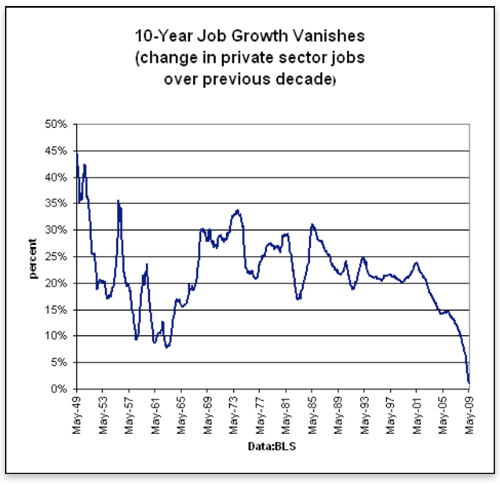
We find a traditional pattern for private-sector job growth that, although volatile (following the business cycle), remains within a 20–30 percent band for the 30-year period starting in 1971. However, this period is followed by an ominous decline in the 2000s, which approaches zero job growth by May of 2009. What's going on?

Mandel doesn't say, although he points out that the real story is somewhat worse than the data suggest. Throughout the 2000s, there was significant growth in public sector jobs, doubling that of the private sector in absolute terms. Mandel adds that, of the private-sector jobs created during this time period, most were in the "HealthEdGov" sector, meaning that these jobs — technically private — would not have existed without government spending.

The situation is troubling, to say the least. From May 1999 to May 2009, private-sector employment increased by only 1.1 percent — the lowest rate of job growth since the 1930s. This reflects structural problems within the US labor force that have increased in severity during this decade.

Consider the last economic correction in the United States. The economy was in recession at the time of 9/11, a tragedy that squelched what looked like a normal private-sector jobs rebound starting several months earlier. (In the graph above, see the bump that was well established by May 2001.)

But the tragedy of 9/11 must include its use as a justification for the largest increase in government spending since the Great Depression. The massive increase in both the welfare and warfare states following 9/11, and the conscription of capital that they entailed, forestalled the inevitable market correction for several years. And since it allowed existing malinvestments to fester, it made the present correction all the worse.

Today, the main response to ill-effects of past interventions seems to be to create even greater ones. This must stop if private-sector job growth is to recover. If not — well, don't look to individual monthly job figures as a source of optimism.

Christopher Westley is an adjunct scholar at the Ludwig von Mises Institute. He teaches in the College of Commerce and Business Administration at Jacksonville State University. Send him mail. See Christopher Westley's article archives. Comment on the blog.


Comments


Post Comment (Moderated)


(Note Commenting Issue: If after Submitting you are returned to the Main Index Page then due to site caching your comment has not been accepted. Solution - Click the Browser Back Button to the article page and Press PAGE REFRESH (you should see the message "You are not authorized to carry out this operation") Now re-enter your comment (ignoring the notice) - If all's well then you will remain on the article page after submitting, a moderator will check and authorise the comment. Alternatively EMAIL to comments @ marketoracle.co.uk , quoting the article number.

FREE Deflation Survival GuideFREE Updated 118 Page Independant Investor E-book
