


Sovereign Debt Default Risk and the Price of Crude Oil
Commodities / Crude Oil Feb 09, 2010 - 01:46 AM GMTBy: Dian_L_Chu

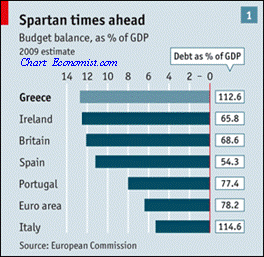
 European and U.S. stock markets have taken a hit recently as spooked investors from Shanghai to Sao Paolo were fleeing risky assets amid concern that the financial crisis in Portugal and Greece could spread through the euro zone with vast implications for the fate of the fragile global economic recovery. (Fig. 1)
Liquidate & Buy Dollar
A steep drop in crude-oil prices triggered declines across the commodities spectrum, as investors nervous about the pace of the economic recovery gravitated back to the dollar. Crude oil tumbled to a seven-week low of $71.19 a barrel last Friday, down 14% since the 2010 high of $83.18 reached on Jan. 6.
Investors’ fled for safety drove the U.S. dollar near a nine-month high against the euro. Emerging market currencies also weakened in Asia, while U.S. stocks fell a fourth straight week, the longest streak since July.
A Shift of Sovereign Risk
According to EPFR Global, risk aversion has prompted a withdrawal of $1.6 billion from emerging market equity funds during the week ending Feb. 3, the biggest outflows in 24 weeks, and $516 million has left Asian equities outside of Japan.
The charts from CDR (Credit Derivatives Research) tell the story of this investors’ perception. According to CDR, there has been a dramatic shift of risk in developed nations relative to emerging and less-developed nations when comparing three sovereign risk indexes, SovV, EM and CEEMEA. (Fig. 2)
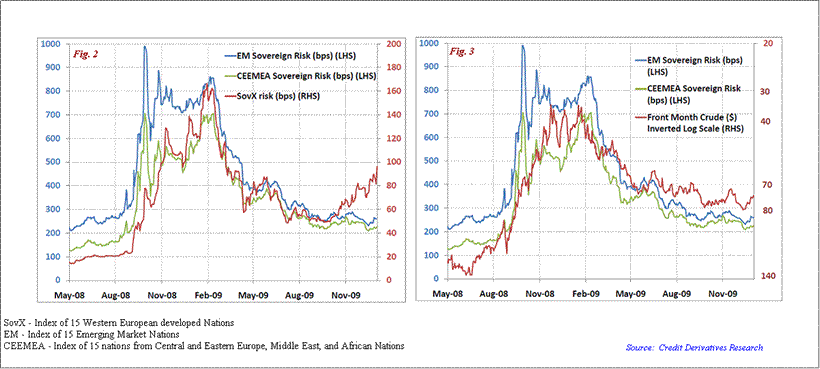
In SovX, the GIPSI (H/T Zero Hedge) - Greece, Italy, Portugal, Spain and Ireland, represent around 65% of the index risk. In EM, Venezuela accounts for 26%, Turkey, Brazil, and Argentina represents 12% respectively of the EM risk. In CEEMEA, Turkey and Russia represent 49% of the index risk (followed by Hungary and Ukraine each at over 8%).
In addition, CDR finds that the sovereign risks of the emerging economies appear to be closely tied to the price of oil:
Oil Price - A Key Risk Factor“It would appear that the CEEMEA and EM sovereign risk indices are threatened more by commodity price pressures than credit risk currently - and given the 'relatively' high price of oil/gas, their risk remains less of a concern than developed nations where the Ponzi appears to be in question.” (Fig. 3)
Emerging market countries, such as Brazil, China or India, are evolving since the early 90s. During this period, the issuance of bonds by these countries has increased significantly reflecting their needs for substantial long term and infrastructure investment.
Among the many determinants of risk bonds, the price of oil is a key factor as it plays a significant role in economic growth, inflation, production costs, trade balances and currency. Nine of the 10 economic recessions in the United States since the end of World War II were preceded by a dramatic increase in the price of oil.
A Sensitivity Issue
Oil prices nowadays are extremely volatile, and sharp fluctuations in oil prices contribute to macroeconomic volatility all over the globe. The impact of this volatility on economy varies according to a country’s relative dependence on oil production and exports.
For oil-exporting countries like Russia and Saudi Arabia, a rise in oil prices caused a perception of risk reduction relative to its obligations. Conversely, an oil-importing country sees its risk index increase due to a barrel price shock.
Financial Crisis 2.0?
Last week's wild commodity price swings underscore how investors aren't totally convinced that the world economy is on an upward trajectory. Investors are worried that multi-governments' debt problems will spread globally similar to the subprime crisis in 2008.
In addition to concerns about GIPSI sovereign debt defaults in the 16-nation euro zone, the U.S. is grappling with its own deficits and the high jobless rate, while China began restricting lending last month to prevent high inflation.
Some analysts expect global commodity prices would eventually firm up reflecting economic recovery albeit high volatility; and fundamentals should increasingly dominate expectations and drive prices.
But there are others see the current “correction” as caused by factors very similar those brought on the “financial crisis of 2007-2010” and warned this could signal “a new crisis in development.”
Seeking Negative Beta
In this environment, a defensive play would be to invest or allocate a portion in regions that are less prone to the price of oil, which is a significant sovereign risk factor. Sector wise, agriculture and alternative investment vehicles in real estate or land development should provide some good diversification to any long term portfolios.
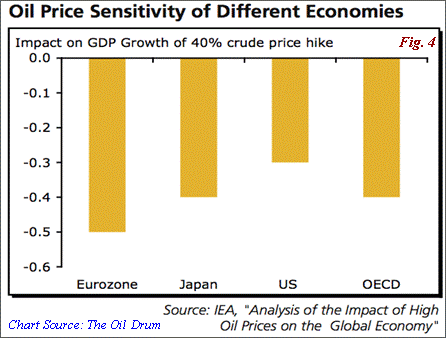
Jeff Rubin, Chief Economist at CIBC World Markets pointed out that the United States is less sensitive to oil price volatilities because it is itself an oil producer (5 million barrels out of 19 million barrels the US consumes are produced in the US), so it receives some of the benefit of both higher and lower oil prices. An IEA analysis also indicated that the U.S. should be less affected by oil price shocks than Japan, OECD and Euro zone. (Fig. 4)
This competitive edge probably partly explains how investors still see the U.S. dollar as a safe haven, and Mr. Geithner's optimism that more debt won't hurt U.S. credit rating, in spite of the fiscal and economic challenges quite similar to what the Euro Zone is facing.
BRIC minus R
In addition to the United State, GDP growth in Brazil, China and India could get boost from the softening and stabilizing of oil prices and should increase their competitiveness. Brazil and Chindia are all oil producers with aggressive state-sponsored exploration and production efforts and strong economic growth prospect. Brazil, with a new and improved investment grade credit rating, is now largely self-sufficient and has insulated its economy from oil price shock on net basis.
The economic impact of oil prices on oil-importing, developing countries such as China and India could be more pronounced primarily because Chindia are more energy-intensive due to its strong growth rate, and less energy efficient. From that perspective, Chindia, though good prospects could be more of a roller-coaster ride for investors.
Among the emerging economies, lower crude oil prices will be a big dampener for Russian economy. Russia's two oil wealth funds declined by a total $1.54 billion over the last month, as more funds were transferred to aid federal budget shortfalls. The Reserve Fund, one of Russia’s two oil wealth funds, is expected to run out by the end of 2010.
Hat Tip: Professor Pinch
Dian L. Chu, M.B.A., C.P.M. and Chartered Economist, is a market analyst and financial writer regularly contributing to Seeking Alpha, Zero Hedge, and other major investment websites. Ms. Chu has been syndicated to Reuters, USA Today, NPR, and BusinessWeek. She blogs at Economic Forecasts & Opinions.
© 2010 Copyright Dian L. Chu - All Rights Reserved Disclaimer: The above is a matter of opinion provided for general information purposes only and is not intended as investment advice. Information and analysis above are derived from sources and utilising methods believed to be reliable, but we cannot accept responsibility for any losses you may incur as a result of this analysis. Individuals should consult with their personal financial advisors.
© 2005-2022 http://www.MarketOracle.co.uk - The Market Oracle is a FREE Daily Financial Markets Analysis & Forecasting online publication.
