


Will U.S. House Prices Drive The 4.8% “Consensus” Nominal GDP Growth Forecast?
Economics / US Economy Jul 28, 2010 - 03:03 AM GMTBy: Andrew_Butter

 I looked up the “consensus” for nominal US GDP growth in The Economist today; you have to add “real” to “CPI” to get the answer - I’m not interested in “real”, for me “real” is what they measure (nominal), and the un-reality starts when they subtract whatever weird and wonderful concoction of inflation is handed down by the Bureau of Labor.
Anyway the “consensus” was 4.8% for 2010, although USA Today surveyed 47 top economic forecasters, and their consensus worked out (nominal) at about 3.7%.
http://www.usatoday.com/money/economy/2010-07-26-econsurvey26_ST_N.htm
All this consensus building is making my head spin, and I’m reminded of John Maynard Keynes’ quote about laying economists head-to tail all round the world and never being able to find a consensus. I’m also wondering how many of the current batch of consensus seekers had reached a consensus that house-prices would go on going up forever in 2005 and 2006? Or are these new consensus seekers?
Anyway, the reason I was interested was because nominal GDP is a driver for most of my models, so I was messing around, and then I noticed this:
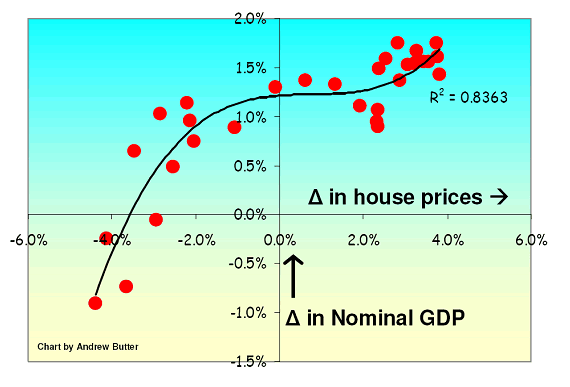
That’s quarterly data from Q1-2000 to Q2-2010; the “X” axis (left to right) is the average quarterly change in house prices of the preceding two years, and the “Y” axis is the average quarterly change in nominal GDP in the subsequent three quarters.
That says from 2000 to now, the main driver of nominal GDP in USA was house prices (up and down).
Uh…Duh!! Yeah OK, we all know that the current malaise was primarily due to the fact that USA had a housing bubble and then it had a bust, so that’s hardly NEWS!!
I acknowledge that’s not very complicated, just one variable plotted against another variable, but it does appear to suggest some sort of cause and effect; like if house prices change, then following that…nominal GDP changes.
But it was a bit of a surprise that you can explain 84% or so of the changes in nominal GDP from the change in house prices in the preceding two years (Oh and don’t fret about the “S” curve (approximated by a third-order polynomial), that’s a perfectly normal relationship; logically a total collapse of hose prices would make everyone dead broke, and an explosion upwards would make everyone so rich that nominal GDP would explode upwards too.
The story of “why” doesn’t have to be particularly complicated either.
When people saw the price of their houses go up, they felt rich, so they didn’t bother to save for the future, and some of them even borrowed money to “unlock” some of the equity that they (thought) they had in their houses; and THEN they went out to get a bit of “Retail Therapy” to reward themselves for their “efforts”.
70% of the US economy is consumer spending, and so like in the old days when they used to say “What’s good for GM is good for America”, all you do is substitute “GM” with “Shoppers”.
And then when house prices went down; they didn’t feel so rich anymore and more to the point their friendly mortgage shark wasn’t around to let them “unlock” some more equity, in fact the shark was being a mite unfriendly and was offering to kick them out of their “equity”.
The interesting thing there is that the “fundamental” for house prices (that’s the line the bubble and the bust oscillates round) is driven by Nominal GDP per house divided by a function of the 30-Year yield, and…and this is the interesting part, the 30 year yield is driven by nominal GDP.
So there is a sort of feedback loop operating there.
A stabilising feedback that operates is that longer term, is the international competitiveness of an economy is a function of the absolute cost of shelter per person; that’s why countries that have sensible policies on house prices and go with the “novel” idea that to make housing “affordable” to ordinary working people, it’s much better to make sure that the prices of housing for them is kept low, rather than setting up complicated ways of lending them money so they can buy very expensive houses they can’t afford.
That’s why the economies of Germany, Hong Kong and Singapore are so “resilient” (all three of those countries have the idea that the role of the government is to make sure that ordinary people have decent, affordable housing, regardless of what the real-estate sharks would like); and why countries that let house prices for ordinary people get out of control (like USA and UK), are so “un-resilient”; and make it their speciality to export jobs.
What’s next for the USA Economy?
Well the Good News is that house prices won’t go down (much) more, about 12% by my estimate.
http://www.marketoracle.co.uk/Article21334.html
The trend-line down will probably be about 1% per quarter over two years; looking at the chart, that works out at about 1% nominal GDP growth per quarter (actually it averages 4.8% going forward three years).
The other good news is that housing in USA now is cheap, which means that ordinary people can afford to live there now, and that unless the Administration makes a concerted effort to shoot themselves in the foot again (their speciality – look at Iraq and Afghanistan), jobs ought to start drifting back.
Two points, the first is that the model says nothing about how much of that 4.8% is inflation, and inflation is a complex issue. Right now since USA still imports a lot of its needs (oil in particular), it’s at the mercy of events outside USA that it cannot control.
The second thing is that it’s hard to see how, long-term, USA can afford to spend the amount of money that it does on playing Rambo-Chasing-Evildoers; that expenditure is inflationary and it’s unnecessary. The BIG threat to the security ordinary Americans is going broke, it’s not a bunch of raggedy lunatics planting IED’s and building one or two nuclear bombs on the other side of the world, and it never was.
By Andrew Butter
Twenty years doing market analysis and valuations for investors in the Middle East, USA, and Europe; currently writing a book about BubbleOmics. Andrew Butter is managing partner of ABMC, an investment advisory firm, based in Dubai ( hbutter@eim.ae ), that he setup in 1999, and is has been involved advising on large scale real estate investments, mainly in Dubai.
© 2010 Copyright Andrew Butter- All Rights Reserved
Disclaimer: The above is a matter of opinion provided for general information purposes only and is not intended as investment advice. Information and analysis above are derived from sources and utilising methods believed to be reliable, but we cannot accept responsibility for any losses you may incur as a result of this analysis. Individuals should consult with their personal financial advisors.
Andrew Butter Archive |
© 2005-2022 http://www.MarketOracle.co.uk - The Market Oracle is a FREE Daily Financial Markets Analysis & Forecasting online publication.
