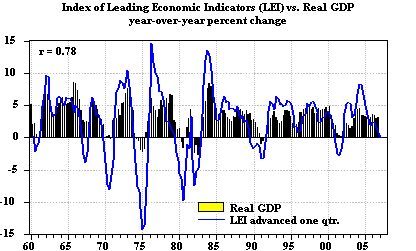
Notwithstanding the fact that even the much respect magazine, The Economist, now implies America as a Ponzi scheme (a troubling development), let's see an opposite view to this morning's take by Eric Sprott.
Category: US Economy
The analysis published under this category are as follows.

Sunday, May 19, 2024
Important Economic And Geopolitical Questions And Their Answers! / Politics / US Economy
By: Raymond_Matison
Determining America’s economic trends and world leadership position is no longer difficult; all we need to do is to answer some simple but foundational questions – and the answer becomes startingly clear. Join in, and see if your own answer to these questions, if markedly different from the ones cited here, leads to a similar or a credible conclusion, giving you clarity on this important American citizen and investor issue.
Read full article... Read full article...

Thursday, September 07, 2023
Why US Annual Budget Deficits Are Getting Worse / Economics / US Economy
By: Nadeem_Walayat
The pandemic a once in a 100 year event sparked rampant deficit spending to bailout the economy, that was 2020, whilst 2021 was nearly as bad! And 2022 did show an improvement by reverting back to pre-pandemic deficit era extremes. However the 2023 deficit is once more ramping up and running at twice the pre-pandemic extreme rate.
Read full article... Read full article...
Thursday, March 03, 2022
America’s Trade Deficit: An Enormous Concern / Economics / US Economy
By: Antonius_Aquinas
Another milestone (or more accurately millstone) was recently passed by the U.S. economy as the January trade deficit surged to an all-time record high of $107.6 billion, up some $26 billion from December’s $80.7 billion imbalance.*
Like the gigantic federal budget deficit, the trade imbalance is no longer talked about by the financial press. There has been little criticism of President Biden on either matter nor are Administration officials questioned about how things can be reversed. In fact, some commentators bizarrely contend that trade deficits show how robust an economy actually is!
The trade deficit was supposed to be alleviated by former President Trump who vowed throughout the 2016 campaign that he would rectify the situation and repeatedly ridiculed U.S. trade negotiators for their lack of financial acumen. He touted that his “friendship” with world leaders, most notably Chinese President Xi Jinping, would result in favorable trade deals for the country.
Read full article... Read full article...
Wednesday, October 20, 2021
Shocking Numbers Show Government Crowding Out Real Economy / Economics / US Economy
By: MoneyMetals
The stampede of dollars into the gold and silver markets has not yet begun. There is record demand for coins, rounds, and bars, but institutional money is still ignoring precious metals, for the most part.
Anyone wondering why, can find a clue in the current makeup of the U.S. economy.
The large majority of the nation’s spending, and wealth, is handled by people who don’t have much in common with gold bugs – at least not yet.
Let’s start with some data.
Read full article... Read full article...
Tuesday, October 12, 2021
The Demand Shock of 2022 / Economics / US Economy
By: Michael_Pento
Investors are growing cautious as we approach the fourth quarter, and their trepidation is justified. Here’s a brief summary of the situation: there is a potential global financial crisis stemming from the Chinese property market meltdown, supply chain bottlenecks are growing worse, Q3 Earnings warnings are being reported from many large corporations, interest rates are rising, inflation is at a 40-year high, tax hikes are coming in ’22, and the threat of a U.S. debt default still hangs in the air until the end of November.The macroeconomic situation today is one of stagflation. Meaning, inflation rates are higher than normal at the same time GDP growth is slowing. To this point, the data shows that 6.2 million people lost their benefits in the week of September 11tt, as most government pandemic unemployment relief programs expired. These people all need to find a job, and quickly, to supplant that huge government weekly stipend that is now gone. Instead, we find that weekly layoffs are consistently higher than any other time since before the pandemic all the way back through 2015. And, we see that only 194k net new jobs were added during the month of September.
Read full article... Read full article...
Wednesday, September 15, 2021
Fed To Taper into Weakening Economy / Economics / US Economy
By: Michael_Pento
Fed Chair Jerome Powell will soon announce the date for tapering its record-setting QE program, despite weakening jobs data.
The Non-farm Payroll Report for August severely disappointed Wall Street's expectations by coming in at just 235,000 net new jobs. Many on Wall Street—because they always look for a silver lining—are now trying to twist the near half-million jobs miss into something beneficial for stocks. This is because they claim the Fed's tapering of its asset purchase program will be delayed.
Nevertheless, the Fed is growing uncomfortable with the pace of stock and home price appreciation. And, doesn't think ending QE equates to a tightening of monetary policy. Of course, the Fed doesn't want to kill the economy by raising interest rates too rapidly. However, they have become very much aware that continuing to print $120 billion each month and further inflating the stock and real estate market has become absolutely dangerous. Inflating asset prices further and boosting CPI from this point would likely soon force the Fed into a regime of rapidly raising interest rates, which would kill the recovery and engender a severe recession.
Wednesday, June 30, 2021
The “Long COVID” Economy / Economics / US Economy
By: Patrick_Watson
According to some analysts, higher inflation is on its way. Americans will spend like crazy and drive prices higher as the pandemic recedes.That’s the theory. It may be right, for a while, but we also have other problems. For one, the pandemic hasn’t ended; it’s simply become optional.
Most US adults can now “opt out” by getting vaccinated. The shots, while not perfect, are proving highly effective. Unfortunately, many are opting to stay vulnerable. We also can’t yet vaccinate children under 12.
This may be an economically significant problem soon. But even if the virus disappears, we are going to spend years repairing the economic damage already done… and more may be coming.
Read full article... Read full article...
Thursday, May 06, 2021
Vaccine Economic Boom and Bust / Economics / US Economy
By: Stephen_McBride
By the numbers, the US looks much better than it did than a few months ago. Jobless claims dropped to their lowest levels of the pandemic; COVID-19 vaccine shots went into arms at a record rate.But we’ve seen how this goes. The virus spreads in waves that recede and then return, often stronger. Some areas of the US are experiencing their fourth wave of coronavirus cases.
Vaccinations are supposed to break this cycle. And maybe they will. Unfortunately, that looks less likely as vaccine demand shows signs of peaking.
That means some establishments have, or will soon, close their doors … to mass vaccinations.
Read full article... Read full article...
Thursday, March 11, 2021
Biden Stimulus And Consumers Are The Keys To Further US/Global Economic Recovery / Economics / US Economy
By: Chris_Vermeulen
At this point in our lives, we are hoping the new COVID-19 vaccines will do their part to help move the world towards more normal consumer and economic activities. The US Senate recently a new $1.9 Trillion stimulus package that should continue to provide assistance to various levels of consumer, state governments, and corporate enterprises. The next question in our mind is “what will the recovery look like if/when it happens?”. We need to look at three critical components of the global economy to help answer this question: Consumer Activity, Debt, and Supply/Demand Functions.
Consumer activity makes up more than 60% of the US GDP. It also drives money flow as consumers engage in economic activity, create credit for new purchases and help to balance the supply/demand equilibrium functioning properly. The participation of the consumer within an economy is essential for a healthy growing economy.
Read full article... Read full article...
Monday, March 08, 2021
US Economy, GDP, Unemployment, Inflation Impact on House Prices Trend 2021 / Economics / US Economy
By: Nadeem_Walayat
The US economy is recovering fast from the corona crash with annualised GDP down just 2.8% for Q3, a remarkable performance and far better than most western nations.
Read full article... Read full article...
Thursday, December 31, 2020
US Economy GDP 2021 / Economics / US Economy
By: Michael_Pento
Wall Street is universally bullish on the economy and stock market for 2021. For example, Morgan Stanley is on record predicting the U.S. economy will expand by 5.9% next year. The stock market has front-run this optimism. The most important valuation metric, total market cap to GDP, currently stands at an unprecedented 185%. This absurd valuation only makes sense if investors believe corporate profits will skyrocket next year. No other bull market in history even comes close to this historic distortion between the price of stocks and the underlying economy.Read full article... Read full article...
Friday, December 04, 2020
Pre-COVID US Economy Wasn’t All That Great Either / Economics / US Economy
By: Michael_Pento
The stock market and economy appear to be doing ok for the moment, as the incredibly dangerous bubble inflates further. This optimism is predicated on a plethora of COVID-19 Vaccines, which are projected to bring the economy back to its pre-COVID state of health. However, the problem with this line of thinking is that 2019 was anything but normal and healthy. It was a messy combination of a Fed slashing interest rates and re-imposing QE in order to achieve a rather mundane GDP growth rate of just 2.2%. The truth is, the pre-virus economic construct was built on Silly Sand—erected on top of asset bubbles, artificial interest rates and an avalanche of new debt issuance.
Not only will a return to “normalcy” merely bring us back to an anemic and non-viable economy, I want to highlight three things I’m watching out for during 2021 that could upend the economy and markets.
Read full article... Read full article...
Friday, October 23, 2020
Sayonara U.S.A. / Economics / US Economy
By: Michael_Pento
The Japanese word for goodbye is Sayonara. But it doesn’t just mean goodbye, it means goodbye forever. Unfortunately, that is what our country is doing to American Capitalism.
In the quixotic fantasy world of Keynesian economics, the more money a government borrows and prints the healthier the economy will become. Those who adhere to this philosophy also believe such profligacy comes without any negative economic consequences in the long run. This specious dogma contends that it is ok for a government to dig further into a big deficit hole during a recession because massive public spending will help the economy to climb out faster. And then, a government can cut spending in the good times, which leads to big budget surpluses.
The trouble with this theory is the time never arrives to bring the scales into balance. Case in point, during the pre-pandemic year 2019, the U.S. had a deficit that was equal to 5% of GDP—one of the worst figures since WWII. This deficit occurred during a time which was purported to be one of the best economies in history. Today, there are negotiations for yet another “stimulus” package after having already spending $3 trillion (15% of GDP) earlier this year. Speaker Pelosi and the Democrats want to spend another $2.2 trillion and Republican President Trump says, “I would like to see a bigger stimulus package, frankly, than either the democrats or Republicans are offering.”
Read full article... Read full article...
Friday, October 16, 2020
US Economic Recovery Is in Need of Some Rescue / Economics / US Economy
By: John_Mauldin
Recovery is coming because the economy has found a new equilibrium. That's what we are told. Except, that’s not what the data says.
Last week, I laid out the case that US government debt would be $50 trillion by 2030. That was using straight-line CBO projections along with the 2008 recovery pattern for government revenue.
I added in off-budget debt at its $269 billion yearly average. But now, USdebtclock.org projects off-budget deficit will rise by over $1 trillion this year.
With that in mind, it's not just that we'll have even higher debt by 2030. It's that this mounting debt will further slow the recovery.
Read full article... Read full article...
Thursday, October 15, 2020
Fed Chairman Begs Congress to Stimulate Beleaguered US Economy / Economics / US Economy
By: MoneyMetals
Precious metals investors faced choppy market seas this week. Gold bobbed to a slight decline while silver essentially treaded water through Thursday’s close. Both are advancing strongly today.
Metals markets are being overshadowed by equities markets. The S&P 500 broke out to a 5-week high on Thursday. The rally comes on a rising tide of Federal Reserve liquidity coupled with on again, off again hopes for a stimulus deal in Washington.
More stimulus is definitely coming. The only question is how many trillions and whether they get dished out before or after the election.
Read full article... Read full article...
Saturday, October 03, 2020
Congressional Budget Office Tax Revenues Set to Surge! In 2 Years, That Is / Economics / US Economy
By: John_Mauldin
All debt shares one common characteristic. A bill comes due at some point and, if the borrower doesn’t pay, the lender either loses their money or finds someone else to pay.
I’ve warned for several years now that our growing global debt load is unpayable. We will eventually “reorganize” it in what I call The Great Reset, likely later in this decade.
Recent developments suggest debt will be even bigger than I expected, to the tune of $50 trillion in the US by 2030. That's double what I expected just one year ago.
Read full article... Read full article...
Sunday, August 30, 2020
3 Truths That Will Define This 3-Part US Economy / Economics / US Economy
By: John_Mauldin
The economy recovery, when it comes—and it will—is going to be uneven.
In some parts of the economy, it's already starting. Other parts will be in what can only be described as a depression for quite some time. And still others are going to take off like a rocket ship.
This three-part economy won't fit compactly into the V- or U-shaped recovery that some are predicting (read: hoping) for. More likely, it will look like a "K."
Whether it's K-shaped or some other to-be-determined letter, there are three truths that will define this economic recovery:
Read full article... Read full article...
Sunday, July 19, 2020
Help the Economy by Going Outside / Economics / US Economy
By: Patrick_Watson
COVID-19 cases are growing fast in large parts of the US. The same folks who said the virus would just go away now say not to worry because fewer people are dying.
A lower mortality rate helps, but it’s still too high. The sheer number of sick people is straining hospital capacity some places. Viruses don’t care what anyone thinks; they just spread until something stops them.
The economy can’t recover if people fear infection everywhere they go. We need to balance public health and economic necessity.
Fortunately, scientists are learning how to reduce risk with fewer economic side effects.
Read full article... Read full article...
Monday, July 06, 2020
The Beatings Will Continue Until the Economy Improves / Economics / US Economy
By: John_Mauldin
You can’t live without making certain presumptions. You presume your car will start, your refrigerator will stay cold, and the lights will turn on when you flip the switch.
In fact, you could argue this “predictability” is what separates advanced economies from primitive ones. Most of us don’t have to worry about being attacked in our sleep or having food tomorrow. That security frees us to do other things.
Read full article... Read full article...
Wednesday, May 06, 2020
Why Americans Don't Have Any Savings / Economics / US Economy
By: Frank_Hollenbeck
In response to a likely worldwide recession, governments have turned on full blast the fiscal and monetary spigots. A $2 trillion spending plan has just been approved in the USA, central banks are on a buying spree, and the $1200 stimulus payment is just helicopter money. Since the government does not have a magical tree of plenty and can only redistribute from the left pocket to the right by taxing, borrowing, or printing money, how does this make any economic sense or make any country better off? Government and Keynesian economists will tell you it’s to protect us from the coming dangers of hoarding; specifically, that banks will stop lending and just let funds sit. Keynes brought hoarding to the forefront of economics in his The General Theory of Employment, Interest, and Money; a concept that the classical economist considered to be irrelevant.
Read full article... Read full article...
Wednesday, November 06, 2019
These Indicators Aren’t Putting to an Economic Resurgence / Economics / US Economy
By: Harry_Dent
 When David Stockman spoke at our IES conference in October, he had a whole slew of charts that showed that the main street economy had nothing to do with the Wall Street one – and that there were more signs of weakening growth than strengthening.
He recently showed some updates and these were the two that most caught my eye. Both of these are from the more cyclical sectors that most often cause recessions.
Read full article... Read full article...
Thursday, October 31, 2019
BEA Reports US Economy Grew by 1.93% GDP Q3 2019 / Economics / US Economy
By: CMI
In their first (preliminary) estimate of the US GDP for the third quarter of 2019, the Bureau of Economic Analysis (BEA) reported that the US economy was growing at a +1.93% annual rate, down -0.08 percentage points (pp) from the prior quarter.
The minor change in the headline masked a material weakening in the growth of consumer spending. The growth rate for aggregate consumer spending on goods and services was reported to be over 1% lower (-1.10pp) than in the prior quarter. The growth of governmental spending (Federal, state and local) also weakened by about half of that amount. But largely offsetting those negative impacts on the headline number were soaring inventories and exports.
Annualized household disposable income was reported to be $253 higher than in the prior quarter, and the household savings rate was reported to be 8.1%, up 0.1pp from the prior quarter.
Wednesday, September 25, 2019
To Fix the Economy, Fix Healthcare / Economics / US Economy
By: Patrick_Watson
If you are American and you have health insurance, you probably get it from either your employer or some kind of government program. Or possibly both, if the government is your employer.
Almost no one in the US gets health insurance on their own. We can’t afford to buy it and insurers can’t afford to sell it, thanks to our crazy patchwork system. As a result, people fall through the gaps and millions remain uninsured.
Even many who are insured might as well not be, since exorbitant deductibles leave them practically uncovered.
Monday, September 09, 2019
Don't Worry About a Recession / Economics / US Economy
By: Steve_H_Hanke
Everyone seems to be wringing their hands about what they fear is an oncoming recession. Indeed, as a sign of the level of the public’s angst, The Economist magazine reports that Google searches related to the word “recession” have surged.
If that wasn’t enough evidence of the hand wringing, the Chairman of President Trump’s Council of Economic Advisers, the respected Tomas Philipson, recently indicated that he was worried about the steady negative drumbeat in the press: that a recession might be just around the corner. Philipson put his finger on the problem when he said, “The way the media reports the weather won’t impact whether the sun shines tomorrow. But the way the media reports on our economy weighs on consumer sentiment, which feeds into consumer purchases and investments.”
Read full article... Read full article...
Monday, August 05, 2019
FOURTH TURNING ECONOMICS / Economics / US Economy
By: James_Quinn
If you feel you’ve recei“In retrospect, the spark might seem as ominous as a financial crash, as ordinary as a national election, or as trivial as a Tea Party. The catalyst will unfold according to a basic Crisis dynamic that underlies all of these scenarios: An initial spark will trigger a chain reaction of unyielding responses and further emergencies. The core elements of these scenarios (debt, civic decay, global disorder) will matter more than the details, which the catalyst will juxtapose and connect in some unknowable way. If foreign societies are also entering a Fourth Turning, this could accelerate the chain reaction. At home and abroad, these events will reflect the tearing of the civic fabric at points of extreme vulnerability – problem areas where America will have neglected, denied, or delayed needed action.” – The Fourth Turning – Strauss & Howe
Sunday, August 04, 2019
Why Trump’s Low-dollar Economic Plan Won’t Work / Economics / US Economy
By: Richard_Mills
The slowdown in the United States, and throughout the world, has led many to speculate that the time has come for an intervention in the US economy.
Despite a healthy stock market and the economy barreling along at near full employment, persistent negative economic indicators have policymakers twitching for some kind of response.
On Friday US Gross Domestic Product numbers failed to inspire. American GDP grew just 2.1% in the second quarter, compared to a 3.1% gain in Q1. One of the most important takeaways from the official report card on the economy, was the value of inventories, or goods waiting to be sold. It shrank by $44.3 billion, Marketwatch reported, knocking a full percentage point off GDP.
Read full article... Read full article...
Wednesday, July 17, 2019
Want to See What's Next for the US Economy? Try This. / Economics / US Economy
By: EWI
Don't listen to the naysayers -- there IS a way to forecast the general health of the economy. This method has repeatedly proven itself.
Yes, you can anticipate the likelihood of a recession, even a depression -- or, conversely, when major economic measures -- like jobs -- will be robust.
That surefire way is the performance of the stock market.
That's right, despite the widespread belief that the economy drives the stock market, it's the stock market which leads the economy. Why not the other way around? Because the economy is a slow boat.
Read full article... Read full article...
Friday, July 12, 2019
State of the US Economy as Laffer Gets Laughable / Politics / US Economy
By: Peter_Schiff
While the willingness to abandon long held beliefs for political gain has always been a common trait among public figures, the spectacle has recently taken on shocking levels of casual audacity. The contempt for even minimal levels of intellectual consistency has allowed Kamala Harris to condemn Joe Biden for his past opposition to Federally mandated busing while simultaneously taking the exact same position herself. These somersaults are particularly common with former economic conservatives seeking to curry favor with President Trump's decidedly non-conservative policies.
We have seen former free-trader Larry Kudlow awkwardly embrace high tariffs and big deficits, and economist Stephen Moore disavow decades of monetary hawkishness to position himself as a potentially reliable Trump loyalist. But the most dizzying reversal came this week when supposedly conservative Reagan administration economist Arthur Laffer (in what I believe to be an audition for a job in the Trump Administration) hit the airwaves to make the case that the Federal Reserve should be run directly by the President, not by the Fed's supposedly independent governors. Come again? Direct political control of a central bank has always been the bogeyman of any conservative economist. Was he serious?
Read full article... Read full article...
Wednesday, July 03, 2019
Freight Slowdown Is a Terrible Sign for the Economy / Economics / US Economy
By: Patrick_Watson
Just as an army moves on its stomach, an economy moves on ships, trucks, and planes. They carry the goods whose purchase adds up to growth.Nowadays many goods are digital, delivered electronically. But we still need lots of physical stuff which must travel to the customer.
Fewer goods in motion mean lower growth… and that’s exactly what is happening.
With technology, businesses have grown adept at managing inventory. Goods don’t typically sit on store shelves very long. Retailers stop ordering quickly when demand falls.
Lower freight volume is a symptom of a disease that’s getting worse.
Read full article... Read full article...
Monday, June 24, 2019
The Bad News About Record-Low Unemployment / Economics / US Economy
By: Robert_Ross
Unemployment is the lowest it’s been in 50 years.
That means most people who want to work can find a job. It also means people are making more money and buying more stuff.
All good. More people working is always positive. But a low unemployment rate is a double-edged sword.
See, the unemployment rate is cyclical. It’s always moving up or down. And at this point—3.6%—there’s almost no room for it to drop more.
That’s where the trouble starts: When the unemployment rate bottoms out, like it’s doing now, it means the economy has peaked. And a recession is probably coming…
Saturday, June 15, 2019
Will the US Economy Fall into Recession? Or Will It Accelerate? / Economics / US Economy
By: Arkadiusz_Sieron
The current economic expansion has just equaled with the longest boom in the US history. Is that not suspicious? We invite you to read our today’s article, which provide you with the valuable lessons from the 1990s expansion for the gold market and find out whether the US economy will die of old age.
Lessons from the 1990s Expansion for the Economy and the Gold Market
The current economic expansion has just equaled with the longest boom in the US history. Unless the sky falls in the next few weeks, we will celebrate a new record in July. Is that not suspicious?
Read full article... Read full article...

Sunday, June 02, 2019
US ECONOMY and House Prices Trend Forecast / Housing-Market / US Economy
By: Nadeem_Walayat
GDP
The US economic fundamentals appear good as real GDP is rising at an annualised rate of +3.2% up from +2.6% a year ago. Whilst not a boom is still definitely not deflationary so supportive of house prices as the economy continues to chug along and thus implies US house prices should revert towards the 4% to 6% trend.
Read full article... Read full article...
Saturday, May 18, 2019
US Economy to Die a Traditional Death… Inflation Is Going to Move Higher / Economics / US Economy
By: MoneyMetals
Welcome to this week’s Market Wrap Podcast, I’m Mike Gleason.
Later in today’s program we’ll hear from Axel Merk of Merk Investments. Axel breaks down the trade war with China and gives us some keen insights on the likely strategy being employed by President Donald Trump there, and also tells us why he sees inflationary pressures returning in the economy and the affects it will have on gold prices. Don’t miss another wonderful interview with the highly respected Axel Merk, coming up after this week’s market update.
As markets continue to gyrate on global trade and tariff threats, precious metals are struggling to capture investor interest.
Lately, the big push in alternative assets has been in Bitcoin. The cryptocurrency has doubled in price over the past two months, though it remains well below its old high.
Gold was the sole metal to show strength amidst the recent selloff in stocks. However, its momentum petered out mid week and turned lower on Thursday. As of this Friday recording, gold prices are down 0.8% for the week to trade at $1,277 an ounce.
Read full article... Read full article...
Sunday, May 12, 2019
US Stock Market Leading Macro Economic Indicators Update / Economics / US Economy
By: Troy_Bombardia
 Instead of trying to predict when the economy will deteriorate in the distant future (which countless experts have tried and failed), we simply look for deterioration among the leading indicators. Instead of predicting the next 10 steps, we seek to predict the next 1-2 steps for the economy.
Here’s a brief summary of the leading economic indicators we track
Positive factors
- Labor market
- Corporate profits
- Financial conditions
- Loans
- High yield spreads
- Inflation-adjusted new orders
- Heavy Truck Sales
Negative factors
- Housing
- Yield curve
- Inflation-adjusted retail sales
- Earnings revisions
- Average weekly hours
Friday, May 10, 2019
Make America’s Economy Great Again / Economics / US Economy
By: Richard_Mills
A lot of Americans find themselves in a quandary over Donald Trump. On the one hand they can’t stand the braggadocious billionaire for his lack of principles, business ethics, exorbitant wealth, his treatment of women, minorities, the list goes on and on. But they also have to admit, the economy is in better shape now than when Barack Obama was installed in the White House.
Can Trump justifiably take credit for the economic expansion of the last two and a half years? Why is the US economy growing? In this article, we’ll take a deep dive into the question, “Why is the American economy great again?”
The sweet spot
The facts would appear to support that notion - the evidence shows that the economy has done extremely well since Trump was inaugurated as president in January, 2017.
In the first quarter, the US economy barreled along at 3.2%. A year ago it was at 4.2%. That’s not the highest growth the American economy has seen historically, but it’s pretty good. Taking a look at the chart below by Trading Economics, we can see that economic growth peaked in 2014, at close to 6%, when Obama was president, then dropped under 1% as the US election cycle began, in 2015. Since Trump has taken the helm, the trend line is clearly up.
Read full article... Read full article...
Tuesday, May 07, 2019
Record-Low Unemployment and Trump’s Message to China: Implications for Gold / Economics / US Economy
By: Arkadiusz_Sieron
The US unemployment rate dropped in April to 3.6 percent, a level not seen since December 1969. So, everything must be great. With the exception of the renewed worries about the U.S.-China trade deal. On Sunday, President Trump surprised the markets again. What did he write exactly and how could his tweets affect the gold market?
US Economy Adds More Than 250,000 new jobs in April
America created 263,000 jobs last month, following a strong rise of 189,000 in March (after an downward revision). The number surprised again on a positive side, as the economists polled by the MarketWatch forecasted 213,000 created jobs.
Read full article... Read full article...
Tuesday, April 30, 2019
U.S. GDP Accelerates, while Socialists Triumph in Spain. Will Gold also Win? / Economics / US Economy
By: Arkadiusz_Sieron
The US economic growth in the Q1 2019 positively surprised. Indeed, on the upside. The doubting Thomasses were proven wrong. And The Socialist Party just won the snap elections in Spain. Is the left back in vogue in the Eurozone? But what does it all mean for the gold market?
US GDP Surprises on the Upside
On Friday, the government said that the US GDP expanded at a 3.2 percent annual pace in the first three months of 2019. What is important is that the number significantly surpassed the forecasts. For example, the economists polled by MarketWatch had expected a 2.3 percent increase. The fears of the slowdown were overblown, as we have been warning for a long time.
Actually, the American economy accelerated in the first three months of 2019, as the economy grew at a 2.2 percent in Q4 2018, as one can see in the chart below.
Tuesday, April 30, 2019
This Indicator Signals the US Economy Is Slowing Down / Economics / US Economy
By: Patrick_Watson
It’s not a good sign for your health if your blood pressure drops too low. Similarly, the economy is probably sick when its circulatory system slows down. You don’t need a blood pressure gauge to know it either. Just count how many trucks you see on the highway.
Under normal conditions, busy highways and seaports mean a growing economy. Businesses are producing more stuff finding its way to consumers.
That was happening since we emerged from the Great Recession in 2009, albeit slower than in the past cycles.
Read full article... Read full article...
Thursday, March 28, 2019
What US Economic Fundementals and Valuations Say For Stock Market Trend 2019 / Economics / US Economy
By: Nadeem_Walayat
FUNDAMENTALS
US Economy
The US economic fundamentals are good as real GDP is rising at an annualised rate of 3.1%, up from +2,5% a year earlier. Whilst not a boom is definitely not deflationary so supportive for stock prices as the economy continues to chug along.
Read full article... Read full article...
Thursday, January 17, 2019
Mauldin: My 2019 Economic Outlook / Economics / US Economy
By: John_Mauldin
I recently did a “2019 Investment Outlook” webinar with my business partner Steve Blumenthal.
We looked at three topics: recession probability, credit conditions, and stock valuations. I can tell, we went deep on the webinar. You can read a transcript or view a recording here.
Here I’ll give you an abbreviated version of that webinar.
Economists Can’t Recognize Recessions in Real Time
Steve started the webinar by noting we are late in an economic cycle. He showed the chart below to illustrate how all cycles have expansion periods that end with recession.
Read full article... Read full article...
Friday, December 07, 2018
This Is the End of Trump’s Economic Sugar High / Economics / US Economy
By: Patrick_Watson
By most measures, the US economy is performing okay. GDP growth is still near 3.5%. Unemployment is below 4%. Inflation is up a bit but still historically low.Yes, the data has flaws. There’s plenty of regional variation. Your mileage may vary. But conditions could be a lot worse.
The problem: Sometimes the economy weakens beneath the surface.
Read full article... Read full article...
Thursday, November 29, 2018
BEA Leaves US 3rd Quarter 2018 GDP Unchanged at 3.50% / Economics / US Economy
By: CMI
In their second estimate of the US GDP for the third quarter of 2018, the Bureau of Economic Analysis (BEA) reported that the US economy was growing at a +3.50% annual rate, up +0.01% from their previous estimate but still down -0.66% from the prior quarter. The +0.01% improvement in the headline number masks a troublesome shift in the composition of that growth from consumer spending to even more inventory growth. The headline contribution from consumer spending on goods and services weakened by -0.24% and the growth is now lower than the prior quarter. Offsetting that was an upward revision to inventories (+0.20%), which are now reported to be growing at a +2.27% annualized rate. As a consequence, the BEA's "bottom line" measurement of the economy (the "real final sales of domestic product") was revised downward by -0.19%, now dropping by over four percent (-4.10%) from the prior quarter.
Read full article... Read full article...
Wednesday, October 10, 2018
The Branded US Economy / Economics / US Economy
By: Peter_Schiff
Last week Donald Trump, in his own estimation, succeeded in replacing what he claimed to be the "worst trade deal in history" with what he claims was "the best trade deal in history." If true, this would not only make good on one of his central campaign promises, but it would be a genuinely significant development. In reality, the unveiling of the United States-Mexico-Canada (USMCA) trade deal is just the latest iteration of the President's talent for branding. As is the case in other aspects of the president's view of economic matters, the difference between then and now is almost purely semantic.
Friday, August 17, 2018
Economic Expansion - Nine Years. Is That Enough? / Economics / US Economy
By: Arkadiusz_Sieron
Nine years. Is it short or long? It depends on what we are talking about. In the geological time scale, it’s a blink of an eye. But in the business cycle time scale, nine years is a really long time. The current economic expansion has recently turned 9 years old, as the Great Recession ended in June 2009, according to the NBER. With 109 months of economic prosperity (as of July 2018), the current cycle is now the second longest in the U.S. history (and data traces back to the 1850s), overshadowed only by the expansion which occurred between March 1991 and March 2001.
Read full article... Read full article...
Monday, April 23, 2018
US Economy Is Cooked, the Growth Cycle has Peaked / Economics / US Economy
By: Adam_Taggart
Hours ago, European Central Bank chief Mario Dragho conceded: "The growth cycle may have peaked"
Of course, those paying attention to the data already knew this. Our politicians and central planers have been peddling to us the fantasy that the global economy is strengthening, finally ready to fire on all cylinders after nearly ten years of dependence on monetary stimulus.
That just ain't so.
Read full article... Read full article...
Tuesday, March 27, 2018
Critical US Economic Indication to Watch Out For / Economics / US Economy
By: Rodney_Johnson
Millennials get a bad rap. Sure, they’re the generation that grew up with participation trophies, winning prizes for completing the arduous task of showing up. And with help from their Boomer professors, they have successfully shamed institutions of higher learning, where for centuries debate was considered a search for the truth, into echo chambers of conformity.I’ve also just learned that this generation has promoted E-sports (that would be watching other people play video games) into such a big deal that the category will get its own E-sports arena in Arlington, Texas.
Read full article... Read full article...
Saturday, March 03, 2018
Maybe The Economy Is Too Good For Investors / Economics / US Economy
By: WMA
In the early 19th century, London financier Nathan Rothschild said “buy on the sound of cannons, sell on the trumpets”. The cannons referred to the start of war (valuations are therefore attractive as disorder begins) and the trumpets refer to the peace treaty ending the conflict (at which time timid investors pile back into risky financial assets). Warren Buffet has often reiterated the same idea first enounced by Rothschild saying “buy when there is blood in the streets” (eg, when valuations are very low).
Tuesday, February 27, 2018
US Goldilocks Economy is DEAD! / Economics / US Economy
By: James_Quinn
“Once you strip out the effects of the debt binge, the artificial stimulus via currency depreciation, and the fabled ‘wealth effect’ from the equity market runup, real GDP growth stripped-down to its core was the grand total of 0.7% last year. Potemkin would be proud.” – David Rosenberg
appears every president finds the religion of false economic narrative once they ascend to power. Trump never stops babbling and tweeting about the fantastic economy and raging jobs market since his election. He has embraced the stock market bubble as proof of his brilliant leadership, rather than the tens of trillions in debt propping up the most overvalued market in world history. Every president takes credit for any good news, spins bad news as good news, or blames the previous president for bad news that can’t be denied. The president has absolutely zero impact on the economy or stock market over the short term. It’s like taking credit for the sun rising in the east each morning.
The Big Lie method works wonders when you have a willfully ignorant, mathematically challenged, easily manipulated populace. I spent the entire Obama presidency obliterating the fake economic data perpetuated by his BLS, BEA and every other government agency trying to paint a rosy economic picture. I voted for Trump because the thought of Crooked Hillary as the president made me ill. Despite disagreeing with many of his economic, budgetary, and military policies during his first year in office, I’d vote for him again over Hillary in an instant. The thought of having that evil shrew running the country gives me chills.
Read full article... Read full article...
Monday, January 15, 2018
The Key Economic Indicator You Should Watch in 2018 / Economics / US Economy
By: John_Mauldin
BY PATRICK WATSON : I think this year’s top risk is a miscalculation by the Federal Reserve—specifically, that it will tighten monetary policy too much.
The Fed is hiking interest rates because its experts believe the economy is close to “full employment.” And the Phillips Curve says wages should start rising any minute now.
Read full article... Read full article...
Sunday, December 17, 2017
Never Mind Tea Leaves, Here’s a Strong Signal from the Economic Dashboard / Economics / US Economy
By: F_F_Wiley
We’ve been seeing more and more commentaries discussing bad stuff that can happen when the Fed tightens policy and, as a result, the yield curve flattens. (See, for example, this piece from Citi Research and ZeroHedge.) No doubt, the Fed’s rate hikes will lead to mishaps as they usually do—in both markets and the economy. But most forecasters expect the economy to expand through next year, believing that the Fed and the yield curve aren’t yet restrictive enough to trigger a recession.
Monday, November 27, 2017
8 Charts That Show How Insane the Economy Is Today / Economics / US Economy
By: John_Mauldin
Since the 2008 financial crisis, there’s been a growing number of ridiculous, inane, and otherwise nonsensical economic interventions from our central bankers that fill the daily economic headlines.
I have gone from the occasional smile to scratching my head now and then to "WTF" moments.
All that said, the economists who designed these interventions had their reasons. They thought lower interest rates and liquidity injections would create jobs, spur investment, and eventually produce inflation.
Read full article... Read full article...
Friday, October 20, 2017
Here’s the US’s Biggest Vulnerability in NAFTA Negotiations / Economics / US Economy
By: John_Mauldin
BY GEORGE FRIEDMAN AND ALLISON FEDIRKA : As the fourth round of NAFTA negotiations comes to an end, the agreement's survival has once again been brought into question.
US President Donald Trump has threatened to strike a new deal with just Canada. Mexico downplayed the threat, saying it would walk away from negotiations if the new terms brought by the US put it at a disadvantage. For their part, the Canadians have been quiet.
Read full article... Read full article...
Wednesday, September 13, 2017
Harvey Will Reflect in Economic Data as Growth—That Might Mislead the Fed into Another Policy Error / Economics / US Economy
By: John_Mauldin
Hurricane Harvey wreaked havoc on South Texas and Louisiana. As a lifelong Texan, I have many friends in that region. They’ve lived through many storms and normally take what nature throws at them in stride.
Not this time.
I am seeing headlines calling this a thousand-year flood. It seems that over 100,000 homes in Houston alone were flooded. Harvey meant business. Recovering from this storm will take a long time and a lot of resources.
Read full article... Read full article...
Wednesday, August 30, 2017
US GDP Growth Upwards Revision to 3.04%, BEA 2nd Quarter 2017 / Economics / US Economy
By: CMI
In their second estimate of the US GDP for the second quarter of 2017, the Bureau of Economic Analysis (BEA) reported that the US economy was growing at a +3.04% annual rate, up +0.48% from their previous estimate and up +1.80% from the prior quarter.
Consumer spending was revised upward to a +2.27% annualized growth rate (up +0.34% from the previous estimate and up +0.95% from the prior quarter). The inventory contribution continued to be essentially neutral (+0.02), while the previous growth in commercial fixed investment was revised upward (to +0.58%). Governmental spending was revised back into contraction (-0.05%), and the growth rates for both exports (+0.45%) and imports (-0.23%) moderated.
Monday, August 21, 2017
The Coming Boom Of Productivity Will Get Our Economy Back On Track / Economics / US Economy
By: John_Mauldin
My good friend Gary Shilling draws some crucial distinctions with respect to wage and jobs and explains why our perplexing US labor market is actually quite rational.
Gary and I share a fundamental optimism regarding our prospects for long-term economic growth, and in this report, he tells us why.
This kind of in-depth dissection of macro trends is what Gary is known for. So without further ado, I’ll let him take it from here.
Read full article... Read full article...
Friday, July 28, 2017
BEA US Economy Q2 2017 Estimates GDP Growth At 2.56% / Economics / US Economy
By: CMI
In their first (preliminary) estimate of the US GDP for the second quarter of 2017, the Bureau of Economic Analysis (BEA) reported that the US economy was growing at a +2.56% annual rate, up +1.14% from a downward revised first quarter.
Consumer spending rebounded, growing at a +1.93% annualized rate during the quarter, up +1.18% from the prior quarter and very similar to the fourth quarter of 2016. The inventory contraction of the prior quarter essentially disappeared (-0.02%), as did the previous robust growth in commercial fixed investment (at only +0.36%). Governmental spending rose slightly (+0.12%), reversing the prior quarter's contraction, and the growth rates for both exports (+0.48%) and imports (-0.31%) moderated.
Monday, July 03, 2017
4 Obvious Signs the US Economy Is Stalling—Here’s What to Do / Economics / US Economy
By: John_Mauldin
BY STEPHEN MCBRIDE : Despite a surge in optimism after the election, nominal GDP growth in 2016 was just 2.95%. This makes 2016 the second-worst year on record since 1959.
And with key economic indicators flashing warnings signs, it looks like the US economy is heading toward big trouble rather than revival.
Here are four signs that paint the picture best.
Read full article... Read full article...
Wednesday, June 28, 2017
The Fed Has Undermined the US Economy’s Ability to Grow / Economics / US Economy
By: John_Mauldin
BY STEPHEN MCBRIDE : The Fed’s hope was that quantitative easing would stimulate economic growth. But a former senior economist for the Fed believes it has done the exact opposite.
Speaking at the Mauldin Economics Strategic Investment Conference, Dr. Lacy Hunt, the executive vice president of Hosington Investment Management and former senior economist for the Dallas Fed, said that quantitative easing has created “significant unintended consequences.”
Read full article... Read full article...
Saturday, June 24, 2017
Proof That This Economic Recovery Narrative is False / Economics / US Economy
By: Sol_Palha
A hallucination is a fact, not an error; what is erroneous is a judgment based upon it. Bertrand Russell
The financial media has provided reams of data trying to lay out the case that this economic recovery is real. Many of the statistics provided do indeed support the theme that the outlook is improving. One must, however, keep these two facts in mind when looking at the data:
- The Fed poured huge amounts of money into this market. Minus the money, this so-called economic recovery would have never come to pass
- Due to the low-interest rate environment, corporation borrowed money on the cheap and poured billions into share buybacks since the crash of 2009.
Friday, June 02, 2017
The Silent Economic Boom / Economics / US Economy
By: Clif_Droke
[Note: I was recently interviewed by Kenneth Ameduri who hosts the Crush The Street internet show. In it I discuss my take on gold, stocks, Trump, the economy and Bitcoin. The interview can be found here: https://crushthestreet.com/videos/live-interviews/economic-bubble-burst-trumps-watch-clif-droke-interview]Though many Americans aren’t feeling it, the economy is quietly gathering forward momentum. With consumers gaining in confidence and real estate heating up on both the commercial and residential levels, the U.S. economy is much stronger than it may seem at first glance.
Sunday, May 14, 2017
US Economy End Game On? / Economics / US Economy
By: Andy_Sutton
For many years now, thousands of bloggers, writers, and such have chronicled the debacle that is the USEconomy. It is a joke. That fact has been well-established. We can liken it to a cancer. Not every section is influenced in the same manner or degree of severity, but all areas are affected somehow. This publication has struggled to stay firmly on the economic side of the fence and not delve into politics – especially the personal type of politics where Mr. X is the bad guy, but Mr. Y is the good guy. We have, however, entered the arena of geopolitics or the politics of nation vs. nation on many occasions because this is where the arena of battle happens to be.
Wednesday, April 26, 2017
Buying American, Losing America / Politics / US Economy
By: Dan_Steinbock
Recently, President Trump signed his “Buy American, Hire American” executive order. Ironically, while the stated goal is to put “America First,” the White House may actually subsidize old industries and undermine innovation.
Recently, President Trump traveled to Wisconsin to sign the “Buy American, Hire American” executive order, which seeks to crack down on fraud and abuse of the skilled worker (H-1B) visa program.
Read full article... Read full article...
Wednesday, April 05, 2017
Odd, Ominous Economic Trend in the US That Is Not Seen Anywhere Else in the World / Economics / US Economy
By: John_Mauldin
I’ve written about this previously, but there are 10 million American men of prime working age (25 to 54) who have simply dropped out of the workforce. And most of them have not only dropped out of the workforce, they have also dropped out from any commitments or responsibilities to society.
It is not just the labor force they are not participating in; they are not participating in the normal ebb and flow of community life.
Read full article... Read full article...
Tuesday, April 04, 2017
The Fake US Economic Recovery May Be Ending / Economics / US Economy
By: Chris_Vermeulen
The “real” Atlanta Fed’s reading of Q1 GDP went off a cliff to less than 1%:
No one has the slightest idea of what is happening as insane levels of debt distort the model’s which economists use to forecast the future economic trends. From here on out, there will be unpleasant surprises all the way around. According to shadow stats, the GDP is in contraction at the rate of -2%.
Read full article... Read full article...
Monday, April 03, 2017
Trump's Reflation Trade is Deflating / Economics / US Economy
By: Michael_Pento
The election of the 45th President brought with it great enthusiasm for the U.S. economy to break out of its eight-year growth malaise and to provide it with a huge adrenaline shot of inflation. But the optimism behind Trump's economic agenda took a serious blow with the inability of House Republicans to even get a vote on repealing and replacing Obamacare.
Sunday, April 02, 2017
Maybe The US Economic Recovery Wasn’t Real After All / Economics / US Economy
By: John_Rubino
For a while there it looked like the US and its main trading partners had finally achieved escape velocity. Growth was up, inflation was poking through the Fed’s 2% target, and most measures of consumer sentiment were bordering on euphoric.
Then it all started to evaporate. Lackluster manufacturing and consumer spending reports sent the Atlanta Fed’s reading of Q1 GDP off a cliff to less than 1%:
Read full article... Read full article...
Friday, March 24, 2017
Maps That Explain Why North America Economy Will Flourish / Economics / US Economy
By: John_Mauldin
BY GEORGE FRIEDMAN : The world has seen great change since the end of the Cold War. For much of the past two millennia, political, military, and economic strength has been based in Eurasia. And, since the 1500s, mostly in Europe.
This is no longer true.
Since the fall of the Soviet Union, the world’s one top power has been in North America. North America is now the center of the international political system. Mainly because of the power of the United States.
Read full article... Read full article...
Monday, March 20, 2017
Small Business Survey Says… Ignore the Hard Data at Your Peril / Economics / US Economy
By: Michael_Pento
Surveys of both consumers and businesses show there is an extreme level of confidence regarding future GDP growth. Consumer confidence is now at its highest level since 2001. Small and medium-sized business owners, the driving force of growth in the economy, appear downright giddy; as the NFIB Small Business Optimism Index recently soared to its highest level since 2004.Read full article... Read full article...
Monday, March 13, 2017
The U.S. Economy, Post-Payrolls & Pre-FOMC / Economics / US Economy
By: Gary_Tanashian
This week’s Notes From the Rabbit Hole included a little Payrolls/Wages related economic discussion before moving on to the usual coverage of stock markets, commodities, precious metals, bonds, currencies and related indicators and market internals. With FOMC on tap there will be more data noise directly ahead, but then I expect markets to smooth out into what is looking like a sensible short and intermediate-term plan.
Friday, February 24, 2017
The Whole US Economy Hangs In The Balance / Economics / US Economy
By: John_Mauldin
I have talked with many of the actors in the tax reform process—both in Congress and in think tanks. These discussions have served as the basis for my recent writing in Thoughts From the Frontline (subscribe here for free).
I’ve seen one point of agreement—the tax system must be massively reformed. That point, sadly, is where agreement ends.
Tax reform ideas usually fail because the status quo gives everybody some kind of perceived benefit. In reality, the benefit may be worth less than people think. But it’s preferable to the uncertainty of a new system.
Read full article... Read full article...
Tuesday, February 21, 2017
The Nexus Between Politics and Economics / Politics / US Economy
By: Michael_Pento
President trump made the following crucial statement on February 9th: "We're going to be announcing something I would say over the next 2 or 3 weeks that will be phenomenal in terms of tax." To be sure, the nucleus of the President’s economic plan is the simplification of the tax code. To get this accomplished means everything for the stock market. Without a reduction in tax rates the air compressor that has been blowing up equity prices to near record and unsustainable valuations will explode.
Monday, February 06, 2017
A Non-Existent US Economic Recovery! / Economics / US Economy
By: Chris_Vermeulen
Where is this economic boom that Former President Obama and his administration had taken so much credit for?
The Obama Administration, with the assistance of the Federal Reserve and Company, deliberately kept the U.S. economy from creating any growth at all. The money that flowed from the Federal Reserve, over the last 8 years, had a direct pipeline that flowed only into Wall Street Investment Banks. The American people were sold this false bill of sale that “Quantitative Easing” was going to make lending money to “Main Street America” easier to access. They promised that there would be a boost in hiring which would, in turn, increase aggregate demand and thereby reflect a newly stimulated economic growth!
Read full article... Read full article...
Friday, January 27, 2017
BEA Estimates US 4th Quarter 2016 GDP at 1.87% / Economics / US Economy
By: CMI
In their first (preliminary) estimate of the US GDP for the fourth quarter of 2016, the Bureau of Economic Analysis (BEA) reported that the US economic growth rate was +1.87%, down by nearly half (-1.66%) from the prior quarter.
The quarter to quarter decline in the headline growth rate came from a number of sources: the growth of consumer spending on services was more than halved (down -0.68%), exports went into contraction (off a dramatic -1.69%) and imports were down yet another -0.86%. Partially offsetting those declines were upticks in consumer spending on goods (up +0.34%), and increases in the growth rate for commercial fixed investment (+0.65%) and inventories (+0.51%).
Read full article... Read full article...
Monday, January 16, 2017
The US Economy Could Turn Around in 2017—Or Crash / Economics / US Economy
By: John_Mauldin
Markets have rallied since November on the expectation that Trump and the Republicans will quickly enact a growth-oriented economic agenda—including tax cuts, regulatory relief, and targeted economic stimulus projects.
As I talk to people involved in the transition, I am gaining more confidence that a good part of that agenda will actually be realized. It’s clear to me that the right people want it to happen, at least.
Read full article... Read full article...
Wednesday, January 11, 2017
10 Potential Black Swans and Opportunities for the US Economy in 2017 / Economics / US Economy
By: John_Mauldin
We’ve reached that wonderful time of year when financial pundits pull out their forecaster hats and take a crack at the future. This time the exercise is particularly interesting because we’re at several turning points. Any one of them could remake the entire year overnight.
I should probably say up front that I am actually somewhat optimistic about 2017—optimistic, meaning I think we will Muddle Through—but that’s a lot better outcome than I was expecting five months ago. However, midcourse corrections may be warranted.
Read full article... Read full article...
Thursday, December 08, 2016
Our Future Economy, Jobs, Banking, And Governance – Part2 / Economics / US Economy
By: Raymond_Matison
One Possible Outcome - Future demographic impact on the global economy
Developing or emerging nations are still growing in population, are at a much younger average age, and are eager to own more goods. They do not yet have the long life span seen in advanced nations, and hence a larger proportion of their population remains as consuming spenders. Their spending patterns will promote the kind of consumer economic model that had existed in the more developed world of Europe and North America in the last century. Accordingly, consumer spending of emerging nations can be projected to rise for decades.
Read full article... Read full article...
Monday, December 05, 2016
Here’s How We Can Avoid a Horrific Economic Future / Economics / US Economy
By: John_Mauldin
We have to face up to our economic reality.
If we don’t bring the budget deficit beneath the nominal growth rate of GDP (which is unlikely to go above 4% in the near future), our debt will explode during recessions; and we will ultimately face a debt crisis.
Those never end well. The choices we will have at that point will be far fewer and even more stark.
Read full article... Read full article...
Monday, December 05, 2016
Our Future Economy, Jobs, Banking, And Governance / Economics / US Economy
By: Raymond_Matison
Part 1. Our Past and Present Experience
World leaders, central bankers, leading politicians, and economists are all clamoring for increased economic growth. If growth falls below a perceived minimum rate, financial or fiscal stimulus programs are initiated and maintained in order to accelerate it. The concept for necessity of continued growth is so engrained in our society, that few question under what kind of conditions, when, why, and for whom it is necessary or beneficial. The populace has been brainwashed for decades to believe if economic growth slows that it will have meaningful negative consequences for our quality of life. Contrariwise, we have been falsely led to believe that if the economy grows rapidly, everyone benefits.
Read full article... Read full article...
Thursday, December 01, 2016
Burn the Flags, Can Trump Salvage The Sinking US Economic Ship? / Economics / US Economy
By: Jeff_Berwick
When Nobel Peace Prize winner, Barack O’Bomber, was sworn into office on January 20, 2009, the national debt was $10.62 trillion.
The United States currently has a national debt total of over $19.9 Trillion according to the US national debt clock as of the writing of this blog. That’s an astonishing 87% increase in less than an 8 year period.
Read full article... Read full article...
Thursday, December 01, 2016
US Economic Data - These Were Supposed To Be Hillary’s Numbers! / Economics / US Economy
By: John_Rubino
Good headlines just keep coming. The Chicago PMI index of Midwest economic activity jumps to its highest level in two years. The ADP employment report shows 216,000 new jobs added in November. US Q2 GDP growth is upgraded to a completely acceptable rate of 3.2%.
Very nice numbers all. And – had the election gone a different way – a big help in easing the transition from one Democrat administration to another. Success breeding success.
Read full article... Read full article...
Tuesday, November 29, 2016
President Trump’s Economic Plan Isn’t Going to Work / Politics / US Economy
By: Mike_Whitney
Will Donald Trump be good for the US economy?
The American people seem to think so. According to a recent survey taken by Gallup “Americans have relatively high expectations (of) the president-elect… Substantial majorities (upward of 60%) believe the Trump administration will improve the economy and create jobs. A slim majority (52%) say he’ll improve the healthcare system.”
Even more impressive, the University of Michigan Consumer Sentiment Index spiked to a 93.8 -high in November, signaling a significant improvement in overall consumer attitudes about the economy.
Read full article... Read full article...
Monday, November 28, 2016
If Trump Does This, We Will Win / Economics / US Economy
By: John_Mauldin
No matter who won the presidency, the economic way forward was not going to be easy. The national debt and deficit must be brought under control, or we will face a crisis.
Avoiding that crisis—even if it is 10 years out—is important. The solution doesn’t have to be implemented all at once. But there has to be a clear trajectory along the lines of the Clinton/Gingrich budget compromises. Those gave us balanced budgets and deficit reduction.
Read full article... Read full article...
Monday, November 21, 2016
Obstacles to Trump’s Economic Growth Plans / Economics / US Economy
By: Raul_I_Meijer
For the second time in a few weeks (see ‘End of Growth’ Sparks Wide Discontent), former British diplomat Alastair Crooke quotes me extensively, and I return the favor. Crooke here attempts to list -some of- the difficulties Donald Trump will face in executing the -economic- measures he promised to take in his campaign. Crooke argues that, as I’ve indicated repeatedly, for instance in America is The Poisoned Chalice, the financial crisis that never ended may be one of his biggest problems.
Here, again, is Alastair Crooke:
We are plainly at a pivotal moment. President-Elect Trump wants to make dramatic changes in his nation’s course. His battle cry of wanting to make “America Great Again” evokes – and almost certainly is intended to evoke – the epic American economic expansions of the Nineteenth and Twentieth centuries.
Read full article... Read full article...
Sunday, November 20, 2016
The Real Barrier To Trump's Economic Policies! / Economics / US Economy
By: Gordon_T_Long
Gordon T Long, Co-Founder of MATASII.com sat down with Mish Shedlock to get his views on what the new Trump Administration and its "Trumponomics" policies will mean to the markets and investment strategies in 2017.
Here are a few of Mish's current views on some of the Key Economic Platforms of "Trumponomics":
Read full article... Read full article...
Wednesday, November 16, 2016
U.S. Economy at Major Long-Term Pivotal Point / Economics / US Economy
By: Clif_Droke
As the dust settles from the U.S. presidential election, multitudes of political analysts and news commentators continue to scratch their heads wondering “what went wrong?” The collective question they're asking of course is in reference to the candidate who was elected President.
This is the wrong question to ask, however. What they should be asking is what led millions of (mostly) middle class voters to rise up against the favored establishment candidate and voice their disapproval with the incumbent party. As is normally the case with anything relating to politics, the answer is to be found in the realm of economics.
Read full article... Read full article...
Wednesday, November 09, 2016
Bill Gross: Trump Election Victory Won't Lead to More Economic Growth / Economics / US Economy
By: Bloomberg
Bill Gross of Janus Capital was interviewed by Erik Schatzker on Bloomberg Markets this morning.
Gross discussed market reaction to the U.S. presidential election, telling Schatzker that Trump's victory won't lead to more economic growth.
SCHATZKER: "Well, let's consider those things for a moment. Let's consider demographics. Let's consider some of the structural obstacles. Can you envision a scenario, all of those things considered, in which the economy grows four percent a year, and in which we add 25 million jobs over who knows what period?"
Read full article... Read full article...
Tuesday, November 08, 2016
US Economy Q3 GDP Was Hogwash / Economics / US Economy
By: Michael_Pento
Since most everyone is focused on the upcoming U.S. elections, many investors may not have had the time to peel back the onion on the third quarter U.S. GDP report. So, if you just glanced at the headline GDP number of a 2.9% annualized growth rate, you may have concluded that the U.S. economy was finally on its way to sustainable growth.
Read full article... Read full article...
Tuesday, November 01, 2016
Make America Economically Great Again / Economics / US Economy
By: John_Mauldin
I recall writing (back in the 1990s and early 2000s) that one of the great things about the US was our economic mobility. By that, I mean the ability of people to shift on the economic spectrum—to move from being a low-income family to being a high-income family, for example.
But recent studies tell us this is no longer the case.
It means the America I grew up in is changing. And that cuts right into my emotional comfort zone. I guess this should not surprise me because (a) the US is always changing, and (b) the evidence clearly shows the cultural shifts and economic woes of the younger generation.
Read full article... Read full article...
Saturday, October 29, 2016
BEA Estimates US 3rd Quarter 2016 GDP Growth to be 2.91% / Economics / US Economy
By: CMI
In their first ("preliminary") estimate of the US GDP for the third quarter of 2016, the Bureau of Economic Analysis (BEA) reported that the growth rate was +2.91%, up +1.49% from the prior quarter.
Most of the reported improvement in the headline number came from a +1.77% quarter-to-quarter gain in inventories, a +0.96% rise in exports, and a +0.39% uptick in governmental spending. Offsetting those improvements was an aggregate -1.41% reduction in the headline number from softening consumer spending on both goods and services. Fixed investments remained in contraction at a -0.09% annualized rate.
Thursday, September 29, 2016
BEA Revises Q2 2016 US GDP Growth Upward to 1.42% / Economics / US Economy
By: CMI
In their third and final estimate of the US GDP for the second quarter of 2016, the Bureau of Economic Analysis (BEA) reported that the growth rate was +1.42%, up +0.33% from their previous estimate and up +0.59% from the prior quarter. Most of the improvement in the headline number came from a +0.24% upward revision in commercial fixed investment. None of the other revisions were statistically significant.
Saturday, September 24, 2016
US Economy GDP Growth Estimates in Free-Fall: FRBNY Nowcast 2.26% Q3, 1.22% Q4 / Economics / US Economy
By: Mike_Shedlock
GDP estimates for third and fourth quarter are now in a free-fall.
Last Friday the FRBNY Nowcast was in a blackout period because of the FOMC meeting on Wednesday.
Today we see estimates tor the last two weeks. Let's also take a look at my guess of the estimates vs. how the estimates came in.
Read full article... Read full article...
Tuesday, September 20, 2016
U.S. Economy - We Can’t Party Like it’s 1999 / Economics / US Economy
By: Rodney_Johnson
I came of age in the early ’80s, when Prince was king of the airwaves (pun intended). His smash hit “1999” had an end-of-days feel to it, asking everyone to “party like it’s 1999.”As time went on and the end of the century loomed, the world grew nervous about what would happen when we reached the year 2000, or Y2K. In the end, none of the doomsday predictions came true. The computers still worked, air traffic control still functioned, hospitals and banks carried on.
Read full article... Read full article...
Saturday, August 27, 2016
Unraveling the Secular Economic Stagnation Story / Economics / US Economy
By: Steve_H_Hanke
Secular stagnation is said to be present when economic growth is negligible or nonexistent over a considerable span of time. Today, secular stagnation has become a popular mantra of the chattering classes, particularly in the United States. The idea is not new, however.Alvin Hansen, an early and prominent Keynesian economist at Harvard University, popularized the notion of secular stagnation in the 1930s. In his presidential address to the American Economic Association in 1938, he asserted that the U.S. was a mature economy that was stuck in a rut. Hansen reasoned that technological innovations had come to an end; that the great American frontier (read: natural resources) was closed; and that population growth was stagnating. So, according to Hansen, investment opportunities would be scarce, and there would be nothing ahead except secular economic stagnation. The only way out was more government spending. It would be used to boost investment via public works projects. For Hansen and the Keynesians of that era, stagnation was a symptom of market failure, and the antidote was government largesse.
Read full article... Read full article...
Thursday, August 18, 2016
These 6 Charts Show Why the Average American Is Fed Up / Economics / US Economy
By: John_Mauldin
BY JOHN MAULDIN writes: The last 20 years have brought great wealth to a few while most of the population was lucky to break even.
Whether you’re a member of the elite/protected class or one of the unprotected, it’s hard to deny this reality.
Read full article... Read full article...
Monday, August 01, 2016
US Economy - 3 Charts Economists Want to Keep Secret / Economics / US Economy
By: EWI
Despite new all-time highs in the stock market, US economic data is lagging. In fact, real GDP per person just dropped to its lowest level in more than 75 years!
While major news outlets never miss a chance to jump on that latest negative trend from society, they seem reluctant to cover basic economic figures that could spell bad news for millions of Americans. Yet the steady dive in US economic performance has recently become too pronounced to ignore.
Read full article... Read full article...
Friday, July 29, 2016
US GDP Forecast Sinks to 1.8% Following Advance Economic Indicators Reports / Economics / US Economy
By: Mike_Shedlock
Today the Census Department released its first "Advance Economic Indicators Report". The new report adds wholesale and retail inventories to its existing International Trade in Goods report.
Read full article... Read full article...
Monday, July 11, 2016
What US Economic Recovery; 62% of Americans Don't Even Have $1000 in Savings / Economics / US Economy
By: Sol_Palha
A key sign of financial health is savings; if one does not have a decent amount of money tucked away for a rainy day, it is a sign that all is not well. Americans have a very hard time sticking to a budget and saving, compared to their Asian counterparts. This is reflected in the startling revelation that over 62% of Americans do not even have $1000 in their savings account. Foreigners are shocked when they find out that Americans have so little money saved for a rainy day.
Read full article... Read full article...
Monday, June 27, 2016
If We Don’t Do Anything, Obesity Will Bankrupt the US Economy / Economics / US Economy
By: John_Mauldin
BY PATRICK COX: A recent study reported that 40% of American women are now obese; the highest percentage in history. Men have a slightly lower rate of obesity at 35%.
This is not the world that Malthusians like Paul Ehrlich and John Holdren (President Obama’s science advisor) predicted a few decades ago. By now, we were supposed to have run out of resources due to overpopulation and starved to death…
Read full article... Read full article...
Thursday, June 16, 2016
The US Consumer-Driven Economy Has Hit a Brick Wall / Economics / US Economy
By: John_Mauldin
Tony Sagami writes: Get a load of this headline from a German newspaper, which translates into “Extreme Low Interest: Who Saves Is the Fool.”
Friday, May 13, 2016
Atlanta Fed GDPNow +2.8% vs. New York Fed Nowcast +1.2% / Economics / US Economy
By: Mike_Shedlock
Following today's retail sales alleged blowout, to which treasury yields actually declined, comes a big GDP upgrade by the Atlanta Fed GDPNow Model vs. a smaller jump by the New York Fed Nowcast Model.
The difference between the forecasts is now a whopping 1.6 percentage points.
Read full article... Read full article...
Wednesday, May 11, 2016
How Strong is The U.S. Economy Really? / Economics / US Economy
By: Clif_Droke
In the six years since the recovery began, there has been endless debate over the strength of the U.S. economy. There are basically two sides of the debate. Those taking the positive side maintain the economy has almost returned to its pre-crisis levels and is on a firm footing. The opposing camp maintains that while the upper classes are in fine shape, the middle class is still hurting from the residual damage inflicted by the housing bubble implosion and credit crash. Is one side entirely mistaken or is there truth to both assertions?
Thursday, April 14, 2016
The Winter of Discontent / Economics / US Economy
By: Peter_Schiff
The Winter of 2015-2016, which came to an end a few weeks ago, has been officially designated as the mildest in the U.S. in 121 years according to NOAA. While this fact will certainly add a major talking point in the global warming debate, it should also be front and center in the current economic discussion. The fact that it isn't is testament to the blatantly self-serving manner in which economic cheerleaders blame the weather when it's convenient, but ignore it when it's not. If economists were consistent (and that's a colossal "if"), the good weather would be taken as a reason to believe the economy is weaker than is being reported.
Friday, April 08, 2016
Oor 'Lawnmower' Economy - Financiers Skim Profits While Main Street Stagnates / Economics / US Economy
By: Gordon_T_Long
Charles Hugh Smith and Gordon T Long share their thinking on why the middle class in America has been experiencing a steady decline in their real standard of living over the last four decades and why the decline has recently accelerated. Their is a fundamental reason why productivity is falling while corporate profits soar and the employment participation rates falls.
Thursday, April 07, 2016
Can We Grow Out Of Our Economic Problems If We’re Not Actually Growing? / Economics / US Economy
By: John_Rubino
The rationale for today’s easy money policies is pretty straightforward: Falling interest rates and rising government deficits will counteract the drag of excessive debts taken on in previous stimulus programs and asset bubbles, enabling the developed world to create wealth faster than it takes on new debt. The result: a steady decline in debt/GDP to levels that allow the current system to survive without wrenching changes.
Sunday, April 03, 2016
What New Economic Recovery? / Economics / US Economy
By: Chris_Vermeulen
The rise of the ‘dollar store business model’ caters to a disappearing ‘middle class’ who are incurring shrinking incomes. This has made ‘dollar stores’ prosper, in the last decade. Dollar stores, for most Americans, have carried an odd sort of stigma. In the past, these stores were seen as shopping for the poor, only. We are all now aware that many people who were in the once strong American ‘middle class’ were thrown off of the prosperity path and into ‘lower income’ brackets from business layoffs, downsizing, and salary reduction. While regular product companies struggle the expanding ‘dollar stores’ have found a niche in this economic climate. The shrinking ‘middle class’ means more customers for ‘dollar stores’.
Friday, March 25, 2016
BEA Revises U.S. GDP Economic Growth Upward to 1.38% for Q4 2015 / Economics / US Economy
By: CMI
In their third and final estimate of the US GDP for the fourth quarter of 2015, the Bureau of Economic Analysis (BEA) reported that the economy was growing at a +1.38% annualized rate, up +0.38% from their previous estimate for the fourth quarter, but still down -0.61% from the third quarter.
The improvement was broadly based, with the revision to consumer expenditures for services having the greatest impact (+0.34%). Exports (+0.09%) and imports (+0.02%) also improved, as did commercial fixed investment (+0.04%) and governmental expenditures (+0.03%).
Tuesday, March 22, 2016
Greenspan Now Worried About Inflation, Says 'Entitlements Crowding Out Investment, Productivity is Dead' / Economics / US Economy
By: Mike_Shedlock
Former Fed Chairman Alan Greenspan spoke with Tom Keene and Mike McKee for Bloomberg TV & Radio. He discussed the ramifications of negative interest rates, entitlement spending, and declining productivity.
On the state of the U.S. and global economy, he said: "We're in trouble basically because productivity is dead in the water."
On whether he is optimistic going forward, Greenspan said: "No. I haven't been for quite a while. And I won't be until we can resolve the entitlement programs. Nobody wants to touch it. And that is gradually crowding out capital investment, and that's crowding out productivity, and it's crowding out the standards of living where do you want me to go from there."
Read full article... Read full article...
Monday, March 14, 2016
President Obama is the One Peddling Fiction on State of US Economy / Economics / US Economy
By: Michael_Pento
In his final State of the Union Address, President Obama chided, "Anyone claiming that America's economy is in decline is peddling fiction." Following the recently released February Non-farm Payroll Report, which showed a net increase of 242 thousand jobs, he doubled down on that same contention. The seemingly robust number of new jobs created prompted the President to remark, "The numbers and the facts don't lie, and I think it's useful given that there seems to be an alternative reality out there from some of the political folks that America is down in the dumps. It's not. America is pretty darn great right now."
Friday, February 26, 2016
BEA Revises U.S. 4th Quarter 2015 GDP Growth Upward to 1.00% / Economics / US Economy
By: CMI
In their second estimate of the US GDP for the fourth quarter of 2015, the Bureau of Economic Analysis (BEA) reported that the economy was growing at a +1.00% annualized rate, up +0.31% from their first estimate for the fourth quarter, but still down -0.99% (nearly half) from the third quarter.
All of the net improvement can be attributed to one line item, inventories -- which were up the same +0.31% as the headline aggregate -- while the sum of the changes in the other line items netted out to zero.
Monday, February 08, 2016
Falling Oil Prices Not the Reason for U.S.’s Economic Woes / Economics / US Economy
By: Antonius_Aquinas
The dramatic fall in the global price of oil is being cited by the financial press, government officials, and academia as the catalyst for the recent abysmal U.S. economic data which shows that the economy is, in all likelihood, sliding into a recession or worse.
While falling oil prices sound like a plausible explanation for the abysmal financial numbers, anyone with a modicum of economic sense (which excludes much of the financial Establishment) can see that it is merely a smokescreen to obfuscate the real culprit.
Read full article... Read full article...
Friday, January 29, 2016
BEA Estimates U.S. Economy 4th Quarter 2015 GDP Growth at 0.69% / Economics / US Economy
By: CMI
In their first "Preliminary" estimate of the US GDP for the fourth quarter of 2015, the Bureau of Economic Analysis (BEA) reported that the economy was growing at a +0.69% annualized rate, down -1.30% from the third quarter.
All of the key line items in this report showed meaningful deterioration relative to the third quarter. The reported growth in consumer spending was less than half of that recorded during the prior quarter. The growth in fixed investments nearly disappeared, as did growth in governmental spending. Exports continued to crater, showing outright contraction.
Read full article... Read full article...
Thursday, January 28, 2016
How The Fed is Suffocating The U.S. Economy / Economics / US Economy
By: Clif_Droke
Investors are worried over the prospects that the long-term momentum behind the stock market recovery of 2009-2015 may be in danger of complete dissipation this year. That would mean a certain date with an extended bear market and, potentially, an economic recession perhaps sometime later this year.
Normally, within the context of an established bull market, worry would be a good thing given that the bull tends to proceed along a "wall of worry." In view of recent actions undertaken by central banks, however, those worries are legitimate as I'll explain in this commentary.
Read full article... Read full article...
Sunday, January 17, 2016
U.S. Economy - The Chart that Explains Everything! / Economics / US Economy
By: Mike_Whitney
Why is the economy barely growing after seven years of zero rates and easy money? Why are wages and incomes sagging when stock and bond prices have gone through the roof? Why are stocks experiencing such extreme volatility when the Fed increased rates by a mere quarter of a percent?
It’s the policy, stupid. And here’s the chart that explains exactly what the policy is.
Read full article... Read full article...
Friday, January 15, 2016
U.S. Consumers Drowning Their Sorrows At The Bar / Economics / US Economy
By: James_Quinn
Month after month I watch as the MSM mouthpieces try to spin declining consumer spending in a positive light. They are practically out of excuses. They are befuddled, because month after month they report “awesome” job gains and can’t understand why all these gainfully employed Americans aren’t buying shit they don’t need like they used to. These faux journalists, spouting propaganda for their ruling class bosses, are willfully ignorant of the fact the job gains are in low paying part-time jobs and the fact that Obamacare and record high rents are sapping any discretionary income households would use to buy stuff.
Read full article... Read full article...
Thursday, January 14, 2016
The American Dream is Dying But it Can be Revived / Economics / US Economy
By: Gordon_T_Long
Charles Hugh Smith and Gordon T Long follow-up to their discussion last month of the puzzle of the falling US Civilian Labor Participation Rate. In this session they tackle the issues associated with "Universal Basic Income" which the public narrative has begun to 'offer up' as a solution.
Thursday, January 14, 2016
Dow Down Nearly 1,500 Points This Year While Obama Claims U.S. Economy Is Great / Economics / US Economy
By: Jeff_Berwick
America, the individual triumph of millions of individuals through the generations has now become the “United State” and like any fascist or communist dictatorship, lies have increased as freedom has decreased. Many huddled around their TV sets (although in decreasing numbers – which is the real hope!) and heard a concentrated dose of untruths last night from the Great Leader for the “State of the Union”.
I didn’t watch. Politicians make me sick to my stomach and the sight of an entire throng of welfare-recipients (Congress) cheering for minutes on end for a man who has never held a real job in his life as he reads from his teleprompter is too much of a chore.
Read full article... Read full article...
Thursday, January 14, 2016
Dallas Fed's Kaplan: Market Swings May Not Reflect U.S. Economy / Economics / US Economy
By: Bloomberg
Federal Reserve Bank of Dallas President Robert Kaplan told Bloomberg's Michael McKee that the stock market swings may not reflect the underlying economy, and officials shouldn't overreact.
On Bloomberg TV's "Bloomberg <GO>" this morning, Kaplan said: "This has been a very tough start to the year. It says a lot though about the turmoil in the markets in China....You've got to watch these market moves, but you've got to realize that they may or may not reflect what's going on with the underlying economy in the United States. I'd say you've got to watch it, and understand it. But not over read or over react."
Read full article... Read full article...
Wednesday, January 13, 2016
This Current Spending Cycle Boom Will Not Continue / Economics / US Economy
By: Rodney_Johnson
In November of 2001 I was on an investment panel with three other people, including David Tice of Prudent Bear fame. He was riding high because, in addition to the recession of 2001, the markets had sold off after 9/11. His fund was doing well and he saw nothing but bad news for the economy and for him in the years ahead.Relying on demographics, I told him and the audience that America’s economy would rebound as consumers spent more, but would then suffer a terrible blow between 2008 and 2010.
Read full article... Read full article...
Tuesday, January 05, 2016
Are We Headed for Another Economic Bust? / Economics / US Economy
By: Frank_Shostak
On Wednesday December 16, 2015, Federal Reserve Bank policymakers raised the federal funds rate target by 0.25 percent to 0.5 percent for the first time since December 2008. There is the possibility that the target could be lifted gradually to 1.25 percent by December next year.
Wednesday, December 23, 2015
U.S. Secular Economic Stagnation? / Economics / US Economy
By: Steve_H_Hanke
Stagnationists have been around for centuries. They have embraced many economic theories about what causes economic stagnation. That’s a situation in which total output, or output per capita, is constant, falling slightly, or rising sluggishly. Stagnation can also be characterized by a situation in which unemployment is chronic and growing.Before we delve into the secular stagnation debate – a debate that has become a hot topic – a few words about current economic developments in the U.S. are in order. What was recently noticed was the Federal Reserve’s increase, for the first time in nearly a decade, of the fed funds interest rate by 0.25 percent. What went unnoticed, but was perhaps more important, was that the money supply, broadly measured by the Center for Financial Stability’s Divisia M4, jumped to a 4.6 percent year-over-year growth rate. This was the largest increase since May 2013.
Read full article... Read full article...
Tuesday, December 22, 2015
BEA Revises 3rd Quarter 2015 U.S. GDP Growth Upward to 1.99% / Economics / US Economy
By: CMI
In their third (and "final") estimate of the US GDP for the third quarter of 2015, the Bureau of Economic Analysis (BEA) reported that the economy was growing at a +1.99% annualized rate, down -0.08% from their previous estimate -- and down nearly 2% (-1.93%) from the second quarter.
Almost all of the revisions in this report were minor, with the largest changes again involving the especially noisy inventory data. Most of the other line items were essentially unchanged. Inventories were reported to have been contracting at a -0.71% annualized rate, a -0.12% deterioration from from the -0.59% contraction rate reported in the previous estimate. As we have mentioned a number of times before, the BEA's treatment of inventories can introduce noise and seriously distort the headline number over short terms -- which the BEA admits by also publishing a secondary headline that excludes the impact of inventories. This BEA "bottom line" (their "Real Final Sales of Domestic Product") was actually revised upward +0.04% to a +2.70% growth rate for the third quarter, from the +2.66% previously reported.
Read full article... Read full article...
Friday, December 18, 2015
The Velocity of the American Consumer / Economics / US Economy
By: Raul_I_Meijer
I was reading something yesterday by my highly esteemed fellow writer Charles Hugh Smith that had me first puzzled and then thinking ‘I don’t think so’, in the same vein as Mark Twain’s recently over-quoted quote:
“It ain’t what you don’t know that gets you into trouble. It’s what you know for sure that just ain’t so.”
I was thinking that was the case with Charles’ article. I was sure it just ain’t so. As for Twain, I’m more partial to another quote of his these days (though it has absolutely nothing to do with the topic:
Read full article... Read full article...
Saturday, December 05, 2015
Strong U.S. Payroll Number +211,000 Assures December Interest Rate Hike / Economics / US Economy
By: Mike_Shedlock
Initial Reaction
Following last month's payroll surge comes a second strong month. The Bloomberg Consensus estimate was 190,000 jobs and the headline total was 211,000. The unemployment rate was steady to 5.0%, the lowest since April 2008. A rate hike in December is now assured.
Read full article... Read full article...
Friday, December 04, 2015
The “Real Stuff” Economy Is Falling Apart / Economics / US Economy
By: John_Rubino
Each month one or two high-profile government reports show the US is growing, adding jobs and generally recovering from the Great Recession. But it’s not clear how that can be, when the part of the economy that makes and moves real things keeps shrinking. Here’s a chart, published recently by Zero Hedge, showing that US manufacturing has been contracting for the past year:
Tuesday, November 24, 2015
BEA Revises 3rd Quarter 2015 US GDP Economic Growth Upward to 2.07% / Economics / US Economy
By: CMI
In their second estimate of the US GDP for the third quarter of 2015, the Bureau of Economic Analysis (BEA) reported that the economy was growing at a +2.07% annualized rate, up +0.58% from their previous estimate -- but still down nearly 2% (-1.85%) from the second quarter.
Friday, November 20, 2015
The End Of The Economic Recovery, In One Chart / Economics / US Economy
By: John_Rubino
One of the questions on analysts’ minds lately is whether stock prices can keep moving up when corporate sales and profits are falling. But the same can be asked about the overall economy. Why would companies hire more people if they’re selling less stuff? The answer is that they probably won’t. As the chart below — put together by good friend Michael Pollaro — illustrates, business sales and employment have tracked closely since at least the 1990s. When sales have fallen, companies have responded with less hiring and more firing.
Read full article... Read full article...
Wednesday, November 11, 2015
BOA's Moynihan: U.S. Consumer Spending Strong in October / Economics / US Economy
By: Bloomberg
Brian Moynihan, Bank of America CEO, spoke with Bloomberg Television's David Westin today about the risks facing the banking industry and the state of the global economy.
Moynihan on U.S. consumer spending: "October is probably one of the strongest months this year relative to October of last year…It's a strong economy…Unemployment levels are down, and wage growth is picking up. That’s all good. Now the question is, what can derail that. And that’s what we have to pay attention to."
Monday, November 09, 2015
U.S. Manufacturing Renaissance Turns Into the Dark Ages / Economics / US Economy
By: Michael_Pento
The October ISM Manufacturing Index, which has been the official barometer of the U.S. manufacturing sector since 1915, came in with a reading of just 50.1. This was a level barely above contraction.
Of the 18 industries surveyed in the Regional Manufacturing Survey, 9 reported contraction in October: Apparel, Leather & Allied Products; Primary Metals; Petroleum & Coal Products; Plastics & Rubber Products; Electrical Equipment, Appliances & Components; Machinery; Transportation Equipment; Wood Products; and Computer & Electronic Products.
Read full article... Read full article...
Friday, October 30, 2015
BEA Reports 3rd Quarter 2015 U.S. GDP Growing at Just 1.49% / Economics / US Economy
By: CMI
In their first estimate of the US GDP for the third quarter of 2015, the Bureau of Economic Analysis (BEA) reported that the economy was growing at a +1.49% annualized rate, down -2.43% from the second quarter.
This report included significant changes in the details as well as the headline. By far the greatest quarter-over-quarter change was in inventories, which subtracted -1.44% from the headline after being essentially neutral during the prior quarter. As we have mentioned before, the BEA's treatment of inventories can introduce noise and seriously distort the headline number over short terms -- which the BEA admits by also publishing a secondary headline that excludes the impact of inventories. This BEA "bottom line" (their "Real Final Sales of Domestic Product") reported a much more respectable +2.93% growth rate for the third quarter.
Tuesday, October 13, 2015
The Deteriorating U.S. Economy / Economics / US Economy
By: Antonius_Aquinas
Despite doubling the national debt and the expansion of the money supply to some $8 trillion since the beginning of Obummer’s misbegotten presidency, the U.S. economy is once again in a free fall. Actually, there has been no real recovery, but a continual deterioration of living standards despite the lies and distortions from the financial media and government authorities.
Conditions, however, are now descending at an even faster pace.
Read full article... Read full article...
Tuesday, October 06, 2015
U.S. Economic Recovery Failure to Launch / Economics / US Economy
By: Peter_Schiff
The popular belief that the U.S. economy has been steadily recovering has endured months of disappointing data without losing much of its appeal. A deep bench of excuses, ranging from the weather to the Chinese economy, has been called on to justify why the economy hasn't built up any noticeable steam, and why the Fed has failed to move rates off zero, where they have been for seven years. But the downright dismal September jobs report that was released last Friday may prove to be the flashing red beacon that even the most skilled apologists can't explain away. The report should make it abundantly clear that we are far closer to recession than recovery. But old notions die hard and, shockingly, most economists still believe that we have hit a temporary speed bump not a brick wall. But at some point healthy hope turns into dangerous delusion. We may have just turned that corner.
Monday, September 28, 2015
Economic Channels of Distress - Fourth Turning Crisis of Trust / Economics / US Economy
By: James_Quinn
In Part 1 of this article I discussed the catalyst spark which ignited this Fourth Turning and the seemingly delayed regeneracy. In Part 2 I pondered possible Grey Champion prophet generation leaders who could arise during the regeneracy. In Part 3 I will focus on the economic channel of distress which is likely to be the primary driving force in the next phase of this Crisis.
There are very few people left on this earth who lived through the last Fourth Turning (1929 - 1946). The passing of older generations is a key component in the recurring cycles which propel the world through the seemingly chaotic episodes that paint portraits on the canvas of history. The current alignment of generations is driving this Crisis and will continue to give impetus to the future direction of this Fourth Turning. The alignment during a Fourth Turning is always the same: Old Artists (Silent) die, Prophets (Boomers) enter elderhood, Nomads (Gen X) enter midlife, Heroes (Millennials) enter young adulthood -- and a new generation of child Artists (Gen Y) is born. This is an era in which America's institutional life is torn down and rebuilt from the ground up -- always in response to a perceived threat to the nation's very survival.
Read full article... Read full article...
Friday, September 18, 2015
U.S. Economy Future Expectations Made Six Months Ago vs. Today's Reality / Economics / US Economy
By: Mike_Shedlock
On Thursday, I noted Bloomberg's comment "Something Very Wrong" with the manufacturing sector.
More completely, Bloomberg stated "There may very well be something wrong with the manufacturing sector, at least in the Northeast where the Empire State index has been in deep negative ground for the last two months followed now by a minus 6.0 headline for the Philly Fed index."
Read full article... Read full article...
Tuesday, September 15, 2015
Empire Fed, Retail Sales, Industrial Production All Miss / Economics / US Economy
By: Ashraf_Laidi
A trifecta of misses in today's US economic releases may not be a game-changer in Thursday's Fed decision because the game is already "unchanged". The September Empire Fed survey posted another double digit decline to remain at 6-year lows, August retail sales rose 0.3% to miss expectations for the sixth consecutive month and industrial production fell 0.4% in August to post seven declines over the past eight months--the worst pattern since 2008-9.
Read full article... Read full article...
Monday, September 14, 2015
Congress Fiddles Whilst the U.S. Economy Burns / Politics / US Economy
By: Dr_Ron_Paul
Reports that the official unemployment rate has fallen to 5.1 percent may appear to vindicate the policies of easy money, corporate bailouts, and increased government spending. However, even the mainstream media has acknowledged that the official numbers understate the true unemployment rate. This is because the government's unemployment figures do not include the 94 million Americans who have given up looking for work or who have settled for part-time employment. John Williams of Shadow Government Statistics estimates the real unemployment rate is between 23 and 24 percent.
Read full article... Read full article...
Tuesday, September 01, 2015
Last Week’s Top News Had Nothing to Do With the Stock Market / Economics / US Economy
By: ...
Here’s the news: The U.S. Commerce Department sharply revised upward its second-quarter gross domestic product (GDP) estimate. The agency now says the value of all goods and services in the nation for the second quarter grew at a seasonally adjusted 3.7% – that’s 61% higher than its earlier forecast.
Read full article... Read full article...
Friday, August 28, 2015
U.S. Economic Fundamentals 'Look Good' - Bullard of St. Louis Fed / Economics / US Economy
By: Bloomberg
St. Louis Federal Reserve President James Bullard spoke with Bloomberg's Brendan Greeley, Michael McKee and Tom Keene from the Jackson Hole economic symposium. He spoke about the outlook for monetary policy, the U.S. economy and recent market volatility.
Bullard said that while world financial markets are volatile, U.S. fundamentals are good: "I'm not denying it's a volatile period. But let me say this. U.S. fundamentals look good….The key question for the committee, and no decisions have been made here, but the key question for the committee is would you want to change the outlook based on the volatility that we've seen over the last 10 days? And I think the answer is going to be not very much."
Wednesday, August 05, 2015
Services ISM Soar, ADP Disappoints / Economics / US Economy
By: Ashraf_Laidi
USD recovered from a disappointing ADP reading to rally across the board when the headline July services ISM hit a 10-year high of 60.3 from June's 56.0. The employment component soared to a 10-year high of 59.6, posting the biggest monthly increase in the history of ISM/NAPM report.
Read full article... Read full article...
Thursday, July 09, 2015
U.S. Economy Slouches toward Recession as Eurozone Crisis Widens / Economics / US Economy
By: MoneyMetals
Stefan Gleason writes: Federal Reserve chair Janet Yellen may have missed her window of opportunity to raise interest rates. The economic data no longer paint a picture of even a tepid recovery. Since the start of the year, key indicators for the economy began pointing toward recession.
Add to that the recent Eurozone chaos surrounding the Greek default and a 30% crash in the Chinese stock market, and economic pressures are growing by the day.
Read full article... Read full article...
Tuesday, June 23, 2015
The Fed’s Failed Efforts to Right the U.S. Economic Ship / Economics / US Economy
By: Harry_Dent
Rodney Johnson writes:
According to a recent Federal Reserve report, American wealth clocked in at $99 trillion in the first quarter of 2015, setting a new record. More than two-thirds of this is in paper assets, with the remaining third in housing and other assets.While the value of all consumer real estate has yet to eclipse its previous peak set in 2006, the equity and debt markets have ramped up over the past six years… even as economic activity remains sluggish and wages stagnant. This probably has a little bit to do with the Fed printing over $4 trillion and force-feeding all the money to the banking system. Read full article... Read full article...
Monday, June 15, 2015
Consumers Not Following Orders / Economics / US Economy
By: James_Quinn
Last week the government reported personal income and spending for April. After months of blaming non-existent consumer spending on cold weather, shockingly occurring during the Winter, the captured mainstream media pundits, Ivy League educated Wall Street economist lackeys, and Keynesian loving money printers at the Fed have run out of propaganda to explain why Americans are not spending money they don’t have. The corporate mainstream media is now visibly angry with the American people for not doing what the Ivy League propagated Keynesian academic models say they should be doing.
Friday, June 05, 2015
Kill the Export-Import Bank and Cut Corporate Taxes / Politics / US Economy
By: Steve_H_Hanke
Former Texas Governor Rick Perry announced his candidacy for the 2016 GOP presidential nomination earlier today. Many recall his 2012 bid, which came to a rather spectacular end when Gov. Perry, on live television, forgot the name of the third federal agency he promised to eliminate if elected president. However, in a recent Wall Street Journal op-ed, Gov. Perry redeemed himself by offering a real candidate for elimination: the Export-Import Bank.
Thursday, June 04, 2015
Uptown Slowdown: The Rich Are Slowing Their Spending Now, Too! / Economics / US Economy
By: Harry_Dent
Recent statistics show that the affluent are rapidly slowing in their spending. Economists are surprised, as usual. We’re not. The beauty of demographic trends is that they allow us to see changes in spending well ahead. It’s the single best indicator we have for the economy.
This is even more important in a time when many leading indicators no longer work, thanks to an economy artificially manipulated by quantitative easing. What we know from our research is that the demographic blows have already started to hit us since 2007, but that they’ll get markedly worse through 2020 and 2022.
Wednesday, June 03, 2015
Even The Good Economic Numbers Are Bad / Economics / US Economy
By: John_Rubino
US factory orders tanked again this morning, and were generally reported that way at first. To take just a few of the low-lights:
- Factory orders have declined in eight of the last nine months.
- Orders for transportation equipment fell 2.4 percent while orders for computers and consumer goods-related equipment also fell by varying amounts.
- Last month’s durable goods orders were revised to -0.3% from the original +1%.
- Business inventories remain at near-record high levels.
Thursday, May 28, 2015
US Economy – Semi b2b Amps Up its Trend / Economics / US Economy
By: Gary_Tanashian
A quick review for newer subscribers: In Q1 2013 we noted that the Semiconductor Equipment industry was in “ramp up” mode per a personal source in the industry. After that pivotal period, we have relied on the Semi Equipment ‘book-to-bill’ ratio as a monthly checkup on what is often an important economic leading indicator. The Canary chirped in 2013 and it is still singing a sweet song today.
Saturday, May 16, 2015
No Money, No Growth / Economics / US Economy
By: John_Rubino
Last August, the US Fed stopped creating new currency out of thin air and dumping it into the banking system. Which is another way of saying the US money supply stopped growing. Here’s the adjusted monetary base — a proxy for the amount of new currency the Fed is creating — over the past eight months:
Monday, May 11, 2015
U.S. Economy is the Tallest Midget / Economics / US Economy
By: Bloomberg
Dick Parsons, former chairman and chief executive officer at Time Warner, spoke with Bloomberg Television's Erik Schatzker and Stephanie Ruhle about the future for former ESPN columnist Bill Simmons, the challenge to build your own brand in digital media and looks at the future of cable M&A. He also discussed the state of banking in the U.S. as firms face penalties for Libor rate-rigging and continued regulatory oversight by the U.S. and global governments.
Sunday, May 03, 2015
U.S. GDP Sucking Spoilt Milk From A Bloated Dead Sow / Economics / US Economy
By: Raul_I_Meijer
With US GDP growth ‘officially’ back where it belongs, in the Arctic zone close to freezing on the surface but much worse in real life, for reasons both Albert Edwards and Ambrose Evans-Pritchard (not exactly a pair of Siamese twins) remarked this week; that is, excluding the “biggest inventory build in history, the economy contracted sharply”, it’s time for everyone to at long last change the angle from which they view the world, if not the color of their glasses.
Thursday, April 30, 2015
What Does The Strong U.S. Dollar Mean For The Economy? / Economics / US Economy
By: Arkadiusz_Sieron
The Fed no longer keeps promises of being "patient". The March's FOMC statement was, however, interpreted as dovish, which caused the plunge in the U.S. dollar. Nevertheless, the renewed expectations of the interest rate hike (caused by some Fed officials' hawkish statements or stronger economic data in the second quarter due to low base in the first quarter) may cause the U.S. dollar to rally further, which could harm the emerging markets and unwind the carry trade. It is then high time we explain the consequences of the possible next bull in the greenback for the global economy.
Wednesday, April 29, 2015
BEA Reports Weak U.S. 1st Quarter 2015 GDP Growth at 0.25% / Economics / US Economy
By: CMI
In their first estimate of the US GDP for the first quarter of 2015, the Bureau of Economic Analysis (BEA) reported that the economy was growing at a +0.25% annualized rate, down sharply (-1.97%) from the +2.22% growth rate recorded for the prior quarter. And according to the "real final sales of domestic product" (BEA's very own "bottom line" for the economy), the economy actually shrank during the quarter, contracting at about a half percent (-0.49%) annualized rate, down -2.81% from last quarter's +2.32%. The difference between the headline number and "final sales" is inventory growth, which is excluded from the "bottom line" figure.
Wednesday, April 29, 2015
U.S. GDP Economic Growth Flat-Lines, Fed Interest Rate Hike Evaporates / Economics / US Economy
By: John_Rubino
As pretty much everyone is now aware, US Q1 growth was way below expectations. And the only reason it was even marginally positive was because businesses expanded their inventories at a record rate. Here’s a chart from Zero Hedge comparing the economy’s growth with that of inventories:
Read full article... Read full article...
Saturday, April 25, 2015
US Factories Crushed By Strong U.S. Dollar / Economics / US Economy
By: John_Rubino
Government statistics are always suspect, for at least one obvious reason: Modern economies are way too big and complex to measure in real-time. So virtually every number is revised in the months after its release, frequently to the point of saying something very different. But by then lots of new data has come out and no one cares about the old numbers.
Monday, April 13, 2015
The U.S. Economic Recovery: True or False? / Economics / US Economy
By: Arkadiusz_Sieron
The stronger than expected February's job market report fueled expectations that the Fed will increase interest rates sooner rather than later. We believed that market reaction was a bit exaggerated, and suggested in the Gold News Monitor not taking the hike for granted. The U.S. recovery is not as strong as it is commonly believed (as it was confirmed by the downgraded Fed's economic projections) and there are many downside risks, such as Greece's crisis, stubbornly low inflation, sluggish wage growth, the Chinese and global slowdown and too strong a greenback, which may stall the Fed's hike.
Saturday, April 11, 2015
Why the American Consumer Will Never Be Back / Economics / US Economy
By: Raul_I_Meijer
That title may be a bit much, granted, because never is a very long time. I might instead have said “The American Consumer Won’t Be Back For A Very Long Time”. Still, I simply don’t see any time in the future that would see Americans start spending again at a rate anywhere near what would be required for an economic recovery. Looks pretty infinity and beyond to me.
However, that is by no means a generally accepted point of view in the financial press. There’s reality, and then there’s whatever it is they’re smoking, and never the twain shall meet. Admittedly, my title may be a bit provocative, but in my view not nearly as provocative, if not offensive, as Peter Coy’s at Bloomberg, who named his latest effort “US Consumers Will Open Their Wallets Soon Enough”.
Read full article... Read full article...
Monday, March 30, 2015
Where the U.S. Economy Is Heading According to Buffett / Economics / US Economy
By: Investment_U
Marc Lichtenfeld writes: Many investors like to follow the “smart money.” And it doesn’t get much smarter than Warren Buffett. So it’s worth examining what stocks Buffett is buying and selling, not just for individual names, but to gauge his overall comfort with the market.
In the quarter ending in December, Buffett’s Berkshire Hathaway (NYSE: BRK) sold all of its shares in Exxon Mobil (NYSE: XOM) and ConocoPhillips (NYSE: COP). It also reduced its holdings in National Oilwell Varco (NYSE: NOV) by about 18%. A lot of Buffett watchers have interpreted his reduced holdings in energy as bad news for the industry.
Read full article... Read full article...
Friday, March 27, 2015
BEA Leaves Q4 2014 U.S. GDP Growth Essentially Unchanged at 2.22% / Economics / US Economy
By: CMI
In their third estimate of the US GDP for the fourth quarter of 2014, the Bureau of Economic Analysis (BEA) reported that the economy was growing at a +2.22% annualized rate, effectively unchanged (+0.04%) from the +2.18% previously reported and down -2.74% from the growth rate reported for the prior quarter.
Wednesday, March 25, 2015
We’re at the Dawn of a “New Energy Age” / Economics / US Economy
By: Money_Morning
Dr. Kent Moors writes: Recently I received a very thoughtful comment from a subscriber.
In response to “The Truth About Iran’s Impact on Oil Prices,” Ramon had this to say about playing “the Iran card:”
Dr. Moors,
I find your updates very helpful in cutting through the chatter. After spending a large amount of time and resources trying to understand petroleum related energy, I developed this question.
Read full article... Read full article...
Wednesday, March 25, 2015
A Very Weak U.S. Economic Recovery / Economics / US Economy
By: EWI
For years, the government has been manipulating its unemployment statistics to line up with its claim that the economy has recovered strongly.
Jim Clifton of Gallup finally couldn't stand it anymore and wrote a terrific op-ed on the subject. Here is the meat of it:
Read full article... Read full article...
Tuesday, March 24, 2015
U.S. Economy Still on Life Support - What Your Governments Hiding From You... / Economics / US Economy
By: EWI
Dear investor,
For years, the government has manipulated its unemployment statistics to line up with its claim that the economy has recovered strongly.
But as a student of the markets, you know that already.
So here's something you may not know ...
Friday, March 13, 2015
Alan Greenspan Warns Crude Oil Price Hasn't Hit Bottom Yet / Economics / US Economy
By: Bloomberg
Former Federal Reserve Chairman Alan Greenspan Alan Greenspan spoke with Bloomberg Television's Betty Liu about the outlook for oil, the U.S. economy and the dollar.
Greenspan told Betty Liu that oil hasn't hit bottom yet: "We are at the point now where, at the current rate of fill, we’re going to run out of room [at our domestic facility in Cushing, Oklahoma] by next month. And then the question is -- where does the crude go? Because everyone's forecast as to what was going to happen when prices collapsed was a sharp curtailment in shale oil production. That has not happened. The weekly figures, which are produced by the Energy Information Agency through March the 6, show a continued rise in domestic crude production and it has got no place to go, because we can’t legally export the way we would for most products. We can do a little exporting and Canada, but essentially, we’re bottling up a huge amount of crude oil in the United States."
Tuesday, March 10, 2015
U.S. Employment, the Economy & Interest Rates / Economics / US Economy
By: Gary_Tanashian
The February Employment report was a strong +295,000 with unemployment dropping to 5.5%. In Friday's Market Notes update we highlighted that per BLS this was a services-driven report as the leading edge of the economy, the smaller but key manufacturing and industrial sectors, have begun to decelerate (notably in forward-looking 'New Orders').
Tuesday, February 24, 2015
U.S. Real Estate Economy Too Many Houses, Not Enough Jobs / Economics / US Economy
By: John_Rubino
Today’s existing home sales report was down another 4.9% to an annual rate of 4.82 million units, the lowest in nearly a year. And this, remember, is in the sixth year of a recovery with reported unemployment below 6% and the Fed preparing to raise interest rates to head off incipient overheating.
Saturday, February 21, 2015
What Uber Could Teach the American Economy / Economics / US Economy
By: John_Mauldin
When I travel around the country, one of the questions that comes up often in conversation is, where will the jobs of the future come from? I have a stock answer that I glibly offer:
In 1980, the Japanese were beating our brains out. Inflation was well into the double digits, as was unemployment. Finding a job was hard (I know), as one industry after another was being reconfigured and jobs seemed to be disappearing left and right. The answer to the question “Where will the jobs come from?” back then was “I don’t know, but they will.”
Read full article... Read full article...
Thursday, February 12, 2015
Deflation, Interest Rates and Currency Wars / Economics / US Economy
By: John_Mauldin
Forecasting is a singularly difficult task and is more often than not fraught with failure. The Federal Reserve has some of the smartest economists in the world, and yet their forecasts are so wrong so often (as in, they almost never get it right) that some have pointed out that it’s almost statistically impossible to be as bad as the Fed. Yet they continue to issue such forecasts and to base economic and monetary policy on them. Go figure.
Their forecasts, like most economic predictions, are based on past performance. Intricate economic models look at history to try to determine the future relationships among economic determinants. I really shouldn’t pick on the Fed so much as point out that almost all of us in the forecasting business have dismal track records. The world has grown so complex that it is singularly difficult to understand the interrelationships of the million-odd factors that determine the outcome of an economy.
Read full article... Read full article...
Tuesday, February 10, 2015
Fed's Powell Sees Slack in U.S. Economy, Inflation Too Low and Following Greece Events Carefully / Economics / US Economy
By: Bloomberg
Federal Reserve Governor Jay Powell spoke with Bloomberg's Peter Cook following his speech at Catholic University today. Powell said that low inflation gives the central bank time to remain patient as it considers when to raise interest rates. He said, "There's plenty of slack out there in the economy" and that "wages do not suggest any tightness in the labor market."
PETER COOK, BLOOMBERG NEWS: I am joined by Governor Jay Powell. Thank you for the time, rare opportunity for us to have a chance to chat with you. I want to ask you first of all about your speech today. You made a pretty strong argument against audit the Fed, the push that we're seeing right now in Congress. The fact that you're making this speech at all tells me that you and your colleagues at the Fed see this as a real threat right now.
Read full article... Read full article...
Monday, February 09, 2015
The Financialized Economy / Economics / US Economy
By: Gary_Tanashian
Does the US Economy and Stock Market Need Manufacturing?
The ISM PMI reports for December and January showed deceleration in line with our view that a persistently strong US dollar would begin to eat away at US manufacturing, exporters and other companies that depend on significant foreign business. But in an age where investors will bid up Twitter* (with its forward P/E of 141 and 30B market cap to 1.2B revenue) by 16% in a day, are we returning to the old days of ‘PE’s don’t matter’ with the hook or tout being ‘it’s all about ad revenue’?
Read full article... Read full article...
Monday, January 05, 2015
Why the World Needs the US Economy to Struggle in 2015 / Economics / US Economy
By: John_Mauldin
The headlines this morning talk about the US dollar hitting an 11-year high. I have been saying for years that the dollar is going to go higher than anyone can imagine. This trade is just in the early innings. And the repercussions will be dramatic, not only for emerging markets that have financed projects in dollars, but also for commodities and energy, gold, and a variety of other investments. The world is at the doorstep of a new era of volatility and currency wars.
Tuesday, December 30, 2014
The Truth Behind U.S. 5% GDP Economic Growth / Economics / US Economy
By: Money_Morning
Shah Gilani writes: Sit down before you read this.
It's going to make your head spin and, worse, change the way you think about what's real in America.
Christmas came early this year, for the market that is, by way of a gift from the U.S. Bureau of Economic Analysis.
Read full article... Read full article...
Tuesday, December 30, 2014
Will Cheap Crude Oil Bail Out the Consumer? / Economics / US Economy
By: Michael_Pento
Analysts on every financial news network are screaming about how the lower oil and gas prices will spur on the U.S. consumer and lead to a stronger economy. It is true that total retail sales rose 0.7 percent in November, beating analysts' expectations of 0.4 percent. And the Thomson-Reuters University of Michigan survey of consumers saw its December 2014 "preliminary index of consumer sentiment" soaring to 93.8--well above last month's 88.8 reading. Yet, despite this, global markets are throwing off many deflationary signals that should not be ignored.
Read full article... Read full article...
Saturday, December 27, 2014
What’s Really Going on Inside the Latest GDP Number / Economics / US Economy
By: Money_Morning
Shah Gilani writes: Sit down before you read this.
It’s going to make your head spin and, worse, change the way you think about what’s real in America.
Christmas came early this year, for the market that is, by way of a gift from the U.S. Bureau of Economic Analysis.
Read full article... Read full article...
Wednesday, December 24, 2014
Crude Oil, US GDP - You Thought The Saudis Were Kidding? / Economics / US Economy
By: Raul_I_Meijer
There are many things I don’t understand these days, and some are undoubtedly due to the limits of my brain power. But at the same time some are not. I’m the kind of person who can no longer believe that anyone would get excited over a 5% American GDP growth number. Not even with any other details thrown in, just simply a print like that. It’s so completely out of left field and out of proportion that you would think by now at least a few more people understand what’s really going on.
Wednesday, December 24, 2014
U.S. Economic GDP Growth Revised Higher to 5% / Economics / US Economy
By: CMI
In their third estimate of the US GDP for the third quarter of 2014, the Bureau of Economic Analysis (BEA) reported that the economy was growing at an astounding +4.96% annualized rate, up an additional +1.07% from their prior estimate for the 3rd quarter and now up +0.37% from the already very healthy 4.59% annualized growth rate registered during the second quarter.
Wednesday, December 17, 2014
Crude Oil Price Crash, U.S. Employment and Economic Growth / Economics / US Economy
By: John_Mauldin
Last week we started a series of letters on the topics I think we need to research in depth as we try to peer into the future and think about how 2015 will unfold. In forecasting US growth, I wrote that we really need to understand the relationships between the boom in energy production on the one hand and employment and overall growth in the US on the other. The old saw that falling oil prices are like a tax cut and are thus a net benefit to the US economy and consumers is not altogether clear to me. I certainly hope the net effect will be positive, but hope is not a realistic basis for a forecast. Let’s go back to two paragraphs I wrote last week:
Tuesday, December 09, 2014
U.S. Economy Post-‘Jobs’ Report; Real or Memorex? / Economics / US Economy
By: Gary_Tanashian
Now it gets interesting because early in the bailout process the Fed talked about achieving certain employment milestones before hiking interest rates. Here we are at the 10th consecutive month with 200,000+ job gains (321,000 in November) and the jobless rate down to 5.8% and still there is a question on when or whether ZIRP will be withdrawn?
Saturday, December 06, 2014
Why the US Economy Is Temporarily Outperforming, In Two Charts / Economics / US Economy
By: John_Rubino
Today’s US employment report was the best in years. 300,000+ new jobs, rising wages, fewer people dropping out of the workforce, the whole package. Very hopeful. And also curious, since the rest of the world seems to be moving in the other direction. Consider:
Thursday, November 27, 2014
The Price Of Oil Exposes The True State Of The Economy / Economics / US Economy
By: Raul_I_Meijer
We should be glad the price of oil has fallen the way it has (losing another 6% today as I write this). Not because it makes the gas in our cars a bit cheaper, that’s nothing compared to the other service the price slump provides. That is, it allows us to see how the economy is really doing, without the multilayered veil of propaganda, spin, fixed data and bailouts and handouts for the banking system.
It shows us the huge extent to which consumer spending is falling, how much poorer people have become as stock markets set records. It also shows us how desperate producing nations have become, who have seen a third of their often principal source of revenue fall away in a few months’ time. Nigeria was first in line to devalue its currency, others will follow suit.
Read full article... Read full article...
Wednesday, November 19, 2014
The U.S. Economy’s Ebb and Flow / Economics / US Economy
By: Harry_Dent
Paul Krugman recently wrote an op-ed in The New York Times about the exit of Bill Gross from Pimco and why that happened because he didn’t understand that we’re in a deflationary or depression-like economy. He kept betting on interest rates rising on a lag from money printing or quantitative easing (QE) but that never happened and his massive bond fund suffered.
I don’t agree with Paul Krugman about too many things, but I do agree with one of his major points in that article.
Read full article... Read full article...
Saturday, November 01, 2014
The Most Important U.S. Economic Charts You'll See / Economics / US Economy
By: DailyWealth
David Eifrig writes: The market is crashing... Ebola is running rampant... Look out for cloaked and bearded ISIS warriors.
You can always find a lot of fear-mongering in the news and in financial markets. Right now, it appears to be a particularly worrisome time.
Most of it is nonsense...
Read full article... Read full article...
Tuesday, October 28, 2014
U.S. Economic Snapshot - Strong Dollar Eating into corporate Profits / Economics / US Economy
By: Gary_Tanashian
Our view has been that a stronger US dollar would eventually start to eat away at corporate results, especially in the manufacturing sector and at US based companies with a global customer base. The decline in revenues thus far is something to be watched because where revenues go, earnings eventually follow.
[edit: the segment previous to this one reviewed a contrast between strong earnings and sagging revenues with companies that have reported earnings thus far]
Read full article... Read full article...
Thursday, October 23, 2014
U.S. Economy Faltering Momentum, Debt and Asset Bubbles / Economics / US Economy
By: John_Mauldin
I featured the thinking of Dr. Lacy Hunt on the velocity of money and its relationship to developed-world overindebtedness and the potential for deflation in this week’s Thoughts from the Frontline, and I thought you’d like to peruse Lacy’s entire recent piece on the subject.
Lacy takes the US, Europe, and Japan one by one, examining the velocity of money (V) in each economy and bolstering the principle, first proposed by Irving Fisher in 1933, that V is critically influenced by the productivity of debt. Then, turning to the equation of exchange (M*V=Nominal GDP, where M is money supply), he demonstrates that we shouldn’t be the least bit surprised by sluggish global growth and had better be on the lookout for global deflation.
Read full article... Read full article...

Monday, October 20, 2014
Investors Quit Complaining, The Environment is Perfect Right Now / Stock-Markets / US Economy
By: DailyWealth
Steve Sjuggerud writes: Man, I'm tired of the complaining in the last few weeks...
Everyone is worried the U.S. economy is weak... and that stocks therefore have to fall. Everyone sees the recent volatility in the markets as proof of this.
Read full article... Read full article...
Wednesday, October 15, 2014
Is the Surge in Capital Goods Orders Due to Malinvestment? / Economics / US Economy
By: Frank_Shostak
Orders for US non-military capital goods excluding aircraft rose by 0.6 percent in August after a 0.2 percent decline in July to stand at $73.2 billion. Observe that after closing at $48 billion in May 2009, capital goods orders have been trending up.
Most commentators regard this strengthening as evidence that companies are investing both in the replacement of existing capital goods and in new capital goods in order to expand their growth.
Read full article... Read full article...
Sunday, October 05, 2014
Grandma Yellen And The Economic Mushroom Cloud On The Horizon / Economics / US Economy
By: Tony_Caldaro
Weekend. Saturday. Beautiful Indian summer imitation where I’m presently located in western Europe. Good time to start out with an empty sheet of text file (for lack of a better term), and stream some consciousness.
Most people must have figured out that things in the economic sphere haven’t gotten any quieter lately. That’s at least something. Stock exchanges in the developed world jumped from a -1%+ loss one day to a 1%+ gain the next. Volatility, nerves, and probably ritalin, have returned. You have to wonder what that means in markets reigned supreme by high-frequency robot traders and central banks, but nevertheless, the public perception remains. And perception is key.
Read full article... Read full article...
Sunday, September 21, 2014
Will the U.S. Economy Go Into Hibernation, Again? / Economics / US Economy
By: Investment_U
Rachel Gearhart writes: The impact of this year’s bitter winter on the economy can be seen in this week’s chart. The chart compares the Citigroup U.S. Economic Surprise Index for 2014 to the average of 2010-2013.
The index compares actual market data to market expectations.
Read full article... Read full article...
Monday, September 15, 2014
Preparing for the Full Force of Reality / Economics / US Economy
By: Dr_Jeff_Lewis
The real economy is suffering and getting worse by the day. The imbalances created by giant finance will not go away, regardless of intervention. There is an odd phenomenon at work. Society is now fully accustomed to the disbelieving the gap. Yesterday, things were going well. The market went up in spite of itself. Tomorrow ought to be the same. Everything must be fine.
Read full article... Read full article...
Thursday, September 11, 2014
Will Europe’s Woes Hurt the U.S. Economy? / Economics / US Economy
By: Clif_Droke
The U.S. economy has so far shown remarkable resilience in the face of several roadblocks year. It has shrugged off the threat of wars in Ukraine and the Middle East, has ignored the tapering of QE, and has been generally unfazed by every other obstacle in its path, whether real or imagined. Now, however, another threat looms in the horizon and poses a much bigger threat than previous challenges. Read full article... Read full article...
Tuesday, September 09, 2014
No Economy For Americans / Economics / US Economy
By: Paul_Craig_Roberts
The Dow Jones stock average closed Friday at 17,137, despite the fact that the payroll jobs report was a measly 125,000 new jobs for August, an insufficient amount to keep up with the growth in the working age population.
The low 125,000 jobs figure is also inconsistent with the Bureau of Economic Analysis’ second estimate of second quarter 2014 US GDP growth of 4.2 percent–a figure beyond the capability of the present-day US economy.
Read full article... Read full article...
Sunday, August 31, 2014
If U.S. Consumers are so Confident Why aren't They Spending? / Economics / US Economy
By: James_Quinn
The sheep have been told their confidence is at a 7 year high by the propaganda peddlers working at the behest of the oligarchy. The sheep are also told that 10 million jobs have been added since the GOTUS played his first round back in 2009. The sheep have been told the record highs in the stock market prove that all is well. If the .1% are doing fantastic, some of the wealth must be trickling down.
Friday, August 29, 2014
The Eurozone is a Growing Problem for U.S. Economy / Economics / US Economy
By: Sy_Harding
· The 18-nation euro-zone is the largest economy in the world, eclipsing that of the U.S.
· The euro-zone is the largest trading partner of the U.S. (the largest importer of U.S. goods, the largest exporter of goods to the U.S.).
· The euro-zone is in an economic crisis.
Read full article... Read full article...
Thursday, August 28, 2014
U.S. Economic Contraction - Blaming That Cold Weather Culprit / Economics / US Economy
By: MISES
Devin Leary-Hanebrink writes: In February, the Federal Reserve made a cursory observation that the unusually severe winter was partly to blame for the stagnant pace of the US economy. The news media, ranging from liberal to conservative, all highlighted the Fed’s report and provided their respective “spin” on how the weather damages the economy. But soon enough, focus turned back to the brutally cold temperatures and not winter’s economic impact.
Tuesday, August 26, 2014
65,000 U.S. Marines Hold up a Mirror to the Economy / Economics / US Economy
By: Don_Miller
I was 18 years old when I left boot camp for Camp Lejeune, North Carolina, where the Marine Corps stationed 65,000 troops. When my unit got our first weekend pass and could actually leave the base in civilian clothes, something I hadn’t worn in several months, I put on a brand new pair of Levis, no belt, penny loafers, white socks, and a collared, buttoned shirt. I had no hair to comb—the Marine Corps saw to that.
Monday, August 25, 2014
Why Isn’t Fed Monetary Pumping Helping the U.S. Economy? / Economics / US Economy
By: Frank_Shostak
Despite all the massive monetary pumping over the past six years and the lowering of interest rates to almost zero most commentators have expressed disappointment with the pace of economic growth. For instance, the yearly rate of growth of the European Monetary Unit (EMU) real GDP fell to 0.7 percent in Q2 from 0.9 percent in the previous quarter. In Q1 2007 the yearly rate of growth stood at 3.7 percent. In Japan the yearly rate of growth of real GDP fell to 0 percent in Q2 from 2.7 percent in Q1 and 5.8 percent in Q3 2010.
Tuesday, August 19, 2014
The Coming U.S. Economic Collapse Will Trigger a Revolution / Economics / US Economy
By: Harry_Dent
When the next economic collapse comes, and it’s inevitable, the revolution against the upper class will kick into higher gear!
Let me explain using my long-term economic cycle — the new 80-year, four season, Generation Wave — and an important 250-year cycle…
Read full article... Read full article...
Tuesday, August 12, 2014
U.S. Economy Nothing New Under the Sun / Economics / US Economy
By: Andy_Sutton
Probably the biggest reason this column has been silent for the past few months is that there has been so much to say; yet there is nothing really new to say. Sometimes I wonder how reporters do it. They write essentially the same story every week or month, but have to come up with different words and flavors. This is likely why the ratings for ‘news’ are so low these days. It isn’t because people have suddenly become adept at sorting the wheat from the chaff; it is just that the news, like most of our world, has become like a soap opera. You can take a few months off, come back, watch an episode or two, and be right back up to speed. Someone will be fighting someone over some doctrine that may or may not have changed.
Sunday, August 10, 2014
The Picture of America's Old and Sick Economy / Economics / US Economy
By: Jas_Jain
As I reported in January 2005 ("Debt") the secular growth in the US GDP ended in late 1990s and all the growth since then has been a result of accumulation of the consumption debt (fiscal deficits plus household debt), as opposed to growth based on incomes, savings and investment, and I predicted that this build up in consumption debt would act as a big drag on the future economic growth. Now, the results (based on the latest GDP data with revisions) are in. Figure below shows the annual growth rate for the preceding 7 years (to smooth out the variations due to the business cycles).
Read full article... Read full article...
Monday, August 04, 2014
How to Play the Strong GDP Economic Growth / Economics / US Economy
By: DailyGainsLetter
On one hand, it’s great the economic growth is showing renewed progress as the advance reading of the second-quarter gross domestic product (GDP) growth came in at an annualized four percent, according to the Bureau of Economic Analysis. (Source: Bureau of Economic Analysis web site, July 30, 2014.)
Now I realize this is only the advance reading and things can change over the next few weeks as more credible estimates come into play, but I’m sure the Federal Reserve is keeping close tabs on the numbers. Investors are also likely quite nervous.
Read full article... Read full article...
Monday, July 28, 2014
Second Quarter Corporate Earnings: Marching Toward a Strong Economic Recovery / Economics / US Economy
By: Frank_Holmes
It's earnings season once again, and though only a quarter of the Russell 1000 has reported so far, the news is just north of positive. All signs indicate that the market has dusted itself off and is back to its cheerful self after a ho-hum first quarter, which was negatively affected by harsh winter weather.
Wednesday, July 16, 2014
U.S. Economy Quarterly Review and Implications for 2014-2015 / Economics / US Economy
By: John_Mauldin
This week’s Outside the Box is from an old friend to regular readers. It’s time for our Quarterly Review & Outlook from Lacy Hunt of Hoisington Investment Management, who leads off this month with a helpful explanation of the relationship between the US GDP growth rate and 30-year treasury yields. That’s an important relationship, because long-term interest rates above nominal GDP growth (as they are now) tend to retard economic activity and vice versa.
The author adds that the average four-quarter growth rate of real GDP during the present recovery is 1.8%, well below the 4.2% average in all of the previous post-war expansions; and despite six years of federal deficits totaling $6.27 trillion and another $3.63 trillion in quantitative easing by the Fed, the growth rate of the economy continues to erode.
Read full article... Read full article...
Monday, July 07, 2014
What Is the Rate of Return on the Louisiana Purchase? / Economics / US Economy
By: David_Howden
David Howden and Daniel Fernández-Renau Atienza write: Everyone loves making a buck, including governments. Unfortunately, the reality of many “great deals,” especially in the history books, has today been inflated to mythical proportions.
While most countries throughout history expanded their frontiers through peaceful trade or the spoils of war, the United States purchased much of its land, mostly from foreign governments. Today several of these land purchases are immortalized as great financial coups for the country.
Read full article... Read full article...
Saturday, June 28, 2014
A Second Quarter U.S. GDP Bounce-Back May Not Be Bullish / Economics / US Economy
By: Sy_Harding
No one, or at least hardly anyone, expects the U.S. economy is sliding into a recession, which would require two straight quarters of negative growth.
The sharp plunge in first quarter GDP, to negative 2.9%, should reverse to a positive reading of some degree in the second quarter. You get no argument from me on that score.
Read full article... Read full article...
Friday, June 27, 2014
U.S. GDP: Is the Economic Sky Falling? / Economics / US Economy
By: Investment_U
Tom Sandford writes: The U.S. economy just came out on top of one of the biggest financial upsets in decades, but you might not know it from the latest report on America’s gross domestic product (GDP).
According to the U.S. Commerce Department, GDP nosedived by 2.9% during the first quarter of 2014. It also set the record for the worst first-quarter performance in five years. Naturally, the news has some investors shaking in their boots.
Read full article... Read full article...
Friday, June 27, 2014
There Are No – Financial – Black Swans / Economics / US Economy
By: Raul_I_Meijer
Oh Japan, what are you doing, where are you going? As Japanese consumer prices rose 3.4% in May (and I do wish people would stop calling this inflation, it is not and never will be), consumer spending was down -8.9% (!). That is from a year earlier, so it has nothing to do with the April 1 tax hike! It’s an insane number when you think about it, and it’s the direct result of Abenomics tightening the thumb screws. With the population having seen their savings collapse, their wages move way down, and now rising prices for food and other basics. While the government and central bank are spending with unparalleled abandon, and pension funds are moving into riskier assets, away from government bonds, which have that same central bank as their only buyer left. Is it also going to purchase all the bonds the pensions funds will bring into the market? Frankly, how can it not?
Friday, June 20, 2014
Global Drag Threatens Worst U.S. Export Performance in Over 60 Years / Economics / US Economy
By: F_F_Wiley
Ever since an über-strong U.S. dollar crushed the export sector in the mid-1980s, the U.S. economy hasn’t looked quite the same.
Exports picked up towards the end of the decade, helped along by the G-7’s historic 1985 powwow at New York’s Plaza Hotel, which led to a coordinated effort to slam back the dollar. Nonetheless, some export industries never fully recovered.
Read full article... Read full article...
Friday, June 20, 2014
U.S. Economy Is Still in the High-Danger Zone / Economics / US Economy
By: Don_Miller
I hate being the bearer of bad news.
I remember the one and only time in my life I agreed to umpire a Little League game behind the plate. My youngest son was on the mound, and his older brother came to bat. The count went to 3-2, and I realized I had a huge knot in my stomach.
I said to myself, “God, please let him swing and hit the ball!” And he did. I don’t even recall where it went; I was just thankful I didn’t have to make a call that would have meant bad news for one of them.
Read full article... Read full article...
Tuesday, June 17, 2014
IMF Christine Lagarde Lagarde - U.S. Economy Not in a Downward Spiral / Economics / US Economy
By: Bloomberg
Christine Lagarde, International Monetary Fund Managing Director, spoke with Bloomberg Television's Tom Keene today about the IMF’s forecast cut for U.S. GDP growth in 2014, how she views the U.S. economy on a global scale and French politics. She also explains why the IMF recommends an increase in the U.S. minimum wage to kick start growth.
Lagarde said, "We have revised downward the 2014 numbers, but we do not think that it will be a downward spiral. We believe that 2015 will be up 3 percent."
Saturday, June 07, 2014
U.S. Economic Statistics Snow Job / Economics / US Economy
By: Peter_Schiff
Economists, investment analysts, and politicians have spent much of 2014 bemoaning the terrible economic effects of the winter of 2014. The cold and snow have been continuously blamed for the lackluster job market, disappointing retail sales, tepid business investment and, most notably, much slower than expected GDP growth. Given how optimistic many of these forecasters had been in the waning months of 2013, when the stock market was surging into record territory and the Fed had finally declared that the economy had outgrown the need for continued Quantitative Easing, the weather was an absolutely vital alibi. If not for the excuse of the bad weather, the entire narrative of a sustainable recovery would have been proven false.
Sunday, June 01, 2014
The Illusionary Economy Revives The Home ATM / Economics / US Economy
By: Raul_I_Meijer
In a recent article, the Wall Street Journal uncovers a big problem in the US housing market, albeit, curiously, without necessarily identifying it as a problem. It would be nice if Americans could trust their once most trusted media to give them the best possible covering of a topic, but the Wall Street Journal apparently prefers to pick the side of, well, Wall Street. The problem not presented as one is the resurgence of American homes as ATMs, of borrowing against a property’s perceived value through home equity loans or home equity lines of credit (Helocs).
Friday, May 30, 2014
The Pretty Girl and the US Economy / Economics / US Economy
By: Raul_I_Meijer
There’s a persistent story that says (though I don’t think I can confirm it) that a pretty girl prefers to surround herself with less pretty girls – all in the eye of the beholder – in order to look prettier. After seeing yesterday’s -1% (-2% if you include Obamacare) US GDP ungrowth number, a fair segment of the financial press and punditry took a page out of the pretty girl playbook and ran with it. What should really be a deeply disturbing number in a 5 year old recovery (which is about 100 years in human terms) that has cost Americans trillions upon trillions in stimulus measures, is easily turned, without batting an eye, into a solid positive. The awful Q1 print, we are now told, serves to make Q2 look that much better.
Friday, May 30, 2014
US Economy GDP Even Worse Than It Looks, Again / Economics / US Economy
By: John_Rubino
As expected, the US revised the most recent quarter’s GDP from barely positive to sharply negative today. But once again the true extent of the problem was hidden by some statistical sleight of hand, in this case wildly-optimistic inflation assumptions.
Here’s an excerpt from the Consumer Metrics Institute’s just-published analysis:
Read full article... Read full article...
Thursday, May 29, 2014
U.S. Economic Growth BEA Revised GDP Sharply Lower to -1% / Economics / US Economy
By: CMI
BEA Revises 1st Quarter 2014 GDP Sharply Downward to Outright Contraction at Nearly a 1% Annual Rate: In their second estimate of the US GDP for the first quarter of 2014, the Bureau of Economic Analysis (BEA) reported that the economy was contracting at a -0.99% annualized rate. When compared to prior quarters, the new measurement is down over 3.6% from the 2.64% growth rate reported for the 4th quarter of 2013, and it is now more than 5% lower than the 4.19% reported for the 3rd quarter of 2013.
Tuesday, May 27, 2014
Just How Weak is the U.S. Economy? / Economics / US Economy
By: Michael_Pento
The Bureau of Economic Analysis (BEA) recently reported that Q1 GDP was only 0.1% in the United States. Most of that anemic number was blamed on worse-than-usual weather. But it should be noted that if our government accurately accounted for inflation, it would be clear to all that economic growth didn't just stall at the start of 2014; but rather it contracted sharply. And if our economy can be thrown into a tailspin by a few snow storms, it is an economy that simply has not recovered from the Great Recession--which supposedly ended five years ago.
Monday, May 26, 2014
U.S. Retail Economic Death Rattle Grows Louder / Economics / US Economy
By: James_Quinn
The definition of death rattle is a sound often produced by someone who is near death when fluids such as saliva and bronchial secretions accumulate in the throat and upper chest. The person can’t swallow and emits a deepening wheezing sound as they gasp for breath. This can go on for two or three days before death relieves them of their misery. The American retail industry is emitting an unmistakable wheezing sound as a long slow painful death approaches.
Wednesday, May 21, 2014
U.S. Economy Is Not Japan Or Europe / Economics / US Economy
By: EconMatters
There has been a trend of late to compare European and Japanese Bond yields to that of the United States and England so I think it necessary to define some large flaws in these comparisons.
Japan Comparison
Let us start with Japan, Japan has an aging demographic, little immigration, very limited natural resources, and have not been a major player in anything other than heavy industry specific nuclear applications and autos since the mid-1980s.
Read full article... Read full article...
Tuesday, May 20, 2014
Echoes of 1937 in the Current U.S. Economic Cycle / Economics / US Economy
By: MISES
Brendan Brown writes: It is not too early to ask how the present US business cycle expansion, already more than five years old, will end. The history of the last great US monetary experiment in “quantitative easing” (QE) from 1934-7 suggests that the end could be violent. Autumn 1937 featured one of the largest New York stock market crashes ever accompanied by the descent of the US economy into the notorious Roosevelt Recession. Should we take comfort from the fact that Friedman and Schwartz, in their epic monetary history, claim to have discovered the policy error by the Federal Reserve which was responsible for the 1937 denouement. And that today’s Fed officials are adamant about having learned their lesson? The short answer is no.
Monday, May 19, 2014
Another Phantom Economic Recovery Fails / Economics / US Economy
By: Michael_Pento
Each year since the recession officially ended in the summer of 2009, Wall Street and Washington have tried to dupe investors into believing a second half recovery was in store for the stock market and economy. However, this promise has failed to come into fruition each year, as annual GDP growth has not reached north of trend growth (3%) since 2005. But, with the hope that investors have a perennial case of amnesia, these cheerleaders are yet again trumpeting the illusion that economic growth is about to surge.
Friday, May 16, 2014
May`s U.S. Employment Report to Top 300K, Rising Inflation / Economics / US Economy
By: EconMatters
Job Market Tightening
The labor market is really starting to tighten and Thursday`s initial jobless claims coming in at 297,000 for the May 10 week is the lowest reading since May 2007. In several of the economic reports this week, increased strength in the labor components also suggest increased hiring in the manufacturing sector in the Empire State Manufacturing Survey coming in at a whopping 19.01.
Read full article... Read full article...
Thursday, May 15, 2014
U.S. Economic Confusion / Economics / US Economy
By: Fred_Sheehan
The Producer Price Index for April was released May 14, 2014. The one-month change was +0.6%, after it rose 0.5% in March (revised to that figure in the April report). Foods rose 2.7% (+1.1% in March). In "All the Junk Food You Love is Pricier This Year," Max Nisen writes on Quartz: "Chipotle's [Grill - CMG: NYSE] food prices were up 34.5% last quarter in total, with big increases in [beef, cheese, avocado, and pork]." Chipotle's CFO John Hurtung laments: "While we want to remain accessible to our customers, we're at a point where we need to pass along these rapidly rising costs." Chipotle's stock price was $505 at the close on May 14, 2014, up from $49 at the great liftoff on March 9, 2009.
Read full article... Read full article...
Wednesday, May 07, 2014
U.S. Economy Death Cross - A Parasite Is Devouring The Heart Of America / Politics / US Economy
By: Raul_I_Meijer
Tyler Durden runs a few lines by us from casino mogul Steve Wynn that paint a micro cosmos of everything that’s going wrong in our economies. Wynn calls the present conditions in which he conducts business “nirvana” because of prevailing artificially low interest rates and downward pressure on the dollar, but he also recognizes who pays for his nirvana. In very few words, he defines with precision how measures ostensibly intended to save the economy instead serve to destroy it, even as – and because -they make it – too – easy for him and his “class” to enrich themselves even further.
Wednesday, May 07, 2014
U.S. Jobs Report and the Band Played On / Economics / US Economy
By: Peter_Schiff
After three months of consistently disappointing jobs numbers, the markets were as keyed up for a good jobs report as a long suffering sailor awaiting shore leave in a tropical port. The just released April jobs report, which claimed that 288,000 jobs were created in the U.S. during the month, provided the apparent good news. But you don't have to go too far beneath the surface to find some troubling trends within the data. Even this minor excavation was too much for the media cheerleaders and Wall Street pitchmen to handle.
Tuesday, May 06, 2014
Americans Find A New Source Of Spending Money / Economics / US Economy
By: Raul_I_Meijer
Hurray! Americans have found a new source of spending money; after ATM-draining their home equity till even the roofs were underwater, and maxing out every single little shred of plastic they could lay their hands on, “families looked around for what was left”, and now it’s time to empty out 401(k)’s until there’s really nothing left at all anymore. Then it’ll be recovery or die, presumably. But a recovery is not going to happen, and certainly not for society’s bottom rung. Oh well, maybe there’s some form of slavery they can enter into. Not surprisingly, the US government is quite content with this new development:
Saturday, May 03, 2014
Gerald Celente Finally Gives a Date for U.S. Economic Collapse / Economics / US Economy
By: Nadeem_Walayat
Gerald Celente, a popular gloom and doom blogger and publisher of the TR Journal finally gives a date for the always coming economic collapse that I must have been hearing about for 5 years now.
WLW Radio - 30th April 2014
"Your predicting an economic collapse, when do you think that is going to happen Gerald?"
"I am going to say by the end of the second quarter." - Gerald Celente
Read full article... Read full article...
Wednesday, April 23, 2014
U.S. Quarterly Economic Review - Optimism at the Fed / Economics / US Economy
By: John_Mauldin
In today’s Outside the Box, Lacy Hunt and Van Hoisington of Hoisington Investment have the temerity to point out that since the Great Recession officially ended in 2009, the Federal Open Market Committee (FOMC) has been consistently overoptimistic in its projections of US growth. They simply expected QE to be more stimulative than it has been, to the tune of about 6% over the past four years – a total of about $1 trillion that never materialized.
Given that dismal track record, our authors ask why we should believe the Fed’s prediction of 2.9% real GDP growth for 2014 and 3.4% for 2015 – particularly with QE being tapered into nonexistence.
Read full article... Read full article...
Friday, April 18, 2014
More To U.S. Economic Slowdown Than Weather / Economics / US Economy
By: Sy_Harding
The stock market has hung in there so far this year in spite of negative economic reports from December through February that indicated the economy was slowing significantly.
Not that the market continued its winter rally. For 2014 so far, the Dow is down 0.9%, the S&P 500 is up just 0.6%, and the Nasdaq is down 2.2%.
Read full article... Read full article...
Tuesday, April 15, 2014
Forecasting U.S. GDP Growth: A Look at WSJ Economists’ Collective Crystal Ball / Economics / US Economy
By: PhilStockWorld
Courtesy of Doug Short: One of the big economic numbers this month will be the Q1 Advance Estimate for GDP, due out on April 30th. With this morning’s first glimpse of March Retail Sales now in hand, let’s take a look at Q1 GDP forecasts from the latest Wall street Journal survey of economists conducted earlier this month. For some context, Q4 2013 Real GDP went from 3.2% in the Advance Estimate to 2.4% in the Second Estimate to 2.6% in the Third Estimate. And of course it will be subject to an annual revision in July.
Tuesday, March 25, 2014
The Huge Economic Indicator Everyone Misses / Economics / US Economy
By: Money_Morning
Keith Fitz-Gerald writes: If you like bull markets, you better hope Janet Yellen is one of the most talkative Fed Chairs in history.
It's not that she's going to say anything brilliant or insightful, just that she says something - anything - on a regular basis.
You see, there's a direct relationship between how much she says and what's happening in the markets. What she says is almost completely irrelevant.
Read full article... Read full article...
Friday, March 21, 2014
Rising Borrowing Costs Could Threaten US Economic Recovery and USD Rally / Economics / US Economy
By: MahiFX
There's an inconvenient truth, which is that many western countries are so heavily indebted that they cannot afford rising interest rates, yet that is exactly what is starting to happen in the US and long before the US Federal Reserve tighten official rates.
Steadily rising interest rates should be supportive for USD as the Fed normalises its monetary policy. Yet the very process of winding down quantitative easing could be sowing the seeds for the next US economic downturn and a weaker USD.
Read full article... Read full article...
Saturday, March 08, 2014
Weakening U.S. Economy Weather or Not? / Economics / US Economy
By: Peter_Schiff
Everyone agrees that the winter just now winding down (hopefully) has been brutal for most Americans. And while it's easy to conclude that the Polar Vortex has been responsible for an excess of school shutdowns and ice related traffic snarls, it's much harder to conclude that the it's responsible for the economic vortex that appears to have swallowed the American economy over the past three months. But this hasn't stopped economists, Fed officials, and media analysts from making this unequivocal assertion. In reality the weather is not what's ailing us. It's just the latest straw being grasped at by those who believe that the phony recovery engineered by the Fed is real and lasting. The April thaw is not far off. Unfortunately the economy is likely to stay frozen for some time to come.Read full article... Read full article...
Monday, March 03, 2014
Is Bad Weather Behind Weak US Economic Trends? / Economics / US Economy
By: Frank_Shostak
Some key US economic data shows visible weakening. The National Association of Home Builders/Wells Fargo sentiment index slumped to 46 in February from 56 in January.
The New York Federal Reserve Bank’s Empire State general business conditions index fell to 4.48 in February from 12.51 the month before.
Saturday, March 01, 2014
Do U.S. Economic Reports Mean Anything This Time? / Economics / US Economy
By: Sy_Harding
Some of the Federal Reserve’s districts compile and release monthly economic reports for their regions.
In the last week or two, those reports were that the Fed’s Empire State (NY) Mfg Index plunged from 12.5 in January to 4.5 in February. The Fed’s Philadelphia Region Index plunged from a positive reading of + 9.4 in January to - 6.3 in February. The Dallas Fed’s Mfg Index dropped from 3.8 in January to 0.3 in February. The Richmond Fed’s Index plummeted from +12 in January to -6 in February.
Read full article... Read full article...
Monday, February 24, 2014
Disappointing U.S. Economic Data - Whether or Not it's the Weather / Economics / US Economy
By: Michael_Pento
Wall Street and Washington have summarily dismissed the recent spate of disappointing economic data by claiming it is solely based upon the weather. The equity market is 100% convinced that winter is to blame for the faltering economy; and that even if stocks have it all wrong, Ms. Yellen and co. will immediately print enough money to make everything ok.
Friday, February 21, 2014
U.S. Economy Weather Impact Narrative Getting Confusing / Economics / US Economy
By: Ronan_Keenan
The “weather impact” debate has been ongoing for much of this year and looks set to continue for a while longer. Initially there seemed to be a clear narrative that colder-than-normal temperatures were slowing economic activity and markets seemed to gladly discount weak figures. But several data releases this week have brought confusion to the tidy story.
Read full article... Read full article...
Saturday, February 08, 2014
U.S. Economic Outlook Is About More Than Just Jobs / Economics / US Economy
By: Sy_Harding
The Labor Department’s employment report for January was the second straight monthly negative surprise in that area of the economy. It showed only 113,000 new jobs were created in January, well short of the consensus forecast for 190,000.
As they did in reaction to December’s dismal jobs report, Wall Street analysts are blaming it on the weather.
Read full article... Read full article...
Monday, February 03, 2014
The Real State of the Union / Politics / US Economy
By: Andy_Sutton
Before anyone gets all bent out of shape, this is NOT going to be a political essay. To restate my position on the issue of politics, I couldn’t care less what group or party anyone belongs to, but rather, about how they do the job they were entrusted with doing. In my lifetime we’ve had but a few lawmakers who truly did their jobs with the trust and stewardship of their constituents in mind. That group grows fewer as we egress from the former America into this brave new world of offshoring, economic microcephalism, and blatant malfeasance.
Monday, January 20, 2014
The Retail Economic Death Rattle / Economics / US Economy
By: James_Quinn
“I was part of that strange race of people aptly described as spending their lives doing things they detest, to make money they don’t want, to buy things they don’t need, to impress people they don’t like.” ― Emile Gauvreau
If ever a chart provided unequivocal proof the economic recovery storyline is a fraud, the one below is the smoking gun. November and December retail sales account for 20% to 40% of annual retail sales for most retailers. The number of visits to retail stores has plummeted by 50% since 2010. Please note this was during a supposed economic recovery. Also note consumer spending accounts for 70% of GDP. Also note credit card debt outstanding is 7% lower than its level in 2010 and 16% below its peak in 2008. Retailers like J.C. Penney, Best Buy, Sears, Radio Shack and Barnes & Noble continue to report appalling sales and profit results, along with listings of store closings. Even the heavyweights like Wal-Mart and Target continue to report negative comp store sales. How can the government and mainstream media be reporting an economic recovery when the industry that accounts for 70% of GDP is in free fall? The answer is that 99% of America has not had an economic recovery. Only Bernanke’s 1% owner class have benefited from his QE/ZIRP induced stock market levitation.
Read full article... Read full article...
Monday, January 13, 2014
Pathetic December U.S. Job Numbers Proof 2014 Will Be a Challenging Year / Economics / US Economy
By: Profit_Confidential
Michael Lombardi writes: What happened?
The Bureau of Labor Statistics (BLS) reported this morning that only 74,000 jobs were added to the U.S. economy in December. Most economists were expecting 200,000 jobs to be created in December—way off reality. The December increase in U.S. payrolls was the slowest pace in almost three years.
Read full article... Read full article...
Friday, January 10, 2014
What Really Bothers Me About the So-Called U.S. Economic Growth / Economics / US Economy
By: DailyGainsLetter
Mohammad Zulfiqar writes: On the surface, the data suggest there’s economic growth in the U.S. economy. We hear that the unemployment rate is declining. Incomes in the U.S. economy are increasing. Consumers are buying more and more goods—as a result, we are going to see higher U.S. gross domestic product (GDP). Growth is intact...right?
Sadly, when I examine the details, I really question if this is all a mirage. Is there really economic growth in the U.S. economy?
Read full article... Read full article...
Monday, January 06, 2014
Economic Indicators Pointing to Weaker U.S. Economic Growth in 2014 / Economics / US Economy
By: DailyGainsLetter
John Paul Whitefoot writes: If the stock market is an indicator of U.S. economic health, then 2013 was a stellar year. The Dow Jones Industrial Average closed out 2013 with a 26% gain. The S&P 500 was up 29%, while the NASDAQ Composite was up 34%.
Read full article... Read full article...
Sunday, January 05, 2014
The Case of the Missing U.S. Economic Recovery / Politics / US Economy
By: Paul_Craig_Roberts
Have you seen the economic recovery? I haven’t either. But it is bound to be around here somewhere, because the National Bureau of Economic Research spotted it in June 2009, four and one-half years ago.
It is a shy and reclusive recovery, like the “New Economy” and all those promised new economy jobs. I haven’t seen them either, but we know they are here, somewhere, because the economists said so.
Read full article... Read full article...
Saturday, December 28, 2013
Economic Forecasts and Drivers 2014 - The Fed, Inflation-Deflation, Interest Rates, Housing and Speculation / Economics / US Economy
By: John_Mauldin
It's that time of year again, when we begin to think of what the next one will bring. I will be doing my annual forecast issue next week, but my friend Gary Shilling has already done his and has graciously allowed me to use a shortened version of his letter as this week's Thoughts from the Frontline. So without any further ado, let's jump right to Gary's look at where we are and where we're going.
Wednesday, December 25, 2013
U.S. Economy - The ‘Real’ Goods on the Latest Durable Goods Data / Economics / US Economy
By: PhilStockWorld
Earlier today I posted an update on the December Advance Report on November Durable Goods Orders. This Census Bureau series dates from 1992 and is not adjusted for either population growth or inflation.
Let’s now review the same data with two adjustments. In the charts below the red line shows the goods orders divided by the Census Bureau’s monthly population data, giving us durable goods orders per capita. The blue line goes a step further and adjusts for inflation based on the Producer Price Index, chained in today’s dollar value. This gives us the “real” durable goods orders per capita. The snapshots below offer an alternate historical context in which to evaluate the standard reports on the nominal monthly data.
Read full article... Read full article...
Thursday, December 12, 2013
U.S. Sub-Par Economic Recovery With a Propensity Towards a Downturn / Economics / US Economy
By: John_Mauldin
It is a regular ritual for major US businesses: the end-of-the-quarter conference call in which the CEO dissects what just happened and gives us some insight on what to expect for the future of the company. My good friend Rich Yamarone, the chief economist at Bloomberg, is the creator of the Bloomberg Orange Book, a compilation of macroeconomic anecdotes gleaned from the comments CEOs and CFOs make on their quarterly earnings conference calls. He not only sits and listens to them present their views, he also picks up the phone and talks to them. He is very clued in on what's happening in the real world of business.
Wednesday, December 11, 2013
Did the U.S. Government Shutdown Help the Economy? / Stock-Markets / US Economy
By: Frank_Holmes
From New Delhi to San Francisco to London, and finally back in San Antonio, I’ve been communicating one consistent theme to investors: Follow the money.What’s really important in following the money is for investors to not get caught up in the negative web spun by the media. There’s a lot of drama these days about Obamacare and Washington dysfunction. Take the government shutdown in October, when the House and Senate fought over the debt ceiling. Economic data wasn’t released, services were halted, national parks were closed, and “non-essential” government workers were told to stay home.
Read full article... Read full article...
Saturday, December 07, 2013
Will The Real U.S. Economy Please Stand Up? / Economics / US Economy
By: Sy_Harding
Are economic reports finally indicating an acceleration in the economic recovery - or not?
Markets need to know. Investors need to know. Most importantly, the Fed needs to know.
The prognosis changes from month to month, even week to week, and this week even day to day, as expectations for Fed action move from taper on, to taper off, to taper on and back again.
Read full article... Read full article...
Thursday, December 05, 2013
Three U.S. Economic Charts Obama Hopes You'll Never See / Economics / US Economy
By: Money_Morning
Keith Fitz-Gerald writes: Today I'm going to show you three charts Obama hoped you'd never see.
Brace yourself.
You're about to get a very different view of the "recovery" picture that the administration keeps painting for us.
Read full article... Read full article...
Friday, November 22, 2013
Economic Recovery Doubtful as New Survey Shows Manufacturing Downturn / Economics / US Economy
By: InvestmentContrarian
Sasha Cekerevac writes: After so many years following the Great Recession, it’s still quite astounding that job creation remains so slow. This obviously indicates the lack of economic growth, even after trillions of dollars have been pumped into the U.S. economy.
While there has been a lot of optimistic talk in the mainstream media, there have been an increasing number of data points indicating America’s economic growth is still very fragile.
Read full article... Read full article...
Saturday, November 09, 2013
Peter Schiff Warns U.S. Econcomy Will Soon Collapse! Be Prepared! - Video / Politics / US Economy
By: Videos
Fall of America & Fall of the dollar – US Economy Will Soon Collapse! Be Prepared!
Friday, November 01, 2013
Why U.S. Consumer Confidence is Falling at an Alarming Rate / Economics / US Economy
By: DailyGainsLetter
Mohammad Zulfiqar writes: Consumer spending is very critical to the U.S. economy, as it makes up a significant portion of the gross domestic product (GDP). If consumer spending declines, then U.S. GDP growth becomes very questionable; when it increases, it can provide an idea about where the U.S. economy is heading.
I look at consumer confidence as one of the indicators of consumer spending. The logic behind this is that if consumers are confident, they will most likely spend more, compared to when they are pessimistic.
Read full article... Read full article...
Thursday, October 24, 2013
What an 81% Increase in Food Stamp Use Really Means for the U.S. Economy / Politics / US Economy
By: DailyGainsLetter
Mohammad Zulfiqar writes: Each day, there’s growing evidence that suggests the American economy isn’t experiencing any economic growth. Unequal job creation is just one of the main topics discussed in the mainstream, but sadly, there are many other facts and figures that show a gruesome image of the U.S. economy as well.
Read full article... Read full article...
Monday, September 30, 2013
America to Become the Next Poland? / Economics / US Economy
By: Profit_Confidential
Michael Lombardi writes:
I want to share with my readers a chart that I find very interesting. The chart below (courtesy of our research group) compares the number of Americans on food stamps since the so-called recovery began in the S&P 500.
As you can see for yourself, they are following the same trajectory! Our research shows that since late 2009, for every one-percent increase in food stamps usage in the U.S., the S&P 500 increased two percent!
Thursday, September 12, 2013
Wall Street Mirrors Sentiments of Main Street / Stock-Markets / US Economy
By: Submissions
Eleonora writes: Homeowners face uncertainty moving forward! Major developments are taking place in the banking sector across the United States. The mortgage boom is now a thing of the past. More and more banks across the United States are closing their facilities and financial units that traditionally worked with customers to refinance their home loans. In fact, one of the major lenders – JP Morgan – laid-off an estimated 2,000 workers during the month of August. 50% of the workers were in the home loans departments.
Wednesday, September 11, 2013
Economic Advantage America / Economics / US Economy
By: John_Mauldin
Today's Outside the Box, which comes to us from good friend Gary Shilling, is unusual because that old confirmed bear is waxing positively bullish about the future prospects of the US. In doing so he mirrors my own views. It is just a matter of time before I go from being bearish on the US because of the dysfunctional US government to being an irrational perma-bull, at least for the next few decades. There is just too much upside potential with this country of ours — if we can muster the political will to handle our serious fiscal issues.
Gary builds the positive case beyond the fiscal concerns, and a compelling case it is. In six crucial areas, he says — demographics, entrepreneurial activity, labor relations, domestic vs. foreign debt financing, currency strength, and energy independence — the US is better positioned than any of its major competitors.
Read full article... Read full article...
Friday, August 23, 2013
This is What the Fed’s QE Has Done for Our Economy / Economics / US Economy
By: Money_Morning
Tara Clarke writes: The Fed's QE (quantitative easing) program has created multiple trillions of dollars since it first started in 2008.
But now there are signs the QE policy will finally come to a close.
On June 19, Federal Reserve Chairman Ben Bernanke announced the Fed may start to taper its QE by the end of the year if it met an unemployment target of 7%, while keeping a targeted inflation rate at 2%.
Read full article... Read full article...
Thursday, August 22, 2013
Market Bubbles and Economic Busts / Politics / US Economy
By: LewRockwell
Charles Goyette writes: Has President Obama at last figured it out?
If only.
The President has been talking a lot of late about the bubble economy. Last month he mentioned “unstable bubbles” that threaten the economy, and the other day in his radio address he referred to “the bubble-and-bust mentality” that has made “a mess” of our economy.
Read full article... Read full article...
Thursday, August 15, 2013
U.S. Economy Set to Continue Grinding Higher / Economics / US Economy
By: DailyWealth
Dr. David Eifrig writes: For the past year, I've been carefully watching for signs of trouble...
The two biggest potential sources of trouble – the two big concerns I hear from investors – are:
Saturday, August 10, 2013
The Half Full U.S. Economy / Economics / US Economy
By: Peter_Schiff
The marginal economic strength that was described in the most recent GDP release from Washington has caused many to double down on their belief that the Federal Reserve will begin tapering Quantitative Easing sometime later this year. While I believe that is a fantasy given our economy's extreme dependence on QE, market observers should have learned long ago that the Bureau of Economic Analysis (BEA) initial GDP estimates can't be trusted. A perusal of their subsequent GDP revisions in the last five years reveals a clear trend: They are almost twice as likely to revise initial estimates down rather than up, and the downward adjustments have been much larger on average.
Friday, August 09, 2013
Fingers of Instability - Developed World Centrally Planned Socialist Economies Continue to Fail / Economics / US Economy
By: Ty_Andros
"In the blink of an eye this week, they made the size of the American economy grow by $560 billion." This is but the latest addition to PHANTOM growth to cover up gross mismanagement of the economy by Washington DC (District of Corruption). A few of the items of NEW growth created out of thin air include double counting of R&D spending which is ALREADY contained in final sales numbers, another is unfunded pension obligations are now called PAID wages. A report of growth is nothing but an apparition (ghost). When socialists can’t get the economy to grow they rely on doublespeak and newspeak for the masses. Look at an illustration of what the new phantom growth has done to the record books courtesy of Lance Roberts (www.streettalklive.com, I highly recommend this newsletter):
Monday, August 05, 2013
The Worst U.S. Jobs Report in Four Months Does One Thing / Economics / US Economy
By: Profit_Confidential
Michael Lombardi writes:
This morning we got news that 162,000 jobs were created in July in the U.S. economy—the worst showing in the past four months. (Source: Bureau of Labor Statistics, August 2, 2013.)
And when we look closely at the July U.S. jobs market report, it gets worse.
First off, the previous months’ numbers keep getting revised downward; the number of jobs added to the U.S. economy in May was revised down from 195,000 to 176,000, and June’s numbers were revised down from 195,000 to 188,000—combined, that’s 26,000 jobs that never really happened.
Wednesday, July 24, 2013
U.S. Economic Review - Inflation, GDP and Long-term Interest Rates / Economics / US Economy
By: John_Mauldin
Lacy Hunt and Van Hoisington kick off their second-quarter Review and Outlook with a contrarian view: "The secular low in bond yields has yet to be recorded." And as usual, they have their reasons; but unlike most of the blabbermouth economic talking heads out there, they aren't interested in endlessly parsing the fitful utterances of Ben Bernanke and friends. Rather, they zero in on the fundamental reasons why long-term Treasury yields have probably not hit their low. Those reasons fall, they say, into four categories: (a) diminished inflation pressures, (b) slowing GDP growth, (c) weakening consumer fundamentals, and (d) anti-growth monetary and fiscal policies.
Then Lacy and Van take us deep into the whys and wherefores of their thesis. Their reasoning and the evidence behind it make for compelling reading – but you may want to read twice.
Read full article... Read full article...
Friday, July 19, 2013
Central Banksters Make the Best Economic Terrorists / Economics / US Economy
By: Richard_Mills
From the minutes of theFederal Reserve meeting April 30th - May 1st 2013.
"Many participants indicated that continued (job market) progress, more confidence in the outlook, or diminished downside risks would be required before slowing the pace of purchases."
On May 22nd Federal Reserve Chairman Ben Bernanke told Congress that a decision could be made, at any of the next few Fed meetings, to scale back the $85 billion in bonds the Fed is buying each month if the economy looked set to maintain momentum. The S&P 500 closed 0.8% lower, the dollar hit a three year high and the bond market sold off with yields on the 10 year Treasury notes jumping above 2%.
Read full article... Read full article...
Tuesday, July 16, 2013
1% U.S. Economic Growth: QE Policy a Failure, Time for A Change / Economics / US Economy
By: EconMatters
Fed Policy – Pushing on a string: Is far too Kind
Economists are now ratcheting down their forecasts for final 2nd quarter GDP to 1% which just further illustrates the ineffectiveness of fed policy measures. Ben Bernanke blames fiscal policies out of Washington, saying he can only do so much to counteract their lack of a healthy tax code, job creation plans, and inefficiencies.
Read full article... Read full article...
Friday, July 12, 2013
U.S. Economic Tide Has Turned, Market Implications / Economics / US Economy
By: Puru_Saxena
The world’s economic landscape is changing and after a disastrous decade, America is once again in the driver’s seat. Contrary to the 2000-2011 time frame (when the developing nations fared a lot better than America), the tide seems to have turned in favour of the world’s largest economy.
As you will recall, at the turn of the millennium, American business was booming and Wall Street was caught up in an epic technology bubble! Back then, American assets were highly sought after and even its currency was extremely strong. Unfortunately, that period of prosperity did not last forever and the bursting of the technology bubble in March 2000 ushered in an era of painful adjustment. Thereafter, in the aftermath of the NASDAQ bust, Mr. Greenspan helped ignite America’s housing boom and we all know how that story ended. To make matters worse, the US Dollar also topped out in 2001 and for almost 10 years, holders of American assets also suffered due to currency devaluation.
Read full article... Read full article...
Tuesday, July 02, 2013
Can Bernanke Brake Without Derailing U.S. Economic Recovery? / Economics / US Economy
By: Frank_Shostak
According to most commentators, reducing monetary stimulus and winding down the balance sheet of the Fed without major economic disruptions is going to be a major challenge for US central bank policy makers. On Wednesday, June 19 Fed Chairman Ben Bernanke, said that given an improved outlook on the economy, the US central bank may moderate the pace of monetary pumping. According to Bernanke, by mid-2014 the Fed may even end the purchasing of assets.
Monday, July 01, 2013
Obama Finds A New Way to Strangle US Economy / Politics / US Economy
By: Money_Morning
Martin Hutchinson writes: The scary question is, is he continuing to wound this recovery on purpose or by accident?
And which answer is worse?
Last Tuesday, President Obama announced his "Action Plan on Climate Change."
Read full article... Read full article...
Saturday, June 29, 2013
Dismal U.S. Consumer Spending to Drag U.S. Back into Recession / Economics / US Economy
By: Profit_Confidential
Michael Lombardi writes: While the mainstream economists were quick to believe that the U.S. economy is growing as the key stock indices suggest, I stood by my opinion that it isn’t.
After the first estimates of gross domestic product (GDP) for the U.S. economy came out, a wave of optimism struck and stock markets rallied. It seemed as if everything was headed in the right direction.
Thursday, June 27, 2013
Real Disposable Income Collapse at 2008 Crisis Rates / Economics / US Economy
By: Graham_Summers
The biggest single most important item in the GDP report yesterday was the collapse in disposable income for Americans.
Most investors will focus on the drop in GDP growth for 1Q13 and view it as opening the door for the Fed to continue with QE 3 and QE 4 without any tapering in sight.
Read full article... Read full article...
Thursday, June 27, 2013
Single Largest Driver of the US Economy is About to Collapse / Economics / US Economy
By: Graham_Summers
The markets continue their dead cat bounce while the economic data worsens.
First quarter US GDP was revised down from an annual rate of 2.4% to 1.8%. The drop was due to lower personal consumption expenditures than initially forecast.
Read full article... Read full article...
Thursday, June 13, 2013
S&P Credit Ratings Agency Upgrades U.S. Economic Outlook - Wrong Again! / Economics / US Economy
By: Money_Morning
Martin Hutchinson writes:
If you're not familiar with the term "putting lipstick on a pig," well I think there is an apt example at play again from the people who seem to be experts at applying the lipstick.
Standard and Poor's this week raised the outlook for the U.S. credit rating from "negative" to "stable," citing reduced fiscal risks and policymakers' willingness to sustain growth.
Read full article... Read full article...
Wednesday, June 12, 2013
What’s Really Holding Back the U.S. Economy / Economics / US Economy
By: InvestmentContrarian
Sasha Cekerevac writes: There continues to be much speculation over when the Federal Reserve will begin to reduce its asset purchase program and lower the level of monetary stimulus. The biggest concern for both the Federal Reserve and the nation is the level of job creation.
Last week, the Bureau of Labor Statistics (BLS) released its monthly report on the level of non-farm job creation, which was as expected: neither too hot nor too cold, with a total of 175,000 new jobs created for the month of May. (Source: Bureau of Labor Statistics, June 7, 2013.)
Read full article... Read full article...
Sunday, May 26, 2013
U.S. Economy Drowning in a Liquidity Trap? / Economics / US Economy
By: Frank_Shostak
Bruce Bartlett recently lamented in The New York Times that given the current state of economic affairs we need more Keynesian medicine to fix the US economy. According to Bartlett, the core insight of Keynesian economics is that there are very special economic circumstances in which the general rules of economics don’t apply and are in fact counterproductive. This happens when interest rates and inflation rates are so low that monetary policy becomes impotent; an increase in the money supply has no boosting effect because it does not lead to additional spending by consumers or businesses. Keynes called this situation a “liquidity trap.” Keynes wrote,
There is the possibility ... that, after the rate of interest has fallen to a certain level, liquidity-preference may become virtually absolute in the sense that almost everyone prefers cash to holding a debt which yields so low a rate of interest. In this event the monetary authority would have lost effective control over the rate of interest.[1]
Read full article... Read full article...
Thursday, May 02, 2013
How the U.S. Government Destroyed the American Economy / Politics / US Economy
By: Bill_Bonner
US stocks are turning down this morning, following news that private-sector job growth in the US slowed the most in seven months.
We've already recommended you exit US stocks and buy gold on the dips.
Nothing has changed our view... So we'll get back to where we left off yesterday – making camp for the night after a long horse trek into the distant reaches of our remote Argentine ranch...
Read full article... Read full article...
Wednesday, May 01, 2013
Has Sequestration Saved the U.S. Economy? / Economics / US Economy
By: Money_Morning
Martin Hutchinson writes: There's a Jamaican saying, "the higher the monkey climbs up the tree, the more his butt is exposed."
The point being that the more we rise, the more vulnerable we become.
That has truly come to pass for a pair of superstars of the dismal science. And it could have a big impact on how successfully (or unsuccessfully) we can get the U.S. economy back on the rails.
Read full article... Read full article...
Tuesday, April 30, 2013
America's Shadow Black Economy Doubles to $2 Trillion / Economics / US Economy
By: Money_Morning
David Zeiler writes: Doing what they can to survive in a dour job market, millions of Americans exist in an underground economy that has ballooned to $2 trillion annually.
By "underground economy," we're talking about all the business activity that is not reported to the government, which includes a growing number of people getting paid for their labor in cash.
Read full article... Read full article...
Saturday, April 27, 2013
The Underground Economic Recovery, a Cashless Society? / Economics / US Economy
By: John_Mauldin
But Mousie, thou art [not alone], In proving foresight may be vain: The best-laid schemes o' mice an' men Gang aft agley, An' lea'e us nought but grief an' pain, For promis'd joy! Robert Burns, To a Mouse, on Turning Her Up in Her Nest with the Plough
It is a common trope in science fiction novels. Economic transactions are handled seamlessly with a wave of a card or a physically imbedded chip, and whatever the author imagines money to be is transferred, far removed from the archaic confines of ancient physical monies. If you Google "cashless society" you get about 600,000 references in under a second, and 20 pages into the references there are still articles on a future world where physical cash is no longer needed. Some see it as a sign of the "end times," some as a capitalist plot, some as a frightening vision of socialists and ever-bigger governments, and some as a logical step in the evolution of a technologically driven international commerce.
Read full article... Read full article...
Saturday, April 27, 2013
BEA U.S. Economy Grows by 2.5% Annualised in Q1 2013 / Economics / US Economy
By: CMI
In their first estimate of the US GDP for the first quarter of 2013, the Bureau of Economic Analysis (BEA) reported that the economy was growing at a 2.50% annualized rate, some 2.12% better than the 0.38% growth rate for the prior quarter.
Although the headline number itself indicates moderate mid-cycle growth, the details within the BEA's report cast at best a mixed message for the overall health of the economy. For example: although the overall contribution from consumer spending was up, it came mainly from spending on services (boosting the headline number by 1.46%, and principally spent on non-discretionary rents and utilities), with consumer spending for goods contributing to the headline number at a more modest 0.78% (down about -0.24% from the prior quarter). And although fixed investments were still contributing a positive 0.53% to the headline number, that was down over a full percent from the prior quarter. In fact, inventories swinging back to growth (after contracting during the prior quarter) arguably provided all of the quarter-to-quarter improvement in the headline growth rate.
Wednesday, April 24, 2013
The Fed's Money Printing Flaw, Velocity and No Inflation / Economics / US Economy
By: John_Mauldin
Lacy Hunt and Van Hoisington launch into their first-quarter "Review and Outlook," this week's Outside the Box, with a statement that some may find eye-opening: "The Federal Reserve (Fed) is not, and has not been, 'printing money'…" But given the facts of life about how money is really created (and destroyed), they are of course right: it's all about the acceleration – or deceleration – in the M2 money supply.
But there are deeper currents here. For, as Van and Lacy say, "A review of post-war economic history would lead to a logical assumption that the money supply (M2) would respond upward to [the Fed's] massive infusion of reserves into the banking system. And yet, the Fed's 3.5x expansion of the monetary base over the past five years has only grown M2 by 35%, and year-over-year growth through March, 2013, was less than 7%. "In other words," say our authors, "there is no evidence that the massive security purchases by the Fed have resulted in a sustained acceleration in monetary growth; nor is there evidence that economic conditions have improved."
Read full article... Read full article...
Tuesday, April 16, 2013
U.S. Economy to Get Jolt from 1.2 Million Homebuilding Jobs / Economics / US Economy
By: Money_Morning
David Zeiler writes: An accelerating rebound in new home construction over the next two years should finally give the U.S. economy the jump-start it needs to progress toward a truly robust recovery.
New home construction continues to bounce back from the lows of 2009, after the housing bubble burst, but still has a long way to go.
Read full article... Read full article...
Saturday, April 13, 2013
An Imaginary U.S. Recession? / Economics / US Economy
By: John_Mauldin
An engineer, a chemist, and an economist are stranded on a deserted island. They are starving, when miraculously they find a box filled with canned food. What to do? They consider the problem, bringing their collective lifetimes of study and discipline to the task.
Being the practical, straightforward sort, the engineer suggests that they simply find a rock and hit the cans until they break open. “No, no!” cry the chemist and economist, “we would spill too much food and the birds would get it!”
Read full article... Read full article...
Thursday, April 11, 2013
Obama's New Budget is a Stealthy Assault on the Middle Class / Politics / US Economy
By: Money_Morning
With a little sleight of hand in how the government calculates inflation, the Obama budget 2014 released today (Wednesday) proposes to both raise taxes on the middle class and reduce future payments to Social Security recipients.
That's quite a reversal coming from a Democratic president who had promised to protect the American middle class.
Read full article... Read full article...
Tuesday, April 09, 2013
Here's Another Troubling Sign America is Circling the Drain / Politics / US Economy
By: Money_Morning
Shah Gilani writes: Don't blame yourself if you missed this tidbit last week...
On Thursday, the Consumer Financial Protection Bureau hit the nation's four largest mortgage insurers with a total of $15.4 million in fines for "allegedly" paying kickbacks to lenders to steer business their way.
Read full article... Read full article...
Sunday, April 07, 2013
The Real Reason There Will Be No Economic Recovery in America / Economics / US Economy
By: Bill_Bonner
Nothing much happened on Wall Street yesterday. The Dow rose 56 points. Gold was flat.
From the Daily Mail in London:
Read full article... Read full article...US sees highest poverty spike since the 1960s, leaving 50 million Americans poor...
Sunday, April 07, 2013
Stockman Takes Down Krugman / Politics / US Economy
By: William_Anderson
In 1981, David A. Stockman, a former Michigan congressman turned budget director for President Ronald Reagan, gave a series of interviews to socialist William Greider who subsequently published an article in Rolling Stone entitled, "The Education of David Stockman." The article portrayed someone who had come into the administration hopeful that the free-spending ways of the 1960s and 70s would be ended and that the U.S. Government would embrace fiscal sanity, but had become disillusioned by the whole process.
Thursday, March 21, 2013
Relationship between Current U.S Deficits, Exchange Rates and Triffin Dilemma / Economics / US Economy
By: Sam_Chee_Kong
After the Great Depression in the 1930s the state of affair of the World economy can be at best described as turbulence. As a result of the Great Depression many countries experience a period of plummeting personal income, tax collection, exports and consumption. During that time most of the world’s economies have unstable exchange rates which also resulted in unstable world trade. Following this many countries engaged in competitive currency devaluation which resulted in the ‘beggar thy neighbour’ policies being adopted. Hence due to the intensified currency wars among nations ‘protectionist’ trade policies are also introduced.
Monday, March 18, 2013
Four Truths About the U.S. Economy All Investors Should Know / Economics / US Economy
By: Profit_Confidential
Truth #1: At the beginning of 2008, there were 28.22 million people in the U.S. economy on food stamps. Fast-forward to 2012, and the number has increased to 46.60 million—an increase of more than 65%. (Source: United States Department of Agriculture, March 8, 2013.) The number of Americans now on food stamps represents almost 15% of the entire population in the U.S. economy right now.
Tuesday, March 05, 2013
Why America Will Be the Next Japan / Economics / US Economy
By: InvestmentContrarian
George Leong writes: The media is harping on about how the U.S. is well on its way to recovery. Well, I don’t agree—the country’s economy is slowing. In the fourth quarter, gross domestic product (GDP) growth based on the second estimate expanded at 0.1%; this is above the -0.1% reading in the first estimate, but nonetheless, it’s below consensus, which estimated the economy would grow 0.5%. I’m not sure how the 0.5% growth was arrived at, but the concerns of the fiscal cliff in the fourth quarter clearly made consumers think twice about spending. Of course, the government also saw its spending curtailed due to the debt limit and pending sequester.
Read full article... Read full article...
Saturday, February 23, 2013
How Long Can U.S. Economy’s Sweet Spot Last This Time? / Economics / US Economy
By: Sy_Harding
Until recently, the recovery from the 2008 financial crisis and meltdown has been in stealth mode all the way, much of the country either unaware of the progress - or in denial that it was happening.That’s even been true of investors, whose success depends so much on being able to separate the facts and reality from the static and noise.
Read full article... Read full article...
Wednesday, February 13, 2013
Why America’s Economic Confidence Is Fragile / Economics / US Economy
By: InvestmentContrarian
George Leong writes: The recession is over, and the U.S. economy is showing some encouraging signs of economic renewal.
Shoppers are hitting the malls and stores, helping to drive up retail sales. I’d stick with the top department stores, like Macys, Inc. (NYSE/M), or discounters, such as Wal-Mart Stores, Inc. (NYSE/WMT), which will continue to rebound.
Read full article... Read full article...
Thursday, February 07, 2013
Euro-zone Prisoner of Bureaucracy, The Good, the Bad, and the Greek / Economics / US Economy
By: John_Mauldin
“The euro will not survive the first major European recession.” – Milton Friedman, 1999
“It seems to me that Europe, especially with the addition of more countries, is becoming ever-more susceptible to any asymmetric shock. Sooner or later, when the global economy hits a real bump, Europe’s internal contradictions will tear it apart.” – Milton Friedman, 1999
“… there will be asymmetric shocks hitting the different countries. That will mean that the only adjustment mechanism they have to meet that with is fiscal and unemployment: pressure on wages, pressure on prices.” – Milton Friedman, 1998
Read full article... Read full article...
Thursday, February 07, 2013
U.S. Econcomy ALL IS WELL! PhD in Stupidity / Economics / US Economy
By: James_Quinn
“Facts do not cease to exist because they are ignored.” – Aldous Huxley
I woke up this past Saturday morning and opened my local paper to find out that all was well. An Associated Press article declared a healthy jobs market, fantastic auto sales, a surging housing market, and a stock market rocketing to new all-time highs. What’s not to love? If the mainstream media says the economy is as good as new, it must be so. Why should we let facts get in the way of a good storyline? The stock market has surged to 2007 highs, so the country’s employment situation must be strong.
Read full article... Read full article...
Wednesday, February 06, 2013
Hidden Good News Buried in Bad U.S. GDP Economic Data / Economics / US Economy
By: Money_Morning
Martin Hutchinson writes: The markets were hit with an unexpected twist last week. On Wednesday the Bureau of Economic Analysis shocked markets by announcing that U.S. Gross Domestic Product had declined by 0.1% in the fourth quarter.
That marked the first time economic output had fallen since the end of the Great Recession.
Read full article... Read full article...
Friday, February 01, 2013
Does The Stock Market Have It Right On The Economy Again? / Stock-Markets / US Economy
By: Sy_Harding
The stock market usually figures out what lies ahead for the economy well before economists and the Fed catch on.That can be seen in the way the market rolls over into a bear market when conditions are still looking great, when investor sentiment is at high levels of bullishness and optimism, when economists are projecting the positive trend to continue in a straight line into the future, and usually turns back up into the next bull market when sentiment is bearish and well before the economy shows signs of pulling out of a recession.
Read full article... Read full article...
Tuesday, January 22, 2013
United States on the Verge of an Explosion of Greatness! / Economics / US Economy
By: Bloomberg
David Tepper, founder of Appaloosa Management, told Bloomberg Television's Stephanie Ruhle on "Market Makers" today that he's "going to come out of the closet right now...we are bullish... This country is on the version of just an explosion of greatness. Do you like that? Explosion of greatness."
On how he founded Appaloosa, Tepper said, "after you work on Wall Street it's a choice, would you rather work at McDonald's or on the sell side? I would choose McDonald's. Over the sell side."
Read full article... Read full article...
Saturday, January 19, 2013
Corporate Hoarding Of Cash May Soon Become A Big Economic Positive! / Economics / US Economy
By: Sy_Harding
For a number of years politicians and analysts have bemoaned the fact that U.S. corporations were hoarding cash to an unprecedented degree, refusing to invest it for future growth that might have helped the economy recover from the back-to-back recessions of 2001 and 2008. Lagging business investment has continuously been tagged as one of the major factors stifling the economy.
Depending on whose numbers you believe, corporations are sitting on a record $2 trillion to $4 trillion in idle cash, earning only today’s minimal interest.
Saturday, January 19, 2013
US Economy - The Erosion of Growth, Tax Consequences From Gain to Drain / Economics / US Economy
By: John_Mauldin
In their fourth-quarter 2012 Quarterly Review and Outlook – today’s OTB – Lacy Hunt and Van Hoisington spell out the consequences of the so-called American Taxpayer Relief Act, as well as the even more egregiously named Affordable Care Act. They quickly conclude that the real effects of the tax increases on both individual taxpayers and the overall economy will be much greater than media reports have suggested.
One of the more interesting impacts is that many corporations, large and small, borrowed multiple billions of dollars to make early or special dividend payments, or paid 2012 bonuses before the year turned over. This, the authors write, “… will cause the fourth quarter national income and product figures to be dramatically overstated and will provide no guide to the prospects for 2013. However … income should show a sharp decline early in 2013.”
Read full article... Read full article...
Friday, January 11, 2013
Outlook for the US Economy in 2013 / Economics / US Economy
By: Brian_Bloom
POTUS may have made a serious tactical error, in "engineering" the House fiscal cliff vote. US Public Debt limit negotiations loom. The error can be retrieved if he backs down and shows humility in negotiations. If he continues with his arrogant approach, the economy (and the gold price) might head south.
The chart below - courtesy Stockcharts.com – shows very clearly that the gold price has arrived at yet another decision point.
Read full article... Read full article...
Sunday, January 06, 2013
US Jobs Report Points to an “Economy Mired in Crisis” / Economics / US Economy
By: Barry_Grey
The December employment report released Friday by the US Labor Department reflects an economy mired in crisis. It shows that five years after the official onset of recession and three and a half years after the recession’s official end, the US has failed to generate a recovery in jobs and incomes for the vast majority of the American people.
US non-farm payrolls saw a net increase of 155,000 jobs, somewhat lower than economists’ projections and barely sufficient to keep pace with the normal monthly growth of the working-age population. The official unemployment rate was set at 7.8 percent, the same as the rate for November, which was upwardly revised from 7.7 percent.
Read full article... Read full article...
Wednesday, January 02, 2013
Fiscal Cliff Deal and the U.S. Economy Swan Dive of 2013 / Politics / US Economy
By: BATR
Hold your breath, the race to the bottom is ready to escalate. The consequence of the corporate consumerism economy has reached the tipping point. The old rules that mainstream spending will dig the way back to prosperity are permanently dead. The one sure implication that is indisputable is that taxes are set to rise at unprecedented levels. With Obamacare revenue obligations coming into effect, the latest phase of centralized medical socialism spreads like a virus. Under such circumstances, how can the patient regain their health?
Monday, December 31, 2012
How Is America Really Doing? 75 Facts Revealed / Economics / US Economy
By: GoldSilverWorlds
An amazing list of real facts was published by The Economic Collapse Blog, entitled 75 Economic Numbers From 2012 That Are Almost Too Crazy To Believe. An excellent article that presents 75 facts & figures, based on research or surveys, indicating the real state of the US. Reviewing those facts and comparing them with the messages in the mainstream media and the government, we see such a huge disconnect.
We selected what we consider “fundamental facts” based on the following themes:
Read full article... Read full article...
Thursday, December 27, 2012
Economic Transition And The Supercycle / Economics / US Economy
By: Andrew_McKillop
WHEN IS A CYCLE A SUPERCYCLE?
The very first modern stockmarket crash of 1719-1721, of the French bourse was entirely driven by the Apple and Facebook-of-the-day. These were shares in the Mississippi Company, a company modeled on England's South Sea Company which peaked and crashed in almost exactly the same timeframe. Mississippi Co.'s first share offering IPO was in January 1719 at a unit price of 500 livres (the French currency of the time). The shares "went viral" driving prices to 10 000 livres per share by December 1719, an 11-month gain of 1,900 percent. All kinds of people became "investors" and many became millionaires just from their holdings of Company shares. The French word “millionaire” was coined to describe speculators who got lucky and got wealthy as a result of the Mississippi Bubble.
Monday, December 24, 2012
Why Bernanke’s Terrified of 2013 / Economics / US Economy
By: Graham_Summers
On December 12, the US Federal Reserve surprised yet again by announcing QE 4: a program through which it would purchase $45 billion of US Treasuries every month.
Between this program and the Fed’s QE 3 Program announced in September, the Fed will be monetizing $85 billion worth of assets every month ($40 billion worth of Treasuries and $45 billion worth of Mortgage Backed Securities) ad infinitum.
Read full article... Read full article...
Sunday, December 23, 2012
U.S. Miles Driven Economic Indicator Hits Another Post-Crisis Low / Economics / US Economy
By: PhilStockWorld
Courtesy of Doug Short.The Department of Transportation’s Federal Highway Commission has released the latest report on Traffic Volume Trends, data through October. Travel on all roads and streets changed by 0.3% (0.9 billion vehicle miles) for October 2012 as compared with October 2011. The 12-month moving average of miles driven increased only 0.51% from October a year ago (PDF report). And the civilian population-adjusted data (age 16-and-over) has set another post-financial crisis low.
Friday, December 21, 2012
How Will the Housing Market Affect the U.S. Economy in 2013? / Economics / US Economy
By: InvestmentContrarian
Sasha Cekerevac writes: One of the most important sectors of the economy is the housing market. The housing market is crucial for several reasons. First, the housing market employs a lot of people, both directly and indirectly. This includes the direct employment of people in the housing industry, such as tradesmen and homebuilders, and the indirect employment of people in related industries, such as the automakers that build pickup trucks to be used by tradesmen and homebuilders.
Friday, December 21, 2012
BEA Raises U.S. 3rd Quarter 2012 GDP Growth Estimate to 3.09% / Economics / US Economy
By: CMI
In their third (and "final") estimate of the US GDP for the third quarter of 2012 the Bureau of Economic Analysis (BEA) found that the economy was growing at a 3.09% annualized rate, an upward revision of +0.42% from the previously published estimate for that quarter and 1.83% better than the second quarter of 2012.
Saturday, December 15, 2012
Fed Policy of Phony Economic Growth Will Destroy the U.S. Dollar / Economics / US Economy
By: Peter_Schiff
By upping the ante once again in its gamble to revive the lethargic economy through monetary action, the Federal Reserve's Open Market Committee is now compelling the rest of us to buy into a game that we may not be able to afford. At his press conference this week, Fed Chairman Bernanke explained how the easiest policy stance in Fed history has just gotten that much easier. First it gave us zero interest rates, then QEs I and II, Operation Twist, and finally "unlimited" QE3.
Thursday, December 13, 2012
U.S. Economy, We Can Ignore Reality! / Economics / US Economy
By: DeviantInvestor
“We can ignore reality, but we cannot ignore the consequences of ignoring reality.” Ayn Rand
With apologies to Ayn Rand, let’s explore some examples of ignoring reality.
We can ignore the (U.S. government) deficit, but we cannot ignore the consequences of ignoring the deficit. If the deficit increases each year, the total debt will soon be so out of control that it is unpayable. Oops, the United States is there now. The consequences that we cannot ignore are:
Read full article... Read full article...
Wednesday, December 12, 2012
BlackRock's Fink: Very Bullish on US Economy 2013 / Economics / US Economy
By: Bloomberg
Larry Fink, CEO of BlackRock, guest hosted Bloomberg TV's "Market Makers" with Erik Schatzker and Stephanie Ruhle today. Fink said that he's "very bullish" on the United States and "our corporations are in fabulous shape with $1.7 trillion in cash...I don't believe you're going to see that much default risk in the next few years."
Fink also said that "95% of the people that are talking about [the fiscal cliff] have no clue" and "I think we will find a solution."
Read full article... Read full article...
Sunday, December 09, 2012
Startling Look at U.S. Job Demographics by Age / Economics / US Economy
By: Mike_Shedlock
ZeroHedge had an interesting set of charts of BLS data in his post Number Of Workers Aged 25-54 Back To April 1997 Levels.
I picked up on that theme and put together this chart of BLS data showing various age groups.
Read full article... Read full article...
Sunday, December 09, 2012
U.S. Real Hourly Wages and Hours Worked Analysis / Economics / US Economy
By: PhilStockWorld
Courtesy of Doug Short. Here is a look at two key numbers in today’s monthly employment report for November: Average Hourly Earnings and Average Weekly Hours. The government has been tracking the data for Production and Nonsupervisory Employees for decades. But coverage of Total Private Employees only dates from March 2006.
Let’s look at the broader series, which goes back far enough to show the trend since before the Great Recession. I want to look closely at a five-snapshot sequence.
Read full article... Read full article...
Saturday, December 08, 2012
Why the 98% Matter to the U.S. Economy / Economics / US Economy
By: InvestmentContrarian
George Leong: President Obama is on a fiscal cliff campaign to show why middle-class America really needs the help. Of course, Republicans want the Bush-era tax cuts to also apply to the top two percent of income earners. This is the major sticking point holding up a deal.
Read full article... Read full article...
Friday, December 07, 2012
U.S. Household Net Worth: The ”Real” Story / Economics / US Economy
By: PhilStockWorld
Courtesy of Doug Short writes: A quick glance at the complete household net worth data series in a linear chart shows a distinct bubble in net worth that peaked in Q4 2007 with a trough in Q1 2009, the quarter the equity markets bottomed. The latest Fed balance sheet shows a total net worth that is 26.4% above the 2009 trough but still 3.8% below the 2007 peak. The nominal Q3 net worth is up 2.7% from Q2 and up 10.4% year over year.
Thursday, December 06, 2012
U.S. Census Bureau - Manufacturing Report / Economics / US Economy
By: Submissions
ForexAbode writes:
Summary:
October 2012 new orders for manufactured durable goods increased 0.8 percent, to $477.6 billion. Shipments rose 0.4 percent, to $482.3 billion. Unfilled orders increased 0.3 percent, to $982.9 billion. And inventories rose 0.1 percent, to $616.0 billion.
Tuesday, December 04, 2012
Will the U.S. Economy Follow Brazil’s Rapid Drop in GDP Growth? / Economics / US Economy
By: InvestmentContrarian
Sasha Cekerevac writes: With the world economy slowing, it is possible that we could see a global recession in 2013. Gross domestic product (GDP) growth for many countries has significantly declined in the third quarter of 2012. While some countries experienced an increase in GDP growth in the first part of the year, it’s quite apparent going into the third quarter that, for most nations, the estimates were far too high.
Read full article... Read full article...
Wednesday, November 28, 2012
The Fed’s Most Ominous Economic Indicator! / Economics / US Economy
By: Sy_Harding
Fed Chairman Bernanke has been pounding the table publicly and privately, stressing how important it is that Congress reach an agreement preventing the economy from going over the fiscal cliff at year-end. You’ve seen the numbers estimating the impact on the already anemic economy.
Tuesday, November 27, 2012
Economic Impact of Super-Storm Sandy and the Electoral Blues Update / Economics / US Economy
By: CMI
Earlier this month we reviewed the impact of Hurricane Sandy and the presidential election on the shopping behavior of American consumers by comparing this year's behavior with what we had observed during the 2008 election campaign. In both cases we witnessed a significant fall-off in consumer demand that was broadly coincidental with the election:
Saturday, November 17, 2012
Hurricane Sandy and the Economy: The Lesson from Katrina / Economics / US Economy
By: PhilStockWorld
Doug Short writes: In studying the data for my latest Big Four Economic Indicators update, I wondered how much impact Hurricane Sandy might have had on the economy in October and what to expect in the months ahead. I thought it would be interesting to take a close look at the behavior of the Big Four in the months before and after Hurricane Katrina hit the coast in August 2005.
Monday, November 12, 2012
Green Shoots of a US Economic Recovery? / Economics / US Economy
By: Alasdair_Macleod
There is growing hope in some quarters that economic recovery is at last under way in the USA. Is this just an election-inspired pick-up in sentiment, now rapidly vanishing, or do we take it more seriously; and if it really is recovery, what are the inflationary consequences?
Read full article... Read full article...
Friday, November 09, 2012
Can President Obama Really Help the U.S. Economy? / Economics / US Economy
By: InvestmentContrarian
Sasha Cekerevac writes: When it comes to the latest presidential election, the central focus for many U.S. citizens has been the lack of gross domestic product (GDP) growth for America. Since the Great Recession began several years ago, GDP growth has remained far below potential, leaving millions of people unemployed and looking for work. During this time, the global economy has also slowed. While President Barack Obama has made large claims about what he can do to help increase GDP growth, let’s take a look at the most likely scenario.
Read full article... Read full article...
Friday, November 02, 2012
Why Hurricane Sandy May Not Be All That Stimulating for US Economy / Economics / US Economy
By: Money_Morning
Martin Hutchinson writes:
Invariably, every major disaster comes with the pundits who promise it brings a silver lining.
With a price tag of $50 to $70 billion, some economic forecasters are already rejoicing about the economic "stimulus" that rebuilding from Sandy will bring. If only it were so.
Read full article... Read full article...
Wednesday, October 24, 2012
Austerity Problems, Fiscal Cliff Perils, U.S. Election it's the Economy Stupid! / Economics / US Economy
By: John_Mauldin
“Spain is not Greece” – Elena Salgado, Spanish Finance Minister, February 2010
“Portugal is not Greece” – The Economist, April 2010
“Greece is not Ireland” – George Papaconstantinou, Greek Finance Minister, November 2010
Read full article... Read full article...
Friday, October 19, 2012
Halloween And The Ghost Economy / Economics / US Economy
By: Andrew_McKillop
Ghost cities in China, ghost racetracks in Greece, ghost jobs and growth in America: Halloween is coming right on time. However, in the now intensely mythologized Euro Crisis, even the ghost of terminal crisis seems to be dying. Today, the Eurozone is running a bigger and bigger capital surplus simply because the economy collapsed. With it, there are impressive falls in imports of Donald Duck flashlights and other stuff from China. Even black oil imports from friendly Russia and Arab countries are declining: most recent YOY data for motor fuel demand in the Eurozone-17 group shows about 6.5% decline. Trade deficits can only decline - as in the USA.
Tuesday, October 16, 2012
U.S. Economic Recovery, Monetary Policy, and Demographics Analysis / Economics / US Economy
By: Mike_Shedlock
Fresh on the heels of my 3:38 AM post Charting Errors in BLS Participation Rate Projections came an interesting speech by William Dudley, president of the Federal Reserve Bank of New York.
Tuesday, October 16, 2012
Fiscal Cliff Threatens U.S. With Recession, Politicans Lack Ability to Find Solution / Politics / US Economy
By: Bloomberg
Bloomberg Television's Trish Regan sits down with four CEOs for a special edition of "Street Smart" focused on fixing the country's debt. Tune in to hear from BlackRock CEO Larry Fink, NASDAQ CEO Bob Greifeld, UPS CEO Scott Davis and Honeywell CEO David Cote, who are all part of the Fix the Debt campaign.
The CEOs agree: It's Washington's fault we're not hiring and not spending. Honeywell's Cote says, "If we were playing with fire in the debt ceiling, we'll be playing with nitroglycerine now when it comes to the fiscal cliff."
Read full article... Read full article...
Saturday, October 13, 2012
When It Comes to Forecasting, Consumers are Smarter Than 'Conomists / Economics / US Economy
By: Lee_Adler
The Thompson Reuters University of Michigan Consumer Sentiment Index was released this morning, and like just about every other September release, it hugely beat economists consensus expectations. I had written several pieces in September alluding to the fact that withholding tax collections had surged early in the month and continued to do well thereafter, foreshadowing what would be stronger than expected economic releases for September.
Saturday, October 13, 2012
What do White-Winged Doves have to do with Economics? / Economics / US Economy
By: D_Sherman_Okst
Everything!
This short, nonfiction, tragicomedy personifies what is wrong with our country, our economy and our totally inept and very dysfunctional legal system that has become a leech to taxpayers and a threat to humanity.
The Great Depression of the 1930s was brought upon by lawlessness. Documented, historical proof that a functioning economy is dependent on a basic legal framework. One that we no longer have.
Read full article... Read full article...
Friday, October 12, 2012
Navigating the US's Politicized Economy / Politics / US Economy
By: Casey_Research
Terry Coxon, Casey Research : Absent the state's involvement in the workings of the marketplace, an investor's central task would be to evaluate companies for their ability to efficiently produce and market what customers want. Shrewdness at that one task would lead to the profits investors are looking for. And there would be other consequences.
The stocks of companies that succeeded in convincing investors that they had the right stuff (primarily through good performance) would be bid up. Stocks of companies that failed to make their case to investors would tend to drift down, and any company whose stock drifted low enough would become a takeover target. A takeover would replace underperforming management with a new team of officers and directors – individuals picked by the people who laid out their own money to buy enough shares to control the company.
Read full article... Read full article...
Monday, October 08, 2012
U.S. Economic Recovery? Sign's of What's Ahead / Economics / US Economy
By: EWI
Several signs suggest economic contraction instead of expansion.
The first was recent front-page news: 8.1% August jobless rate. The number would have been higher, but it excludes people who gave up the job search.
Read full article... Read full article...
Monday, September 17, 2012
The Economic Dreamtime Comes Of Age / Politics / US Economy
By: Andrew_McKillop
For at least 4 years, hundreds of commentators have analyzed and predicted "the slow train wreck" of the global economy. Advice they give ranges from buying gold to not spending extravagantly, avoiding the "home equity trap" of buying apartments or houses, avoiding the stock market and staying mobile. What we have instead of the train wreck is “anticipation management” by the markets and a predictable and constant, "reassuring" talk up of the general economy and its so-called resilience by mainstream financial media, from Bloomberg and the Economist, to the WSJ and FT. Their game is to tell us there is no end in sight for spinning out the party.
Friday, September 07, 2012
U.S. Economic Report Card / Economics / US Economy
By: Richard_Mills
Let's ask ourselves two simple questions;
- How do economists, and Federal Reserve chief Ben Bernanke is an economist, discern whether an economy is growing, is vibrant and healthy? Well, for most economists it's a simple number, they use a country's Gross Domestic Product (GDP) to measure the state of the economy.
- What's the most important thing for a politician? The answer is getting reelected.
Sunday, September 02, 2012
Middle Class Lost Decade, Who do You Blame? / Politics / US Economy
By: Mike_Shedlock
The Pew Research center ponders The Lost Decade of the Middle Class.
Read full article... Read full article...Since 2000, the middle class has shrunk in size, fallen backward in income and wealth, and shed some -- but by no means all -- of its characteristic faith in the future.
Sunday, September 02, 2012
The U.S. Consumer Has In Fact Changed / Economics / US Economy
By: Tony_Pallotta
The consumer represents 70% of total economic output. So as the bond market is to the capital market, so is the consumer to the economy. When the consumer sneezes, the economy catches more than just a cold.
Since the "end" of the 2008 recession something very interesting has happened to the US economy. The US consumer has actually changed their spending habits. They have actually started to live more within their means. And that is a very positive sign for a number of reasons both financially and socially.
Read full article... Read full article...
Friday, August 31, 2012
U.S. Economies Financial Tectonic Plates Are Shifting Once Again / Economics / US Economy
By: EWI
History books call the period after the War of 1812 "The Era of Good Feelings."
America was a young nation that had a sense of purpose. National political strife was at a minimum; optimism was in the air.
Major advances in technology and engineering brought the country turnpikes for easier travel and "The Canal Craze" for more efficient commerce.
Read full article... Read full article...
Thursday, August 30, 2012
U.S. 2012:Q2 GDP Growth Upward Revision Reflects Stronger Final Sales / Economics / US Economy
By: Asha_Bangalore
The real gross domestic product of the US economy grew at annual rate of 1.7% in the second quarter, slightly higher than the original estimate of a 1.5% increase. Stronger growth in consumer spending, a smaller trade gap, and an upward revision of government outlays more than offset reductions in business investment outlays and residential investment expenditures to result in a higher estimate of GDP for the second quarter. As a result of the revisions, final sales increased at an annual rate of 2.0% in the second quarter, previously reported as a 1.2% gain. (Details of GDP data are available here).
Thursday, August 30, 2012
BEA Revises Estimate of Annualized U.S. GDP Economic Growth to 1.73% / Economics / US Economy
By: CMI
In their first revision to their estimate of the second quarter 2012 GDP, the Bureau of Economic Analysis (BEA) found that the annualized rate of U.S. domestic economic growth was 1.73%, up 0.19% from their initial estimate -- but still down about a quarter of a percent from the 1.97% reported for the prior quarter and down over two and a quarter percent from the 4.10% growth rate for the 4th quarter of 2011. The changes in the GDP growth shown in this report do not represent actual month-to-month changes in the economy, but merely a refined understanding of the previously reported data for the second quarter.

Monday, August 20, 2012
Bernanke's Dual Mandate Trap / Interest-Rates / US Economy
By: EconMatters
After reporting an uptick of national unemployment rate of 8.3%, it is of little surprise that the Labor Dept. said on Friday that jobless rates rose in 44 U.S. states in July, with many states showing a monthly increase in more than three years.
Monday, August 13, 2012
U.S. Economic Facts and Consequences of Growth in Government Jobs vs. Private Jobs vs. Population Growth / Economics / US Economy
By: Mike_Shedlock
Keynesian clowns are concerned about the decline in government jobs in the past few years. They want the government to step up spending and hire more workers to make up for the loss of jobs in the private sector.
Here is a chart from reader Tim Wallace that will help put the recent loss of government jobs in a better perspective.
Sunday, August 12, 2012
U.S. Economy Huge Reality Check Ahead? / Economics / US Economy
By: Money_Morning
Shah Gilani writes:
Let's try and be insightful today, shall we?
Equities have been rallying; we'll call it the summer rally.
Major benchmarks are only a few percentage points off their highs. It's all good, right?
Thursday, August 09, 2012
Why U.S. Econcomy the Bears Are Wrong…Again / Economics / US Economy
By: Yiannis_G_Mostrous
Since the beginning of the year, being bearish and trashing the global economy has been the favorite pastime for the majority of market observers. Recurring negative themes have been the sluggish US economy, the supposedly imminent demise of the euro and the slowdown in growth of China’s gross domestic product (GDP).
Read full article... Read full article...
Tuesday, August 07, 2012
U.S. Economic Recovery Orders and Production: No Time for Complacency / Economics / US Economy
By: John_Mauldin
We have been assaulted with economic news of all sorts, from every corner of the globe, while trying to watch the Olympics and while we would rather be enjoying summer and decompressing (at least in the Northern hemisphere).
But the data keeps coming. My friend John Silvia, the Chief Economist of Wells Fargo, has been with me in Maine this past weekend. And as we caught fish and shared our thoughts, we also both managed to get out our respective writing done. His note this morning is a particularly interesting analysis of US data, which has him wondering about his call for tepid growth but no recession
Read full article... Read full article...
Friday, August 03, 2012
Mr. Bernanke's Postponement Strategy? / Economics / US Economy
By: Ian_R_Campbell
On Wednesday, August 1 Chairman Bernanke provided an update on the Federal Reserve's position on the U.S. economy. He commented briefly in a negative tone on U.S. GDP growth, unemployment, consumer spending and the housing sector. He said the Fed's U.S. inflation expectations remained stable. He reconfirmed the Fed's policy of reinvesting in U.S. treasuries until December 2012.
Read full article... Read full article...
Wednesday, August 01, 2012
U.S. Economy on Soft Trajectory as Consumer Spending Falls / Economics / US Economy
By: Asha_Bangalore
Real consumer spending declined 0.1% in June, after posting gains of 0.2% and 0.1% in April and May, respectively. Outlays of durable goods and services held steady in June, but that of non-durables fell 0.4%. We can discern the causes for a drop in consumer non-durables when the Commerce Department publishes complete details of consumer expenditures on Friday, August 3. More importantly, the level of real consumer spending in June ($9576 billion) is lower than the second quarter average ($9582 billion), which sets up the case of strong monthly gains in consumer spending in the third quarter if consumer spending has to make a noticeable contribution to real GDP. There are doubts about a strong trajectory of consumer spending in the second-half of the year, given the current worrisome labor market situation.
Monday, July 30, 2012
The Multi-Trillion Dollar Black Hole That Could Undermine the U.S. Economy / Economics / US Economy
By: Money_Morning
Shah Gilani writes:
The difficulties facing retirees aren't just their problems. Underfunded pensions weigh down everyone's retirement expectations and America's future growth prospects.
Kicking the can down the road on this one has involved everything from outright lying to misrepresentation, bordering on fraud in the way pension plans calculate their liabilities.
Read full article... Read full article...
Friday, July 27, 2012
Will US GDP Numbers Lead to QE3? / Economics / US Economy
By: GoldCore
Today's AM fix was USD 1,618.75, EUR 1,321.43, and GBP 1,031.51 per ounce.
Yesterday’s AM fix was USD 1,603.00, EUR 1,321.74and GBP 1,034.26 per ounce.
Silver is trading at $27.79/oz, €22.65/oz and £17.74/oz. Platinum is trading at $1,420.70/oz, palladium at $571.75/oz and rhodium at $1,150/oz.
Read full article... Read full article...
Thursday, July 26, 2012
America’s Competitive Spirit Driving Global Economic Growth / Economics / US Economy
By: Frank_Holmes
One of the few things that Barack Obama and Mitt Romney can agree on is that our economy is still struggling to regain its strength. Stubborn unemployment and sluggish growth at home combined with a slowing China and a dysfunctional eurozone have cast a dark shadow on America’s eternal optimism. The media favors negative news and the 24/7 cycle of gloom and doubt can be dispiriting.
We are always looking for the economic points of light around the globe and strive to provide a counterpoint to the pervasive pessimism. As Warren Buffett once said, “It’s never paid to bet against America. We come through things, but it’s not always a smooth ride.
Read full article... Read full article...
Wednesday, July 25, 2012
Manufacturing Returning To U.S.? / Economics / US Economy
By: Ian_R_Campbell
There are increasing reports of repatriation of manufacturing to the U.S. from China and other low cost producer nations where product transportation costs are high, and where in some cases for 'high end products' (some furniture products for example) quality is seen to be better for 'made in America' products. That said:
Read full article... Read full article...
Tuesday, July 24, 2012
Encouraging Data Buried in Otherwise Gloomy Economic News / Economics / US Economy
By: Asha_Bangalore
The European debt crisis continues to make headline news with Spanish and Italian government bond yields marking new post summit highs. These events have intensified the downside risks of economic growth in the United States in the quarters ahead. Buried in the sea of glum economic headlines, the Chicago Fed National Activity Index (CFNAI) increased to -0.15 in June from -0.48 in May. This index has a reputation of identifying turning points of economic activity in the United States.
Read full article... Read full article...
Thursday, July 19, 2012
There is a Hole in the U.S. Economy, Economic Growth Could be Slashed By 71% / Economics / US Economy
By: Dan_Amerman
Everything from the ability to pay for Social Security, to projected federal deficits, to retirement planning and stock market valuations is based upon assumptions that the United States and other nations will emerge from crisis and return to "normal" long-term growth rates.
What happens if we don't return to those growth rates?
Read full article... Read full article...
Wednesday, July 11, 2012
U.S. Labor Market and Sales News Remains Unsatisfactory / Economics / US Economy
By: Asha_Bangalore
There were 3.642 million job openings in May according to the job openings and labor turnover report (JOLTS), which lags the employment report by one month. The job openings rate (number of job openings on the last business day of the month as a percent of total employment plus job openings) moved up slightly to 2.7% in May from 2.5% in April, but matches the rate seen in March. The hiring rate (number of hires during the entire month as a percentage of total employment) at 3.3% in May has held at this level in three out of first five months of the year. Essentially, the report confirms the message from the employment report of sluggish labor market conditions.
Monday, July 09, 2012
Barack Obama's Presidency Economic Report Card – Fail / Economics / US Economy
By: James_Quinn
We are now three and one half years into Barack Obama's presidency. I thought a few pertinent charts would help us assess the success of his economic policies. Upon his election he demanded an $800 billion stimulus package in order to keep the unemployment rate from surpassing 8%. The $800 billion was to be spent over two years we were told and then government spending would be scaled back to pre-stimulus levels. There were 145 million Americans employed when Obama was elected. There are 9 million more working age Americans today than there were in 2008. There are now 142.4 million employed Americans. So, we've added 9 million potential workers and still have 2.6 less Americans employed. We have the same number of Americans employed as we did in early 2006, when there were 17 million less working age Americans.
Monday, July 02, 2012
Can the U.S Economy "de-couple" from the Eurozone Debt Crisis? / Economics / US Economy
By: Money_Morning
Martin Hutchinson writes:
As the Eurozone teeters on the edge of a breakup, it begs the question: Can the U.S economy "de-couple" from the Eurozone debt crisis?
Ultimately, the answer comes down to fate of the euro. It's the linchpin to everything.
Read full article... Read full article...
Friday, June 29, 2012
U.S. Economy Real GDP Composition Modified, Though Q1 Headline Remains Unchanged / Economics / US Economy
By: Asha_Bangalore
Real GDP of the US economy grew at an annual rate of 1.9% in the first quarter, unchanged from the preliminary estimate. Although the headline was not changed, contributions of several components were modified. Consumer spending (+2.5% vs. +2.7% previous estimate), equipment and software (+3.5% vs. +3.9% previous estimate), exports (+4.2% vs. +7.2% prior estimate), inventories, and imports (+2.7% vs. +6.1% prior estimate) were revised down. Residential investment expenditures (+20% vs. +19.4% prior estimate) and structures (+1.9% vs. -3.3% prior estimate) were raised. In addition to the upward revisions, a smaller trade gap also helped to offset the downward revisions and leave the headline unchanged. There were upwards of each of the inflation measures.
Friday, June 29, 2012
U.S. Economy GDP, The Hood Looks OK But It's A Mess Underneath / Economics / US Economy
By: Tony_Pallotta
This week the final revision to Q1 2012 GDP was released. The headline is simple, GDP remains unchanged at 1.9%. Not great but not horrible either, right? I mean 2% growth amid outright contraction in Europe is good. Perhaps the US has finally decoupled?
You don't need an economics degree (trust me on that one) to look underneath the hood and see that this "unchanged revision" was actually indicative of something more sinister. That the US economy is not only in trouble but is clearly "coupled."
Read full article... Read full article...
Thursday, June 21, 2012
Fed Downgrades U.S. Economic Outlook and Buys Insurance / Economics / US Economy
By: Asha_Bangalore
Of the Fed's three options available today (do nothing, engage in QE3, extend Operation Twist), it has chosen the diplomatic route. It appears the Fed was concerned that if it took the path of using only language to indicate support it could rock a fragile global financial system. Given that emergency aid could not be justified, QE3 was out of the question at the present time. The Fed has chosen an extension of Operation Twist as it provides insurance and has fewer avenues of criticism. The Fed indicated that an extension of maturities of its Treasury security holdings will not expire as of June but will remain in place until the end of 2012. The expectation is that this action would exert downward pressure on long term interest rates.
Tuesday, June 19, 2012
U.S. Economy Flirting with Disaster / Economics / US Economy
By: John_Mauldin
This week I offer a main course, a veritable piece de resistance, for Outside the Box readers, from my friend Rich Yamarone. Rich is Chief Economist for Bloomberg and one really sharp talent. He helps write Bloomberg Brief: Economics, a daily notebook that comes out every business morning with an all-encompassing view of what's happening and will happen.
I have been on stage with him several times recently and have spent even more time with him over dinners. He keeps reminding me to pay attention to the slow-motion slowdown and eventual (he says) recession that is coming right here to the US. He thinks ten-year bond rates could scare 0.5% (not a typo!) if/when both Europe and China have a simultaneous crisis and the US is seen as a real –and perhaps the last – safe haven (to which I would add: besides gold). Certainly 1% on the ten-year and 2% on the 30-year will be on offer in such a scenario.
Read full article... Read full article...
Saturday, June 02, 2012
U.S. Economic Recovery Reality Bites / Economics / US Economy
By: Peter_Schiff
Many people became convinced that data releases earlier this year indicated that "recovery" in the U.S. was imminent. But as I have been saying for months, this evidence would ultimately be shown to be as reliable as sightings of Bigfoot. Lots of people claim to say they have seen it, some even produce plaster footprints, but in the end all we have is a guy in an ape suit. The economic recovery, that has been discussed so loudly and often in recent months, will be shown to be similarly mythical.
Read full article... Read full article...
Thursday, May 31, 2012
US Unemployment and the Ubiquitous 'Zombie Job' Market / Economics / US Economy
By: Bill_Bonner
Yesterday was Memorial Day. We said a prayer for all the brave men and women who died in war…after all, we have a heart!
But the brain never quite gets in sync. When it looks at what those soldiers were doing, it wishes they had never left home. America’s wars were almost all ‘wars of choice,’ says a friend. “They were fought to expand the power of the empire. The Mexican-American war was a bald-faced grab for Mexican land. The ‘Civil War’ was a battle to bring the South into submission. The US took Puerto Rico and the Philippines in the Spanish American war. President Wilson took the US into WWI simply to throw our weight around in Europe; we had no dog in that fight. He botched up the peace so badly that the Europeans went to war again 20 years later to sort it out. That was a war – WWII in Europe – that the US didn’t have to get involved in either.
Read full article... Read full article...
Tuesday, May 29, 2012
Labor Market Issues Hold Down U.S. Consumer Confidence Index in May / Economics / US Economy
By: Asha_Bangalore
The Conference Board’s Consumer Confidence Index slipped in May to 64.8 from 68.7 in the prior month. The sub-components of the index measuring the present situation (45.9 vs. 51.2 in April) and expectations of consumers (77.6 vs. 80.4 in April) declined in May. The current level of the Consumer Confidence Index is back to the mark seen in December. The Conference Board’s index is running counter to the improvement of the University of Michigan Consumer Sentiment Index (79.3 vs. 76.3 in April). Labor market indicators play a big role in the Conference Board’s Consumer Confidence Index compared with the University of Michigan consumer optimism gauge.
Read full article... Read full article...
Friday, May 11, 2012
U.S. Trade, Initial Jobless Claims – Mixed Signals / Economics / US Economy
By: Asha_Bangalore
The trade deficit widened to $51.83 billion in March from $45.42 billion in the prior month. Exports (+2.9%) and imports (+5.2%) of goods and services both advanced in March, but imports outpaced exports. After adjusting for inflation, the goods trade gap increased to $48.9 billion during March from $44.1 billion in the previous month. A large part of the widening of the trade gap was from the non-petroleum component with oil imports accounting for the relatively smaller share. Capital goods excluding autos (+7.8%), autos (+4.8%), and consumer spending excluding autos (+7.8%) were thelarge components of imports. Exports of capital goods excluding autos rose 2.7% in March.
Read full article... Read full article...
Tuesday, May 01, 2012
U.S. Consumers Still Key to Economic Outlook / Economics / US Economy
By: John_Mauldin
What I like most about Gary Shilling's economic analysis is that it's thorough.In the piece that follows – an excerpt from Gary's monthly INSIGHT – he ranges from the importance of US consumer spending and the unemployment rate, to the actions of the Fed, to business cost cutting and productivity, to the housing crisis and household debt, to state and local government fiscal issues, to US exports– Etc.! So by time he gets ready to deliver conclusions, you know they're well-supported. And Gary's overall conclusion here, regarding the rest of 2012, is a strong one and maybe not quite what you'd expect.
Sunday, April 29, 2012
U.S. GDP Miss Far Bigger Than Announced, Real GDP is 0% / Housing-Market / US Economy
By: Mike_Shedlock
The Advance Estimate for Q1 GDP came in at 2.2%, down from 3.0% in the previous quarter, and below most mainstream media estimates of 2.5%.
However, my friend BC notes ....
The GDP deflator is reported to have averaged 1.2% annualized in the past 2 qtrs. Had the trend rate from '11 persisted, the deflator would have subtracted 2.6% annualized from real GDP, resulting in a 2-qtr. growth of real GDP of 0%.
Read full article... Read full article...
Saturday, April 28, 2012
U.S. Q1 2012 GDP Sends Mixed Message / Economics / US Economy
By: Tony_Pallotta
The US economy expanded 2.2% in Q1 2012 versus 3% in Q4 2011 based on the first of three GDP estimates. Forecasts were for 2.5% growth with "whisper" numbers in the 3% range. As always on the surface this appears OK although one can easily argue this far into a "recovery" the economy should be growing at a faster pace. In fact the economy is closer to "stall speed" versus "escape velocity."
Friday, April 27, 2012
U.S. Economy Having Difficulty Gaining Traction According to PIMCO's El-Erian / Economics / US Economy
By: Bloomberg
Bloomberg TV's Betty Liu spoke with Mohamed El-Erian of PIMCO, who said that the Federal Reserve is likely to provide additional assistance if the economy weakens further, but there is "no immediate need" to do so.
El-Erian also said that the U.S economy needs to add 250,000 to 300,000 jobs every month if we are to "seriously start reducing unemployment to something that is acceptable," but that "the labor market is cooling off and doing so too early."
Read full article... Read full article...
Tuesday, April 24, 2012
U.S. Mortgage Refinancing: Stimulative or Redistributive? / Economics / US Economy
By: Paul_L_Kasriel
This "etude" has nothing to do with today's economic or market events. Rather, it is a little "acorn" for you to bury today and dig up in the future when some partial-equilibrium yahoo on CNBC says that total spending in the economy will get a boost as households refinance their mortgages at lower interest rates. Yes, the folks doing the refinancing will now have more income left over after making their monthly mortgage payment to spend on other things.
Read full article... Read full article...
Sunday, April 22, 2012
Did Bernanke Prevent Another Great Depression? / Politics / US Economy
By: Frank_Shostak
In a lecture given at George Washington University on March 27, 2012, the chairman of the Fed said that the US central bank's aggressive response to the 2007–2009 financial crisis and recession helped prevent a worldwide catastrophe. Various economic indicators were showing ominous signs at the time. After closing at 3.1 percent in September 2007, the yearly rate of growth of industrial production fell to minus 14.8 percent by June 2009. The yearly rate of growth of housing starts fell from 20.5 percent in January 2005 to minus 54.8 percent in January 2009.
Monday, April 16, 2012
Why Has the American Economic System Failed? / Economics / US Economy
By: Jesse
"We always want to keep in mind what the function, the purpose, of the economy is. The purpose of an economy is not producing GDP. It is increasing the welfare of citizens, and it is increasing the welfare of most citizens. And the American economic system has failed, and failed very badly. Most Americans today are worse off, most American households have lower real income adjusted for inflation than they had fifteen years ago."
Friday, April 13, 2012
U.S. Jobless Claims, Wholesale Prices, and Trade Gap – Mixed Economic Message / Economics / US Economy
By: Asha_Bangalore
Initial jobless claims rose 13,000 to 380,000 during the week ended April 7, putting the four-week moving average back at 368,500 after posting readings below this level in the past two weeks. Continuing claims, which lag initial jobless by one week, fell 98,000 to 3.251 million. The soft payroll gains in March and the currently weekly gain in claims support the view that labor market conditions are improving only gradually.
Tuesday, April 10, 2012
Economic Recovery - Who are We Kidding? / Economics / US Economy
By: Axel_Merk
The global economy is healing, so we are told. Yet, the moment the Federal Reserve (Fed) indicates just that - and thus implying no additional stimulus may be warranted - the markets appear to throw a tantrum. In the process, the U.S. dollar has enjoyed what may be a temporary lift. To make sense of the recent turmoil, let's look at the drivers of this "recovery" and potential implications for the U.S. dollar, gold, bonds and the stock market.
Friday, April 06, 2012
Obama's Pretzel Logic / Politics / US Economy
By: Peter_Schiff
As this fall's presidential election takes shape as a contest between Barack Obama and Mitt Romney, the rhetoric out of both camps is becoming sharper and more ideological. Looking to exploit Governor Romney's increasingly close association with Wisconsin representative Paul Ryan (who has been mentioned as a potential vice presidential nominee), the President dedicated a lengthy address earlier this week to specifically heap scorn on Ryan's budget plan (Ryan is the chairman of the House Budget Committee). The attack lines used by the President not only reveal a preview of the fall campaign but also offer a glimpse of Obama's skewed views of the social and economic history of the United States.
Read full article... Read full article...
Sunday, April 01, 2012
Plunge In U.S. Savings Rate Highlights Economic Risk / Economics / US Economy
By: Tony_Pallotta
I can't resist mentioning the irony of talking about personal income "growth" on April Fool's Day. You can't make this stuff up. The headlines read "US consumer Spending Rose 0.8% In February, Best Gain In 7 Months; Income Lagged"
Sunday, April 01, 2012
Higher U.S. Gas Prices and the Illusion of Economic Recovery / Economics / US Economy
By: Bob_Chapman
The housing recovery seems to have been a temporary affair. Preliminary data frames March as weak as last October. It looks like lower interest rates boasted sales. Those rates are up from 4.72% to 5.02%.
Saturday, March 31, 2012
The Fed's "Operation Twist". Europe and America. Grim Economic Prospects / Politics / US Economy
By: Bob_Chapman
Seven months after the official announcement on 9/21/11 of “Operation Twist” not much progress has been made at the long end of the market to reduce yields. The yield on the 10-year T-note has gone from 1.88% to 2.3% and the 30-year bond went from 3.03% to 3.41%. The episode has been marred by hedge fund and sovereign selling, which has left the short end a little higher, but the long end much higher. The question now is how much did this cost the Fed for such disappointing results?
Saturday, March 31, 2012
Money Is Starting to Burn a Hole in Households’ Pockets / Economics / US Economy
By: Paul_L_Kasriel
February personal consumption expenditures (PCE) increased 0.8% month-to-month in nominal terms and 0.5% in real terms. In real terms, the February PCE increase was the strongest since last September. From some of the naysayers out there (David), we keep hearing that the economic “green shoots” that have emerged this past winter were due to the unusually mild temperatures. Really? One area of consumer expenditures that has not been boosted by the mild temperatures is electricity and natural gas.
Thursday, March 29, 2012
US Economy Hits Another Roubini Road-Hump: Is This The End? / Interest-Rates / US Economy
By: Andrew_Butter
Nouriel Roubini made his name out of a paper he co-authored in 2003 with someone whose name I forget, and everyone else did too. His thesis then was that the U.S. Current Account deficit (basically a long word for the trade deficit in Goods and Services) was unsustainable, so there would be a meltdown.
He was actually wrong for the right reasons; his idea was that the demand for U.S. Treasuries by foreigners was not enough to finance the Trade/Current Account Deficit, that part was right.
Read full article... Read full article...
Friday, March 23, 2012
U.S. Economy Dead Man Walking, The Crash of 2012 / Economics / US Economy
By: Casey_Research
Doug Casey, Casey Research writes: In an interview with Louis James, the inimitable Doug Casey throws cold water on those celebrating the economic recovery.
[Skype rings: It's Doug Casey, calling from Cafayate, Argentina. He sounds tired, but pleased with himself.]
Doug: Lobo, get out your mower; it's time to cut down some green shoots again, and debunk a bit of the so-called recovery.
Read full article... Read full article...
Wednesday, March 21, 2012
Is the U.S. Economy Really Healing? / Economics / US Economy
By: Michael_Pento
Please don’t believe the hype that the American economy is healing. While it is true that some data is showing improvement, the true fundamentals of the economy continue to erode.America’s trade deficit hit $52.6 billion in January. That’s the highest level since October of 2008 and is clear evidence that we have fully reverted back to our under production, under saving and overconsumption habits with alacrity.
Read full article... Read full article...
Tuesday, March 20, 2012
U.S. Trade Deficit Rains on the Jobs Parade / Politics / US Economy
By: Peter_Schiff
Earlier this month the Labor Department reported that 227,000 new jobs were added to the economy in February, marking the third consecutive month of positive jobs growth. Many observers took the news as evidence that the recovery has taken hold in earnest, helping send the S&P 500 index to the highest level in nearly five years. However the very same day the Commerce Department reported that, after surging for much of the last year, the U.S. trade deficit increased to $52.6 billion for January, the largest monthly trade gap since October 2008. This second data set should dampen enthusiasm for the first.
Tuesday, March 13, 2012
FOMC Meeting March 13, Fed Expected Stand Pat as U.S. Economic Recovery Remains Stable / Economics / US Economy
By: Asha_Bangalore
It is widely expected that the Fed will stand pat at the March 13 FOMC meeting. Nevertheless, the Fed’s view about the economy should reflect nuanced modifications, which will offer hints about the next policy step.
The key question is if there is a need for additional policy action to support economic growth. Incoming economic data present a mixed picture. The ISM factory survey shows continued growth but at a slower pace compared with readings of recent months. The composite index moved down to 52.4 from 54.1 and the index measuring new orders stood at 54.9 from 57.6 in January (see Chart 1). Factory production data for February are scheduled for publication on March 16.
Read full article... Read full article...
Monday, March 12, 2012
U.S. Economy Rotting From Beneath / Economics / US Economy
By: EWI
Dear Investor,
Are you shocked that even with a 24-hour news cycle, crucial bits of economic news still fall through the cracks?
Read full article... Read full article...
Friday, March 09, 2012
Mohamed El-Erian, U.S. Economy is 'Muddling Along' / Economics / US Economy
By: Bloomberg
Mohamed El-Erian, chief executive officer and co-chief investment officer at PIMCO, spoke about the February U.S. jobs report and the European debt crisis on Bloomberg Television this morning. El-Erian said the economy is "muddling through" and that "one-off factors" have contributed to a recent stock market rally.
Thursday, March 08, 2012
Facts on the Horrific U.S. Long-Term Economic Decline / Politics / US Economy
By: LewRockwell
End of the American Dream writes: Most Americans know that things used to be much better in the United States, but they don't have the facts and the figures to back that belief up. Well, after reading the shocking statistics in this article nobody should be left with any doubt that things have gotten worse in America. There are less jobs, incomes are down, home values have plummeted, poverty is up, consumer debt is way up, dependence of the government has skyrocketed and government debt is totally out of control. Sadly, it hasn't really mattered which political party has had control over the White House. Things have gotten worse under Obama, they got worse under Bush, and they got worse under Clinton. We are in the midst of a horrific long-term economic decline and the American people desperately need to wake up.
Sunday, March 04, 2012
Did U.S. Q4 GDP Data Pull In Future Economic Growth / Economics / US Economy
By: Tony_Pallotta
No economics degree is required nor any complex analysis to understand how vulnerable the US economy is right now. In Q4 the economy expanded by 3% fueled by a 1.9% increase in inventory. By comparison Q3 inventory contracted (1.4%). In other words if the two year inventory trajectory did not suddenly reverse Q4 GDP quite possibly would have been flat to negative.
Saturday, March 03, 2012
U.S. Economy, Is This As Good As It Gets For Now? / Economics / US Economy
By: Sy_Harding
In Europe, the euro-zone debt crisis has pretty much faded from headlines. The arrangements that will bail out Greece - at least for now - have been pretty much finalized. The European Central Bank has made two huge rounds of low cost 3-year loans available to European banks, and that seems to be working to assure that the eurozone financial system will be okay for several years.Read full article... Read full article...
Thursday, March 01, 2012
Get the Dire Economic Stats You Won't Get from 24-Hour News / Economics / US Economy
By: EWI
Dear Investor,
Are you shocked that even with a 24-hour news cycle, crucial bits of economic news still fall through the cracks?
The financial media only seem to regurgitate the same, tired bullish proclamations about the year ahead. It will be better than 2011, they say, but the numbers don't lie. By some revealing measures, the economy is actually worse now than it was at the end of 2010.
Read full article... Read full article...
Monday, February 27, 2012
U.S. Economy Extend and Pretend is Coming To An End / Politics / US Economy
By: James_Quinn
The real world revolves around cash flow. Families across the land understand this basic concept. Cash flows in from wages, investments and these days from the government. Cash flows out for food, gasoline, utilities, cable, cell phones, real estate taxes, income taxes, payroll taxes, clothing, mortgage payments, car payments, insurance payments, medical bills, auto repairs, home repairs, appliances, electronic gadgets, education, alcohol (necessary in this economy) and a countless other everyday expenses. If the outflow exceeds the inflow a family may be able to fund the deficit with credit cards for awhile, but ultimately running a cash flow deficit will result in debt default and loss of your home and assets. Ask the millions of Americans that have experienced this exact outcome since 2008 if you believe this is only a theoretical exercise. The Federal government, Federal Reserve, Wall Street banks, regulatory agencies and commercial real estate debtors have colluded since 2008 to pretend cash flow doesn’t matter. Their plan has been to “extend and pretend”, praying for an economic recovery that would save them from their greedy and foolish risk taking during the 2003 – 2007 Caligula-like debauchery.
Saturday, February 25, 2012
Can the U.S. Economy Sidestep Europe’s Recession? / Economics / US Economy
By: Sy_Harding
The surprises continue in the U.S. economic recovery.
This week’s reports include that home prices rose 0.7% in December, an encouraging ending to a year in which prices were down another 2.4% for the full year. And existing home sales rose 4.3% in January. Even more surprising, the inventory of unsold homes has now fallen to its lowest level since March, 2005.
Read full article... Read full article...
Saturday, February 18, 2012
Tax Receipts And Economic Expansion They Don't Add Up / Economics / US Economy
By: Tony_Pallotta
Taking economic data at face value "trusting" the seasonal adjustment is comparable to looking at an income statement and ignoring cash flow. In other words if the income statement says a company generated a profit well the cash flow will be there.
In the case of US economic data the closest thing we have is monthly tax receipts. I will be digging more into this data in the coming weeks and months to get a better sense just how well the economy is doing. For now I wanted to share an analysis based purely on tax receipts.
Read full article... Read full article...
Wednesday, February 15, 2012
January U.S. Retail Sales Decelerating Trend Remains in Place / Economics / US Economy
By: Asha_Bangalore
Retail sales increased 0.4% in January after a steady reading in December. The December estimate was revised down slightly from the earlier reading of 0.1%. In January, auto purchases in the retail sales report show a 1.1% decline, while unit auto sales increased to an annual rate of 14.2 million units in January vs. 13.6 million units in December. Unit auto sales matter in the computation of consumer spending. Gasoline sales rose 1.4% in January, a price related gain.
Read full article... Read full article...
Tuesday, February 14, 2012
U.S. Trade Deficit Data Belies Economic Recovery / Economics / US Economy
By: Michael_Pento
Wall Street is extolling the virtues of our rising U.S. trade deficit as a sure sign the economy is well on the road to a full and viable recovery. It was reported last week that our level of trade imbalance jumped to a six-month high in December to $48.8 billion (up 3.7%), from $47.1 billion in the prior month. For all of 2011, the shortfall grew 12% to $558 billion, the most since 2008.
Read full article... Read full article...
Sunday, February 12, 2012
US Trade Deficit Trouble On The Horizon / Economics / US Economy
By: Tony_Pallotta
I'm intrigued how studying one economic data point can give you valuable insight into others. One such example is that of the recent US trade deficit. The December trade deficit increased to $48.8 billion from $47 billion in November. Although this report will have a slight negative impact on Q4 GDP there is something possibly more telling about the trajectory of the US economy.
Friday, February 10, 2012
Lagging Economic Indicators and Nagging Debt Fundamentals / Economics / US Economy
By: Andy_Sutton
After the first weekend of the Holiday shopping season, there were jubilant members of the mainstream press virtually jumping out of their skins at the news that holiday spending was looking strong. The initial counts showed an uptick in spending and that was all the MSM needed. Interestingly at the same time, the ‘bad cops’, namely the Fed and other central banks, were quietly talking about more easing, the rotten labor market, and the debt crisis in Europe, still bubbling beneath the surface. So what gives here? Is the economy back off to the races or are we merely continuing to kick the can down the road in spite of the obviously sour fundamentals?
Friday, February 10, 2012
Of U.S. Jobs, Debts and Budgets / Economics / US Economy
By: Richard_Mills
Consumer confidence spiked last December. Gas prices were lower for the third straight month, a mild early winter meant that many consumers paid less to heat their houses, the auto sector posted another strong month, consumers spent more on recreation and demand for student loans increased.
Consumers seemed inclined to spend and get deeper into debt.
Read full article... Read full article...
Friday, February 10, 2012
U.S. Economy Better Days Ahead? / Economics / US Economy
By: Puru_Saxena
BIG PICTURE – Over the past month, US economic data has surpassed analysts’ expectations and this positive surprise has triggered a rally on Wall Street.
You may recall that only a few months ago, the investment community was worried about Europe and many were questioning the survival of the single currency. During that period, investors were dumping all sorts of risky assets and capital was flowing towards the world’s reserve currency and the most liquid government bond market. Back then, European leaders were desperately trying to find a solution to the debt crisis and policymakers were engaged in what seemed to be never ending talks!
Tuesday, February 07, 2012
Illusion Of Economic Recovery – Feelings & Facts / Economics / US Economy
By: James_Quinn
"There is no means of avoiding a final collapse of a boom brought about by credit expansion. The alternative is only whether the crisis should come sooner as the result of voluntary abandonment of further credit expansion, or later as the final and total catastrophe of the currency involved." - Ludwig von Mises
Sunday, February 05, 2012
U.S. ISM Economic Data Cracks Beneath The Surface / Economics / US Economy
By: Tony_Pallotta
I was going to discuss the payroll report this week but the highly questionable report has been somewhat "discussed to death." What has not been discussed though is the ISM data for January.
ISM is broken into two components, services and manufacturing. Interesting that services represents a larger portion of the economy yet is given less emphasis. But that is neither here nor there. Both reports came in stronger than expected with services at a 10 month high while both continue to remain above the 50 level which defines expansion (above) and contraction (below).
Read full article... Read full article...
Friday, February 03, 2012
U.S. Jobs, El-Erian U.S. Structural Issues Aren't Being Dealt With / Economics / US Economy
By: Bloomberg
PIMCO CEO and co-CIO Mohamed El-Erian spoke with Bloomberg Television's Betty Liu, Scarlet Fu and Dominic Chu this morning about today's jobs report and the global economy.
On jobs, El-Erian said that "let's not also forget the numbers outside these headlines...we should not lose sight that we have structural issues that are not being dealt with."
Read full article... Read full article...
Tuesday, January 31, 2012
U.S. Real Consumer Spending Falls in December / Economics / US Economy
By: Asha_Bangalore
Real consumer spending slipped 0.1% in December after postings in October and November. All major components – durable goods (-0.1%), nondurables (-0.1%) and services (-0.1%) – fell in December and trimmed the pace of consumer spending in the fourth quarter.
Saturday, January 28, 2012
U.S. Economy Waist Deep in the Big Muddy / Economics / US Economy
By: Peter_Schiff
With its announcement this week that it will keep interest rates near zero until at least late 2014, the Federal Reserve has put another large crack into the foundations underlying the US dollar. In a misguided attempt to provide clarity and transparency, Ben Bernanke has instead laid out a simple road map for economists and investors to follow. The signposts are easily understood: the Fed will stop at nothing in pursuing its goals of creating phantom GDP growth, holding down unemployment, propping up stock and housing prices, and monetizing government debt. To do so, it will continue to pursue a policy of negative interest rates, while ignoring the collateral damage of unsustainable debt, virulent inflation, misallocated resources and credit, suffering yield-dependent retirees, and a devalued U.S. currency.
Read full article... Read full article...
Friday, January 20, 2012
Consumer Price Index, Jobless Claims and Housing Starts All Favourable Aspects / Economics / US Economy
By: Asha_Bangalore
The Consumer Price Index (CPI) held steady in December, after posting a similar reading in November. The energy price index inched down 1.3% in December, marking the third consecutive decline. The recent increase in oil prices should be reflected in the January CPI report. The food price index increased 0.2% in December putting the year-to-year gain at 4.7% vs. 1.5% in all of 2010. The energy price index moved up 6.6% in 2011 compared with a 7.7% jump in 2010. The 3.0% increase in the overall CPI in 2011 reflects these gains as well as an acceleration of the core CPI, which excludes food and energy.
Friday, January 20, 2012
Fed’s Beige Book Paints a Rosier U.S. Economic Picture as Employment Improves / Economics / US Economy
By: Dr_Jeff_Lewis
The U.S. Federal Reserve Bank released its latest Beige Book on Wednesday, January 11th. In it, U.S. central bank officials included in the survey indicated that U.S. economic conditions in their respective regions seemed to have improved somewhat in December of 2011 compared with conditions observed the previous month.
Read full article... Read full article...
Thursday, January 19, 2012
Economic Reports Underscore More Positives of the U.S. Economy / Economics / US Economy
By: Asha_Bangalore
Today’s economic reports present a bullish picture of the U.S economy. Industrial production in December was strong and optimism of homebuilders improved in January, while wholesale prices fell.
Industrial production rose 0.4% in December after declining 0.3% during November. The 0.9% jump in factory production, which accounts for the bulk of total industrial production, stands out in today’s report after a 0.4% drop in November. Factory production rose at an annual rate of 3.9% in the fourth quarter vs. a 5.00% increase in third quarter that represents a rebound from the Japan disaster. Production of factory goods was widespread in December with wood products, primary metals, computers, machinery, motor vehicles, and aerospace equipment posting noticeable gains.
Read full article... Read full article...
Tuesday, January 17, 2012
U.S. Economy GDP Forecasts 2012 and Recession Odds / Economics / US Economy
By: PhilStockWorld
Courtesy of Doug Short. On Friday of next week (January 27th) we’ll get the Advance Estimate for Q4 GDP from the Bureau of Economic Analysis. Meanwhile, the Wall Street Journal’s January Survey of economists is now available. Let’s see what their crystal ball is telling them about Q4 GDP (download Excel File).
Saturday, January 14, 2012
Declining Trend of US Exports Warrants Close Watching / Economics / US Economy
By: Asha_Bangalore
The trade deficit of the U.S. widened to $47.75 billion in November from $43.27 billion in the prior month. Nominal exports of goods and services have dropped for two consecutive months, while exports of goods adjusted for fell 1.5% in November after posting gains in each of the two prior months. Imports of goods and services also advanced in November. The October-November data imply that a widening of the trade deficit in the fourth quarter is a negative for GDP growth.
Friday, January 13, 2012
U.S. Retail Sales Strong Q4, But Underlying Momentum is Slowing / Economics / US Economy
By: Asha_Bangalore
Retail sales rose only 0.1% in December, after a 0.4% jump in November. The strong performance of retail sales in November and December has given a lift to total retail sales in the fourth quarter. It is nearly certain that consumer spending in the fourth quarter (+2.5%, forecast) will exceed that of the third quarter (+1.7%).
Read full article... Read full article...
Wednesday, January 11, 2012
Fed Dismisses U.S. Economic Recovery / Economics / US Economy
By: Michael_Pento
The Fed is becoming more concerned about the sustainability of the U.S. recovery, just as the economy looks to be gaining momentum. The unemployment rate has dropped from 9.4% in December of 2010, to 8.5% twelve months later. The American economy has added 1.5 million jobs over the past year, according to the establishment survey of employment, while the household survey shows we have averaged a monthly gain of 230,000 jobs over the past six months. Meanwhile, the average work week and hourly earnings also showed improvement in the December Nonfarm payroll report. In addition, Gross Domestic Product has increased for nine consecutive quarters and is anticipated to post just under a 3% annualized growth in Q4 2011, up from 1.8% during the prior quarter.
Wednesday, January 11, 2012
Outlook of Small Businesses Improves, But Still Short of Levels Seen in Good Economic Times / Economics / US Economy
By: Asha_Bangalore
The Small Business Optimism Index moved up to 93.8 during December from 92 in the prior month. The improvement is noteworthy and it is the highest since February 2011. However, the level of the index is within the range seen during the recession (see Chart 1).
Read full article... Read full article...
Tuesday, January 10, 2012
Headwinds That Could Rock the U.S. Economy / Economics / US Economy
By: Asha_Bangalore
The key question about the growth trajectory of the U.S. economy for 2012 is if domestic economic momentum that is visible in bullish economic reports of past – ISM factory survey data, Q4 auto sales, and December employment report – will prevail in the rest of 2012 and offset headwinds from Europe (and its associated ramifications) and the setback from a decelerating trend of business activity in China. In the context, we will be providing periodic updates as economic reports are published.
Read full article... Read full article...
Wednesday, January 04, 2012
US Economic Forecast for 2012 and the Presidential Election Year Cycle / Economics / US Economy
By: BATR
When it comes to business cycles, the former rules no longer seem to apply. The seminal events that changed the economic landscape after the 2008 financial crash still points to an uncertain future and marginal recovery. If you watch CNBC or Bloomberg business news, you hear that a modest recovery is in place. Accepting this kind of reporting may temporarily make you feel better, but in the real economy, the prospects for a rebound are mere fiction. Prosperity only exists for the chums of the insider financial system, who are immune from actual market conditions. Under the privileged and favoritism model, political subsidies and bailouts are more important than creative industry or innovative execution.
Friday, December 30, 2011
Five U.S. Economy Economic Blunders of 2011 and Five Fixes for 2012 / Economics / US Economy
By: Money_Morning
David Zeiler writes : Government's ability to fix the economy's problems may be limited, but it at least should try not to make matters worse. Unfortunately - but not surprisingly - many of the things that happened in Washington this year did the U.S. economy more harm than good. More than two years after the official end to the recession, the U.S. economy is still suffering through sluggish growth and an 8.6% unemployment rate. "They've been wrong from the beginning, and they're still wrong," said Money Morning Chief Investment Strategist Keith Fitz-Gerald of U.S. government policymakers. "It makes you wonder if any of these people passed Economics 101." That said, here are five of the government's worst economic blunders of 2011:
Sunday, December 18, 2011
U.S. Economy Center Cannot Hold, Where Is My Return to the Mean? / Economics / US Economy
By: John_Mauldin
Turning and turning in the widening gyre
The falcon cannot hear the falconer;
Things fall apart; the centre cannot hold;
Mere anarchy is loosed upon the world,
The blood-dimmed tide is loosed, and everywhere
The ceremony of innocence is drowned;
The best lack all conviction, while the worst
Are full of passionate intensity.
- The Second Coming, by William Butler Yeats (1865-1939)
Read full article... Read full article...
Wednesday, December 14, 2011
Fed Stands Pat as the Curtain Closes on 2011 / Economics / US Economy
By: Asha_Bangalore
The Fed upgraded the performance of the U.S. economy compared with its assessment in November. The FOMC vote to stand pat was nearly unanimous, with only one dissent. Chicago Fed President Evans dissented as he would have preferred additional policy accommodation. The economy is now seen to be growing at a moderate pace despite the slowing conditions abroad. The Fed noted that while there are "some improvements in the labor market," the "unemployment rate remains elevated."
Saturday, December 10, 2011
Drop in U.S. Oil Imports Leads to Lower Trade Deficit / Economics / US Economy
By: Asha_Bangalore
The trade deficit narrowed to $43.5 billion in October from $44.2 billion in the prior month. A 0.8% drop in nominal exports of good and service and a 1.0% drop in imports of goods and services resulted in an overall improvement of the trade gap. Real exports of goods increased 1.2% but real imports of goods fell 0.3% in October. Oil imports declined in October (2.8%) reflecting a lower quantity and price.Read full article... Read full article...
Monday, December 05, 2011
U.S. Economic System Misunderstanding Capitalism / Economics / US Economy
By: Bill_Bonner
As expected, the euphoria died overnight. On Wednesday, the Dow was up nearly 500 points. Thursday, it fell 23 points.
More and more people are coming to the same conclusion. The bull market is a fraud. And the system is corrupt. And they’re right. But not for the reasons they think.
Read full article... Read full article...
Friday, December 02, 2011
The U.S. Consumer is Finally Bouncing Back / Economics / US Economy
By: Money_Morning
David Zeiler writes:
Consumers shed housing debt in the third quarter while ratcheting up spending elsewhere, raising hope that the single biggest driver of the U.S. economy - consumer spending - is back on the rise.
Mortgage balances fell 1.3% in the July-September period, according to data from the Federal Reserve Bank of New York, while overall household debt shrank by 0.6%.
Read full article... Read full article...
Thursday, December 01, 2011
Why the U.S. Economy Will Be Weaker Than Expected in 2012 / Economics / US Economy
By: Money_Morning
Kerri Shannon writes:
Anyone who hoped the U.S. economy would get back on track in 2011 was sorely disappointed.
The European sovereign debt crisis and the abysmal failure of policymakers to take effective action undermined any chance we had at a strong recovery.
Read full article... Read full article...
Thursday, December 01, 2011
U.S. Economic Reports Paint a Bullish Picture / Economics / US Economy
By: Asha_Bangalore
The Pending Home Sales Index (PHSI) of the National Association of Realtors rose 10.4% to 93.3 in October, reflecting gains in all four regions of the nation. The PHSI is a indicator of actual of sales of existing homes with a lead of 1-2 months. The year-to-year increase of the PHSI is noteworthy. However, the issue of contract cancellations is a dark cloud hanging over the housing market. In recent months, the percentage of realtors reporting contract cancellations due to appraisal problems and failure to obtain credit has risen. Therefore, the October PHSI could be an exaggeration of the likely sales of home that will take place. Nonetheless, the increase of the October PHSI is a positive development in the housing sector.
Read full article... Read full article...
Wednesday, November 30, 2011
Yellen is Supportive of Additional Fed Action to Support U.S. Economic Activity / Economics / US Economy
By: Asha_Bangalore
The Fed's Vice Chair Janet Yellen presented a case for additional Fed action to support economic activity in the United States. These two excerpts (emphasis added) from her speech indicate her opinion about the necessity for Fed action
Sunday, November 20, 2011
Is Economic Optimism Warranted Or Not? / Economics / US Economy
By: Tony_Pallotta
"Things are not always what they seem; the first appearance deceives many; the intelligence of a few perceives what has been carefully hidden" - Author unknown
Recent economic data has surprised to the upside and once again hope springs eternal. Like a school of bait fish many economists and market pundits seem to be reversing course scrambling to highlight the positives in the economy while ignoring the structural problems that still exist.
Read full article... Read full article...
Wednesday, November 16, 2011
U.S. October Retail Sales Bode Well for the Final Quarter of 2011 / Economics / US Economy
By: Asha_Bangalore
Retail sales rose 0.5% in October after a 1.1% increase in September. Unit auto sales matter in the computation of GDP, not the retail sales tally. Unit auto sales rose to 13.26 million units in October from 13.1 million units in September. These numbers imply that auto sales will make a positive contribution to spending in October. Gasoline sales are largely influenced by the price of gasoline; the 0.4% drop in gasoline sales in October reflects lower prices. Gasoline prices show a downward trend in the early days of November, implying a possible drop of the price index in November.
Read full article... Read full article...
Friday, November 11, 2011
U.S. Exports Narrows Trade Gap, Possibly Upward Revision of 2011:Q3 GDP / Economics / US Economy
By: Asha_Bangalore
The trade deficit narrowed to $43.1 billion in September from $44.9 billion in August. The improvement of the trade gap reflects a 1.4% increase in exports of goods and services of the United States and a small gain of 0.3% in the nation’s imports of goods and services. Although the inflation adjusted petroleum trade deficit widened slightly in September ($11.9n billion vs. $11.5 billion in August), the non-petroleum trade deficit narrowed ($35.4 billion vs. $37.2 billion in August).Read full article... Read full article...
Wednesday, November 09, 2011
The Continuing Zombification of the US Economy / Economics / US Economy
By: Bill_Bonner
We have been exploring the zombification of the US economy. Major industries – finance, health, education and defense – have been taken over by zombies, parasites whose real interest is to transfer wealth to themselves, from the part of the economy that remains productive.
As the economy becomes more zombified, the part of it dominated by these non-productive industries increases, leaving fewer resources for the productive part. And as the productive part weakens, so does the entire economy’s ability to produce real wealth, or grow its way out of debt.
Read full article... Read full article...
Saturday, November 05, 2011
Stupid Government Tricks, Let’s Tax the Millionaires, Where Will the Jobs Come From? / Economics / US Economy
By: John_Mauldin
I find myself in Liam's taxi on the beautiful drive to Kilkenny through the Irish countryside for a few hours this very early Friday morning, so what better time to begin writing about employment than in a country that is struggling, just as most of the developed world is, to find good jobs for its people. I'm on my way to a conference that will talk about the economics that is driving the world's leading governments to distraction in Cannes. Is Greece going to vote? Take the money? Will it be an orderly default? Should Ireland default? Whatever I write, the situation will change as soon as I hit the send button tonight. (For the record, I think Greece should have a referendum. You don't go into what they are getting ready to suffer without national buy-in. No elitist deals. Put it to the people to decide, one way or the other.)
Friday, November 04, 2011
U.S. Economic Productivity Improves, Labor Cost Remains Contained / Economics / US Economy
By: Asha_Bangalore
Productivity of the U.S. economy rose 3.1% in the third quarter, after posting decline in the first-half of the year. The downside of the improvement in productivity in the present environment is that it prevents firms from increasing payrolls.
Read full article... Read full article...
Saturday, October 29, 2011
U.S. Consumer Spending is Likely to Show Tepid Growth Once Again / Economics / US Economy
By: Asha_Bangalore
Real consumer spending increased 0.5% in September after a steady reading in August. In the third quarter, consumer spending increased at an annual rate of 2.4% vs. 0.7% in the second quarter. At first blush this is impressive, but digging further leads to a different story. The saving rate of households fell to 3.6% in September, putting the quarterly average at 4.1% vs. 5.0% in the first-half of the year.
Read full article... Read full article...
Friday, October 28, 2011
U.S. Real GDP Momentum Pickup Buys Time Before Fed Acts Again / Economics / US Economy
By: Asha_Bangalore
Real gross domestic product (GDP) of the U.S. economy grew at an annual rate of 2.5% in the third quarter after registering an abysmally slow performance in the first-half of the year (+0.9%). The headline and details of the third quarter GDP report are both encouraging given that considerations of a double dip surfaced in recent weeks.
Wednesday, October 26, 2011
U.S. Consumer Confidence Index Near Recession Low in October / Economics / US Economy
By: Asha_Bangalore
The Conference Board’s Consumer Confidence Index dropped 6.6 points to 39.8 in October. This reading is approaching the recession low of 25.3 recorded in February 2009. The Present Situation Index fell 7.0 points to 26.3, while the Expectations Index dropped to 48.7 from 55.1 in September. Essentially, the latest consumer confidence numbers are raising a red flag in an already weak economic environment.
Saturday, October 15, 2011
U.S. September Retail Sales Noteworthy Pickup, But Q3 Consumer Spending is Tepid / Economics / US Economy
By: Asha_Bangalore
Retail sales rose 1.1% in September, after an upwardly revised 0.3% increase in August (previously reported as unchanged). Strong auto sales (+3.6%) and a 1.2% jump in gasoline sales were only part of the story. Purchases of apparel (+1.3%), furniture (+1.1%), and general merchandise (+0.7%) also advanced in September. In the third quarter, total retail sales increased at an annual rate of 4.5% vs. 4.7% in the second quarter. Excluding gasoline, retail sales move up at annual rate 4.6% in the third quarter vs. 3.1% in the second quarter.
Friday, October 14, 2011
Cash Rich Firms Will Not Hire and Invest Until Demand Gains Momentum / Economics / US Economy
By: Asha_Bangalore
Non-financial corporate firms were holding $2.047 trillion in liquid assets in the second quarter of 2011. These liquid assets (Sum of foreign deposits, checkable deposits/currency, time & savings deposits, money market fund shares, security RPs, commercial paper, US government securities, municipal securities, and mutual fund shares) as a percent of short-term liabilities are close to historical highs (see Chart 1).
Wednesday, October 12, 2011
Poor Sales Continue to Haunt Small Businesses / Economics / US Economy
By: Asha_Bangalore
The September survey of the National Federation of Independent Business (NFIB) shows an improvement in the outlook of small businesses. The Small Business Optimism Index rose to 88.9 in September from 88.1 in August after a string of six straight monthly declines, which is good news.
Read full article... Read full article...
Thursday, October 06, 2011
The Way Out of Our Economic Mess / Economics / US Economy
By: Terry_Coxon
Terry Coxon, Casey Research writes: "A rock and a hard place" is a long-running theme of Casey Research publications. It refers to the dilemma the US government has wandered into with its continued policy of rescue inflation. The "rock" is what will happen if the Fed pauses for long in printing still more money – the collapse of an economy burdened by an accumulation of mistakes that rescue inflation has been keeping at bay. The "hard place" is the disruptive price inflation that becomes more likely (and likely more severe) with every new dollar the Fed prints to keep the effects of those mistakes suppressed.
Wednesday, October 05, 2011
The Great Default and the Great Divergence / Economics / US Economy
By: Gary_North
The #1 Historical Question Is Unanswered
I do not refer here to a historical question raised by a book said to be revealed by God. I refer to a question that historians have struggled with for a century without any agreed-upon solution. It is this:
What happened between 1780 and 1820 that produced compound per capita economic growth in Britain and the United States of approximately 2% per year?
Read full article... Read full article...
Wednesday, October 05, 2011
Bernanke Presents a Pessimistic Economic View, Reassures Fed Stands Ready to Support / Economics / US Economy
By: Asha_Bangalore
At the outset, Bernanke’s testimony to the Joint Economic Committee listed positive developments of the current economic recovery – improvement of factory production, narrowing of the trade gap compared with the period prior to 2007, strong equipment and software spending, and a more sound banking and financial sector. The rest of the testimony was significantly more subdued and pessimistic. He reiterated his observations from last month that consumers are very cautious in their spending decisions as their net worth has dropped and that households “continue to struggle with high debt burdens and reduced access to credit.” More importantly, Bernanke sees “more sluggish job growth in the period ahead.” He also noted that the FOMC has revised down its projections of GDP growth. The weak housing market was also part of the testimony. In the prepared testimony and Q&A session, Chairman Bernanke stressed the importance of solving housing market issues.
Read full article... Read full article...
Sunday, October 02, 2011
U.S. Consumer Spending in August Puts Q3 Change at Tepid Mark / Economics / US Economy
By: Asha_Bangalore
Real consumer spending held steady in August inclusive of a 0.1% increase in spending of durable goods and services and a 0.4% drop in purchases of services. Chairman Bernanke’s concern about the decelerating trend of consumer spending is justified. Real consumer spending grew only 1.77% from a year ago and real disposable income also shows a loss of momentum (see Chart 4). The July-August consumer spending numbers point a tepid increase in consumer spending in the third quarter, roughly 1.5%. This is slightly higher than the 0.7% increase in the second quarter but it is not a barnburner by any means.
Read full article... Read full article...
Saturday, October 01, 2011
Real Pro-growth Tax Incentives to Save America / Economics / US Economy
By: Barry_Elias
There is a better way to optimize our scarce resources.
Six weeks ago, the following information and graphic of mine were published by Moneynews regarding government expenditures as a percentage of GDP.
Friday, September 30, 2011
U.S. Q2 Real GDP Growth Revised Up, Jobless Claims Decline Partly Due to Technical Issues / Economics / US Economy
By: Asha_Bangalore
Real GDP of the U.S. economy increased at an annual rate of 1.3% in the second quarter, slightly higher than the earlier estimate of a 1.0% gain. The main reasons for the larger gain in GDP were stronger growth of structures, consumer service sector outlays, exports, and residential investment expenditures.
Thursday, September 22, 2011
US Corporations Moving to Offshore Tax Havens / Politics / US Economy
By: Bob_Chapman
One of the greatest detriments to job creation in the US is the overseas income deferral law. This unbelievable gift to transnational corporations is at the heart of free trade, globalization, offshoring and outsourcing. Presently these corporations are sitting on $2.2 trillion in untaxed profits, which is costing the American taxpayer almost $800 billion in lost tax revenue if like in 2006 they are allowed to bring the funds back at 5-1/4% taxation. Those conglomerates want to bring those funds back into the US tax free, which means $1 trillion in lost taxes, taking advantage of the current financial situation in the US.
Tuesday, September 20, 2011
Fed is Measuring U.S. Economic Health by the Wrong Number / Economics / US Economy
By: Vitaliy_Katsenelson
Mark Twain once said, “To a man with a hammer, everything looks like a nail.” To the Federal Reserve — an institution employing an army of economists and academics — everything looks like an economic problem that needs to be quantitatively eased. As a result, the Fed is killing the economy.
Read full article... Read full article...
Thursday, September 15, 2011
U.S. Economy Suffers Lost Decade, The Great Middle Class Poverty / Economics / US Economy
By: EconMatters
In yet another sign that the Great Recession cuts deep and long--the number of Americans living below the official poverty line reached 46.2 million, the highest in 52 years since the Census Bureau started tracking the figures in 1959.
The overall poverty rate also climbed to a 17-year high at 15.1%, which means 1 in 6 Americans are living below poverty line largely due to the high unemployment and underemployment rate. The official poverty line for 2010 is defined as an annual income of $22,314 for a family of four, and $11,139 for an individual.
Tuesday, September 13, 2011
Twin Economic Problems: Employment and Consumer Spending / Economics / US Economy
By: Asha_Bangalore
The elevated unemployment rate remains at the top of the Fed’s worry list. Nearly as important is the recent trend of consumer spending. Bernanke’s speech of September 8 included an important takeaway on consumer spending:
Friday, September 09, 2011
Fragile State of the U.S. Economy, Bernanke Hints at Additional Monetary Policy Easing / Economics / US Economy
By: Asha_Bangalore
Chairman Bernanke summarized the fragile status of the U.S. economy and indicated that the Fed has tools that it is willing to employ to provide support to the economy. He did not dwell on the specifics of the tools. The key passage of the speech indicating that the Fed is vigilant and will act promptly is noteworthy:
Friday, September 02, 2011
El-Erian Says Today's Employment Report is Grim and Scary / Economics / US Economy
By: Bloomberg
Pimco’s Mohamed El-Erian and Gene Sperling, director of the National Economic Council, spoke to Bloomberg Television’s Betty Liu this morning about the unemployment report and the state of the U.S. economy.
El-Erian said that the unemployment report is “grim and scary” and that “hopefully it will ring alarm bells in Washington.”
Read full article... Read full article...
Tuesday, August 30, 2011
What's Going On With The U.S. Economy? / Economics / US Economy
By: Mike_Whitney
There's a very good post over at Mish's Global Economic Trend Analysis today. ("US in recession right here, right now") Blogger Mike Shedlock makes the case that the economy may already be in recession. It's all matter of whether if one uses the the consumer price index (CPI) or the the BEA's measure of price inflation to make their calculations. There's a fair amount of technical jargon to wade through in the article, but the charts are pretty persuasive and--if nothing else--they reinforce most people's suspicions that the economy is getting worse by the day.
Tuesday, August 30, 2011
U.S. Consumer Spending Pickup in July Lacks Durability / Economics / US Economy
By: Asha_Bangalore
Real consumer spending increased 0.5% in July after holding steady in May and June. Consumer outlays of durables (+2.0%) raised the overall reading; it was largely an increase in purchases of cars (12.2 million vs. 11.6 million in June). The 0.5% gain in service expenditures reflects a big increase in health care expenditures. Purchases of non-durables declined 0.3% in July vs. a 0.4% increase in the prior month.
Read full article... Read full article...
Monday, August 29, 2011
Fed Can't Fix U.S. Economy Without Washington's Help / Economics / US Economy
By: Money_Morning
David Zeiler writes:
The U.S. Federal Reserve has exhausted nearly all of its resources in trying to help the U.S. economy, Chairman Ben S. Bernanke said in a speech Friday at Jackson Hole, WY.
Now it's up to the federal government to do its part by fixing U.S. fiscal policy.
Read full article... Read full article...
Monday, August 29, 2011
Field Of U.S. Economic Dreams / Economics / US Economy
By: Tony_Pallotta
"If you build it he will come." - Field Of Dreams
"We built it and he did not show." - US economic reality
The consumer driven recession has begun. Keeping it very simple of the four GDP components (consumer, fixed investment, government and net trade) the consumer has simply rolled over. In Q1 2011 the consumer contributed 1.46% to the 0.4% total GDP. In other words if it was not for consumer growth or even if .5% of that growth was removed the economy contracted in Q1 2011.
Read full article... Read full article...
Saturday, August 27, 2011
Trade With China and India Will Not Collapse America's Economy / Politics / US Economy
By: Gary_North
For over half a century, I have read warnings that free trade is a threat to America. The freer it gets, the more we are told that slave labor in Asia is threatening the workers of America.
We hear calls for fair trade. Who is to decide what is fair trade? Congress. Ah, yes: Congress. The source of fairness if ever there was one. No special interests there, putting their PAC-filled fingers on the balance scale of justice.
Read full article... Read full article...
Saturday, August 27, 2011
Bernanke Keeps Door Open for Additional Stimulus on Weaker Economic Growth / Economics / US Economy
By: Asha_Bangalore
Chairman Bernanke stressed that the Fed “has a range of tools that can be used to provide additional stimulus” but he was silent on specifics. He mentioned that the costs and benefits of these options were discussed at the August 9 meeting. These details will be available when minutes of this meeting are published on August 30. He reiterated parts of the August 9 policy statement noting that “the Committee will continue to assess the economic outlook in light of incoming information and is prepared to employ its tools as appropriate to promote a stronger recovery in a context of price stability.”
Saturday, August 27, 2011
The Fed Will Allow Business Cycle To Play Out Longer This Time! / Economics / US Economy
By: Sy_Harding
The Federal Reserve played its part well, along with the Treasury Department, the White House, and Congress, in helping prevent the financial meltdown of 2008-2009 from turning the ‘Great Recession’ of 2007-2009 into the next Great Depression.
But its solo intervention with its QE2 quantitative easing program last year to boost the again faltering economy seems to have only delayed the business cycle.
Wednesday, August 17, 2011
Is The U.S. Price Index Inflating Real GDP? / Economics / US Economy
By: Tony_Pallotta
There is no shortage of correlations such as the one shown below (PPI VS real GDP) that brings into question the real GDP reported over the past two years. In other words real GDP appears somewhat inflated since Q3 2009. You can substitute PPI in the chart below and find many similar relationships or should I say "divergences from reality."
Read full article... Read full article...
Tuesday, August 16, 2011
Widening U.S. Trade Deficit Adds to Fears of Global Economic Slowdown / Economics / US Economy
By: Money_Morning
David Zeiler writes: The widening U.S. trade deficit surprised analysts last week by reaching a level not seen since October 2008, while the decline in exports added to growing evidence of a global economic slowdown.
The U.S. Commerce Department announced last Thursday that the trade gap grew 4.4%, to $53.1 billion from $50.8 billion in May. Economists had expected it to shrink to $48 billion.
Read full article... Read full article...
Wednesday, August 10, 2011
Falling Oil Prices Will Stimulate Consumer Spending / Economics / US Economy
By: Paul_L_Kasriel
As shown in Chart 6, the price of a barrel of West Texas Intermediate crude oil fell to $81.31 on August 8, the lowest price since November 23, 2010. Some talking heads on the cable financial news channels will tell you that this decline in oil prices could be the catalyst for stronger growth in consumer spending in the coming months. Could be, but might not be. You see, it all depends on why the price of crude oil has been falling since late April. If the price of crude is falling because there has been an increase in the supply of crude oil, then yes, this decline in the price of crude is positive for consumer spending and economic growth in general. But, if the decline in the price of crude is due to a decrease in the demand for crude oil, then the decline in the price of crude oil is symptomatic of weakening global economic growth.
Read full article... Read full article...
Wednesday, August 10, 2011
Waiting for an Inverted Yield Curve to Signal an Imminent Recession? / Economics / US Economy
By: Paul_L_Kasriel
Don’t hold your breath. As Chart 1 shows, moving from a positive spread between the yield on the Treasury 10-year security and the fed funds rate has more often than not in the past 55 years signaled the commencement of a recession on the near-term horizon. There have been a few miscues – instances when a recession occurred without the spread turning negative prior to the onset of the recession and some instances when the spread turned negative but a recession did not ensue. So, like so many other leading indicators, the negative-spread recession indicator is not foolproof.
Wednesday, August 03, 2011
Five Things You Need to Know About the U.S. Economy / Economics / US Economy
By: David_Galland
David Galland, Managing Director, Casey Research writes: At any point during the recent negotiations in Washington over the debt, did you seriously think for even a second that the U.S. was about to default?
Of course, in time the U.S. government (along with many others) will default. However, they are highly unlikely to do so by decree or even through the sort of legislative inaction recently on display. Rather, it will come about through the time-honored tradition of screwing debtors via the slow-roasting method of monetary inflation.
Read full article... Read full article...
Tuesday, August 02, 2011
U.S. Economic Fundamentals Are More Important, Debt-Ceiling Deal is an Induced Necessity / Economics / US Economy
By: Asha_Bangalore
On July 31, President Obama, Senator Reid, and House Speaker Boehner shook hands on a deal that will be voted on later today. The deal negotiated would lead to a total reduction of the budget deficit by $2.1 trillion during the 2012-2021 period. It also includes raising the debt ceiling between $2.1 trillion and $2.4 trillion by the final months of 2012. The timing and magnitude of the spending cuts as indicated in Table 3 of the latest scoring from the Congressional Budget Office (CBO's assessment of new legislation)point to discretionary spending cuts in the entire 2012-2021 period. Lower federal government outlays in 2012 in a fragile economic environment are a setback to economic growth.
Sunday, July 31, 2011
U.S. Real GDP Revisions Indicate Economy Still in Recovery Phase / Economics / US Economy
By: Asha_Bangalore
The U.S. economy grew at an annual rate of 1.3% in the second quarter after a downwardly revised 0.4% increase in the first quarter (previously estimated to have increased 1.9%). From a year ago, real GDP advanced only 1.6%, the smallest increase in the current recovery.
Thursday, July 28, 2011
U.S. Businesses Appear to Have Selective Uncertainty / Economics / US Economy
By: Paul_L_Kasriel
I keep hearing that what is holding U.S. businesses back from expanding and hiring is “uncertainty.” Exactly what new types of uncertainty businesses face in the current environment vs. past environments is rarely spelled out. But if, in fact, businesses are paralyzed due to uncertainty, I would not expect them to be stepping up their purchases of capital equipment. After all, capital equipment has a relatively long life. If businesses were unusually uncertain about the long-term outlook, they would be more reluctant to make longer-term commitments, which the purchase of capital equipment is. Rather, if businesses were unusually uncertain about the future, they might be more inclined to hire workers, who, after all, can be dismissed on short notice if conditions were to change suddenly.
Read full article... Read full article...
Saturday, July 23, 2011
Outcome of Tax Cuts Following the 2001 Recession - Noteworthy Facts / Economics / US Economy
By: Asha_Bangalore
The Economic Growth and Tax Relief Reconciliation Act of 2001 (EGTRRA) and Jobs and Growth Tax Relief Reconciliation Act of 2003 (JGTRRA) lowered taxes on personal income, dividends and capital gains. Personal income tax rate for the highest bracket was reduced in steps from 39.6% (tax rate prior to EGTRRA) to 35% (after the JGTRRA legislation). These changes of income tax rates had sunset provisions and were set to expire in 2010; but they were extended under the Tax Relief, Unemployment Insurance Reauthorization, and Job Creation Act of 2010 (TRUIRJCA). Read full article... Read full article...
Thursday, July 21, 2011
Continued Sluggish U.S. Economic Growth Expected Through 2012 / Economics / US Economy
By: Paul_L_Kasriel
With this commentary, we unveil our first formal forecast of U.S. economic activity and interest rates for 2012. The forecast for real GDP growth is only marginally better in 2012 vs. the forecast for 2011 - on a Q4/Q4 basis, 2.45% in 2012 vs. 2.20% in 2011. We do expect some forward momentum to build in the second half of 2012 with respect to real GDP growth and for this momentum to intensify in 2013. The reason for this building momentum is an expectation of a resumption of Federal Reserve quantitative easing (QE) early in 2012 and/or a pick-up in bank credit creation. Because our forecast is for below-potential real economic growth, our view is that the unemployment rate will creep up from its Q2:2011 average of 9.1%, peaking at 9.5% in Q3:2012. It will not be until 2013, that any sustained meaningful decline in the unemployment rate sets in.
Saturday, July 16, 2011
Factory Production Decelerating Even After Excluding Autos / Economics / US Economy
By: Paul_L_Kasriel
Industrial production moved up 0.1% in June, following two consecutive monthly declines. Supply chain problems from the Japanese natural disaster led to a decline in auto production in each of the three months of the second quarter. Production at the nation's utilities rose 0.9% in June following a 2.0% drop in May.
Read full article... Read full article...
Friday, July 15, 2011
U.S. Q2 Retail Sales Suggest Mild Gain in Consumer Spending / Economics / US Economy
By: Asha_Bangalore
Retail sales rose only 0.1% during June after a revised 0.1% drop in May. The tally of retail sales for the second quarter shows a significant deceleration in the second quarter (+4.4%) after a 10.5% annualized gain in the first quarter, which partly reflects the vast swings of gasoline prices. Auto sales advanced 0.8% in June according to today's retail sales report, which is different from the unit sales data for June (11.5 million units vs. 11.8 million units in May).
Read full article... Read full article...
Wednesday, July 13, 2011
This Is Not Economic Recovery, It's the Great Correction / Economics / US Economy
By: Bill_Bonner
The fight for recovery is over. The feds have waved the white flag. Maybe…
The Labor Department came out with the latest employment numbers last week. They were atrocious. Only about a fifth as many new jobs as economists expected. Which shows you three things.
Read full article... Read full article...
Wednesday, July 13, 2011
April's Narrower U.S. Trade Deficit Looks to Have Been a Fluke / Economics / US Economy
By: Paul_L_Kasriel
In price-adjusted terms, the U.S. trade deficit in goods widened by almost $3.9 billion in May compared with its narrowing of $5.7 billion in April. Real U.S. exports of goods decreased 1.5% or $1.5 billion in May. Real U.S. imports of goods increased 1.6% or $2.3 billion. In April, imports contracted by $4.6 billion. This occurred in part because of the interruption in imports from Japan of motor vehicle parts. Imports of Japanese-produced motor vehicle parts rebounded in May and likely did so in June, too (see Chart 2).
Read full article... Read full article...
Sunday, July 10, 2011
Has the 120-year Inflation Deflation Cycle Bottomed Early? / Economics / US Economy
By: Clif_Droke
In light of the impressive equities market rally from 2009 through 2011, some are wondering if perhaps the economic long wave has bottomed early. I recently received an email asking a question that is relevant to our discussion. He writes, "Suppose the big 120-year cycle hit a few years early, which for a cycle this long would certainly be possible. Perhaps the March 2009 low was the deflationary 120-year cycle low point, and the bull market just carries on for several more years. Is this possible?"
Saturday, July 09, 2011
U.S. Jobs Report Rains On Soft Spot Hopes! / Economics / US Economy
By: Sy_Harding
The Labor Department’s employment report on Friday pretty much took the hope out of Washington and Wall Street’s expectations that the economic slowdown in the first half of the year was just a soft spot that will quickly be replaced by strong growth in the current quarter and second half.
The economy slowed to only 1.8% growth in the 1st quarter and economic reports have been even more dismal since, to say nothing of the Fed’s QE2 stimulus program having expired at the end of June.
Read full article... Read full article...
Friday, July 08, 2011
Warren Buffett on U.S. Housing Market, Employment, Economy and Debt / Economics / US Economy
By: Bloomberg
Warren Buffett spoke with Bloomberg Television's Betty Liu for an hour this morning from the annual Allen & Co. Sun Valley Conference in Idaho. Buffett commented on today's job numbers, saying to "bet very heavily" against a double-dip recession and that employment will gain "big time" on a housing recovery.
Thursday, July 07, 2011
U.S. Payrolls, Keeping Things In Perspective / Economics / US Economy
By: Tony_Pallotta
The calls for an economic soft patch are growing louder in the face of the ADP print today above expectations. The 13 weeks of weekly claims above 400,000 is not being dismissed simply not discussed.
Read full article... Read full article...
Saturday, July 02, 2011
U.S. Economy Half Year Review, We Should Be OK, Except... / Economics / US Economy
By: John_Mauldin
We are halfway through the year, and what a ride it has been. Today I will share my thoughts on what the next six months could look like, and endeavor to keep it short and simple, as we have a holiday weekend. There will be more than a few charts. What does the end of QE2 mean? What can we expect from Europe? Is a commodity bubble getting ready to burst? Is it really a bubble? There is a lot to cover.
Wednesday, June 29, 2011
U.S. Consumer Confidence Index Loses Ground / Economics / US Economy
By: Asha_Bangalore
The Conference Board's Consumer Confidence Index dropped to 58.5 in June from 61.7 in the prior month. The Expectations Index (72.4 vs. 76.6 in May) and the Present Situation Index (37.6 vs. 39.3) fell in June. The soft labor market situation and rising food energy prices have played a role in reducing optimism of consumers.
Read full article... Read full article...
Tuesday, June 28, 2011
U.S. May Consumer Spending Augurs Poorly for 2011:Q2 / Economics / US Economy
By: Asha_Bangalore
Real consumer spending fell 0.13% in May following a downwardly revised 0.06% drop in the prior month. Rising gasoline prices have adversely affected consumer spending; purchases of gasoline (nominal) declined in May, the first decline since November. Purchases of cars have dropped for three consecutive months, reflecting the supply chain problem from the natural disaster in Japan that has reduced the availability of cars (see Chart 2).
Monday, June 20, 2011
U.S. Economy 2011 Mid Year Forecast Update / Economics / US Economy
By: Mike_Stathis
The story remains pretty much unchanged relative to what I have been discussing over the past several months.
Throughout our research publications I have been pointing to the impressive earnings from U.S. corporations. I have also noted numerous upward revisions in 2011 EPS, which of course implies a higher stock market. As a consequence, I have been bullish throughout this, as well as over the previous year. At the same time, I discussed my expectations of a weaker economy in the second half of the year.
Read full article... Read full article...
Friday, June 17, 2011
U.S. Mixed Economic Reports, Housing Starts Moved Up, Jobless Claims Declined / Economics / US Economy
By: Asha_Bangalore
Economic reports of the past two days present a mixed picture of underlying economic conditions. Factory production data excluding autos moved up but factory surveys - Empire State Manufacturing Survey and factory report from the Federal Reserve Bank of Philadelphia--point to a weakening of activity. The National Association of Home Builders continue to believe that the housing market is in a slump, but today's housing starts data suggest a small turnaround. Jobless claims numbers point to a small improvement, but the level of jobless claims is elevated.
Wednesday, June 15, 2011
Small Businesses Remain Pessimistic About the Near Term / Economics / US Economy
By: Asha_Bangalore
The survey of the National Federation of Independent Business continues to show a pessimistic outlook about business conditions in the near term. The Small Business Optimism Index fell to 90.9 in May from 91.2 in the prior month. It is important to note that the index has fallen for three straight months and the level of the index has failed to move up to levels seen during an expansionary phase of a business cycle.
Read full article... Read full article...
Wednesday, June 15, 2011
U.S. Weak Retail Sales Casts Shadow on Q2 Consumer Spending / Economics / US Economy
By: Asha_Bangalore
Retail sales fell 0.1% in May, after a revised 0.3% increase in the prior month. Retail sales last declined in June 2010 led by lower gasoline prices. Auto sales dropped in May, which is consistent with the unit auto sales numbers published earlier in the month.
Read full article... Read full article...
Tuesday, June 14, 2011
Key Economic Reports Prior to June 21-22 FOMC Meeting / Economics / US Economy
By: Asha_Bangalore
It is widely recognized that the U.S. economy has lost momentum in the second quarter. The FOMC meeting of June 21-22 and Chairman Bernanke's press conference of June 22 will focus on this aspect. In the meanwhile, a string of economic reports are scheduled for publication prior to the FOMC meeting. Of these reports, retail sales, Consumer Price Index, industrial production, and housing starts should be the major market movers and they will have a bearing on the policy outlook presented after the close of the FOMC meeting.
Thursday, June 09, 2011
U.S. Economy Brakes Even Before Fed Takes Its Foot Off the Accelerator / Economics / US Economy
By: Paul_L_Kasriel
In our April 28 update, we emphasized that our forecast was in “transition” from stronger to weaker in large part depending on the behavior of bank credit. This month we have made the transition to a significantly weaker outlook, not only because of the current behavior of bank credit, but also because of the current behavior of the overall economy. With regard to the latter, even before the Federal Reserve has terminated its second round of quantitative easing – that is, even before the Fed has taken its foot off the monetary accelerator – the underlying pace of U.S. economic activity already appears to be coming in weaker than we had anticipated. Consistent with our downwardly-revised real GDP growth outlook, we have revised up our forecast for the unemployment rate. In addition, we have revised down our forecast for the yield levels of the Treasury 2- and 10-year securities. (See tables at the end of this commentary containing our current and April 28 forecasts.) If we are close to the mark on our second-half GDP and unemployment rate forecasts, we could envision another round of Fed quantitative easing commencing early in 2012 with no Fed policy interest rate hikes occurring until early 2013.
Wednesday, June 08, 2011
Destruction of US Manufacturing, Confessions of an Economic Terrorist / Economics / US Economy
By: Andrew_Butter
Just in case anyone has an idea to dispatch seventy-two SEALS by helicopter to deliver me a tap-tap, like they did to that other guy, save your money, I’m a minnow.
If you want to know the real “culprits”, have a look at this chart:
Read full article... Read full article...
Sunday, June 05, 2011
Freak-a-nomics and the United States of McDonalds / Politics / US Economy
By: Patrick_Henningsen
This is one of those Freak-a-nomic statistics that, if you were in government, you wouldn’t ever want it to be released to the public, especially during a protracted recession like we are currently witnessing in the US. No would want to admit that the Golden Arches are holding up the American economy.
Thursday, June 02, 2011
U.S. Construction Spending Remains Lackluster / Economics / US Economy
By: Asha_Bangalore
Total construction outlays rose 0.4% in April, reflecting an increase in home improvement outlays (+7.6%) and expenditures of non-residential outlays (+0.5%). Outlays pertaining to new housing (-0.9%) fell in April.
Read full article... Read full article...
Wednesday, June 01, 2011
Falling U.S. Consumer Confidence Index Wipes Out Gains of Last Six Months / Economics / US Economy
By: Asha_Bangalore
The Conference Board's Consumer Confidence Index dropped to 60.8 in May from 66.0 in the prior month. The 5.2-point decline wiped out a large part of the improvement of the last six months. The Present Situation (39.3 vs. 40.2) and Expectations (75.2 vs. 83.2) indexes both fell in May.
Read full article... Read full article...
Tuesday, May 31, 2011
Offshoring has Destroyed the US Economy / Politics / US Economy
By: Paul_Craig_Roberts
These are discouraging times, but once in a blue moon a bit of hope appears. I am pleased to report on the bit of hope delivered in March of 2011 by Michael Spence, a Nobel prize-winning economist, assisted by Sandile Hlatshwayo, a researcher at New York University. The two economists have taken a careful empirical look at jobs offshoring and concluded that it has ruined the income and employment prospects for most Americans.
Thursday, May 26, 2011
The American Manufacturing Crisis and Why it Matters / Economics / US Economy
By: Ian_Fletcher
Despite the denial chorus of the same politicians, financiers, and economists who told us prior to 2008 that our financial sector was fine, the American public is increasingly aware of the truth: American manufacturing is in a state of deep crisis. (And ,as I argued in a previous article, the recent small uptick in this sector doesn’t change that fact.)Read full article... Read full article...
Wednesday, May 25, 2011
Greece Economy Structural Problems Compared to US / Economics / US Economy
By: Mike_Shedlock
Many countries have restrictions and requirements on doctors, nurses, lawyers etc. Greece carries the idea to extreme.
According to Keep Talking Greece "closed professions" include beauticians, drama and dance school instructors, bakers, antiques dealers, insurance agents, insurance consultants, employment consultants, diagnostics centre staff, translators, divers, cameramen, driving school instructors, cab drivers, tourist bus drivers, newspaper stand owners, electricians, sound technicians, private school owners, tobacco sellers, gun manufacturers and sellers, hairdressers, private investigators, port workers, real estate agents, lifeguards, carpenters, financiers, opticians, auditors, movie/theatre director and even car mechanics.
Monday, May 23, 2011
Is the U.S. Economic Growth Spurt Over? / Economics / US Economy
By: Bill_Bonner
As you know, we’ve been wondering about the exhaustion of the Industrial Revolution innovation…and the bankruptcy of the Social Welfare state as a result.
We take for granted that a healthy economy “grows.” Our governments depend on it to pay the bills. Our investments depend on it too; we buy investments that we hope will become more valuable as sales and profits grow along with the economy. But what if all of our assumptions about what is “normal” are wrong? What if the growth spurt we have known for the last 300 years was the exception, not the rule? And what if it were now coming to an end?
Read full article... Read full article...
Friday, May 20, 2011
How a State Light-bulb Law Could Revive the American Factory / Economics / US Economy
By: Money_Morning
Martin Hutchinson writes:
South Carolina is close to pulling off a dramatic end-run around the federal government.
If that state succeeds, the end result could have a serious impact on every U.S. manufacturing industry from cars to toilets.
Read full article... Read full article...
Wednesday, May 18, 2011
U.S. Industrial Production Held Back Partly Related to Natural Disaster in Japan / Economics / US Economy
By: Asha_Bangalore
Industrial production held steady in April after a 0.7% in March. The 1.7% jump in utilities production and 0.8% increase in mining output offset the 0.4% decline in factory production. The 8.9% decline in auto output was the major reason for the flat headline. Excluding motor vehicle output, factory production rose 0.2% in April after a 0.3% gain in the prior month.Read full article... Read full article...
Friday, May 13, 2011
Why Economic Growth is Dead / Economics / US Economy
By: Dr_Martenson
John Rolls Submits: The end of the second round of quantitative easing (QE II) is going to be a complete disaster for the paper markets -- specifically commodities, stocks, and then finally bonds, in that order, with losses of 20% to 50% by the end of October. The only thing that will arrest the plunge will be QE III, although we should remain alert to the likelihood that it will be named something else in an attempt to obscure what it really is. Perhaps it will be known as the "Muni Asset Trust Term Liquidity Facility" or the "American Prime Purchase Program," but whatever it is called, it will involve hundreds of billions of thin-air dollars being printed and dumped into the financial system.
Friday, May 13, 2011
U.S. Retail Sales, Wholesale Price Inflation, Jobless Claims Economic Worries / Economics / US Economy
By: Asha_Bangalore
Economic data published this morning contain bothersome aspects. Retail sales recorded the smallest monthly increase since July 2010, initial jobless claims remain at an elevated level, and wholesale prices moved up, inclusive of core prices which exclude food and energy.
Thursday, May 12, 2011
U.S. Trade Deficit Widens on Higher Oil Prices In March / Economics / US Economy
By: Asha_Bangalore
The trade deficit widened to $48.18 billion in March from $45.44 billion in the prior month. Nominal exports (+4.6%) and imports (+4.9%) of goods and services advanced in March. In real terms, exports of goods grew 4.8%, while that of imports moved up 3.7%. Effectively, the real trade deficit of goods widened only slightly (%50.1 billion vs. $49.3 billion in February. For the first quarter, the real trade deficit of goods stands at $49.9 billion compared with $45.5 billion in the fourth quarter. The first quarter trade deficit is slightly smaller than the assumption included in the advance estimate of first quarter GDP, implying a small upward revision. The net impact on GDP will be determined by retail sales and inventories numbers to be published on May 12.
Wednesday, May 11, 2011
U.S. Small Business Survey Highlights Continued Pessimism about Business Conditions / Economics / US Economy
By: Asha_Bangalore
The Small Business Optimism Index declined to 91.2 in April from 91.9 in the prior month. More importantly, fewer firms had plans to increase capital expenditures in the next 3 to 6 months (21% vs. 24% in March) and the percentage of respondents indicating plans to increase payrolls held steady in April (2.0%).
Read full article... Read full article...
Sunday, May 08, 2011
U.S. Economy Endgame, Muddle Through or Debt Crisis? / Economics / US Economy
By: John_Mauldin
This week I finish the two-part letter on the Endgame and give you my thoughts on the economy and how it all plays out over the next five years. This is the second part of a speech I gave last week at the Strategic Investment Conference in La Jolla. It is a rather bold forecast, and fraught with peril and likely errors, but that is my job here. Damn the torpedoes, etc. I must offer one large caveat! If the facts change so will my forecast, but this is the view into my very cloudy crystal ball as I see it today. As always, remember that those of us in the forecasting world are often wrong but seldom in doubt. Read accordingly.
Friday, May 06, 2011
U.S. Economy Crippled / Economics / US Economy
By: Tony_Pallotta
Something happened in April that crippled the US economy. First it was the reports from four regional Fed manufacturing surveys showing a sharp slowdown in growth. Then weekly jobless claims began printing four handles each week with today's 474,000 on top of last week's 429,000. The real kicker was Wednesday's ISM Services that registered a very sharp drop off and now sits precariously close to contraction.
Friday, May 06, 2011
U.S. Economic Data to Ponder About Before the April Employment Report / Economics / US Economy
By: Asha_Bangalore
The April employment report is scheduled for publication Friday, May 6. An increase of 190,000 payroll jobs and a steady reading for the unemployment rate (8.8%) is our forecast. The consensus forecast is an increase of 200,000 jobs and an unchanged jobless rate. Nonfarm payrolls increased 216,000 in March, with the private sector accounting for a gain of 230,000 jobs. Private sector hiring has risen at an impressive clip in the February-March period (average of 235,000 jobs). Against this backdrop, the jobless claims numbers for the week ended April 30 were unexpected. Initial jobless claims rose 43,000 to 474,000 and the prior week's estimate was raised to 431,000 from 429,000.
Thursday, May 05, 2011
ISM Non-Manufacturing Survey Shows Slowing U.S. Economy / Economics / US Economy
By: Asha_Bangalore
The ISM non-manufacturing survey results point to slowing conditions in the service sector of the economy in April. The composite index declined to 52.8 in April from 57.3 in March. This is the second monthly decline and the lowest since July 2010 (see Chart 1). The composite index is made up of four equally weighted components. Of the four components, supplier deliveries advanced in April (53.0 vs. 51.5), while indexes tracking new orders (52.7 vs. 64.1 in March), business activity (53.7 vs. 59.7 in March) and employment (51.9 vs. 53.7) declined.
Tuesday, May 03, 2011
Bin Laden's Death and U.S. Economy / Economics / US Economy
By: Bloomberg
Mohamed El-Erian, CEO and co-CIO of Pimco, appeared on Bloomberg Television today with Willow Bay from the Milken Conference in Los Angeles, where he discussed the effect of Bin Laden's death on the markets as well as the U.S. economy and Federal Reserve policy.
Tuesday, May 03, 2011
U.S. Economy Faces Domestic Economic Headwinds / Economics / US Economy
By: Tony_Pallotta
If you watched the move Inside Job then you realized as it ended that we were in fact living the sequel. The movie is far from over. The problems are far from being addressed. The solutions may be close but the leadership needed is no where near.
Week after week I may sound like a broken record. Like someone who has missed the bull run and trying to defend lost opportunity. At some point this market will turn. Those who said they will get out at or near the top will again be proven wrong. Their paper profits will turn into paper losses and they will argue they "cannot afford to sell." What has frustrated the bears will one day frustrate the bulls.
Read full article... Read full article...
Saturday, April 30, 2011
Has the Fed Decided to Fight Inflation Instead of Unemployment? / Economics / US Economy
By: Washingtons_Blog
William Alden writes in a Huffington Post liveblog entitled "Inflation Vs. Jobs":
Bernanke's argument about inflation isn't consistent, economist Paul Krugman says.
Read full article... Read full article...
Friday, April 29, 2011
Goolsbee on the Slowdown in U.S. Economic Growth, Bernanke Concern Over S&P Rating / Economics / US Economy
By: Bloomberg
Austan Goolsbee, chairman of the White House Council of Economic Advisers, spoke to Bloomberg TV's Hans Nichols about today's report showing the U.S. economy slowed more than forecast in Q1. Goolsbee said about the S&P's judgment about the U.S.'s triple A rating was "a data point" and he also said that 2011 and 2011 are "still looking fairly positive" for economic growth. Goolsbee appeared on Bloomberg Television's "Bottom Line."
Thursday, April 28, 2011
Growth and Inflation Equals Growthflation / Economics / US Economy
By: John_Hampson
It's an awkward term, but its what we've got: growth AND inflation. And the US Fed yesterday made it clear they will continue to support both.
Growthflation makes for big nominal gains in stocks and commodities, even if less in real terms, and that means little incentive on the short side. Eventually we will see excessive inflation and overtightening kill growth, but right now we see strong leading indicators together with a continued policy of stimulus from the Fed (QE2 into the end of June, reinvestment of maturing securities for a few months after that, and most likely rates on hold until 2012), a recipe for more growth and more inflation. Essentially the Fed is keen to bring back those 7 million lost jobs (employment being the notorious laggard) and continues to talk down inflation.
Wednesday, April 27, 2011
Net Trade Deficits - A Leading Indicator of U.S. Economic Woes! / Economics / US Economy
By: Ian_R_Campbell
Many people think the root cause of the current U.S. economic problems is the sub-mortgage debacle. I certainly think that is a major contributor both to those problems, and to the timing of them. However, I believe (and have believed since 2005 when I first started to seriously study the U.S. and its evolving place in the world economic order) that what is happening now would have happened eventually absent the sub-prime crisis - albeit many years from now.
Friday, April 22, 2011
Whiff of Decelerating Trend in Second Tier U.S. Economic Reports / Economics / US Economy
By: Asha_Bangalore
The March employment report, including a 8.8% unemployment rate and a gain of 230,000 private sector jobs, set a bullish tone early in the month, but today's reports are sending a different message. Initial jobless claims fell 13,000 to 403,000 during the week ended April 16. The four-week moving average at 399,000 has moved up 391,000 posted four weeks ago.
Saturday, April 16, 2011
U.S. Factory Production Strong in March and the First Quarter / Economics / US Economy
By: Asha_Bangalore
Industrial production rose 0.8% during March, following more muted gains of 0.1% in each of the prior two months. Factory production, which excludes output of the nation's utilities and mining sector, advanced 0.7% in March, following impressive gains of 0.8% and 0.6% in January and February, respectively. As a result of these strong monthly increases, factory production in the first quarter of 2011 moved up at an annual rate of 9.2%, the largest increase since 1997 (see Chart 4). Read full article... Read full article...
Wednesday, April 13, 2011
U.S. March Small Business Survey is Disappointing, Trade Gap Temporary Narrowing / Economics / US Economy
By: Asha_Bangalore
The Small Business Optimism Index dropped 2.6 points to 91.9 from 94.5 in March. The details of the survey are disappointing following an encouraging March employment report of the nation. The composite index registered the second monthly decline in six months.
Saturday, April 02, 2011
How The Foreign Laundromat Trashed the U.S. Economy / Economics / US Economy
By: Andrew_Butter
I was looking at Vietnam recently. Apparently the streets are paved with gold and so I’m going over next week to check that out, but I’m getting more confused by the minute.
On one hand (supposedly) FDI is pouring into Vietnam, on the other hand, you read in the Financial Times that the Vietnamese are sending their gold jewellery to Switzerland to be melted down and turned into ingots to be stored in a vault (outside Vietnam). Or converted into a “hard” currency…although there again, there is a bit of a debate going on these days about where you might find one of those?
Read full article... Read full article...
Saturday, March 26, 2011
U.S. Fourth Quarter Real GDP Economic Growth Upward Revision / Economics / US Economy
By: Asha_Bangalore
Real GDP of the economy grew at an annual rate of 3.1% in the fourth quarter of 2010, revised up from the prior estimate of a 2.8% increase. The U.S economy grew 2.9% in 2010 after a 2.6% decline in 2009. The outlook for 2011 is for a slightly stronger performance, with most of the growth representing self-sustained economic growth compared with artificial support that has maintained economic momentum in 2010 to a large extent.
Thursday, March 24, 2011
US Growth Expectations Neglect Weak Consumer Sector / Economics / US Economy
By: ECR_Research
Consensus on US growth this year is around 3.5%, and many economists and analysts expect the same growth rate, or a bit higher, the years thereafter. But where will this expected growth come from?
This is however the bright side of the medallion. There is, unfortunately, another side, which makes it really questionable how the US could possible attain a growth rate of 3.5% or higher for the coming years. There are several points to make.
Read full article... Read full article...
Thursday, March 24, 2011
Rumours of America's Economic Death Are Exaggerated: Credit Crunch Was a Blip / Economics / US Economy
By: Andrew_Butter
A good sign of impending economic death is when people stop lending money to you.
What’s strange is that in some quarters conventional wisdom has it that America is on death’s door with hyper-inflation just around the corner as a punishment for all the BAD money printing.
Read full article... Read full article...
Monday, March 21, 2011
American Jobs, Factories and Investment: The Picture is Grim / Economics / US Economy
By: Gerard_Jackson
The Washington Post recently published a story revealing that if the hidden jobless were included in the unemployment rate it would jump to 10.5 per cent. (Hidden workforce challenges domestic economic recovery) This is a damning indictment of Obama's economic policies and Bernanke's monetary mismanagement. Even more damning is the fact that Obama appears completely unfazed by the situation. Now he did not create this recession any more than Bush created the 2000 recession -- irrespective of what America's utterly corrupt media assert -- but his policies are responsible for making it worse. To say that America is in an even more frightful mess than would otherwise be the case because of this man's dogmatic leftism and mindless hostility to free markets would be a severe understatement. However, recriminations -- no matter how well deserved -- will not alleviate the situation.
Wednesday, March 16, 2011
FOMC Meeting 15th March: Fed More Bullish, Japan U.S. Trade Facts / Economics / US Economy
By: Asha_Bangalore
The Fed left the federal funds rate unchanged at 0%-0.25%, as expected and indicated it would continue its quantitative easing program of $600 billion. There were no dissents at the meeting, despite disagreements among members about the quantitative easing program that is underway, as revealed in the minutes of the January meeting and subsequent speeches of Fed Presidents.
Sunday, March 13, 2011
U.S. Economy on Steroids, Poverty Levels Equal to the 1930s / Economics / US Economy
By: Bob_Chapman
Wall Street at least temporarily relieved of the burden of having to buy Treasuries & Agency bonds, is looking at the jump in oil prices as nothing more than an irritant to their plans for a higher market. Bill Dudley of the NY Fed, a most powerful member, continues to make a vigorous defense of Federal Reserve policies. He, and a few other Fed participants, and Chairman Bernanke believe liquidity is the key for solving problems. That is not only in the realm of debt purchases, but in the relief it brings to Wall Street and banking. It relieves them of the responsibility of having to make those purchases to assist the Fed.
Friday, March 11, 2011
U.S. Trade Deficit Widens in January / Economics / US Economy
By: Asha_Bangalore
The trade deficit of the U.S. economy widened to $46.3 billion in January from $40.3 billion in the prior month. Exports of goods and services advanced 2.7% in January, while imports of goods and services also grew 5.2%. Imports of both petroleum (+3.7%) and non-petroleum products (+4.2%) items rose in January. If this trend continues in February and March, the trade deficit would cutback real GDP growth noticeably.
Read full article... Read full article...
Friday, March 11, 2011
U.S. Households Net Worth Advances, Outstanding Debt Declines / Economics / US Economy
By: Asha_Bangalore
Household net worth rose to $56.82 trillion in the fourth quarter of 2010, a 3.9% increase from the third quarter (or $2.1 trillion increase). Net worth of household has risen 16.6% from the first quarter of 2009 (the recent low, see Chart 1). Households lost 26% of their net worth between the second quarter of 2007 and first quarter of 2009, the largest loss in the post-war period. In the fourth quarter, households experienced gains in equity holdings that more than offset the loss from real estate.
Tuesday, March 08, 2011
The Crude Oil Economic Booby Trap / Economics / US Economy
By: Mike_Whitney
Rising oil prices threaten to derail the recovery. Oil at $106 per barrel (Monday's price) is not a problem, but oil at $160 is. With fighting increasing in Libya and social unrest spreading across the Middle East, no one knows where prices will settle. That leaves Fed chairman Ben Bernanke with a tough decision. Should he call off QE2 prematurely and let the stock market drift sideways or go-til-June and hope for the best? If the Fed tightens too early, deflationary pressures will reemerge further straining bank balance sheets and consumer spending. Housing prices will fall sharply and foreclosures will mushroom. But if Bernanke holds-firm with his zero rates and bond buying program--especially when the ECB is raising rates--he could trigger a bond market rout and send the dollar into freefall.
Friday, March 04, 2011
Currency Revaluation Won’t Fix America’s Trade Mess / Politics / US Economy
By: Ian_Fletcher
It is sometimes suggested that our trade problems (job losses, international indebtedness) will go away on their own once currency values adjust. Bottom line? A declining dollar will eventually solve everything.
Read full article... Read full article...
Wednesday, March 02, 2011
Bernanke "Fed Prepared to Respond as Necessary" to Support Economic Recovery and Price Stability / Economics / US Economy
By: Asha_Bangalore
A likely threat of inflation following the Fed's extraordinary monetary accommodation and rising commodity prices is the most discussed topic in recent days. Chairman Bernanke addressed concerns about inflation in lucid terms in his semi-annual testimony this morning. First, he noted that the "rate of pass-through from commodity price increases to broad indexes of U.S. consumer prices has been quite low in recent decades, partly reflecting the relatively small weight of materials inputs in total production as well as the stability of longer-term inflation expectations." Read full article... Read full article...
Wednesday, March 02, 2011
U.S. Manufacturing “Red Hot”? Dream On / Economics / US Economy
By: Ian_Fletcher
There is an article in the Huffington Post today which, before apparently being retitled, asserted in its headline that U.S. manufacturing is now "red hot," and whose text quotes a financial analyst (apparently approvingly) who asserts that it is.This is based on a report from the respected Institute for Supply-Chain Management which reports that manufacturing output in the U.S. has expanded for 19 months straight.
Read full article... Read full article...
Tuesday, March 01, 2011
U.S. Government Proposed Spending Cuts and Current Energy Price Increases / Economics / US Economy
By: Paul_L_Kasriel
Effect on Total Economy-Wide Spending from a Cut in Government Spending
Suppose that the federal government cuts its current spending on goods and services. Assuming nothing is done to tax rates, this means that the government's current borrowing will fall commensurately. (This represents a shift in the demand curve for credit, not a movement along it.) All else the same, the interest rates, with the exception of the one-day federal funds rate, which is targeted by the Federal Reserve, will decline as the demand for credit declines.
Read full article... Read full article...
Tuesday, March 01, 2011
U.S. Consumer Spending Disappoints, But Partly Weather-Related / Economics / US Economy
By: Asha_Bangalore
Real consumer spending fell 0.1% in January after a 0.3% increase in the prior month. Purchases of durable goods increased 0.3% but this strength was offset by declines in purchases of non-durables (-0.2% vs. +0.1% in December) and services (-0.1% vs. +0.2% in December).
Saturday, February 26, 2011
U.S. Real Growth GDP for Q4 2010 Revised Lower to 2.8% from 3.2% / Economics / US Economy
By: Asha_Bangalore
Downward revisions of consumer spending (4.1% vs. 4.4% advance estimate) and state & local government outlays (-2.4% vs. -0.9% advance estimate) were the two major sources of revisions accounting for the reduction in the pace of growth of real GDP in the fourth quarter of 2010 to 2.8% from 3.2% in the advance estimate. In addition, spending on equipment and software and residential investment expenditures were reported to have advanced at a slower clip in the fourth quarter (see table below).
Friday, February 25, 2011
The Economic Recovery that Never Was / Economics / US Economy
By: Andy_Sutton
It is my belief that as the headlines continue to roll in about fiscal woes from sea to shining sea that we are going to get a full appreciation for the fraud that has been perpetrated on the American people in the form of the ‘economic recovery’ that the media has been stumping for since the middle of 2009. This ‘wag the dog’ type undertaking has been about confidence, perceptions, and little else. Absolutely, there are pockets of the nation where people have found work. After all, when your government dumps nearly a trillion dollars into the economy it is going to have SOME effect. Our goal from the beginning of these hyperstimulation maneuvers was to point out the unsustainability of this course of action and more importantly to predict the consequences thereof.
Wednesday, February 23, 2011
U.S. Consumer Confidence Moves Up, Largely From the Expectations Component / Economics / US Economy
By: Asha_Bangalore
The Conference Board's Consumer Confidence Index rose 5.6 points to 70.4 in February, the highest reading in three years (see Chart 3). The Current Situation Index (33.4 vs.31.1 in January) and the Expectations Index (95.1 vs. 87.3 in January) both posted gains, with the latter climbing to the highest level since December 2006 (see Chart 4).
Read full article... Read full article...
Monday, February 21, 2011
Address Structural Economic Problems of Unemployment, Debt, and Inflation With Chicanery / Economics / US Economy
By: D_Sherman_Okst
Structural Economic Problem #1: Unemployment
Seventy percent of our economy is driven from private sector employment:
- Without consumers the economy is finished
- Without jobs and with maxed out debt loads the consumer is finished
Thursday, February 17, 2011
Fed Upgrades U.S. GDP Growth Forecast, Remains Significantly Concerned About Unemployment / Economics / US Economy
By: Asha_Bangalore
The minutes of the January FOMC meeting show the Fed more optimistic about economic growth in 2011. The Fed raised the central tendency for real GDP growth in 2011 to 3.4% - 3.9% from the November forecast of 3.0% to 3.6% (see Table 1). The revisions to projections of economic growth in 2012 and 2013 were small compared with the revision of estimates for 2011.
Saturday, February 12, 2011
Widening of U.S. Trade Deficit Partly Reflects Jump in Oil Imports / Economics / US Economy
By: Asha_Bangalore
The trade deficit of the U.S. economy widened to $40.6 billion in December from $38.3 billion in the prior month. Exports (+1.8%) and imports (+2.6%) of goods and services advanced in December. Petroleum imports (+12.2% in real terms) made up a large part of imports in December.Read full article... Read full article...
Wednesday, February 09, 2011
Bullish Small Business Optimism Index and Opposing Views from the Fed / Economics / US Economy
By: Asha_Bangalore
The NFIB survey results of small businesses for January 2011 point to an improved outlook. The composite index moved up to 94.1 in January from 92.6 in the prior month. The level of the composite index is close to the pre-recession reading of 94.4 in November 2007 (see Chart 1).
Saturday, February 05, 2011
The Burden of Lower Economic Growth and Frequent Recessions / Economics / US Economy
By: John_Mauldin
"My best guess is that we'll have a continued recovery, but it won't feel terrific. Even though technically we'll be in recovery and the economy will be growing, unemployment will still be high for a while and that means that a lot of people will be under financial stress." -- Benjamin Bernanke, Chairman of the Federal Reserve in a Q&A at the Woodrow Wilson International Center for Scholars
Saturday, February 05, 2011
U.S. January Employment Report Suggests Continutation of Fed Easy Monetary Policy Stance / Economics / US Economy
By: Asha_Bangalore
The January employment report includes special factors, so the format of today's commentary is different from the procedure we follow for each month's employment report. The comment starts with a discussion of the special factors, followed by a conclusion, and ends with an analysis of customary details.
Wednesday, February 02, 2011
The Economic “Recovery” in Consumer Loans Isn’t Real / Economics / US Economy
By: Casey_Research
Bud Conrad, The Casey Report writes: The amount of loans being provided by our banking system is a good reflector of the strength of our economy. Below is a big-picture view that shows the total loans in the U.S. as the Fed reports in its H.8 each week. We can see that loans outstanding declined at a rapid rate at the beginning of the current great recession, but there seems to be a recovery in the little jump at the end of the chart, as highlighted by the two small black arrows. A little closer look shows that the Consumer Loans segment is the source of the optimism that we see in the total.
Sunday, January 30, 2011
U.S. Real Statistical Economic Recovery, Bubble Complacency / Economics / US Economy
By: John_Mauldin
The Recent GDP Numbers – A Real Statistical Recovery
Consumer Spending Rose? Where Was the Income?
A Bubble in Complacency
Egypt
This week I had the privilege of being on the same panel with former Comptroller General David Walker and former Majority Leader (and presidential candidate) Richard Gephardt. A Democrat to the left of me and a self-declared nonpartisan to the right, stuck in the middle and not knowing where the unrehearsed conversation would take us. As it turned out, to a very interesting conclusion, which is the topic of this week's letter. By way of introduction to those not familiar with them, David M. Walker (born 1951) served as United States Comptroller General from 1998 to 2008, and is now the Founder and CEO of the Comeback America Initiative. Gephardt served in Congress for 28 years, was House Majority Leader from 1989 to 1995 and Minority Leader from 1995 to 2003, running for president in 1988 and 2004.
Read full article... Read full article...
Friday, January 28, 2011
Why Consumer Spending Remains a Problem / Economics / US Economy
By: Profit_Confidential
Consumer spending on Black Friday and Cyber Monday was excellent, but the spending momentum failed to extend into the holiday shopping season. The retail sales excluding auto in December slipped to 0.5%, down from one percent in November and below the estimate of 0.6%. Spending remains problematic and will hamper growth.
Read full article... Read full article...
Friday, January 28, 2011
U.S. Durable Goods and Housing Home Sales Data / Economics / US Economy
By: Asha_Bangalore
Durable goods orders fell 2.5% in December, reflecting largely the impact of a significant drop in orders of civilian aircraft ($24 million vs. $5.019 billion in November). Excluding transportation, orders of durable goods moved up 0.5% in December vs. 4.5% gain in the prior month. Also orders of non-defense capital goods excluding aircraft rose 1.4% in December.
Wednesday, January 26, 2011
U.S. Consumer Confidence Index Soars in January / Economics / US Economy
By: Asha_Bangalore
The Conference Board's Consumer Confidence Index rose to 60.6 in January from 53.3 in December. The January reading is the highest since May 2010. The Present Situation Index (31 vs. 24.9 in December) and Expectations Index (80.3 vs. 72.3 in December) advanced in January.
Read full article... Read full article...
Sunday, January 23, 2011
U.S. Economic Turmoil in 2011 / Economics / US Economy
By: Stephen_Lendman
Wall Street predicts blue skies. Economic recovery will continue. Stocks will deliver double-digit gains. On January 14, the Wall Street Journal's Economic Forecast Survey headlined, "Economists Optimistic on Growth," expecting in 2011:
Wednesday, January 19, 2011
Tossing the U.S. Consumer Under the Bus And Insanely Expecting an Economic Recovery / Economics / US Economy
By: D_Sherman_Okst
I’ve been pouring through the Fed Reserve’s recent release of circa 2005 FOMC meeting transcripts. The most striking observation that one can make is that the consumer - the very lifeblood that determines whether our economy will live or die - has been discarded.
Discarded --- as in tossed under the bus.
Read full article... Read full article...
Tuesday, January 18, 2011
U.S. Economic Growth Recession Continues, QE2's Problems / Economics / US Economy
By: John_Mauldin
Long-time readers of Outside the Box are familiar with the names Dr. Lacy Hunt and Van Hoisington. They are a regular feature here, as quite frankly, anything that Lacy writes or says I pay serious attention to. This is their regular quarterly report, where they outline seven things that are likely to retard US growth. An easy read, but take the time to think this through.
Hoisington Investment Management Company (www.hoisingtonmgt.com) is a registered investment advisor specializing in fixed-income portfolios for large institutional clients. Located in Austin, Texas, the firm has over $4 billion under management, composed of corporate and public funds, foundations, endowments, Taft-Hartley funds, and insurance companies.
Read full article... Read full article...
Friday, January 14, 2011
We Could be in Great Depression II – But We’re Not! / Economics / US Economy
By: Sy_Harding
Global financial authorities proved to be quite adept at reacting quickly, step-by-panicked step, to the financial crisis as it unfolded, making hasty dramatic moves dreamed up on the fly in panicked weekend meetings.
That the efforts worked is obvious. We are not in Great Depression II.
Wednesday, January 12, 2011
Long Shadows Cast Over US Economy 2011 / Economics / US Economy
By: Jim_Willie_CB
Numerous are the threats to the USEconomy and US financial structures. Many are hidden threats, subtle challenges to undermine increasingly fragile support systems, planks, and cables that hold the system together. The year 2011 will be when the system breaks in open visible fashion, when the explanations that justify it sound silly and baseless, when the entire bond world endures major crashes. All thing financial are inter-related. Recall that in summer 2007, the professor occupying the US Federal Reserve claimed the subprime mortgage crisis was isolated.
Sunday, January 09, 2011
U.S. and Global Economic Forecast 2011, Russia and the Roots of World Inflation / Economics / US Economy
By: John_Mauldin
It is time once again to throw caution and wisdom to the wind and actually make my 11th annual forecast. I have to admit this is the most stressful letter I write each year. I do at least 5-10 times more research and thinking about this issue than any other. On a positive note, this may be one of the more optimistic forecast letters I have done in a long time. But there are some asterisks, as always. We will survey the world, trying to peer through the fog of the future. There are some very interesting side trails we will want to explore. Did you know some events in Russia could have real ramifications for inflation in China, the US, and the world? I pay attention to the background details and bring them to you. So settle back as we tour the world.
Friday, January 07, 2011
U.S. Real GDP vs. Potential GDP – Time to Assess this Yardstick / Economics / US Economy
By: Asha_Bangalore
The U.S economy has registered six quarters of economic growth, inclusive of the projected increase in real GDP during the fourth quarter of 2010 (see Chart 1).
Wednesday, January 05, 2011
FOMC Meeting Minutes Indicate Fed Sees "Slow Progress" Towards Full Employment / Economics / US Economy
By: Asha_Bangalore
The Fed is focused on meeting its dual mandate of price stability and full employment. In this regard, the minutes indicate that the FOMC sees "only a gradual pickup in growth with slow progress toward maximum employment." A few participants held that an upside risk could emerge from a sharp growth in bank lending, given the easy monetary policy stance in place. At the same time, there was a great deal of concern about the housing market, particularly the large supply of unsold homes.
Read full article... Read full article...
Monday, December 27, 2010
The Ghost of Economic Future / Economics / US Economy
By: Bill_Bonner
What does the ghost of Christmas Future have to show us? What grave? What empty chair? What jokers at the funeral?
The end of the year approacheth. What do we know? What have we learned? Where have we come to?
Read full article... Read full article...
Tuesday, December 21, 2010
US Wealth Distribution, Where Zombies Go to Feast / Politics / US Economy
By: Bill_Bonner
A warning… Bad stuff coming!
We’ve come to the warm latitudes for our Christmas holiday. Your editor didn’t really want to do so. He travels so much for business, he longed to stay home for Christmas. He imagined himself sitting in front of the fire…happily drinking eggnog and eating fruitcake. Or, cutting down trees and mending fences.
Read full article... Read full article...
Monday, December 13, 2010
The U.S. Economy is Recovering and Employment is Growing - WHO’S LYING? / Economics / US Economy
By: James_Quinn
Have you noticed the latest sound bites coming from the punditry in the corporate mainstream media? Here is the latest wisdom flowing from the lying mouthpieces of the ruling oligarchy (Wall Street, Washington DC, Mega-corporations):The economy is recovering and employment is growing.
Consumers are deleveraging, saving and using cash for purchases.
Retailers are doing fantastic as consumers increase spending.
Read full article... Read full article...
Monday, December 13, 2010
Inflation, Deflation and the U.S. Economy Year Ahead / Economics / US Economy
By: Clif_Droke
The inflation versus deflation debate has raged for years but since the credit crisis the debate has become highly politicized. If the credit crisis taught us anything it is that the risk of deflation far outweighs that of inflation. Yet there is an entrenched view emerging in political circles that is actively opposed to the government’s attempts at re-inflating the economy following the deflationary collapse of 2008. Read full article... Read full article...
Tuesday, December 07, 2010
Bernanke On the U.S. Economy, Fact, Fiction and Finally the Fix / Economics / US Economy
By: D_Sherman_Okst
Fiction: In this 60 Minutes clip Bernanke tells Scott Pelley, “The other concern I should mention is that inflation is very, very low…”
Fact: There is massive inflation!
Read full article... Read full article...
Thursday, December 02, 2010
ISM Manufacturing Survey – Slight Moderation in U.S. Factory Activity / Economics / US Economy
By: Asha_Bangalore
The ISM manufacturing survey results for November show a moderation in the pace of activity. The level of the composite index during November (56.6) suggests that the manufacturing is growing but at a slightly slower pace compared with October (56.9). Indexes tracking new orders (56.6 vs. 58.9 in October) and production (55.0 vs. 62.7 in October) declined but are holding above 50.0. Indexes measuring employment and exports dropped, while the import orders index moved up during November. The national index points to a mild slowing in factory conditions, while the November regional surveys of Philadelphia, Chicago, and New York sent a more bullish message.
Read full article... Read full article...
Tuesday, November 30, 2010
U.S. Household Debt Deleveraging - Largest Decline on Record / Economics / US Economy
By: Asha_Bangalore
The soft trajectory of consumer spending and continued reduction in residential investment expenditures reflects the sharp reduction in household debt. Outstanding home mortgages have dropped from $10.606 trillion in the first quarter of 2008 to $10.126 trillion in the second quarter of 2010 (see Chart 1). Household credit card debt has fallen roughly $157 billion from the peak in the third quarter of 2008 to $2.41 trillion (see Chart 1).
Saturday, November 27, 2010
Bernanke Rolling the Dice: America's Financial Dilemma / Economics / US Economy
By: Bob_Chapman
There is no question that the world is at a boil. Germany is drawing anger; N. Korea has attacked S. Korea; flaying about the FED’s Mr. Bernanke blames China for America’s sad economic and financial dilemma; five suits, class action and RICO, have been filed against JPMorgan Chase and HSBC for having manipulated silver prices and class actions are rumored to be in process for naked shorting, which has been rampant in the market for years, a felony hedge fund investigation of insider trading, which the SEC has absolutely refused to pursue.
Thursday, November 25, 2010
U.S. Durable Goods Orders Discouraging Report / Economics / US Economy
By: Asha_Bangalore
Orders of durable goods fell 3.3% in October vs. a 5.0% increase in September. Orders of non-defense capital goods excluding aircraft dropped 4.5% in October following a 1.9% gain in September.
Read full article... Read full article...
Wednesday, November 24, 2010
New Estimate Indicates Real U.S. GDP Grew Faster in Q3 2010 / Economics / US Economy
By: Asha_Bangalore
Real GDP of the U.S. economy grew at an annual rate of 2.5% in the third quarter, which is higher than the advance estimate of a 2.0% increase. Upward revisions of consumer spending, equipment and software spending, exports, government spending, and smaller decline in residential investment expenditures more than offset the decline in structural investment expenditures, previously reported to have added to GDP, to result in a higher rate of growth.
Monday, November 22, 2010
U.S. Unemployment to Remain High Through 2011 and Beyond / Economics / US Economy
By: Money_Morning
Don Miller writes:
Stocks are up nearly 70% from their bear market lows. Corporate profits are rising. And the economy is expanding. Yet the unemployment rate continues to hover around 10%.
Neither President Barack Obama's $787 billion stimulus program, nor the U.S. Federal Reserve's quantitative easing has generated enough good news to convince companies to hire meaningful numbers of new workers.
Read full article... Read full article...
Friday, November 19, 2010
Will Christmas Shopping Revive the U.S. Economy? / Economics / US Economy
By: Danny_Schechter
Funny how, back in 1929, we had a black Thursday and then a Black Friday as the market crashed, plunging the country into a depression. Now we have every retailer in every mall in America on their knees praying for a prosperous black Friday the day after Thanksgiving,
Thursday, November 18, 2010
U.S. Jobless Claims 4-Week Moving Average Inching Below 450K / Economics / US Economy
By: Asha_Bangalore
Initial jobless claims rose 2,000 to 439,000 during the week ended November 13. Continuing claims, which lag initial jobless claims by one week, fell 48,000 to 4.295 million, the fourth consecutive weekly decline. A large part of the decline is attributed to expiration of eligibility for unemployment insurance. Unemployment claims under special programs increased 121,238. It remains a challenge to sort out the special programs data as a number of people could be no longer eligible under the guidelines of the programs.Read full article... Read full article...
Thursday, November 11, 2010
Marc Faber on U.S. Trade Deficit Doom as a Cause of the Financial Crisis / Economics / US Economy
By: Videos
Marc Faber Discussing the U.S. trade deficit as the real cause of the financial crisis that boosted emerging markets and commodities which should be thanking Ben Bernanke. U.S. could benefit form exporting agricultural commodities.
Tuesday, November 09, 2010
U.S. Commercial and Industrial Demand for Loans Remains Weak / Economics / US Economy
By: Asha_Bangalore
The Fed's Senior Loan Officer Survey results of October indicate that demand for commercial and industrial loans from large and medium sized firms was weaker compared with the third quarter survey (see chart 1). A larger percentage of bankers indicated weaker demand from small firms. This information is discouraging because stronger economic growth in the months ahead is tied to a likely pickup in loan demand.
Wednesday, November 03, 2010
The U.S. Mid-Term Elections are Over… Yet it Ain’t Over / Politics / US Economy
By: Joseph_Toronto
Our financial system and our economy nearly collapsed over two years ago. With proper management we should have recovered, but we haven’t. Unemployment, the one thing that voters see and feel, front and center, remains the highest it’s been for decades and voters are justifiably angry.
Wednesday, November 03, 2010
U.S. Economy Could Swallow Five Bitter Pills or One Sweet but Deadly / Economics / US Economy
By: Michael_Pento
It seems the current Chairman of the Federal Reserve is of the belief that diluting the dollar is the cure for everything from a recession to male pattern baldness. And like other snake-oil salesmen before him, Mr. Bernanke is heavy on promises and light on results. Here are five prescriptions that money printing can't fulfill:
Sunday, October 31, 2010
U.S. GDP Report Heralds Still Higher US Unemployment / Economics / US Economy
By: Barry_Grey
The Commerce Department on Friday estimated that the US economy grew at an anemic annual rate of 2.0 percent in the third quarter, a pace that all but ensures a further rise in unemployment.
The government claims that the recession ended in June of 2009, but the quarterly increases in the nation’s gross domestic product (GDP) this year have been far below those recorded following previous major recessions. US GDP rose 3.7 percent in the first quarter of 2010 and then slowed to 1.7 percent in the second.
Read full article... Read full article...
Sunday, October 31, 2010
Bernanke gets his "pink slip" / Economics / US Economy
By: Mike_Whitney
Question: What is the difference between a full-blown Depression and an excruciatingly "slow recovery"?
Answer--Inventories and a bit of fiscal stimulus.
Read full article... Read full article...
Tuesday, October 19, 2010
Huge Rise in U.S. Unemployment Expected After Mid-Term Elections / Economics / US Economy
By: Mike_Shedlock
Earlier this month Gallup released a survey that showed unemployment rose .8% to 10.1%
Read full article... Read full article...Unemployment, as measured by Gallup without seasonal adjustment, increased to 10.1% in September -- up sharply from 9.3% in August and 8.9% in July. Much of this increase came during the second half of the month -- the unemployment rate was 9.4% in mid-September -- and therefore is unlikely to be picked up in the government's unemployment report on Friday.
Monday, October 18, 2010
U.S. Industrial Production Unexpectedly Drops; Where to From Here? / Economics / US Economy
By: Mike_Shedlock
In yet another sign of a weakening economy, Production in U.S. Unexpectedly Dropped in September
Read full article... Read full article...Output at factories, mines and utilities fell 0.2 percent, the first decline since the recession ended in June 2009, figures from the Federal Reserve showed today. Factory production also decreased 0.2 percent, reflecting declines in consumer durable goods, like appliances and furniture.
Sunday, October 17, 2010
Currency Wars, The Cycle of Deflation and Misguided U.S. Economic Policy / Economics / US Economy
By: Gordon_T_Long
The critical issues in America stem from minimally a blatantly ineffective public policy, but overridingly a failed and destructive Economic Policy. These policy errors are directly responsible for the opening salvos of the Currency War clouds now looming overhead.
Friday, October 15, 2010
Widening U.S. Trade Deficit Will Trim Q3 Real GDP Growth / Economics / US Economy
By: Asha_Bangalore
The trade deficit widened to $46.3 billion in August, reflecting a small increase in exports and a large jump of imports. The July-August data suggest that the trade deficit will trim the headline real GDP reading in the third quarter. Read full article... Read full article...
Monday, October 11, 2010
A Spooked U.S. Economy in October / Politics / US Economy
By: Dr_Ron_Paul
Last week we received worse than expected unemployment numbers, challenging recent claims that the recession has come and gone. Also, as the economy continues to suffer the after effects of the Federal Reserve-created bubbles of the last decade, there is renewed interest in gold. Fears that the Federal Reserve will pump even more money into the system had caused the price of gold to reach new highs.
Read full article... Read full article...
Friday, October 08, 2010
Fantastic Economic News, U.S. Nonfarm Payrolls Decline by 95,000 / Economics / US Economy
By: Mike_Shedlock
Today we have fantastic news from the BLS that the economy shed 95,000 jobs, far weaker than the economists' consensus expectation of a mere 5,000 drop.
Moreover, part-time workers for economic reasons increased by a whopping 612,000 workers, much higher than an recent numbers and also higher than a year ago. The effect of rising part-time work is the effective unemployment rate shot up .4% to 17.1%
Read full article... Read full article...
Saturday, October 02, 2010
ISM Manufacturing Survey Points to Slowing U.S. Economy in Q3 / Economics / US Economy
By: Asha_Bangalore
The composite ISM manufacturing index edged down to 54.4 in September from 56.3 in the prior month. Indexes tracking production (56.5 vs. 59.9 in August), new orders (51.1 vs. 53.1 in August), employment (56.5 vs. 60.4 in August), and vendor deliveries (53.3 vs. 56.6 in August) declined, while the inventories index rose to 55.6 from 51.4 in August. Readings above 50.0 denote an expansion in activity. Although the levels of each of the sub-components of the composite index continue to hold above 50, the declines registered in September, excluding the gain in the inventories index, imply that factory activity advanced at a slower pace in September compared with August.
Saturday, October 02, 2010
They Say the U.S. Recession Ended Over a Year Ago / Economics / US Economy
By: Hans_Wagner
The National Bureau of Economic Research (NBER) told us the recession ended June 2009, when economic activity stopped going down and turned up.
The problem is most people are still worried about their jobs, if they have one and the lackluster performance of the recovery so far. With unemployment fluctuating between 9.4 and 10.1%, and the underemployment rate near 17%, it is no wonder the news from the NBER received such skepticism. Even the Federal Reserve said consumer demand, bank lending and housing remain weak, especially for this stage of the recovery.
Read full article... Read full article...
Wednesday, September 29, 2010
U.S. Unemployment Rate Could be Higher in September vs. August / Economics / US Economy
By: Asha_Bangalore
The Conference Board's Consumer Confidence Index slipped to 48.5 in September from 53.2 in August. The September reading is the lowest since February 2010 (46.4). The historical low is 25.3, registered in February 2009. The University of Michigan Consumer Sentiment index also declined in September (66.6 vs. 68.9 in August). The decline in consumer outlook appears to be tied to the prevailing conditions in the job market. Although the recent recession officially ended in June 2009 and real GDP has posted growth for four straight quarters, the 9.6% unemployment rate in August is an elevated level playing an important role in the pessimistic outlook of consumers.
Tuesday, September 28, 2010
Q.E. Economic Engine Revs But Car Goes Nowhere / Economics / US Economy
By: Mike_Shedlock
The economy is stuck in neutral so stepping on the QE gas pedal is highly unlikely to accomplish much except increase the noise level. Yet, the philosophy at the Fed seems to be, if gas doesn't work, give the engine more gas.
So the engine continues to rev louder and louder, and treasury yields drop, but that does not and will not put Americans back to work.
Read full article... Read full article...
Monday, September 27, 2010
Generating Economic Optimism, Put On a Happy Face? / Economics / US Economy
By: Douglas_French
Since two years of zero interest rates, $800 billion in fiscal stimulus, and the bailout of any business remotely viewed as systemically important haven't resuscitated the dead economy, now the tonic suggested is optimism. American business owners and consumers need to quit getting their daubers down and keep the sunny side up.
Saturday, September 11, 2010
Obama Walking in Reagan's Shoes / Politics / US Economy
By: Mike_Whitney
The Fed's Beige Book, which was released on Wednesday, provides a sobering look at an economy that is sputtering-along on empty. Nearly all the districts reported slower activity amid "widespread signs of deceleration". The stimulus-fueled rebound, which powered GDP above 5% two quarters earlier, has progressively dissipated slashing growth to an anemic 1.6%. As underemployment has soared to 16.5% and deflation has continued to tighten its grip, all talk of a "recovery" has ceased and policymakers have grown more tentative, unwilling to do anything that might cost them votes in the upcoming midterm elections.
Saturday, September 11, 2010
U.S. Wholesale Inventories Rise More than Expected; But Where's the Demand? / Economics / US Economy
By: Mike_Shedlock
Rising inventories to meet rising demand is one thing, rising inventories in the face of weak or falling consumer demand is another. On the inventory side of the equation, Wholesale Inventories in U.S. Rose More Than Forecast
Friday, September 10, 2010
Meet the New Goldilocks Economy / Economics / US Economy
By: Andy_Sutton
Back in the glory days of 2008, the mainstream press, political pundits, and various government officials talked about the idea of the Goldilocks economy. Not too hot, not too cold, but just right. Of course the analogy ended when the bears chased Goldilocks out of the cottage. While the same outlets aren’t trotting out the fairy tale this time around, it is clear that the US has hit phase two of the Goldilocks economy and it is my guess that most folks will like this one even less than the first.
Saturday, September 04, 2010
U.S. Government Policy Caused America's Unemployment Crisis / Economics / US Economy
By: Washingtons_Blog
The unemployment rate has risen again for the the first time in 4 months. I predicted a growing, long-term unemployment problem last year.
Indeed, even after the government plays with the numbers to make them look better (using inaccurate birth-death models and other tricks-of-the-trade), this is how the current jobs downturn compares with other post-WWII recessions:
Read full article... Read full article...
Friday, September 03, 2010
Weighing In On the Week’s Economic Reports! / Economics / US Economy
By: Sy_Harding
The stock market this week is saying I was wrong in warning in last week’s column that we might already be back in recession in this, the third quarter of the year.
I have to agree that the alarming trend of worsening economic reports since May seemed to turn a bit more mixed with this week’s reports.
Read full article... Read full article...
Friday, September 03, 2010
U.S. Unemployment Rises to 9.6%, A Look Beneath the Surface / Economics / US Economy
By: Mike_Shedlock
This morning the BLS reported a decrease of 64,000 jobs. However, that reflects a decrease of 114,000 temporary census workers.
Excluding the census effect, government lost 7,000 jobs. Were the trend to continue, this would be a good thing because Firing Public Union Workers Creates Real Jobs.
Wednesday, August 25, 2010
U.S. Unable to Remain World Stronghold on Consumer Demand / Economics / US Economy
By: Pravda
American consumers are not in a hurry to spend, production remains weak, and conversations about the risk of deflation become more acute. It is likely that the U.S. government will prepare new incentive programs that will inflate national debt. However, the experts believe it will not affect the dollar in a negative way.
Read full article... Read full article...
Tuesday, August 24, 2010
The Importance of Business Start-ups and When Did Thrift Become Bad? / Economics / US Economy
By: John_Mauldin
This weekend I wrote about the problems of being an entrepreneur in our Muddle Through Economy. I would like to follow that up with two brief (but somewhat controversial) essays on two aspects of starting up small businesses. The first, by Vivek Wadhwa, points out that start-ups account for all of the net new jobs, and is a summary of a paper from the Kaufman Foundation. (You can read the 12 page paper at
www.kauffman.org/..)
Monday, August 23, 2010
Mainstream Economists Fail to Make Arrive at Logical Conclusions on U.S. Debt and Consumer Spending / Economics / US Economy
By: Peter_Schiff
In a CNBC debate last week, former Labor Secretary Robert Reich presented a set of contradictory beliefs that unfortunately reflect the conventional wisdom of modern economists. In a discussion with Wall Street Journal columnist Stephen Moore, Reich correctly and comprehensively listed the reasons why American consumers could spend so lavishly before the crash of 2008 and why they can no longer keep up the pace. But instead of making the logical conclusion that former levels of spending were unsustainable and that spending should now reflect current conditions, he advocated that government take on additional debt so that tapped out consumers can spend like they used to.
Thursday, August 19, 2010
U.S. Weekly Unemployment Claims Hit 500,000 Bearing Every Economist's Forecast / Economics / US Economy
By: Mike_Shedlock
Once again the pile of overoptimistic economist estimates continues to mount. Today, weekly unemployment claims hit 500,000 exceeding every forecast. This is (at minimum) the 4th time since March every economist was overly optimistic regarding unemployment claims. Nicely done guys.
Thursday, August 19, 2010
How to Protect Your Wealth From U.S. Debt Economic Stagnation Japan Style / Economics / US Economy
By: Money_Morning
Martin Hutchinson writes:
Grim unemployment figures, growing worries about crushing debt loads and the apparent absence of any inflation are causing many investors to ask a tough question: Is the U.S. economy catching the "Japan disease," the dreaded and dreadful malaise that has left the onetime Asian powerhouse in a stagnant state since 1990?
Wednesday, August 18, 2010
18 Signs That America Is Rotting Right In Front Of Our Eyes / Economics / US Economy
By: Pravda
Sometimes it isn't necessary to quote facts and figures about government debt, unemployment and the trade deficit in order to convey how badly America is decaying. The truth is that millions of Americans can watch America rotting right in front of their eyes by stepping out on their front porches. Record numbers of homes have been foreclosed on and in some of the most run down cities as many as a third of all houses have been abandoned.
Wednesday, August 18, 2010
U.S. Bank Credit Increases a Healthy 8.3%, But One Month Does Not Make a Trend / Economics / US Economy
By: Paul_L_Kasriel
In July, for only the second time in the past 21 months, U.S. commercial bank total credit (loans and securities) increased (see Chart 1). And it was a healthy increase at 8.3% annualized. Obviously, we do not know whether this is the beginning of an upward trend in bank credit. But if it is, then we feel a lot more confident about our 2011 real GDP forecast, which has the economy's growth rate picking up. The primary assumption underlying our forecast of faster real GDP growth in 2011 is a resumption in the growth of bank credit.
Tuesday, August 17, 2010
Recession Batters State Budgets Which Could Slow Economic Recovery / Economics / US Economy
By: John_Mauldin
There were a lot of questions last week when I wrote about public pensions. So for this week’s Outside the Box, I offer you some more information about how bad the state deficit situation is, and for your specific state. States are having to cut more than 1% of national GDP in fiscal 2011, as federal stimulus money is slowly drying up. And that is just states. Local municipalities and schools have a similar problem. And then add on the possibility of the Bush tax cuts going away and that is a very serious situation. It is why I am so concerned and vocal about the need for the Bush tax cuts to be extended for at least one year until the economy is growing above stall speed. The headwinds from cities and states are severe, as you can see.
Tuesday, August 17, 2010
Am I A Bit Too Pessemistic on the U.S. Economy? / Economics / US Economy
By: Matthew_Ehrlich
A Follow Up To ‘Us Economic Outlook Update’ - I have often said that the best way to truly learn and understand something is to try to teach it. That way, you have to deal with the questions that come from a wide variety of different views. Presenting an article, similarly evokes questions that make us dig deeper to better define or improve our explanation. Several comments I received to my article “U.S. Economic Outlook Update, Is the Downturn Finally Over, if not, When it will end?” http://www.marketoracle.co.uk/Article21778.html said that I was way too pessimistic and that real estate bubbles usually last only a few years. They also questioned weather housing or employment were key issues to the recession as opposed to financial institutions causing the whole mess. So, here is my deeper explanation of why I think that this time it’s different and the intertwined housing/employment relationship has dictated the outcome.
Sunday, August 15, 2010
ECRI Leading Economic Indicator Pointing to Double Dip Recession or Just Fine? / Economics / US Economy
By: Mike_Shedlock
Lakshman Achuthan and Anirvan Banerji, Co-founders, Economic Cycle Research Institute (ECRI), continue to pour out statements about the ECRI WLI that are worth taking a close look at, if not outright challenging them.
Saturday, August 14, 2010
Foreclosures and Mounting Unemployment, Signs of Slowing U.S. Economy / Economics / US Economy
By: Barry_Grey
Reports released this week on initial applications for jobless benefits, bank seizures of foreclosed homes and retail sales all reflect a dramatic decline in US economic growth and growing social distress.
On Thursday, the Labor Department reported that first-time jobless claims rose by 2,000 last week to 484,000, the third weekly rise in the past month and the highest level in six months. As has been the case with virtually all US economic data in recent weeks, the figures defied the more optimistic forecasts of economists. They had predicted jobless filings would fall by 14,000.
Read full article... Read full article...
Friday, August 13, 2010
Innovation, What Made America Great is Now Killing Her! / Economics / US Economy
By: Gordon_T_Long
"Creative Destruction is Secular not Cyclical" - What made America great was her unsurpassed ability to innovate. Equally important was also her ability to rapidly adapt to the change that this innovation fostered. For decades the combination has been a self reinforcing growth dynamic with innovation offering a continuously improving standard of living and higher corporate productivity levels, which the US quickly embraced and adapted to. This in turn financed further innovation. No country in the world could match the American culture that flourished on technology advancements in all areas of human endeavor. However, something serious and major has changed across America. Daily, more and more are becoming acutely aware of this, but few grasp exactly what it is. It is called Creative Destruction.
Thursday, August 12, 2010
Jobs and Income, the Only Things That Matter… And No One Talks About / Economics / US Economy
By: Graham_Summers
Today, most pundits are growing increasingly concerned that we are headed for a “double dip” recession. I think this view is idiotic as the US “recovery” was in fact nothing more than a small bounce in economy activity within the context of a DEPRESSION.
Regardless, the stooges are out again in full force proclaiming that the US economy is in trouble again (duh), that the Stimulus high is wearing off (duh again) and that the only solution is to issue more Stimulus and money printing to stop another economic contraction (WHAT!?!).
Read full article... Read full article...
Tuesday, August 10, 2010
U.S. Economic Outlook Update, Is the Downturn Finally Over, if not, When it will end? / Economics / US Economy
By: Matthew_Ehrlich
Living in Asia for most of the past ten years and having spent another twenty traveling between Wall Street and Asia, I am constantly being asked if the US economic downturn is finally over and if not, when it will end. Not an easy question and if you are going to even attempt to understand my answer, you have to look at some of the MECHANICS of how it started, how it grew, how we got to where we are now and the possible paths to bring about an end.
Monday, August 09, 2010
Fooled by Economic Stimulus, U.S. Economy Structural Problems Still Intact / Economics / US Economy
By: Mike_Shedlock
Bill Watkins, a California Lutheran University professor, provides a nice summary on New Geography of the failure of various stimulus efforts to do anything meaningful in the wake of a collapse by Lehman, a collapse he says is a "regime shift".
Monday, August 09, 2010
U.S. Economy Between a Rock and a Hard Place Facing Dire Options / Economics / US Economy
By: Lorimer_Wilson
“The U.S. is in an untenable position - between a rock and a hard place - in an inescapable debt trap - where the options are, at best, dire – either hyperinflation or a deflationary depression! It would seem that all we can do is ride out the storm in a boat laden with gold” said Jeff Nielson (BullionBullsCanada.com) in a recent speech* going on to say:
Friday, August 06, 2010
Disappointing Jobs Report as U.S. Economy Fails to Respond to Massive Fiscal and Monetary Stimulus / Economics / US Economy
By: Peter_Schiff
Today’s disappointing payroll report reveals that the U.S. economy has failed to respond to the massive fiscal and monetary stimuli that have flooded the nation over the past two years. Not only is the news bad for job seekers and political incumbents, but it’s also a strong signal for traders to flee the U.S. dollar. The malaise in the U.S., where stimulus is still the word of the day, stands in contrast to active recoveries in Europe and Asia, where governments are actively removing stimulus. As a result, we are now headed for the eighth consecutive weekly decline in the Dollar Index.
Read full article... Read full article...
Friday, August 06, 2010
Why America Will Be the Next Banana Republic / Politics / US Economy
By: Money_Morning
Shah Gilani writes:
The great American tradition of individualism, entrepreneurship and revolution is being systematically undermined by a cadre of financial strongmen bent on turning us into just another "banana republic" - where a subdued and apathetic population is subjugated by a ruling class of wealthy oligarchs.
Thursday, August 05, 2010
Consumer Spending – Another Drag on the U.S. Economy! / Economics / US Economy
By: Sy_Harding
Most of the time in American history it’s been a good thing that Americans love to spend, a good thing that consumer spending accounts for 70% of the U.S. economy.Read full article... Read full article...
Wednesday, August 04, 2010
Baby Boomer Dynamics, Housing, Jobs Creation, and the Falling Participation Rate / Economics / US Economy
By: Mike_Shedlock
Job estimates are often difficult to predict because month-to-month variances can swing wildly. However, census firing is about to take back another chunk of census hiring and I expect another bad looking jobs report this month.
Interestingly, Geithner is making excuses in advance.
Wednesday, August 04, 2010
U.S. Corporate Hiring No Longer Improving; Americans Less Optimistic / Economics / US Economy
By: Mike_Shedlock
Corporate hiring has been in a weak but generally improving condition from January through June according to a Gallup Poll. That positive trend is now broken as noted in U.S. Job Creation Remains Level in July
Read full article... Read full article...Gallup's Job Creation Index finds job growth essentially unchanged for the third consecutive month, with a score of +7 in July -- about on par with +8 in June and +7 in May. Job market conditions are better now than they were during the financial crisis at this time a year ago (-2), but remain far below the already-recessionary levels found at this point in 2008 (+20).
Monday, August 02, 2010
ISM Manufacturing Report Points Slowing U.S. Economy / Economics / US Economy
By: Paul_L_Kasriel
The July ISM manufacturing composite index slipped 0.7 points to a level of 55.5. This marks the third consecutive decline in this index (see Chart 1). Although the supplier deliveries and employment indexes increased marginally (by 1.0 and 0.8 points, respectively), the July composite index would have declined by significantly more if it had not been for the 4.4 point increase in the inventories index.
Wednesday, July 28, 2010
Will U.S. House Prices Drive The 4.8% “Consensus” Nominal GDP Growth Forecast? / Economics / US Economy
By: Andrew_Butter
I looked up the “consensus” for nominal US GDP growth in The Economist today; you have to add “real” to “CPI” to get the answer - I’m not interested in “real”, for me “real” is what they measure (nominal), and the un-reality starts when they subtract whatever weird and wonderful concoction of inflation is handed down by the Bureau of Labor.
Tuesday, July 27, 2010
NAFTA Has Resulted in Increased U.S. Unemployment / Politics / US Economy
By: Global_Research
Mark Vorpahl writes: On July 7, 2010, President Obama made the following remarks:
We're also reforming our own restrictions on exports, consistent with our national security interests. And we hope to move forward on new agreements with some of our key partners. I've instructed U.S. Trade Representative Ron Kirk to begin discussions to help resolve outstanding issues with the pending Korean Free Trade Agreement before my visit to Korea in November. It's an agreement that will create new jobs and opportunity for people in both of our countries.
Sunday, July 25, 2010
Hypocrite Geithner Says Private Sector Must Drive Economy / Politics / US Economy
By: Mike_Shedlock
Like most politicians, Treasury Secretary Tim Geithner likes to talk out of both sides of his mouth, generally saying contradictory things in sound bites that may sound reasonable at first glance, but look idiotic upon closer inspection.
Saturday, July 24, 2010
Making Sense of the Economic Puzzle / Economics / US Economy
By: Clif_Droke
You can tell a lot about the state of the economy by simply looking at the covers of national news magazines. Or perhaps a better way of saying it is that you can get a good sense of how most Americans perceive the state of the economy by perusing the mainstream magazines.Read full article... Read full article...
Thursday, July 22, 2010
Bernanke is "Unusually Uncertain" - Is that an Improvement? / Economics / US Economy
By: Mike_Shedlock
In response to Bernanke Says Economic Outlook is "Unusually Uncertain", Fed Prepared for "Actions as Needed" I received this comment from "Economics Teacher".
Read full article... Read full article...
Thursday, July 15, 2010
Savings Are a Lousy Excuse for America’s Trade Deficit / Economics / US Economy
By: Ian_Fletcher
Everyone who’s been paying attention knows by now that Americans consume too much and save too little. This is statistically true, but it has unfortunately become the basis of a mischievous lie about the cause of America’s monstrous trade deficits. That is, many orthodox economists have been claiming that our trade deficit is really a savings problem in disguise.
Thursday, July 15, 2010
Census Bureau Reports Fictional Hogwash About Retail Sales / Economics / US Economy
By: Mike_Shedlock
Today the Census Bureau posted its Advance Monthly Retail Sales and Food Services Report for June 2010.
Read full article... Read full article...
Monday, July 12, 2010
Recession, Deflation and Deficits Economic Outlook 2010 / Economics / US Economy
By: John_Mauldin
I look forward at the beginning of every quarter to receiving the Quarterly Outlook from Hoisington Investment Management. They have been prominent proponents of the view that deflation is the problem, stemming from a variety of factors, and write about their views in a very clear and concise manner. This quarter's letter is no exception, where they once again delve into the history books to bring up fresh and relevant lessons for today. This is a must read piece.
Monday, July 12, 2010
U.S. Economy Dancing On Quicksand / Economics / US Economy
By: Bob_Clark
Do not attempt to adjust the picture. We control the horizontal and the vertical. (Old outer limits TV show intro)
Bernanke speaking to the heads of the reserve banks.
Read full article... Read full article...
Monday, July 12, 2010
Obama Failed Economic Policy, No Recovery Without Job Creation / Economics / US Economy
By: Mike_Shedlock
There will be no recovery without jobs, and there will be no net job creation if small businesses, especially startups, do not lead the way.
Monday, July 12, 2010
Retail Sales Signal Economic Recovery Or the Bleeding Edge of the Great Recession's Next Down Cycle? / Economics / US Economy
By: Adam_Lass
Is Retail the "guiding light" of the recovery – or the bleeding edge of the Great Recession's next down cycle?
"It was the best of times, it was the worst of times..."
I know it's a bit saddle-worn, but old Chas. Dickens was one heck of a student of humanity, and his opening to A Tale of Two Cities, what with its dichotomous wisdom, foolishness, belief and incredulity, just seemed too apropos to pass on today.
Read full article... Read full article...
Saturday, July 10, 2010
Thoughts on U.S. Employment Numbers and Double-Dip Recessions / Economics / US Economy
By: John_Mauldin
It's More Than Just Birth/Death
It's a Seasonal Thing
A Breakdown in Communications
Some Thoughts on Double-Dip Recessions
Just how dynamic is the US job market? If I told you we created over 4 million jobs in April, would you believe me? I had a long conversation with Mohamed El-Erian of PIMCO yesterday. He is openly speculating that employment may no longer be just a lagging indicator but may also be predictive. It is an interesting insight, which we will explore as we take a very deep look at US employment. And I answer a few questions about my thought that there is a 60% chance for a recession in 2011, and why there is a 40% chance we won't. What could change those numbers? We explore that and more, while I suffer from the injustice that LeBron will play with Wade and Bosh. Where's a nonproliferation treaty when you need it?
Read full article... Read full article...
Saturday, July 10, 2010
Potholes in the Economic Recovery, U.S. GDP Forecast / Economics / US Economy
By: Paul_L_Kasriel
For various reasons that will be discussed below, we are lowering our 2010 real gross domestic product (GDP) forecast. At the same time, we are publicly unveiling our 2011 forecast - admittedly not nearly as anxiously awaited as LeBron's revelation. For the second half of 2010, we now are projecting annualized real GDP growth of 1.8% versus our May forecast of 2.5%. This lower second-half projection and the Commerce Department's revised lower first quarter growth reduces our Q4/Q4 2010 real GDP growth forecast to 2.2% versus May's forecast of 2.7%. As a result of our reduced 2010 real GDP growth projection, the forecast for the unemployment rate has been increased. For Q4:2010, we now place the average unemployment rate at 10.3% versus the May forecast of 10.0%. Our Q4/Q4 2011 forecast for real GDP growth is 3.2%.
Thursday, July 08, 2010
Fastest Growth in 4 Years Retail Sales Hype / Economics / US Economy
By: Mike_Shedlock
The Wall Street Journal reports Retailers Turn in a Mixed Bag for June Sales.
Tuesday, July 06, 2010
Signs of Cooling U.S. Economy in ISM and Jobs Data / Economics / US Economy
By: Mike_Shedlock
In yet another sign the economy is cooling substantially, three components of the June Services ISM are now in contraction, with the overall index declining much faster than economists expected.
Saturday, July 03, 2010
Really Dismal Unemployment Numbers a Central Banker's Nightmare / Economics / US Economy
By: John_Mauldin
Some Really Dismal Numbers
Unemployment Went Down?
Earnings Take a Hit
Money Supply Concerns
A Central Banker's Nightmare
Why Don't You Reform Yourselves?
There’s a reason economics is called the dismal science, and weeks like this just give it further meaning. In economics, there is what you see and what you don’t. This week we are going to examine the headline data we all see and then take a look for what most observers do not see. Then we’ll try to think about what it all really means. With employment, housing, and the ISM numbers, there is a lot to cover. And this letter will print out longer than usual, as there are a lot of charts. Warning: remove sharp objects from the vicinity and pour yourself your favorite adult beverage. This does not make for fun reading.
Read full article... Read full article...
Monday, June 28, 2010
U.S. Economy Mid Year Economic Forecast 2010 / Economics / US Economy
By: Money_Morning
Don Miller writes: Most textbook economists say that the U.S. economy is engaged in a broad-based recovery. But while there's a consensus that there's no "double-dip" recession on the horizon, the evidence suggests the nation's economy is headed for a slowdown in the second half of 2010.
The reason: In a market that derives 70% of its growth from consumer spending, the last half of this year will be all about those consumers - and about the economy's inability to generate enough jobs to keep the nation's cash registers ringing.
Read full article... Read full article...
Saturday, June 26, 2010
Terms of Trade Superiority at Forecasting U.S. Real GDP! / Economics / US Economy
By: Francois_Soto
ECRI Weekly LEI Issue
Many market participants are debating whether or not a double dip recession will occur within the next quarters. As we are writing our report, ECRI Weekly LEI fell quickly to 122.5 points from 134.7 in April. This indicator did a good job leading U.S. Real GDP Y/Y by 6 months over the last two decades. However, ECRI Weekly LEI recently became quite unreliable as it increased up to 25% Y/Y in April, a level consistent with an unrealistic 8% U.S. Real GDP Y/Y! You can notice the problem on the left chart below.
Monday, June 21, 2010
101 Scary Thoughts about the U.S. Economy / Economics / US Economy
By: Gary_North
1. The crucial objective factor promoting economic growth in a private property social order is per capita investment.
2. Americans save less than 5% of household income.
3. The Federal Reserve System runs the show economically; Congress doesn't.
Read full article... Read full article...
Monday, June 21, 2010
Consumer Deleveraging: the New “wall of worry” / Economics / US Economy
By: Clif_Droke
Everywhere one turns it seems that fear lurks just behind the corner, just waiting to pounce. Every day we’re bombarded by fear in the news headlines, be it from a financial, economic or geopolitical perspective. Nowhere is this more apparent than the current fear campaign over the U.S. debt situation, specifically, consumer deleveraging. Read full article... Read full article...
Wednesday, June 16, 2010
As the Stimulus Fades U.S. Economy and Stock Market Loses Steam / Economics / US Economy
By: Claus_Vogt
Over the past two years, we’ve seen the largest stimulus policies the world has ever produced.
As a result, sovereign debt and central banks’ balance sheet holdings have gone through the roof!
Read full article... Read full article...
Monday, June 14, 2010
U.S. Economy Slows as States Lose Federal Stimulus Funds / Economics / US Economy
By: Mike_Shedlock
For only the second time in 50 years, state budget cuts will act as a fiscal drag on GDP as noted by Bloomberg in Economy in U.S. Slows as States Lose Federal Stimulus Funds.
Saturday, June 12, 2010
Investors Face Long-term Structural Changes of Lower Growth, Higher Volatility and Unemployment / Economics / US Economy
By: John_Mauldin
The Frog in the Frying Pan
Three Structural Changes
The Economy Won't Produce Enough Jobs
The End Game
Like an Army But with No Discipline
Tonight I am in Venice, but I have arranged for a special edition of Thoughts from the Frontline, written by Jonathan Tepper of Variant Perception, a research firm in London. I have been corresponding with Jonathan for some time, and we have had some solid, and lately quite frequent, conversations. I am very impressed with this young man, whose perceptions and insights I find quite thoughtful.
Read full article... Read full article...
Friday, June 11, 2010
After Government Economic Stimulus / Economics / US Economy
By: Andy_Sutton
There is perhaps no better example of the destructive nature of government intervention than the current housing and retail goods markets. For the past three years a spend-happy Congress lavished these areas with stimulus spending, tax credits, and other palliatives all aimed at papering over the structural defects in these markets. In the case of housing, the problem was years of easy money, sky-high prices, and zero-standards lending.
Friday, June 04, 2010
U.S. Economy Stalling as Easy Money Effect Wears Off! / Economics / US Economy
By: Mike_Larson
The evidence is coming fast and furious — and it all points in the same direction! Washington’s “bought and paid for” economic recovery is stalling out as the easy money effect wears off.
Just consider what we’ve learned in the past several days …
Read full article... Read full article...
Friday, June 04, 2010
Stubbornly High Unemployment Shows U.S. Economy Still Plagued by Jobless Economic Recovery / Economics / US Economy
By: Money_Morning
Don Miller writes: While a surge in corporate profits reflect an improving economy, several government reports show that the United States continues to be plagued by a lingering "jobless recovery."
Most analysts, including President Barack Obama, are predicting a strong May jobs report due out today (Friday) with more than 500,000 new jobs added to the U.S. economy.
Read full article... Read full article...
Friday, June 04, 2010
MasterCard Study Says Consumer Spending Has Taken A Break / Economics / US Economy
By: Mike_Shedlock
Michael McNamara, Vice President, Research and Analysis for SpendingPulse, observes Consumer Takes a Respite as Spending in Many Sectors Declines.
Thursday, June 03, 2010
Countdown to U.S. Economic Collapse / Economics / US Economy
By: Pravda
Michael Snyder writes: So just how bad is the U.S. economy? Well, the truth is that sometimes it is hard to put into words. We have squandered the great wealth left to us by our forefathers, we have almost totally dismantled the world's greatest manufacturing base, we have shipped millions of good jobs overseas and we have piled up the biggest mountain of debt in the history of mankind.
Wednesday, June 02, 2010
The Economic Impact of the Horrific Gulf Oil Spill / Economics / US Economy
By: Paul_Mladjenovic
As I watch from a distance the great catastrophe in the Gulf of Mexico, I think with great concern what the impact will be above and beyond the monumental environmental impact for the immediate areas.
Beyond the corporate and governmental blunders, blaming and dithering, we have to recognize what must be done and also what we face as a society.
Read full article... Read full article...
Friday, May 28, 2010
Gerald Celente Clash of the Economists - What's Next For Our Economy? / Economics / US Economy
By: Videos
ABC6 News Anchor John DeLuca sat down with two prominent economists, with two drastically different outlooks for the nation's economy.
Gerald Celente, Director of the Trends Research Institute, sees a very bleak future for the United States, and a major collapse coming soon for the entire nation, maybe the entire world.
Read full article... Read full article...
Wednesday, May 26, 2010
U.S.A Drops From 1st to 3rd Most Competitive Country / Economics / US Economy
By: Pravda
The United States of America has, for the first time in a decade, fallen from first place to third in the ranking of the Most Competitive Countries, according to the World Competitiveness Yearbook 2010, drawn up by the Institute for Management Development in Switzerland.
Read full article... Read full article...
Tuesday, May 25, 2010
The U.S. Economy Really is in Trouble / Economics / US Economy
By: Gerard_Jackson
Although industrial production has continued to grow manufacturing has started to slow. There were mass layoffs in April with manufacturing taking the lead. The Fed reported that that its index of manufacturing activity for New York, New Jersey and Connecticut had slowed significantly while the Philadelphia Fed reported that manufacturing growth had decelerated and that in May there was a significant drop in orders for manufactured goods. Adding to the woe was a report by The Conference Board that its index of leading economic indicators dropped in April, the first fall in about twelve months. What the devil is going on? Without a doubt this is the worst 'recovery' in post-war history.
Saturday, May 22, 2010
The True State of Today’s U.S. Economy, Facts Vs Fiction / Economics / US Economy
By: David_Galland
By David Galland, Managing Editor, The Casey Report : There is a lot of “noise” being tossed out by the politicos and their preferred pundits about how the U.S. economy is on the mend. Thus it is important to try and separate fact from fiction about where things really stand.
Monday, May 10, 2010
April U.S. Jobs Report, Should We Be Upbeat on Unemployment? / Economics / US Economy
By: Douglas_French
The April jobs report was described as "upbeat," with the reported 290,000 positive job gain the best in four years. "It clearly shows that this economic recovery can no longer be seen as a jobless one," said Bart van Ark, chief economist of research firm The Conference Board. "Companies apparently are finding they can't squeeze out any more output without adding workers."
Thursday, May 06, 2010
U.S. Anemic GDP Growth Rate Not Good Enough / Economics / US Economy
By: Hans_Wagner
In normal times, a 3.2 percent GDP growth rate for the United States is good. In the 1980’s the U.S. suffered another severe recession. During that recovery, GDP grew at a 7 to a 9 percent rate for more than one year. A 3.2 percent GDP annual growth rate barely creates enough jobs to keep up with the expanding population. It does nothing for all those who lost their jobs and are looking for work. The U.S. unemployment rate is 9.7 percent and the underemployment rate, a more accurate measure of the true unemployment situation is running at the 16.5% level.
Monday, May 03, 2010
Was There A Plan to Blow Up The U.S. Economy? / Politics / US Economy
By: Mike_Whitney
Many people now believe that the financial crisis was not an accident. They think that the Bush administration and the Fed knew what Wall Street was up to and provided their support. This isn't as far fetched as it sounds. As we will show, it's clear that Bush, Greenspan and many other high-ranking officials understood the problem with subprime mortgages and knew that a huge asset bubble was emerging that threatened the economy. But while the housing bubble was more than just an innocent mistake, it doesn't rise to the level of "conspiracy" which Webster defines as "a secret agreement between two or more people to perform an unlawful act." It's actually worse than that, because bubblemaking is the dominant policy, and it's used to overcome the structural problems in capitalism itself, mainly stagnation.
Friday, April 30, 2010
Reconnecting Wall Street to Main Street / Economics / US Economy
By: Peter_Schiff
Hemant Kathuria writes: Much has been made about how the massive bailouts of Wall Street firms have come at the expense of US taxpayers. And after having posted record profits during the peak of the real estate boom, it is easy to understand Main Street's anger at picking up the multi-trillion dollar tab - especially as Wall Street's bonus machine is spinning once again.
Sunday, April 18, 2010
Financial Reform Bill Will Devastate U.S. Economy, and Goldman Sachs CDO's Squared / Stock-Markets / US Economy
By: John_Mauldin
First, Let's Kill the Angels
Equal Choice, Equal Access, Equal Opportunity
Some Quick Thoughts on Goldman
La Jolla and Dallas
When you draft a 1,300-page "financial reform" bill, various special interests get language tucked into the bill to help their agendas. However, the unintended consequences can be devastating. And the financial reform bill has more than a few such items. Today, we look briefly at a few innocent paragraphs that could simply kill the job-creation engine of the US. I know that a few Congressmen and even more staffers read my letter, so I hope that someone can fix this. The Wall Street Journal today noted that the bill, while flawed, keeps getting better with each revision. Let's hope that's the case here.
Read full article... Read full article...
Saturday, April 17, 2010
U.S. Economy and Interest Rate Forecasts Update / Economics / US Economy
By: Paul_L_Kasriel
It has been a while since we last wrote an economic and interest rate update - February 22, to be exact. There are two reasons for the absence of a March update - heavy travel schedule and not much new to say on the subject. In the broad scheme of things, the only significant change to the forecast is with respect to inflation. Back in February, we were expecting the CPI to increase by 2.5% in 2010 on a Q4/Q4 basis. Now we are forecasting an increase of only 1.7%.
Monday, April 12, 2010
U.S. Economy Catch-22 of a China Yuan Currency Revaluation / Economics / US Economy
By: Colin_Brodhead
The stage has been set for a play of the utmost irony, coupled to an acceleration in the decline of the fundamental U.S. economy. Members of the U.S. Congress have recently urged the Treasury Department to declare China a "currency manipulator," thus implicitly threatening China with punitive measures if it does not allow the value of its currency to rise against the dollar.
Friday, April 09, 2010
Why the Fed Won’t Rescue America’s Plunging Savings Rate / Economics / US Economy
By: Money_Morning
Martin Hutchinson writes: In the 1992 election campaign, H. Ross Perot predicted a "giant sucking sound" of U.S. jobs heading for Mexico if the North American Free Trade Agreement passed. Perot seems to have been wrong on that - wherever U.S. jobs have gone, it's not Mexico.
Friday, April 09, 2010
U.S. Consumers Are Back", Mish Says "Show Me The Money" / Economics / US Economy
By: Mike_Shedlock
MarketWatch is reporting March sales are fresh signal that U.S. consumers are back.
Thursday, April 08, 2010
Consumer Balance Sheet and Consumer Spending in Perspective Economic Recovery Implications / Economics / US Economy
By: Mike_Shedlock
Here is an interesting chart on Consumer Balance Sheet, Savings Rate, and Debt Service Ratio posted by Barry Ritholtz.
Tuesday, April 06, 2010
Dollar Yuan Exchange Rate Issues to Dominate China U.S. April Summit Visit / Economics / US Economy
By: Paul_L_Kasriel
Chinese President Hu Jintao will attend the Nuclear Security Summit in Washington, D.C. on April 12-13. One of the main agenda items of this summit is to fashion a multilateral strategy to deal with Iran's suspected nuclear weapons development program. But the announcement of President Hu's attendance at this summit has set off speculation that the Chinese government is prepared to let the yuan appreciate versus the U.S. dollar. From about July 2005 through June 2008, the yuan was allowed to slowly appreciate versus the dollar. But in July 2008 as the global financial crisis was intensifying, the Chinese government stabilized the yuan/dollar exchange rate. (See Chart 1.)
Read full article... Read full article...
Sunday, April 04, 2010
U.S. Dollar Gains on March Jobs Growth / Economics / US Economy
By: LiveCharts
For only the second time in the 27 month period since the start of the US recession, employers have added jobs. This is the news from the US Labor Department in its monthly payroll report for March released early Friday (April 2) morning.
Read full article... Read full article...
Sunday, April 04, 2010
Underemployment In The U.S. Rises to 20.3% in March / Economics / US Economy
By: Dian_L_Chu
Reports from the Labor Department today showed companies in the U.S. created more jobs in March than at any time in the past three years, showing the recovery is broadening and becoming more entrenched.
Payrolls rose by 162,000 workers, the most gain since March 2007, though the increase included 48,000 temporary Census workers. Unemployment remains at 9.7% for a third month.
Sunday, April 04, 2010
U.S. Friday Jobs Report / Economics / US Economy
By: PhilStockWorld
Most markets are closed Friday. Japan was open and they went up 41 points (0.37%) and the MSCI Asia Pacific Index also went up 0.3% in Tokyo 1trading and Russia fell 0.1% but markets in Australia, Hong Kong, China, New Zealand, Singapore, India, the Philippines, Indonesia, the U.S. and all of western Europe are closed today for holidays. Strangely though, the Futures Market is open this morning so that can make things very tricky on a big data day like today.
Wednesday, March 31, 2010
U.S. Unemployment Increasing Seasonal Adjustment Amplitude / Economics / US Economy
By: Mike_Shedlock
My question is on the the increasing amplitude of BLS seasonal adjustments as noted in BLS Seasonal Adjustments Gone Haywire; 11% Unemployment Coming by May?
Tuesday, March 30, 2010
U.S. Census Numbers Uncensored / Economics / US Economy
By: Casey_Research
Vedran Vuk, Casey Research writes:
The Census aims to be every man’s hero. It promises an economic stimulus, a reduction in unemployment, and greater funds for every community. Of course, the reality is much closer to a game of musical chairs with your money. And guess who will be left standing?
Saturday, March 27, 2010
More Greenspan Financial Crisis Excuses / Politics / US Economy
By: Submissions
Greenspan is all over the place on here, just trying to cover his inneptitude. He claims this is a once in a century event while the US has to reel in it's debt. I got news for Greenspan, the bubble crashes will only get worse. We have the same system and it will only become more and more difficult for $1 trillion to magically appear to save these 'Bubbles'.
Wednesday, March 24, 2010
Growing Gap between Government and Private Sector Benefits / Economics / US Economy
By: Mike_Shedlock
Michael Mandel, former chief economist for BusinessWeek, is now writing on his own blog. Please consider his latest post on The Growing Gap between Govt and Private Sector Benefits.
Read full article... Read full article...
Saturday, March 20, 2010
China Currency Dispute Threat to U.S. Muddle Through Economic Growth / Economics / US Economy
By: John_Mauldin
O Canada
The Threat to Muddle Through
Back to 1971
The fault, dear Brutus, is not in our stars
GDP = C + I + G + Net Exports
If the Chinese allowed the renminbi to rise, would that make the USA better off? That is the contention of a cabal of critics from Senators to Nobel laureates. Paul Krugman wants to see a 25% tariff on Chinese goods. Today we examine that idea, and look at the real problems that we face. If only it were so easy. The numbers just don't add up. The fault, dear Brutus...
Read full article... Read full article...
Thursday, March 11, 2010
U.S. Economic Recovery Has Stalled, Unemployment Claims at 462,000 / Economics / US Economy
By: Mike_Shedlock
Any economists blaming snow for recent weekly claims reports need to search for additional excuses. Once again, today's numbers appear like reporting in the movie Groundhog Day.
Wednesday, March 10, 2010
The Three most IMMINENT Economic Disasters. How to survive … / Economics / US Economy
By: Sean_Brodrick
Of all the major disasters and threats to your security ahead — and all the major profit opportunities — three stand out as the most imminent of all:
Disaster #1: America’s Empire of Debt. If you think Americans are living a normal life, think again. Our entire consumer economy, lifestyle, livelihood — and nearly all or wealth — is predicated on one thing: DEBT.
Read full article... Read full article...
Wednesday, February 03, 2010
A Mortally Wounded Private Sector / Economics / US Economy
By: Michael_Pento
The President’s 2011 budget proposal was so outrageously egregious that Obama had to hold a special conference on Monday just to spin the news.
Read full article... Read full article...
Sunday, January 31, 2010
US GDP: The breakdown / Economics / US Economy
By: Vishal_Damor
U.S. government declared its fourth quarter GDP which grew at a 5.7% annual rate. This number didn’t result from actual economic growth per se, but from a slower rate of decline of inventories. Inventory numbers that were falling at a slower rate acccounted for approximately 3.4% of the 5.7% GDP growth at the end of 2009. There has been a decrease in inventories for seven quarters in a row. Private businesses decreased inventories $33.5 billion in the fourth quarter, following a bigger decrease of $139.2 billion in the third quarter and an even biggerdecrease of $160.2 billion in the second.
Friday, January 29, 2010
U.S Economy's Secret Weapon for Economic Growth / Economics / US Economy
By: Money_Morning
Martin Hutchinson writes: The U.S. employment picture isn't pretty. At 10%, the unemployment rate is at its highest level in nearly three decades, and it's expected to move higher. American employers cut 4.2 million jobs last year, and nearly 15.3 million people are unemployed.
Wednesday, January 27, 2010
Robert Shiller on Flawed Economic Theory and the U.S. Housing Market Signs of Life / Economics / US Economy
By: Submissions
Robert Shiller discusses flawed economic theory that forgets that people drive economy, financial sector regulation and signs of life bubbling back into the U.S. Housing Market.
Wednesday, January 27, 2010
What Should We Make of Obama's "Spending Freeze" / Politics / US Economy
By: Washingtons_Blog
The big news today is Obama's proposed "spending freeze".
Fiscal liberals say this cuts spending at the exact time that we most need to increase it.
Read full article... Read full article...
Tuesday, January 26, 2010
Social Security “Fixes” Will Compound Existing Economic Problems / Economics / US Economy
By: Nilus_Mattive
I take retirement matters very seriously, which is why I’m constantly on the alert for any hint of a change coming out of Washington.
And make no mistake: There have been times when I agree with new legislation. For example, I had no problem with the temporary suspension of required minimum distributions last year. I also love this year’s revamped Roth conversion laws.
Read full article... Read full article...
Tuesday, January 19, 2010
U.S. Economic Collapse, Foundations of the Economy have been Destroyed / Economics / US Economy
By: Global_Research
The vast majority of the talking heads on television are still speaking of the current economic collapse as if it is a temporary “recession” that will soon be over. So far, the vast majority of the American people seem to believe this as well, although for many Americans there is a very deep gnawing in the pit of their stomachs that is telling them that there is something very, very wrong this time around. The truth is that the foundations of the U.S. economy have been destroyed by an orgy of government, corporate and individual debt that has gone on for decades. It was the greatest party in the history of the world, but now the party is over.
Sunday, January 17, 2010
Google Cyberattacks China's War on the U.S. Economy / Politics / US Economy
By: Peter_Navarro
China's recent cyberattacks against Google and as many as 33 other U.S. corporations open up a dangerous new industrial espionage front in Beijing's war on American business.
Read full article... Read full article...
Wednesday, January 13, 2010
Unemployment The Most Important Challenge Facing the U.S. Economy / Economics / US Economy
By: Claus_Vogt
From the start of the economic and financial crisis that began in 2007, I made it clear that this was not a garden variety recession. Instead, I said, it was the aftermath of the bursting of the largest real estate bubble the world had ever seen.
Many developments of the past three years support my thesis. Now I predict that this will not be a garden variety recovery either. We should expect some false starts in the economy and a bear market rally for stocks.
Read full article... Read full article...
Sunday, January 03, 2010
United States a Ponzi Scheme that Works! / Economics / US Economy
By: Trader_Mark
Notwithstanding the fact that even the much respect magazine, The Economist, now implies America as a Ponzi scheme (a troubling development), let's see an opposite view to this morning's take by Eric Sprott.
Friday, December 25, 2009
Fragile U.S. Economy Under Increasing Stress from Escalating Afghanistan War / Politics / US Economy
By: Global_Research
Sherwood Ross writes: If Iraq war spending helped plunge the U.S. economy into its worst slump since the Depression, what does President Obama think his escalation of the Afghan war will do it?
Wednesday, December 02, 2009
David Kotok of Cumberland Advisors: Asian Views on America / Economics / US Economy
By: Trader_Mark
David Kotok of Cumberland Advisors is a frequent guest on CNBC and unlike many of the bullish, seal clapping brigade often brings pragmatic realism to the TV screen. In his latest missive from last week he reflects on observations from his latest trip to Asia, and I think there are some very compelling insights for American readers who have been indoctrinated in American exceptionalism since birth.
Friday, November 20, 2009
This Black Friday Will Be More Important Than Most! / Economics / US Economy
By: Sy_Harding
The day after the Thanksgiving holiday in the U.S., known as Black Friday, traditionally marks the beginning of the holiday shopping season in the U.S.
Friday, November 20, 2009
U.S. Economy is a Geriatric on Viagra / Economics / US Economy
By: Brian_Bloom
A retired friend, an academic in a field unrelated to the subject of economics or finance, recently asked me to tell him what I thought was happening in these (to him) surreal worlds. Why are some people so bearish that they were effectively anticipating the end of the world whilst others are insisting that a bull market is upon us?
Thursday, November 19, 2009
United States at Recession or Inflation Crossroads / Economics / US Economy
By: John_Browne
The U.S. economy is in uncertain times. Analysts are split between those seeing recovery and those fearing a second downturn. This confusion is being echoed in the highest levels of government as President Obama simultaneously speaks about the need for more federal spending and warns of the dangers of increased debt. As the volatile markets indicate, investors are not only confused - they are seriously concerned.
Tuesday, November 17, 2009
United States Economy At Zero Hour To Service Debt Mountain / Economics / US Economy
By: John_Mauldin
Today's Outside the Box comes to us from England. My European partner Niels Jensen from time to time sends me some of the best letters he reads from the hedge fund world. He is an excellent filter for me, and this week's Outside the Box offering is no exception. Below is the November commentary from Eclectica fund manager Hugh Hendry. He challenges the current preoccupation with the falling dollar and China, and posits what would happen if that thinking is wrong? It offers some very thought-provoking ideas. You can contact them for more information at info@eclectica-am.com or visit their website: http://www.eclectica-am.com
Thursday, October 29, 2009
U.S. Q3 GDP, Watch the Consumer Component / Economics / US Economy
By: Ashraf_Laidi
Aside from whether US Q3 GDP growth will stand above the 3.0%, markets will watch the contribution from the US consumer versus that of inventory restocking. Personal consumption expenditure (PCE) is expected +3.0% after -0.9% and +0.6% in Q2 and Q1. Risk appetite will particularly welcome any evidence of a consumer-led recovery, in which case could prove positive for equities and risk currencies (EUR, GBP, CAD, AUD, NZD). In the event that a rise in inventory accumulation overshadows the increase in personal consumption, a rally in risk assets (equities, commodities and higher yielding currencies) would be accompanied by renewed pressure in USD and JPY.
Read full article... Read full article...
Monday, October 12, 2009
EMphase Finance US Economics Monthly Report October 2009 / Economics / US Economy
By: Francois_Soto
Dear reader
EMphase Finance is proud to launch its new research service US Economics Monthly.
The goal of this publication is to provide in an executive format a clean, clear and concise overview of the US economy for both private and institutional clients.
Sunday, September 20, 2009
America's Berlin Wall, A Disaster That's Hard to Escap / Economics / US Economy
By: DailyWealth
Editor's note: My friend Steve Sjuggerud is one of the most optimistic analysts I know� and he always manages to find big opportunities even in the worst market situations. That's why when Steve warns me something is going wrong, I always take notice. I know it's serious. Please read on for just such a warning...
Tuesday, September 15, 2009
U.S. Retail Sales Bounce on Federally Subsidized Auto Sales / Economics / US Economy
By: John_Mauldin
One of my favorite sources of information is The Liscio Report by Philippa Dunne & Doug Henwood. Among other things, each month they survey all the states about tax revenues, expenses and then give us the results in a very pithy fashion. No one pays taxes unless they have to, and thus taxes tell us a lot about the current spending and income situation. Taxes are a far more reliable indicator then surveys, which most "data" is based on.
Monday, September 14, 2009
The US Golden Age Is Over, Destruction of an Empire / Politics / US Economy
By: Bill_Bonner
Edward Gibbon described the happiest age of mankind as the period of the “five good emperors” between AD98 and AD180, when Marcus Aurelius died.
What was America’s Golden Age?
Read full article... Read full article...
Friday, September 04, 2009
Daily Economic Outlook, U.S. Non Farm Payroll Potential For Surprise / Economics / US Economy
By: Lloyds_TSB
Data from the US this week, notably the stronger-than-expected outcomes of the manufacturing and services ISM surveys, have raised the likelihood that the economy has returned to growth in the current quarter, ending the longest contraction since quarterly records started in 1947. However, the focus today is squarely on the labour market, an area of the economy that will significantly lag the wider recovery and represents the main downside risk to sustained economic growth.
Thursday, September 03, 2009
How to Lower the U.S. Deficit Without Killing Social Security / Politics / US Economy
By: Shamus_Cooke
When it was recently announced that the federal deficit was $2 trillion higher than previously estimated, corporate vultures — after years of high-altitude circling — began their descent.
The dying entity they’re after is the U.S. social safety net — Social Security, Medicare, etc. Years of waiting have finally paid off; the long awaited pretext for scavenging has arrived in the huge federal deficit.&
Saturday, August 15, 2009
What Are the Prospects for the US Economy? / Economics / US Economy
By: Global_Research
Bob Chapman writes: “The trade of governing has always been monopolized by the most ignorant and the most rascally individuals of mankind.” — Thomas Paine
The 10-year note auction yielded 3.73%. The bid to cover was 2.49 to 1 versus the average of the last ten auctions of 2.48 to 1. Indirect participation was 45.7% versus an average of 30%; we believe this is because foreign central banks are buying in behalf of the Fed via money they swapped with them.
Read full article... Read full article...
Friday, July 17, 2009
Expect Seven Years of Subpar Economic Growth and High Unemployment / Economics / US Economy
By: Mike_Shedlock
BLS data shows Unemployment Rate Tops 10% In 15 States.
Friday, July 10, 2009
United States Heading For National Socialism Economy / Economics / US Economy
By: LewRockwell
It was common on the left to intimate that George W. Bush was like Hitler, a remark that would drive the National Review crowd through the roof but which I didn't find entirely outrageous. Bush's main method of governance was to stir up fear of foreign enemies and instigate a kind of nationalist hysteria about the need for waging war and giving up liberty through security.
Wednesday, July 08, 2009
Another Victim of America’s Ponzi Scheme Economy (Part 2) / Politics / US Economy
By: Mike_Stathis
Today, America’s “New Economy” is based exclusively on services - primarily financial and technology-based services, with a whole slew of attorneys and consultants to support transactions and legal agreements.
Tuesday, July 07, 2009
The Passing of Billy Mays Will Boost My Personal Saving Rate / Economics / US Economy
By: Paul_L_Kasriel
This is meant as no disrespect to the family of Billy Mays. Rather, it is intended as utmost admiration of the man. My house and garage are full of the products - almost two of each product - that Billy Mays advertised on basic cable television. He was one of the best salespersons I have ever seen. I would purchase almost anything Billy Mays was selling.Read full article... Read full article...
Sunday, July 05, 2009
Is the Fed Predicting Economic Stagnation for the US? / Economics / US Economy
By: Gerard_Jackson
For sometime now I have been pointing out that things would be bad, not because I prefer gloom to joy but because the Fed's disgraceful monetary shenanigans over the years made the current situation inevitable. In the meantime, the profoundly ignorant Obama and his statist cronies are making things far worse. And what do we get from the Fed? Well, allow me to refer you to Janet Yellen, President of the San Francisco Fed, who opined that the US can look forward a very slow recovery marked by high unemployment.
Tuesday, June 23, 2009
Unemployment Crisis Grips U.S. States / Economics / US Economy
By: Global_Research
Tom Eley writes: The unemployment rate increased in 48 of 50 states and Washington, DC, in May, according to US Department of Labor statistics. For the year as a whole, the jobless rate has increased in every state, and in eight states it is now at its highest level since 1976, when monthly state-level statistics were first issued by the federal government. The national jobless rate in May rose to 9.4 percent.
Monday, June 22, 2009
The US Economy: Recession, Depression and Monetary Mismanagement / Economics / US Economy
By: Gerard_Jackson
The Institute for Supply Management reports that May was the "16th consecutive month of contraction in the manufacturing sector". Even though the contraction appears to be slowing the demand for capital goods continues to drop with no sign of a reversal in sight as of yet. Of course, this fall in demand has hit the producers of capital goods. In the meantime unemployment continues to rise with some commentators expecting it to reach 11 per cent before the year is out and maybe even climb to 12 per cent next year. Therefore the current signs suggest the US could be sliding into an actual depression, if it isn't there already.
Tuesday, June 16, 2009
Is Economic Recovery Closer Than You Think? / Economics / US Economy
By: Q1_Publishing
The divide between bull and bear camps is growing wider each day.
There isn’t much middle ground. You’re either in it, waiting for a pullback, or waiting for the collapse.
Read full article... Read full article...
Thursday, June 11, 2009
Worst of the U.S. Recession Over / Economics / US Economy
By: Pravda
Oil prices soared above $71 a barrel Wednesday to reach a 2009 high, as investors poured money into crude markets to protect themselves against the inflation risks posed by a weakening U.S. dollar.
Read full article... Read full article...
Wednesday, June 10, 2009
What the Dramatic Turn in the U.S. Saving Rate Could Mean to You / Economics / US Economy
By: Money_and_Markets
Claus Vogt writes: During the past few weeks of exciting “green shoot” news, a very important economic statistic has been ignored: The U.S. saving rate.
U.S. citizens have been saving less and less since the early 1980s. And the saving rate even turned negative during the height of the real estate bubble.
Read full article... Read full article...
Thursday, June 04, 2009
United States Destined to Become the Great Britain of the 21st Century? / Economics / US Economy
By: James_Quinn
WHO ARE THOSE GUYS - Sheriff Ray Bledsoe: [to Butch and Sundance] You should have let yourself get killed a long time ago when you had the chance. See, you may be the biggest thing that ever hit this area, but you're still two-bit outlaws. I never met a soul more affable than you, Butch, or faster than the Kid, but you're still nothing but two-bit outlaws on the dodge. It's over, don't you get that? Your times is over and you're gonna die bloody, and all you can do is choose where.
Wednesday, June 03, 2009
GM Bankruptcy, There Goes The Country / Economics / US Economy
By: John_Browne
Yesterday, after a painfully long death spiral, General Motors finally filed for Chapter 11 bankruptcy protection. Oftentimes, bankruptcy portends rebirth. Unfortunately, the politically-inspired GM plan holds no such possibilities. Under the current deal, the restructuring of GM will cost taxpayers some $100 billion (after the hidden costs of interest and refinancing are included). Even then, it is highly unlikely that GM will ever be competitive or that its debts will ever be repaid. Far worse, the massive government bailout will delay rather than encourage broader economic recovery. And yet, U.S. stock markets rose on the GM announcement as if it were good news.
Wednesday, May 27, 2009
Are the US Consumers Ready to Go Shopping Again? / Economics / US Economy
By: Mark_OByrne
The recent Consumer Confidence survey conducted in the US revealed a surprising increase in consumer confidence for the month of May. In marked contrast to the previous few months, May's figure was the highest it has been since September 2008. However, while better than at the start of the year, the figure remains at historically depressed levels. Furthermore, US house prices have dropped over 18% in March from the same period last year.
Read full article... Read full article...
Saturday, May 23, 2009
The Economy / Politics / US Economy
By: Kevin_Geary
An Original Children's Story in Pictures and Words by Kevin Geary ©2009
One day, the Bankers came to Congress and said, "We're completely broke!"
Friday, May 15, 2009
Why the Economy Will Recover Differently This Time / Economics / US Economy
By: Hans_Wagner
Eventually the economy will stop declining and start to recover. The manner in which it recovers will provide investors substantial profits if they have a well-founded theme to base their investing strategy. This recession is the result of substantive changes in the economy that will be with us for years to come. Once the recover begins, we should have a good idea how each sector will deal with a stumble along economy. Since the stock market anticipates a recovery by rallying earlier, it is important for investors to be prepared for the changes that are coming.
Tuesday, March 31, 2009
The Cost of Running a Global Empire / Politics / US Economy
By: James_Quinn
Generals gathered in their masses Just like witches at black masses
Evil minds that plot destruction
Sorcerers of deaths construction
Read full article... Read full article...
Monday, March 30, 2009
Noam Chomsky on Geithner the U.S. Economy and Democracy / Politics / US Economy
By: Submissions
Video & Transcript -
Chomsky: Plan is recycled Bush/Paulson. We need nationalization and steps towards democratization. Read full article... Read full article...
Thursday, March 26, 2009
United States Economy, U.S. Dollar and the China Factor / Economics / US Economy
By: Jim_Willie_CB
A crisis of global confidence in the US Dollar is upon us. Foreigners have begun to lose respect for USGovt approach to problem solving, for US bank administration, and for US Dollar custodial management. Foreigner creditors have suffered deep losses from fraudulent bond export, continue to sit atop mountains of US$-based debt securities, and watch current events in horror. The heap of moldy paper includes both USTreasury Bonds and USAgency Mortgage Bonds. Foreigner creditors see the US Dollar valuation propped up by liquidation forces rather than US Economic strength. Foreigner creditors see the USTBond yields forced down by liquidation forces rather than USGovt debt integrity. Read full article... Read full article...
Tuesday, March 24, 2009
When the United States Ruled the World / Economics / US Economy
By: James_Quinn
I used to rule the world Seas would rise when I gave the word
Now in the morning I sleep alone
Sweep the streets I used to own
Read full article... Read full article...
Monday, March 09, 2009
Collapse of the United States, Repeating the Same Mistakes as the Soviet Union / Economics / US Economy
By: Nadeem_Walayat
Author Dmitry Orlov in the following video explains why the United States must work on creating a new economy rather than patching the old failed economy as the United States following the same trajectory as the former Soviet Union around debt, politics, militariasm and energy that ended in total economic and political collapse. Read full article... Read full article...
Wednesday, March 04, 2009
The Old Consumer Economy Faces A New Era Of Thrift / Economics / US Economy
By: Guy_Lerner
The troubles in the financial markets over the last year will lead to a new era of thrift, and this will be radically different than the past 20 years of excesses as consumers change their habits. Consumers are already retrenching and increasing their savings amongst the economic uncertainty, but I think these changes portend an even deeper shift in personal behavior. Read full article... Read full article...
Wednesday, March 04, 2009
The Other Looming $7 Trillion Financial Crisis: Social Security / Politics / US Economy
By: Money_and_Markets
Nilus Mattive writes: My new retirement report just went to press yesterday, so the material is fresh in my mind. And while I can't share the contents with you here in Money and Markets , there is one topic in that report that I want to talk about today. Read full article... Read full article...
Tuesday, March 03, 2009
The End of the Consumer Credit Empire: Stairway to Retail Heaven / Economics / US Economy
By: James_Quinn
There's a lady who's sure All that glitters is gold
And she's buying a stairway to heaven
When she gets there she knows
If the stores are all closed
With a word she can get what she came for
Read full article... Read full article...
Thursday, February 26, 2009
Why the U.S. Economy is Designed to Fail / Politics / US Economy
By: Richard_C_Cook
President Barack Obama showed a great deal of gumption in standing before Congress last night delivering his first speech to the joint assembly. All the trappings of power were on display as members of the House and Senate, the Supreme Court, the Joint Chiefs, the Cabinet, and the VIP guests hugged and waved at each other, radiant in their tailored attire only two nights after the Hollywood stars put on their own show on Oscar night.Read full article... Read full article...
Wednesday, February 25, 2009
How Can the U.S. Economy Recover Without Manufacturing Capacity? / Politics / US Economy
By: Submissions
"You can't put people to work in American factories that don't exist." Read full article... Read full article...
Tuesday, February 24, 2009
How the US Economy Was Lost / Economics / US Economy
By: Submissions
Paul Craig Roberts writes:
The American economy has gone away. It is not coming back until free trade myths are buried six feet under. America's 20th century economic success was based on two things. Free trade was not one of them. America's economic success was based on protectionism, which was ensured by the union victory in the Civil War, and on British indebtedness, which destroyed the British pound as world reserve currency. Following World War II, the US dollar took the role as reserve currency, a privilege that allows the US to pay its international bills in its own currency. Read full article... Read full article...
Wednesday, February 04, 2009
Pessimism Ahead of Friday's NonFarm Payrolls Jobs Report / Economics / US Economy
By: Michael_Pento
Any Hope for Job Growth? - This Friday's release on nonfarm payrolls will shine a burning light on our nation's need to promote growth and create new jobs. After losing 2.7 million jobs in 2008, projections are to start off 2009 with a 1/2 million reduction in payrolls. The unemployment rate which closed the year at 7.2% is expected to climb to 7.4% in this latest report.Read full article... Read full article...
Wednesday, February 04, 2009
America and the Creation of an Economic Frankenstein / Politics / US Economy
By: Oxbury_Research
Jim McTague has been writing articles for Barron's for a very long time. He's a better journalist than I and likely earns more money. He writes a column called D.C. Current for the august investment weekly and boasts the title Washington Editor. For my part… well, it's not nice to boast. The only thing the two of us may have in common is a Northern Irish distaste for all things orange and a love of the Pogues. The fact that our grandfathers once put the boots to a black and tan before his went and ratted out mine, I'll leave to another time. Read full article... Read full article...
Sunday, January 25, 2009
Obituary of the Too Much Economy / Economics / US Economy
By: Submissions
Our economy is in the process of burying the corpse of Too Much at the corner of Wall Street and Broad. Pall bearers will carry this leveraged ponzi scheme past the International Monetary Fund and the World Bank seeking alms from the poor. Our elected Representatives have decided the corpse will lie in state at the Rotunda of the U.S. Capitol until these United States are bled to third world status.Read full article... Read full article...
Friday, January 23, 2009
Unemployment: How Do We Measure A Shortage Of Work? / Economics / US Economy
By: Ronald_R_Cooke
A Modest Proposal - According to the U. S. Department of Labor (DOL), employers cut 524,000 jobs in December, 2008. The seasonally adjusted unemployment rate increased to 7.2%. That’s bad news for a struggling economy. Unemployed people have fewer spending options. They tend to buy only what they absolutely need. Food tops the list. Rent or mortgage payments come next. Then utility bills, emergency medical expenses, and money for transportation – most likely in the form of car or truck payments and fuel. Purchases of clothing, a new car, electronics, toys, and so on can be deferred. Savings erode all too quickly. Personal confidence ebbs. Family life is strained.Read full article... Read full article...
Thursday, January 15, 2009
Social Mood Will Define The Economic Future / Politics / US Economy
By: Mike_Shedlock
Boomers have known only inflationary or reflationary conditions for most, if not all of their conscious lives. Here is the pattern: Want, work, borrow, spend, enjoy, and worry about the bills tomorrow, as if tomorrow would never come. Now tomorrow is dawning, the bills are due, and boomers are now entering end of life with a need to consume what they perceived would be a treasure chest of accumulated wealth that would allow them to sustain their inflationary lifestyles to life's end.
Read full article... Read full article...
Wednesday, January 14, 2009
Last Nail in the Coffin for the U.S. Economy / Economics / US Economy
By: Money_and_Markets
Martin Weiss writes: The government has just released one of the most shocking federal budget reports of all time.
Even if you overlook the gaping holes in their economic assumptions, it's obvious the federal deficit is going to deliver a punch below the belt of the economy.
Read full article... Read full article...
Tuesday, January 13, 2009
U.S. Consumer Booms Inevitable Bust / Economics / US Economy
By: Oxbury_Research
A Nation Named Desire - Classic film buffs will be familiar with the 1951 film – A Streetcar Named Desire – which starred Marlon Brando and Vivian Leigh. My favorite scene in the film involves Blanche DuBois (Vivian Leigh) and Stanley Kowalski (Marlon Brando).
Blanche DuBois is a fallen woman – her family fortune and estate are gone. In an absolutely classic line, Blanche says to Stanley Kowalski - “I have always depended on the kindness of strangers”.
Read full article... Read full article...
Sunday, January 11, 2009
Obama Ups U.S. Job Creation Program to 4 Million / Economics / US Economy
By: Mike_Shedlock
While increasing his jobs creation forecast to 4 million jobs, Obama Calls for Sacrifice, Scaling Back Campaign Promises . President-elect Barack Obama said turning around the U.S. economy will require cutting back on some campaign promises and personal sacrifice from Americans.
Read full article... Read full article...
Friday, January 02, 2009
United States a Banana Republic? / Economics / US Economy
By: Michael_Pento
Well, agriculturally speaking the answer is no: the United States has minimal banana production and the four leading exporters of the fruit are all located south of the Tropic of Cancer. Sadly, however, once you “peel” away the façade, the U.S. has recently embraced economic policies that could soon lead us to carrying the moniker of “banana republic.” Hanlon, being the optimist that he is, gets a little queasy when I use such phrases, but since respectable figures such as Steve Forbes and Larry Kudlow have even raised the question lately, he'll hold his nose and indulge me here!Read full article... Read full article...
Saturday, December 27, 2008
What Happened to the American Dream? / Politics / US Economy
By: James_Quinn
“The American Dream is that dream of a land in which life should be better and richer and fuller for everyone, with opportunity for each according to ability or achievement. It is a difficult dream for the European upper classes to interpret adequately, and too many of us ourselves have grown weary and mistrustful of it. It is not a dream of motor cars and high wages merely, but a dream of social order in which each man and each woman shall be able to attain to the fullest stature of which they are innately capable, and be recognized by others for what they are, regardless of the fortuitous circumstances of birth or position." --Historian and writer James Truslow Adams in his 1931 book Epic of America. Read full article... Read full article...
Friday, December 12, 2008
Our Asset Value Trend Dependent Economy / Economics / US Economy
By: Tim_Iacono
The Federal Reserve's latest Flow of Funds Report contains some painful news about how our asset-dependent economy is faring in what is now an increasingly asset-averse world. This time around we have double the trouble as prices for both stocks and housing are declining. Read full article... Read full article...
Friday, November 28, 2008
Retail Sales to Suffer in 2009 as U.S. Consumers Cut Spending / Economics / US Economy
By: Money_Morning
Jennifer Yousfi writes: Retail experts are predicting one of the most dismal holiday shopping seasons in decades this year – a crucial stretch that will set the stage for poor retail sales throughout 2009. Read full article... Read full article...
Tuesday, November 25, 2008
Obama Unveils Economic Team and 2.5 Million Job Stimulus Plan / Politics / US Economy
By: Money_Morning
Jason Simpkins writes: President-elect Barack Obama yesterday (Monday) formally unveiled his economic team, including the nomination of New York Federal Reserve Bank President Timothy F. Geithner as the new administration's U.S. Treasury secretary. The team's first challenge will be assembling an economic stimulus package that could be even larger than the $700 billion Troubled Asset Relief Program (TARP) the Bush Administration has deployed.Read full article... Read full article...
Tuesday, November 25, 2008
Black Friday Approaches for Retailers as Holiday Shopping Season Begins / Economics / US Economy
By: Money_Morning
William Patalon III writes: As Thanksgiving approaches, the American people should be thankful for the declining gasoline prices that help enable many of them to afford holiday travel this year. Speaking of the holiday, after the traditional bird has been devoured, one additional time honored tradition remains – shopping. The Friday after Thanksgiving, known as “Black Friday,” represents the official start of the holiday shopping season. Historically, it is the day that retailers moved out of the “red” (losses) and into the “black” (profits).Read full article... Read full article...
Tuesday, November 25, 2008
Obama's First Moves on the Financial Crisis and Foreign Policy / Politics / US Economy
By: STRATFOR
Three weeks after the U.S. presidential election, we are getting the first signs of how President-elect Barack Obama will govern. That now goes well beyond the question of what is conventionally considered U.S. foreign policy — and thus beyond Stratfor's domain. At this moment in history, however, in the face of the global financial crisis , U.S. domestic policy is intimately bound to foreign policy. How the United States deals with its own internal financial and economic problems will directly affect the rest of the world. Read full article... Read full article...
Tuesday, November 18, 2008
UK Inflation CPI Falls Sharply as Economy Heads for Deflation / Economics / US Economy
By: Nadeem_Walayat
UK inflation as measured by the CPI slumped by the largest amount since the series began in 1997, falling from 5.2% to 4.5%. This follows hard on the heels of the Bank of England's panic 1.5% interest rate cut earlier in the month which was accompanied by BOE statements that UK economy would contract by 2% GDP during 2009, that puts the UK on target to experience a worse recession than that of the early 1990's as Gordon Browns boom turns to bust. The RPI measure which the BoE also warned was heading towards deflation i.e. a negative RPI during 2009 fell sharply from 5% to 4.2%.Read full article... Read full article...
Saturday, November 15, 2008
End of the Era of Big Consumer Spending / Economics / US Economy
By: Michael_J_Panzner
Friday morning, the Commerce Department announced that October retail sales fell 2.8%, the fourth straight drop and the worst one-month decline since records began in 1992. Stripping out sales of autos and gasoline, the year-over-year total rose just 1.5%, less than the rate of inflation and the worst 12-month rate of change since February 2003. Read full article... Read full article...
Saturday, November 15, 2008
Economic Forecasts and Analysis For U.S. Financial Markets (Nov 17-21) / Economics / US Economy
By: Joseph_Brusuelas
The week ahead in financial markets will see a modest quantity of data that will hit the tapes largely on Thursday and Friday. The major market moving events will be the Friday release of the October advance retail sales data and the Thursday release of the US Trade Balance, Jobless Claims and the US Budget Statement. On Friday in Frankfurt Germany, Fed Chair Bernanke and ECB President Trichet will lead a cast of global central banking all-stars that will address monetary policy within the current global financial crisis. Read full article... Read full article...
Monday, November 10, 2008
U.S. Economic Pain Precedes Greatest Investment Opportunity of a Generation / Economics / US Economy
By: Money_Morning
Shah Gilani writes: If there's a proverb that captures the outlook for the U.S. economy in the New Year, it's the one that says: “It's always darkest before the dawn.”
Regardless of any formal announcement of whether or not the United States drops into an actual recession, the ongoing credit crisis guarantees a contraction of the American economy by virtually every measure we know. That period of darkness will be marked by a dramatic slowdown in economic activity, as well as by rising unemployment, additional declines in U.S. stock prices, and constant volatility. It could last as long as 12-18 months.
Read full article... Read full article...
Sunday, November 09, 2008
Economic Forecasts and Analysis For U.S. Financial Markets (Nov 10-14) / Economics / US Economy
By: Joseph_Brusuelas
The week ahead in financial markets will see a modest quantity of data that will hit the tapes largely on Thursday and Friday. The major market moving events will be the Friday release of the October advance retail sales data and the Thursday release of the US Trade Balance, Jobless Claims and the US Budget Statement. On Friday in Frankfurt Germany, Fed Chair Bernanke and ECB President Trichet will lead a cast of global central banking all-stars that will address monetary policy within the current global financial crisis. Read full article... Read full article...
Saturday, November 08, 2008
Obama Could Avoid Depression by Rebuilding America's Crumbling Infrastructure / Economics / US Economy
By: Jennifer_Barry
On a daily basis, we drive on paved roads over bridges, take a hot shower, turn the lights on and off, and take out the trash. Most of us take these experiences for granted, expecting that our needs will be satisfied in a safe and convenient way. The universal availability of these services differentiates a modern country from a developing nation. Read full article... Read full article...
Friday, November 07, 2008
Jobs Contract 10th Straight Month; Unemployment Soars To 6.5% / Economics / US Economy
By: Mike_Shedlock
Before taking a look at the monthly jobs data, let's take a look at weekly claims. The US Department of Labor is reporting Initial Unemployment Insurance Claims continue to rise. Read full article... Read full article...
Friday, November 07, 2008
Non-Farm Payrolls Collapse in October as U.S. Unemployment Rate Soars / Economics / US Economy
By: Joseph_Brusuelas
The October estimate of non-farm payrolls saw firms reduce payrolls by -240K for the month and the rate of unemployment jump sharply to 6.5%. Revisions made by Labor Department subtract an additional -179K over the past two months. The decline in October's payroll tally has reduced employment by 1.2mln during the first 10 months of 2008, with over half of that total occurring over the past 90 days. The household survey saw a decline of -297K, which is above its three-month average of -287K. The number of unemployed individuals increased by 603K to 10.1mln in October.Read full article... Read full article...
Tuesday, November 04, 2008
United States Entering its Darkest Period In History / Politics / US Economy
By: Dr_Janice_Dorn
As predicted in The Big Rollover Thesis that we first presented in 2005, we are on the cusp of entering the darkest period in history that most of us have ever experienced. The people that really know about this are the Silent Generation. They feel it intensely because they were either born into it or grew up in it. They want to speak about it, but are either silenced or in fear. At a time when we need their guidance, ageism is upon us, and no one wants to listen to them.Read full article... Read full article...
Monday, November 03, 2008
Economic Forecasts and Analysis For U.S. Financial Markets (Nov 3-7) / Economics / US Economy
By: Joseph_Brusuelas
The first week of November will see another heavy week of data releases on the calendar that will feature the first significant look at the data from the real economy in October, when the credit markets seized up. The primary market-moving event will be the Friday publication of the October estimate of non-farm payrolls that we expect to contract by -225K. The week will kick off with the release of the October ISM survey of manufacturing conditions nationwide, total vehicle sales and the construction spending report for September. Read full article... Read full article...
Sunday, November 02, 2008
LIBOR Unfreezing as Fed Takes Aggressive Action to Boost Economy / Interest-Rates / US Economy
By: Prieur_du_Plessis
CNNMoney.com: Bernanke discusses future of Fannie and Freddie “Federal Reserve Chairman Ben Bernanke said Friday that the federal government will need to continue to play a role in the future of the mortgage financing market.
Read full article... Read full article...
Monday, October 27, 2008
U.S. Government Spending the Economy into Oblivion / Politics / US Economy
By: Dr_Ron_Paul
With news this week that Congress is poised to consider a new stimulus package, I am forced to again ask a question that seems silly in Washington: How will we pay for this?Read full article... Read full article...
Monday, October 27, 2008
Economic Forecasts and Analysis For U.S. Financial Markets (Oct 27-31) / Economics / US Economy
By: Joseph_Brusuelas
After the heaviest week of Fed talk and macro data releases in recent memory, the calendar will see a very light week of rhetoric and economic releases. Monday, will see the publication of the Conference Board's index of leading economic indicators, Thursday the weekly jobless claims data and the week will conclude with the publication of the September existing home sales. Read full article... Read full article...
Friday, October 24, 2008
Upping the Economic Stimulus Dosage / Economics / US Economy
By: Peter_Schiff
Insanity is often defined as repeating the same action while expecting a different result. Recent Congressional activity to push through this year's second economic “stimulus” package certainly indicates that many of our political leaders may have special needs. Read full article... Read full article...
Monday, October 20, 2008
U.S. States Face Tax Shortfalls, Frugality To Hit Budgets / Economics / US Economy
By: Mike_Shedlock
The Los Angeles Times is reporting States face new budget shortfalls .The moribund economy is drying up tax revenues more dramatically than expected, forcing 22 states, including California, to confront growing budget gaps. Some states have already eliminated jobs and services -- and more cuts are likely.
Read full article... Read full article...
Sunday, October 19, 2008
Economic Forecasts and Analysis For U.S. Financial Markets (Oct 20-24) / Economics / US Economy
By: Joseph_Brusuelas
After the heaviest week of Fed talk and macro data releases in recent memory, the calendar will see a very light week of rhetoric and economic releases. Monday, will see the publication of the Conference Board's index of leading economic indicators, Thursday the weekly jobless claims data and the week will conclude with the publication of the September existing home sales.Read full article... Read full article...
Saturday, October 18, 2008
Leading U.S. Economic Indicators Hit 33 Year Lows / Economics / US Economy
By: Mike_Shedlock
The Economic Cycle Research Institute ECRI reports Weekly Leading Index Growth at 33-yr Low .
A measure of future economic growth in the United States fell to its worst level in 6 years and its annualized growth rate had its biggest weekly decline in almost four decades to hit a fresh 33-year low, a search group said on Friday.
Read full article... Read full article...
Friday, October 17, 2008
Reduced Gasoline Prices Provide Economic Relief, But May Not Change Consumer Outlook / Economics / US Economy
By: Joseph_Brusuelas
Gasoline prices have seen a steep decline over the past three months. Since hitting a peak on July 20, the national average price for a gallon of gasoline has declined 52 cents, which should inject approximately $120 to $130 billion into the pocketbooks of consumers, with more expected on the way.Read full article... Read full article...
Friday, October 17, 2008
U.S. Worsening Economic Outlook / Economics / US Economy
By: Michael_J_Panzner
This morning, the Federal Reserve Bank of Philadelphia announced that its general economic index for October fell from 3.8 in September to a much worse-than-forecast minus 37.5, the lowest level in nearly two decades. That follows yesterday's news that the Federal Reserve Bank of New York's general economic index declined to a record low of minus 24.6, also below expectations. Together with another regularly updated index, the Richmond Federal Reserve Bank's manufacturing sector activity survey (October data has not yet been released), these indicators seem to make it clear that the economic outlook remains bleak. Read full article... Read full article...
Thursday, October 16, 2008
U.S. Economy Still on Life Support / Economics / US Economy
By: John_Browne
On Monday October 13th , the Dow took the fifth biggest upward leap (in percentage terms) in its history and, most notably, since the 1930's. It appeared that Paulson and his fellow G-7 finance ministers had solved the credit crisis. Despite the fact that G-7 taxpayers will be stuck with $3.5 trillion of liabilities to support their governments' bailout plans, the stock markets nevertheless bustled with euphoria. The next day, reality dawned once again, and all markets closed down. Read full article... Read full article...
Monday, October 13, 2008
Economic Forecasts and Analysis For U.S. Financial Markets (Oct 13-17) / Economics / US Economy
By: Joseph_Brusuelas
The week of October 13-17 will see perhaps the most important week of macroeconomic data and Fed talk of the year. The weekend of Oct 10-12 will see the G-7 meeting in Washington where finance ministers will attempt to formulate a common policy to stem the damage to global financial markets. We expect them to consider guaranteeing all term lending at the meeting. The statements of Fed Chair Bernanke and ECB President Trichet can be expected to support whatever important decisions are arrived at the G-7 meeting. Read full article... Read full article...
Monday, October 06, 2008
Economic Forecasts and Analysis For U.S. Financial Markets (Oct 6-10) / Economics / US Economy
By: Joseph_Brusuelas
The week of October 6-10 will see a light week of economic data that will be dominated by the Tuesday FOMC minutes from the September 16 meeting and Fed Chair Ben Bernanke speech that same day. Other data to be released during the week will be the Wednesday pending home sales report for August and the weekly initial claims data on Thursday. The week will close with the publication of the August trade balance and the September import price estimate. Depending on events over the weekend out of the US Congress and perhaps the Fed, the market conditions may see a bit of volatility during the early part of next week over economic concerns and redemptions in the hedge fund community. Read full article... Read full article...
Sunday, October 05, 2008
Soaring Unemployment, Brace for Massive Job Losses / Economics / US Economy
By: Mike_Shedlock
Main Street and Wall Street both better be bracing for layoff because they are coming. I talked about that a bit in Jobs Contract 9th Consecutive Month . Mass Layoffs Rise
Read full article... Read full article...
Friday, October 03, 2008
US Non-Farm Payroll Jobs Contract for 9th Consecutive Month / Economics / US Economy
By: Mike_Shedlock
Before taking a look at the monthly jobs data, let's take a look at weekly claims. The US Department of Labor is reporting Initial Unemployment Insurance Claims continue to rise.
Seasonally Adjusted
Read full article... Read full article...
Thursday, October 02, 2008
US Employment Picture: September Non-Farm Payrolls Forecast / Economics / US Economy
By: Joseph_Brusuelas
The upcoming release of the September non-farm payrolls report by the Bureau of Labor Statistics will not provide much comfort to the market or the public. Our forecast implies that payrolls will decline -105K and that the rate of unemployment will increase to 6.2% for the month. The strike at Boeing and the displacement of workers in the Southeast due to the twin hurricanes that hit the area during the sampling period should send the headline estimate of job losses above the recent trend. The risk for the report is to the downside and we do expect that the rate of job destruction will increase in the coming months. Read full article... Read full article...
Tuesday, September 30, 2008
US Economic Data and Events for September 30, 2008 / Economics / US Economy
By: Joseph_Brusuelas
* The failure of the TARP on the floor of the House of Representatives has moved action towards overnight trading in Asia and early morning action in Europe. With the credit markets currently jammed up, volatility should be expected to shape the overnight action and the direction of US markets in early morning trading Tuesday.
• News flow will provide direction for the markets as Congress dithers over what action to take to stem the tide of the growing crisis. It does appear that the plan in its current form, or in another, will not be resubmitted to House until Thursday at the earliest.
Read full article... Read full article...
Monday, September 29, 2008
Economic Forecasts and Analysis For US Financial Markets (Sept 29-3rd Oct) / Economics / US Economy
By: Joseph_Brusuelas
The week of September 29-October 3 will see very important data that will provide information on the condition of the consumer and the labor sector. The major data risk for the week will occur with the Monday release of the August personal and income statement and the Friday publication of the September estimate of non-farm payrolls. We look for modest declines in real spending and a loss of -105K payrolls with the unemployment rate increasing to 6.2%. Read full article... Read full article...
Sunday, September 21, 2008
Economic Forecasts and Analysis For US Financial Markets (Sept 22-26) / Economics / US Economy
By: Joseph_Brusuelas
The week of September 22-26 will see a modest week of US macro data. However, given the dislocation in the markets, the upcoming week will provide a test to see if recent steps taken by global central banks and the immanent mergers of large financial's can inject a measure of confidence and stability into markets. The major data releases for the week will be the publication of the existing homes sales and new home sales data for August on Tuesday and Thursday respectively. The durable goods report will be released on Wednesday and the weekly jobless claims report will be published on Thursday. The week will conclude with the final estimate of Q2'08 GDP and the consumer sentiment report from the University of Michigan. Read full article... Read full article...
Friday, September 19, 2008
The United States Becoming an Impoverished Nation / Politics / US Economy
By: Richard_C_Cook
Everything the Federal Reserve and the U.S. Treasury Department are trying to do to stem the tide of the self-destructing U.S. financial system is a stopgap. They are locking the barn door after the horse—many horses—have already escaped, and they know it.
They also know the cause of the crisis is not subprime mortgage lending—that was just the trigger. Cries to re-regulate the failed financial industry are coming from Congress, the media, and investors around the world. But lax regulation is not the cause of the problem either.
Read full article... Read full article...
Saturday, September 13, 2008
Banana Backed Securities Turning United States into a Banana Republic / Stock-Markets / US Economy
By: David_Petch
Imagine if you will the US government finally after nearly 50 years opened the vaults of Fort Knox for an inventory of gold by an "External Auditor". There have been claims by the folks of the US Government of audits as recent as one year ago…there are a number of thoughts regarding IF there is in fact any gold present in Fort Knox. This article is not intended to debate the above thought, but to metaphorically "think" what they truly would find within the vaults of Fort Knox. My thoughts are that opening the vault of Fort Knox as above would result in seeing it filled with bananas…quite a contrast to the expected yellow objects "thought" to be contained behind tonnes of steel.Read full article... Read full article...
Tuesday, September 09, 2008
US Hiring Intentions Lowest In 17 Years: Manpower / Economics / US Economy
By: Mike_Shedlock
MarketWatch, citing data from Manpower, is reporting Glum outlook on jobs .Unless you work in the oil, gas or related mining industries, the job market is unlikely to look brighter in the fourth quarter, and even retailers are glum about hiring for the upcoming holiday season, according to the latest Manpower Employment Outlook Survey.
Read full article... Read full article...
Monday, September 08, 2008
US Economy Confounds Economic Pundits / Economics / US Economy
By: Gerard_Jackson
What gives here? The Commerce Department reports that GDP grew at an annual rate of 3.3 per cent while unemployment rose to 6.1 per cent, giving partisan commentators enough ammunition to attack each other. Politically I'm a very conservative man who thoroughly detests the Democratic Party and who tends to think of most journalists as nothing better than leftwing cockroaches, an opinion that has been greatly strengthened by the media's disgusting attacks on Sarah Palin. Nevertheless, the one thing I will never do is bend economics for partisan reasons. To do so would be to cheat my readers.Read full article... Read full article...
Friday, September 05, 2008
US Employment Data Gives Sobering Does of Economic Reality / Economics / US Economy
By: Andy_Sutton
In the 1980's, the Ford Motor Company used the slogan “Quality is Job #1”. This was helpful in their campaign to compete with their Japanese counterparts who were perceived to have higher quality automobiles. It would seem, based on recent trends in the employment market that government is now Job #1. This morning's employment situation report contained some real shockers, the biggest being that the US unemployment rate is now at 6.1%, jumping from 5.7% a month ago. Out of the 7 subsectors tracked in the report, only government and education/healthcare are expanding. Since a good percentage of education and healthcare expenditures are financed either directly or indirectly by the government, it would seem that Uncle Sam is about the only one hanging out a Help Wanted sign these days. Read full article... Read full article...
Friday, September 05, 2008
GDP Deflator Fantasyland as Investor Wealth disappears Down the Rabbit Hole / Economics / US Economy
By: Peter_Schiff
In recent months, investors have been unjustly chastised for their lack of consistency. In truth, they have an unblemished record of drawing the wrong conclusions. Last week’s 2nd quarter GDP report provides the freshest evidence of market cluelessness. In its report, the Commerce Department stunned economy watchers by showing a 3.3% annualized increase in 2nd Quarter GDP. The robust growth apparently wrong-footed those expecting further recessionary signals, lent further strength to the current dollar rally, and encouraged previously cautious investors to take another look at U.S. stocks.
Read full article... Read full article...
Friday, September 05, 2008
US Unemployment Soars as Jobs Decline for 8th Consecutive Month / Economics / US Economy
By: Mike_Shedlock
Before taking a look at the monthly jobs data, let's take a look at weekly claims. The US Department of Labor is reporting Initial Unemployment Insurance Claims continue to rise.
Seasonally Adjusted
In the week ending Aug. 30, the advance figure for seasonally adjusted initial claims was 444,000, an increase of 15,000 from the previous week's revised figure of 429,000. The 4-week moving average was 438,000, a decrease of 3,250 from the previous week's revised average of 441,250.
Wednesday, September 03, 2008
US Economy Second Half Stimulus and Bailouts Bounce? / Economics / US Economy
By: Brady_Willett
With U.S. home prices crashing, inflation expectations rising, and consumer confidence plummeting, you would think that the U.S. economy would be shedding jobs at a pace comparable, at minimum, to previous recessions. This hasn't been the case, at least not yet. Rather, despite posting job losses in each of the last 7-months U.S. nonfarm payrolls have held up surprisingly well this year. Read full article... Read full article...
Tuesday, September 02, 2008
Contradictory Economic Reports Whipsaw Investor Expectations / Economics / US Economy
By: Money_Morning
William Patalon III writes: No wonder this economy is so hard to figure out: The economic reports are as volatile as the economy itself.
Just when the dreaded "R" word seemed to be creeping back into the daily office chatter, a few economic reports last week seemed to reaffirm that the enhanced pessimism may be a tad bit early.
Read full article... Read full article...
Tuesday, September 02, 2008
Tale of Two Shopping Malls / Economics / US Economy
By: Paul_Tustain
"...Overcapacity – first of credit, then of real estate – drove the price of renting sharply lower, bankrupting cautious investors along with big borrowers..."
A TEXAN CUSTOMER who came to see me a few months ago told me a story which illustrates the fine mess we're in.
Read full article... Read full article...
Monday, September 01, 2008
The US Economy and Global Monetary Disorder / Economics / US Economy
By: Gerard_Jackson
"Inflation is always and everywhere a monetary phenomenon," so said Milton Friedman. After that it was down hill. The Chicago school so defined inflation and deflation that they largely severed the monetary root from which these phenomena spring. Hence a stable price level was seen as the ideal. (Even the great Knut Wicksell subscribed to the fallacy of the stable price level). Read full article... Read full article...
Monday, September 01, 2008
Can Exports Save US Economy from Recession? / Economics / US Economy
By: Money_and_Markets
Jack Crooks writes: Since the start of the U.S. housing downturn we've been told that consumers were in trouble. After the subprime market shakeout we were told our economy was in trouble. And after credit tightened up we were told to expect an inevitable U.S. recession.
But yet ... we're not in a recession. At least not technically speaking since that is defined as two quarters of negative GDP growth.
Read full article... Read full article...
Thursday, August 21, 2008
Soaring Savings Rate Heralds End of Consumerism / Economics / US Economy
By: Mike_Shedlock
In Revisiting the M3 Contraction I stated " consumers are saving, rather than spending their stimulus checks ". Some found that statement hard to believe. Let's take a look. Sev writes: " Mish, the argument that more people are saving is something I find hard to believe. Their bills are skyrocketing and "price" increases are eating into their monthly costs. Maybe some have paid down bills but I would bet the vast majority don't have the means. Now maybe ultra rich people are moving their vast sums into perceived safer investment vehicles but the thought that actual saving is increasing I don't think makes complete sense.
Read full article... Read full article...
Monday, August 18, 2008
Economic Forecasts and Analysis For US Financial Markets (August 18-22) / Economics / US Economy
By: Joseph_Brusuelas
The week of August 18-22 will see a very light week of economic data on the calendar. Aside from Dallas Fed President Fisher's comments on the US Economy on Wed, the only potentially market moving macro data for the week will be the Monday release of the PPI and Tuesday publication of the Housing Starts series for July. The remainder of the major data for the week will be released on Thursday when the weekly jobless claims series, the August Philadelphia Fed survey and the June index of leading economic indicators are published. Read full article... Read full article...
Thursday, August 14, 2008
Global Goldilocks Economy ? / Economics / US Economy
By: Kurt_Kasun
The new narrative forming among the Goldilocks crowd is that US economic supremacy reigns once again, as manifest in a reawakened "King Dollar". The US dollar will continue to strengthen, commodity prices will plummet, and the stock market can only rally from here since all of the bad news has already been discounted. The Global Goldilocks view is that the rest of the world slows just enough to dampen commodity pressures and prices, but the world does not slow too much to wreck the American economy. The dollar strengthens resulting in capital flows into the US . And voila-- we have a return to the glory days of the 1990s. Read full article... Read full article...
Wednesday, August 13, 2008
Social Security Is Morally Bankrupt / Politics / US Economy
By: Alex_Epstein
August 14 marks Social Security's 73rd birthday--placing it eight years past standard retirement age. But, despite the program's $10-trillion-plus dollar shortfall, no politician dares to suggest that this disastrous program be phased out and retired; all agree on one absolute: Social Security must be saved. While the program may have financial problems, virtually everyone believes that some form of mandatory government-run retirement program is morally necessary.Read full article... Read full article...
Friday, August 08, 2008
American Dream Optimism in Denial of Inflation and Slumping Economy / Economics / US Economy
By: Peter_Schiff
In holding overnight rates steady at 2% this week, the Fed once again put forth its belief that despite a cascade of horrific financial data, the economy was likely to continue to grow slowly and that inflation would moderate. Although wrong on both counts, this view is consistent with the relative optimism that prevails across the country. After nearly two decades of an uninterrupted consumption binge, most Americans simply refuse to believe that anything can seriously derail the American economy. It's a pleasant dream, but the wakeup call can't be too far off. Read full article... Read full article...
Thursday, August 07, 2008
US Soaring Jobless Claims and the "L" Shaped Recession / Economics / US Economy
By: Mike_Shedlock
Implications Of An Overleveraged Consumer For an economy overleveraged on consumer spending the chart could hardly look worse. Yet, it is going to get worse, lots worse. Hiring has stalled, commercial real estate is hitting the skids, vacancy rates at malls are rising, lease rates are dropping. In short, the Shopping Center Economic Model Is History .
Read full article... Read full article...
Monday, August 04, 2008
Economic Forecasts and Analysis For US Financial Markets (August 4th- 8th 2008) / Economics / US Economy
By: Joseph_Brusuelas
The FOMC meeting on Wednesday and the personal income/spending report on Monday will shape the upcoming week in US financial markets. Other first tier data to be published during the upcoming week will be the ISM non-manufacturing reports on Tuesday, jobless claims on Thursday and non-farm productivity/unit labor cost report on Friday. The week will see another five days of plentiful earnings reports. Of the large number of firms reporting the releases by AMBAC, MBIA, Freddie Mac and Proctor and Gamble all retain the capacity to move the markets. Due to the FOMC meeting, there will be no Fed speak on during the week of August 4-8 Read full article... Read full article...
Friday, August 01, 2008
US Jobs Decline for 7th Month, Deep Revisions to Bad Data / Economics / US Economy
By: Mike_Shedlock
Before taking a look at the monthly jobs data, let's take a look at weekly claims. The US Department of Labor is reporting Initial Unemployment Insurance Claims continue to rise.
Seasonally Adjusted
In the week ending July 26, the advance figure for seasonally adjusted initial claims was 448,000, an increase of 44,000 from the previous week's revised figure of 404,000. The 4-week moving average was 393,000, an increase of 11,000 from the previous week's revised average of 382,000.
Friday, August 01, 2008
Bank Bailouts and Weak Economy Ensure Worsening US Budget Deficit / Economics / US Economy
By: Joseph_Brusuelas
The mid-session review of the federal budget released during the past week saw the White House revise its outlook for the deficit towards nominal highs. The administration is forecasting that the deficit will come in at $389 billion in 2008 and the 2009 deficit should arrive at $482 billion.
The provisional estimate is a snapshot of current spending plans that does not take into account the emerging economic reality. This year seven banks have failed, which may be a grim preview of the forthcoming problems among regional and second-tier banks. The economic slowdown has generated tax receipts through the first nine months of fiscal 2008 equal to 17.9% of GDP, which is less than the 40-year average.
Read full article... Read full article...
Thursday, July 31, 2008
Fallacies and Lies of Bailouts as US Heads for Economic Armageddon / Economics / US Economy
By: Brady_Willett
While Elton John made us think of Norma Jean as a candle in the wind, the financial markets in 2008 bring to mind a stick of lit dynamite in a hurricane. Does an explosion loom before the unpredictable gusts finally dissipate? If so, gold may be the only answer… The Misnomer
Read full article... Read full article...
Thursday, July 31, 2008
America's Financial Collapse- It's the Economy Stupid! / Economics / US Economy
By: Mike_Stathis
It's shocking to see so many who remain in denial about the economy, specifically the pundits. Until they see two consecutive quarters of negative GDP growth (a ridiculously misleading metric – see my previous article “How Washington is Fooling You With GDP Data”) they refuse to admit we are in a recession. And the media acts as puppets, repeating these same lines without scrutinizing the data. Who do these people think they're kidding? If you're running a show designed to help investors, shouldn't you be ahead of the curve instead of behind it? Serving as broadcasters for inaccurate data that's been manipulated to fool the public does nothing to aid an audience looking for real investment guidance. Read full article... Read full article...
Wednesday, July 30, 2008
New York Governor Warns Of Economic and Budget Crisis / Economics / US Economy
By: Mike_Shedlock
The New York Times is reporting Paterson Warns of Economic Crisis .In a rare, brief televised address, Gov. David A. Paterson announced on Tuesday afternoon that he would call the Legislature into an emergency session on Aug. 19 to address what he called an economic and budget crisis confronting New York State as a result of plummeting revenues and rising costs.
Read full article... Read full article...
Monday, July 28, 2008
US Recession Trend Status on US GDP Growth Data / Economics / US Economy
By: Money_Morning
William Patalon III writes: A hectic week on the economic calendar is highlighted by the initial look at second quarter gross domestic product (GDP). Remember, a recession is defined as two consecutive quarters of negative growth, so doomsayers have targeted this week's release as confirmation of their pessimism.
Fortunately, the analyst consensus holds that the economy expanded at a faster pace than the 1% rate of the first quarter, putting us safely outside of recession territory. Investors get another view inside the struggling labor market where layoffs (mainly among financials) have resulted in overall job contractions for five consecutive months.
Read full article... Read full article...
Monday, July 28, 2008
Economic Forecasts and Analysis For US Financial Markets (July 28-August 1) / Economics / US Economy
By: Joseph_Brusuelas
The week of July 28-August 1 will see a fairly significant amount of US macro data. The major releases will be clustered near the end of the week on Thursday and Friday. Thursday will see the publication of the preliminary GDP for Q2, jobless claims, Chicago PMI and the employment cost index for Q2. The week will be capped by the release of the July non-farm payrolls report and the estimate of the ISM of national manufacturing conditions for that same month. Tuesday will see the release of July consumer confidence survey by the Conference Board and Wednesday will see the ADP estimate of payrolls for July. The week will see another heavy five days of earnings statements with heavyweights such as Disney, Starbucks, Chevron and Berkshire-Hathaway reporting near the end of the week. Read full article... Read full article...
Friday, July 25, 2008
US Conflicting Economic Data : Payrolls and Second Quarter GDP Growth / Economics / US Economy
By: Joseph_Brusuelas
The upcoming week will be defined by two closely linked US macroeconomic data that will frame the debate about which direction the economy is poised to take during the latter half of 2008. Yet, these two data are likely to paint two very different portraits regarding the condition of the economy. On Thursday the market will observe the preliminary estimate of economic growth during the second quarter of the year, followed by the publication of the July non-farm payrolls the next morning. Read full article... Read full article...
Sunday, July 20, 2008
Commercial Bankruptcies Soar as BLS Jobs Data Shown as Worthless / Economics / US Economy
By: Mike_Shedlock
The McClatchy Washington Bureau is reporting Commercial bankruptcies soar, reflecting widening economic woes . Commercial filings for the first half of 2008 are up 45 percent from last year, as the national climate for commerce continues to deteriorate amid rising energy and food costs, mounting job losses, tighter credit and a reticence among consumers to part with discretionary income.
Read full article... Read full article...
Saturday, July 19, 2008
Credit Crisis and Housing Bust- Don't Worry the World Will Not End / Economics / US Economy
By: John_Mauldin
- The World Will Not End
- Take a Deep Breath
- 9% Growth in Housing or a 4% Loss?
Housing starts rose 9% and the market cheerleaders proclaimed that we have seen a bottom. But not if you look at the actual numbers. New unemployment claims were OK, but not if you look at the actual numbers. And inflation was simply ugly, no matter what numbers you look at. However, oil is down and there is reason to think it may have further to go on the downside. We cover all this and more, as we first look at why the world is not going to end.
Read full article... Read full article...
Friday, July 18, 2008
US Consumer Retail Sales Contraction Worse than 2001 / Economics / US Economy
By: Paul_L_Kasriel
Don't write off the U.S. consumer, right? Wrong. On a year-over-year basis there has been a sharp deceleration in nominal retail sales growth. On a year-over-year basis, there has been a sharp contraction in price-adjusted retail sales. The chart below using quarterly average data illustrates this. Growth in nominal retail sales peaked back in the first quarter of 2006 at 7.6% in this cycle. In the second quarter of this year, nominal retail sales growth had slowed to just 2.6%.Read full article... Read full article...
Wednesday, July 16, 2008
Status Report on the Collapse of the U.S. Economy / Economics / US Economy
By: Richard_C_Cook
With the economic news of the week of July 14—the continuing crisis among mortgage lenders, the onset of bank failures, the announced downsizing of General Motors, the slide of the Dow-Jones below 11,000—we are seeing the ongoing collapse of the U.S. economy. Even the super-rich are becoming nervous as cries for an emergency suspension of short selling ring out. Read full article... Read full article...
Tuesday, July 15, 2008
Bernanke Delivers 'Hogwash' Testimony to Congress / Economics / US Economy
By: Mike_Shedlock
Chairman Ben S. Bernanke testified Before the U.S. Senate in the Fed's Semiannual Monetary Policy Report to Congress . Let's take a look at some of the highlights.
The economy has continued to expand, but at a subdued pace. In the labor market, private payroll employment has declined this year, falling at an average pace of 94,000 jobs per month through June. Employment in the construction and manufacturing sectors has been particularly hard hit, although employment declines in a number of other sectors are evident as well. The unemployment rate has risen and now stands at 5-1/2 percent.
Monday, July 14, 2008
Economic Forecasts and Analysis For US Financial Markets (July 14-18) / Economics / US Economy
By: Joseph_Brusuelas
The week of July 14-18 will see a major five days macro data, earnings and Fed Talk in the context of a very shaky market. Just a few potential market moving events upcoming on the schedule are: the two-day testimony on monetary policy and the economy by Fed Chair Ben Bernanke scheduled for Tuesday and Wednesday. Earnings statements that may shape the entire trading week will be published will be JP Morgan on Wednesday and Merrill Lynch, Citi and Thornburg Mortgage on Thursday. Read full article... Read full article...
Monday, July 14, 2008
The US Economy Is in Deep Trouble / Economics / US Economy
By: Joseph_Brusuelas
Over the past few weeks many notable analysts have made the case that the economy is in the process of recovery. The market has celebrated the wonder of the “resilient consumer.” Given the still fragile state of the economy we think that this is a bit overblown. A cold-eyed, hard-nosed analysis of the true condition of all things financial provides us with a very different assessment of the economy. But, with a major week of fundamental data and the onset of earnings season for financials upon us we thought it pertinent to put a few ideas to rest.Read full article... Read full article...
Friday, July 11, 2008
US Trade:Deficit Realities and Fallout / Economics / US Economy
By: Andy_Sutton
I want everyone to forget the first sentence of last week's column. Things are not scary; they're bordering on out of control on several fronts. In particular, there are two items which are getting nearly no press that urgently need to be discussed. While the media world continues to focus on whether or not Fannie Mae and Freddie Mac have another 12 hours of solvency left, our trade deficit continues to persist despite continued weakness in the Dollar and out of control import prices. I like to use these two macro measures as a barometer of not only what is going on now, but what is likely to happen down the road.Read full article... Read full article...
Tuesday, July 08, 2008
Strip Mall Vacancies Spike to Levels Last Seen in 1995 / Economics / US Economy
By: Mike_Shedlock
MoneyNews is reporting Retail Property, Vacancies Q2 Worst in 30 Years .U.S. store closings and cutbacks turned the second quarter into the worst for strip mall owners in 30 years, as budget-conscious consumers flocked to low-cost warehouse-style grocery centers, according to a report by real estate research firm Reis.
Read full article... Read full article...
Friday, July 04, 2008
US Jobs Report Less than Expected; Based on BLS Statistical Assumptions / Economics / US Economy
By: Mark_OByrne
Gold was down $12.90 to $931.90 in New York yesterday and silver closed at $18.28, down 5 cents. Gold remained at these levels in Asia but has fallen near to yesterday's lows in early trading in Europe. Oil has fallen marginally < $144.40 down 0.6% - Light Sweet Crude Oil Future - Combined - AUG08> and the dollar is flat after yesterday's strong gains.Read full article... Read full article...
Thursday, July 03, 2008
US Jobs Decline for 6th Consecutive Month Data / Economics / US Economy
By: Mike_Shedlock
Before taking a look at the monthly jobs data, let's take a look at weekly claims. The US Department of Labor is reporting Initial Unemployment Insurance Claims continue to rise.
Seasonally Adjusted
In the week ending June 28, the advance figure for seasonally adjusted initial claims was 404,000, an increase of 16,000 from the previous week's revised figure of 388,000. The 4-week moving average was 390,500, an increase of 11,250 from the previous week's revised average of 379,250.
Thursday, July 03, 2008
US Economy Experiencing Wage Price Deflation Spiral / Economics / US Economy
By: Mike_Shedlock
The deflation train picks up steam as AirTran Asks Employees To Take "Temporary" Pay Cuts . On Wednesday, AirTran Holdings asked for temporary wage concessions from all of its employees, TradeTheNews reported. AirTran will ask all workers to accept pay cuts between 5% and 13%, and officers will take a 15% cut, effective in August, for six months.
Read full article... Read full article...
Wednesday, July 02, 2008
US Downward Economic Spiral in Employment Market / Economics / US Economy
By: Mike_Shedlock
The New York Times is reporting Deepening Cycle of Job Loss Seen Lasting Into '09 .
Plummeting home prices have in recent months eliminated jobs for hundreds of thousands of people, from bankers and real estate agents to construction workers and furniture manufacturers.
“The labor market is clearly deteriorating, and it's highly likely to keep deteriorating,” said Andrew Tilton, an economist at Goldman Sachs. “It's clear that the housing downturn and credit crunch are still very much under way. Clearly, there are more jobs to be lost in housing, finance and construction — hundreds of thousands of more jobs to be lost collectively.”
Monday, June 30, 2008
Economic Forecasts and Analysis For US Financial Markets (June 30-July 4) / Economics / US Economy
By: Joseph_Brusuelas
The country may be celebrating its independence, but the markets will see a week of very important data and an address on the financial crises and the economy from the Fed and US Treasury. The major events of the week will be the publication of the June non-farm payrolls report on Thursday. Wednesday will see an address on the economy by US Treasury Secretary Paulson and a talk on the current global financial disruption by FOMC Gov. Mishkin. Read full article... Read full article...
Thursday, June 26, 2008
The Nondefense Market for Durable Goods - The Big Picture / Economics / US Economy
By: Paul_L_Kasriel
Chart 1 shows that in May, shipments of durable goods excluding defense were down year-over-year 4.4%; new orders for the same were down 4.3%. Both started to soften in late 2006 when the tentacles of the housing recession began squeezing other sectors of the economy. The housing recession is taking its toll on the demand for discretionary consumer goods, which is reflected in the contraction in durable goods activity.Read full article... Read full article...
Friday, June 20, 2008
US Recession Masked by the Fed Dumping Treasuries to Support Banking System / Economics / US Economy
By: Paul_L_Kasriel
For the second month in a row, the Conference Board's index of Leading Economic Indicators (LEI) increased by 0.1% in May. And for the second month in a row, the interest spread between the yield on the 10-year Treasury security and the fed funds rate made a large positive contribution to the change in the LEI, 0.14 in April and 0.19 in May. All else the same, had it not been for the positive contributions from the interest spread component, the LEI would have contracted in April and May. Is there any reason to hypothesize that the spread component is biased upwards? Read full article... Read full article...
Tuesday, June 17, 2008
US Economy Hits the Canvas, Fed Expected to Keep Rates on Hold at 2% / Economics / US Economy
By: Mike_Whitney
The economy is in tatters. Consumer confidence has plummeted, food and energy prices are soaring, and the housing market is experiencing its biggest crash since the Great Depression. Manufacturing is down, unemployment is up, gasoline is topping $4 per gallon, and tent cities are sprouting up throughout the Southwest. If there's a silver lining to this mess; it's not visible from planet earth. Read full article... Read full article...
Monday, June 16, 2008
Economic Calendar Forecasts and Analysis: Week Ahead In US Financial Markets (June 16-20 2008) / Economics / US Economy
By: Joseph_Brusuelas
The market will observe a healthy amount of macroeconomic data to be released during the upcoming five trading days. The major data that have the capacity to move the market will be the release of the PPI and housing starts data for May, both of which will be released on Tuesday. Fed talk for the week will be light and Fed Chair Ben Bernanke will speak before a Senate committee on healthcare and US competitiveness on Monday. Read full article... Read full article...
Wednesday, June 11, 2008
The Next Big Federal Spending Spree / Politics / US Economy
By: John_Browne
As the economic indicators turn down and election year politics heats up, the calls from politicians for more government intervention and enhanced economic stimulus are becoming more strident. Last week, with the onset of the general presidential campaign, and with increased attention on the economy shown by the Bush administration, I could not help but think that something big was in the air. And by big, I mean the kind of massive new Federal spending initiatives that we haven't seen since the Great Society of the 1960's. Read full article... Read full article...
Tuesday, June 10, 2008
Friday's US Employment Report and the Stock Market / Economics / US Economy
By: Paul_J_Nolte
Friday's reaction to the employment report was somewhat of a surprise, given that fewer job losses were “created”, however what spooked everyone was the big jump in the unemployment rate. The report left a sour taste in investor's mouths, given the good news from the merger front (Verizon and Alltel) as well as good numbers from Wal-Mart (the “main” recipient of the rebate checks). Energy prices were in full retreat earlier in the week, but that reversed with a vengeance by the end of the week, as oil prices rose by their largest daily amount ever.Read full article... Read full article...
Monday, June 09, 2008
Democrats and Recessions / Politics / US Economy
By: Gerard_Jackson
Now that Obama is the Democrats' contender for the presidency, they can resume their attacks on the US economy. These moral cretins have still got the effrontery to assert that the Bush economy is one of the worst in the country's history when that appellation should be awarded to the Roosevelt administration. (The second worst would be the Hoover administration).Read full article... Read full article...
Friday, June 06, 2008
May Jobs: US Unemployment Skyrockets to 5.5% Confirming Recession / Economics / US Economy
By: Mike_Shedlock
Yahoo!Finance is reporting Unemployment rate jumps to 5.5 percent in May .
The nation's unemployment rate jumped to 5.5 percent in May — the biggest monthly rise since 1986 — as nervous employers cut 49,000 jobs. The latest snapshot of business conditions showed a deeply troubled economy, with dwindling job opportunities in a time of continuing hardship in the housing, credit and financial sectors.
Read full article... Read full article...
Friday, June 06, 2008
The Spin On Jobs Statistics- Non-Farm Payrolls Friday / Economics / US Economy
By: Mike_Shedlock
Given that it takes 150,000 jobs to keep up with birthrate, anything under 100,000 jobs is a weak showing. Numbers under 50,000 are actually pathetic. However, it's easy to put a positive spin on things when expectations are in the gutter.Read full article... Read full article...
Wednesday, June 04, 2008
US Living Standards and Productivity / Economics / US Economy
By: Gerard_Jackson
Boring as this might seem to some of our rightwing pundits, we can get no where in economic debate without the application of theory. Many of the questions that are popping up these days are linked to the alleged connection between productivity, unemployment and inflation. There are no links here in the functional sense. In a free market unemployment will not rise even where productivity is falling.Read full article... Read full article...
Tuesday, June 03, 2008
Stock Markets Marking Time Ahead of Real State of US Economy / Stock-Markets / US Economy
By: Paul_J_Nolte
The calendar turns another page and we dive headlong into summer with the hope/expectation that the government checks that have hit our accounts over the past few weeks will save us from the deep end of the debt pool. The reports last week provided little comfort that the economy is improving, as spending and income merely matched inflation – and the income number does include the rebate “income”. So for another month, the consumer is spending what they have and trying to keep pace with an ever-faster treadmill. Housing still looked poor, with the Case-Shiller index still showing lower housing prices. Little surprise that the consumer is feeling blue, with confidence at the lowest level in nearly 16 years.Read full article... Read full article...
Monday, June 02, 2008
Are Subsistence Wages Killing The United States? / Economics / US Economy
By: Mike_Shedlock
I received an interesting Email last week from Minyan "MC" who is concerned about globalization's effect on jobs and wages. Let's tune in to his thoughts: There is a mania in this country to slash wages to a subsistence level (or worse). This is a symptom of the greed and corporate cronyism that is killing the country.
The powers-that-be that run the US are determined to crush wages, even when they realize that people are doing without food, health insurance, etc. We keep hearing news stories that about 10% of our population doesn't have sufficient food? The root cause is the mania to cut wages and lay off workers.
Read full article... Read full article...
Monday, June 02, 2008
Betting on Biggs and other Economic Predictions / Economics / US Economy
By: Paul_Petillo
Some folks would like to call these days an inflection point. But that would be a prediction. The markets are going up, down and sideways in an unpredictable way and yet we are still trying to divine some semblance of normal where normal may not exist.
Douglas Noël Adams, the late author of the classic Hitchhiker's Guide to the Galaxy suggested that, "Human beings, who are almost unique in having the ability to learn from the experience of others, are also remarkable for their apparent disinclination to do so." But in days like these, where experience seems to be as passé as our dominance on the global economy, who do you listen to?
Read full article... Read full article...
Monday, June 02, 2008
Why Consumer Spending Won't Save the US Economy from Depression / Economics / US Economy
By: Gerard_Jackson
Regardless of the spiteful attempts of the Democrats and a corrupt media, the US economy is not going to sink into a depression. (When in 2000 Cheney observed, correctly, that the economy was in recession he was accused by the same corrupt media and the Democrats of trying "to talk down the economy"). Some economic commentators have stressed that based on a year-over-year basis GDP rose by 2.5 per cent in the first quarter of this year, most of it due the country's export boom.
Read full article... Read full article...
Saturday, May 31, 2008
US Economy Stuck in the Purple Haze of Stagflation / Economics / US Economy
By: Joseph_Brusuelas
With the economy caught somewhere in the purple haze between recession and anemic growth, many market prognosticators have been making the case that the worst is behind us.
With respect to the credit crisis, I do think that with the exception of a few nerve-rattling write-offs still to come, that is true. Credit spreads have begun to narrow, volatility measures seem to have settled down in recent weeks and the very unorthodox liquidity measures taken by the Fed appear to have calmed the nerves of market actors and appears to be in the process of pushing the market back towards something approximating normalcy.
Read full article... Read full article...
Monday, May 26, 2008
Bush Economic and Housing Boom was Fueled by Credit Expansion / Economics / US Economy
By: Gerard_Jackson
America's sluggish economy has the ever-so patriotic Democrats and their media playmates drooling over the prospect of a recession and rising unemployment. Those political activists who have the brazen effrontery to call themselves journalists have been gleefully drawing unfavourable comparisons between the economy under Bush and the Clinton boom, painting the former as a dreadful record of lousy growth, stagnant wages and tax cuts for the rich.
Read full article... Read full article...
Friday, May 23, 2008
Financial Markets Behind the Curve as Consumer Spending Acts as Leading Economic Indicator / Economics / US Economy
By: Joseph_Brusuelas
The past two quarters have seen anemic 0.6% rates of growth and we expect that personal consumption for the advance Q1'08 growth report will advance 1.0%, which would be the weakest three months of personal consumption since the beginning of the 2001 recession.
The primary catalyst behind the subpar performance has been the steep increase in headline costs. The price of domestically produced gasoline has increased 20.7% and the cost of food has risen 5.1% over the past year. This has eroded what little increase in wages that consumers have seen as the business cycle has come to an end.
Read full article... Read full article...
Monday, May 19, 2008
Getting Real with GDP and Government Inflation Adjustments / Economics / US Economy
By: Michael_Pento
With the release of last week's Consumer Price inflation numbers, the debate over the accuracy of the government's reported Consumer Price Index data was once again front and center. The official numbers showed that the overall rate of consumer inflation rose .2% while the over-hyped core rate rose just a paltry .1%.
However, these incredible April numbers were the result of a seasonal adjustment that removed much of the increase in gasoline prices. Unbelievably, the report claimed that consumer's energy costs were unchanged while the actual price of crude oil rose about 12.5% and gas prices rose 11% during the same period in question—that's some adjustment!
Read full article... Read full article...
Sunday, May 18, 2008
The Fed at Interest Rate Crossroads Between Inflation and Economic Growth / Economics / US Economy
By: John_Mauldin
- Retail Sales Take a Dive
- Accounting for Inflation
- The Fed at the Crossroads
- Sell in May and Go Away
Is the economy poised for a recovery, as the stock market seems to expect? Or are we in for another few more quarters of recession and/or slow growth? In this week's letter we take a look at consumer spending, inflation, and other data to see if we can find a clue or two to give us an idea of the direction of the economy. There is a lot of data, so let's jump right in.
Read full article... Read full article...
Sunday, May 18, 2008
Unemployment Rate: What Is The Real Story? / Economics / US Economy
By: Ronald_R_Cooke
If you have been reading my essays, you know I firmly believe the United States Department of Labor (DOL), Bureau Of Labor Statistics (BLS) understates the rate of inflation (see: CPI: Sophisticated Economic Theory, Terrible Ethics). You also know that a low Rate Of Inflation means that the Department of Commerce (DOC), Bureau Of Economic Analysis (BEA) overstates “Real” Gross Domestic product (see: “American GDP: Can We Trust The BEA Data?” and: “Yes Virginia. This Is A Recession.”). Read full article... Read full article...
Monday, May 05, 2008
US Economic Stimulus Not a Silver Bullet / Economics / US Economy
By: Mike_Shedlock
While pondering whether there is going to be a second half recovery on the basis of stimulus checks, let's first take a look at the possible repercussions of Cash-Out Refis Lowest in Four Years . Fifty-six percent of Freddie Mac-owned loans were cash-out refinances in the first quarter of 2008, the smallest percentage since Q2 in 2004, the GSE said Friday. First quarter's share compares starkly to the 77 percent share of refinancing posted just one quarter earlier, and underscores the new reality for most homeowners.Read full article... Read full article...
Friday, May 02, 2008
Debt the Price for Economic Growth / Economics / US Economy
By: Andy_Sutton
Our call from last week is playing out exactly as we forecasted. The Fed cut interest rates, signaled a willingness to pause, and the Dollar has begun another dead cat bounce. Included below is a chart that shows other dead cat bounces that have occurred during the past year. Note the end result of each of the prior bounces: an ultimately lower Dollar. There is no reason to believe this time will be any different. We outlined the reasons for this assumption in last week's piece.Read full article... Read full article...
Wednesday, April 30, 2008
Sharp Fall in Consumer Spending / Economics / US Economy
By: Mick_Phoenix
Does the consumer truly believe?The past three Occasional Letters have been quite an in-depth discussion about the path taken by the Federal Reserve and recently by the Bank of England in their attempts to deal with the deflationary forces unleashed by the credit crash. Since those discussions we have seen evidence that supports my view as seen recently in the Weekly Reports.
Read full article... Read full article...
Friday, April 25, 2008
For the Real Forces Behind US Economic Growth Look at the Nasdaq / Economics / US Economy
By: Brian_Bloom
Think about this- One of the most interesting economists of the early 20 th Century was Joseph Schumpeter.Here is a quote from the Wikipedia article: “Schumpeter's theory is that the success of capitalism will lead to a form of corporatism and a fostering of values hostile to capitalism, especially among intellectuals. The intellectual and social climate needed to allow entrepreneurship to thrive will not exist in advanced capitalism; it will be replaced by socialism in some form.
Read full article... Read full article...
Thursday, April 24, 2008
Teachers Strike as Real Inflation is Far Higher than the CPI / Politics / US Economy
By: Nadeem_Walayat
Today saw the biggest teachers strike in 20 years as the Government tried to force teachers to accept a pay deal of 2.45% linked to the Consumer Price index (CPI) (2.5%) instead of the more recognised Retail Price Index (RPI) (4.1%). The CPI is the internationally standardised inflation measure that is designed so as to under report inflation and thus make the jobs of politicians and finance ministers easier when it comes to public sector pay deals.Read full article... Read full article...
Wednesday, April 23, 2008
US Social Security Budget Deficit: False Alarm Or False Hope? / Politics / US Economy
By: Ronald_R_Cooke
A recent Wall Street Journal MarketWatch column by Dr. Irwin Kellner entitled “False Alarm” concludes Social Security is not likely to run out of money any time soon.Read full article... Read full article...
Tuesday, April 22, 2008
US Economic Quarterly Review and Outlook for 2008 / Economics / US Economy
By: John_Mauldin
This week's Outside the Box is from my friends at Hoisington Management. While somewhat technical, they make the case that a slowdown in consumer spending is inevitable. This is worth taking some time and thinking about. Quoting: "This means that consumer spending increases should be approximately zero for the next three years. Further exacerbating the problem is the personal saving rate which declined from 5.2% in the decade of the 1990s to average 1.3% in the last seven years, and now stands at 0.3%. Should declining wealth, rising unemployment and poor economic conditions cause consumers to begin to save and lift the rate back to the 1.3% average of the past seven years, real consumer spending would experience a multi-year contraction." Read full article... Read full article...
Tuesday, April 22, 2008
The US Needs a Good Dose of Supply-side Economics Instead of Interest Rate Cuts / Economics / US Economy
By: Gerard_Jackson
Since last September the Fed has slashed the fed funds rate by 300 basis points to 2.25 per cent. Will there be anymore cuts? Not if Martin Feldstein, former chairman of President Reagan's Council of Economic Advisors, has anything to do with it. Feldstein, now a Harvard economics professor, argues that further cuts would promote commodity prices and inflation without solving the economy's woes. What he didn't say is that what the US economy needs is more production — not more monetary manipulation — if genuine demand is to expand.Read full article... Read full article...
Saturday, April 19, 2008
Will Fed Actions and American Culture Prevent a Soft Depression? / Economics / US Economy
By: John_Mauldin
- The Muddle Through Question
- Clowns to the Left of Me, Jokers to the Right of Me, Here I am Stuck in the Muddle Through Middle With You!
- A Soft Depression? Not.
- South Africa and Swiss Mountains
A few weeks ago I asked for readers to send me questions and said I would try and answer them while I was in Switzerland. Some of them were quite good and have given me ideas for whole newsletters but will require a lot of research. But a lot of them fell into two basic camps. This week we look at a number of questions from readers about my thoughts on the Muddle Through Economy.
Read full article... Read full article...
Friday, April 18, 2008
The Collapse of the US Economy / Economics / US Economy
By: Peter_Schiff
Recent high profile bankruptcies of mainstay American retailers, such as The Sharper Image and Linens ‘n Things, as well as the proposed mergers between Blockbuster/Circuit City and Delta/Northwest, and the admissions from the nation's leading student lenders that their business models are no longer viable, mark the beginning of a long overdue overhaul of the American economy. In short, the economy will be getting smaller and more expensive. Read full article... Read full article...
Monday, April 14, 2008
The Problems Spread as US Recession Takes Hold / Economics / US Economy
By: John_Browne
 Last week, General Electric one of the finest companies in the world and an American icon, announced a major fall in earnings. Amazingly, the bad news surprised Wall Street, and GE shares fell 13 percent in a single day. Some surprise!
GE is one of the best-diversified and well managed companies on earth, and is seen as a barometer of both the US and the world economies. Its latest earnings report was impacted by the expected fall in financial services and a continued strength in overseas earnings. However, it also showed a largely unexpected fall in the sales of US medical devises as public and not-for-profit hospitals, suffering massive increases in their borrowing costs, cut back on spending.
Read full article... Read full article...
Friday, April 11, 2008
Falling US Dollar and Trouble with the Trade Deficit / Economics / US Economy
By: Andy_Sutton
Ever since the falling dollar really hit the radar screen of the mainstream media, one predictable, knee-jerk response was that this would be a miracle elixir for our ailing export economy. Further, they asserted, the weak dollar would cure the trade deficit. This is a prime example of what happens when textbook logic is used in place of reality. I dedicated the second edition of Economic Myth Busters back in September 2007 to the absurd notion that the weak dollar was good for the American economy. In the 6 months since the article some notable trends have developed.Read full article... Read full article...
Wednesday, April 09, 2008
Deficits Never Drove the US Economy / Economics / US Economy
By: Gerard_Jackson
The myth that President Bush's deficits rescued the American economy from recession has taken root among some conservative economic commentators. (Of course, if you are a hardcore Democrat then Republican economic policies are always awful). This is a typical Keynesian response by people who should damn well know better.Read full article... Read full article...
Tuesday, April 08, 2008
US Job Less Report- Surprise!, Surprise!, Surprise! / Economics / US Economy
By: Paul_J_Nolte
Market analysts are sounding like Gomer Pyle upon the release of the employment report – surprise, surprise, surprise! Not only did the headline job loss come in worse than expected, but also the revisions to past months shaved enough from the initial estimates to put the first three months of the year into negative territory. Investor's will need to get used to being disappointed, as a recessionary environment tends to bring out the worst in economic data. Dead ahead is first quarter earnings, with Alcoa stepping off first. Already earnings have declined by more than 10% from the peak last year and expectations are actually high (if excluding the financial sector) for a decent earnings season. While the large multi-national firms should do just fine (as exports are doing very well), we don't believe the current economic environment supports a generally strong earnings season.Read full article... Read full article...
Tuesday, April 08, 2008
Interest Rates and the Keynesian Myth / Interest-Rates / US Economy
By: Gerard_Jackson
Still lurking in the Keynesian woodshed is the myth that interest is a monetary phenomenon that is artificially keeping capital scarce. Eliminate interest and presto! Capital will become superabundant. Keynes repeated this preposterous fallacy in the Paper of the British Experts , 8 April 1943, in which he asserted that "Credit expansion performs the miracle . . . of turning stone into bread".Read full article... Read full article...
Monday, April 07, 2008
US Economy, Commodity Prices and the Trade Cycle / Economics / US Economy
By: Gerard_Jackson
The current economic situation brings to mind 1999 when worries about the state of the US economy were piling up faster than rationalisations about the country's alleged growth rate. There was less talk of a "new era" economy and more about a "correction". What was it that brought about a more subdued assessment in so many quarters? Commodity prices are the answer.Read full article... Read full article...
Sunday, April 06, 2008
Is the US Fed Inflating or Deflating? / Economics / US Economy
By: Mick_Phoenix
Welcome to the Weekly Report. This week, I stick my nose in where it ain't wanted. (again)We get down in the dirt about deflation and we look at some stocks and wonder why and I show you my long term indicators.
Now, I'm not one to boast, really I'm not. No one enjoys the likes of me stuffing “I told you so” remarks down reader's throats. There comes a time when it does become slightly unavoidable. Is it ego, a demand of recognition? Is it a desire to be kingpin, the ultra guru? Frankly my dear, I don't give a damn, as long as my readers get something that helps make life as an investor /trader easier then my attitude is “so what?”
Read full article... Read full article...
Saturday, April 05, 2008
Ring-Fence the Bad Assets- Re-Arranging the Deck Chairs on the Titanic? / Economics / US Economy
By: Paul_L_Kasriel
Yesterday I expressed my opinion on the lack of economic substance of allowing financial institutions to value the assets on their books at historical cost or whatever they so desire ( Mark It as You Choose, but Is Enough Cash Coming In? ). Today, yet another "costless" solution to the bad-asset problem is being put forth in the Financial Times - quarantine the bad apples from the good ( Wall St banks seek to ring-fence bad assets ). ,br> Read full article... Read full article...
Thursday, April 03, 2008
No Economic Depression on the Horizon ... / Economics / US Economy
By: Money_and_Markets
Larry Edelson writes: Last week I told you that the mortgage crisis is not over. This week, the message I want you to come away with is that the mortgage and credit crisis do not present a doomsday scenario.
Don't misunderstand — I am not cavalier about the financial crisis the U.S. is going through. It is scary stuff. Probably the worst crisis this country has seen since the Great Depression.
Read full article... Read full article...
Tuesday, April 01, 2008
Inflation Deflation Battle / Economics / US Economy
By: Fake_Ben
Round One Winner: Schiff - In a recent article, I wrote about Mike “Mish” Shedlock of the blog Global Economic Trend Analysis ( http://globaleconomicanalysis.blogspot.com ) and Peter Schiff, of Euro Pacific Capital, Inc. ( http://www.europac.net/ ). I separated them into the camps of the deflationistas (Shedlock) and the inflationistas (Schiff) .Read full article... Read full article...
Monday, March 31, 2008
Further Weakness in the US Economy / Economics / US Economy
By: Paul_J_Nolte
The worst quarter since the first half of 2002 will be in the books at the close today, and not a day too soon. The news of the week included still poor housing data, although a few glimmers of hope in that the declines were less than originally estimated. Too were the refi and new purchase activity, reported by Mortgage Bankers Association, jumped as mortgages rates moved modestly lower. This week will be loaded with the usual first week data, including employment, which will likely show another contraction in payrolls, further fueling those sitting on the fence that we are indeed in a recession.Read full article... Read full article...
Monday, March 24, 2008
Savings and the US Economy- Fallacy of Including Home Ownership in Savings / Economics / US Economy
By: Gerard_Jackson
A while ago David Malpass, financial writer and chief economist at Bear Stearns, (and I do mean that Bear Stearns) argued that US savings are under reported because they exclude "cash flow improvements from realized gains on equities, houses, and mortgage refinancing." Now I am not referring to Malpass as a means to take a swipe at Bear Stearns and the quality of its advisors: that's the market's job. What Malpass did was to inadvertently draw attention to the confusion that reigns among the economic commentariat with respect to the nature of saving and its critical importance for economic welfare. Read full article... Read full article...
Saturday, March 22, 2008
Wall St. Stocks Rally on Philly Fed US Economic Outlook / Economics / US Economy
By: Paul_L_Kasriel
"NEW YORK, March 20 (Reuters) - U.S. stocks jumped on Thursday, pushing the Dow briefly up more than 1 percent, as a reading on factory activity in the mid-Atlantic region fell by less than analysts' had forecast, improving views on the U.S. economic outlook."
Tell me. On what basis did "analysts" have to predict what the Philly Fed March factory activity headline would be? For that matter, on what basis do "analysts" have for predicting what weekly initial jobless claims will be.
Read full article... Read full article...
Monday, March 10, 2008
Can Supply-side Economics Save the US Economy from the Boom Bust Cycle? / Economics / US Economy
By: Gerard_Jackson
Current trends in the US economy are worrying a lot of people -- and so they should. Unfortunately worrying never solved any problems, only action can do that. But in order to solve a problem once must first identify it. Remember that economic trends are the product of deeper forces. For instance, a continual rise in productivity year after year is the fruit of capital accumulation increasing faster than the population. On the other hand, the so-called boom-bust cycle is the result of bad economics. Read full article... Read full article...
Monday, March 03, 2008
Kings of Denial: What Bush and Bernanke are NOT telling you about the Economy ... / Economics / US Economy
By: Money_and_Markets
Martin Weiss writes: Never underestimate the capacity of politicians and bureaucrats to trap themselves into a pattern of denial.
That's what Fed Chairman Greenspan did in the early 2000s, even while he was helping to create the greatest housing bubble of all time.
Read full article... Read full article...
Thursday, February 28, 2008
What if Conventional Wisdom On Economic Growth and Consumer Spending Is Wrong? / Economics / US Economy
By: Tim_Iacono
There it was, right in the middle of the front page of yesterday's Wall Street Journal about four paragraphs down in the lead story titled " Decline in Home Prices Accelerates " - more evidence that the economy as we know it could be fundamentally flawed, yet you'd never get a hint of that even from reading one of the the world's finest business publication.Read full article... Read full article...
Wednesday, February 27, 2008
Bernanke's Mission Impossible- To Boost the Economy To Win the Election / Economics / US Economy
By: Nadeem_Walayat
 Ben Bernanke's Mission Impossible is to deliver a favorable economic climate conducive towards a Republican election victory in November 2008,
The mission requires the US Fed to -
- abandon the defense of the dollar,
- to abandon the fight against inflation,
- to prop up the ailing banking system by as much money as is required (money supply),
Monday, February 25, 2008
US Economic Boom and Busts / Economics / US Economy
By: Gerard_Jackson
The US Economy: Been there before - There are times when in order to find out where we are we need to discover how we got there. And this is certainly the case with economies, and the US economy is no exception. This is why economic lessons are vitally important and why they need to be constantly aired lest the public be led astray by demagogues and economic illiterates. (Think Obama and Hillary Clinton). One of the most important lessons that was largely disregarded in the 1990s is that booms are always followed by busts. (The dishonest US mainstream media's response to this fact is to blame recessions on Republicans and always credit Democrats with the good times).Read full article... Read full article...
Saturday, February 23, 2008
US Fed's Up Beat Forecasts on Pessimistic Economic Growth Outlook / Economics / US Economy
By: John_Mauldin
- The Muddle Through Fed
- Risks to the Downside
- Consumers Gone Wild
- Leaving the Ballpark After All these Years
This week the Fed offered us their forecasts for 2008-10 for the economy, inflation and employment. We will look at some of the details which I think will be of interest. Then we glance at some data on the savings rate which suggests consumer spending may be in for more of a challenge than many think. There is a lot of ground to cover.
Read full article... Read full article...
Friday, February 22, 2008
Inflation: America 's Greatest Export / Economics / US Economy
By: Peter_Schiff
Unfortunately one of the few things still made in America is inflation. In fact, it now ranks as our greatest export.
A significant by-product of the current global economic system, wherein Americans spend money they do not earn to buy foreign products that they do not make, is that trillions of dollars are now parked in foreign banks just looking for somewhere to go.
Read full article... Read full article...
Monday, February 18, 2008
Saving as the Source of Most Spending and the Implications for the 'Economic Stimulus Package' / Economics / US Economy
By: Gerard_Jackson
Standing Keynesian GDP on its head: Saving Not Consumption as the Main Source of Spending - Professor George Reisman writes: According to the prevailing Keynesian dogma, consumption is the main form of spending in the economic system, while saving is mere non-spending and thus a 'leakage' from the spending stream. This dogma underlies much of government economic policy in the United States, including the so-called economic stimulus package that has just been enacted. In this article, I prove, to the contrary, that consumption is not the main form of spending in the economic system and that the source of most spending is, in fact, saving. I prove my claims by starting with the very formulations of the expenditure aggregates presented by the Keynesian doctrine itself.
Read full article... Read full article...
Sunday, February 17, 2008
Bernanke's State of the US Economy Speech: "You are all Dead Ducks!" / Economics / US Economy
By: Mike_Whitney
 Even veteran Fed-watchers were caught off-guard by Chairman Bernanke's performance before the Senate Banking Committee on Thursday. Bernanke was expected to make routine comments on the state of the economy but, instead, delivered a 45 minute sermon detailing the afflictions of the foundering financial system. The Senate chamber was stone-silent throughout. The gravity of the situation is finally beginning to sink in.
 Read full article... Read full article...
Tuesday, February 12, 2008
Financial Destiny of United States is in China's Hands / Economics / US Economy
By: Professor_Emeritus
Uncle Sam is Crying "Uncle" - Tertium datur - People tend to think in terms of black-and-white. Many of my correspondents think that either hyperinflation or deflation is in store for the dollar; tertium non datur (no third possibility given). I would say tertium datur . The third possibility is a hybrid of hyperinflation and deflation. I described this scenario in my previous article “Opening the Mint to Gold and Silver”. It is possible, even probable, that we shall witness collapsing world trade and collapsing world employment together with competitive currency devaluations, as the three superpowers compete in trying to corner gold. The lure of gold is very strong. “There is no fever like gold fever” and, contrary to conventional wisdom, governments are especially susceptible. Read full article... Read full article...
Saturday, February 09, 2008
Flying the Chinese-Made American Flag to Stimulate the US Economy / Economics / US Economy
By: Walter_Brasch
Walking down Main Street, pushing a grocery cart loaded with clothes, toys, and appliances was Marshbaum. Fastened to the right front corner of the cart was an American flag tied onto a three-foot ruler.Read full article... Read full article...
Saturday, February 09, 2008
Credit Crisis is Getting Worse as ISM Services Survey Falls out of Bed / Economics / US Economy
By: John_Mauldin
- Consumers, Credit, and Complications
- Unemployment is Understated
- The Credit Crisis is Simply Getting Worse
- The Falling Knife of Credit Spreads
- Capital Ratios Are Under More and More Pressure
- The ISM Services Survey Simply Falls out of Bed
- Upgrades, Orlando, and a Proud Dad
The evidence continues to mount that the US is in a recession. In this week's letter, we will look at the blind spot in the unemployment statistics, the continuing meltdown in the credit markets, and the simply awful service sector implosion in the ISM data, and then add a few thoughts on the housing market. There is a lot of data to cover, so this week's letter should be particularly interesting. The letter will print longer than normal, since there are lots of graphs.
Read full article... Read full article...
Thursday, February 07, 2008
The Dichotomy of the US Economic Downturn / Economics / US Economy
By: Paul_Petillo
We crave transparency but once we have it we tend to no longer want it. We seek information, but once we get the news we react poorly. We look for some signs from a time past hoping that what once happened could possibly shed light on what is. But this time it is different.
At no time in recent history have we been confronted by so much conflicting information, cloaked appraisals of where we are and where we are headed, veiled attempts at regaining normalcy or risk with as little risk as possible and all this while we have two economies running side-by-side. One economy, that according to Mr. Bush is doing just fine and the other one, the rest of us live with each day.
Read full article... Read full article...
Thursday, February 07, 2008
Case Shiller Home Price Index the Leading Indicator of Economic Downturn / Economics / US Economy
By: Tim_Iacono
By popular demand, the collection of charts featuring the S&P Case-Shiller Home Price Index has been updated. First, the home price index versus one of stupidest things that economists have ever dreamed up - the home ownership cost substitute used in the consumer price index, otherwise known as "owners' equivalent rent". Read full article... Read full article...
Wednesday, February 06, 2008
Ron Paul Talks about the US Economic Collapse / Politics / US Economy
By: Brent_Harmes
Anyone who has not listened carefully to what Congressman Ron Paul is saying should probably have a quick listen. Congressman (and Presidential Candidate) Paul has served on The House Banking Committee and The Financial Services Committee. If anyone is in a position to see what our country has in store financially it is this man.Read full article... Read full article...
Tuesday, February 05, 2008
US Panic Interest Rate Cuts and the US Economic Recession / Economics / US Economy
By: Gerard_Jackson
Harold Wilson once said that "a week in politics is a long time". Well, that goes double for economies. Last week I said " against my better judgement " that the report on US manufacturing by the Institute for Supply Management was painting a rather grim picture that showed manufacturing was contracting.
Read full article... Read full article...
Tuesday, January 29, 2008
Economic Stimulus Package Will Not Fix the US Economy / Economics / US Economy
By: Dr_Ron_Paul
This past week in Washington there has been much talk about the economy. It seems by their actions the leadership and the Fed is finally willing to admit we have a problem, and we need to do something about the economic mess we are in. This is a good thing. However, they are still not being honest about the root cause of our impending crisis and want to deal only with symptoms, not the disease.Read full article... Read full article...
Saturday, January 26, 2008
US Economy Rescue Plan - "I know what you did last rebate-time" / Economics / US Economy
By: Andy_Sutton
We'd just finished a nasty fall in the stock market. Tech stocks had crashed, with the NASDAQ losing over 60% of its value. The economy was slowing down and a recession seemed imminent. Something clearly had to be done. The last thing a rookie President needs in his first days in office is a recession. What better an idea to curry favor with the voters than a tax rebate? I remember receiving my $600 Bushbate during the summer of 2001. Mired in graduate school tuition bills, I did the most un-American thing of all: I paid bills with my check. My rebate didn't really stimulate anything other than my own sanity perhaps. However, in order for the rebates to stimulate the economy, the recipients of the money have to spend it into the economy. In theory, this will cause production to increase and growth to ensue. Read full article... Read full article...
Friday, January 25, 2008
US Economy Rescue Plan of $1,200 per American Family, More Checks Will Follow! / Economics / US Economy
By: Tim_Iacono
One Gold Coin for Every American FamilyIf American families are smart (and if they are able), they'll take that $1,200 check coming from the gubment and buy a single one-ounce American Eagle gold coin. Now that monetary policy and fiscal policy appear to be firing on all cylinders, it will probably be one of the easiest and best decisions they'll ever make - the only real question is whether or not $1,200 will be enough by the time the checks arrive in May.
Read full article... Read full article...
Friday, January 25, 2008
US Financial Services Industry the Next Sector to Move to Asia / Economics / US Economy
By: Peter_Schiff
Over the past half-century, the United States has seen its global dominance in dozens of industries slip away. One plum that we have maintained is our gargantuan financial services industry, whose contribution to total GDP more than tripled between 1947 and 2005. However, the current global financial crisis, manufactured on Wall Street and exported to the entire world, may result in the U.S. losing its financial crown as well.Read full article... Read full article...
Monday, January 21, 2008
Is the US Economy Already in Recession? / Economics / US Economy
By: Gerard_Jackson
Figures from the Institute of Supply Management are painting a grim picture. Its PMI (performance manufacturing index) stood at 47.7 in December against 50.8 November. (Anything below 50 indicates a contraction). For the same period production fell from 51.9 to 47.3 while employment remained largely unchanged. Ordinarily this would be enough for anyone ' including me ' to declare the US economy in recession. Unfortunately the situation is not that clear because we have yet to learn what Bernanke will do in the near future.Read full article... Read full article...
Saturday, January 19, 2008
Bush's Voodoo Stimulus Package - White House In Full Panic Mode! / Economics / US Economy
By: Mike_Whitney
The White House is now in full-panic mode. In fact, the falling stock market has the administration so worried that Bush will deliver a speech later today that will lay out the details of a “stimulus package” designed to rev-up flagging consumer spending. The desperation is palpable. Fed chairman Bernanke's appearance on Capital Hill on Thursday turned out to be a total bust. Bernanke was supposed to calm jittery investors with promises of rates cuts and easy credit. Instead, his gloomy predictions put the market into a tailspin sending the Dow Jone's down 306 points by day's end. Now it's up to Bush and Co. to pick up the pieces and try to restore confidence in Wall Street.Read full article... Read full article...
Saturday, January 19, 2008
Credit Default Swaps: The Continuing Crisis and Big Story for 2008 / Economics / US Economy
By: John_Mauldin
In this issue:
- Democrats Ready to Politicize the Fed
- More BLS BS
- Credit Default Swaps: The Continuing Crisis
- A Stimulating Political Package
- The Economy Continues to Weaken
- Europe, Phoenix, and My New Chair
After a wild week in the markets, there is so much to write about, it is hard to know where to start. The headline number says jobless claims fell 20,000. That would be good news, if it were true. Sometimes you need to look behind the curtain to see how these statistics are made. As we will see, claims were actually up by 26,000. I wrote in my annual 2008 predictions that the big story of the year would turn out to be credit default swaps and counter-party risk. I will admit to thinking it would take more than a few weeks for that to happen. And the Senate is hampering the ability of the Fed to work, and doing so for blatant political purposes, in an effort to reduce the independence of the Fed. There is that and a lot more to cover in what should be an interesting letter.
Read full article... Read full article...
Friday, January 18, 2008
George Bush Begs Saudi's for Cheap Crude Oil - The Begging is Only the Beginning! / Economics / US Economy
By: Andy_Sutton
Begging for OilEarlier this week, news reports surfaced about how President Bush, during his recent trip to the Middle East urged the oil producing countries of that region to step up production to meet current market conditions. His plea, however, was less than well received. The Saudis, in effect, told Mr. Bush to get lost, saying “Oil production is controlled by the market”. I'll allow that this utterance is cloaked in ambiguity. It is worrisome, however, especially against the backdrop of persistently high oil prices. The Saudis have either an unwillingness or inability to ramp up production.
Read full article... Read full article...
Thursday, January 17, 2008
US GDP Statistics : Can We Trust The BEA Data? / Economics / US Economy
By: Ronald_R_Cooke
Introduction In another life (circa 1962), I was an auditor for AT&T. Nothing spectacular. Mostly cash and property reviews. Then some business process analysis. It was my good fortune to have two older gentlemen as partners. They graciously decided to teach this green college kid how to be a good auditor. It was a great learning experience. One of the tricks they taught me was called the “reasonable test”. If the data under audit was within the parameters of like data from other audits, then it was reasonable to assume there were no problems of procedure or management. If, on the other hand, the data did not seem to make sense versus circumstantial criteria, then it would be reasonable to assume further audit investigation was warranted. This technique of measuring the quality of information has become a cornerstone of my work ever since. Read full article... Read full article...
Wednesday, January 16, 2008
The Financial Foundations of the American Century - Financial Tsunami Part II / Economics / US Economy
By: F_William_Engdahl
The ongoing and deepening global financial crisis, nominally triggered in July 2007 by an event involving a small German bank holding securitized assets backed by USA sub-prime real estate mortgages, can best be understood as an essential part of an historical process dating back to the end of the Second World War—the rise and decline of the American Century.
The American Century, proudly proclaimed by Time-Life founder and establishment insider, Henry Luce in a famous 1941 Life magazine editorial, was built on the preeminent role of New York banks and Wall Street investment banks which had by then clearly replaced the City of London as the center of gravity of global finance. Luce's American Century was to be built in a far more calculated manner than the British Empire it replaced.
Read full article... Read full article...
Wednesday, January 16, 2008
Fed's Small Fixes for a Growing Economic Problem / Economics / US Economy
By: Paul_Petillo
The economy has taken a serious turn since the first of the year. January has seen the Wilshire 5000 drop 4.9%, unemployment tick up, and write-downs and write-offs increase in size. Fortunately, the news is finally reaching the campaign trail. Problem is no one can quite agree on whether these problems are short-term or long, good or bad, recessionary or just simply the result of a poor calculation done months, perhaps years ago. So what happened when we turned the calendar?Read full article... Read full article...
Tuesday, January 15, 2008
US Economy and Bernanke's Superficial Understanding of Economics / Economics / US Economy
By: Gerard_Jackson
At the beginning of the month the Fed sent out a press release in which it brought attention to "a string of large current account deficits" by the US. We also had Mr Bernanke grandly declaring: We stand ready to take substantive additional actions as needed to support growth and to provide adequate insurance against downside risks.Read full article... Read full article...
Monday, January 14, 2008
US Social Security Trust Fund Government Designed and Controlled Ponzi Scheme / Economics / US Economy
By: Steve_Selengut
As an investor, I've always wondered why Social Security is such a problem. What's so difficult about managing this particular Trust Fund, and why is it so different from other investment accounts that pay out a constant stream of income? The private sector does it routinely with defined benefit pension plans and fixed annuities, so what's the big deal? Is Social Security failing because it hasn't been invested soundly, or is there some other reason?Read full article... Read full article...
Saturday, January 12, 2008
US Trade Deficit Reduction Reliant on Increased Savings and Reduced Consumption / Economics / US Economy
By: John_Mauldin
In this issue:
- What Are They Thinking?
- The Reality of Trade Deficits
- Fair Tax Nonsense
- How to Create an Immigration Depression
- Stimulate the Economy by Cutting Spending?
- Tax Hikes to Help Us Grow?
In the past week, I have been in the car coming home late from work, with the presidential debates are on the radio. It is very discouraging to listen to what passes for economic literacy among the candidates. In reality, many candidates are espousing policies that are quite dangerous at worst, or simply misleading at best. Far too many in both parties tell a frustrated America what it wants to hear, rather than the economic reality. The Republicans have some of the worst offenders.
Read full article... Read full article...
Wednesday, January 09, 2008
The Economy & The Fat Kid / Economics / US Economy
By: Darryl_R_Schoon
Credit-based economies constantly need to expand in order to service constantly increasing levels of debt. Central banks adjust the flow of credit to maintain the balance between economic expansion and economic contraction.Read full article... Read full article...
Saturday, January 05, 2008
US Economy Forecast 2008 - First Recession then Recovery / Economics / US Economy
By: John_Mauldin
In this issue:
Forecast 2008: Recession and Recovery
18,000 Jobs? Not Really.
Housing: Going Down, Down, Down
Who's Got My Credit Default Swap Back?
Counterparty Risk is the Real Sleeper Issue
The Fed: Too Little, Too Late
Europe, Santa Barbara, China, and The Motley Fool
It's that time of year, when I throw caution to the wind and present my annual forecast issue. Jumping to the conclusion, I think a recession has begun, so the relevant question is to ask when the recovery will begin. We will look at the housing market, the continued implosion of the credit markets, and the deteriorating employment picture. Will the Fed worry more about employment and recession or about the very real inflation pressures? Oil? Gold? Which way the dollar? I am going to make some unusual calls, as well as highlight what I think will be the next looming problem in the growing credit crisis. We'll try to cover it all in just a few pages.
Read full article... Read full article...
Friday, January 04, 2008
Wall Street Eyes Wide Shut to Inflation and Impact of Sovereign Wealth Fund Investments / Stock-Markets / US Economy
By: Peter_Schiff
As our economic ship continues to spring leaks, the goldilocks crowd still clings to the false belief that the Fed can easily keep us afloat with a few more rate cuts. This comfort has sustained many upbeat forecasts despite overwhelming evidence of an unfolding economic and monetary catastrophe of historic proportions.
On Monday we learned that Merrill Lynch, having just sold a $4.5 billion stake to the Singapore government, is again passing around the hat, this time wooing the Chinese and Saudi governments for badly needed funds. This of course follows similar moves by U.S. investment houses Citigroup, Morgan Stanley and Bear Stearns. These developments should be disconcerting on many levels, yet most seem unperturbed.
Read full article... Read full article...
Monday, December 31, 2007
Memory Lane and President Bush's US Tax Suts / Economics / US Economy
By: Gerard_Jackson
As we enter the New Year I thought it appropriate to reflect on President Bush's tax cuts, the ones that the Democrats and their media flunkies screamed would wreck the US economy by generating an unsustainable deficit. It was easy — and still is — to spring to the conclusion that the Democrats' response was driven by opportunism and a deeply ingrained cynicism.Read full article... Read full article...
Monday, December 17, 2007
America's Currency Problems are due to Bad Economics / Economics / US Economy
By: Gerard_Jackson
Bernanke has now cut rates three time in the last three months. Given Bernanke's Keynesian instincts it was always on the cards that he would go for cuts. The real question is how far will he go. Some commentators are urging him to cut rates further. The origin of this dangerous advice comes from the inverted treasury yield curve, with short term rates now at 4.25 per cent as against 4 per cent for long term rates. Now what these people are really saying is that Bernanke should force rates down below 4 per cent.Read full article... Read full article...
Sunday, December 16, 2007
Fed Fumbling in The Dark; Investors Hold Anti-Recession Stocks In Uncertain Times / Stock-Markets / US Economy
By: Money_and_Markets
Mike Larson writes: I don't know if you're a fan of the Benny Hill Show or if you've ever watched those old Keystone Cops films, but they both featured madcap comedy skits, with a bunch of people running around, often at cross-purposes, and ultimately accomplishing nothing.
And I was reminded of them this week by the Federal Reserve's latest actions. To recap:
Read full article... Read full article...
Saturday, December 15, 2007
Academics at the Fed Have No Real Money Markets Experience - US In Stagflation / Economics / US Economy
By: John_Mauldin
In this issue:
- Things That Go Bump in the Night
- Foolish Investor of the Year?Really?
- Breaking the Buck at Bank of America
- Inflation Rears it Ugly Head
- Academics at the Fed
- 1% Growth plus 4.3% Inflation = Stagflation
- London, Switzerland, and Barcelona
From ghoulies and ghosties,
And long-leggedy beasties,
And things that go bump in the night,
Good Lord, deliver us!
-Traditional Scottish Prayer
It's been a long time since we have looked in my worry closet, but there are definitely bumping sounds coming from behind the door. While largely over-looked, Bank of America closed down an "enhanced cash" fund and did the unthinkable and broke the buck. But the real story is even worse. I make the suggestion that you look at your cash funds and see what is in its portfolio. You may want to redeem ahead of the crowd.
Read full article... Read full article...
Tuesday, December 11, 2007
US Interest Rate Cuts and Mortgage Bailout Will Avert US Recession in 2008 / Interest-Rates / US Economy
By: Nadeem_Walayat
The US Fed's reaction to date to the housing bust and US subprime mortgage credit crisis is by making deep cuts in US interest rates that today will see at least a further 0.25% cut bringing the rate down to 4.25%, off 1% from the 5.25% high just 3 months ago.
The US Fed is clearly in full blown panic mode, with the aim of the cuts to avert a potentially deep US recession.
Read full article... Read full article...
Wednesday, December 05, 2007
US Consumer Confidence Heads South Signaling Recession / Economics / US Economy
By: John_Mauldin
In the second installment of our special two day Outside the Box letter, we have good friend Greg Weldon's giving us his thoughts in his regular "Weldon's Money Monitor." Consumer expenditures account for approximately 2/3rds of
U.S. GDP. A precursor to any underlying changes in consumer expenditures is consumer sentiment. Greg explains to us the state of the American consumer and how current federal and institutional initiatives will not help thwart the looming recession. You can read his work at www.weldononline.com . Read full article... Read full article...
Tuesday, December 04, 2007
Is the Fed Too Late to Head Off a US Recession? / Economics / US Economy
By: Donald_W_Dony
With the ongoing weakness of many of the key leading indicators spurred on by the subprime mortgage debacle, has the U.S. already started to slip into a recession? We know the housing and banking sectors remain in a free fall with no apparent evidence of a bottom and that consumer confidence has dramatically declined in recent months. But is that the signal of the start? And what is the definition of a recession? Read full article... Read full article...
Monday, December 03, 2007
US Interest Rate Cuts To Not Show In Economic Data Until Late 2008 / Interest-Rates / US Economy
By: Paul_J_Nolte
The last three weeks really just didn't count as far as the markets were concerned. Never mind the multiple 200+ down days for the Dow, the multiple 200+ up days or the many “key” 9 to 1 volume days on both up and down days, as the markets are right where they were on November 7 th , before all the bad (and good) stuff happened. The housing and sub-prime issues continue to pervade trader's thoughts and actions and until an infusion of cash to Citigroup, investors felt we were on the cusp of a financial meltdown. Comments from Fed officials in advance of their meeting on the 11 th also indicated they stood at the ready to cut rates further to avoid further erosion in the economy.Read full article... Read full article...
Sunday, December 02, 2007
The Grand Sale of American Assets Such as 5% of Citicorp to Abdu Dhabi / Economics / US Economy
By: Andy_Sutton
Turn on the evening news in most cities recently and you will see images of rows of homes, many for sale, many with foreclosure signs in the front yards. On weekends the tables come out and are strategically placed in the driveway heavily laden with the possessions of the soon-to-be-prior occupants of the home. These are selling off anything they can muster to scrape together rent for the next roof over their heads, the next car payment, or the next VISA bill. Most observers look at this and have at least a pang of pity or perhaps take a moment to be thankful for their good fortune.Read full article... Read full article...
Friday, November 30, 2007
The Era of Credit Driven Consumer Spending Comes to an End / Economics / US Economy
By: Peter_Schiff
In an article this week that examined the troubles brewing in Citigroup's mortgage business, the Wall Street Journal focused on Natalie Brandon, a 51 year old married woman from Granada Hills, CA, who is currently unable to make the payments on her $625,000 adjustable rate home loan from Citigroup, despite the fact that the rate will not even reset higher until June of next year. Amazingly, the Journal reported that Mrs. Brandon bought the house in 1985 for just $105,000, but had chosen to refinance five times over the past seven years, borrowing more than $500,000 and spending every single penny. While this may be an extreme example of American profligacy, it is by no means unique. Unfortunately this type of behavior typifies everything that is wrong with the modern American economy.Read full article... Read full article...
Friday, November 30, 2007
The Bernanke Interest Rate Cycle, Age of Turbulence and Pavlov's Dog / Interest-Rates / US Economy
By: Tim_Iacono
Well, the big news yesterday was that Federal Reserve Vice Chairman Donald Kohn "opened the door" to more interest rate cuts by the Fed and, as a result, equities rallied.
Like Pavlov's dogs it seems.
Read full article... Read full article...
Thursday, November 29, 2007
The Fed Fails to Comprehend the Problems Facing US Economy and Dollar / Interest-Rates / US Economy
By: Alex_Wallenwein
US Fed vice-chairman Donald Kohn is in a quandary.
I'm sure he's not alone. It's just that he happened to be tasked with making a set of statements that would have been far too embarrassing for Bernanke to make. That is especially so after Ron Paul publicly slapped him with his own ledger book, so to speak.
Read full article... Read full article...
Thursday, November 29, 2007
US Fed Behind the Economic and Housing Curve / Economics / US Economy
By: Jim_Willie_CB
The US Federal Reserve is behind the curve. Great consequences have resulted and are likely to continue to result. Many words can be used to describe this group. What come to mind are inept, compromised, corrupted, distracted, ill-trained, but also clueless, deceptive, myopic, overly cautious, and off the market in their focus. When they remain transfixed on economic growth versus price inflation, they are stuck in the past, in a world that no longer exists. The corrupt spew of fraudulent mortgage bonds disseminated throughout the investment community has both crippled the banking system from profound distrust, and inhibited the USEconomy from credit supply fraught with obstacles. With their irresponsibly slow reaction to significant threats to the entire economic and financial system, the hapless USFed has put several things at grave risk. Since mid-September, the USFed has cut the official rate twice by a total of 75 basis points (0.75%), and reduced the discount rate. Read full article... Read full article...
Tuesday, November 27, 2007
Leading Indicators: Part 1- U.S. Economic Health is Weakening / Economics / US Economy
By: Donald_W_Dony
After almost five years of easy continuous expansion, the cracks are beginning to show in the U.S. economy. From a failing U.S. dollar to deep investor fears in the housing market to ever louder concerns over the twin deficits. This article examines three key indicators and their implications in 2008. Read full article... Read full article...
Tuesday, November 27, 2007
The Red Queen US Economy / Economics / US Economy
By: Paul_Petillo
"Well, in our country," said Alice (of Lewis Carroll's "Through the Looking-Glass" fame), still panting a little, "you'd generally get to somewhere else — if you run very fast for a long time, as we've been doing."
"A slow sort of country!" said the Queen. "Now, here, you see, it takes all the running you can do, to keep in the same place. If you want to get somewhere else, you must run at least twice as fast as that!"
Read full article... Read full article...
Monday, November 26, 2007
US Recession Avoidable - The Falling US Dollar and the US Economy / Economics / US Economy
By: Gerard_Jackson
What a week that was. Australia's conservative government gets thrashed by a bunch of unioncrats, lefty journalists and an economic illiterate with intellectual pretensions while at the same time as the US dollar goes high diving. These are certainly interesting times.Read full article... Read full article...
Tuesday, November 20, 2007
Is the US Economy Facing a Credit Crunch? / Economics / US Economy
By: Gerard_Jackson
Every time an economic crisis seems to be on the horizon you can bet your last dollar that scores of advisers will be warning that a drop in consumer confidence will cause a fall in consumer demand which will drive the economy into recession. For the umpteenth time, business spending drive the economy and not consumption. The Bureau of Economic Analysis now includes intermediate goods in its calculations, producing what it calls “gross output”. This figure shows business spending at about 50 per cent of aggregate spending. My own calculations put total spending at about $30 trillionRead full article... Read full article...
Friday, November 16, 2007
Small Businesses Join Big Businesses and Households In Their US Economic Pessimism / Economics / US Economy
By: Paul_L_Kasriel
The Small Business Optimism Index, which is tallied by the National Federation of Independent Business, dropped 1.1 points in October to a level of 96.2. As shown in Chart 1, this October level is below levels that prevailed just before the past two recessions. Charts 2 and 3 show qualitatively similar results for large corporation CEOs and for the little people – households. It seems as though just about everyone is as or more pessimistic about the economic landscape as they were just prior to the past two recessions. Everyone, that is, except the stock jockeys today. I wonder what Kool-Aid they are drinking.Read full article... Read full article...
Thursday, November 15, 2007
US October Retail Sales Growth Slows Whilst PPI Inflation Shows Small Rise / Economics / US Economy
By: Paul_L_Kasriel
Retail sales rose 0.2% in October, following a revised 0.7% gain in the prior month. Excluding autos and gasoline , retails sales edged up 0.1% during October after a 0.2% increase in the prior month. The component of retail sales which excludes autos, gas , and building materials, often used to gauge underlying strength of consumer spending, held steady in October following a 0.2% gain in the prior month. The August reading (-0.4% now vs. 0.0 original estimate) of this measure shows a downward revision, which points to a downward revision of consumer spending in the third quarter. Each of these measures sends a convincing message of soft retail sales.Read full article... Read full article...
Wednesday, November 14, 2007
United States Living on Borrowed Time As Housing Bust Could Bankrupt Mortgage Insurers / Economics / US Economy
By: Mike_Whitney
On Monday, Asian stock markets took another drubbing on fears that the credit squeeze which began in the United States would continue to worsen in the months ahead. Every index from Tokyo to Sidney fell sharply continuing the “self-reinforcing” vicious cycle of losses started last week on Wall Street. The Nikkei 225 average fell 3.3%, India's Sensex dropped 2.9%, Taiwan tumbled 3.5%, and Hong Kong's Hang Seng slumped a whopping 4.5%. The subprime tsunami is presently headed towards downtown Manhattan, where nervous traders are already hunkered-down in the trenches---ashen and wide-eyed-- awaiting the opening bell. Local supermarkets reported an unexpected early–morning run on Valium and Tylenol. Good thinking. Read full article... Read full article...
Monday, November 12, 2007
The Depreciating US Dollar and the US Economy / Economics / US Economy
By: Gerard_Jackson
Well, we are certainly living in interesting times, bearing in mind that this is said to be a Chinese curse. Consumer confidence is down even though consumer spending seems to be holding up month after month. The Dow Jones Industrial Average drops by 223.55, sending out panic signals to numerous investors. Yet this fall amounted to only 1.69 per cent. We then get the news that productivity leapt to an annualised rate of 4.9 per cent in the July-September quarter while unit labour costs eased.Read full article... Read full article...
Friday, November 09, 2007
Deteriorating Economic Conditions From Main Street to Wall Street / Economics / US Economy
By: Peter_Schiff
Recent reports of better than expected job growth and a 3.9% gain in 3rd quarter GDP have spawned much talk about how the resilience of the American consumer is enabling the country to weather the subprime storm. In reality, the unfolding financial crisis on Wall Street is in fact a direct result of the deteriorating economic conditions on Main Street . Read full article... Read full article...
Monday, November 05, 2007
How Long Can The US Economy Defy Economic Gravity? / Economics / US Economy
By: Gerard_Jackson
Some readers (judging by their tone, I think they are Democrats) took issue with my view that there was still steam in the US economy and that the subprime fiasco would not sink it (It's not the housing market that threatens the US economy). I also pointed out more than once that readers should not be surprised if the Fed cuts rates. Well, the jury has passed its verdict: real gross domestic product came in at an annual rate of 3.9 per cent for the third quarter. This was on top of the 3.8 per cent growth rate for the second quarter. Taken at face value one would have to say that the US economy is accelerating.Read full article... Read full article...
Monday, November 05, 2007
U.S. Economy: Some Cracks Showing / Economics / US Economy
By: Donald_W_Dony
Speculation continues about the U.S. economy. Is it going into a recession or not? There are numerous reports from analysts and economists on credible news outlets like Bloomberg and CNBC about the state of affairs of the American nation. All market pundits seem to provide good evidence in support of their opinions, but I have not seen or heard a commentary on one of the most reliable leading indicators of the economy; the stock market. Read full article... Read full article...
Tuesday, October 30, 2007
The Growth Recession and Early Stages of a Housing Depression / Economics / US Economy
By: John_Mauldin
This week in Outside the Box, Van Hoisington and Dr. Lacy Hunt of Hoisington Management undertake an assiduous analysis of the economy, specifically quantifying the underlying impact of the real estate market on GDP growth through the follow-on adverse effects on consumer spending.
As outlined in previous publications, the housing debacle has not by any stretch of the imagination reached bottom, having an estimated $800 billion of adjustable rate mortgages reset between October 2007, and December 2008. These resets Hoisington indicates are the home buyers who bought at the top of the 2006 housing market, many of whom paid zero down and received mortgage rates of 0%.
Read full article... Read full article...
Monday, October 29, 2007
US Economy: The Subprime Market, Depreciation and the Exchange Rate / Economics / US Economy
By: Gerard_Jackson
Current economic commentary is misleading a great number of people. The problem is — as always — bad economics. We can all recall that it was not long ago when we were told by a horde of financial and economic advisers that the subprime market would sink the American economy. What this lot overlooked was the important fact that only about 14 per cent of mortgages are subprime. Moreover, less than 2 per cent of these are in trouble.Read full article... Read full article...
Friday, October 26, 2007
US Administrations Economic Gang - Send in the Clowns / Economics / US Economy
By: Peter_Schiff
Four leading members of the Bush administration's economic team, including Ed Lazear, Chairman of the Council of Economic Advisors, Commerce Secretary Carlos Gutierrez, Al Hubbard, director of the National Economic Council, and Jim Nussle, director of the Office of Management and Budget, convened on a CNBC panel earlier this week and confidently forecast that the economy would avoid a recession. As they uttered their platitudes, we learned that housing sales plunged again, with national inventories of unsold homes hitting a new record high, and that Merrill Lynch disclosed nearly $8 billion in losses. Set against this backdrop of deteriorating economic news, it would have been more honest, and perhaps more effective, if the Administration team came on stage in clown makeup and oversize shoes.Read full article... Read full article...
Friday, October 26, 2007
A Different Kind of US Recession - Nominal Vs Real Decline in GDP / Economics / US Economy
By: Andy_Sutton
In a recent interview with Britain's Telegraph newspaper, Jim Rogers, the world-renowned investor declared the United States to be in recession. He didn't stop there. He has taken the next step and rid himself of the downtrodden US Dollar in favor of Chinese Yuan, Japanese Yen and the Swiss Franc. A bold move? A lone voice in a sea of complacency? Not so; Rogers is just the latest in a growing line of credible voices to abandon the US and its struggling currency. Read full article... Read full article...
Tuesday, October 23, 2007
US Economy Gradually Sliding Into Recession / Economics / US Economy
By: Ned_W_Schmidt
This week's chart shows U.S. economy gradually sliding into recession. This indicator is the average year-to-year change of about twenty measures. Many are real measures, like tons or units, so some of false impressions created by incorrect price calculations are avoided. Only recently has the collapse of the housing sector been acknowledged as a serious negative on U.S. economy. Many have mistakenly believed Wall Street could “feed” the nation.Read full article... Read full article...
Tuesday, October 23, 2007
US Economy in Meltdown? / Economics / US Economy
By: Gerard_Jackson
On Friday the 19 October the Dow Jones industrial average plummeted by over 360 points. This immediately sent alarm bells ringing throughout the financial community ? along with nightmares of October 1929 when the Dow Jones dropped from 400 to 145 in November. This dramatic fall in share prices was not confined to America. From March 1929 to June 1931 the prices of Dutch shares dived by 60 per cent; for Germany it was 61.7 per cent from April 1927 to June 1931, and French share prices dropped by 55.7 per cent from February to June 1931. (Wilhem Röpke, Crises & Cycles , William Hodge and Company Limited, 1936, p. 57 )Read full article... Read full article...
Friday, October 19, 2007
Consumer Inflation – Likely to Trend Higher in the Months Ahead and Multi-Family Housing Starts Plunge / Economics / US Economy
By: Paul_L_Kasriel
After being relatively benign in the previous four months, the increase in the CPI flared up in September, increasing 0.3% month-to-month and 2.8% year-over-year. In August, the year-over-year increase was only 2.0%. After having fallen for three consecutive months, the energy component of the CPI increased 0.3% in September. Food prices continued their steady monthly increases, rising 0.5% in September. Unless there is a sharp drop in energy prices, year-over-year increases in the CPI are likely to climb even higher as energy prices now are considerably higher than they were in the fourth quarter of last year.Read full article... Read full article...
Thursday, October 18, 2007
Housing Market Down, Inflation Up / Economics / US Economy
By: Tim_Iacono
Two important economic reports were released just a short time ago. Housing starts and permits for new constuction are way down and inflation is on the rise. Surprise!Read full article... Read full article...
Wednesday, October 17, 2007
U.S. Economy Ends Third Quarter with a Whimper As Housing Slump Continues / Economics / US Economy
By: Paul_L_Kasriel
The Federal Reserve reported today that industrial production (IP) in September increased by only 0.1% after being flat in August. The 3.9% annualized growth in Q3 IP (versus 3.6% in Q2) was "front-loaded" with the 0.6% month-to-month increase in July. Capacity utilization (CAPU) was unchanged in September from August at 82.1%. In this cycle, the peak CAPU occurred in July and August 2006 at 82.1%.Read full article... Read full article...
Monday, October 15, 2007
The State of US economy: Greenspan and Bernanke Have A Lot To Answer For / Economics / US Economy
By: Gerard_Jackson
Because I haven't read Greenspan's book The Age of Turbulence: Adventures in a New World I'll have to confine myself to those parts that some commentators have fastened on to and hope they are accurate. It has been reported that Greenspan believes that the collapse of the Soviet Union made the job of fighting inflation much easier because the output of millions of workers who had been freed from communism exerted a downward pressure on the prices.Read full article... Read full article...
Sunday, October 14, 2007
US in a Slow Motion Recession But May Avoid a Technical Recession / Economics / US Economy
By: John_Mauldin
In this issue:
The GDP Equation
How Low Can You Go?
The Key Variable Problem
The Importance of Fiscal Policy
The Slow Motion Recession
New Orleans and More Birthdays
A recession is technically defined as two consecutive quarters of negative growth in the Gross Domestic Product (GDP). This week we look at how the GDP is actually calculated to give us an idea as to the potential for a recession. We re-visit my concepts of a Slow Motion Recession and a Muddle Through Economy. We briefly look at the sliding dollar and housing, and see how it all adds up. You'll need to put your thinking caps on, but it should be interesting.
Read full article... Read full article...

Friday, October 12, 2007
Why a Weak US Dollar Hurts U.S. Manufacturers / Currencies / US Economy
By: Peter_Schiff
The vast majority of economists are currently hailing the freefall of the dollar as a windfall for American business. While some domestic manufacturers may enjoy some initial benefits from a weaker dollar, they will ultimately suffer many adverse consequences as well. More importantly, the dollar's demise is a disaster for American consumers.Read full article... Read full article...
Monday, October 08, 2007
US Economy’s Bubble: Casting the Recession Runes / Economics / US Economy
By: Gerard_Jackson
That the US economy is running into problems is becoming clearer by the day. It is equally clear that America’s economic commentariat is still wedded to the fallacy that consumption drives economies. Time after time I keep reading that consumer spending is more than 70 per cent of GDP which means that if consumer spending falls the economy will slide into recession. What matters, however, is total spending, of which business spending is the most important component. The problem here is that the commentariat has unthinkingly swallowed the fallacy that including spending between stages of production would be a case of double-counting.Read full article... Read full article...
Saturday, October 06, 2007
The Prevent A US Recession At All costs Defense / Economics / US Economy
By: Andy_Sutton
Undoubtedly, I am not alone in my amazement how time and time again, in the waning moments of the big game, defenses give up wins by using the 'prevent defense'. In football, it involves backing up your defense on its heels and allowing itself to be nickeled and dimed to death by any quarterback who can throw a spiral. The idea is not to give up the big play. Despite the best of intentions, however, the results are generally the same: a big loss.Read full article... Read full article...
Saturday, October 06, 2007
US In a Slow Motion Recession Due to Housing Market Bubble Bust / Economics / US Economy
By: John_Mauldin
In this issue:
Why 110,000 Jobs Is Not Enough
GDP Is Set to Be Lower
The Slow Motion Recession
The Texas Chainsaw Massacre
One (Cut) and Done?
Republicans for Protectionism?
A New Chair for an Old Back
Austin and The Ten Tenors
The market certainly seemed pleased with the new jobs number. The glass is more than half full - or is it? Fed Vice-chairman seemed to suggest that the economy was getting better and the Fed might not need to make any further rate cuts. Is it now "One (Cut) and Done?" This week we look at what employment growth tells us about the growth of the US economy, spend some more time looking at how a fall in home prices will affect consumer spending, and muse on whether the Fed is indeed done cutting. We look at the scariest headline I have read in the Wall Street Journal in years, and I tell you about a chair that has done wonders for my back. It's a lot to cover, so let's jump right in.
Read full article... Read full article...
Friday, October 05, 2007
The Big Picture - 2008 Economic Contraction to Hit US Economy Due to Dollar Stagflation / Economics / US Economy
By: Brian_Bloom
There is an anomaly in the equity markets which seems not to be drawing enough attention.
This anomaly can be seen by comparing the following two monthly charts (courtesy Decisionpoint.com).
Read full article... Read full article...
Wednesday, October 03, 2007
US Economy Sliding towards Stagflation - Global Bond Vigilantes Hooked on Gold / Economics / US Economy
By: Gary_Dorsch
Nowadays, traders of all different stripes are betting on more rate cuts by the Federal Reserve in the months ahead. Since mid-July, the odds of a US economic recession have been mounting, led by sliding home prices and the first loss of US jobs in four years in August. Sales of new single-family homes fell 8.3% in August to a 795,000 annual sales pace, to stand 21.3% lower from a year ago, and the glut of unsold existing US homes has swelled to the highest in 18-years. Read full article... Read full article...
Wednesday, October 03, 2007
Greenspan's Dark Legacy Unmasked / Economics / US Economy
By: Stephen_Lendman
After retiring as the Federal Reserve's second longest ever serving chairman, Alan Greenspan is now cashing in big late in life at age 81. He chaired the Fed's Board of Governors from the time he was appointed in August, 1987 to when he stepped down January 31, 2006 amidst a hail of ill-deserved praise for his stewardship during good and perilous times. USA Today noted "the onetime jazz band musician went out on a high note." The Wall Street Journal said "his economic legacy (rests on results) and seems secure." The Washington Post cited his "nearly mythical status." Read full article... Read full article...
Monday, October 01, 2007
Unpredictable US Economy Ahead / Economics / US Economy
By: Regent_Markets
A new low for the US dollar, and a mixed bag of economic news, gave investors few clues as to what the FOMC might do next with the interest rate.Read full article... Read full article...
Wednesday, September 26, 2007
US Housing Crash Deepens As the US Drifts Towards Stagflation / Economics / US Economy
By: Nadeem_Walayat
The US Shiller House Price Index which reflects the housing market of America's ten largest cities fell by an annualized 4.5%, which greatly increases the probability of a US recession sparked by the deepening housing bear market that has already made itself felt in the form of the Subprime mortgage sparked credit crunch. As an adjunct to falling house prices, property sales also continue to tumble with the National Association of Realtors reporting sales of family homes falling by 4.3% in August alone to the lowest annualized rate since August 2002. Read full article... Read full article...
Monday, September 24, 2007
NOLTE NOTES The Halo Effect Continues from the US Interest Rate Cut / Interest-Rates / US Economy
By: Paul_J_Nolte
The Fed surprised many in the markets and cut rates half of one percent (50bp) and the equity markets cheered to the tune of 400 Dow points. Either the Fed is VERY interested in heading off recession or there is more bad news ahead that they would like to be able to cut off before it built too difficult to overcome. The inflation news was certainly good – enough to provide the additional cover for the Fed to cut by 50bp. The housing numbers reported last week were certainly very poor and combined with a few corporate reports (FedEx and Circuit City) indicating that the consumer remains inthe struggling mode.Read full article... Read full article...
Saturday, September 22, 2007
House Prices to Drop by 50%, US Still Headed for A Recession Despite Fed Rate Cut / Economics / US Economy
By: John_Mauldin
In this issue:
A Sea Change at the Fed
Transmission Problems
A 50% Drop in Housing Prices
Wildness Lies in Wait
I Still Think Recession
It's Good to Be Home
The term "sea change" has come to mean a profound transformation ever since Will Shakespeare used it in The Tempest. I think this week we witnessed a true sea change in central bank policy, on both sides of the Atlantic. The stock market rejoiced over a 50 basis point cut from the Fed, assuming that it will stimulate growth and avoid anything more than a slowdown. In this week's letter, we ponder several questions. Why did the Fed decide to cut now when the rhetoric of just a few weeks ago was that of inflation fighting? What do they see? Are more rate cuts coming? Will they make any difference? And who is Frederic (Rick) Mishkin and why is he maybe the most important Fed governor you haven't heard of? There's a lot of ground to cover, and it should make for an interesting letter.
Read full article... Read full article...
Tuesday, September 18, 2007
US Economy Looks at Recession; Whilst China Consumer Boom Takes Off / Economics / US Economy
By: Money_and_Markets
Tony Sagami writes: If you watch much CNBC or read the financial newspapers, you probably noticed a small-but-growing stream of Wall Street experts forecasting a recession for our country.
Right now, economists put the odds of a U.S. recession at one in three. But, in my view, they might want to consider ratcheting up their forecasts …
Six Signs of a Coming Recession in the U.S.
Read full article... Read full article...
Tuesday, September 18, 2007
How What the Fed Does, Doesn't Matter - The Apposite Economy / Interest-Rates / US Economy
By: Paul_Petillo
President Bush we now know is “Damn Certain”. Alan Greenspan, retired Fed Chairman now turned economic rabblerouser released his new memoir on Monday that could have been subtitled “Damn Certain too”. Ben Bernanke, the current Fed chairman and according to the two previously mentioned gentleman is doing a fine job, possibly a heckuva one, will no doubt publish his account one day of what is happening to the economy with a subtitle, “Damn Certain As Well”. These are, it seems, the only three people in America certain of anything and if that is the case, we are in more serious trouble than previously thought.Read full article... Read full article...
Tuesday, September 18, 2007
US Now in Growth Recession, Full Blown Recession Tomorrow? / Economics / US Economy
By: Paul_L_Kasriel
On a year-over-year basis, growth in real gross domestic product (GDP) is settling in at around 2%. Although the economy's precise potential growth rate is unknown, most estimates center around 2-3/4%. Therefore, it is safe to say that the economy currently is growing below its potential growth rate and is likely to continue so in the foreseeable future. This situation is sometimes referred to as a growth recession. As economic growth persists below potential, the unemployment rate begins edging higher and the manufacturing capacity utilization (operating) rate begins moving lower. Chart 1 shows that these events are beginning to occur now. Read full article... Read full article...
Monday, September 17, 2007
Why Consumer Led Recoveries Can Be Bad For Economies / Economics / US Economy
By: Gerard_Jackson
There is genuine bafflement among orthodox economists (at least in private) about the forces that burst bubbles and bring economies to their knees. Whenever a slowdown emerges the inevitable impulse to call for rate cuts make itself felt. I have even had economists tell me that America's post-WWII boom vindicates the Keynesian vote, forgetting — perhaps they don't know — that Keynesians predicted something like 6-8 million unemployed because of the massive drop in government spending once the war was over. In fact, for the fiscal years 1944 to 1947 government spending dropped by $56 billion, a fall of 59 per cent! The result was a boom in employment that completely refuted Keynesianism.Read full article... Read full article...
Friday, September 14, 2007
Americas Economic Dominance Fades As the US Dollar Continues to Slump / Economics / US Economy
By: Peter_Schiff
American Consumers are Losing their Crown - With the U.S. Dollar Index breaking decisively below its long-term support level, the sun is finally setting on the golden age of American consumption. As America 's economic dominance fades, so too will the faith in the central thesis that has explained its apparent success and has shaped the majority of recent economic theory. Read full article... Read full article...
Thursday, September 13, 2007
US Economic Crisis: The US Political Leadership Has Failed / Economics / US Economy
By: Richard_C_Cook
As the 2007 economic collapse picks up speed, it's time to take a hard look at the performance of the U.S. national political leadership in meeting some of their most fundamental responsibilities. It's time to face the fact of serious failure over the last quarter century.
During this time, the leaders of both political parties and of major institutions such as the Federal Reserve have presided over the abandonment of some of the most solemn obligations of constitutional government. They have done this in order to embrace an agenda favorable mainly to the financial, corporate, and government elites.
Read full article... Read full article...
Thursday, September 13, 2007
Federal Reserve Chatter – Looking Forward to tomorrow's Economic Data / Economics / US Economy
By: David_Urban
Monday was an interesting day as Federal Reserve officials gave speeches which were dissected by the market for clues ahead of next weeks FOMC meeting.
Janet Yellen, president of the San Francisco Federal Reserve and one of the two governors who asked for a discount rate decrease, cited risks to consumer spending from the subprime fallout and downward pressure but also cautioned against a bailout.
Read full article... Read full article...
Tuesday, September 11, 2007
US Economy Heading for a Recession? / Economics / US Economy
By: Gerard_Jackson
There have been oodles of commentary about the effects of the subprime real estate fiasco and how this will impact on the US economy. The first thing to bear in mind is that this financial disaster should be laid at the feet of the Fed. Without its loose monetary policies the credit to fund subprime mortgages on a massive scale would not have been available. Pumping masses of credit into the banking system is like pouring water into a bucket that is full. It's gotta overflow. And this is precisely what America got: an overflow of credit that went into funding a lot of dodgy loans — and not all of them are mortgages. Read full article... Read full article...
Monday, September 10, 2007
Contrary to Opinion, US is Not In a Recession Yet / Economics / US Economy
By: Paul_J_Nolte
First it was if, then it became when and now it is how much. The very weak jobs report on Friday moved the Fed to front and center in the debate on economic growth and how aggressive should the Fed be in cutting interest rates to save a faltering economy. While a negative reading on “job creation” does not necessarily mean we are entering a recession, the likelihood of one has increased. However, other economic reports last week were not as dire, as the consumer seemed content to spend, judging by the retail sales figures provided by the various retail companies.Read full article... Read full article...
Saturday, September 08, 2007
Consumer Confidence is the Greatest Bubble of All! / Economics / US Economy
By: Andy_Sutton
If you're like me, you have sat back over the past month or two and wondered what took so long. This is not to say that I am a gloomist by any means. There are a very small percentage of us that look at the economy and markets from a very different perspective. A perspective grounded in common sense. I can distill the difference down to a simple comparison: Most of the world believes there is a free lunch. We do not.Read full article... Read full article...
Tuesday, September 04, 2007
Manufacturing is the key factor to the US Economy Avoiding Recession, Not the Sub-prime Mortgage Market Meltdown / Economics / US Economy
By: Gerard_Jackson
It would be an understatement to call the current thinking of the economic commentariat confused. For this lot consumer spending drives the economy. Therefore it follows that the subprime mortgage crisis will hit consumer spending and then spread to manufacturing resulting in a full-blown recession. (This is not good news — unless your name is Nancy Pelosi or Harry Reid). Fortunately the subprime fiasco is not a threat to the US economy. It is nothing more than a symptom of the Fed’s loose monetary policy. Without credit expansion these loans would never have been made.Read full article... Read full article...
Monday, September 03, 2007
How Payroll Taxes Kill Jobs / Economics / US Economy
By: Gerard_Jackson
Actually they don’t — so long as the market is allowed to factor them into lower net pay. First and foremost, it should never be forgotten that payroll taxes are part of the worker’s gross wage. Raising payroll taxes is economically the same as legislating for higher wage rates. Nevertheless, I did have one so-called economist make the ludicrous argument that because the government spends the payroll receipts no unemployment can emerge because aggregate spending has been increased. This is the kind of economic idiocy that drives me up the wall.Read full article... Read full article...
Thursday, August 30, 2007
The War on Working Americans - Part II / Economics / US Economy
By: Stephen_Lendman
This article was written to assess the state of working America in the run-up to Labor Day, 2007. Organized labor today is severely weakened following decades of government and business duplicity to crush it. Part I reviewed the labor movement's rise in the 19th century and subsequent decline post-WW II and especially in the last three decades. Hope arose for some change in the Democrat-led 100th Congress. A weak effort emerged, but Senate Republicans killed it.Organized labor is struggling to remain relevant and claw its way back. The enormous obstacles it faces are reviewed below as well as the condition of working Americans today in a globalized world affecting their lives and welfare heading "south" in the "land of opportunity" offering pathetically little.
The Loss of High-Paying Jobs from Outsourcing Under Globalized Market-Based Rules Read full article... Read full article...
Thursday, August 30, 2007
US / Mexico : Failed System and Failed State / Economics / US Economy
By: Jim_Willie_CB
TRIBUTE TO KURT RICHEBACHER. He was a valued colleague and an inspiration to my newsletter. Our week together in Cannes will forever be etched in my memory.
Amusement is my response when other writers call me or my work ‘extremist' as Claude Cormier recently has. He is a topnotch analyst out of Quebec , whose work is respected and admired. He himself cites extreme events, like comparisons between the United States and Argentina , in the decimation of the middle class amidst prolific inflation and financial sector foul play. Labels are not kind, but my job is to analyze the extreme situation on a host of fronts. To be honest, the label is taken here as an extreme compliment, since it means my perceptions are squarely on target. Additional extreme observations can be detailed, which points to systemic breakdown. The US financial system shows signs of failure, the USEconomy suffering deeply in association. If one were to list the extreme events and factors in the last few years, reaching a climax nowadays, the recitation would flow over into several dozen pages.
Read full article... Read full article...
Friday, August 24, 2007
US Recession, It's a Shoe In / Economics / US Economy
By: Peter_Schiff
The current economic debate really boils down to one essential question: "Will there be a recession?" To me, the question has about as much vitality as debating whether Roger Clemens will be inducted into the Baseball Hall of Fame. (With over 300 wins and more strikeouts than any other pitcher besides Nolan Ryan, the Rocket is a sure thing for Cooperstown ). Similarly, a recession is not a question of “if” but merely of “when”.Read full article... Read full article...
Thursday, August 16, 2007
Don’t Underestimate the U.S. Consumer? The Global Economy Is Strong? / Economics / US Economy
By: Paul_L_Kasriel
These are two common refrains from mainstream economists who never foresaw a recession until it already had been declared by the NBER. Today we received some information that ought to give these mainstreamers pause for thought.Read full article... Read full article...
Tuesday, August 14, 2007
It's Not the Housing Market That Threatens the US Economy / Economics / US Economy
By: Gerard_Jackson
The reported collapse of the mortgage market has clearly spooked markets and the great majority of analysts. We are even told that this financial ‘disaster' is rippling through Europe and Asia, forcing their central banks to pump up the money supply. But belief that the bursting of a housing boom could send the US economy into recession is, in my opinion, a complete fallacy.
Friday, August 10, 2007
You Know Things Are Bad When The WSJ Trots Out Malpass and Wesbury In The Same Week / Economics / US Economy
By: Paul_L_Kasriel
This headline is from an email I received today from a well-known financial journalist noted for her proclivity for identifying "naked emperors." I will address Malpass' errors in another commentary. But in this short note I want to talk to Wesbury's op-ed piece in today's WSJ, "Fair but Unbalanced".
Before countering some of Wesbury's almost perennial happy-talk, let me acknowledge a bit of truth in his essay. The financial media, especially the broadcast financial media, do like to "spice it up," akin to professional wrestling, by having bulls and bears duke it out. After all, as Wesbury indicates, it's all about ratings and ad dollars. Sound bites sell, not analysis. But that's the extent of our agreement.
Read full article... Read full article...
Wednesday, August 08, 2007
US Economic Growth in Domestic Private Final Demand : Its Falling - Can It Get Up? / Economics / US Economy
By: Paul_L_Kasriel
If the housing recession is not spreading to other parts of the economy, how do you account for the fact that growth in real domestic private final demand is slowing? Real domestic private final demand includes the following line items from the gross domestic product (GDP) accounts: personal consumption expenditures, nonresidential fixed investment expenditures and residential investment expenditures. Real domestic private final demand represented about 87% of real GDP in the past five years. Chart 1 shows the growth in real domestic private final demand in recent years – on both a quarter-to-quarter annualized basis and year-over-year basis.
Read full article... Read full article...
Tuesday, August 07, 2007
Some Advice For Ben Bernanke on the State of the US Economy / Economics / US Economy
By: Tim_Iacono
Here are a few words of advice for current Fed chairman Ben Bernanke who will prognosticate on the state of the U.S. economy in the FOMC policy statement today.
First, start assigning blame - get political man! The next few months are probably going to be pretty rough and next year might be even worse, so start pointing your finger at the guy who is responsible for all of this.
Read full article... Read full article...
Tuesday, August 07, 2007
Monetarism and the US economy / Economics / US Economy
By: Gerard_Jackson
Tom Nugent's article on the US economy and monetary policy inadvertently revealed the severe shortcomings of monetary debate in the US. ( Monetarism: Dead at Last? , National Review Online , 23 July 2007). Nugent refers to Wayne Angell, a former member of the Federal Reserve Board, who appeared on the Larry Kudlow show on CNBC , who said that the Fed was targeting the federal funds rate. What was really interesting was his comment that monetary growth merely responded to changes in the demand for money.
Read full article... Read full article...
Tuesday, July 31, 2007
No Worry about US Consumer Spending So Long As Jobs/Income Are Growing? / Economics / US Economy
By: Paul_L_Kasriel
That's the rallying cry of the economic bulls. Aside from the fact that jobs and personal income are coincident indicators, not leading indicators, and that labor compensation as a percent of consumer spending tends to rise just before the onset of recessions (see Payroll Growth = Consumer Spending Growth?), will jobs and income growth alone be enough to sustain real consumption growth going forward? That is, with mortgage equity withdrawals drying up and corporate buybacks and private equity buyouts slowing down, suppose that consumer spending relative to disposable income reverts to its mean. What rate of growth in real consumer spending could we look forward to in 2007?
Read full article... Read full article...
Wednesday, July 25, 2007
Wealth Effect or Borrowing / Asset Sales Effect? / Economics / US Economy
By: Paul_L_Kasriel
In the question-and-answer session following his semiannual monetary policy report to Congress last week, Fed Chairman Ben Bernanke pooh-poohed the notion that mortgage equity withdrawal (MEW) had played much of a role in funding household spending in recent years. Rather, Chairman Bernanke, like most academics, cited the "wealth effect" as responsible for stimulating household spending.Read full article... Read full article...
Wednesday, July 25, 2007
Q2 US Real GDP Growth Forecast: Chicago Fed at 2.7%; Consensus at 3.2% / Economics / US Economy
By: Paul_L_Kasriel
Of course, the Chicago Fed does not release to the public its GDP forecasts. But it does publish an index called the National Activity Index (NAI), which is, in effect, a darned good coincident indicator of real GDP growth. The NAI is a weighted average of 85 existing monthly indicators of economic activity drawn from five broad categories:Read full article... Read full article...
Saturday, July 14, 2007
Philly Fed President Plosser: Consumer Spending, Exports Are Cause for Optimism / Economics / US Economy
By: Paul_L_Kasriel
Really?
Light motor vehicle sales down for six consecutive months (see Chart 1) is cause for consumer spending optimism? Bed Bath & Beyond, Best Buy, Circuit City, Sears Holdings, Home Depot and West Marine recently issuing profit warnings are a cause for consumer spending optimism?
Saturday, July 14, 2007
Inflation, Birth / Death Ratio and Asking the Chinese to Buy Our Mortgages / Stock-Markets / US Economy
By: John_Mauldin
In this issue:
The Birth/Death Ratio
Retail Sales Up? Let's Hear it for Inflation!
King Dollar and the Guillotine
Asking the Chinese to Buy Our Mortgages?
A Half a Trillion and Counting
Albacore, Maine, Denmark and Europe
Is the economy slowing down or is it getting ready to go on a new tear? Judging by the run-up in the Dow, the answer is a major turnaround for the economy in the last half of the year, from the close-to-recession numbers of the first quarter. So, what has happened to my forecast of a slowdown or minor recession?
Read full article... Read full article...
Tuesday, July 10, 2007
US Bureau of Labor Statistics "Phantom" Workers Now Account for 56% of Payroll Increase / Economics / US Economy
By: Paul_L_Kasriel
Each month the Bureau of Labor Statistics attempts to estimate how many jobs were created (or eliminated) by smaller businesses not yet included in its survey of employers. This estimate is referred to as the "birth/death" adjustment. In the 12 months ended June, total-not-seasonally-adjusted nonfarm payrolls increased by 1.982 million. During the same interval, the birth/death adjustment contributed 1.111 million jobs to the total. That is, in the 12 months ended June, the birth/death adjustment accounted for 56.0% of the 12-month increase in total nonfarm payrolls.Read full article... Read full article...
Friday, July 06, 2007
The Tentacles of the Housing Recession Are Beginning to Strangle the US Consumer / Economics / US Economy
By: Paul_L_Kasriel
Light motor vehicle sales in the U.S. dropped 3.4% month-to-month in June to a seasonally adjusted rate of 15.6 million units. Excluding the Katrina-depressed sales of September 2005, the June 2007 sales rate was the slowest since September 2002. Light motor vehicle sales have declined sequentially for six consecutive months (see Chart 1). On a quarterly average basis, new light motor vehicle sales contracted at an annual rate of 12.7% in Q2 vs. a 6.2% increase in Q1.Read full article... Read full article...
Thursday, June 28, 2007
Chicago Fed Index Suggests Continued Below Trend US Growth in Q2 / Economics / US Economy
By: Paul_L_Kasriel
The Chicago Fed publishes a national economic activity index each month that only the Chicago Fed's economic research department and I pay attention to. This index is not a leading one, but is a coincident one.
The Chicago Fed National Activity Index (CFNAI) is a weighted average of 85 existing monthly indicators of economic activity drawn from five broad categories: 1) output and income 2) employment, unemployment and hours 3) personal consumption, housing starts and sales 4) manufacturing and trade sales and 5) inventories and orders.
Read full article... Read full article...
Tuesday, June 19, 2007
Time to Change America by Challenging Economic Fundamentals / Economics / US Economy
By: Richard_C_Cook
Though headlines are dominated by the war in Iraq, everyone realizes there is something wrong with the US economy. But few have focused on the connection between the two.
It is clear that the post-World War II era of worldwide dollar hegemony is beginning to slip. The ideas of a "New American Century" put forth by Washington-based neocons actually may represent a last-gasp attempt to use military force to hold onto a system whereby the US has supported its domestic economy through trade domination of most of the rest of the world.
Read full article... Read full article...
Tuesday, June 19, 2007
An Emergency Program of Monetary Reform for the United States - Part 2 or 2 / Economics / US Economy
By: Richard_C_Cook
THE NATIONAL DIVIDEND SOLUTION
The way out of the monetary dilemma, said Douglas, was not to opt for Marxism or socialism, because economic democracy cannot be achieved by another collectivist “-ism” to replace finance capitalism. Also, Marxism, like finance capitalism, assumes an economy of scarcity. It simply says that workers have a greater right to the limited supply of manufactured products than do business owners.
Read full article... Read full article...
Monday, June 18, 2007
An Emergency Program of Monetary Reform for the United States - Part 1 of 2 / Economics / US Economy
By: Richard_C_Cook
The mass media show attractive images of the comfortable lifestyles of the upper income earners who benefit from the cash-rich global economy. Which luxury car to drive, which championship golf course to frequent, which hedge funds to invest in, which stock brokers to consult—good questions if you've got the money! But behind this attractive scenery, debt, bankruptcy, and poverty are a tsunami that is overwhelming much of the world's population, including growing numbers in the U.S.
Following close on the heels of these calamities is a worldwide breakdown in law and order. Drug dealing, money laundering, gangsterism, white collar crime, political corruption, weapons trafficking, human slavery, terrorism, and endemic warfare are the dark side of a global financial system where everything has a price, the rich seem above the law, and individual security is almost impossible to attain.
Read full article... Read full article...
Monday, June 18, 2007
US Economy - Smoke and Mirrors / Economics / US Economy
By: Paul_J_Nolte
It is nice to be able to take a bit of a vacation, come back and see that everything is just as you left it. Including the SP500. OK, so there was a bit of volatility while on the trip, with markets rising and falling by 70+ points in all but three trading days for the month of June. Everything from China to inflation to interest rates has been blamed or credited with the daily changes in the markets, however it just may be that investors are struggling with still high valuations and a likely slowing to the economy.Read full article... Read full article...
Saturday, June 16, 2007
It's Official: The Crash of the U.S. Economy has begun / Economics / US Economy
By: Richard_C_Cook
It's official. Mark your calendars. The crash of the U.S. economy has begun. It was announced the morning of Wednesday, June 13, 2007, by economic writers Steven Pearlstein and Robert Samuelson in the pages of the Washington Post, one of the foremost house organs of the U.S. monetary elite.Pearlstein's column was titled, “The Takeover Boom, About to Go Bust” and concerned the extraordinary amount of debt vs. operating profits of companies currently subject to leveraged buyouts.
Read full article... Read full article...
Saturday, June 09, 2007
Narrowing in April US Trade Gap Suggests Weak Domestic Demand / Economics / US Economy
By: Paul_L_Kasriel
In nominal terms, the U.S. April trade deficit narrowed significantly to $58.5 billion from March's downwardly revised gap of $62.4 billion. In price-adjusted terms, the trade deficit in goods also narrowed sharply in April to $54.9 billion from March's $59.6 billion. So, this more-than-expected narrowing in the trade deficit ought to cause forecasters to bump up their secondquarter GDP forecasts, right? Wrong. Most of the narrowing in the deficit was the result of weaker imports, not stronger exports. In price adjusted terms, imports of goods fell 3.6% month-to- month, while exports fell 0.4%.Read full article... Read full article...
Thursday, June 07, 2007
White House Buys into “Immaculate” Recovery Theme / Economics / US Economy
By: Paul_L_Kasriel
Today the White House updated its economic forecast from that made last November. Back then, the Bush administration was expecting real GDP growth of 2.9% in 2007 on a Q4/Q4 basis. Now it is forecasting 2007 real GDP growth of 2.3%. Given the 0.6% annualized growth in Q1, this forecast implicitly assumes average growth of 2.87% in the remaining three quarters of 2007. For 2008, the White House is forecasting even stronger growth from the assumed 2.87% over the remainder of 2007 - 3.1% for 2008. As far as I can tell by looking at the White House's annual average forecast for the 3-month T-bill rate in 2007, 4.8, it assumes no Fed interest rate cuts this year.Read full article... Read full article...
Wednesday, June 06, 2007
The More the Fed Delays Cutting US Interest Rates, the More We Cut Our GDP Forecast / Economics / US Economy
By: Paul_L_Kasriel
The Federal Open Market Committee (FOMC), the monetary policy arm of the Federal Reserve, has communicated that it is quite content to hold the federal funds rate at 5-1/4% for an extended period despite four consecutive quarters of sub-par real economic growth and a moderation in core consumer inflation (i.e., excluding food and energy components). Why is the FOMC content to remain on hold? Because it has a forecast calling for enough of a rebound in economic growth later this year to avoid a recession and it desires further moderation in core inflation.Read full article... Read full article...
Wednesday, June 06, 2007
May Retail Sales Looking Soft as Bernanke Appears To Be A Team Player / Economics / US Economy
By: Paul_L_Kasriel
Last week we learned that seasonally-adjusted car and truck sales were down a little from April, which were down a little from March, which were down a little from February, which were down a little from January, which were down a little from December (see Chart 1). Today we learned that seasonally-adjusted chain store sales in May, according to the International Council of Shopping Centers (ICSC) were down 0.7% from April. Nominal gasoline prices may energize nominal May retail sales to be reported next week by the Census Bureau.Read full article... Read full article...
Saturday, June 02, 2007
Real Consumer Spending is the Key to US Recession and Stock Market Sell Off / Economics / US Economy
By: John_Mauldin
Thoughts from the Frontline - In this issue:
Some Discretion in Discretionary Spending, Please
Real Consumer Spending is the Key
The Great Puzzle
Edinburgh, Barcelona, Planes and Trains
Are we on a slippery slope of a recession, or was last quarter's weak GDP a turning point? This week's travel shortened e-letter looks at recent data and re-visits some thoughts on consumer spending from friend Joe Ellis' superb book called Ahead of the Curve. This week I wrote from a rainy Edinburgh, Scotland, although this afternoon was pleasant enough, allowing me to walk around some. But on to important matters.
Read full article... Read full article...
Saturday, June 02, 2007
US in Recession and Housing Market Nosediving, What you don't Hear from the Media... / Economics / US Economy
By: Andy_Sutton
... will hurt you
This is not going to come as a big shock to anyone, but it is now rather clear that the media is aiding and abetting the Federal Reserve (and others) in its do-nothing stance with regards to interest rates. Taking a look back throughout history, media complicity is a common occurrence and usually happens when government at some level needs 'cover' to execute a particular policy.
Read full article... Read full article...
Friday, June 01, 2007
Will the Real Private Nonfarm Payrolls Please Stand Up? / Economics / US Economy
By: Paul_L_Kasriel
Each month the BLS heroically makes an adjustment to private nonfarm payrolls for the estimated hiring by new businesses not yet included in the BLS survey and the firing by closed-down businesses not captured in the BLS survey. This is called the "birth/death" adjustment. The birth/death adjustment does not take into account cyclical influences on business start-ups and failures.Read full article... Read full article...
Friday, June 01, 2007
When Will All This Bad News on the US Economy Sink In? / Economics / US Economy
By: Peter_Schiff
As a steady stream of bad U.S. economic news accumulates, one wonders when the stock market will finally take notice. After years of highly effective spin coming from Washington and Wall Street, stock investors must re-learn how to recognize bad news, and to stop making lemonade out of every economic lemon that comes their way.Read full article... Read full article...
Thursday, May 31, 2007
The Great American Household Savings Myth / Economics / US Economy
By: Paul_L_Kasriel
In the cover article of the May 28 edition of Barron's (see The Great American Savings Myth ) Gene Epstein, Barron's economics editor, argues that household saving is being underestimated. Epstein's argument centers principally on two issues – the growth in household net worth and the absence of spending on intangibles, such as research and development, from our official Gross Domestic Product (GDP)/saving statistics.
Read full article... Read full article...
Tuesday, May 29, 2007
The Four Cylinders of Economic Growth - Part 1 / Economics / US Economy
By: Clif_Droke
Making economic predictions has always been a popular pastime, and never so more than today. We all fancy ourselves armchair economists, and why not, with the stakes higher than ever. Our very livelihoods are to a large extent tied up in the future direction of the economy. With so much at stake now and in the year ahead, the topic of economic growth has never been more relevant.
Yet behind all the economic rhetoric is a question that is seldom asked, namely, what exactly makes our economy tick? Why is it that some countries (notably the U.S.) seem to always have an essentially vibrant economy while others are constantly stuck in neutral...or worse! In short, what are the keys to economic growth? I think you'll agree that they can be distilled into essentially four key principles, which we'll examine here.
Read full article... Read full article...
Monday, May 28, 2007
United States Battles Won and Battles Lost / Economics / US Economy
By: Money_and_Markets
 Martin Weiss writes: Today is the day I remember my uncle Al, who volunteered for the Battle of the Bulge in World War II, was blown off a transport truck, suffered a lifelong injury, and has since passed away.
But it's also my day to remember my father, Irving Weiss, who fought battles of a less violent kind.
Dad's struggle wasn't against a tangible enemy. Nor did it endanger his life. But its impact on our economy was longer lasting: He fought to safeguard the U.S. dollar. And although he won several battles, ultimately, he lost the war.
Read full article... Read full article...
Saturday, May 26, 2007
The Econtarian - Waiting for Godot and Predicted Supply-Side Results / Economics / US Economy
By: Paul_L_Kasriel
If ever there have been federal tax cuts tailored to produce supply-side economic behavior, they were implemented during President George W. Bush's administration starting in 2001. Marginal tax rates on wage/salary income as well as the tax rates on capital income (capital gains and dividend income) both were reduced. In fact, according to data from the Tax Policy Center, the marginal effective tax rates on capital income are the lowest (23%) of any year starting with 1953 (see www.taxpolicycenter.org).Read full article... Read full article...
Thursday, May 24, 2007
Social, Economic and Energy Trends / Economics / US Economy
By: David_Vaughn
Uranium remains the most exciting commodity moving strong on the markets.
Uranium has so far stayed out of the political mainstream so there has not been a coordinated drive to suppress its price. Uranium continues to be influenced by the simple powers of supply and demand. And the demand for uranium is definitely there. Just in the United States alone a new renaissance in nuclear power is dawning. This fact is probably one of the strongest and most powerful of trends as we move deeper into the 21 st century.
Read full article... Read full article...
Wednesday, May 23, 2007
US Dollar Bills, Construction Employment And Undocumented Workers / Economics / US Economy
By: Paul_L_Kasriel
Housing is in a relatively deep recession, yet the decline in residential construction employment (not including specialty contractors) has been relatively mild (see Chart 1).Read full article... Read full article...
Tuesday, May 22, 2007
The US Trade Deficit - Cause for Concern? / Economics / US Economy
By: Mike_Hewitt
Can the US trade deficit continue forever? Will there come a time when foreigners will become less likely to hold US denominated assets? Should such a time arrive, the US Federal Reserve will be forced to increase interests rates to prevent a collapse of the US dollar. This would be catastrophic to the US housing market and US economy as a whole.
Imagine an American counterfeiter who uses the fraudulent dollars to purchase Chinese goods. What would you say of such a scenario? Now imagine a US Central Bank that creates money “out of thin air”, places that money into a bank, where upon the bank lends it to an American importer who then uses them to purchase Chinese goods.
Read full article... Read full article...
Tuesday, May 22, 2007
US Economy May Wake Up Without Consumers' Prodding? / Economics / US Economy
By: Paul_L_Kasriel
In Mondays Wall Street Journal , reporter Christopher Conkey wrote a piece suggesting that with 75% of the economy faltering, the other 25% was going to accelerate, preventing the 100% from stalling out. Let's start with business investment. Historically, business fixed investment is a lagging indicator.
That is, after residential investment (housing) and consumer spending head for the deck, then business investment follows household spending down. This pattern of business fixed investment spending lagging household spending is shown in Chart 1. On a contemporaneous basis, the correlation between the two series is 0.47. The highest correlation between the series, 0.69, occurs when household spending is advanced (leads) by two quarters.
Read full article... Read full article...
Saturday, May 19, 2007
Thoughts from the Frontline - Core Inflation vs. Headline Inflation and Real GDP vs. Nominal / Economics / US Economy
By: John_Mauldin
In this issue:
Are We There Yet?
Core Inflation vs. Headline Inflation
Real vs. Nominal
A Crack in the Consumer Armor?
Ethanol Madness
Los Angeles and Europe
Summer driving season is almost upon us. I remember more than a few long road trips with young kids, who would eventually get bored and tired and lulled into sleep, and with a stop for gas would wake up and ask, "Are we there yet?" or "Where are we?" They would be impatient to get "there" (ok, so was Dad), and the journey was something to be endured rather than enjoyed for its own sake. Today, traveling with the older kids (6 of them 18-30, with just one still at 13) is a lot different, as we look forward to the time together, with great conversation and lots of laughs.
Read full article... Read full article...
Friday, May 18, 2007
Henry Paulson Putting Lipstick on a Pig / Economics / US Economy
By: Peter_Schiff
As Treasury Secretary Henry Paulson continues to drum up interest in direct investment in the United States , he will rely on a set of skills that only a long-time Wall Street pro can truly master. It is part of the investment banker's playbook to perform financial makeovers on questionable companies that they are engaged to sell, a process commonly known as "putting lipstick on a pig."Read full article... Read full article...
Friday, May 18, 2007
US Has The Worst Performing Economy / Economics / US Economy
By: Money_and_Markets
I just got back from The Las Vegas Money Show, where I had a fantastic time speaking with subscribers and catching up on all the latest financial trends.
In a second, I'm going to give you a quick summary of what I told everyone at the conference. But first, I want to briefly point out something that happened in the few short days that I was gone …
I'm talking about the fact that the underperformance in commercial real estate shares, which I told you about two weeks ago , is getting worse.
Read full article... Read full article...
Thursday, May 17, 2007
Trapped in a Government Spending Spree / Economics / US Economy
By: TheDailyReckoning
The Mogambo Guru writes : "I deftly add the $3.7 trillion in spending by the federal government plus the $1.3 trillion by the state governments, and after a few tries I triumphantly announce that we are looking at a cool $5 trillion or more per year! Wow!"
My excuse is that I was driven insane by the incessant noise from the sensitive Mogambo Economic Seismograph System (MESS), the recording pens noisily clicking and clacking, all the time clicking and clacking, clicking and clacking as they bang back and forth, erratically scrawling and scratching a frantic graph of financial desperation and doom across that rolling strip of graph paper.
Read full article... Read full article...
Wednesday, May 16, 2007
Preparing for Weakness in the U.S Economy / Economics / US Economy
By: Money_and_Markets
I'm something of the resident bull here at Weiss Research. While Martin and Mike often take a more pessimistic view of economic events, I generally look on the sunny side. The vigorous discussions we have are great reality checks for the whole team.
As much as I hate to admit it, some of the things Martin and Mike have been talking about, as well as other recent developments, do look downright bearish to me.
The good news is that there are still reasons to be bullish, and plenty of great places to invest. I'll get to that in a moment.
Read full article... Read full article...
Monday, May 14, 2007
How the Fed Causes Recessions / Economics / US Economy
By: Gerard_Jackson
It is taken for granted that the US will go into recession on the grounds that the boom-bush cycle is an inherent part of the free market. (Democrats and their lying media mates are fervently praying that the next recession will happen on Bush's watch). Now that Greenspan has retired and Bernanke heads the reserve most commentators expect that it will be business as usual. Unfortunately they are right. Bernanke made that clear a while ago with a supportive comment about the "price rule".
Read full article... Read full article...
Monday, May 07, 2007
US Economy and China's Currency -- What Gives? / Economics / US Economy
By: Gerard_Jackson
"Currency manipulation places American workers, farmers and businesses at a competitive disadvantage and this Congress will work with the administration to hold trading partners accountable to the rules of trade," said House Trade Subcommittee Chairman Sander Levin (D - MI). (And some readers still wonder why I have such intellectual contempt for most politicians, especially the likes of Levin). The basic problem for the US economy is not an undervalued Chinese currency but monetary policy.Read full article... Read full article...
Saturday, May 05, 2007
US Economy, Stuck in the Middle with You / Economics / US Economy
By: John_Mauldin
Clowns to the left of me, Jokers to the right, here I am Stuck in the middle with you! - Stealers Wheel, 1974
The recent data on the economy is stronger than was expected. Does this mean that the slowdown we have seen for the past few quarters is behind us? Other data suggests the economy is weakening (witness the very slow 1.3% GDP growth last quarter). This week we look at the seeming disconnect in the data, briefly examine where the real stock market booms are happening, and re-visit the housing markets. It's a lot for what will be a quick letter (and lots of charts), as I am trying to leave town, so let's jump right in.
Read full article... Read full article...
Friday, May 04, 2007
“Growth” is in the Eye of the Beholder - US GDP falls 10% in Euro Terms / Economics / US Economy
By: Peter_Schiff
It may come as a shock to many of you, but I too believe that we are experiencing a "Goldilocks" economy. However, unlike most on Wall Street I do not define this as economic growth that is neither too hot nor too cold. I believe the analogy is apt simply because
U.S. economic growth is a fairy tale! When such gains are measured against the gains in the price of just about anything people buy, or in just about any foreign currency, it's a whole different story. For example; measured in euros, U.S. GDP has declined from 11.5 trillion in January of 2000 to 10 trillion today. From a European perspective, the U.S. economy has been in a seven-year recession, with GDP declining by close to 2% per annum.
Read full article... Read full article...
Friday, May 04, 2007
The "Something for Nothing Army", on the March! / Economics / US Economy
By: Ty_Andros
Today's Tedbits is about broad social trends and what you can bank on in formulating your investment strategies. It is not gloom and doom, it is reality! See it for what it is and thrive. The world is changing, change provides opportunity: Globalization is the future unfolding before our eyes.
Understand it, don't be afraid of it, none of us can prevent the future coming at us at one day at a time. Next week will be doing an in-depth analysis of the Energy markets, don't miss it!!
Read full article... Read full article...
Saturday, April 21, 2007
LEI and KRWI Signal Imminent Recession, Is it Different This Time? / Economics / US Economy
By: Paul_L_Kasriel
The bulls on the economy had better hope it's different this time because both the index of Leading Economic Indicators (LEI) and the Kasriel Recession Warning Indicator (KRWI) are sending out recession warning signals now that March data are available. As I discussed in earlier commentaries (see The Econtrarian " Recession Imminent? Both the LEI and the KRWI are Flashing Warning " and The Econtrarian " When The Facts Change, I Change My Model - What Do You Do? "), year-over-year contractions in the quarterly average level of the LEI usually presage recessions, as shown in Chart 1.Read full article... Read full article...
Friday, April 13, 2007
Yes the FOMC is Predominently Concerned about Inflation, BUT... / Economics / US Economy
By: Paul_L_Kasriel
The Federal Open Market Committee (FOMC) has a baseline forecast that real Gross Domestic Product (GDP) will grow this year somewhat below the economy's potential growth rate, which the FOMC perceives to be about 2-3/4%, and core consumer inflation will gradually move lower toward the 2% upper bound of the FOMC's “comfort zone.” That's the baseline forecast. But since the end of January, the FOMC has grown more concerned about inflation overshooting and real economic growth undershooting their respective forecasts.
In a sense, the Fed is caught on the horns of a dual mandate – to promote full employment along with price stability. We believe that this dual-mandate dilemma will be resolved early in the second half of this year. That is, we expect the FOMC to become predominantly more concerned with full employment and less concerned about price stability.
Read full article... Read full article...
Tuesday, April 10, 2007
Leading Economic Indicator attacked for signaling sluggish GDP growth / Economics / US Economy
By: Paul_L_Kasriel
When The Facts Change, I Change My Model - What Do You Do?
On March 22, I published a commentary entitled" US Recession Imminent? Both the Leading Economic Indicators and the KRWI are Flashing Warning Signs ". The LEI refers to the index of Leading Economic Indicators published by the Conference Board. The KRWI (Kasriel Recession Warning Indicator) is something I happened on in my independent research.
Read full article... Read full article...
Saturday, April 07, 2007
The US Economy financed by debt and excessive speculation - Cliff-Risk Nation / Economics / US Economy
By: Michael_J_Panzner
In the credit derivatives market, certain instruments are exposed to what is known as "cliff risk." This ominous sounding phrase describes a situation where the last in a series of adverse developments obliterates the value of what was only recently viewed as a triple-A-rated security. Up until that point, however, rating agencies, investors, and bankers assume that circumstances will eventually right themselves and that the principal will be paid in full, in spite of whatever bad news might have come along beforehand.
This latter way of thinking is not confined to the nether world of complex securities with tongue-twisting names like CDOs-squared. In many respects, it describes a point-of-view that permeates many aspects of modern financial life. Increasingly, Americans have taken it for granted that good times beget more of the same and they have acted accordingly. If bad news comes along, the damage is absorbed. Unlike with some toxic derivatives, however, many believe that if circumstances do manage to take a turn for the worse, something can always be done about it.
Read full article... Read full article...
Wednesday, April 04, 2007
Bubbles, Derivatives and Global Financial Shocks - Itchy Trigger Fingers / Stock-Markets / US Economy
By: Dr_William_R_Swagell
In his new book “FINANCIAL ARMAGEDDON” ( www.financialarmageddon.com ) Michael Panzner paints a chilling picture of how he sees the current global asset and credit bubbles climaxing. Need I say it… not at all well!
Panzner, is “a 25-year veteran of the global stock, bond, and currency markets…(who) has worked in New York and London for HSBC, Soros Funds, ABN Amro, Dresdner Bank. and JPMorgan Chase”.
Read full article... Read full article...
Tuesday, April 03, 2007
Financial Markets - Time to Pay Attention, China Trade War, Housing, Iran and more / Economics / US Economy
By: Dr_Martenson
There's so much happening in the markets both financially and geopolitically, that I hardly know where to begin.
Probably the most shocking news of the week was not the tension in the Middle East around Iran. No, as disturbing as is the possibility of another shooting war in immediate proximity to 25% of the world's daily oil shipments, the reality of a trade war with China announced on Friday (March 30 th , 2007) was even more disturbing:
The Bush administration, facing heavy pressure to deal with soaring trade deficits, will impose economic sanctions against China as a way of protecting American paper producers from unfair Chinese government subsidies, a Commerce Department official said Friday.
The action will reverse 20 years of U.S.trade policy by treating China, which is classified as a nonmarket economy, in the same way that other U.S. trading partners are treated in disputes involving government subsidies.
The decision was to be announced by Commerce Secretary Carlos Gutierrez. Department official said Friday.
Read full article... Read full article...
Wednesday, March 28, 2007
Bernanke's JEC Testimony - Fed Still Worried Most About Inflation, However ... / Economics / US Economy
By: Paul_L_Kasriel
Am I missing something? Has not the FOMC marginally moved toward - not all the way to - an agnostic position with regard to its next likely directional change in the federal funds rate? That's what I took away from Fed Chairman Bernanke's JEC testimony and Q & A today. Yes, the FOMC still sees higher inflation as the "predominant policy concern ...[h]owever, the uncertainties around the outlook have increased somewhat in recent weeks."
One of those uncertainties has to do with business capital spending. To wit, "the magnitude of the slowdown [in business equipment and software expenditures] has been somewhat greater than would be expected given the normal evolution of the business cycle."
Read full article... Read full article...
Wednesday, March 28, 2007
Learning Curves - Yield Curve turns Positive, Recession ? / Economics / US Economy
By: Brady_Willett
Yesterday CBS's Mark Hulbert attacked bearish 'advisors' that neglected to announce that the U.S. yield curve was no longer inverted. Apparently Mr. Hulbert believes that those who pointed out that recession usually follows a curve inversion should have immediately ratcheted down their recession odds because the curve told them to do so.
"I'd be a very poor man if my wealth were dependent on getting a dollar for every one of those advisers who, since late last week, has even acknowledged that the yield curve has become positive again - much less conceded that, by the logic of their previous argument, a recession has become less likely.
It just goes to show how difficult it is to be truly objective in this business."
Read full article... Read full article...
Thursday, March 22, 2007
US Recession Imminent? Both the Leading Economic Indicators and the KRWI are Flashing Warning Signs / Economics / US Economy
By: Paul_L_Kasriel
Today the Conference Board reported that its index of Leading Economic Indicators (LEI) for February declined by 0.5% on the heel's of January's downwardly revised 0.3% drop. The January-February LEI average is down 0.49% from its Q1:2006 average. If the January and February levels of the LEI are not changed after revisions, then in order for the first quarter's LEI average to equal that of Q1:2006, the March LEI would have to increase 1.7%.
The last time the month-to-month increase in the LEI even approached this magnitude was back in March 2004, when it increased 1.4%. So, as of right now, the odds favor the first quarterly average year-over-year contraction in the LEI of this current economic expansion.
Read full article... Read full article...
Tuesday, March 20, 2007
US Recession Watch Perhaps, But Not Yet Warning / Economics / US Economy
By: Paul_L_Kasriel
Every recession commencing with the one in 1970 has been preceded by the combination of a negative spread between the Treasury 10-year yield and the federal funds rate and a year-over-year contraction in the CPI-adjusted monetary base (bank reserves plus currency). When both of these variables are calculated on a quarterly average basis, there have been no false recession alarms. To date, every recession has been preceded by at least two quarters of this combination. This is shown in Chart 1 in which the vertically-shaded areas represent recessionary periods.Read full article... Read full article...
Wednesday, March 14, 2007
What's Down With Nominal US Retail Sales Growth? / Economics / US Economy
By: Paul_L_Kasriel
Asha will do her usual excellent job of synthesizing the February retail sales report and highlighting the important implications of it. But I wanted to call your attention to an interesting trend change in retail sales.Read full article... Read full article...
Wednesday, March 14, 2007
US Housing recession increasing risks of US Economic recession as growth continues to slow / Economics / US Economy
By: Paul_L_Kasriel
Three quarters of below potential growth and counting.
As everyone knows, the housing recession is the biggest drag on the pace of economic activity right now. But is the housing recession at its bottom? And more importantly, are there negative multiplier effects emanating from the housing recession? With regard to whether the housing recession has hit bottom; it is doubtful. In an average housing downturn, real residential investment expenditures decline by about 25% peak to trough.
Chart 1