


BubbleOmics 101: China Does Not Have a Residential Property Bubble
Housing-Market / China Economy Aug 04, 2010 - 07:39 PM GMTBy: Andrew_Butter

 Bubbleomics 101:
1: Fundamental Price = Demand divided by Supply (Adam Smith)
2: If not – sorry folks…the market’s not working properly (Albert Eintein?)
I’m not too sure about #2, but it might explain that awful-brain-wasting disease called “physics envy” that has atrophied so many otherwise brilliant minds.
How do you spot a bubble?
Simple, divide price by the fundamental and if that’s bigger than one you got a clue, the bigger that number is, the bigger the clue. If you want to run a check on your estimate of the fundamental work out the Depreciated Replacement Cost (DRC).
Well at least that’s what International Valuation Standards (IVS) says, and me I’m just a “paint-by-numbers” guy….I always do what IVS say, and when they say I must report Other Than Market Value rather than Market Value, well that’s what I do. Oh…and by-the-way they invented a BIG word for when the market isn’t working properly, they call it “disequilibrium”.
Of course there’s nothing new there, the first edition of IVS was published in 2000. Although sadly not a lot of people read it, certainly not the resident “bubble spotters” in USA, and most certainly not the blind-leaders of the blind-lenders in the Bank of International Settlements; that’s by-the-way, why they have credit crunches.
Anyway Chinas been in the “Bubble-News” recently. All those amateur bubble-spotters who failed to spot the US housing bubble are out in force, making sure they don’t get caught with their pants down again.
The logic is… well actually I was speed-reading and I kept nodding-off so I may have missed a bi…but I think the idea is that prices on new homes have gone up a lot, like really a lot, so that HAS to be a bubble!!
Perfect logic (for a physics-envier), and oh…silly me…sorry I forgot, there is something else…”USA had a housing bubble that started in 2000 and it popped in 2006, so that proves that China’s going to have one too! Because…Err…bubbles are infectious”?
Sorry to disappoint, but thanks to an excellent analysis of the housing market in China by Wu, Gyourko, and Deng (http://www.nber.org/papers/w16189.pdf ), you can work out what’s wrong with that logic on the back of an envelope.
Well pretty much, the way that goes is as follows:
The “fundamental” (what International Valuatuion Standards calls “Other-Than-Market-Value), can be roughly figured out from the demand (nominal GDP of China is a good first estimate (from Wikipedia and Google), and let’s assume the algorithm for the appropriate yield is a constant over the period – for the sake of argument), then you divid that by the urban population (also a bit of a rough number – kindly provided by Wu, Gyourko, and Deng), and again, assuming for the sake of argument (rough numbers) that those people are living in housing units (however cramped) rather than in tents and also, that the bodies per unit remained constant.
Note: For an explanation about how all that works see: http://www.marketoracle.co.uk/Article6250.html
OK that’s a lot of “wild assumptions” but I reckon it’s “good enough for a ten-minute back of the enveloped analysis; do the arithmetic, and this is what you get:
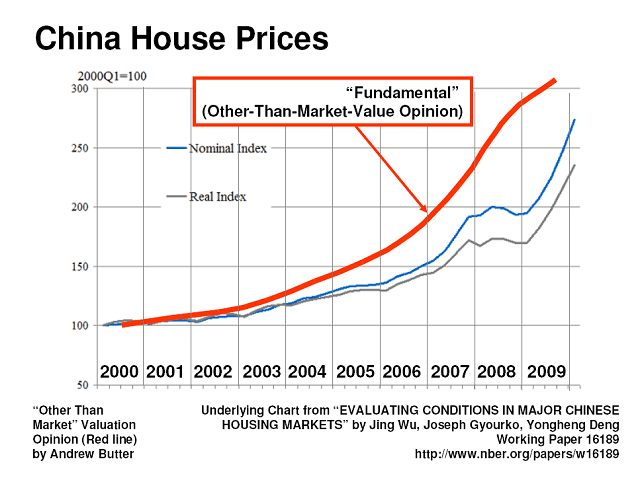
My (valuation) opinion (done strictly in accordance with the International back-of-the envelope valuation standards (IBOEVS)) , house prices (in general) in China, are 85% of the “fundamental”, and that the huge price rise in recent years can be explained by:
1: Nominal GDP growing a lot faster than supply of decent new housing.
2: Market distortions arising from the fact that housing only started to be “privatized” in 1998 (and initially since there were no benchmarks it got sold to cheap – which is why you had to pay a kickback to a government official to buy anything).
i.e. the Chinese are waking up to the idea that they can afford to live in the cramped lousy apartments that the State provide with about 5m2 per person; and so they are “trading-up”.
Sure, in an evolving and chaotic market where the State and the Semi-State is still heavily involved (as is pointed out by Wu, Gyourko, and Deng ), there will be local areas of bubbles, and sure, some of the developers who didn’t know what they were doing and built “luxury” for a market that is much more pre-ocuped with air-conditioning and (indoor) flushing toilets, are going to get cremed, but that’s not a bubble, that’s just the market working.
http://www.voxeu.org/index.php?q=node/5353
Just how risky are China’s housing markets?
Yongheng Deng Joseph Gyourko Jing Wu |
Financial bubbles are governed by something like the economic equivalent of physics Heisenberg's uncertainty principle. It is impossible to observe a bubble with certainty without actually altering the bubble itself. If people knew it was a bubble, it wouldn't be a bubble – it would have already collapsed. It would not, however, be impossible to envision “diagnostic tests” that would provide a probabilistic identification of a bubble. Unfortunately the state of economics does not provide such a procedure (see Flood and Hodrick 1990 for an early analysis of what would be required to determine convincingly whether or not a speculative bubble exists).
I’m sorry to be sounding-off like an “obnoxious ass” again (as one kind commentator remarked recently), but my view on that exhibition of economic physics envy is that if you can’t figure out what a bubble is, and you don’t have a model that proves you can predict the dynamics of a bubble in at least ONE instance, then you shouldn’t be talking about the subject.
This is how you tell if there is a housing bubble, anywhere:
1: You work out nominal GDP per housing unit.
2: You plot that against price per housing unit.
3: If you want to be “super scientific” you divide that by a function of the yield (Y) on what is considered a 100% safe asset (in USA the 30 year treasury is a good benchmark – in China I have absolutely no idea what it is).
That get’s you to a formula which says:
Fundamental Price per unit = C1 + C2 x (nominal GDP per unit) x (function of1/Y)
That formula works out the fundamental in every housing market I have looked at and the constants (C1 and C2) are pretty constant whether you are in USA, UK, Germany, Hong Kong or Dubai (the function.
Divide the price per housing unit at the time by the “fundamental” and you can work out how big the “bubble” is (anything over 20% is not good, anything over 40% is alarming).
By Andrew Butter
Twenty years doing market analysis and valuations for investors in the Middle East, USA, and Europe; currently writing a book about BubbleOmics. Andrew Butter is managing partner of ABMC, an investment advisory firm, based in Dubai ( hbutter@eim.ae ), that he setup in 1999, and is has been involved advising on large scale real estate investments, mainly in Dubai.
© 2010 Copyright Andrew Butter- All Rights Reserved
Disclaimer: The above is a matter of opinion provided for general information purposes only and is not intended as investment advice. Information and analysis above are derived from sources and utilising methods believed to be reliable, but we cannot accept responsibility for any losses you may incur as a result of this analysis. Individuals should consult with their personal financial advisors.
Andrew Butter Archive |
© 2005-2022 http://www.MarketOracle.co.uk - The Market Oracle is a FREE Daily Financial Markets Analysis & Forecasting online publication.
