


Global Economy Surging; U.S. Still Sagging Due to Continuing Housing Bust and Dollar Crash
Stock-Markets / Global Stock Markets Oct 08, 2007 - 08:20 AM GMT

 Elisabeth and I just got back from a quick trip to Japan. Our main reason for going was to visit Anthony, who got his B.A. in Japanese language a few years ago and has been working in Tokyo since May.
But I also wanted to do a quick reality check on everything we've been telling you regarding the Japanese yen.
And this morning, to help make sure you're on the right track with your global investments, I'm calling on my team to run through a similar reality check on everything we've been telling you about other major countries as well.
The Cheapest Major Currency in the World
This wasn't the first time we went to Japan.
In 1980, before Anthony was born, I worked at Wako Securities, Inc. in Tokyo, editing the first-ever Japanese language newsletter on overseas markets.
Nor was that my family's first experience with Japan's economy and language.
Before World War II, Dad published a special book for investors, titled Why Japan and the U.S. Must Work Together , while both my parents learned spoken Japanese at the Japan Society in New York City.
My Ph.D. dissertation was about Japanese culture. My investment books have been translated and published in Japan since 1980. I've written for at least a dozen Japanese publications. And I can tell you flatly: Everything I know and see validates our view that the Japanese yen is getting ready to take off.
A key reason: It's cheap.
 |
On this trip, for example, we stayed at a traditional Japanese ryokan in a quiet, but centrally located, neighborhood near Tokyo University.
The cost, including two Japanese meals served daily in our room: Less than $100 per person.
And if you think that's cheap for Tokyo, consider how cheap it was for the newlyweds from Spain who were staying in the room next door: Only 65 euros each.
They raved and ranted about how cheap Japan was compared to Europe. Even Tokyo's 5-star Western-style hotels, although more expensive, are much cheaper than Madrid's or Berlin's.
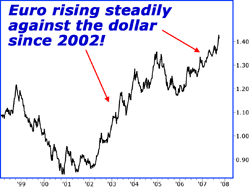
The reason is pretty obvious: The euro has been rising steadily against the dollar since 2002. It's now at new, all-time highs, and moving still higher.
 |
 |
The Japanese yen, in contrast, didn't start rising against the dollar until 2005 and has been doing so more gradually.
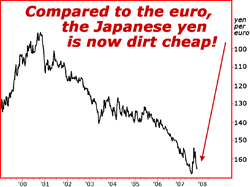
So right now, compared to the euro, the Japanese yen is dirt cheap!
Think of it this way:
Back in 2001, when Europeans traveled to Japan, they got just 100 yen for each euro. Now, they get 165 yen.
So to them, everything in Japan is now selling at a huge discount!
Don't underestimate the importance of this great discrepancy. It means that …
- To catch up to the euro, the Japanese yen would have to rise by more than 50%.
- Even if the yen surges against the dollar, Japanese manufacturers will still be able to export their goods to Europe — and most of the rest of the world — without getting priced out of those markets.
So which currency do you invest in? The euro that's been rising steadily for a long time? Or the Japanese yen, which you can buy at a huge bargain relative to the rest of the world?
 |
According to our currency expert Jack Crooks, the best answer is both!
That gives you good diversification: One currency already in a solid uptrend … plus one currency with the best potential to jump explosively in the months ahead.
His favorite vehicles: Rydex's currencySHARES ™ offering nice yield and appreciation and the Philadelphia Exchange's World Currency Options ™, which offers ease of trading, low cost of entry, the ability to strictly control your risk … and leverage.
Canadian Dollar Through the Roof!
 |
While the U.S. economy is sagging, Canada's — driven by a rip-roaring boom in commodities — is surging.
Just last week, we learned that Canada's jobless rate fell to a 33-year low of 5.9%, with wages rising at the fastest pace in at least a decade.
So while America frets about the excess supply of homes, the biggest issue in Canada right now is the shortage of labor.
Meanwhile, the Bank of Canada's quarterly business outlook survey paints a picture of an economy that's unfazed by what's happening across the border in the U.S.
 |
 |
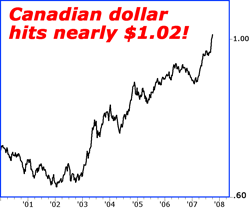
The immediate consequence: The Canadian dollar catapulted higher by another 1.59 cents on Friday, closing the week at $101.85.
Our Canada expert Sean Brodrick, who helicopters to remote regions even most Canadians never see, explains it this way:
"Canada is the only country in the world that's largely driven by vast natural resources and has a modern, industrial democracy very similar to ours.
"So with commodities now whirling faster than the blades of a chopper, it should come as no surprise whatsoever that the Canadian economy and the Canadian dollar are taking off.
"That's what I told you on my first mission to the Great White North years ago.
"And that's what the latest, dramatic market moves are telling you right now."
Brazil's Market Exploding Higher!
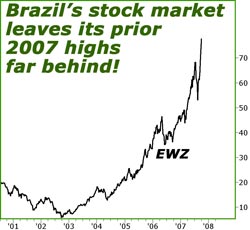
The opportunity is similar in Brazil, also driven skyward by the rapidly rising value of its vast natural resources.
 |
And the Brazilian currency— once a pariah and outcast among the world's largest— is also surging against the U.S. dollar.
The immediate consequence: Its stock market has broken all records, leaving its prior 2007 highs far behind.
Our Dow, despite its new highs, looks pale by comparison.
What's holding it back? The latest news on the U.S. housing bust, which Mike covers next …
Shocking New Plunge in Housing Market!
Heavy-Weight on U.S. Dollar and Economy!
by Mike Larson
Stacey and I don't get to visit Asia, let alone fly in helicopters to the Hudson Bay.
 |
Our two young daughters keep us pretty much close to home.
Plus, it's my job to keep track of the U.S. economy.
And right now, everywhere I look, I see more signs of a housing market still in the throes of a downturn …
First, TOUSA Inc., a regional home builder with projects in my neck of the woods, just announced it was pulling all of its previous financial guidance. According to the company's CEO, Antonio Mon:
"Conditions in all of our markets weakened more than we anticipated due to a number of factors including: recent severe liquidity challenges in the credit and mortgage markets, diminished consumer confidence, increased home inventories and foreclosures, and downward pressure on home prices."
Second, pending home sales plunged 6.5% between July and August, more than triple the 2.1% drop economists had forecast. The National Association of Realtors' Index, which tracks the signing of contracts to buy existing homes, now sits at 85.5 — the lowest since the NAR started tracking in 2001.
Third, major financial firms are reporting widespread losses on everything from mortgage bonds to slices of highly leveraged corporate loans.
A prime example: Citigroup says its third-quarter profits will plunge a whopping 60%.
The main factors: A $1.4 billion pre-tax write down on commitments to lend money for leveraged buyouts … $1.3 billion in losses on subprime and other loans it was planning to package into securities … $600 million in losses on bad trades … and $2.6 billion in added credit costs due to rising delinquencies and portfolio growth.
Their stocks are shrugging off the bad news, which is natural after getting killed for so long. But that doesn't change the dire reality on the ground in the housing and mortgage markets.
Look: Wall Street has gotten the housing market dead wrong since 2005. Almost two years ago to the day — right here in Money and Markets — Martin and I sounded a major housing market alarm .
We said the U.S. housing market was beginning to crash and, while it was difficult to see at the time, that crash would lead to sharp price declines.
We were practically laughed out of the room for that kind of talk. Wall Street and the housing industry were still pooh-poohing any mention of a bursting bubble.
A year later, in a piece titled " Housing Values Falling! Housing Stocks Rising? ", I highlighted a stunning disconnect between housing fundamentals and housing stocks. I pointed out that investors were buying, betting a rising stock market and the prospect of Fed cuts would turn the sector around.
I said the action looked a lot like the stupid bottom-fishing that went on in tech stocks after the dot-com bust. Investors kept saying the worst was over then … and kept getting their heads handed to them every time they bought.
When Martin and I published our original 2005 column, the Philadelphia Housing Index was trading around 260. It then proceeded to tank 20% to around 209, when the second column was published. Since then, the Index has dropped another 20%, to around 167.
Some individual home building stocks have fared even worse:
- That company I mentioned earlier — TOUSA. Well, it was trading at more than $30 in August 2005. Last week, it was worth less than $2!
- Another local firm called Levitt Corp. has lost 85% of its value.
- And remember some of the mortgage stocks we warned you about, like New Century Financial? They've gone broke.
Right now, lower rates are driving down the value of the dollar and flooding the economy with money. And that's likely to continue for now. So don't be surprised to see further gains in the stock market, including home builders and financial companies. A good time to take your profits on the ETFs we recommended for playing the downside in housing!
But any talk of a recovery in the housing market and mortgage markets is vastly premature.
- The market is still dramatically oversupplied, with more than 2 million excess single-family homes up for sale.
- We're still facing a tighter mortgage market, one that's not going to offer liberal financing terms again for a long, long time.
- We're still in a weak economy, with layoffs rising and job creation slowing. That bodes ill for housing demand.
- Those so-called real estate "investors" who flooded the market the past few years are gone from the market; their money, vaporized. Many won't ever be back again. Lastly …
- We're still going to see home prices decline through next year and probably into 2009. It's the only way prices are going to come back in line with median incomes — and the only way to reduce the inventory overhang.
Even in the most optimistic scenario, this has got to be a drag on the U.S. economy and the U.S. dollar.
Our recommendation: Shift a reasonable portion of your wealth into the world's strongest economies and foreign currencies.
Martin Weiss and Mike Larson
P.S. Today and tomorrow are your last days to join Jack Crooks for historic currency recommendations being issued Wednesday. Click here for our latest report.
This investment news is brought to you by Money and Markets . Money and Markets is a free daily investment newsletter from Martin D. Weiss and Weiss Research analysts offering the latest investing news and financial insights for the stock market, including tips and advice on investing in gold, energy and oil. Dr. Weiss is a leader in the fields of investing, interest rates, financial safety and economic forecasting. To view archives or subscribe, visit http://www.moneyandmarkets.com .
Money and Markets Archive |
© 2005-2022 http://www.MarketOracle.co.uk - The Market Oracle is a FREE Daily Financial Markets Analysis & Forecasting online publication.
