


US Dollar Haunted by the Ghosts of Halloween
Currencies / US Dollar Oct 30, 2007 - 09:12 PM GMTBy: Gary_Dorsch


 The story of Halloween goes back over 2000 years to the ancient Celts. Druidic priests regarded October 31st as the end of the year. Not only was it their day for celebrating the year's harvest, but also a festival for honoring the dead. In order to appease the wandering spirits that they believed roamed at night, the Celtic priests made fires in which they burned sacrifices, made charms, and cast spells.
As they danced around the fires, the season of the sun passed and the season of darkness would begin. As Halloween 2007 approaches, traders in the global money markets are betting that Federal Reserve chief Ben “B-52” Bernanke will sacrifice the US dollar with another rate cut, in order to cast a magic spell over Wall Street.
But if “B-52” Ben delivers another big-bang, a half-point rate cut to 4.25%, it might unleash a cadre of evil spirits, ghosts, and demons that would haunt the US dollar to its graveyard.
The US housing slump, already the most severe in more than a decade, has taken another turn for the worse, and has convinced the vast majority of global currency, commodity, and stock market operators that the Fed will opt for a small 0.25% rate cut on Halloween eve. The Bernanke Fed shocked the global markets on Sept 18th, with a half-point rate cut to 4.75%, justifying the aggressive cut as a pre-emptive strike, to keep the credit crunch from toppling a faltering US economy.
US sales of previously owned homes and condos fell 8% in September to a record low of 5.04 million annual units, amid tighter lending standards, and a meltdown in BBB sub-prime mortgage debt to 25 cents on the dollar. The slower pace of sales drove the inventory of unsold homes to 4.40 million, representing a 10.5-month supply, the highest since 1999. The national median existing home price for both single-family and condos dropped 4.2% from a year ago to $211,700.
Guru “Easy” Al Greenspan, the “godfather” of the sub-prime mortgage crisis, said on Sept 16th, he would not be surprised if US home prices fell by double-digits into 2008. A fall in home prices on that scale would be unprecedented in US history. US residential real estate has an aggregate value of about $21 trillion, and is the single biggest source of US household wealth. If home prices fall 15%, it could wipe out $3 trillion of household wealth, and deal a huge blow to consumer spending.
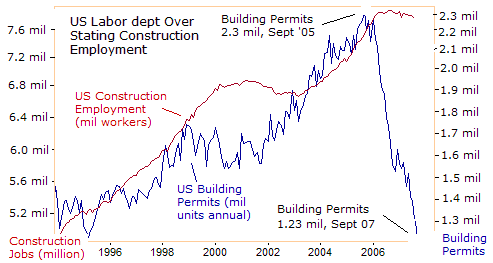
A double-digit decline in US home prices could also spark big job losses. Construction employment fell about 15% in both the 1990's and 1980's recessions, and it dropped 18% in the recession of the mid-1970's. In each case, the sector's declines were far steeper than job losses in the overall economy, and the recovery took longer. About 7.6 million Americans workers are employed by construction companies, so a 15% decline would translate into the loss of 1 million jobs. Building permits fell 7.3% to an annual rate of 1.23 million in Sept, the slowest pace since the March 1995.
Last Friday, the yield on the US Treasury's 2-year note plunged to 3.78%, the lowest in two years, discounting Fed rate cuts of 50 basis points to 4.25% by year's end. The Bernanke Fed is slashing the fed funds rate at a time of extreme hyper-inflation in the global commodities markets, with crude oil hovering near $92 /barrel, gold eyeing $800 /oz, and soybeans above $10 /bushel. The US dollar is skidding to record lows, making a sham of the US Treasury's “strong dollar” mantra.
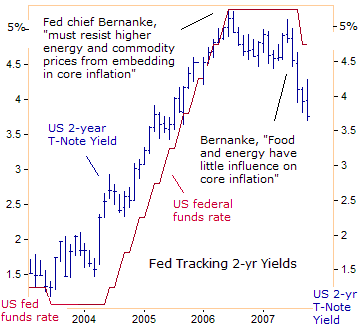
Old timers can remember the days when central bankers would respond to higher commodity and oil prices by lifting interest rates, to keep inflation in check. But in today's world, global central bankers are addicted to double-digit money supply growth, in order to inflate their economies to prosperity. The net result is the onset of “Hyper-Inflation” that is fueling near parabolic rallies in many commodity and stock markets, and sea-borne shipping rates are up 150% this year.
In his first year as Fed chief, Mr Bernanke tried to shed his dovish feathers by hiking the fed funds rate 75 basis point to 5.25% by June 2006. “The Fed will be vigilant to insure that the recent pattern of elevated monthly core inflation readings is not sustained. The Fed must continue to resist any tendency for increases in energy and commodity prices to become permanently embedded in core inflation,” Bernanke said on June 5, 2006, trying to reincarnate himself as a wise old owl.
But a year later, on July 10th, 2007, Bernanke was reverting back to his natural self, arguing that the historic rise in crude oil and agricultural commodities were just speculative bubbles, and not worthy of consideration, when calculating inflation pressures within the economy. “If inflation expectations are well anchored, swings in volatile energy and food prices should have relatively little influence on core inflation,” Bernanke told the National Bureau of Economic Research.
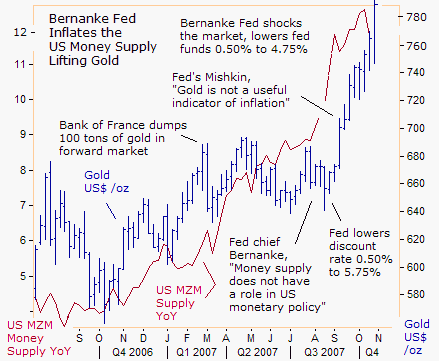
Bernanke also told the NBER that the “monetary aggregates do not have a special role in the formulation of US monetary policy because “our experience has shown a relatively weak relationship between money and inflation and money and output.” He also said “monetary policy was not a good tool to pop inflated asset prices,” yet Bernanke has no problem with propping up the stock market with rate cuts.
The MZM money supply is a preferred measure of the US money supply by economists, because it represents money readily available within the economy for spending and consumption. It's a mixture of all the liquid and zero maturity money, included in M1 plus institutional and retail money market funds, less small time deposits. Since the Fed halted its rate hike campaign in August 2006, the annual growth rate of MZ has tripled from 4% to 11.8% last week.
Yet on Sept 27th, Fed governor Frederic Mishkin was boasting that, “Inflation has come down in the old-fashioned way. Tighter monetary policy and a commitment to price stability by central banks throughout the world have led to lower inflation and an anchoring of inflation expectations,” he declared. On Sept 11th, Mishkin said the “Gold was not a particularly useful indicator of inflation expectations,” while yellow metal was breaking thru the psychological $700 /oz barrier.
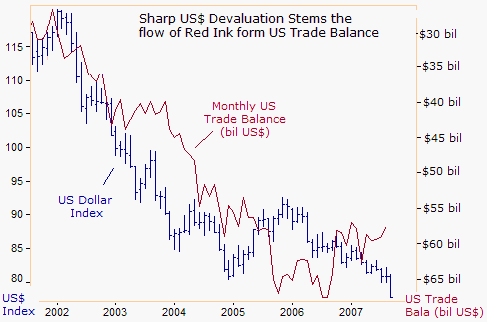
One reason behind the US Treasury's devaluation of the dollar is to boost US exports overseas, and offset the drag on the economy from weaker home prices. US exports hit a record high of $138 billion in August, and helped to reduce the US trade deficit to $57.5 billion in August, from a record shortfall of $67 billion in July 2006. Still, crude oil has spiked $20 per barrel higher since August, which will widen the deficit again. To finance its external deficits, the US must attract $2.1 billion per day, or watch the dollar fall under its own weight.
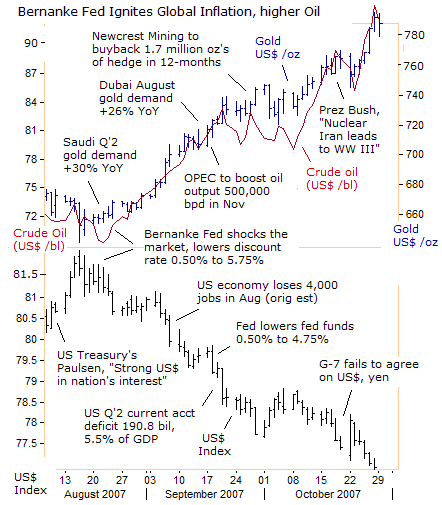
The Bernanke Fed's addiction to monetizing the stock market and cheapening the US dollar has some interesting side effects. Each Fed rate cut has translated into higher gold and oil prices, which fuels inflationary psychology worldwide. Yet the Bernanke Fed escapes criticism from the mainstream media for destroying the purchasing power of the greenback. Instead, the mainstream media accepts doctored-up inflation statistics, fashioned by government apparatchniks as gospel.
It enables the Bernanke Fed to argue that inflation is under control, while it turns up the money printing presses at full speed. However, Gold bugs and crude oil traders are not easily duped by the government's propaganda, making life difficult for the Fed. Now, the Wall Street Journal is running a last minute article, casting doubt about the inevitability of a Fed rate cut on Oct 31st, citing “anonymous” sources, to spark a shakeout of overextended and overzealous commodity bulls.
Tokyo Warlords Repeat the “Big Lie”
“If you tell a lie big enough and keep repeating it, people will eventually come to believe it. The lie can be maintained only for such time as the State can shield the people from the political, economic and/or military consequences of the lie. It thus becomes vitally important for the State to use all of its powers to repress dissent, for the truth is the mortal enemy of the lie, and thus by extension, the truth is the greatest enemy of the State,” remarked Nazi propaganda chief Joseph Goebbels, the master of the “big lie” tactic.
For the past eight months, Tokyo apparatchniks have repeatedly told the big lie. Japan is the world's largest food importer and fourth largest oil importer, yet the Japanese government says consumer prices are 0.1% lower today, than a year ago. Tokyo's fuzzy math indicates that Japan is the only place on earth that is not feeling the pinch of soaring commodity and sea borne shipping rates.
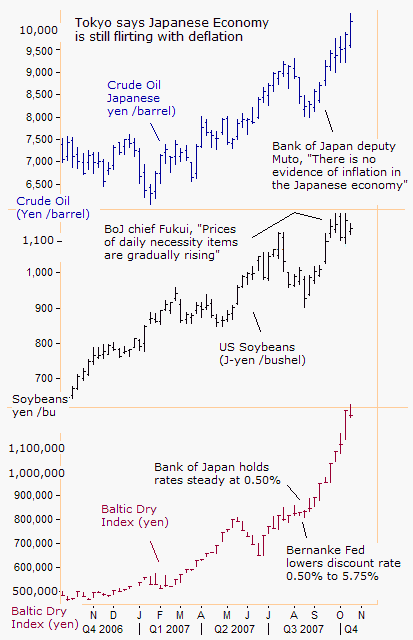
Contrary to the government's “big lie” however, the price of crude oil in yen terms is up 44% from a year ago, soybeans are up 42%, and the Baltic Dry Index, which measures the cost of shipping dry goods by sea, is up 250% from a year ago, for local importers. Yet on Sept 7th, Bank of Japan deputy Toshiro Muto said, “There is not yet any evidence of inflationary pressure in the economy.”
Propaganda artist Goebbells used to say, “Think of the media as a great keyboard on which the government can play,” and no one does it better than Tokyo's warlords, who provide the central bank with the necessary political cover to keep its interest rates pegged at an abnormally low 0.50%, spawning the $1.05 trillion “yen carry” trade, which inflates global commodity and stock markets worldwide.
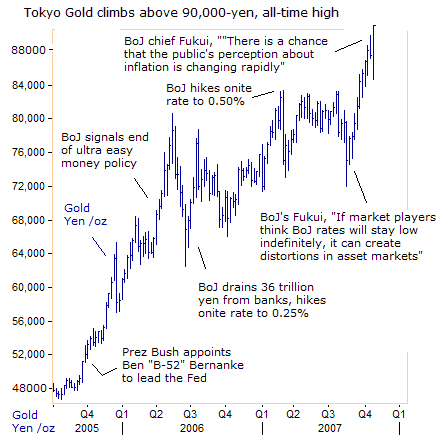
But Tokyo gold traders have seen thru the government's “big lie”, lifting gold prices to 90,000-yen per ounce last night, up 100% from two years ago. On August 23rd, Mr Fukui acknowledged that the BoJ's ultra-low interest rates are fueling global inflation, “If market players come to think the BOJ will keep rates at a low level that deviates from economic conditions that would prompt them to tilt risks excessively and create distortions in asset markets,” he said.
On Oct 11th, with Tokyo gold hovering around 85,000-yen /oz, Fukui acknowledged, “While the official consumer price index is barely moving, there is a chance the public's perception on prices is changing significantly,” he said. Yet Fukui has ruled out a rate hike for the rest of this year, with Japan's economy flirting with recession.
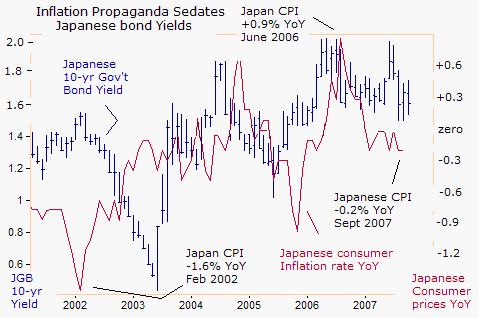
Japanese gold traders see a world beset by hyper-inflation, but Japanese bond traders have adopted the government's “big lie,” about deflation, and are locking up yields at 1.60% for the next ten years. When the 10-year JGB yields tried to climb above key resistance at 2% last summer, BoJ chief Fukui jawboned them lower, “The recent movements in long-term rates are very problematic, so we need to watch them closely,” (the code words for market intervention), Fukui warned.
Group of Seven calls for Stronger Chinese Yuan
With the US dollar tumbling to historic lows across the globe, and a Global “Oil Shock”, unfolding in the background, currency traders were interested to find out if the “Group of Seven” finance ministers and central bankers could set aside their differences and agree to a rescue package for the greenback. Instead, the G-7 and kept its standard line, “excess volatility in currencies is undesirable and they should trade in line with fundamentals,” a tactic acceptance of a weaker dollar.
Traders understand this riddle to mean that the G-7 accepts an orderly devaluation of the US dollar, while the Bank of Japan is still allowed to manipulate the yen. The G-7 accounts for two-thirds of the $53 trillion world economy and includes the US, UK, Japan, Germany, Italy, France and Canada. But the G-7 called for an “accelerated appreciation of the Chinese yuan” as Europe and Canada joined the US, calling it grossly undervalued and threatening their trade balances.
China's trade surplus is expected to reach $250 billion this year, as exports surge to $1.2 trillion and imports grow to $950 billion, the Xinhua news agency reported on October 28th. Total volume of foreign trade could exceed $2.1 trillion, up 20% over last year, and could rise another 15% to $2.4 trillion in 2008, Xinhua said. China's trade surplus of $185.6 billion in the first nine months of 2007, exceeded the record surplus of $177.5 billion for all of 2006.
Su Ning, vice governor of the People's Bank of China (PBoC), signaled a further tightening of monetary policy in the weeks ahead. “We will continue leaning toward moderate tightening. We will enhance economic control efforts at appropriate times to ensure money supply and credit growth remains stable,” Su said. China's economy expanded at a 11.5% annual rate in the third quarter and consumer price inflation in September slowed to 6.2%, not far from a 10-year of 6.5% in August.
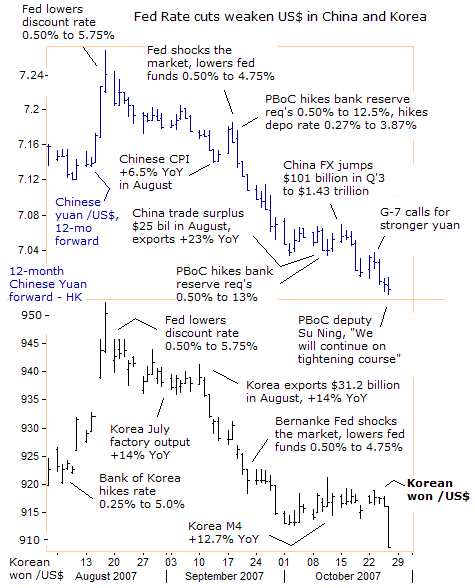
China's one-year deposit rate is 3.87% is slightly below the US$ Libor rate of 4.64%. But another PBoC rate hike, coupled with Fed rate cuts, could narrow the gap towards zero percent, and attract more hot money to the Chinese yuan. Last night, the yuan jumped 0.3% to 7.475 against the dollar, its biggest daily gain since its July 2005 revaluation, which might indicate the PBoC is responding to G-7 pressure for faster appreciation to help curb its money supply growth.
In Hong Kong, forward traders are betting the US$ will fall below the psychological 7.0-yuan level within 12-months, or 6.5% below the dollar's current level in the spot market, to address the yawning trade imbalance between Europe and the US. China's foreign currency reserves rose by $367.3 billion in the first nine months of this year, to a record $1.434 trillion in the third quarter, already exceeding last year's increase of $247.3 billion. The PBoC inflates its M2 money supply at a 18.5% annualized rate to sop up the tidal wave of money flowing into the country.
US$ Tumbles to 10-year Low against Korean won
The US dollar also fell to 907.10 Korean on Monday, it's lowest since Sept 1997, on expectations for Fed rate cuts in the months ahead. In a surprise move, the Bank of Korea (BoK) hiked its overnight loan rate 0.25% to 5.00% on August 9th, a week before the Bernanke Fed shocked the global markets, by slashing its discount rate by a half-point to 5.75%. Traders expect Seoul to intervene to slow the dollar's descent.
Early this month, the Korean Ministry of Finance and Economy said it lost 26 trillion won in 2006, by trying to slow the dollar's decline through intervention, up from a loss of 17.8 trillion won a year earlier. The government has sustained the loss through its operation of a foreign exchange stabilization fund, a kind of money pool raised by issuing currency stabilization bonds at yields of 5.10% today.
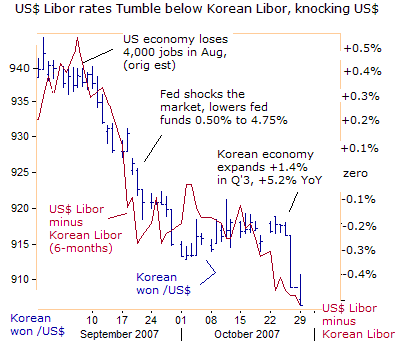
Korean banks are raising interest rates on savings deposits to attract more funds as a growing number of depositors are taking money out of banks and into brokerage accounts for speculation in gold and Kospi blue chips. The average one-year bank deposit rate reached 5.28% last month, up from 5.11% a month earlier, to its highest level since July 2001. Kookmin Bank said it will offer a deposit product next month, which provides over 6% interest income per year.
That would put the US$ at a huge interest rate disadvantage against the Korean won, and traders could soon test the resolve of the Ministry of finance to defend the dollar at the psychological 900-won rate. Still, Seoul may acquiesce to a stronger won to help deflect the spiraling cost of crude oil. South Korea imports 900 million barrels of crude oil a year, which means a rise of $10 /barrel would increase the cost of oil imports by additional $9 billion, inflicting a huge burden on manufacturers.
Bernanke Fed Transmits Inflation to Persian Gulf
The Bernanke Fed is expanding the growth rate of the US M3 money at a 15% annualized clip, its fastest in history, and creating headaches for Persian Gulf central bankers, who are pegging their currencies to the US dollar. In order to maintain a stable dollar peg with the Kuwaiti dinar and the Saudi riyal, Gulf central bankers have been forced to accelerate the growth rate of their money supply to prevent the dollar from collapsing under its own weight.
Last year, as a result of sharply higher oil prices, Saudi Arabia's income soared to $194 billion, and the kingdom posted a $95 billion surplus in its balance of payments account, while Kuwait had a $50 billion surplus. That's in sharp contrast to the US, which ran an $840 billion external deficit. With the Bernanke Fed slashing the fed funds rate below Persian Gulf rates, traders are wondering if the dollar pegs might become unglued against the dinar and riyal, to stave off inflation at home.
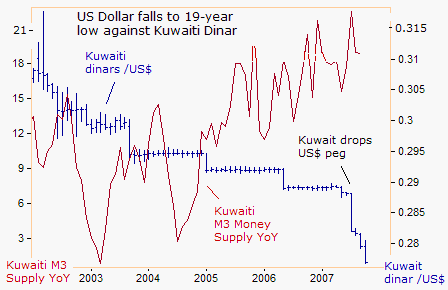
Kuwait's central bank allowed the US dollar to slip to a new 19-year low point of 0.27720 dinar this week, a devaluation of 0.14 percent. The currency of the Middle East's fourth-largest oil exporter has risen 4.3% since May 19th, when the Kuwaiti central bank dropped its crawling peg to the US dollar and adopted a basket of currencies. Kuwait buys more than a third of its imports in euros, which are becoming increasingly expensive, and pushing inflation to 4.5%, a 12-year high.
In reaction to the Bernanke Fed's decision to lower the fed funds rate 0.50% to 4.75%, Kuwait's central bank cut its repo by 50 basis points to 4.75% on Sept 19, after lowering the repo rate by 25 basis points to 5.25% on Sept. 12. But lower Kuwaiti interest rates can lead to an acceleration of its M3 money supply, which is 19% higher from a year, and threatening higher inflation.
Saudi Arabia's central bank has usually tracked interest-rate moves by the Fed to maintain the riyal's peg to the US$. Saudi Arabia's repo rate is targeted at 5.50%, but the central bank did not match the Fed rate cut to 4.75% last month. That left Saudi Arabia's repo rate 75 basis points higher than the fed funds rate, compared to an average spread of 36 basis points between the two rates over the last 15 years.
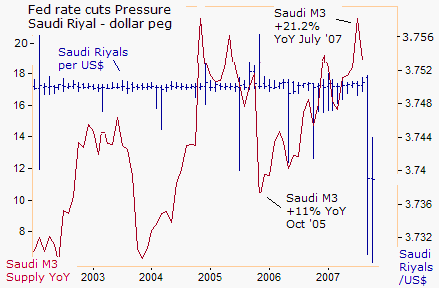
“The Saudi riyal's peg to the US dollar will remain unchanged,” declared Hamad Al-Sayari, governor of the Saudi Arabian Monetary Agency (SAMA) on October 28th, after a meeting with GGC central bankers. Riyadh is inflating its M3 money supply at an 18.8% annualized clip, to keep the dollar from tumbling against the riyal. But explosive Saudi money supply growth could ignite faster inflation towards a 6% rate in a matter of months, according to local economists.
Explosive money supply growth did revive Saudi demand for gold, which rose to 42.5 tons in Q'2 of 2007, up 30% from 32.6 tons a year earlier. Global traders are always interested to know how Kuwait, the United Arab Emirates, and Saudi Arabia are investing their “oil windfall.” The three oil-rich kingdoms held an estimated $1.55 trillion in foreign assets as of May 31st, exceeding China's $1.43 trillion FX stash.
OPEC is likely to discuss creating a basket of currencies for pricing its oil basket at its Nov 11th summit, said Venezuela's Energy Minister Rafael Ramirez on Oct 26th. “The need to establish a basket of currencies will probably be a point of discussion in the next OPEC summit. The dollar as a benchmark currency has been weakening quite a lot and it creates distortions in oil markets,” Ramirez said.
Central Bankers dumbfounded by Global "Oil Shock"
OPEC's oil income is mushrooming to new heights this year, after US crude oil prices surged a record high of $93.68 /barrel on Oct 29th, up 30% since the Bernanke Fed put the US dollar's devaluation in motion. “Speculation and geopolitics are still ruling the market,” said Libya's hawkish oil chief Shokri Ghanem on Oct 29th. “OPEC's role is very limited now. We already agreed to increase the production 500,000 bpd from November 1st. I don't know what else OPEC can do at this time,” he said.
Central bankers have poured massive doses of cash into financial markets to ease a liquidity crisis, sparked by the sub-prime debt debacle. The Bank of Japan offers near zero percent yen loans for global speculators. Much of the money has found its way into crude oil futures, commodities, and emerging markets, while the US Treasury and Federal Reserve have engineered a US dollar devaluation.
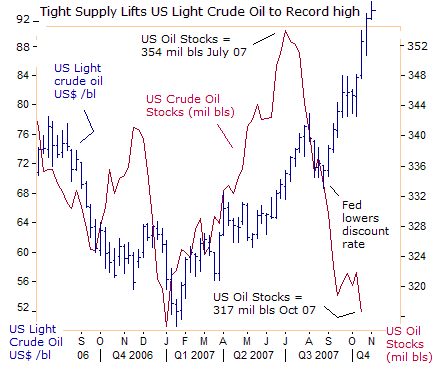
“We're beginning to see this extraordinary period of disinflation and economic growth is coming to a halt,” said former Fed chief Greenspan on October 2nd. “We now have to be very sensitive to the fact that inflationary pressures could well get out of hand. The trade-off between inflation and growth has become more negative,” and he added that Mr Bernanke was likely to have a tougher job than he did.
And just as the US dollar fell to new lows against the Euro, Mexico's state-owned oil company Pemex said it was shutting about 600,000 bpd of oil output due to bad weather in the Gulf of Mexico. The shutdown comes at a bad time, with US oil inventories tumbling to 317 million barrels, or 6% lower than a year ago, leaving little margin of error for unexpected supply disruptions from Iraq or Nigeria.
ECB Signals baby-step Rate hike to counter Inflation
While the Bernanke Fed is lowering interest rates and pouring more gasoline on the flames of global inflation, the European Central Bank is gathering up a tiny bit of courage, and telegraphing a quarter-point rate hike to 4.25% in the weeks ahead. “In Europe, there are upside risks to price stability related to the evolution of food prices and crude oil, along with the possibility that salaries and corporate profits are growing with more dynamism than we expected, in a context of high-capacity utilization,” said ECB member Jose Manuel Gonzalez-Paramo on Oct 29th.
“In the current environment, monetary policy must not allow inflation developments to influence long-term expectations. To achieve this, we will do what is necessary and required to ensure price stability for the medium term,” warned Bundesbank chief Axel Weber on Oct 30th. “We will do what is necessary to counter inflation risks. It is too early to dismiss the need for a future monetary policy response,” he said
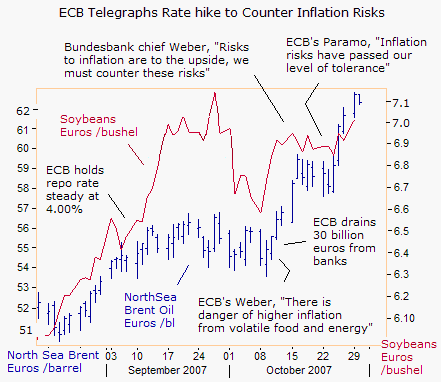
The ECB has stood motionless for the past several months however, watching in a state of utter disbelief, as the price of North Sea Brent climbed 20% in euro terms, while soybeans moved 16% higher. On Oct 19th, Bundesbank chief Axel Axel Weber was still in a state of denial about the historic rise in crude oil prices. “I assume that a part of the oil price development will normalize. You shouldn't see the current movement of oil prices as being permanent,” he suggested.
Weber noted that high oil prices contain “a double risk, both increasing inflation and slowing growth. If the oil price continues to be high that would dampen growth very much. We should watch the development with great vigilance, but there is no reason for exaggeration,” he said. ECB central bankers are typically too slow to react to market signals, and don't engage in pre-emptive strikes against inflation.
The ECB has decided to live with a stronger Euro to help dampen the cost of imported energy and raw materials. Still, the surge in global commodities has been so powerful, that food and energy prices are moving swiftly higher in euro terms. Yet even if the ECB carries out its token threat of a miniscule quarter-point rate hike to 4.25%, it's unlikely to offset the stimulus of Fed rate cuts.
The Global Money Trends newsletter is happy to announce a special bonus for new and existing subscribers, - “Audio Broadcasts”, posted on Monday and Wednesday evenings, during Asian trading hours, to the Log-In section of our website, with our latest analysis of gold, crude oil, base metals, foreign currencies, interest rates and the top stock markets from around the world.
To make life easier, Global Money Trends also presents a model portfolio of our top-20 picks in the global stock markets, to take advantage of historic price movements in the global commodity markets and foreign currencies. That's in addition to our regular newsletter, published on Friday, for 44 weekly editions.
By Gary Dorsch,
Editor, Global Money Trends newsletter
http://www.sirchartsalot.com
This article is just the Tip of the Iceberg, of what’s available in the Global Money Trends newsletter! Here's what you will receive with a subscription, Insightful analysis and predictions for the (1) top dozen stock markets around the world, Exchange Traded Funds, and US home-builder indexes (2) Commodities such as crude oil, copper, gold, silver, the DJ Commodity Index, and gold mining and oil company indexes (3) Foreign currencies such as, the Australian dollar, British pound, Euro, Japanese yen, and Canadian dollar (4) Libor interest rates, global bond markets and central bank monetary policies, (5) Central banker "Jawboning" and Intervention techniques that move markets.
GMT filters important news and information into (1) bullet-point, easy to understand analysis, (2) featuring "Inter-Market Technical Analysis" that visually displays the dynamic inter-relationships between foreign currencies, commodities, interest rates and the stock markets from a dozen key countries around the world. Also included are (3) charts of key economic statistics of foreign countries that move markets.
A subscription to Global Money Trends is offered at only $150 US dollars per year for “44 weekly issues”, including access to all back issues. Click on the following hyperlink, to order now, http://www.sirchartsalot.com/newsletters.php Call toll free from USA to order, Sunday thru Thursday, 2 am to 4 pm EST, at 866-576-7872.
Mr Dorsch worked on the trading floor of the Chicago Mercantile Exchange for nine years as the chief Financial Futures Analyst for three clearing firms, Oppenheimer Rouse Futures Inc, GH Miller and Company, and a commodity fund at the LNS Financial Group.
As a transactional broker for Charles Schwab's Global Investment Services department, Mr Dorsch handled thousands of customer trades in 45 stock exchanges around the world, including Australia, Canada, Japan, Hong Kong, the Euro zone, London, Toronto, South Africa, Mexico, and New Zealand, and Canadian oil trusts, ADR's and Exchange Traded Funds.
He wrote a weekly newsletter from 2000 thru September 2005 called, "Foreign Currency Trends" for Charles Schwab's Global Investment department, featuring inter-market technical analysis, to understand the dynamic inter-relationships between the foreign exchange, global bond and stock markets, and key industrial commodities.
Copyright © 2005-2007 SirChartsAlot, Inc. All rights reserved.
Disclaimer: SirChartsAlot.com's analysis and insights are based upon data gathered by it from various sources believed to be reliable, complete and accurate. However, no guarantee is made by SirChartsAlot.com as to the reliability, completeness and accuracy of the data so analyzed. SirChartsAlot.com is in the business of gathering information, analyzing it and disseminating the analysis for informational and educational purposes only. SirChartsAlot.com attempts to analyze trends, not make recommendations. All statements and expressions are the opinion of SirChartsAlot.com and are not meant to be investment advice or solicitation or recommendation to establish market positions. Our opinions are subject to change without notice. SirChartsAlot.com strongly advises readers to conduct thorough research relevant to decisions and verify facts from various independent sources.
Gary Dorsch Archive |
© 2005-2022 http://www.MarketOracle.co.uk - The Market Oracle is a FREE Daily Financial Markets Analysis & Forecasting online publication.
